Search This Blog

Monday, April 27, 2026

Quadratic equation

From Wikipedia, the free encyclopedia

In mathematics, a quadratic equation (from Latin quadratus 'square') is an equation that can be rearranged in standard form as  where the variable represents an unknown number, and a, b, and c represent known numbers, where a ≠ 0. (If a = 0 and b ≠ 0 then the equation is linear, not quadratic.) The numbers a, b, and c are the coefficients of the equation and may be distinguished by respectively calling them, the quadratic coefficient, the linear coefficient and the constant coefficient or free term.

The values of that satisfy the equation are called solutions of the equation, and roots or zeros of the quadratic function on its left-hand side. A quadratic equation has at most two solutions. If there is only one solution, one says that it is a double root. If all the coefficients are real numbers, there are either two real solutions, or a real double root, or two complex solutions that are complex conjugates of each other. A quadratic equation always has two roots, if complex roots are included and a double root is counted for two. A quadratic equation can be factored into an equivalent equation  where r and s are the solutions for .

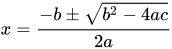
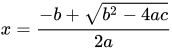
The quadratic formula expresses the solutions in terms of a, b, and c. Completing the square is one of several ways for deriving the formula.
Solutions to problems that can be expressed in terms of quadratic equations were known as early as 2000 BC.

The quadratic equation contains only powers of that are non-negative integers, and therefore it is a polynomial equation. In particular, it is a second-degree polynomial equation, since the greatest power is two.

Solving the quadratic equation

Figure 1. Plots of the quadratic function, y = eh x squared plus b x plus c, varying each coefficient separately while the other coefficients are fixed at values eh = 1, b = 0, c = 0. The left plot illustrates varying c. When c equals 0, the vertex of the parabola representing the quadratic function is centered on the origin, and the parabola rises on both sides of the origin, opening to the top. When c is greater than zero, the parabola does not change in shape, but its vertex is raised above the origin. When c is less than zero, the vertex of the parabola is lowered below the origin. The center plot illustrates varying b. When b is less than zero, the parabola representing the quadratic function is unchanged in shape, but its vertex is shifted to the right of and below the origin. When b is greater than zero, its vertex is shifted to the left of and below the origin. The vertices of the family of curves created by varying b follow along a parabolic curve. The right plot illustrates varying eh. When eh is positive, the quadratic function is a parabola opening to the top. When eh is zero, the quadratic function is a horizontal straight line. When eh is negative, the quadratic function is a parabola opening to the bottom.
Figure 1. Plots of quadratic function y = ax2 + bx + c, varying each coefficient separately while the other coefficients are fixed (at values a = 1, b = 0, c = 0)

A quadratic equation whose coefficients are real numbers can have either zero, one, or two distinct real-valued solutions, also called roots. When there is only one distinct root, it can be interpreted as two roots with the same value, called a double root. When there are no real roots, the coefficients can be considered as complex numbers with zero imaginary part, and the quadratic equation still has two complex-valued roots, complex conjugates of each-other with a non-zero imaginary part. A quadratic equation whose coefficients are arbitrary complex numbers always has two complex-valued roots which may or may not be distinct.

The solutions of a quadratic equation can be found by several alternative methods.

Factoring by inspection

It may be possible to express a quadratic equation ax2 + bx + c = 0 as a product (px + q)(rx + s) = 0. In some cases, it is possible, by simple inspection, to determine values of p, q, r, and s that make the two forms equivalent to one another. If the quadratic equation is written in the second form, then the "Zero Factor Property" states that the quadratic equation is satisfied if px + q = 0 or rx + s = 0. Solving these two linear equations provides the roots of the quadratic.

For most students, factoring by inspection is the first method of solving quadratic equations to which they are exposed. If one is given a quadratic equation in the form x2 + bx + c = 0, the sought factorization has the form (x + q)(x + s), and one has to find two numbers q and s that add up to b and whose product is c (this is sometimes called "Vieta's rule" and is related to Vieta's formulas). As an example, x2 + 5x + 6 factors as (x + 3)(x + 2). The more general case where a does not equal 1 can require a considerable effort in trial and error guess-and-check, assuming that it can be factored at all by inspection.

Except for special cases such as where b = 0 or c = 0, factoring by inspection only works for quadratic equations that have rational roots. This means that the great majority of quadratic equations that arise in practical applications cannot be solved by factoring by inspection.

Completing the square

Figure 2 illustrates an x y plot of the quadratic function f of x equals x squared minus x minus 2. The x-coordinate of the points where the graph intersects the x-axis, x equals −1 and x equals 2, are the solutions of the quadratic equation x squared minus x minus 2 equals zero.
Figure 2. For the quadratic function y = x2x − 2, the points where the graph crosses the x-axis, x = −1 and x = 2, are the solutions of the quadratic equation x2x − 2 = 0.

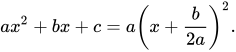
The process of completing the square makes use of the algebraic identity which represents a well-defined algorithm that can be used to solve any quadratic equation. Starting with a quadratic equation in standard form, ax2 + bx + c = 0

  1. Divide each side by a, the coefficient of the squared term.
  2. Subtract the constant term c/a from both sides.
  3. Add the square of one-half of b/a, the coefficient of x, to both sides. This "completes the square", converting the left side into a perfect square.
  4. Write the left side as a square and simplify the right side if necessary.
  5. Produce two linear equations by equating the square root of the left side with the positive and negative square roots of the right side.
  6. Solve each of the two linear equations.

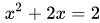
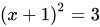
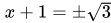
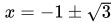
We illustrate use of this algorithm by solving 2x2 + 4x − 4 = 0

The plus–minus symbol "±" indicates that both and are solutions of the quadratic equation.

Quadratic formula and its derivation

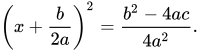
Completing the square can be used to derive a general formula for solving quadratic equations, called the quadratic formula. The mathematical proof will now be briefly summarized. It can easily be seen, by polynomial expansion, that the following equation is equivalent to the quadratic equation: Taking the square root of both sides, and isolating x, gives:
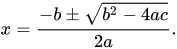
Some sources, particularly older ones, use alternative parameterizations of the quadratic equation such as ax2 + 2bx + c = 0 or ax2 − 2bx + c = 0 , where b has a magnitude one half of the more common one, possibly with opposite sign. These result in slightly different forms for the solution, but are otherwise equivalent.

A number of alternative derivations can be found in the literature. These proofs are simpler than the standard completing the square method, represent interesting applications of other frequently used techniques in algebra, or offer insight into other areas of mathematics.

A lesser known quadratic formula, as used in Muller's method, provides the same roots via the equation This can be deduced from the standard quadratic formula by Vieta's formulas, which assert that the product of the roots is c/a. It also follows from dividing the quadratic equation by giving solving this for and then inverting.
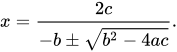
One property of this form is that it yields one valid root when a = 0, while the other root contains division by zero, because when a = 0, the quadratic equation becomes a linear equation, which has one root. By contrast, in this case, the more common formula has a division by zero for one root and an indeterminate form 0/0 for the other root. On the other hand, when c = 0, the more common formula yields two correct roots whereas this form yields the zero root and an indeterminate form 0/0.

When neither a nor c is zero, the equality between the standard quadratic formula and Muller's method, can be verified by cross multiplication, and similarly for the other choice of signs.

Reduced quadratic equation

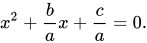
It is sometimes convenient to reduce a quadratic equation so that its leading coefficient is one. This is done by dividing both sides by a, which is always possible since a is non-zero. This produces the reduced quadratic equation:

where p = b/a and q = c/a. This monic polynomial equation has the same solutions as the original.

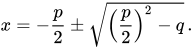
The quadratic formula for the solutions of the reduced quadratic equation, written in terms of its coefficients, is
Discriminant

Figure 3. This figure plots three quadratic functions on a single Cartesian plane graph to illustrate the effects of discriminant values. When the discriminant, delta, is positive, the parabola intersects the x-axis at two points. When delta is zero, the vertex of the parabola touches the x-axis at a single point. When delta is negative, the parabola does not intersect the x-axis at all.
Figure 3. Discriminant signs

In the quadratic formula, the expression underneath the square root sign is called the discriminant of the quadratic equation, and is often represented using an upper case D or an upper case Greek delta A quadratic equation with real coefficients can have either one or two distinct real roots, or two distinct complex roots. In this case the discriminant determines the number and nature of the roots. There are three cases:

  • If the discriminant is positive, then there are two distinct roots both of which are real numbers. For quadratic equations with rational coefficients, if the discriminant is a square number, then the roots are rational—in other cases they may be quadratic irrationals.
  • If the discriminant is zero, then there is exactly one real root sometimes called a repeated or double root or two equal roots.
  • If the discriminant is negative, then there are no real roots. Rather, there are two distinct (non-real) complex roots which are complex conjugates of each other. In these expressions i is the imaginary unit.

Thus the roots are distinct if and only if the discriminant is non-zero, and the roots are real if and only if the discriminant is non-negative.

Geometric interpretation

Visualisation of the complex roots of y = ax2 + bx + c: the parabola is rotated 180° about its vertex (orange). Its x-intercepts are rotated 90° around their mid-point, and the Cartesian plane is interpreted as the complex plane (green).

The function f(x) = ax2 + bx + c is a quadratic function. The graph of any quadratic function has the same general shape, which is called a parabola. The location and size of the parabola, and how it opens, depend on the values of a, b, and c. If a > 0, the parabola has a minimum point and opens upward. If a < 0, the parabola has a maximum point and opens downward. The extreme point of the parabola, whether minimum or maximum, corresponds to its vertex. The x-coordinate of the vertex will be located at , and the y-coordinate of the vertex may be found by substituting this x-value into the function. The y-intercept is located at the point (0, c).

The solutions of the quadratic equation ax2 + bx + c = 0 correspond to the roots of the function f(x) = ax2 + bx + c, since they are the values of x for which f(x) = 0. If a, b, and c are real numbers and the domain of f is the set of real numbers, then the roots of f are exactly the x-coordinates of the points where the graph touches the x-axis. If the discriminant is positive, the graph touches the x-axis at two points; if zero, the graph touches at one point; and if negative, the graph does not touch the x-axis.

Quadratic factorization

The term is a factor of the polynomial if and only if r is a root of the quadratic equation It follows from the quadratic formula that In the special case b2 = 4ac where the quadratic has only one distinct root (i.e. the discriminant is zero), the quadratic polynomial can be factored as

Graphical solution

Figure 4. Graphing calculator computation of one of the two roots of the quadratic equation 2x2 + 4x − 4 = 0. Although the display shows only five significant figures of accuracy, the retrieved value of xc is 0.732050807569, accurate to twelve significant figures.
A quadratic function without real root: y = (x − 5)2 + 9. The "3" is the imaginary part of the x-intercept. The real part is the x-coordinate of the vertex. Thus the roots are 5 ± 3i.

The solutions of the quadratic equation may be obtained from the graph of the quadratic function which is a parabola.


If the parabola intersects the x-axis in two points, there are two real roots, which are the x-coordinates of these two points (also called x-intercept).

If the parabola is tangent to the x-axis, there is a double root, which is the x-coordinate of the contact point between the graph and parabola.

If the parabola does not intersect the x-axis, there are two complex conjugate roots. Although these roots cannot be visualized on the graph, their real and imaginary parts can be.

Let h and k be respectively the x-coordinate and the y-coordinate of the vertex of the parabola (that is the point with maximal or minimal y-coordinate. The quadratic function may be rewritten Let d be the distance between the point of y-coordinate 2k on the axis of the parabola, and a point on the parabola with the same y-coordinate (see the figure; there are two such points, which give the same distance, because of the symmetry of the parabola). Then the real part of the roots is h, and their imaginary part are ±d. That is, the roots are or in the case of the example of the figure


Avoiding loss of significance

Although the quadratic formula provides an exact solution, the result is not exact if real numbers are approximated during the computation, as usual in numerical analysis, where real numbers are approximated by floating point numbers (called "reals" in many programming languages). In this context, the quadratic formula is not completely stable.

This occurs when the roots have different order of magnitude, or, equivalently, when b2 and b2 − 4ac are close in magnitude. In this case, the subtraction of two nearly equal numbers will cause loss of significance or catastrophic cancellation in the smaller root. To avoid this, the root that is smaller in magnitude, r, can be computed as where R is the root that is bigger in magnitude. This is equivalent to using the formula

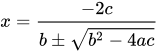
using the plus sign if and the minus sign if

A second form of cancellation can occur between the terms b2 and 4ac of the discriminant, that is when the two roots are very close. This can lead to loss of up to half of correct significant figures in the roots.

Examples and applications

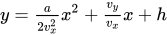
The trajectory of the cliff jumper is parabolic because horizontal displacement is a linear function of time , while vertical displacement is a quadratic function of time . As a result, the path follows quadratic equation , where and are horizontal and vertical components of the original velocity, a is gravitational acceleration and h is original height. The a value should be considered negative here, as its direction (downwards) is opposite to the height measurement (upwards).

The golden ratio is found as the positive solution of the quadratic equation

The equations of the circle and the other conic sectionsellipses, parabolas, and hyperbolas—are quadratic equations in two variables.

Given the cosine or sine of an angle, finding the cosine or sine of the angle that is half as large involves solving a quadratic equation.

The process of simplifying expressions involving the square root of an expression involving the square root of another expression involves finding the two solutions of a quadratic equation.

Descartes' theorem states that for every four kissing (mutually tangent) circles, their radii satisfy a particular quadratic equation.

The equation given by Fuss' theorem, giving the relation among the radius of a bicentric quadrilateral's inscribed circle, the radius of its circumscribed circle, and the distance between the centers of those circles, can be expressed as a quadratic equation for which the distance between the two circles' centers in terms of their radii is one of the solutions. The other solution of the same equation in terms of the relevant radii gives the distance between the circumscribed circle's center and the center of the excircle of an ex-tangential quadrilateral.

Critical points of a cubic function and inflection points of a quartic function are found by solving a quadratic equation.

In physics, for motion with constant acceleration , the displacement or position of a moving body can be expressed as a quadratic function of time given the initial position and initial velocity : .

In chemistry, the pH of a solution of weak acid can be calculated from the negative base-10 logarithm of the positive root of a quadratic equation in terms of the acidity constant and the analytical concentration of the acid.

History

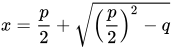
Babylonian mathematicians, as early as 2000 BC (displayed on Old Babylonian clay tablets) could solve problems relating the areas and sides of rectangles. There is evidence dating this algorithm as far back as the Third Dynasty of Ur. In modern notation, the problems typically involved solving a pair of simultaneous equations of the form: which is equivalent to the statement that x and y are the roots of the equation:

The steps given by Babylonian scribes for solving the above rectangle problem, in terms of x and y, were as follows:

  1. Compute half of p.
  2. Square the result.
  3. Subtract q.
  4. Find the (positive) square root using a table of squares.
  5. Add together the results of steps (1) and (4) to give x.

In modern notation this means calculating , which is equivalent to the modern day quadratic formula for the larger real root (if any) with a = 1, b = −p, and c = q.
Geometric methods were used to solve quadratic equations in Babylonia, Egypt, Greece, China, and India. The Egyptian Berlin Papyrus, dating back to the Middle Kingdom (2050 BC to 1650 BC), contains the solution to a two-term quadratic equation. Babylonian mathematicians from circa 400 BC and Chinese mathematicians from circa 200 BC used geometric methods of dissection to solve quadratic equations with positive roots. Rules for quadratic equations were given in The Nine Chapters on the Mathematical Art, a Chinese treatise on mathematics. These early geometric methods do not appear to have had a general formula. Euclid, the Greek mathematician, produced a more abstract geometrical method around 300 BC. With a purely geometric approach Pythagoras and Euclid created a general procedure to find solutions of the quadratic equation. In his work Arithmetica, the Greek mathematician Diophantus solved the quadratic equation, but giving only one root, even when both roots were positive.

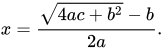
In 628 AD, Brahmagupta, an Indian mathematician, gave in his book Brāhmasphuṭasiddhānta the first explicit (although still not completely general) solution of the quadratic equation ax2 + bx = c as follows: "To the absolute number multiplied by four times the [coefficient of the] square, add the square of the [coefficient of the] middle term; the square root of the same, less the [coefficient of the] middle term, being divided by twice the [coefficient of the] square is the value." This is equivalent to The Bakhshali Manuscript written in India in the 7th century AD contained an algebraic formula for solving quadratic equations, as well as linear indeterminate equations (originally of type ax/c = y).
Muhammad ibn Musa al-Khwarizmi (9th century) developed a set of formulas that worked for positive solutions. Al-Khwarizmi goes further in providing a full solution to the general quadratic equation, accepting one or two numerical answers for every quadratic equation, while providing geometric proofs in the process. He also described the method of completing the square and recognized that the discriminant must be positive, which was proven by his contemporary 'Abd al-Hamīd ibn Turk (Central Asia, 9th century) who gave geometric figures to prove that if the discriminant is negative, a quadratic equation has no solution. While al-Khwarizmi himself did not accept negative solutions, later Islamic mathematicians that succeeded him accepted negative solutions, as well as irrational numbers as solutions. Abū Kāmil Shujā ibn Aslam (Egypt, 10th century) in particular was the first to accept irrational numbers (often in the form of a square root, cube root or fourth root) as solutions to quadratic equations or as coefficients in an equation. The 9th century Indian mathematician Sridhara wrote down rules for solving quadratic equations.

The Jewish mathematician Abraham bar Hiyya Ha-Nasi (12th century, Spain) authored the first European book to include the full solution to the general quadratic equation. His solution was largely based on Al-Khwarizmi's work. The writing of the Chinese mathematician Yang Hui (1238–1298 AD) is the first known one in which quadratic equations with negative coefficients of 'x' appear, although he attributes this to the earlier Liu Yi. By 1545 Gerolamo Cardano compiled the works related to the quadratic equations. The quadratic formula covering all cases was first obtained by Simon Stevin in 1594. In 1637 René Descartes published La Géométrie containing the quadratic formula in the form we know today.

Advanced topics

Alternative methods of root calculation

Vieta's formulas

Vieta's formulas (named after François Viète) are the relations between the roots of a quadratic polynomial and its coefficients. They result from comparing term by term the relation with the equation


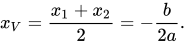
The first Vieta's formula is useful for graphing a quadratic function. Since the graph is symmetric with respect to a vertical line through the vertex, the vertex's x-coordinate is located at the average of the roots (or intercepts). Thus the x-coordinate of the vertex is The y-coordinate can be obtained by substituting the above result into the given quadratic equation, giving Also, these formulas for the vertex can be deduced directly from the formula (see Completing the square)

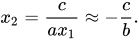
For numerical computation, Vieta's formulas provide a useful method for finding the roots of a quadratic equation in the case where one root is much smaller than the other. If |x2| << |x1|, then x1 + x2x1, and we have the estimate: The second Vieta's formula then provides: These formulas are much easier to evaluate than the quadratic formula under the condition of one large and one small root, because the quadratic formula evaluates the small root as the difference of two very nearly equal numbers (the case of large b), which causes round-off error in a numerical evaluation. The figure shows the difference between (i) a direct evaluation using the quadratic formula (accurate when the roots are near each other in value) and (ii) an evaluation based upon the above approximation of Vieta's formulas (accurate when the roots are widely spaced). As the linear coefficient b increases, initially the quadratic formula is accurate, and the approximate formula improves in accuracy, leading to a smaller difference between the methods as b increases. However, at some point the quadratic formula begins to lose accuracy because of round off error, while the approximate method continues to improve. Consequently, the difference between the methods begins to increase as the quadratic formula becomes worse and worse.

This situation arises commonly in amplifier design, where widely separated roots are desired to ensure a stable operation (see Step response).

Trigonometric solution

In the days before calculators, people would use mathematical tables—lists of numbers showing the results of calculation with varying arguments—to simplify and speed up computation. Tables of logarithms and trigonometric functions were common in math and science textbooks. Specialized tables were published for applications such as astronomy, celestial navigation and statistics. Methods of numerical approximation existed, called prosthaphaeresis, that offered shortcuts around time-consuming operations such as multiplication and taking powers and roots. Astronomers, especially, were concerned with methods that could speed up the long series of computations involved in celestial mechanics calculations.

It is within this context that we may understand the development of means of solving quadratic equations by the aid of trigonometric substitution. Consider the following alternate form of the quadratic equation,

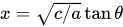
where the sign of the ± symbol is chosen so that a and c may both be positive. By substituting

and then multiplying through by cos2(θ) / c, we obtain

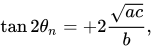
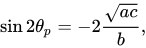
Introducing functions of 2θ and rearranging, we obtain

where the subscripts n and p correspond, respectively, to the use of a negative or positive sign in equation [1]. Substituting the two values of θn or θp found from equations [4] or [5] into [2] gives the required roots of [1]. Complex roots occur in the solution based on equation [5] if the absolute value of sin 2θp exceeds unity. The amount of effort involved in solving quadratic equations using this mixed trigonometric and logarithmic table look-up strategy was two-thirds the effort using logarithmic tables alone. Calculating complex roots would require using a different trigonometric form.

To illustrate, let us assume we had available seven-place logarithm and trigonometric tables, and wished to solve the following to six-significant-figure accuracy:

  1. A seven-place lookup table might have only 100,000 entries, and computing intermediate results to seven places would generally require interpolation between adjacent entries.
  2. (rounded to six significant figures)

Solution for complex roots in polar coordinates

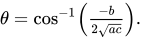
If the quadratic equation with real coefficients has two complex roots—the case where requiring a and c to have the same sign as each other—then the solutions for the roots can be expressed in polar form as
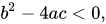

where and

Geometric solution

Figure 6. Geometric solution of eh x squared plus b x plus c = 0 using Lill's method. The geometric construction is as follows: Draw a trapezoid S Eh B C. Line S Eh of length eh is the vertical left side of the trapezoid. Line Eh B of length b is the horizontal bottom of the trapezoid. Line B C of length c is the vertical right side of the trapezoid. Line C S completes the trapezoid. From the midpoint of line C S, draw a circle passing through points C and S. Depending on the relative lengths of eh, b, and c, the circle may or may not intersect line Eh B. If it does, then the equation has a solution. If we call the intersection points X 1 and X 2, then the two solutions are given by negative Eh X 1 divided by S Eh, and negative Eh X 2 divided by S Eh.
Figure 6. Geometric solution of ax2 + bx + c = 0 using Lill's method. Solutions are −AX1/SA, −AX2/SA

The quadratic equation may be solved geometrically in a number of ways. One way is via Lill's method. The three coefficients a, b, c are drawn with right angles between them as in SA, AB, and BC in Figure 6. A circle is drawn with the start and end point SC as a diameter. If this cuts the middle line AB of the three then the equation has a solution, and the solutions are given by negative of the distance along this line from A divided by the first coefficient a or SA. If a is 1 the coefficients may be read off directly. Thus the solutions in the diagram are −AX1/SA and −AX2/SA.

Carlyle circle of the quadratic equation x2 − sx + p = 0.

The Carlyle circle, named after Thomas Carlyle, has the property that the solutions of the quadratic equation are the horizontal coordinates of the intersections of the circle with the horizontal axis. Carlyle circles have been used to develop ruler-and-compass constructions of regular polygons.

Generalization of quadratic equation

The formula and its derivation remain correct if the coefficients a, b and c are complex numbers, or more generally members of any field whose characteristic is not 2. (In a field of characteristic 2, the element 2a is zero and it is impossible to divide by it.)

The symbol in the formula should be understood as "either of the two elements whose square is b2 − 4ac, if such elements exist". In some fields, some elements have no square roots and some have two; only zero has just one square root, except in fields of characteristic 2. Even if a field does not contain a square root of some number, there is always a quadratic extension field which does, so the quadratic formula will always make sense as a formula in that extension field.

Characteristic 2

In a field of characteristic 2, the quadratic formula, which relies on 2 being a unit, does not hold. Consider the monic quadratic polynomial over a field of characteristic 2. If b = 0, then the solution reduces to extracting a square root, so the solution is and there is only one root since In summary, See quadratic residue for more information about extracting square roots in finite fields.

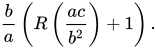
In the case that b ≠ 0, there are two distinct roots, but if the polynomial is irreducible, they cannot be expressed in terms of square roots of numbers in the coefficient field. Instead, define the 2-root R(c) of c to be a root of the polynomial x2 + x + c, an element of the splitting field of that polynomial. One verifies that R(c) + 1 is also a root. In terms of the 2-root operation, the two roots of the (non-monic) quadratic ax2 + bx + c are and

For example, let a denote a multiplicative generator of the group of units of F4, the Galois field of order four (thus a and a + 1 are roots of x2 + x + 1 over F4. Because (a + 1)2 = a, a + 1 is the unique solution of the quadratic equation x2 + a = 0. On the other hand, the polynomial x2 + ax + 1 is irreducible over F4, but it splits over F16, where it has the two roots ab and ab + a, where b is a root of x2 + x + a in F16.

Banana republic

From Wikipedia, the free encyclopedia
The phrase banana republic was coined in 1904 by American writer O. Henry.

In political science, the term banana republic describes a politically and economically unstable country with an economy dependent upon the export of natural resources.

A banana republic is a country with an economy of state capitalism, where the country is operated as a private commercial enterprise for the exclusive profit of the ruling class. Typically, a banana republic has a society of extremely stratified social classes, usually a large impoverished working class and a ruling class plutocracy, composed of the business, political, and military elites. The ruling class controls the primary sector of the economy by exploiting labor. Such exploitation is enabled by collusion between the state and favored economic monopolies, in which the profit, derived from the private exploitation of public lands, is private property. At the same time, the debts incurred thereby are the financial responsibility of the public treasury. Therefore, the term banana republic is a pejorative descriptor for a servile oligarchy that abets and supports, for kickbacks, the exploitation of large-scale plantation agriculture, especially banana cultivation.

Such an imbalanced economy remains limited by the uneven economic development of towns and countries and usually reduces the national currency into devalued banknotes (paper money), thereby rendering the country ineligible for international development credit.

Etymology

Cover of Cabbages and Kings (1904 edition)

In the 20th century, American writer O. Henry (William Sydney Porter, 1862–1910) coined the term banana republic to describe the fictional Republic of Anchuria in the book Cabbages and Kings (1904), a collection of thematically related short stories inspired by his experiences in Honduras, whose economy was heavily dependent on the export of bananas. He lived there for six months until January 1897, hiding in a hotel while he was wanted in the United States for embezzlement from a bank.

In the early 20th century, the United Fruit Company, a multinational corporation, was instrumental in the creation of the banana republic phenomenon. Together with other American corporations, such as the Cuyamel Fruit Company, and leveraging the power of the U.S. government, the corporations created the political, economic, and social circumstances that led to a coup of the locally elected democratic government that established banana republics in Central American countries such as Honduras and Guatemala. No official apology has ever been done by any banana company or the U.S. with only the C.I.A. backed dictator of Guatemala apologizing in 2011.

Origin

The history of the banana republic began with the introduction of the banana fruit to the United States in 1870, by Lorenzo Dow Baker, captain of the schooner Telegraph, who bought bananas in Jamaica and sold them in Boston at a 1,000% profit. The banana proved popular with Americans, as a nutritious tropical fruit that was less expensive than locally grown fruit in the U.S., such as apples; in 1913, 25 cents (equivalent to $8.14 in 2025) bought a dozen bananas, but only two apples. In 1873, to produce food for their railroad workers, American railroad tycoons Henry Meiggs and his nephew, Minor C. Keith, established banana plantations along the railroads they built in Costa Rica; recognising the profitability of exporting bananas, they began exporting the fruit to the Southeastern United States.

Minor C. Keith, American banana planter and businessman

In the mid-1870s, to manage the new industrial-agriculture business enterprise in the countries of Central America, Keith founded the Tropical Trading and Transport Company: one-half of what would later become the United Fruit Company (UFC), later Chiquita Brands International, created in 1899 by merger with the Boston Fruit Company, owned by Andrew Preston. By the 1930s, the international political and economic tensions created by the United Fruit Company enabled the corporation to control 80–90% of the banana business in the U.S.

By the late 19th century, three American multinational corporations (the UFC, the Standard Fruit Company, and the Cuyamel Fruit Company) dominated the cultivation, harvesting, and exportation of bananas, and controlled the road, rail, and port infrastructure of Honduras. In the northern coastal areas near the Caribbean Sea, the Honduran government ceded to the banana companies 500 hectares per kilometre (2,000 acre/mi) of a laid railroad, despite there being neither passenger nor freight railroad service to Tegucigalpa, the capital city. Among the Honduran people, the United Fruit Company was known as El Pulpo ("The Octopus" in English), because its influence pervaded Honduran society, controlled their country's transport infrastructure, and manipulated Honduran national politics with anti-labour violence.

In 1924, despite the UFC monopoly, the Vaccaro brothers established the Standard Fruit Company (later the Dole Food Company) to export Honduran bananas to the U.S. port of New Orleans. The fruit-exporting corporations kept U.S. prices low by legalistic manipulation of Central American national land use laws to cheaply buy large tracts of prime agricultural land for corporate banana plantations in the republics of the Caribbean Basin, the Central American isthmus, and tropical South America; the American fruit companies then employed the dispossessed Central and South American and Caribbean populations as low-wage employees.

By the 1930s, the United Fruit Company owned 1,400,000 hectares (3.5 million acres) of land in Central America and the Caribbean and was the single largest landowner in Guatemala. Such holdings gave it great power over the governments of small countries, one of the factors confirming the suitability of the phrase "banana republic".

Honduras

In 1912, for the Cuyamel Fruit Company, American mercenary "general" Lee Christmas overthrew the civil government of Honduras to install a military government friendly to foreign businesses.

In the early 20th century, Moldovan-American businessman Sam Zemurray (founder of the Cuyamel Fruit Company) was instrumental in establishing the "banana republic" stereotype. He entered the banana-export business by buying overripe bananas from the United Fruit Company to sell in New Orleans. In 1910, Zemurray bought 6,075 hectares (15,000 acres) in the Caribbean coast of Honduras for use by the Cuyamel Fruit Company. In 1911, Zemurray conspired with Manuel Bonilla, an ex-president of Honduras (1904–1907), and American mercenary Lee Christmas, to overthrow the civil government of Honduras and install a military government friendly to foreign businesses.

The mercenary army of the Cuyamel Fruit Company, led by Christmas, effected a coup d'état against President Miguel R. Dávila (1907–1911) and installed Bonilla (1912–1913). The United States ignored the deposition of the elected government of Honduras by a private army, justified by the U.S. State Department's misrepresenting Dávila as too politically liberal and a poor businessman whose management had indebted Honduras to Great Britain. This was a geopolitically unacceptable circumstance in light of the Monroe Doctrine. The coup d'état was a consequence of the Dávila government's having slighted the Cuyamel Fruit Company by colluding with the rival United Fruit Company to award them a monopoly contract for the Honduran banana in exchange for the UFC's brokering of U.S. government loans to Honduras.

The political instability consequent to the coup d'état stalled the Honduran economy, and the unpayable external debt (c. US$4 billion) of Honduras was excluded from access to international investment capital. That financial deficit perpetuated Honduran economic stagnation and perpetuated the image of Honduras as a banana republic. The inherited foreign debt functionally undermined the Honduran government, which allowed foreign corporations to manage the country and become sole employers of the Honduran people. The American fruit companies controlled the economic infrastructure (road, rail, and port, telegraph and telephone) they had built in Honduras.

The U.S. dollar went on to become the legal-tender currency of Honduras; Christmas became commander of the Honduran Army, and later was appointed U.S. Consul to Honduras. 23 years later, after corporate interest among the American businessmen, Zemurray assumed control of the rival United Fruit Company in 1933.

Guatemala

Guatemala contains the regional socio-economic legacy of a 'banana republic': inequitably distributed agricultural land and natural wealth, uneven economic development, and an economy dependent upon a few export crops—usually bananas, coffee, and sugarcane. The inequitable land distribution is an important cause of national poverty, as well as the accompanying sociopolitical discontent and insurrection. Almost 90% of the country's farms are too small to yield adequate subsistence harvests to the farmers. 2% of the country's farms occupy 65% of the arable land as the property of the local oligarchy.

During the 1950s, the United Fruit Company sought to convince the governments of U.S. presidents Harry S. Truman (1945–1953) and Dwight D. Eisenhower (1953–1961) that the popular, elected government of President Jacobo Árbenz of Guatemala was secretly pro-Soviet for having expropriated unused "fruit company lands" to landless peasants. In the Cold War (1945–1991) context of the proactive anti-communist politics exemplified by U.S. senator Joseph McCarthy in the years 1947–1957, geo-political concerns about the security of the Western Hemisphere facilitated Eisenhower's ordering and authorising Operation Success. The U.S. Central Intelligence Agency deposed Árbenz' democratically elected government by means of a coup d'état in 1954, and installed the pro-business government of Colonel Carlos Castillo in its place. Castillo was assassinated by a presidential guard three years later.

A mixed history of elected presidents and puppet-master military juntas were the governments of Guatemala in the course of the 36-year Guatemalan Civil War (1960–1996). However, in 1986, at the 26-year mark, the Guatemalan people promulgated a new political constitution, and elected Vinicio Cerezo (1986–1991) president; then Jorge Serrano Elías (1991–1993).

Ecuador

In the early 20th century, Ecuador was primarily a cocoa exporting country; however, due to diseases and competition from other exporters, the country sought an alternative crop that could serve as a significant export. Ecuador became a major producer of bananas due to its comparative advantage in fertile lowlands, low labor costs, and skilled workers. Additionally, Ecuador has many environmental advantages, such as a lack of natural disasters and no excess humidity that may allow diseases to fester. The minimal disease prevalence has decreased pesticide costs in Ecuador compared to other banana republic countries. The world's major importer of bananas is the European Union. Ecuador produces its bananas during the European's highest demand season for bananas, which is December through May, further contributing to Ecuador's advantage in the banana market.

Ecuador is the world's largest exporter of bananas, representing over a third of international banana sales, and banana export revenues were a quarter of Ecuador's total value of merchandise exports. Ecuador is considered a banana republic country due to its dependence on the banana and multinational corporations for the functionality of its economy. Still, it differs in a few characteristics of the typical banana republic country. Instead of the major banana corporations that contain large plantations throughout the country, such as Dole, Chiquita, or Del Monte, Ecuador's banana production mainly comes from over five thousand small-holder farmers. Corporations originally established plantations in Ecuador, but issues with switching from the Gros Michel variety to the Cavendish variety, lack of knowledge about this new variety, and an overvalued exchange rate caused the corporations to give production back to independent farmers around the 1960s. Corporations now directly contract smallholder farmers in Ecuador instead of owning their plantations. However, corporations still influence prices paid to producers, pesticide use, and other growing decisions.

There are a variety of actors that participate in the production of bananas in Ecuador. There are groups that provide financial and economic services to fund the independent farmers. Some organizations include the Ecuadorian Central Bank and Banking for Rural and Urban Productive Development. A different set of actors supplies research for producers so they can combat diseases and produce bananas more efficiently. Some examples are the Agrocalidad and phytosanitary regulatory agency, as well as research groups from universities in Ecuador. Lastly, there is a group of actors that are manufacturers, importers, or suppliers of agrochemicals and machinery. Banana exporting countries rely heavily on cartons that transport bananas, supplied by companies such as Industria Cartonera Ecutoriana and Cartonera Pichincha.

Banana market

Market structure

Global banana exports by region

The banana market structure is oligopolistic due to five major corporations having major control over the market. World trade is dominated by Chiquita Brands, Dole Food Company, Del Monte Fresh Produce, Noboa, and Fyffes, who collectively control over three quarters of the banana market. These companies own large plantations or contract independent farmers, have their own distribution systems, and skilled marketing strategies to contribute to large economies of scale and marketing power. The corporations have immense power due to the large role the banana industry plays in the global economy. The industry produces large amounts of export revenue, and employs thousands of people across production, distribution networks, marketing, and employees in retail stores. Furthermore, four out of the five top banana exporting countries in 2009, which are Ecuador, Colombia, Philippines, Costa Rica, and Guatemala, are considered banana republic countries, with Central and South America and Caribbean accounting for over 83% of world banana exports.

Consumer preferences

Banana republic countries depend on exports, so consumer preferences play a hefty factor in how bananas are produced. Banana exporting countries face significant losses due to unmarketable bananas. There are certifications bananas can receive to be more appealing for consumers, such as the Fair Trade, Organic, and Rainforest Alliance certifications that market sustainability, fair labor conditions, or different growing methods.

External features taken into consideration include being overripe, having insect damage, being short in size, or containing scarring on the peel. Internal features that cause bananas to be rejected include taste, texture, sweetness, and shelf life. The cavendish variety accomplishes being the preferable banana due to its marketability and is the most common banana on the market. The largest importers of bananas are the United States, Japan, and the European Union. The EU imports the majority of bananas, but also contains regulations on the features of the product. The European Union requires bananas to be free of bruises, unripe and green, with the stalk intact, and the banana itself cannot have abnormal curvature.

Modern era

Pesticides

Chiquita bananas in a store
Chiquita bananas

Chiquita Brands International and the Dole Food Company have shifted their focus of maintaining the environments on their plantations and making agriculture more efficient by breeding and growing more resilient versions of foods, such as Cavendish bananas. Both companies have been working to employ better farming practices, especially regarding the use of pesticides, as both companies have received heavy criticism for the amount and effects of the pesticides they have used on their products. Although the pesticides do not generally represent a safety concern for consumers abroad, they can be harmful to residents and the ecosystems in which they are used. Many banana farmers from Central and South America were exposed to dibromochloropropane (DBCP) from the 1960s to 1980s, which can lead to birth defects, elevated risk of cancer, central nervous system damage, and most commonly, infertility.

Labour conditions and treatment of workers

Women cleaning Cavendish bananas for packaging at a plantation in Ecuador (from whence most of America's bananas are imported)

Both the Dole Food Company and Chiquita Brands International have argued that their labourers and farmers are being treated much better in the 21st century than they were during the height of the banana republics. While workers do have better conditions than they did during the 20th century, these large corporations allegedly still suppress labour union movements through intimidation and harassment. Working conditions on banana plantations are dangerous, with very low wages and long hours in difficult conditions. The workers are not cared for and are often replaced as they have very little policy about job security in the case of sickness or injury. The plantation workers are also exposed to toxic pesticides on a daily basis, causing harm. Unionists who pressure these corporations for better working conditions are commonly targeted and forced to leave their positions. The workers also receive no benefits, and as the plantations are in countries with lax safety regulations, there are minimal health policies.

Women banana workers

During the 1970s and 1980s, men migrated to cities for work, leaving women available to work for multinational companies on plantations.  Women represent about a fifth of the workforce in the banana industry, and are known as Bananeras, or women workers on banana plantations. Men generally work in the fields while women have jobs that pertain to selecting, washing, and packaging the bananas. Due to a gendered division of labor, women often work more than one job for income. Jobs on banana plantations that pay more are often more physically difficult and are reserved for men. However, there is little difference in the money paid to men and women for the same tasks completed. Women primarily package bananas, where pay is measured by the amount of boxes that are filled with bananas at the end of each day. The roles of packagers depend on the scale of production and ability of the producer to export bananas, so many women are contracted once or twice a week to work.

Women are often excluded from benefiting from agricultural cooperatives because a majority are not landowners and lack power in the decision-making process. There is no trade union to educate women about legal working rights, according to the Coordinating Body of Latin American Banana and Agro-Industrial Unions (COLSIBA). However, gender quotas are being implemented in agricultural programs to advance gender equality and allow women to be beneficiaries of land.

There have been criticisms of women working in direct contact with pesticides, fungicides, herbicides, and insecticides through the application of chemicals and washing bags that contain insecticides. Pregnant and breastfeeding women are particularly affected, as pregnant women will work with chemicals until the later stages of pregnancy and will return to work after the birth. Exposure to pesticides, as well as smoke from tobacco, waste burning, and cooking fuel increase the risks of asthma, rhinitis, and allergic skin conditions. Women banana workers often face the challenge of being a caretaker and bananera, as there is limited access to childcare, limited education and training, and a difficulty of working more than one job. Women are often at risk of sexual assault and domestic violence due to issues in management of Occupational Health, Safety, and Environment.

Challenges to the banana republic

European Union Banana Dispute

The European Banana Dispute began as the EU attempted to create a single market, or the General Agreement on Tariffs and Trade (GATT). However, the EU struggled to commit to the initiative while also honoring the Lomé Convention, the "Banana Protocol" in the Treaty of Rome, and honoring the Accession Treaties. The prior treaties were to ensure that economies of former colonies, or African, Caribbean, and Pacific (ACP) countries, would have support. Because of prior obligations to former colonies, the banana market was becoming exempt from GATT. A quota of 2 million bananas from the Americas were allowed in the EU with a 30% tariff while ACP countries received duty-free importation.

Percentage of global banana imports by region

Five American countries were contracted with the GATT, and argued the preferential tariffs were discriminatory. Three banana republic countries, Ecuador, Guatemala, and Honduras, plus the United States and Mexico challenged the regulations in the World Trade Organization (WTO). American banana exporting countries asked for the EU banana market to have no preferences whatsoever. The WTO arbitration panel ruled that $192 million was owed to the United States for lost banana sales.

The EU Common Market Organization for Bananas was a collection of efforts to regulate the banana market. The EU was aiming to assure that former colonies would get higher prices for their bananas considering their higher production costs, honor the Lomé Convention, and ensure consumers had an adequate supply of bananas from underdeveloped Americas. An agreement was reached in April 2001 between the United States and EU. The EU implemented a system of importation based on historical licensing, with underdeveloped American countries and ACP countries having their own categories of licenses, designated tariffs, and quotas. Chiquita Brands and Dole Food Company together share 44% of the licenses.

Prevalent diseases

Banana stalk infected with Fusarium Wilt

Diseases such as the Panama Disease (fusarium wilt), black sigatoka leaf spot, black leaf streak disease, banana bunchy top disease, Cardano, and Moko disease create challenges for banana republic countries as they generate massive losses for banana farms. Diseases in banana production produce more production costs than any other biotic factor. Fusarium wilt can survive for over thirty years in the soil, threatening a rapid spread of disease as infected soil can be found on tires, shoes, tools, run-off water, and irrigation systems.

The most popular banana on the commercial market is the Cavendish banana, a type of banana with no genetic variation to other bananas of its variety. The cavendish is not seeded, and propagates by producing vegetative suckers that can be removed from the parents and planted separately. New sprouts are clones of the parent plant, unless they have a genetic mutation, making them more susceptible to disease. The most popular banana before the Cavendish, the Gros Michel variety, was wiped out by Panama disease due to a lack of genetic evolution to become more resistant to the disease.

The primary solution used are pesticides and agrochemicals. However, many pesticides have various negative effects on health, the environment, and economy. Pesticides and other chemicals to ward off disease also account for almost a third of production costs on banana farms. Others have proposed genetic engineering, but it is a controversial topic. Other solutions include removal of affected leaves, but this can affect the period when bananas are harvested for export, known as the green period.  Management systems can also be improved so communication is clear between farmers and different levels of government about the spread of diseases.

Modern Honduras and Guatemala

Honduras and Guatemala have faced significant challenges with governmental corruption as a result of the dictatorships backed by the U.S. government, Effraín Ríos Montt (1982–1983) for Guatemala, and Roberto Suazo Córdova (1982–1986) for Honduras. The political instability caused by the dictators falling and being replaced with democratically elected presidents left the government with very little power, leading to corruption of the government and the rise of drug cartels. Today, the governments of Guatemala and Honduras still have very little power, as drug cartels control much of the land and are allied with corrupt officials and law enforcement officers. These drug cartels serve as the main transporters of cocaine and other drugs from Central and South Americas to the United States. This has also caused extreme levels of violence, with Honduras having one of the highest homicide rates in the world: 38 per 100,000 people according to UNODC. Guatemala and Honduras also continue to have very low economic diversity, with their primary exports being clothing items and food items.

In art

Poetry

In his poem "La United Fruit Co.", Pablo Neruda denounced the corporate subjugation of underdeveloped Americas.

In his book Canto General (General Song, 1950), Chilean poet Pablo Neruda (1904–73) denounced foreign corporate political dominance of Central and South American countries with the four-stanza poem "La United Fruit Co."; the second-stanza reading in part:

... The Fruit Company, Inc.
Reserved for itself the most succulent,
The central coast of my own land,
The delicate waist of the Americas.

It rechristened its territories
As the "Banana Republics",
And over the sleeping dead,
Over the restless heroes
Who brought about the greatness,
The liberty and the flags,
It established a comic opera ...

Novels

The novel One Hundred Years of Solitude (1967), by Gabriel García Márquez, depicts the imperialistic capitalism of foreign fruit companies as voracious socio-economic exploitation of natural resources of the fictional South American town of Macondo and its people. Domestically, the corrupt national government of Macondo abets the business policies and labour practices of the foreign corporations, which brutally oppress the workers. In the novel, a specific scene depicts the real-life 1928 Banana Massacre, related to the death of workers who struck against poor conditions in banana plantations in Colombia.

Modern interpretations

Graffiti implying "banana republic of Slovenia"

United States

The Kingdom of Hawaii, now the U.S. state of Hawaii, was once an independent country under political pressure from American sugar plantation owners, who in 1887 forced King Kalākaua to write a new constitution that benefited American businessmen at the expense of the working class. This constitution is known as the "Bayonet Constitution" due to its threat of force. In the case of Hawaii, the U.S. was also interested in the strategic military significance of the islands, leasing Pearl Harbor and later acquiring Hawaii as a territory.

Post-colonial states

Countries that obtained independence from colonial powers in the 20th century have, at times, tended to share traits of banana republics due to the influence of large private corporations in politics; examples include the Maldives (resort companies) and the Philippines (the tobacco industry, the U.S. government, and corporations).

On 14 May 1986, then Australian Treasurer Paul Keating stated that Australia might become a banana republic. This has received both commentary and criticism and is seen as part of a turning point in Australia's political and economic history.

Pakistan

In March 2023, PTI Chairman and former prime minister of Pakistan Imran Khan said his country had "become a banana republic".

Rigid rotor

From Wikipedia, the free encyclopedia https://en.wikipedia.org/wiki/Rigid_rotor Linear rotor T...