Search This Blog

Wednesday, March 25, 2026

Gödel, Escher, Bach

From Wikipedia, the free encyclopedia
https://en.wikipedia.org/wiki/G%C3%B6del,_Escher,_Bach

Cover of the first edition

Gödel, Escher, Bach: an Eternal Golden Braid (1979) by Douglas Hofstadter, is a book about the intellectual themes common to the lives and the works of the logician Kurt Gödel, the artist M. C. Escher, and the composer Johann Sebastian Bach, and shows the thematic connections among mathematics, symmetry, and intelligence. Through short stories, illustrations, and analyses, Gödel, Escher, Bach: an Eternal Golden Braid explains how systems acquire meaningful context from the "meaningless" elements that compose a system; self-reference and formal rules; isomorphism; the meaning of communication; how knowledge can be represented and stored; the methods and limitations of symbolic representation; and the notion of "meaning".

As a cognitive scientist, Hofstadter said that Gödel, Escher, Bach is not about the relationships of mathematics, art, and music, but about how cognition emerges from hidden neurological mechanisms, e.g. how individual neurons in the brain coordinate to create a coherent mind.

Gödel, Escher, Bach won the Pulitzer Prize for General Nonfiction and the National Book Award for Science Hardcover.

Structure

Gödel, Escher, Bach is in interweaving narratives and the main chapters alternate dialogues among fictional characters, usually Achilles and the tortoise, first used by Zeno of Elea and later by Lewis Carroll in "What the Tortoise Said to Achilles". These origins are related in the first two dialogues, and later dialogues introduce new characters such as the Crab. These narratives often are self-referential and metafictional.

Word play, such as puns are used to connect ideas, such as the "Magnificrab, Indeed" with Bach's Magnificat in D; "SHRDLU, Toy of Man's Designing" with Bach's "Jesu, Joy of Man's Desiring"; and "Typographical Number Theory", or "TNT", which inevitably reacts explosively when it attempts to make statements about itself. One dialogue contains a story about a genie (from the Arabic "Djinn") and various "tonics" (of both the liquid and musical varieties), which is titled "Djinn and Tonic". Sometimes word play has no significant connection, such as the dialogue "A Mu Offering", which has no close affinity to Bach's The Musical Offering.

One dialogue in the book is written in the form of a crab canon, in which every line before the midpoint corresponds to an identical line past the midpoint. The conversation still makes sense due to uses of common phrases that can be used as either greetings or farewells ("Good day") and the positioning of lines that double as an answer to a question in the next line. Another is a sloth canon, where one character repeats the lines of another, but slower and negated.

Themes

The book contains many instances of recursion and self-reference, where objects and ideas speak about or refer back to themselves. One is Quining, a term Hofstadter invented in homage to Willard Van Orman Quine, referring to programs that produce their own source code. Another is the presence of a fictional author in the index, Egbert B. Gebstadter, a man with initials E, G, and B and a surname that partially matches Hofstadter. A phonograph dubbed "Record Player X" destroys itself by playing a record titled I Cannot Be Played on Record Player X (an analogy to Gödel's incompleteness theorems), an examination of canon form in music, and a discussion of Escher's lithograph of two hands drawing each other.

To describe such self-referencing objects, Hofstadter coins the term "strange loop", a concept he examines in more depth in his follow-up book I Am a Strange Loop. To escape many of the logical contradictions brought about by these self-referencing objects, Hofstadter discusses Zen koans. He attempts to show readers how to perceive reality outside their own experience and embrace such paradoxical questions by rejecting the premise, a strategy also called "unasking".

Elements of computer science such as call stacks are also discussed in Gödel, Escher, Bach, as one dialogue describes the adventures of Achilles and the Tortoise as they make use of "pushing potion" and "popping tonic" involving entering and leaving different layers of reality. The same dialogue has a genie with a lamp containing another genie with another lamp and so on. Subsequent sections discuss the basic tenets of logic, self-referring statements, ("typeless") systems, and even programming. Hofstadter further creates BlooP and FlooP, two simple programming languages, to illustrate his point.

Puzzles

The book is filled with puzzles, including Hofstadter's MU puzzle, which contrasts reasoning within a defined logical system with reasoning about that system. Another example can be found in the chapter titled Contracrostipunctus, which combines the words acrostic and contrapunctus (counterpoint). In this dialogue between Achilles and the Tortoise, the author hints that there is a contrapunctal acrostic in the chapter that refers both to the author (Hofstadter) and Bach. This can be spelled out by taking the first word of each paragraph, to reveal "Hofstadter's Contracrostipunctus Acrostically Backwards Spells J. S. Bach". The second acrostic is found by taking the first letters of the words of the first, and reading them backwards to get "J S Bach", as the acrostic sentence self-referentially states.

Reception and impact

Gödel, Escher, Bach won the Pulitzer Prize for General Nonfiction and the National Book Award for Science Hardcover.

Martin Gardner's July 1979 column in Scientific American stated, "Every few decades, an unknown author brings out a book of such depth, clarity, range, wit, beauty and originality that it is recognized at once as a major literary event."

For Summer 2007, the Massachusetts Institute of Technology created an online course for high school students built around the book.

In its February 19, 2010, investigative summary on the 2001 anthrax attacks, the Federal Bureau of Investigation suggested that Bruce Edwards Ivins was inspired by the book to hide secret codes based upon nucleotide sequences in the anthrax-laced letters he allegedly sent in September and October 2001, using bold letters, as suggested on page 404 of the book. It was also suggested that he attempted to hide the book from investigators by throwing it in the trash.

In 2019, British mathematician Marcus du Sautoy curated a series of events at London's Barbican Centre to celebrate the book's fortieth anniversary.

I Am a Strange Loop

Hofstadter has expressed some frustration with how Gödel, Escher, Bach was received. He felt that readers did not fully grasp that strange loops were supposed to be the central theme of the book, and attributed this confusion to the length of the book and the breadth of the topics covered.

To remedy this issue, Hofstadter published I Am a Strange Loop in 2007, which had a more focused discussion of the idea.

Translation

Hofstadter claims the idea of translating his book "never crossed [his] mind" when he was writing it—but when his publisher brought it up, he was "very excited about seeing [the] book in other languages, especially… French." He knew, however, that "there were a million issues to consider" when translating, since the book relies not only on word-play, but on "structural puns" as well—writing where the form and content of the work mirror each other (such as the "Crab canon" dialogue, which reads almost exactly the same forwards as backwards).

Hofstadter gives an example of translation trouble in the paragraph "Mr. Tortoise, Meet Madame Tortue", saying translators "instantly ran headlong into the conflict between the feminine gender of the French noun tortue and the masculinity of my character, the Tortoise." Hofstadter agreed to the translators' suggestions of naming the French character Madame Tortue, and the Italian version Signorina Tartaruga. Because of other troubles translators might have retaining meaning, Hofstadter "painstakingly went through every sentence of Gödel, Escher, Bach, annotating a copy for translators into any language that might be targeted."

Translation also gave Hofstadter a way to add new meaning and puns. For instance, in Chinese, the subtitle is not a translation of an Eternal Golden Braid, but a seemingly unrelated phrase Jí Yì Bì (集异璧, literally "collection of exotic jades"), which is homophonic to GEB in Chinese. Some material regarding this interplay is in Hofstadter's later book, Le Ton beau de Marot, which is mainly about translation.

Subjectivity and objectivity (philosophy)

From Wikipedia, the free encyclopedia

The distinction between subjectivity and objectivity is a basic idea of philosophy, particularly epistemology and metaphysics. Various understandings of this distinction have evolved through the work of philosophers over centuries. One basic distinction is:

  • Something is subjective if it is dependent on minds (such as biases, perception, emotions, opinions, imaginary objects, or conscious experiences). If a claim is true exclusively when considering the claim from the viewpoint of a sentient being, it is subjectively true. For example, one person may consider the weather to be pleasantly warm, and another person may consider the same weather to be too hot; both views are subjective.
  • Something is objective if it can be confirmed or assumed independently of any minds. If a claim is true even when considering it outside the viewpoint of a sentient being, then it may be labelled objectively true. For example, many people would regard "2 + 2 = 4" as an objective statement of mathematics.

Both ideas have been given various and ambiguous definitions by differing sources as the distinction is often a given but not the specific focal point of philosophical discourse. The two words are usually regarded as opposites, though complications regarding the two have been explored in philosophy: for example, the view of particular thinkers that objectivity is an illusion and does not exist at all, or that a spectrum joins subjectivity and objectivity with a gray area in-between, or that the problem of other minds is best viewed through the concept of intersubjectivity, developing since the 20th century.

The distinction between subjectivity and objectivity is often related to discussions of consciousness, agency, personhood, philosophy of mind, philosophy of language, reality, truth, and communication (for example in narrative communication and journalism).

Etymology

The root of the words subjectivity and objectivity are subject and object, philosophical terms that mean, respectively, an observer and a thing being observed. The word subjectivity comes from subject in a philosophical sense, meaning an individual who possesses unique conscious experiences, such as perspectives, feelings, beliefs, and desires, or who (consciously) acts upon or wields power over some other entity (an object).

In different fields

In Ancient philosophy

Aristotle's teacher Plato considered geometry to be a condition of his idealist philosophy concerned with universal truth.  In Plato's Republic, Socrates opposes the sophist Thrasymachus's relativistic account of justice, and argues that justice is mathematical in its conceptual structure, and that ethics was therefore a precise and objective enterprise with impartial standards for truth and correctness, like geometry. The rigorous mathematical treatment Plato gave to moral concepts set the tone for the western tradition of moral objectivism that came after him. His contrasting between objectivity and opinion became the basis for philosophies intent on resolving the questions of reality, truth, and existence. He saw opinions as belonging to the shifting sphere of sensibilities, as opposed to a fixed, eternal and knowable incorporeality. Where Plato distinguished between how we know things and their ontological status, subjectivism such as George Berkeley's depends on perception. In Platonic terms, a criticism of subjectivism is that it is difficult to distinguish between knowledge, opinions, and subjective knowledge.

Platonic idealism is a form of metaphysical objectivism, holding that the ideas exist independently from the individual. Berkeley's empirical idealism, on the other hand, holds that things only exist as they are perceived. Both approaches boast an attempt at objectivity. Plato's definition of objectivity can be found in his epistemology, which is based on mathematics, and his metaphysics, where knowledge of the ontological status of objects and ideas is resistant to change.

In Western philosophy

In Western philosophy, the idea of subjectivity is thought to have its roots in the works of the European Enlightenment thinkers Descartes and Kant though it could also stem as far back as the Ancient Greek philosopher Aristotle's work relating to the soul. The idea of subjectivity is often seen as a peripheral to other philosophical concepts, namely skepticism, individuals and individuality, and existentialism.The questions surrounding subjectivity have to do with whether or not people can escape the subjectivity of their own human existence and whether or not there is an obligation to try to do so.

Important thinkers who focused on this area of study include Descartes, Locke, Kant, Hegel, Kierkegaard, Husserl, Foucault, Derrida, Nagel, and Sartre.

Subjectivity was rejected by Foucault and Derrida in favor of constructionism, but Sartre embraced and continued Descartes' work in the subject by emphasizing subjectivity in phenomenology. Sartre believed that, even within the material force of human society, the ego was an essentially transcendent being—posited, for instance, in his opus Being and Nothingness through his arguments about the 'being-for-others' and the 'for-itself' (i.e., an objective and subjective human being).

The innermost core of subjectivity resides in a unique act of what Fichte called "self-positing", where each subject is a point of absolute autonomy, which means that it cannot be reduced to a moment in the network of causes and effects.

Religion

One way that subjectivity has been conceptualized by philosophers such as Kierkegaard is in the context of religion. Religious beliefs can vary quite extremely from person to person, but people often think that whatever they believe is the truth. Subjectivity as seen by Descartes and Sartre was a matter of what was dependent on consciousness, so, because religious beliefs require the presence of a consciousness that can believe, they must be subjective. This is in contrast to what has been proven by pure logic or hard sciences, which does not depend on the perception of people, and is therefore considered objective. Subjectivity is what relies on personal perception regardless of what is proven or objective.

Many philosophical arguments within this area of study have to do with moving from subjective thoughts to objective thoughts with many different methods employed to get from one to the other along with a variety of conclusions reached. This is exemplified by Descartes deductions that move from reliance on subjectivity to somewhat of a reliance on God for objectivity. Foucault and Derrida denied the idea of subjectivity in favor of their ideas of constructs in order to account for differences in human thought. Instead of focusing on the idea of consciousness and self-consciousness shaping the way humans perceive the world, these thinkers would argue that it is instead the world that shapes humans, so they would see religion less as a belief and more as a cultural construction.

Phenomenology

Others like Husserl and Sartre followed the phenomenological approach. This approach focused on the distinct separation of the human mind and the physical world, where the mind is subjective because it can take liberties like imagination and self-awareness where religion might be examined regardless of any kind of subjectivity. The philosophical conversation around subjectivity remains one that struggles with the epistemological question of what is real, what is made up, and what it would mean to be separated completely from subjectivity.

In epistemology

In opposition to philosopher René Descartes' method of personal deduction, natural philosopher Isaac Newton applied the relatively objective scientific method to look for evidence before forming a hypothesis. Partially in response to Kant's rationalism, logician Gottlob Frege applied objectivity to his epistemological and metaphysical philosophies. If reality exists independently of consciousness, then it would logically include a plurality of indescribable forms. Objectivity requires a definition of truth formed by propositions with truth value. An attempt of forming an objective construct incorporates ontological commitments to the reality of objects.

The importance of perception in evaluating and understanding objective reality is debated in the observer effect of quantum mechanics. Direct or naïve realists rely on perception as key in observing objective reality, while instrumentalists hold that observations are useful in predicting objective reality. The concepts that encompass these ideas are important in the philosophy of science. Philosophies of mind explore whether objectivity relies on perceptual constancy.

In historiography

History as a discipline has wrestled with notions of objectivity from its very beginning. While its object of study is commonly thought to be the past, the only thing historians have to work with are different versions of stories based on individual perceptions of reality and memory.

Several history streams developed to devise ways to solve this dilemma: Historians like Leopold von Ranke (19th century) have advocated for the use of extensive evidence –especially archived physical paper documents– to recover the bygone past, claiming that, as opposed to people's memories, objects remain stable in what they say about the era they witnessed, and therefore represent a better insight into objective reality. In the 20th century, the Annales School emphasized the importance of shifting focus away from the perspectives of influential men –usually politicians around whose actions narratives of the past were shaped–, and putting it on the voices of ordinary people. Postcolonial streams of history challenge the colonial-postcolonial dichotomy and critique Eurocentric academia practices, such as the demand for historians from colonized regions to anchor their local narratives to events happening in the territories of their colonizers to earn credibility. All the streams explained above try to uncover whose voice is more or less truth-bearing and how historians can stitch together versions of it to best explain what "actually happened."

Trouillot

The anthropologist Michel-Rolph Trouillot developed the concepts of historicity 1 and 2 to explain the difference between the materiality of socio-historical processes (H1) and the narratives that are told about the materiality of socio-historical processes (H2). This distinction hints that H1 would be understood as the factual reality that elapses and is captured with the concept of "objective truth", and that H2 is the collection of subjectivities that humanity has stitched together to grasp the past. Debates about positivism, relativism, and postmodernism are relevant to evaluating these concepts' importance and the distinction between them.

In his book "Silencing the past", Trouillot wrote about the power dynamics at play in history-making, outlining four possible moments in which historical silences can be created: (1) making of sources (who gets to know how to write, or to have possessions that are later examined as historical evidence), (2) making of archives (what documents are deemed important to save and which are not, how to classify materials, and how to order them within physical or digital archives), (3) making of narratives (which accounts of history are consulted, which voices are given credibility), and (4) the making of history (the retrospective construction of what The Past is).

Because history (official, public, familial, personal) informs current perceptions and how we make sense of the present, whose voice gets to be included in it –and how– has direct consequences in material socio-historical processes. Thinking of current historical narratives as impartial depictions of the totality of events unfolded in the past by labeling them as "objective" risks sealing historical understanding. Acknowledging that history is never objective and always incomplete has a meaningful opportunity to support social justice efforts. Under said notion, voices that have been silenced are placed on an equal footing to the grand and popular narratives of the world, appreciated for their unique insight of reality through their subjective lens.

In social sciences

Being "Objective" has several meaning, it can refer to value neutrality (impartiality) or to truth (as opposed to subjective opinions).

Subjectivity is an inherently social mode that comes about through innumerable interactions within society. As much as subjectivity is a process of individuation, it is equally a process of socialization, the individual never being isolated in a self-contained environment, but endlessly engaging in interaction with the surrounding world. Culture is a living totality of the subjectivity of any given society constantly undergoing transformation. Subjectivity is both shaped by it and shapes it in turn, but also by other things like the economy, political institutions, communities, as well as the natural world.

Though the boundaries of societies and their cultures are indefinable and arbitrary, the subjectivity inherent in each one is palatable and can be recognized as distinct from others. Subjectivity is in part a particular experience or organization of reality, which includes how one views and interacts with humanity, objects, consciousness, and nature, so the difference between different cultures brings about an alternate experience of existence that forms life in a different manner. A common effect on an individual of this disjunction between subjectivities is culture shock, where the subjectivity of the other culture is considered alien and possibly incomprehensible or even hostile.

Political subjectivity is an emerging concept in social sciences and humanities. Political subjectivity is a reference to the deep embeddedness of subjectivity in the socially intertwined systems of power and meaning. "Politicality", writes Sadeq Rahimi in Meaning, Madness and Political Subjectivity, "is not an added aspect of the subject, but indeed the mode of being of the subject, that is, precisely what the subject is."

Scientific objectivity is practicing science while intentionally reducing partiality, biases, or external influences. Moral objectivity is the concept of moral or ethical codes being compared to one another through a set of universal facts or a universal perspective and not through differing conflicting perspectives.

Journalistic objectivity is the reporting of facts and news with minimal personal bias or in an impartial or politically neutral manner.

Population proportion

From Wikipedia, the free encyclopedia

In statistics a population proportion, generally denoted by or the Greek letter , is a parameter that describes a percentage value associated with a population. A census can be conducted to determine the actual value of a population parameter, but often a census is not practical due to its costs and time consumption. For example, the 2010 United States census showed that 83.7% of the American population was identified as not being Hispanic or Latino; the value of .837 is a population proportion. In general, the population proportion and other population parameters are unknown.

A population proportion is usually estimated through an unbiased sample statistic obtained from an observational study or experiment, resulting in a sample proportion, generally denoted by and in some textbooks by . For example, the National Technological Literacy Conference conducted a national survey of 2,000 adults to determine the percentage of adults who are economically illiterate; the study showed that 1,440 out of the 2,000 adults sampled did not understand what a gross domestic product is. The value of 72% (or 1440/2000) is a sample proportion.

Mathematical definition

A Venn Diagram illustration of a set and its subset . The proportion can be calculated by measuring how much of is in .

A proportion is mathematically defined as being the ratio of the quantity of elements (a countable quantity) in a subset to the size of a set :

where is the count of successes in the population, and is the size of the population.

This mathematical definition can be generalized to provide the definition for the sample proportion:

where is the count of successes in the sample, and is the size of the sample obtained from the population.

Estimation

One of the main focuses of study in inferential statistics is determining the "true" value of a parameter. Generally the actual value for a parameter will never be found, unless a census is conducted on the population of study. However, there are statistical methods that can be used to get a reasonable estimation for a parameter. These methods include confidence intervals and hypothesis testing.

Estimating the value of a population proportion can be of great implication in the areas of agriculture, business, economics, education, engineering, environmental studies, medicine, law, political science, psychology, and sociology.

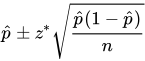
A population proportion can be estimated through the usage of a confidence interval known as a one-sample proportion in the Z-interval whose formula is given below:

where is the sample proportion, is the sample size, and is the upper critical value of the standard normal distribution for a level of confidence .

Proof

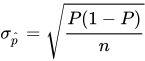
To derive the formula for the one-sample proportion in the Z-interval, a sampling distribution of sample proportions needs to be taken into consideration. The mean of the sampling distribution of sample proportions is usually denoted as and its standard deviation is denoted as:

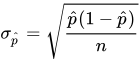
Since the value of is unknown, an unbiased statistic will be used for . The mean and standard deviation are rewritten respectively as:

and

Invoking the central limit theorem, the sampling distribution of sample proportions is approximately normal—provided that the sample is reasonably large and unskewed.

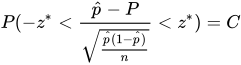
Suppose the following probability is calculated:

,

where and are the standard critical values.

The sampling distribution of sample proportions is approximately normal when it satisfies the requirements of the Central Limit Theorem.

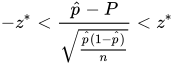
The inequality

can be algebraically re-written as follows:

From the algebraic work done above, it is evident from a level of certainty that could fall in between the values of:

.

Conditions for inference

In general the formula used for estimating a population proportion requires substitutions of known numerical values. However, these numerical values cannot be "blindly" substituted into the formula because statistical inference requires that the estimation of an unknown parameter be justifiable. For a parameter's estimation to be justifiable, there are three conditions that need to be verified:

  1. The data's individual observation have to be obtained from a simple random sample of the population of interest.
  2. The data's individual observations have to display normality. This can be assumed mathematically with the following definition:
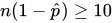
    • Let be the sample size of a given random sample and let be its sample proportion. If and , then the data's individual observations display normality.

  3. The data's individual observations have to be independent of each other. This can be assumed mathematically with the following definition:
    • Let be the size of the population of interest and let be the sample size of a simple random sample of the population. If , then the data's individual observations are independent of each other.

The conditions for SRS, normality, and independence are sometimes referred to as the conditions for the inference tool box in most statistical textbooks.

Example

Suppose a presidential election is taking place in a democracy. A random sample of 400 eligible voters in the democracy's voter population shows that 272 voters support candidate B. A political scientist wants to determine what percentage of the voter population support candidate B.

To answer the political scientist's question, a one-sample proportion in the Z-interval with a confidence level of 95% can be constructed in order to determine the population proportion of eligible voters in this democracy that support candidate B.

Solution

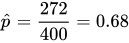
It is known from the random sample that with sample size . Before a confidence interval is constructed, the conditions for inference will be verified.

  • Since a random sample of 400 voters was obtained from the voting population, the condition for a simple random sample has been met.
  • Let and , it will be checked whether and
and
The condition for normality has been met.
  • Let be the size of the voter population in this democracy, and let . If , then there is independence.
The population size for this democracy's voters can be assumed to be at least 4,000. Hence, the condition for independence has been met.

With the conditions for inference verified, it is permissible to construct a confidence interval.

Let and

To solve for , the expression is used.

The standard normal curve with which gives an upper tail area of 0.0250 and an area of 0.9750 for .
A table with standard normal probabilities for .

By examining a standard normal bell curve, the value for can be determined by identifying which standard score gives the standard normal curve an upper tail area of 0.0250 or an area of 1 – 0.0250 = 0.9750. The value for can also be found through a table of standard normal probabilities.

From a table of standard normal probabilities, the value of that gives an area of 0.9750 is 1.96. Hence, the value for is 1.96.

The values for , , can now be substituted into the formula for one-sample proportion in the Z-interval:

Based on the conditions of inference and the formula for the one-sample proportion in the Z-interval, it can be concluded with a 95% confidence level that the percentage of the voter population in this democracy supporting candidate B is between 63.429% and 72.571%.

Value of the parameter in the confidence interval range

A commonly asked question in inferential statistics is whether the parameter is included within a confidence interval. The only way to answer this question is for a census to be conducted. Referring to the example given above, the probability that the population proportion is in the range of the confidence interval is either 1 or 0. That is, the parameter is included in the interval range or it is not. The main purpose of a confidence interval is to better illustrate what the ideal value for a parameter could possibly be.

Common errors and misinterpretations from estimation

A very common error that arises from the construction of a confidence interval is the belief that the level of confidence, such as , means 95% chance. This is incorrect. The level of confidence is based on a measure of certainty, not probability. Hence, the values of fall between 0 and 1, exclusively.

Estimation of P using ranked set sampling

A more precise estimate of P can be obtained by choosing ranked set sampling instead of simple random sampling

Strange loop

From Wikipedia, the free encyclopedia For other uses, see Strange loop (disa...