Edison cylinder phonograph c. 1899. The phonograph cylinder
is a storage medium. The phonograph may be considered a storage device,
especially as machines of this vintage were able to record on blank
cylinders.On a reel-to-reel tape recorder (Sony TC-630), the recorder is data storage equipment and the magnetic tape is a data storage medium.Various electronic storage devices, with a coin for scaleDNA and RNA can be considered as biological storage media.
Data storage is the recording (storing) of information (data) in a storage medium. Handwriting, phonographic recording, magnetic tape, and optical discs are all examples of storage media. Biological molecules such as RNA and DNA are considered by some as data storage. Recording may be accomplished with virtually any form of energy. Electronic data storage requires electrical power to store and retrieve data.
A recording medium is a physical material that holds information.
Newly created information is distributed and can be stored in four
storage media–print, film, magnetic, and optical–and seen or heard in
four information flows–telephone, radio and TV, and the Internet as well as being observed directly. Digital information is stored on electronic media in many different recording formats.
With electronic media, the data and the recording media are sometimes referred to as "software" despite the more common use of the word to describe computer software. With (traditional art) static media, art materials such as crayons
may be considered both equipment and medium as the wax, charcoal or
chalk material from the equipment becomes part of the surface of the
medium.
Some recording media may be temporary, either by design or by nature. Volatile organic compounds may be used to preserve the environment or to purposely make data expire over time. Data such as smoke signals or skywriting are temporary by nature. Depending on the volatility, a gas (e.g., atmosphere, smoke) or a liquid surface such as a lake would be considered a temporary recording medium if at all.
Global capacity, digitization, and trends
A 2003 UC Berkeley report estimated that about five exabytes
of new information were produced in 2002 and that 92% of this data was
stored on hard disk drives. This was about twice the data produced in
2000. The amount of data transmitted over telecommunications systems
in 2002 was nearly 18 exabytes—three and a half times more than was
recorded on non-volatile storage. Telephone calls constituted 98% of the
telecommunicated information in 2002. The researchers' highest estimate
for the growth rate of newly stored information (uncompressed) was more
than 30% per year.
In a more limited study, the International Data Corporation
estimated that the total amount of digital data in 2007 was 281
exabytes and that the total amount of digital data produced exceeded the
global storage capacity for the first time.
A 2011 Science Magazine
article estimated that the year 2002 was the beginning of the digital
age for information storage: an age in which more information is stored
on digital storage devices than on analog storage devices. In 1986, approximately 1% of the world's capacity to store information
was in digital format; this grew to 3% by 1993, to 25% by 2000, and to
97% by 2007. These figures correspond to less than three compressed exabytes in 1986, and 295 compressed exabytes in 2007. The quantity of digital storage doubled roughly every three years.
It is estimated that around 120 zettabytes of data will be generated in 2023, an increase of 60x from 2010, and that it will increase to 181 zettabytes generated in 2025.
There are two broad classes of mass storage: local data in devices such as smartphones or computers,
and enterprise servers and data centers for the cloud. For local
storage, SSDs are on the way to replacing HDDs. Considering the mobile
segment from phones to notebooks, the majority of systems today is based
on NAND Flash. As for Enterprise and data centers, storage tiers have established using a mix of SSD and HDD.
Electronic quantum holography (also known as quantum holographic data storage) is a holographic imagery and information storage technology based on the principles of electron holography.
By recording both the amplitude and phase of electron waves through
interference using a reference wave, electronic quantum holography can encode and read out data at high precision and density, storing as much as 35 bits per electron.
Electronic quantum holography differs from classical holography
in discussing the fundamental principles of each technology. Typically,
classical holography relies on optical coherence,
using the interference between a reference beam and an object beam to
record the phase (the position of the wave) and amplitude (the height of
the wave) of light. Because this process depends on stable, first-order
interference, classical holography requires coherent and well-aligned
light sources. Additionally, the performance of classical holography can
falter under unstable conditions such as mechanical vibrations, random
phase fluctuations, or stray illumination.
By contrast, electronic quantum holography, and quantum
holography itself, encode holographic information in the second-order
coherence of entangled photon pairs rather than first-order coherence.
Through the use of spatial-polarization hyper-entangled photons (photons
that are linked in both their physical path and the direction of their
light wave's vibration), quantum holography can reconstruct phase images
through coincidence measurements even when illumination is incoherent
or unpolarized. This allows for remote interference between photons that
do not share overlapping paths, provides protection from noise and
phase disorder, and can produce enhanced spatial resolution compared to
classical holography.
History
Dennis Gabor Holography Model
While working with electron microscopy, Hungarian physicist Dennis Gabor
recognized that image distortion caused by the spherical aberration of
electron lenses limited resolution. To address this, he proposed a
lens-less imaging method that used the wave nature of electrons to
record and reconstruct the complete wavefront, both its amplitude and
phase, resulting in what became known as a hologram.
The practical application of electron holography emerged only later, as
it required a more advanced understanding of electron interference and
specialized instrumentation. Gabor's work in classical holography in
1948 would eventually lead to him winning a Nobel Prize in 1971.
In 1968, German physicists Gottfried Möllenstedt and Gerd Wahl found that Gabor's lens-less approach was not ideal for electron microscopy. They developed the method of image-plane off-axis holography, which became one of the most successful and widely used techniques in electron holography. Similarly, American electrical engineer Emmet Leith
had conducted research on off-axis holography in the 1960's, and his
work helped advance holography into popularity alongside Möllenstedt and
Wahl's work.
The invention of digital holography
emerged in the late 1960's, as J.W.Goodman, and American electrical
engineer and physicist, proposed the idea of reconstructing an image of
an object through electronically recording holograms. This breakthrough
in digital holography grew in prominence with the development of charge-coupled devices, as the introduction of these devices enabled quantitative phase imaging, and the generation of digital image reconstructions.
As developments in digital holography continued, the field slowly began to see the incorporation of quantum mechanics. Developments involving consistent electron sources and digital image
reconstruction allowed for scientists to retrieve the full wavefunction
of the electron. This was one of the first bridges between digital and
electronic quantum holography, as the reconstructed wavefront represents
the quantum mechanical wavefunction of the electron beam instead of an
optical analogue. Techniques based on the Aharonov-Bohm effect,
which depend closely on the wavefunction phase were able to further
demonstrate that holography could detect phase shifts stemming from
electromagnetic potentials; even in areas that did not contain any
electric or magnetic field. This set precedent for holography as a
practical method for probing different quantum phenomena, such as gauge
fields, magnetic flux, and microscopic electromagnetic structures.
As research entered the early 2000's, ultrafast electron
microscopy and femtosecond-scale electron pulses allowed for
time-resolved holography, enabling studies of rapid electron-wave
dynamics. This would all eventually lay the foundation for quantum
holography.
Early developments
Scanning Tunneling Microscope schematic
In 2009, Stanford University's Department of Physics set a new world record for the smallest writing using a scanning tunneling microscope and electron waves to write the initials "SU" at 0.3 nanometers, surpassing the previous record set by IBM in 1989 using xenon
atoms. This achievement also set a record for the density of
information. Before this technology was invented the density of
information had not exceeded one bit per atom. Researchers of electronic
quantum holography however were able to push the limit to 35 bits per
electron or 20 bits nm−2.
Later, in 2019, Maden et al. explored a new holographic imaging technique using ultrafast transmission electron microscopy
to visualize electromagnetic fields. They introduced both local and
nonlocal holography techniques that improved time resolution, allowing
researchers to measure the phase and group velocities of surface plasmon polaritons with high precision.
In particular, the nonlocal approach allowed scientists to
separate the reference and probe fields, which was a limitation in
earlier optical approaches. This breakthrough would open the door to the
possibility of studying quantum effects and collective excitations such
as excitons, phonons, and polarizabilities at an atomic and sub
femtosecond scale.
Recent advancements
In 2022, Töpfer et al. worked on developing techniques to capture
holograms using photon pairs without directly capturing one of the
photons. This method would be known as induced coherence without induced
emission, and in it, researchers measure the interference of one photon
to reconstruct the phase and amplitude of the undetected photon. This
method proved to be a major step in improving the precision and
practicality of electronic quantum holography imaging, as it improved
phase stability and minimized the need for complex stabilization
equipment.
In the following year, Yesharim et al. had extended holography
into the quantum domain, with the development of quantum nonlinear
holography. This would utilize nonlinear photonic crystals,
whose patterned nonlinear coefficient shapes the spatial correlations
of entangled photon pairs generated through spontaneous parametric
down-conversion. Additionally, unlike typical nonlinear holography,
which uses simulated optical processes, quantum nonlinear holography
uses photon pairs that are generated by vacuum fluctuations, allowing
the crystal structure to select specific signal-idler mode pairs while
suppressing others. Using two-dimensional electric-field-poled KTP
crystals (potassium titanyl phosphate crystals), the ability to directly
imprint Hermite-Gauss mode patterns into the nonlinear medium was
demonstrated, allowing for compact generation of spatially entangled qubits
and qudits without the need for pump or beam shaping. The generated
states exhibited high-fidelity correlations and violated the CHSH inequality.
This method minimizes the optical complexity typically required
for high-dimensional quantum state engineering and is compatible with
continuous-wave lasers and on-chip photonic integration. Further
development using segmented and cascaded poling structures or future
three-dimensional nonlinear photonic crystals, are expected to extend
the range of available spatial modes and further tailor quantum state
generation.
Recently, in 2025, research in electronic quantum holography has
begun to move beyond photonic interferometers and electron-based methods
towards programmable atomic systems that can directly manipulate
quantum light. In a study published in Physical Review Research,
Lloyd and Bekenstein demonstrate a form of quantum holography using a
two-dimensional array of Rydberg atoms to construct a "quantum meta
surface". This allowed them to control the phase and amplitude of a
single photon with precision. Because they were able to control the
states of the photon, researchers could generate a programmable
holographic pattern in the quantum wavefunction of light, demonstrating
the ability for information to be stored and projected at a quantum
level. As such, this research provides a stepping stone to building
scalable quantum imaging and information storing technology.
Technology
A copper chip is placed in a microscope and cleaned. Carbon monoxide
molecules are then placed on the surface and moved around. When the
electrons in copper interact with the carbon monoxide molecules, they
create interference patterns that create an electronic quantum hologram.
This hologram can be read like a stack of pages in a book, and can contain multiple images at different wavelengths.
In optical quantum holography, information is typically encoded using spatially entangled photon pairs created through spontaneous parametric down-conversion
in nonlinear crystals. The paired photons exhibit strong correlations
in position and momentum that can be measured in the image and Fourier planes of the optical system. A spatial light modulator
applies a phase pattern to one of the protons, while the second photon
passes through a compensating or reference path. The phase information
does not appear in standard, raw intensity images. Instead, the
information is accessed by computing second-order intensity correlations
between symmetric detector pixels. Because the correlation function
depends on the relative phase between the photons, it is possible for
the hologram to be reconstructed even when only one photon interacts
with the phase object.
Example of a CCD
Additionally, quantum holographic systems generally depend on
high-sensitivity electron-multiplying CCD detectors that capture
millions of frames in order to accumulate adequate coincidence
statistics. In general, spatial resolution is determined by the
correlation width of the wavefunction of the two photons, which in turn
determines the smallest resolvable feature in the reconstructed phase map. The phase distortions introduced by birefringent
components can be measured and compensated using spatial light
modulator patterns in such a way that ensures consistent measurement
bases across the detector field. In contrast to classical holography, which directly reads out diffraction patterns from intensity images, quantum holography retrieves analogous information from correlation
matrices, which will allow for enhanced resolution and operation at
lower light levels. Both effects originate from the use of entangled
photons, whose second-order coherence properties allow holographic
reconstruction beyond the cutoff of the classical diffraction.
Applications
Quantum holography using undetected light has potential in a wide
variety of scientific and technological fields. Because the technique
allows for holograms to be created without detecting the photon that
illuminate the object, images can be created at wavelengths that would
be otherwise difficult to measure. This has led to proposed usage in
biomedical imaging. By probing an object with mid-infrared lights, which
are useful for identifying biological tissue or chemical compositions,
they can detect visible photons, which are easier to pick up on standard
silicon-based image sensors. This approach is also viable beyond
biomedical imaging, with proposed usage in materials analysis and
environmental sensing, as this approach allows for a safer and more
precise way to image samples that may get easily damaged through direct
exposure to light.
Beyond the imaging and information storage applications of
electronic quantum holography, holographic techniques have also been
proposed for high-security applications. One way researchers have
approached this is by creating "quantum holograms" through the usage of
entangled photons on meta surfaces, enabling holographic letters. Their
appearance will depend on polarization states, and will provide
anti-counterfeiting and secure-communication functionalities.
In addition to these applications, electronic holographic
techniques have demonstrated capabilities in material analysis at an
atomic level. High-resolution electron holography enables the
identification of individual atom columns in complex structures, such as
a "dumbbell" structure. For example, gallium and arsenic columns in
GaAs can be differentiated using phase shifts in the reconstructed
electron wave, even if the atomic numbers are similar. Holography has
also been applied to ferroelectric crystals, revealing local charge
distributions and atomic dipoles that may be otherwise challenging to
detect. Through combining precise phase measurements and high spatial
resolution, researchers are able to study interfaces, nanodomains, and
subtle atomic-scale distortions, providing detailed information on the
structure and electronic properties of materials, and extending the use
of holographic imaging beyond typical microscopy.
Low-energy electron holography reconstructs image of DNA
Within microscopy, new methods for imaging nanoscale structures have
been developed through the use of precise phase patterns within
nonlinear crystals to construct the spatial properties of photon pairs.
These techniques will allow for medical imaging at a single-cell scale.
To achieve this, the crystals encode spatial information provided by
extremely weak optical signals into the quantum correlations of the
photon pairs. Due to the hologram being imprinted during the nonlinear
conversion process, the resultant light fields are able to maintain
structural and phase details that typical microscopy may not. When
combined with modulating optics and quantum state tomography, cell
features can be reconstructed in a high-fidelity model without much
photodamage, which provides an option for safely studying sensitive
biological samples.
In quantum physics, a measurement
is the testing or manipulation of a physical system to yield a
numerical result. A fundamental feature of quantum theory is that the
predictions it makes are probabilistic.
The procedure for finding a probability involves combining a quantum state,
which mathematically describes a quantum system, with a mathematical
representation of the measurement to be performed on that system. The
formula for this calculation is known as the Born rule. For example, a quantum particle like an electron can be described by a quantum state that associates to each point in space a complex number called a probability amplitude.
Applying the Born rule to these amplitudes gives the probabilities that
the electron will be found in one region or another when an experiment
is performed to locate it. This is the best the theory can do; it cannot
say for certain where the electron will be found. The same quantum
state can also be used to make a prediction of how the electron will be moving, if an experiment is performed to measure its momentum instead of its position. The uncertainty principle
implies that, whatever the quantum state, the range of predictions for
the electron's position and the range of predictions for its momentum
cannot both be narrow. Some quantum states imply a near-certain
prediction of the result of a position measurement, but the result of a
momentum measurement will be highly unpredictable, and vice versa.
Furthermore, the fact that nature violates the statistical conditions
known as Bell inequalities indicates that the unpredictability of quantum measurement results cannot be explained away as due to ignorance about local hidden variables within quantum systems.
Measuring a quantum system generally changes the quantum state
that describes that system. This is a central feature of quantum
mechanics, one that is both mathematically intricate and conceptually
subtle. The mathematical tools for making predictions about what
measurement outcomes may occur, and how quantum states can change, were
developed during the 20th century and make use of linear algebra and functional analysis. Quantum physics has proven to be an empirical success and to have wide-ranging applicability.
In quantum mechanics, each physical system is associated with a Hilbert space, each element of which represents a possible state of the physical system. The approach codified by John von Neumann represents a measurement upon a physical system by a self-adjoint operator on that Hilbert space termed an "observable". These observables play the role of measurable quantities familiar from classical physics: position, momentum, energy, angular momentum and so on. The dimension of the Hilbert space may be infinite, as it is for the space of square-integrable functions
on a line, which is used to define the quantum physics of a continuous
degree of freedom. Alternatively, the Hilbert space may be
finite-dimensional, as occurs for spin
degrees of freedom. Many treatments of the theory focus on the
finite-dimensional case, as the mathematics involved is somewhat less
demanding. Indeed, introductory physics texts on quantum mechanics often
gloss over mathematical technicalities that arise for continuous-valued
observables and infinite-dimensional Hilbert spaces, such as the
distinction between bounded and unbounded operators; questions of convergence (whether the limit of a sequence of Hilbert-space elements also belongs to the Hilbert space), exotic possibilities for sets of eigenvalues, like Cantor sets; and so forth. These issues can be satisfactorily resolved using spectral theory;the present article will avoid them whenever possible.
The eigenvectors of a von Neumann observable form an orthonormal basis for the Hilbert space, and each possible outcome of that measurement corresponds to one of the vectors comprising the basis. A density operator is a positive-semidefinite operator on the Hilbert space whose trace is equal to 1. For each measurement that can be defined, the probability distribution
over the outcomes of that measurement can be computed from the density
operator. The procedure for doing so is the Born rule, which states that
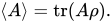
where is the density operator, and is the projection operator onto the basis vector corresponding to the measurement outcome . The average of the eigenvalues of a von Neumann observable, weighted by the Born rule probabilities, is the expectation value of that observable. For an observable , the expectation value given a quantum state is
A density operator that is a rank-1 projection is known as a pure quantum state, and all quantum states that are not pure are designated mixed. Pure states are also known as wavefunctions. Assigning a pure state to a quantum system implies certainty about the outcome of some measurement on that system (i.e., for some outcome ). Any mixed state can be written as a convex combination of pure states, though not in a unique way. The state space of a quantum system is the set of all states, pure and mixed, that can be assigned to it.
The Born rule associates a probability with each unit vector in
the Hilbert space, in such a way that these probabilities sum to 1 for
any set of unit vectors comprising an orthonormal basis. Moreover, the
probability associated with a unit vector is a function of the density
operator and the unit vector, and not of additional information like a
choice of basis for that vector to be embedded in. Gleason's theorem
establishes the converse: all assignments of probabilities to unit
vectors (or, equivalently, to the operators that project onto them) that
satisfy these conditions take the form of applying the Born rule to
some density operator.
In functional analysis and quantum measurement theory, a positive-operator-valued measure (POVM) is a measure whose values are positive semi-definite operators on a Hilbert space. POVMs are a generalisation of projection-valued measures
(PVMs) and, correspondingly, quantum measurements described by POVMs
are a generalisation of quantum measurement described by PVMs. In rough
analogy, a POVM is to a PVM what a mixed state is to a pure state. Mixed
states are needed to specify the state of a subsystem of a larger
system (see Schrödinger–HJW theorem);
analogously, POVMs are necessary to describe the effect on a subsystem
of a projective measurement performed on a larger system. POVMs are the
most general kind of measurement in quantum mechanics, and can also be
used in quantum field theory. They are extensively used in the field of quantum information.
In quantum mechanics, the POVM element is associated with the measurement outcome , such that the probability of obtaining it when making a measurement on the quantum state is given by
,
where is the trace operator. When the quantum state being measured is a pure state this formula reduces to
A measurement upon a quantum system will generally bring about a
change of the quantum state of that system. Writing a POVM does not
provide the complete information necessary to describe this state-change
process. To remedy this, further information is specified by decomposing each POVM element into a product:
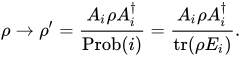
The Kraus operators, named for Karl Kraus, provide a specification of the state-change process. They are not necessarily self-adjoint, but the products are. If upon performing the measurement the outcome is obtained, then the initial state is updated to
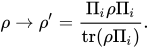
An important special case is the Lüders rule, named for Gerhart Lüders. If the POVM is itself a PVM, then the Kraus operators can be taken to
be the projectors onto the eigenspaces of the von Neumann observable:
If the initial state is pure, and the projectors have rank 1, they can be written as projectors onto the vectors and , respectively. The formula simplifies thus to
Lüders rule has historically been known as the "reduction of the wave packet" or the "collapse of the wavefunction". The pure state implies a probability-one prediction for any von Neumann observable that has
as an eigenvector. Introductory texts on quantum theory often express
this by saying that if a quantum measurement is repeated in quick
succession, the same outcome will occur both times. This is an
oversimplification, since the physical implementation of a quantum
measurement may involve a process like the absorption of a photon; after
the measurement, the photon does not exist to be measured again.
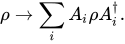
We can define a linear, trace-preserving, completely positive map, by summing over all the possible post-measurement states of a POVM without the normalisation:
It is an example of a quantum channel,
and can be interpreted as expressing how a quantum state changes if a
measurement is performed but the result of that measurement is lost.
Examples
Bloch sphere representation of states (in blue) and optimal POVM (in red) for unambiguous quantum state discrimination on the states and . Note that on the Bloch sphere orthogonal states are antiparallel.
The prototypical example of a finite-dimensional Hilbert space is a qubit, a quantum system whose Hilbert space is 2-dimensional. A pure state for a qubit can be written as a linear combination of two orthogonal basis states and with complex coefficients:
A measurement in the basis will yield outcome with probability and outcome with probability , so by normalization,
An arbitrary state for a qubit can be written as a linear combination of the Pauli matrices, which provide a basis for self-adjoint matrices:
where the real numbers are the coordinates of a point within the unit ball and
POVM elements can be represented likewise, though the trace of a POVM
element is not fixed to equal 1. The Pauli matrices are traceless and
orthogonal to one another with respect to the Hilbert–Schmidt inner product, and so the coordinates of the state are the expectation values of the three von Neumann measurements defined by the Pauli matrices.If such a measurement is applied to a qubit, then by the Lüders rule,
the state will update to the eigenvector of that Pauli matrix
corresponding to the measurement outcome. The eigenvectors of are the basis states and , and a measurement of is often called a measurement in the "computational basis." After a measurement in the computational basis, the outcome of a or measurement is maximally uncertain.
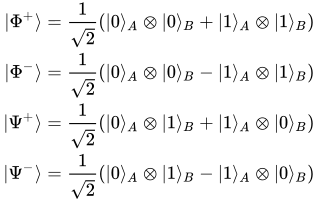
A pair of qubits together form a system whose Hilbert space is
4-dimensional. One significant von Neumann measurement on this system is
that defined by the Bell basis, a set of four maximally entangled states:
Probability density for the outcome of a position measurement given the energy eigenstate of a 1D harmonic oscillator
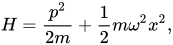
A common and useful example of quantum mechanics applied to a continuous degree of freedom is the quantum harmonic oscillator. This system is defined by the Hamiltonian
and these values give the possible numerical outcomes of an energy
measurement upon the oscillator. The set of possible outcomes of a position measurement on a harmonic oscillator is continuous, and so predictions are stated in terms of a probability density function that gives the probability of the measurement outcome lying in the infinitesimal interval from to .
Stern–Gerlach
experiment: Silver atoms travelling through an inhomogeneous magnetic
field, and being deflected up or down depending on their spin; (1)
furnace, (2) beam of silver atoms, (3) inhomogeneous magnetic field, (4)
classically expected result, (5) observed result.
The Stern–Gerlach experiment, proposed in 1921 and implemented in 1922, became a prototypical example of a quantum measurement having a
discrete set of possible outcomes. In the original experiment, silver
atoms were sent through a spatially varying magnetic field, which
deflected them before they struck a detector screen, such as a glass
slide. Particles with non-zero magnetic moment are deflected, due to the magnetic field gradient,
from a straight path. The screen reveals discrete points of
accumulation, rather than a continuous distribution, owing to the
particles' quantized spin.
Transition to the "new" quantum theory
A 1925 paper by Werner Heisenberg, known in English as "Quantum theoretical re-interpretation of kinematic and mechanical relations", marked a pivotal moment in the maturation of quantum physics. Heisenberg sought to develop a theory of atomic phenomena that relied
only on "observable" quantities. At the time, and in contrast with the
later standard presentation of quantum mechanics, Heisenberg did not
regard the position of an electron bound within an atom as "observable".
Instead, his principal quantities of interest were the frequencies of
light emitted or absorbed by atoms.
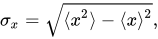
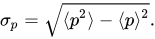
Writing and for the self-adjoint operators representing position and momentum respectively, a standard deviation of position can be defined as
and likewise for the momentum:
The Kennard–Pauli–Weyl uncertainty relation is
This inequality means that no preparation of a quantum particle can
imply simultaneously precise predictions for a measurement of position
and for a measurement of momentum. The Robertson inequality generalizes this to the case of an arbitrary pair of self-adjoint operators and . The commutator of these two operators is
and this provides the lower bound on the product of standard deviations:
Substituting in the canonical commutation relation, an expression first postulated by Max Born in 1925,[37] recovers the Kennard–Pauli–Weyl statement of the uncertainty principle.
The existence of the uncertainty principle naturally raises the
question of whether quantum mechanics can be understood as an
approximation to a more exact theory. Do there exist "hidden variables",
more fundamental than the quantities addressed in quantum theory
itself, knowledge of which would allow more exact predictions than
quantum theory can provide? A collection of results, most significantly Bell's theorem, have demonstrated that broad classes of such hidden-variable theories are in fact incompatible with quantum physics.
John Stewart Bell published the theorem now known by his name in 1964, investigating more deeply a thought experiment originally proposed in 1935 by Einstein, Boris Podolsky and Nathan Rosen.According to Bell's theorem, if nature actually operates in accord with any theory of local
hidden variables, then the results of a Bell test will be constrained
in a particular, quantifiable way. If a Bell test is performed in a
laboratory and the results are not thus constrained, then they
are inconsistent with the hypothesis that local hidden variables exist.
Such results would support the position that there is no way to explain
the phenomena of quantum mechanics in terms of a more fundamental
description of nature that is more in line with the rules of classical
physics. Many types of Bell test have been performed in physics
laboratories, often with the goal of ameliorating problems of
experimental design or set-up that could in principle affect the
validity of the findings of earlier Bell tests. This is known as
"closing loopholes in Bell tests".
To date, Bell tests have found that the hypothesis of local hidden
variables is inconsistent with the way that physical systems behave.
Quantum systems as measuring devices
The Robertson–Schrödinger uncertainty principle establishes that when
two observables do not commute, there is a tradeoff in predictability
between them. The Wigner–Araki–Yanase theorem demonstrates another consequence of non-commutativity: the presence of a conservation law limits the accuracy with which observables that fail to commute with the conserved quantity can be measured. Further investigation in this line led to the formulation of the Wigner–Yanase skew information.
Historically, experiments in quantum physics have often been
described in semiclassical terms. For example, the spin of an atom in a
Stern–Gerlach experiment might be treated as a quantum degree of
freedom, while the atom is regarded as moving through a magnetic field
described by the classical theory of Maxwell's equations.
But the devices used to build the experimental apparatus are themselves
physical systems, and so quantum mechanics should be applicable to them
as well. Beginning in the 1950s, Léon Rosenfeld, Carl Friedrich von Weizsäcker
and others tried to develop consistency conditions that expressed when a
quantum-mechanical system could be treated as a measuring apparatus. One proposal for a criterion regarding when a system used as part of a
measuring device can be modeled semiclassically relies on the Wigner function, a quasiprobability distribution that can be treated as a probability distribution on phase space in those cases where it is everywhere non-negative.
A quantum state for an imperfectly isolated system will generally
evolve to be entangled with the quantum state for the environment.
Consequently, even if the system's initial state is pure, the state at a
later time, found by taking the partial trace
of the joint system-environment state, will be mixed. This phenomenon
of entanglement produced by system-environment interactions tends to
obscure the more exotic features of quantum mechanics that the system
could in principle manifest. Quantum decoherence, as this effect is
known, was first studied in detail during the 1970s. (Earlier investigations into how classical physics might be obtained as
a limit of quantum mechanics had explored the subject of imperfectly
isolated systems, but the role of entanglement was not fully
appreciated.) A significant portion of the effort involved in quantum computing research is to avoid the deleterious effects of decoherence.
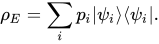
To illustrate, let denote the initial state of the system, the initial state of the environment and the Hamiltonian specifying the system-environment interaction. The density operator can be diagonalized and written as a linear combination of the projectors onto its eigenvectors:
Expressing time evolution for a duration by the unitary operator , the state for the system after this evolution is
which evaluates to
The quantities surrounding can be identified as Kraus operators, and so this defines a quantum channel.
Specifying a form of interaction between system and environment
can establish a set of "pointer states," states for the system that are
(approximately) stable, apart from overall phase factors, with respect
to environmental fluctuations. A set of pointer states defines a
preferred orthonormal basis for the system's Hilbert space.
Quantum information and computation
Quantum information science studies how information science
and its application as technology depend on quantum-mechanical
phenomena. Understanding measurement in quantum physics is important for
this field in many ways, some of which are briefly surveyed here.
Measurement, entropy, and distinguishability
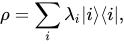
The von Neumann entropy is a measure of the statistical uncertainty represented by a quantum state. For a density matrix , the von Neumann entropy is
writing in terms of its basis of eigenvectors,
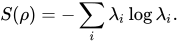
the von Neumann entropy is
This is the Shannon entropy
of the set of eigenvalues interpreted as a probability distribution,
and so the von Neumann entropy is the Shannon entropy of the random variable defined by measuring in the eigenbasis of . Consequently, the von Neumann entropy vanishes when is pure. The von Neumann entropy of can equivalently be characterized as the minimum Shannon entropy for a measurement given the quantum state , with the minimization over all POVMs with rank-1 elements.
Many other quantities used in quantum information theory also
find motivation and justification in terms of measurements. For example,
the trace distance between quantum states is equal to the largest difference in probability that those two quantum states can imply for a measurement outcome:
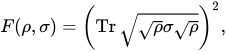
Similarly, the fidelity of two quantum states, defined by
expresses the probability that one state will pass a test for
identifying a successful preparation of the other. The trace distance
provides bounds on the fidelity via the Fuchs–van de Graaf inequalities:
Circuit
representation of measurement. The single line on the left-hand side
stands for a qubit, while the two lines on the right-hand side represent
a classical bit.
Quantum circuits are a model for quantum computation in which a computation is a sequence of quantum gates followed by measurements. The gates are reversible transformations on a quantum mechanical analog of an n-bitregister. This analogous structure is referred to as an n-qubitregister.
Measurements, drawn on a circuit diagram as stylized pointer dials,
indicate where and how a result is obtained from the quantum computer
after the steps of the computation are executed. Without loss of generality, one can work with the standard circuit model, in which the set of gates are single-qubit unitary transformations and controlled NOT gates on pairs of qubits, and all measurements are in the computational basis.
Measurement-based quantum computation (MBQC) is a model of quantum computing
in which the answer to a question is, informally speaking, created in
the act of measuring the physical system that serves as the computer.
Quantum state tomography is a process by which, given a set of data
representing the results of quantum measurements, a quantum state
consistent with those measurement results is computed. It is named by analogy with tomography, the reconstruction of three-dimensional images from slices taken through them, as in a CT scan. Tomography of quantum states can be extended to tomography of quantum channels and even of measurements.
Quantum metrology is the use of quantum physics to aid the
measurement of quantities that, generally, had meaning in classical
physics, such as exploiting quantum effects to increase the precision
with which a length can be measured. A celebrated example is the introduction of squeezed light into the LIGO experiment, which increased its sensitivity to gravitational waves.
Laboratory implementations
The range of physical procedures to which the mathematics of quantum measurement can be applied is very broad. In the early years of the subject, laboratory procedures involved the recording of spectral lines, the darkening of photographic film, the observation of scintillations, finding tracks in cloud chambers, and hearing clicks from Geiger counters. Language from this era persists, such as the description of measurement outcomes in the abstract as "detector clicks".
The double-slit experiment is a prototypical illustration of quantum interference,
typically described using electrons or photons. The first interference
experiment to be carried out in a regime where both wave-like and
particle-like aspects of photon behavior are significant was G. I. Taylor's
test in 1909. Taylor used screens of smoked glass to attenuate the
light passing through his apparatus, to the extent that, in modern
language, only one photon would be illuminating the interferometer slits
at a time. He recorded the interference patterns on photographic
plates; for the dimmest light, the exposure time required was roughly
three months. In 1974, the Italian physicists Pier Giorgio Merli [it], Gian Franco Missiroli, and Giulio Pozzi implemented the double-slit experiment using single electrons and a television tube. A quarter-century later, a team at the University of Vienna performed an interference experiment with buckyballs, in which the buckyballs that passed through the interferometer were ionized by a laser, and the ions then induced the emission of electrons, emissions which were in turn amplified and detected by an electron multiplier.
Modern quantum optics experiments can employ single-photon detectors. For example, in the "BIG Bell test" of 2018, several of the laboratory setups used single-photon avalanche diodes. Another laboratory setup used superconducting qubits. The standard method for performing measurements upon superconducting qubits is to couple a qubit with a resonator
in such a way that the characteristic frequency of the resonator shifts
according to the state for the qubit, and detecting this shift by
observing how the resonator reacts to a probe signal.
Despite the consensus among scientists that quantum physics is in
practice a successful theory, disagreements persist on a more
philosophical level. Many debates in the area known as quantum foundations concern the role of measurement in quantum mechanics. Recurring questions include which interpretation of probability theory
is best suited for the probabilities calculated from the Born rule; and
whether the apparent randomness of quantum measurement outcomes is
fundamental, or a consequence of a deeper deterministic process. Worldviews that present answers to questions like these are known as "interpretations" of quantum mechanics; as the physicist N. David Mermin once quipped, "New interpretations appear every year. None ever disappear."
A central concern within quantum foundations is the "quantum measurement problem,"
though how this problem is delimited, and whether it should be counted
as one question or multiple separate issues, are contested topics. Of primary interest is the seeming disparity between apparently
distinct types of time evolution. Von Neumann declared that quantum
mechanics contains "two fundamentally different types" of quantum-state
change.
First, there are those changes involving a measurement process, and
second, there is unitary time evolution in the absence of measurement.
The former is stochastic and discontinuous, writes von Neumann, and the
latter deterministic and continuous. This dichotomy has set the tone for
much later debate. Some interpretations of quantum mechanics find the reliance upon two
different types of time evolution distasteful and regard the ambiguity
of when to invoke one or the other as a deficiency of the way quantum
theory was historically presented. To bolster these interpretations, their proponents have worked to
derive ways of regarding "measurement" as a secondary concept and
deducing the seemingly stochastic effect of measurement processes as
approximations to more fundamental deterministic dynamics. However,
consensus has not been achieved among proponents of the correct way to
implement this program, and in particular how to justify the use of the
Born rule to calculate probabilities. Other interpretations regard quantum states as statistical information
about quantum systems, thus asserting that abrupt and discontinuous
changes of quantum states are not problematic, simply reflecting updates
of the available information. Of this line of thought, Bell asked, "Whose information? Information about what?" Answers to these questions vary among proponents of the informationally-oriented interpretations.






































![{\displaystyle [A,B]=AB-BA,}](https://wikimedia.org/api/rest_v1/media/math/render/svg/b2a47259b42e63c048c65f67d304404867841951)
![{\displaystyle \sigma _{A}\sigma _{B}\geq \left|{\frac {1}{2i}}\langle [A,B]\rangle \right|={\frac {1}{2}}\left|\langle [A,B]\rangle \right|.}](https://wikimedia.org/api/rest_v1/media/math/render/svg/d15f644ab43a23f762c87886b1ae050f83b001ba)
![{\displaystyle [{x},{p}]=i\hbar }](https://wikimedia.org/api/rest_v1/media/math/render/svg/d7dad6e853b68a93aa6607b63a3a08cfc24d6088)




![{\displaystyle \rho _{S}'={\rm {tr}}_{E}U\left[\rho _{S}\otimes \left(\sum _{i}p_{i}|\psi _{i}\rangle \langle \psi _{i}|\right)\right]U^{\dagger },}](https://wikimedia.org/api/rest_v1/media/math/render/svg/04f34a1930a48d600509e418c6bd2616f2bfe784)


![{\displaystyle {\frac {1}{2}}||\rho -\sigma ||=\max _{0\leq E\leq I}[{\rm {tr}}(E\rho )-{\rm {tr}}(E\sigma )].}](https://wikimedia.org/api/rest_v1/media/math/render/svg/546b08be0062e916339e9e0efc9f88b40e8553a7)