Search This Blog

Saturday, May 16, 2026

Nanolaser

From Wikipedia, the free encyclopedia

A nanolaser is a laser that has nanoscale dimensions and it refers to a micro-/nano- device which can emit light with light or electric excitation of nanowires or other nanomaterials that serve as resonators. A standard feature of nanolasers includes their light confinement on a scale approaching or suppressing the diffraction limit of light. These tiny lasers can be modulated quickly and, combined with their small footprint, this makes them ideal candidates for on-chip optical computing.

History

Albert Einstein proposed the stimulated emission in 1916, which contributed to the first demonstration of laser in 1961. From then on, people have been pursuing the miniaturization of lasers for more compact size and less energy consumption all the time. Since people noticed that light has different interactions with matter at the nanoscale in the 1990s, significant progress has been made to achieve the miniaturization of lasers and increase power conversion efficiency. Various types of nanolasers have been developed over the past decades.

In the 1990s, some intriguing designs of microdisk laser and photonic crystal laser were demonstrated to have cavity size or energy volume with micro-/nano- diameters and approach the diffraction limit of light. Photoluminescence behavior of bulk ZnO nanowires was first reported in 2001 by Prof. Peidong Yang from the University of California, Berkeley and it opened the door to the study of nanowire nanolasers. These designs still do not exceed the diffraction limit until the demonstration of plasmonic lasers or spasers.

David J. Bergman and Mark Stockman first proposed amplified surface plasmon waves by stimulated emission and coined the term spaser as "surface plasmon amplification by stimulated emission of radiation" in 2003. Until 2009, the plasmonic nanolasers or spasers were first achieved experimentally, which were regarded as the smallest nanolasers at that time.

Development timeline of nanolasers.

Since roughly 2010, there has been progress in nanolaser technology, and new types of nanolasers have been developed, such as parity-time symmetry laser, bound states in the continuum laser and photonic topological insulators laser.

Comparison with conventional lasers

While sharing many similarities with standard lasers, nanolasers maintain many unique features and differences from the conventional lasers due to the fact that light interacts differently with matter at the nanoscale.

Mechanism

Similar to the conventional lasers, nanolasers also based on stimulated emission which was proposed by Einstein; the main difference between nanolaser and the conventional ones in mechanism is light confinement. The resonator or cavity plays an important role in selecting the light with a certain frequency and the same direction as the most priority amplification and suppressing the other light to achieve the confinement of light. For conventional lasers, Fabry–Pérot cavity with two parallel reflection mirrors is applied. In the case of nanowires, it was shown  that the two ends of a nanowire acting as scatters, rather than two parallel mirrors as in the case of Fabry–Pérot cavity, provide the feedback mechanism for nanowire lasers. In this case, light could be confined to a maximum of half its wavelength and such limit is deemed the diffraction limit of light. To approach or decrease the diffraction limit of light, one way is to improve the reflectivity of gain medium, such as using photonic bandgap and nanowires. Another effective way to exceed the diffraction limit is to convert light into surface plasmons in nanostructuralized metals, for amplification in cavity. Recently, new mechanisms of strong light confinement for nanolasers including parity–time symmetry, photonic topological insulators, and bound states in the continuum have been proposed.

Properties

Comparison of nanolasers and macro lasers in properties. Compared with macro lasers, nanolasers have decreased sizes, lower thresholds and accelerated modulation speeds.

Compared with conventional lasers, nanolasers show distinct properties and capabilities. The biggest advantages of nanolasers are their ultra-small physical volumes to improve energy efficiencies, decrease lasing thresholds, and achieve high modulation speeds.

Types

Microdisk laser

SEM image of microdisk laser with a whispering-gallery mode resonator.

A microdisk laser is a very small laser consisting of a disk with quantum well structures built into it. Its dimensions can exist on the micro-scale or nano-scale. Microdisk lasers use a whispering-gallery mode resonant cavity. The light in cavity travels around the perimeter of the disk and the total internal reflection of photons can result in a strong light confinement and a high quality factor, which means a powerful ability of the microcavity to store the energy of photons coupled into the cavity.

Photonic crystal laser

Photonic crystal lasers utilize periodic dielectric structures with different refractive indices; light can be confined with the use of a photonic crystal microcavity. In dielectric materials, there is orderly spatial distribution. When there is a defect in the periodic structure, the two-dimensional or three-dimensional photonic crystal structure will confine the light in the space of the diffractive limit and produce the Fano resonance phenomenon, which means a high quality factor with a strong light confinement for lasers. The fundamental feature of photonic crystals is the photonic bandgap, that is, the light whose frequency falls in the photonic band gap cannot propagate in the crystal structure, thus resulting in a high reflectivity for incident light and a strong confinement of light to a small volume of wavelength scale. The appearance of photonic crystals makes the spontaneous emission in the photon gap completely suppressed. But the high cost of photonic crystal impedes the development and spreading applications of photonic crystal lasers.

Nanowire laser

Scheme of nanowire lasers.

Semiconductor nanowire lasers have a quasi-one-dimensional structure with diameters ranging from a few nanometers to a few hundred nanometers and lengths ranging from hundreds of nanometers to a few microns. The width of nanowires is large enough to ignore the quantum size effect, but they are high quality one-dimensional waveguides with cylindrical, rectangular, trigonal, and hexagonal cross-sections. The quasi-one-dimensional structure and high feedback provided by scattering of light at the nanowire ends  makes it have good optical waveguide and the ability of light confinement. Nanowire lasers are similar to Fabry–Pérot cavity in mechanism, but different in quantitative reflection coefficients  High reflectivity of nanowire and flat end facets of the wire constitute a good resonant cavity, in which photons can be bound between the two ends of the nanowire to limit the light energy to the axial direction of the nanowire, thus meeting the conditions for laser formation. Polygonal nanowires can form a nearly circular cavity in cross section that supports whispering-gallery mode.

Plasmonic nanolaser

Schematic illustration of a plasmonic nanolaser. The process of lasing formation includes energy transfer convert photons into surface plasmons.

Nanolasers based on surface plasmons are known as plasmonic nanolasers, with sizes far exceeding the diffraction limit of light. If a plasmonic nanolaser is nanoscopic in three dimensions, it is also called a spaser, which is known to have the smallest cavity size and mode size. Design of plasmonic nanolaser has become one of the most effective technology methods for laser miniaturization at present. A little bit different from the conventional lasers, a typical configuration of plasmonic nanolaser includes a process of energy transfer to convert photons into surface plasmons. In plasmonic nanolaser or spaser, the exciton is not photons anymore but surface plasmon polariton. Surface plasmons are collective oscillations of free electrons on metal surfaces under the action of external electromagnetic fields. According to their manifestations, the cavity mode in plasmonic nanolasers can be divided into the propagating surface plasmon polaritons (SPPs) and the non-propagating localized surface plasmons (LSPs).

Schematic of a SPP mode, where surface plasmon polaritons propagate along an interface between metal and dielectric.

SPPs are electromagnetic waves that propagate along the interface between metal and medium, and their intensities decay gradually in the direction perpendicular to the propagation interface. In 2008, Oulton experimentally validated a plasma nanowire laser consisting of a thin dielectric layer with a low reflectivity growing on a metal surface and a gain layer with a high refractive index semiconductor nanowire. In this structure, the electromagnetic field can be transferred from the metal layer to the intermediate gap layer, so that the mode energy is highly concentrated, thus greatly reducing the energy loss in the metal.

Schematic of configuration of a 3D spaser surrounded by a gain medium based on localized surface plasmons. Metal core provides plasmon mode and surface plasmon polaritons are formed on the surface of nanoshell with a silicon dioxide doped with dye as gain medium.

The LSP mode exists in a variety of different metal nanostructures, such as metal nanoparticles (nanospheres, nanorods, nanocubes, etc.) and arrays of nanoparticles. Unlike the propagating surface plasmon polaritons, the localized surface plasmon does not propagate along the surface, but oscillates back and forth in the nanostructure in the form of standing waves. When light is incident to the surface of a metal nanoparticles, it causes a real displacement of the surface charge relative to the ions. The attraction between electrons and ions allows for the oscillation of electrode cloud and the formation of local surface from polarization excimer. The oscillation of electrons is determined by the geometrical boundaries of different metal nanoparticles. When its resonance frequency is consistent with the incident electromagnetic field, it will form the localized surface plasmon resonance. In 2009, Mikhail A. Noginov of Norfolk State University in the United States successfully verified the LSPs-based nanolaser for the first time. The nanolaser in this paper was composed of an Au core providing the plasmon mode and a silicon dioxide doped with OG-488 dye providing the gain medium. The diameter of the Au core was 14 nm, the thickness of the silica layer was 15 nm, and the diameter of the whole device was only 44 nm, which was the smallest nanolaser at that time.

New types of nanolasers

In addition, there have been some new types of nanolasers developed in recent years to approach the diffraction limit. Parity-time symmetry is related to a balance of optical gain and loss in a coupled cavity system. When the gain–loss contrast and coupling constant between two identical, closely located cavities are controlled, the phase transition of lasing modes occurs at an exceptional point. Bound states in the continuum laser confines light in an open system via the elimination of radiation states through destructive interference between resonant modes. A photonic topological insulator laser is based on topological insulators optical mode, where the topological states is confined within the cavity boundaries and they can be used for the formation of laser. All of those new types of nanolasers have high quality factor and can achieve cavity size and mode size approaching the diffraction limit of the light.

Applications

Due to the unique capabilities including low lasing thresholds, high energy efficiencies and high modulation speeds, nanolasers show great potentials for practical applications in the fields of materials characterization, integrated optical interconnects, and sensing.

Nanolasers for material characterization

The intense optical fields of such a laser also enable the enhancement effect in non-linear optics or surface-enhanced-raman-scattering (SERS). Nanowire nanolasers can be capable of optical detection at the scale of a single molecule with high resolution and ultrafast modulation.

Nanolasers for integrated optical interconnects

Internet is developing at an extremely high speed with large energy consumption for data communication. The high energy efficiency of nanolasers plays an important role in decreasing energy consumption for future society.

Nanolasers for sensing

Plasmonic nanolaser sensors have recently been demonstrated that can detect specific molecules in air and be used for optical biosensors. Molecules can modify the surface of metal nanoparticles and impact the surface recombination velocity of gain medium of a plasmonic nanolaser, which contributes to the sensing mechanism of plasmonic nanolasers.

Challenges

Although nanolasers have shown great potential, there are still some challenges towards the large-scale use of nanolasers, for example, electrically injected nanolasers, cavity configuration engineering and metal quality improvement. For nanolasers, the realization of electrically injected or pumped operation at room temperature is a key step towards its practical application. However, most nanolaser are optically pumped and the realization of electrically injected nanolasers is still a main technical challenge at present. Only a few studies have reported electrically injected nanolasers. Moreover, it still remains a challenge to realize cavity configuration engineering and metal quality improvement, which are crucial to satisfy the high-performance requirement of nanolasers and achieve their applications. Recently, nanolaser arrays show great potential to increase the power efficiency and accelerate modulation speed.

Stimulated emission

From Wikipedia, the free encyclopedia
 
Laser light is a type of stimulated emission of radiation.

Stimulated emission is the process by which an incoming photon of a specific frequency can interact with an excited atomic electron (or other excited molecular state), causing it to drop to a lower energy level. The liberated energy transfers to the electromagnetic field, creating a new photon with a frequency, polarization, and direction of travel that are all identical to the photons of the incident wave. This is in contrast to spontaneous emission, which occurs at a characteristic rate for each of the atoms/oscillators in the upper energy state regardless of the external electromagnetic field.

According to the American Physical Society, the first person to correctly predict the phenomenon of stimulated emission was Albert Einstein in a series of papers starting in 1916, culminating in what is now called the Einstein B Coefficient. Einstein's work became the theoretical foundation of the maser and the laser. The process is identical in form to atomic absorption in which the energy of an absorbed photon causes an identical but opposite atomic transition: from the lower level to a higher energy level. In normal media at thermal equilibrium, absorption exceeds stimulated emission because there are more electrons in the lower energy states than in the higher energy states. However, when a population inversion is present, the rate of stimulated emission exceeds that of absorption, and a net optical amplification can be achieved. Such a gain medium, along with an optical resonator, is at the heart of a laser or maser. Lacking a feedback mechanism, laser amplifiers and superluminescent sources also function on the basis of stimulated emission.

Overview

Electrons and their interactions with electromagnetic fields are important in our understanding of chemistry and physics. In the classical view, the energy of an electron orbiting an atomic nucleus is larger for orbits further from the nucleus of an atom. However, quantum mechanical effects force electrons to take on discrete positions in orbitals. Thus, electrons are found in specific energy levels of an atom, two of which are shown below:

When an electron absorbs energy either from light (photons) or heat (phonons), it receives that incident quantum of energy. But transitions are only allowed between discrete energy levels such as the two shown above. This leads to emission lines and absorption lines.

When an electron is excited from a lower to a higher energy level, it is unlikely for it to stay that way forever. An electron in an excited state may decay to a lower energy state which is not occupied, according to a particular time constant characterizing that transition. When such an electron decays without external influence, emitting a photon, that is called "spontaneous emission". The phase and direction associated with the photon that is emitted is random. A material with many atoms in such an excited state may thus result in radiation which has a narrow spectrum (centered around one wavelength of light), but the individual photons would have no common phase relationship and would also emanate in random directions. This is the mechanism of fluorescence and thermal emission.

An external electromagnetic field at a frequency associated with a transition can affect the quantum mechanical state of the atom without being absorbed. As the electron in the atom makes a transition between two stationary states (neither of which shows a dipole field), it enters a transition state which does have a dipole field, and which acts like a small electric dipole, and this dipole oscillates at a characteristic frequency. In response to the external electric field at this frequency, the probability of the electron entering this transition state is greatly increased. Thus, the rate of transitions between two stationary states is increased beyond that of spontaneous emission. A transition from the higher to a lower energy state produces an additional photon with the same phase and direction as the incident photon; this is the process of stimulated emission.

History

Stimulated emission was a theoretical discovery by Albert Einstein within the framework of the old quantum theory, wherein the emission is described in terms of photons that are the quanta of the EM field. Stimulated emission can also occur in classical models, without reference to photons or quantum-mechanics. (See also Laser § History.) According to physics professor and director of the MIT-Harvard Center for Ultracold Atoms Daniel Kleppner, Einstein's theory of radiation was ahead of its time and prefigures the modern theory of quantum electrodynamics and quantum optics by several decades.

Mathematical model

Stimulated emission can be modelled mathematically by considering an atom that may be in one of two electronic energy states, a lower level state (possibly the ground state) (1) and an excited state (2), with energies E1 and E2 respectively.

If the atom is in the excited state, it may decay into the lower state by the process of spontaneous emission, releasing the difference in energies between the two states as a photon. The photon will have frequency ν0 and energy 0, given by: where h is the Planck constant.

Alternatively, if the excited-state atom is perturbed by an electric field of frequency ν0, it may emit an additional photon of the same frequency and in phase, thus augmenting the external field, leaving the atom in the lower energy state. This process is known as stimulated emission.

In a group of such atoms, if the number of atoms in the excited state is given by N2, the rate at which stimulated emission occurs is given by where the proportionality constant B21 is known as the Einstein B coefficient for that particular transition, and ρ(ν) is the radiation density of the incident field at frequency ν. The rate of emission is thus proportional to the number of atoms in the excited state N2, and to the density of incident photons.

At the same time, there will be a process of atomic absorption which removes energy from the field while raising electrons from the lower state to the upper state. Its rate is precisely the negative of the stimulated emission rate,

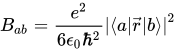
The rate of absorption is thus proportional to the number of atoms in the lower state, N1. The B coefficients can be calculated using dipole approximation and time dependent perturbation theory in quantum mechanics as:  where B corresponds to energy distribution in terms of frequency ν. The B coefficient may vary based on choice of energy distribution function used, however, the product of energy distribution function and its respective B coefficient remains same.

Einstein showed from the form of Planck's law, that the coefficient for this transition must be identical to that for stimulated emission:

Thus absorption and stimulated emission are reverse processes proceeding at somewhat different rates. Another way of viewing this is to look at the net stimulated emission or absorption viewing it as a single process. The net rate of transitions from E2 to E1 due to this combined process can be found by adding their respective rates, given above:

Thus a net power is released into the electric field equal to the photon energy times this net transition rate. In order for this to be a positive number, indicating net stimulated emission, there must be more atoms in the excited state than in the lower level: . Otherwise there is net absorption and the power of the wave is reduced during passage through the medium. The special condition is known as a population inversion, a rather unusual condition that must be effected in the gain medium of a laser.

The notable characteristic of stimulated emission compared to everyday light sources (which depend on spontaneous emission) is that the emitted photons have the same frequency, phase, polarization, and direction of propagation as the incident photons. The photons involved are thus mutually coherent. When a population inversion () is present, therefore, optical amplification of incident radiation will take place.

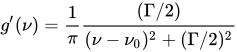
Although energy generated by stimulated emission is always at the exact frequency of the field which has stimulated it, the above rate equation refers only to excitation at the particular optical frequency corresponding to the energy of the transition. At frequencies offset from the strength of stimulated (or spontaneous) emission will be decreased according to the so-called line shape. Considering only homogeneous broadening affecting an atomic or molecular resonance, the spectral line shape function is described as a Lorentzian distribution where is the full width at half maximum or FWHM bandwidth.

The peak value of the Lorentzian line shape occurs at the line center, . A line shape function can be normalized so that its value at is unity; in the case of a Lorentzian we obtain

Thus stimulated emission at frequencies away from is reduced by this factor. In practice there may also be broadening of the line shape due to inhomogeneous broadening, most notably due to the Doppler effect resulting from the distribution of velocities in a gas at a certain temperature. This has a Gaussian shape and reduces the peak strength of the line shape function. In a practical problem the full line shape function can be computed through a convolution of the individual line shape functions involved. Therefore, optical amplification will add power to an incident optical field at frequency at a rate given by

Stimulated emission cross section

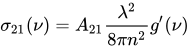
The stimulated emission cross section is where

Optical amplification

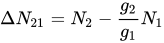
Stimulated emission can provide a physical mechanism for optical amplification. If an external source of energy stimulates more than 50% of the atoms in the ground state to transition into the excited state, then what is called a population inversion is created. When light of the appropriate frequency passes through the inverted medium, the photons are either absorbed by the atoms that remain in the ground state or the photons stimulate the excited atoms to emit additional photons of the same frequency, phase, and direction. Since more atoms are in the excited state than in the ground state then an amplification of the input intensity results.

The population inversion, in units of atoms per cubic metre, is

where g1 and g2 are the degeneracies of energy levels 1 and 2, respectively.

Small signal gain equation

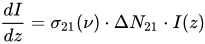
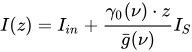
The intensity (in watts per square metre) of the stimulated emission is governed by the following differential equation:

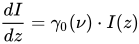
as long as the intensity I(z) is small enough so that it does not have a significant effect on the magnitude of the population inversion. Grouping the first two factors together, this equation simplifies as

where

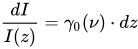
is the small-signal gain coefficient (in units of radians per metre). We can solve the differential equation using separation of variables:

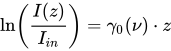
Integrating, we find:

or

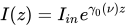
where

is the optical intensity of the input signal (in watts per square metre).

Saturation intensity

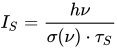
The saturation intensity IS is defined as the input intensity at which the gain of the optical amplifier drops to exactly half of the small-signal gain. We can compute the saturation intensity as

where

is the Planck constant, and
is the saturation time constant, which depends on the spontaneous emission lifetimes of the various transitions between the energy levels related to the amplification.
is the frequency in Hz

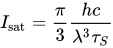
The minimum value of occurs on resonance, where the cross section is the largest. This minimum value is:

For a simple two-level atom with a natural linewidth , the saturation time constant .

General gain equation

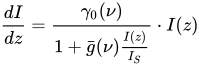
The general form of the gain equation, which applies regardless of the input intensity, derives from the general differential equation for the intensity I as a function of position z in the gain medium:

where is saturation intensity. To solve, we first rearrange the equation in order to separate the variables, intensity I and position z:

Integrating both sides, we obtain

or

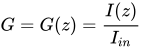
The gain G of the amplifier is defined as the optical intensity I at position z divided by the input intensity:

Substituting this definition into the prior equation, we find the general gain equation:

Small signal approximation

In the special case where the input signal is small compared to the saturation intensity, in other words,

then the general gain equation gives the small signal gain as

or

which is identical to the small signal gain equation (see above).

Large signal asymptotic behaviour

For large input signals, where

the gain approaches unity

and the general gain equation approaches a linear asymptote:

Fluorescence

From Wikipedia, the free encyclopedia https://en.wikipedia.org/wiki/Fluoresce...