In physics, the fundamental interactions or fundamental forces
are interactions in nature that appear not to be reducible to more
basic interactions. There are four fundamental interactions known to
exist: gravity, electromagnetism, weak interaction, and strong interaction. The gravitational and electromagnetic interactions produce long-range
forces whose effects can be seen directly in everyday life. The strong
and weak interactions produce forces at subatomic scales and govern nuclear interactions inside atoms. Some scientists hypothesize that a fifth force might exist, but these hypotheses remain speculative.
Within the Standard Model, the strong interaction is carried by a particle called the gluon and is responsible for quarks binding together to form hadrons, such as protons and neutrons. As a residual effect, it creates the nuclear force that binds the latter particles to form atomic nuclei. The weak interaction is carried by particles called W and Z bosons, and also acts on the nucleus of atoms, mediating radioactive decay. The electromagnetic force, carried by the photon, creates electric and magnetic fields, which are responsible for the attraction between the negatively chargedorbitalelectrons and the positively charged atomic nuclei which holds atoms together, as well as chemical bonding and electromagnetic waves, including visible light,
and forms the basis for electrical technology. The electromagnetic
force is far stronger than gravity, but unlike gravity, the
electromagnetic force has opposing negative and positive charges. Large objects
tend to have about the same number of negative charges as positive
charges making them effectively uncharged with no resulting
electromagnetic forces between them. Over (astronomical)
distances, gravity is the dominant force, responsible for holding
together the large scale structure in the universe, such as planets,
stars, and galaxies. The historical success of models that show
relationships between fundamental interactions have led to efforts to go
beyond the Standard Model (which does not describe gravity) and combine
all four forces into a theory of everything.
History
Classical theory
In his 1687 theory, Isaac Newton
postulated space as an infinite and unalterable physical structure
existing before, within, and around all objects while their states and
relations unfold at a constant pace everywhere, thus absolute space and time.
Inferring that all objects bearing mass approach at a constant rate,
but collide by impact proportional to their masses, Newton inferred that
matter exhibits an attractive force. His law of universal gravitation implied there to be instant interaction among all objects. As conventionally interpreted, Newton's theory of motion modelled a central force without a communicating medium. Thus Newton's theory violated the tradition, going back to Descartes, that there should be no action at a distance. Conversely, during the 1820s, when explaining magnetism, Michael Faraday inferred a field filling space and transmitting that force. Faraday conjectured that ultimately, all forces unified into one.
In 1873, James Clerk Maxwell
unified electricity and magnetism as effects of an electromagnetic
field whose third consequence was light, travelling at constant speed in
vacuum. If his electromagnetic field theory held true in all inertial frames of reference, this would contradict Newton's theory of motion, which relied on Galilean relativity. If, instead, his field theory only applied to reference frames at rest relative to a mechanical luminiferous aether—presumed
to fill all space whether within matter or in vacuum and to manifest
the electromagnetic field—then it could be reconciled with Galilean
relativity and Newton's laws. (However, such a "Maxwell aether" was
later disproven; Newton's laws did, in fact, have to be replaced.)
The Standard Model of particle physics was developed throughout the
latter half of the 20th century. In the Standard Model, the
electromagnetic, strong, and weak interactions associate with elementary particles, whose behaviours are modelled in quantum mechanics (QM). For predictive success with QM's probabilistic outcomes, particle physics conventionally models QM events across a field set to special relativity, altogether relativistic quantum field theory (QFT). Force particles, called gauge bosons—force carriers or messenger particles of underlying fields—interact with matter particles, called fermions.
Everyday matter is atoms, composed of three fermion types: up-quarks and down-quarks constituting, as well as electrons orbiting, the atom's nucleus. Atoms interact, form molecules,
and manifest further properties through electromagnetic interactions
among their electrons absorbing and emitting photons, the
electromagnetic field's force carrier, which if unimpeded traverse
potentially infinite distance. Electromagnetism's QFT is quantum electrodynamics (QED).
The force carriers of the weak interaction are the massive W and Z bosons. Electroweak theory (EWT) covers both electromagnetism and the weak interaction. At the high temperatures shortly after the Big Bang, the weak interaction, the electromagnetic interaction, and the Higgs boson
were originally mixed components of a different set of ancient
pre-symmetry-breaking fields. As the early universe cooled, these fields
split into the long-range electromagnetic interaction, the short-range weak interaction, and the Higgs boson. In the Higgs mechanism,
the Higgs field manifests Higgs bosons that interact with some quantum
particles in a way that endows those particles with mass. The strong
interaction, whose force carrier is the gluon, traversing minuscule distance among quarks, is modeled in quantum chromodynamics (QCD). EWT, QCD, and the Higgs mechanism comprise particle physics' Standard Model (SM). Predictions are usually made using calculational approximation methods, although such perturbation theory is inadequate to model some experimental observations (for instance bound states and solitons). Still, physicists widely accept the Standard Model as science's most experimentally confirmed theory.
Overview of the fundamental interactions
An
overview of the various families of elementary and composite particles,
and the theories describing their interactions. Fermions are on the
left, and bosons are on the right.
The interaction of any pair of fermions in perturbation theory can then be modelled thus:
Two fermions go in → interaction by boson exchange → two changed fermions go out.
The exchange of bosons always carries energy and momentum
between the fermions, thereby changing their speed and direction. The
exchange may also transport a charge between the fermions, changing the
charges of the fermions in the process (e.g., turn them from one type of
fermion to another). Since bosons carry one unit of angular momentum,
the fermion's spin direction will flip from +1⁄2 to −1⁄2 (or vice versa) during such an exchange (in units of the reduced Planck constant). Since such interactions result in a change in momentum, they can give rise to classical Newtonian forces.
In quantum mechanics, physicists often use the terms "force" and
"interaction" interchangeably; for example, the weak interaction is
sometimes referred to as the "weak force".
According to the present understanding, there are four fundamental interactions or forces: gravitation, electromagnetism, the weak interaction,
and the strong interaction. Their magnitude and behaviour vary greatly,
as described in the table below. Modern physics attempts to explain
every observed physical phenomenon by these fundamental interactions.
The fundamental interactions can be compared using dimensionless coupling constants that characterize the intensity or "strength" of the interactions.
The modern (perturbative) quantum mechanical view of the fundamental forces other than gravity is that particles of matter (fermions) do not directly interact with each other, but rather carry a charge, and exchange virtual particles (gauge bosons), which are the interaction carriers or force mediators. For example, photons mediate the interaction of electric charges, and gluons mediate the interaction of color charges.
The full theory includes perturbations beyond simply fermions
exchanging bosons; these additional perturbations can involve bosons
that exchange fermions, as well as the creation or destruction of
particles: see Feynman diagrams for examples.
Gravitation is the weakest of the four interactions at the atomic scale, where electromagnetic interactions dominate.
Gravitation is the most important of the four fundamental forces
for astronomical objects over astronomical distances for two reasons.
First, gravitation has an infinite effective range, like
electromagnetism but unlike the strong and weak interactions. Second,
gravity always attracts and never repels; in contrast, astronomical
bodies tend toward a near-neutral net electric charge, such that the
attraction to one type of charge and the repulsion from the opposite
charge mostly cancel each other out.
Even though electromagnetism is far stronger than gravitation,
electrostatic attraction is not relevant for large celestial bodies,
such as planets, stars, and galaxies, simply because such bodies contain
equal numbers of protons and electrons and so have a net electric
charge of zero. Nothing "cancels" gravity, since it is only attractive,
unlike electric forces which can be attractive or repulsive. On the
other hand, all objects having mass are subject to the gravitational
force, which only attracts. Therefore, only gravitation matters on the
large-scale structure of the universe.
The long range of gravitation makes it responsible for such large-scale phenomena as the structure of galaxies and black holes and, being only attractive, it slows down the expansion of the universe. Gravitation also explains astronomical phenomena on more modest scales, such as planetaryorbits,
as well as everyday experience: objects fall; heavy objects act as if
they were glued to the ground, and animals can only jump so high.
Gravitation was the first interaction to be described mathematically. In ancient times, Aristotle hypothesized that objects of different masses fall at different rates. During the Scientific Revolution, Galileo Galilei
experimentally determined that this hypothesis was wrong under certain
circumstances—neglecting the friction due to air resistance and buoyancy
forces if an atmosphere is present (e.g. the case of a dropped
air-filled balloon vs a water-filled balloon), all objects accelerate
toward the Earth at the same rate. Isaac Newton's law of Universal Gravitation
(1687) was a good approximation of the behaviour of gravitation.
Present-day understanding of gravitation stems from Einstein's General Theory of Relativity of 1915, a more accurate (especially for cosmological masses and distances) description of gravitation in terms of the geometry of spacetime.
Although general relativity has been experimentally confirmed (at
least for weak fields, i.e. not black holes) on all but the smallest
scales, there are alternatives to general relativity.
These theories must reduce to general relativity in some limit, and the
focus of observational work is to establish limits on what deviations
from general relativity are possible.
Proposed extra dimensions could explain why the gravity force is so weak.
Electromagnetism
and weak interaction appear to be very different at everyday low
energies. They can be modeled using two different theories. However,
above unification energy, on the order of 100 GeV, they would merge into a single electroweak force.
The electroweak theory is very important for modern cosmology, particularly on how the universe evolved. This is because shortly after the Big Bang, when the temperature was still above approximately 1015K, the electromagnetic force and the weak force were still merged as a combined electroweak force.
Electromagnetism is the force that acts between electrically charged particles. This phenomenon includes the electrostatic force acting between charged particles at rest, and the combined effect of electric and magnetic forces acting between charged particles moving relative to each other.
Electromagnetism has an infinite range, as gravity does, but is
vastly stronger. It is the force that binds electrons to atoms, and it holds molecules together. It is responsible for everyday phenomena like light, magnets, electricity, and friction. Electromagnetism fundamentally determines all macroscopic, and many atomic-level, properties of the chemical elements.
In a four kilogram (~1 gallon) jug of water, there is
of total electron charge. Thus, if we place two such jugs a meter
apart, the electrons in one of the jugs repel those in the other jug
with a force of
This force is many times larger than the weight of the planet Earth. The atomic nuclei
in one jug also repel those in the other with the same force. However,
these repulsive forces are canceled by the attraction of the electrons
in jug A with the nuclei in jug B and the attraction of the nuclei in
jug A with the electrons in jug B, resulting in no net force.
Electromagnetic forces are tremendously stronger than gravity, but tend
to cancel out so that for astronomical-scale bodies, gravity dominates.
Electrical and magnetic phenomena have been observed since ancient times, but it was only in the 19th century James Clerk Maxwell discovered that electricity and magnetism are two aspects of the same fundamental interaction. By 1864, Maxwell's equations had rigorously quantified this unified interaction. Maxwell's theory, restated using vector calculus, is the classical theory of electromagnetism, suitable for most technological purposes.
The constant speed of light in vacuum (customarily denoted with a lowercase letter c) can be derived from Maxwell's equations, which are consistent with the theory of special relativity. Albert Einstein's 1905 theory of special relativity, however, which follows from the observation that the speed of light
is constant no matter how fast the observer is moving, showed that the
theoretical result implied by Maxwell's equations has profound
implications far beyond electromagnetism on the very nature of time and
space.
In another work that departed from classical electro-magnetism, Einstein also explained the photoelectric effect
by utilizing Max Planck's discovery that light was transmitted in
'quanta' of specific energy content based on the frequency, which we now
call photons. Starting around 1927, Paul Dirac combined quantum mechanics with the relativistic theory of electromagnetism. Further work in the 1940s, by Richard Feynman, Freeman Dyson, Julian Schwinger, and Sin-Itiro Tomonaga, completed this theory, which is now called quantum electrodynamics,
the revised theory of electromagnetism. Quantum electrodynamics and
quantum mechanics provide a theoretical basis for electromagnetic
behavior such as quantum tunneling,
in which a certain percentage of electrically charged particles move in
ways that would be impossible under the classical electromagnetic
theory, that is necessary for everyday electronic devices such as transistors to function.
The weak interaction or weak nuclear force is responsible for some nuclear phenomena such as beta decay. Electromagnetism and the weak force are now understood to be two aspects of a unified electroweak interaction — this discovery was the first step toward the unified theory known as the Standard Model. In the theory of the electroweak interaction, the carriers of the weak force are the massive gauge bosons called the W and Z bosons. The weak interaction is the only known interaction that does not conserve parity; it is left–right asymmetric. The weak interaction even violates CP symmetry but does conserve CPT.
The strong interaction, or strong nuclear force, is the
most complicated interaction, mainly because of the way it varies with
distance. The nuclear force is powerfully attractive between nucleons at
distances of about 1 femtometre (fm, or 10−15 metres), but
it rapidly decreases to insignificance at distances beyond about 2.5 fm.
At distances less than 0.7 fm, the nuclear force becomes repulsive.
This repulsive component is responsible for the physical size of nuclei,
since the nucleons can come no closer than the force allows.
After the nucleus was discovered in 1908, it was clear that a new
force, today known as the nuclear force, was needed to overcome the electrostatic repulsion,
a manifestation of electromagnetism, of the positively charged protons.
Otherwise, the nucleus could not exist. Moreover, the force had to be
strong enough to squeeze the protons into a volume whose diameter is
about 10−15m, much smaller than that of the entire atom. From the short range of this force, Hideki Yukawa predicted that it was associated with a massive force particle, whose mass is approximately 100 MeV.
The 1947 discovery of the pion ushered in the modern era of particle physics. Hundreds of hadrons were discovered from the 1940s to 1960s, and an extremely complicated theory of hadrons as strongly interacting particles was developed. Most notably:
Geoffrey Chew, Edward K. Burdett and Steven Frautschi grouped the heavier hadrons into families that could be understood as vibrational and rotational excitations of strings.
While each of these approaches offered insights, no approach led directly to a fundamental theory.
Murray Gell-Mann along with George Zweig
first proposed fractionally charged quarks in 1961. Throughout the
1960s, different authors considered theories similar to the modern
fundamental theory of quantum chromodynamics (QCD) as simple models for the interactions of quarks. The first to hypothesize the gluons of QCD were Moo-Young Han and Yoichiro Nambu, who introduced the quark color
charge. Han and Nambu hypothesized that it might be associated with a
force-carrying field. At that time, however, it was difficult to see how
such a model could permanently confine quarks. Han and Nambu also
assigned each quark color an integer electrical charge, so that the
quarks were fractionally charged only on average, and they did not
expect the quarks in their model to be permanently confined.
In 1971, Murray Gell-Mann and Harald Fritzsch
proposed that the Han/Nambu color gauge field was the correct theory of
the short-distance interactions of fractionally charged quarks. A
little later, David Gross, Frank Wilczek, and David Politzer discovered that this theory had the property of asymptotic freedom, allowing them to make contact with experimental evidence.
They concluded that QCD was the complete theory of the strong
interactions, correct at all distance scales. The discovery of
asymptotic freedom led most physicists to accept QCD since it became
clear that even the long-distance properties of the strong interactions
could be consistent with experiment if the quarks are permanently confined: the strong force increases indefinitely with distance, trapping quarks inside the hadrons.
Assuming that quarks are confined, Mikhail Shifman, Arkady Vainshtein
and Valentine Zakharov were able to compute the properties of many
low-lying hadrons directly from QCD, with only a few extra parameters to
describe the vacuum. In 1980, Kenneth G. Wilson
published computer calculations based on the first principles of QCD,
establishing, to a level of confidence tantamount to certainty, that QCD
will confine quarks. Since then, QCD has been the established theory of
strong interactions.
QCD is a theory of fractionally charged quarks interacting by
means of 8 bosonic particles called gluons. The gluons also interact
with each other, not just with the quarks, and at long distances the
lines of force collimate into strings, loosely modeled by a linear
potential, a constant attractive force. In this way, the mathematical
theory of QCD not only explains how quarks interact over short distances
but also the string-like behavior, discovered by Chew and Frautschi,
which they manifest over longer distances.
Higgs interaction
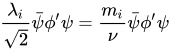
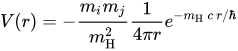
Conventionally, the Higgs interaction is not counted among the four fundamental forces.
with Higgs mass 125.18 GeV. Because the reduced Compton wavelength of the Higgs boson is so small (1.576×10⁻¹⁸ m, comparable to the W and Z bosons), this potential has an effective range of a few attometers. Between two electrons, it begins roughly 1011 times weaker than the weak interaction, and grows exponentially weaker at non-zero distances.
Unification
The fundamental forces may become unified into a single force at very high energies and on a minuscule scale, the Planck scale. Particle accelerators
cannot produce the enormous energies required to experimentally probe
this regime. The weak and electromagnetic forces have already been
unified with the electroweak theory of Sheldon Glashow, Abdus Salam, and Steven Weinberg, for which they received the 1979 Nobel Prize in physics. Numerous theoretical efforts have been made to systematize the existing
four fundamental interactions on the model of electroweak unification.
Grand Unified Theories
(GUTs) are proposals to show that each of the three fundamental
interactions described by the Standard Model is a different
manifestation of a single interaction with symmetries
that break down and create separate interactions below some extremely
high level of energy. GUTs are also expected to predict some of the
relationships between constants of nature that the Standard Model treats
as unrelated and gauge coupling unification for the relative strengths of the electromagnetic, weak, and strong forces. Some attempts at GUTs hypothesize "shadow" particles, such that every known matter particle associates with an undiscovered force particle, and vice versa, altogether supersymmetry
(SUSY). Other theorists seek to quantize the gravitational field by the
modelling behaviour of its hypothetical force carrier, the graviton and achieve quantum gravity (QG). One approach to QG is loop quantum gravity (LQG). Still other theorists seek both QG and GUT within one framework, reducing all four fundamental interactions to a Theory of Everything (ToE). The most prevalent aim at a ToE is string theory, although to model matter particles, it added SUSY to force particles—and so, strictly speaking, became superstring theory. Multiple, seemingly disparate superstring theories were unified on a backbone, M-theory. Theories beyond the Standard Model remain highly speculative, lacking great experimental support.
A so-called theory of everything, which would integrate GUTs with a quantum gravity theory, faces a greater barrier because no quantum gravity theory (e.g., string theory, loop quantum gravity, and twistor theory)
has secured wide acceptance. Some theories look for a graviton to
complete the Standard Model list of force-carrying particles, while
others, like loop quantum gravity, emphasize the possibility that
time-space itself may have a quantum aspect to it.
Some theories beyond the Standard Model include a hypothetical fifth force, and the search for such a force is an ongoing line of experimental physics research. In supersymmetric theories, some particles, known as moduli,
acquire their masses only through supersymmetry breaking effects and
can mediate new forces. Another reason to look for new forces is the
discovery that the expansion of the universe is accelerating (also known as dark energy), creating a need to explain a nonzero cosmological constant and possibly other modifications of general relativity. Fifth forces have also been suggested to explain phenomena such as CP violations, dark matter, and dark flow.
Machine ethics (or machine morality) is the field of research concerned with designing Artificial Moral Agents (AMAs), robots or artificially intelligent computers that behave morally or as though moral. To account for the nature of these agents, it has been suggested to
consider certain philosophical ideas, like the standard
characterizations of agency, rational agency, moral agency, and artificial agency, which are related to the concept of AMAs.
There are discussions on creating tests to see if an AI is capable of making ethical decisions. Alan Winfield concludes that the Turing test is flawed and the requirement for an AI to pass the test is too low. A proposed alternative test is one called the Ethical Turing Test,
which would improve on the current test by having multiple judges decide
if the AI's decision is ethical or unethical. Neuromorphic
AI could be one way to create morally capable robots, as it aims to
process information similarly to humans, nonlinearly and with millions
of interconnected artificial neurons. Similarly, whole-brain emulation
(scanning a brain and simulating it on digital hardware) could also in
principle lead to human-like robots, thus capable of moral actions. And large language models are capable of approximating human moral judgments. Inevitably, this raises the question of the environment in which such
robots would learn about the world and whose morality they would inherit
– or if they end up developing human 'weaknesses' as well: selfishness,
pro-survival attitudes, inconsistency, scale insensitivity, etc.
In Moral Machines: Teaching Robots Right from Wrong, Wendell Wallach
and Colin Allen conclude that attempts to teach robots right from wrong
will likely advance understanding of human ethics by motivating humans
to address gaps in modern normative theory
and by providing a platform for experimental investigation. As one
example, it has introduced normative ethicists to the controversial
issue of which specific learning algorithms to use in machines. For simple decisions, Nick Bostrom and Eliezer Yudkowsky have argued that decision trees (such as ID3) are more transparent than neural networks and genetic algorithms, while Chris Santos-Lang argued in favor of machine learning
on the grounds that the norms of any age must be allowed to change and
that natural failure to fully satisfy these particular norms has been
essential in making humans less vulnerable to criminal "hackers".
Some researchers frame machine ethics as part of the broader AI
control or value alignment problem: the difficulty of ensuring that
increasingly capable systems pursue objectives that remain compatible
with human values and oversight. Stuart Russell
has argued that beneficial systems should be designed to (1) aim at
realizing human preferences, (2) remain uncertain about what those
preferences are, and (3) learn about them from human behaviour and
feedback, rather than optimizing a fixed, fully specified goal. Some authors argue that apparent compliance with human values may
reflect optimization for evaluation contexts rather than stable internal
norms, complicating the assessment of alignment in advanced language
models.
AI has become increasingly inherent in facial and voice recognition
systems. These systems may be vulnerable to biases and errors
introduced by their human creators. Notably, the data used to train them
can have biases.
According to Allison Powell, associate professor at LSE
and director of the Data and Society programme, data collection is
never neutral and always involves storytelling. She argues that the
dominant narrative is that governing with technology is inherently
better, faster and cheaper, but proposes instead to make data expensive,
and to use it both minimally and valuably, with the cost of its
creation factored in. Friedman and Nissenbaum identify three categories of bias in computer
systems: existing bias, technical bias, and emergent bias. In natural language processing, problems can arise from the text corpus—the source material the algorithm uses to learn about the relationships between different words.
Large companies such as IBM, Google, etc. that provide significant funding for research and development have made efforts to research and address these biases. One potential solution is to create documentation for the data used to train AI systems. Process mining
can be an important tool for organizations to achieve compliance with
proposed AI regulations by identifying errors, monitoring processes,
identifying potential root causes for improper execution, and other
functions. However, there are also limitations to the current landscape of fairness in AI, due to the intrinsic ambiguities in the concept of discrimination, both at the philosophical and legal level.
Racial and gender biases
Bias can be introduced through historical data used to train AI systems. `For instance, Amazon terminated their use of AI hiring and recruitment because the algorithm favored male candidates over female ones. This was because Amazon's system was trained with data collected over a
10-year period that included mostly male candidates. The algorithms
learned the biased pattern from the historical data, and generated
predictions where these types of candidates were most likely to succeed
in getting the job. Therefore, the recruitment decisions made by the AI
system turned out to be biased against female and minority candidates.
The performance of facial recognition
and computer vision models may vary based on race and gender. Facial
recognition algorithms made by Microsoft, IBM and Face++ all performed
significantly worse on darker-skinned women. Facial recognition was shown to be biased against those with darker
skin tones. AI systems may be less accurate for black people, as was the
case in the development of an AI-based pulse oximeter that overestimated blood oxygen levels in patients with darker skin, causing issues with their hypoxia treatment. In 2015, controversy erupted after a Black couple were labeled "Gorillas" by Google Photos. Oftentimes the systems are able to easily detect the faces of white
people while being unable to register the faces of people who are black.
This has led to the ban of police usage of AI materials or software in
some U.S. states.
The reason for these biases is that AI pulls information from across
the internet to influence its responses in each situation. For example,
if a facial recognition system was only tested on people who were white,
it would make it much harder for it to interpret the facial structure
and tones of other races and ethnicities. Biases often stem from the training data rather than the algorithm itself, notably when the data represents past human decisions.
A 2020 study that reviewed voice recognition systems from Amazon,
Apple, Google, IBM, and Microsoft found that they have higher error
rates when transcribing black people's voices than white people's.
Injustice
in the use of AI is much harder to eliminate within healthcare systems,
as oftentimes diseases and conditions can affect different races and
genders differently. This can lead to confusion as the AI may be making
decisions based on statistics showing that one patient is more likely to
have problems due to their gender or race. This can be perceived as a bias because each patient is a different
case, and AI is making decisions based on what it is programmed to group
that individual into. This leads to a discussion about what should be
considered a biased decision in the distribution of treatment. While it
is known that there are differences in how diseases and injuries affect
different genders and races, there is a discussion on whether it is
fairer to incorporate this into healthcare treatments, or to examine
each patient without this knowledge. In modern society there are certain
tests for diseases, such as breast cancer,
that are recommended to certain groups of people over others because
they are more likely to contract the disease in question. If AI
implements these statistics and applies them to each patient, it could
be considered biased.
In the justice system, AI can have biases against black people,
labeling black court participants as high-risk at a much larger rate
than white participants. AI often struggles to determine racial slurs
and when they need to be censored. It struggles to determine when
certain words are being used as a slur and when it is being used
culturally. The COMPAS
program has been used to predict which defendants are more likely to
reoffend. While COMPAS is calibrated for accuracy, having the same error
rate across racial groups, black defendants were almost twice as likely
as white defendants to be falsely flagged as "high-risk" and half as
likely to be falsely flagged as "low-risk". Another example is within Google's ads that targeted men with
higher-paying jobs and women with lower-paying jobs. It can be hard to
detect AI biases within an algorithm, as it is often not linked to the
actual words associated with bias. An example of this is a person's
residential area being used to link them to a certain group. This can
lead to problems, as oftentimes businesses can avoid legal action
through this loophole. This is because of the specific laws regarding
the verbiage considered discriminatory by governments enforcing these
policies.
Large language models often reinforce gender stereotypes,
assigning roles and characteristics based on traditional gender norms.
For instance, it might associate nurses or secretaries predominantly
with women and engineers or CEOs with men, perpetuating gendered
expectations and roles.Additionally, facial recognition, computer vision, or automatic gender recognition models can reinforce bias against both cisgenderand transgender people through misclassification of gender that is misaligned with the person's identity.
Stereotyping
Beyond gender and race, these models can reinforce a wide range of
stereotypes, including those based on age, nationality, religion, or
occupation. This can lead to outputs that unfairly generalize or
caricature groups of people, sometimes in harmful or derogatory ways. For instance, scholars highlighted how AI systems can reproduce and
amplify global inequalities, particularly when data and model
development are concentrated in Western countries, raising concerns
about fairness and representation in AI systems.
Such stereotypes stem directly from the design of AI systems and
programmatic models from which they are trained. Stereotypes that target
specific demographics originate from societal biases embedded during
the programming process, outdated datasets, and algorithmic
architectures that prioritize high-ranking and majority groups rather
than underrepresented ones. Research also amplifies user feedback as a primary contributor to
stereotypes within AI, as human interactions introduce bias.
Additionally, the AI industry is a male-dominant field, primarily young
adult males, creating a lack of diversity that cultivates inequalities
in AI databases. Word embeddings reveal that the use of "person/people"
within AI algorithms displays gender inequality, as it prioritizes men
over women rather than neutrality.
Language bias
AI is primarily trained on English. Celeste Rodriguez Louro has argued that mainstream American English is the primary variety of English used to train generative AI systems, resulting in a linguistic bias toward homogeneity and the exclusion of other varieties of English. Since current large language models are predominantly trained on
English-language data, they often present Western views as truth, while
systematically downplaying non-English perspectives. As of 2024, most AI systems are trained on only 100 of the 7,000 world languages.
Political bias
Language models may also exhibit political biases. Since the training
data includes a wide range of political opinions and coverage, the
models might generate responses that lean towards particular political
ideologies or viewpoints, depending on the prevalence of those views in
the data.This skewing of the data is known as algorithmic bias, or when an AI
has a predisposition to certain answers based on the data that the AI
was trained on. This can create an AI system that is not giving objective answers, but
rather skewed answers that lean towards differing ends of the political
spectrum. It is said that ChatGPT is a more liberal skewed AI model. It has been found that users are more likely to agree with answers that
coincide with their existing political beliefs. Some AI systems try to
gauge the political affiliation of the user so that the generated
answers can be politically skewed to align with the user, leading to a never-ending confirmation bias loop. It is more difficult
for users to perceive a political bias if they already align with the
answer, allowing these AI companies and programmers to ultimately get away with their politically biased AI models.
Dominance by tech giants
The commercial AI scene is dominated by Big Tech companies, including Alphabet Inc., Amazon, Apple Inc., Meta Platforms, Microsoft, and SpaceX. Some of these players already own the vast majority of existing cloud infrastructure and computing power from data centers, allowing them to entrench further in the marketplace. Their current dominance within the market of technology makes it very
hard for newer companies to compete and be successful in the long-run
within the industry. It has been suggested by competition law scholars that the tech giants
of the world may be using their power within the market to foreclose the
market from potential competitors and, in turn, charge higher prices to
consumers. In light of some of these concerns, governments around the world have
been considering and implementing laws that would prevent large
companies from continuing or executing these practices. These tech giants have the money that it takes to build the
infrastructure needed nowadays. The five biggest are projected to spend
$602 billion in 2026 on capital expenditures alone, which would be a 32%
increase from the year prior. In this spending, it is estimated that 75% will go towards AI-specific infrastructure. With the significant growth that has been seen in the tech industry
with AI, it is important to keep the industry competitive and fair.
The largest generative AI models require significant computing
resources to train and use. These computing resources are often
concentrated in massive data centers. The resulting environmental
impacts include greenhouse gas emissions, water consumption, and electronic waste. Despite improved energy efficiency, the energy needs are expected to increase, as AI gets more broadly used.
Electricity consumption and carbon footprint
These resources are often concentrated in massive data centers, which
require demanding amounts of energy, resulting in increased greenhouse
gas emissions. A 2023 study suggests that the amount of energy required to train large
AI models was equivalent to 626,000 pounds of carbon dioxide or the
same as 300 round-trip flights between New York and San Francisco.
Water consumption
In addition to carbon emissions, these data centers also need water for cooling AI chips. Locally, this can lead to water scarcity and the disruption of ecosystems. Around two liters of water are needed per each kilowatt hour of energy used in a data center. While data centers use water for cooling AI chips, there are also many
indirect uses that negatively impact the environment. Over 80% of total
water consumption comes from electricity generation that is used to fuel
these large-scale data centers. In addition to this, around 2/3 of data centers built are placed in water-scarce regions. Because of this, AI development can compete with local communities and
agriculture for water usage. A lot of companies do not fully disclose
the severity of their impact on water consumption, which raises ethical
concerns on whether these companies are truly for the people or if they
are looking for maximum profit. A solution these data centers have
implemented is to use zero-water air-cooling systems, but this results
in higher carbon emissions and increased electricity usage. Companies
have to decide to prioritize the local concern of water usage or the
global concern of carbon emissions. With only a single AI query, 16.9mL
of water is used, but only 2.2mL goes towards the cooling of the
systems. This is less than 15% of the total water used in the interaction, which exemplifies the severity of indirect water usage.
Electronic waste
Another problem is the resulting electronic waste (or e-waste). This can include hazardous materials and chemicals, such as lead and mercury,
resulting in the contamination of soil and water. In order to prevent
the environmental effects of AI-related e-waste, better disposal
practices and stricter laws may be put in place.
Prospective
The rising popularity of AI increases the need for data centers and intensifies these problems. There is also a lack of transparency from AI companies about the
environmental impacts. Some applications can also indirectly affect the
environment. For example, AI advertising can increase consumption of fast fashion, an industry that already produces significant emissions.
However, AI can also be used in a positive way by helping to
mitigate the environmental damages. Different AI technologies can help
monitor emissions and develop algorithms to help companies lower their
emissions.
Open source
Bill Hibbard
argues that because AI will have such a profound effect on humanity, AI
developers are representatives of future humanity and thus have an
ethical obligation to be transparent in their efforts. Organizations like Hugging Face and EleutherAI have been actively open-sourcing AI software. Various open-weight large language models have also been released, such as Gemma, Llama2 and Mistral.
However, making code open source does not make it comprehensible, which by many definitions means that the AI code is not transparent. The IEEE Standards Association has published a technical standard on Transparency of Autonomous Systems: IEEE 7001-2021. The IEEE effort identifies multiple scales of transparency for different stakeholders.
There are also concerns that releasing AI models may lead to misuse. For example, Microsoft has expressed concern about allowing universal
access to its face recognition software, even for those who can pay for
it. Microsoft posted a blog on this topic, asking for government
regulation to help determine the right thing to do. Furthermore, open-weight AI models can be fine-tuned
to remove any countermeasure, until the AI model complies with
dangerous requests, without any filtering. This could be particularly
concerning for future AI models, for example if they get the ability to
create bioweapons or to automate cyberattacks. OpenAI, initially committed to an open-source approach to the development of artificial general intelligence (AGI), eventually switched to a closed-source approach, citing competitiveness and safety reasons. Ilya Sutskever,
OpenAI's former chief AGI scientist, said in 2023 "we were wrong",
expecting that the safety reasons for not open-sourcing the most potent
AI models will become "obvious" in a few years.
Strain on open knowledge platforms
In April 2023, Wired reported that Stack Overflow,
a popular programming help forum with over 50 million questions and
answers, planned to begin charging large AI developers for access to its
content. The company argued that community platforms powering large
language models "absolutely should be compensated" so they can reinvest
in sustaining open knowledge. Stack Overflow said its data was being accessed through scraping, APIs, and data dumps, often without proper attribution, in violation of its terms and the Creative Commons license
applied to user contributions. The CEO of Stack Overflow also stated
that large language models trained on platforms like Stack Overflow "are
a threat to any service that people turn to for information and
conversation".
Aggressive AI crawlers have increasingly overloaded open-source infrastructure, "causing what amounts to persistent distributed denial-of-service (DDoS) attacks on vital public resources", according to a March 2025 Ars Technica article. Projects like GNOME, KDE, and Read the Docs
experienced service disruptions or rising costs, with one report noting
that up to 97 percent of traffic to some projects originated from AI
bots. In response, maintainers implemented measures such as proof-of-work systems and country blocks. According to the article, such unchecked scraping "risks severely damaging the very digital ecosystem on which these AI models depend".
In April 2025, the Wikimedia Foundation
reported that automated scraping by AI bots was placing strain on its
infrastructure. Since early 2024, bandwidth usage had increased by 50
percent due to large-scale downloading of multimedia content by bots
collecting training data for AI models. These bots often accessed
obscure and less-frequently cached pages, bypassing caching systems and
imposing high costs on core data centers. According to Wikimedia, bots
made up 35 percent of total page views but accounted for 65 percent of
the most expensive requests. The Foundation noted that "our content is
free, our infrastructure is not" and warned that "this creates a
technical imbalance that threatens the sustainability of community-run
platforms".
Transparency
Approaches like machine learning with neural networks
can result in computers making decisions that neither they nor their
developers can explain. It is difficult for people to determine if such
decisions are fair and trustworthy, leading potentially to bias in AI
systems going undetected, or people rejecting the use of such systems. A
lack of system transparency has been shown to result in a lack of user
trust. Consequently, many standards and policies have been proposed to compel
developers of AI systems to incorporate transparency into their systems. This push for transparency has led to advocacy and in some jurisdictions legal requirements for explainable artificial intelligence. Explainable artificial intelligence encompasses both explainability and
interpretability, with explainability relating to providing reasons for
the model's outputs, and interpretability focusing on understanding the
inner workings of an AI model.
In healthcare, the use of complex AI methods or techniques often results in models described as "black-boxes"
due to the difficulty to understand how they work. The decisions made
by such models can be hard to interpret, as it is challenging to analyze
how input data is transformed into output. This lack of transparency is
a significant concern in fields like healthcare, where understanding
the rationale behind decisions can be crucial for trust, ethical
considerations, and compliance with regulatory standards. Trust in healthcare AI has been shown to vary depending on the level of transparency provided. Moreover, unexplainable outputs of AI systems make it much more difficult to identify and detect medical error.
Accountability
A special case of the opaqueness of AI is that caused by it being anthropomorphised, that is, assumed to have human-like characteristics, resulting in misplaced conceptions of its moral agency.[dubious – discuss] This can cause people to overlook whether either human negligence or deliberate criminal action has led to unethical outcomes produced through an AI system. Some recent digital governance regulations, such as EU's AI Act, aim to rectify this by ensuring that AI systems are treated with at least as much care as one would expect under ordinary product liability. This includes potentially AI audits.
According to a 2019 report from the Center for the Governance of AI
at the University of Oxford, 82% of Americans believe that robots and AI
should be carefully managed. Concerns cited ranged from how AI is used
in surveillance and in spreading fake content online (known as deep
fakes when they include doctored video images and audio generated with
help from AI) to cyberattacks, infringements on data privacy, hiring
bias, autonomous vehicles, and drones that do not require a human
controller. Similarly, according to a five-country study by KPMG and the University of Queensland
Australia in 2021, 66–79% of citizens in each country believe that the
impact of AI on society is uncertain and unpredictable; 96% of those
surveyed expect AI governance challenges to be managed carefully.
Not only companies, but many other researchers and citizen
advocates recommend government regulation as a means of ensuring
transparency, and through it, human accountability. This strategy has
proven controversial, as some worry that it will slow the rate of
innovation. Others argue that regulation leads to systemic stability
more able to support innovation in the long term. The OECD, UN, EU, and many countries are presently working on strategies for regulating AI, and finding appropriate legal frameworks.
On June 26, 2019, the European Commission High-Level Expert Group
on Artificial Intelligence (AI HLEG) published its "Policy and
investment recommendations for trustworthy Artificial Intelligence". This is the AI HLEG's second deliverable, after the April 2019
publication of the "Ethics Guidelines for Trustworthy AI". The June AI
HLEG recommendations cover four principal subjects: humans and society
at large, research and academia, the private sector, and the public
sector. The European Commission claims that "HLEG's recommendations reflect an
appreciation of both the opportunities for AI technologies to drive
economic growth, prosperity and innovation, as well as the potential
risks involved" and states that the EU aims to lead on the framing of
policies governing AI internationally. To prevent harm, in addition to regulation, AI-deploying organizations
need to play a central role in creating and deploying trustworthy AI in
line with the principles of trustworthy AI, and take accountability to
mitigate the risks.
In June 2024, the EU adopted the Artificial Intelligence Act (AI Act). On August 1st 2024, The AI Act entered into force. The rules gradually apply, with the act becoming fully applicable 24 months after entry into force. The AI Act sets rules on providers and users of AI systems. It follows a risk-based approach, where depending on the risk level, AI
systems are prohibited or specific requirements need to be met for
placing those AI systems on the market and for using them.
Deepfakes are digital media generated or altered with AI to impersonate someone. The term "deepfake" is a portmanteau of "deep learning" and "fake". It emerged on Reddit
in 2017, after users began sharing non-consensually-generated
pornographic deepfake videos. By the early 2020s, as generative AI
became widely available, deepfake became a household term. Deepfake
victims are frequently public figures engaging in controversial actions. For example, in 2024, pornographic deepfakes of Taylor Swift went viral on the social network X. Deepfake audio and video have been used for scams, notably by
impersonating company executives or close relatives and asking for bank
transfers.
Increasing use
AI has been slowly making its presence more known throughout the
world, from chatbots that seemingly have answers for every homework
question to generative AI that can create a painting about whatever one
desires. AI has become increasingly popular in hiring markets, from the ads that
target certain people according to what they are looking for to the
inspection of applications of potential hires. Events such as COVID-19
have sped up the adoption of AI programs in the application process,
due to more people having to apply electronically, and with this
increase in online applicants the use of AI made the process of
narrowing down potential employees easier and more efficient. AI has
become more prominent as businesses have to keep up with the times and
ever-expanding internet. Processing analytics and making decisions
becomes much easier with the help of AI. As Tensor Processing Units (TPUs) and graphics processing units
(GPUs) become more powerful, AI capabilities also increase, forcing
companies to use it to keep up with the competition. Managing customers'
needs and automating many parts of the workplace leads to companies
having to spend less money on employees.
AI has also seen increased usage in criminal justice and
healthcare. For medicinal means, AI is being used more often to analyze
patient data to make predictions about future patients' conditions and
possible treatments. These programs are called clinical decision support systems
(DSS). AI's future in healthcare may develop into something further
than just recommended treatments, such as referring certain patients
over others, leading to the possibility of inequalities.
In 2020, professor Shimon Edelman noted that only a small portion of
work in the rapidly growing field of AI ethics addressed the possibility
of AIs experiencing suffering. This was despite credible theories
having outlined possible ways by which AI systems may become conscious,
such as the global workspace theory or the integrated information theory. Edelman notes one exception had been Thomas Metzinger,
who in 2018 called for a global moratorium on further work that risked
creating conscious AIs. The moratorium was to run to 2050 and could be
either extended or repealed early, depending on progress in better
understanding the risks and how to mitigate them. Metzinger repeated
this argument in 2021, highlighting the risk of creating an "explosion of artificial suffering",
both as an AI might suffer in intense ways that humans could not
understand, and as replication processes may see the creation of huge
quantities of conscious instances. Podcast host Dwarkesh Patel said he cared about making sure no "digital equivalent of factory farming" happens. In the ethics of uncertain sentience, the precautionary principle is often invoked.
Several labs have openly stated they are trying to create
conscious AIs. There have been reports from those with close access to
AIs not openly intended to be self aware, that consciousness may already
have unintentionally emerged. These include OpenAI founder Ilya Sutskever in February 2022, when he wrote that today's large neural nets may be "slightly conscious". In November 2022, David Chalmers argued that it was unlikely current large language models like GPT-3
had experienced consciousness, but also that he considered there to be a
serious possibility that large language models may become conscious in
the future. Anthropic hired its first AI welfare researcher in 2024, and in 2025 started a "model welfare" research program that explores
topics such as how to assess whether a model deserves moral
consideration, potential "signs of distress", and "low-cost"
interventions.
According to Carl Shulman and Nick Bostrom,
it may be possible to create machines that would be "superhumanly
efficient at deriving well-being from resources", called
"super-beneficiaries". One reason for this is that digital hardware
could enable much faster information processing than biological brains,
leading to a faster rate of subjective experience. These machines could also be engineered to feel intense and positive subjective experience, unaffected by the hedonic treadmill.
Shulman and Bostrom caution that failing to appropriately consider the
moral claims of digital minds could lead to a moral catastrophe, while
uncritically prioritizing them over human interests could be detrimental
to humanity.
Joseph Weizenbaum argued in 1976 that AI technology should not be used to replace people in positions that require respect and care, such as:
A customer service representative (AI technology is already used today for telephone-based interactive voice response systems)
A nursemaid for the elderly (as was reported by Pamela McCorduck in her book The Fifth Generation)
A soldier
A judge
A police officer
A therapist (as was proposed by Kenneth Colby in the 1970s)
Weizenbaum says that humans require authentic feelings of empathy
from people in these positions. If machines replace humans, we will
find ourselves alienated, devalued and frustrated, for the AI system
would not be able to simulate empathy. Artificial intelligence, if used
in this way, represents a threat to human dignity. Weizenbaum argues
that the fact that we are entertaining the possibility of machines in
these positions suggests that we have experienced an "atrophy of the
human spirit that comes from thinking of ourselves as computers."
Pamela McCorduck
counters that, speaking for women and minorities "I'd rather take my
chances with an impartial computer", arguing that there are conditions
where it would preferable to have automated judges and police that have
no personal agenda at all. However, Kaplan
and Haenlein stressed in 2019 that such AI systems are only as smart as
the data used to train them since they are, in their essence, nothing
more than fancy curve-fitting machines; using AI to support a court
ruling can be highly problematic if past rulings show bias toward
certain groups since those biases get formalized and ingrained, which
makes them even more difficult to spot and fight against.
Weizenbaum was also bothered that AI researchers (and some
philosophers) were willing to view the human mind as nothing more than a
computer program (a position now known as computationalism). To Weizenbaum, these points suggest that AI research devalues human life.
AI founder John McCarthy
objects to the moralizing tone of Weizenbaum's critique. "When
moralizing is both vehement and vague, it invites authoritarian abuse",
he writes. Bill Hibbard writes that "Human dignity requires that we strive to remove our
ignorance of the nature of existence, and AI is necessary for that
striving."
As the widespread use of autonomous cars becomes increasingly imminent, new challenges raised by fully autonomous vehicles must be addressed. There have been debates about the legal liability of the responsible party if these cars get into accidents. In one report where a driverless car hit a pedestrian, the driver was
inside the car but the controls were fully in the hand of computers.
This led to a dilemma over who was at fault for the accident.
In another incident on March 18, 2018, Elaine Herzberg was struck and killed by a self-driving Uber
in Arizona. In this case, the automated car was capable of detecting
cars and certain obstacles in order to autonomously navigate the
roadway, but it could not anticipate a pedestrian in the middle of the
road. This raised the question of whether the driver, pedestrian, the
car company, or the government should be held responsible for her death.
Currently, self-driving cars are considered semi-autonomous,
requiring the driver to pay attention and be prepared to take control if
necessary. Thus, it falls on governments to regulate drivers who over-rely on
autonomous features and to inform them that these are just technologies
that, while convenient, are not a complete substitute. Before autonomous
cars become widely used, these issues need to be tackled through new
policies.
Experts contend that autonomous vehicles ought to be able to
distinguish between rightful and harmful decisions since they have the
potential of inflicting harm. The two main approaches proposed to enable smart machines to render
moral decisions are the bottom-up approach, which suggests that machines
should learn ethical decisions by observing human behavior without the
need for formal rules or moral philosophies, and the top-down approach,
which involves programming specific ethical principles into the
machine's guidance system. However, there are significant challenges
facing both strategies: the top-down technique is criticized for its
difficulty in preserving certain moral convictions, while the bottom-up
strategy is questioned for potentially unethical learning from human
activities.
Some experts and academics have questioned the use of robots for
military combat, especially when such robots are given some degree of
autonomous functions. The US Navy has funded a report which indicates that as military robots
become more complex, there should be greater attention to implications
of their ability to make autonomous decisions. The President of the Association for the Advancement of Artificial Intelligence has commissioned a study to look at this issue. They point to programs like the Language Acquisition Device which can emulate human interaction.
On October 31, 2019, the United States Department of Defense's
Defense Innovation Board published the draft of a report recommending
principles for the ethical use of AI by the Department of Defense that
would ensure a human operator would always be able to look into the 'black box' and understand the kill-chain process. However, a major concern is how the report will be implemented. The US Navy has funded a report which indicates that as military robots become more complex, there should be greater attention to implications of their ability to make autonomous decisions. Some researchers state that autonomous robots might be more humane, as they could make decisions more effectively. In 2024, the Defense Advanced Research Projects Agency funded a program, Autonomy Standards and Ideals with Military Operational Values (ASIMOV), to develop metrics for evaluating the ethical implications of autonomous weapon systems by testing communities.
Research has studied how to make autonomous systems with the
ability to learn using assigned moral responsibilities. "The results may
be used when designing future military robots, to control unwanted
tendencies to assign responsibility to the robots." From a consequentialist
view, there is a chance that robots will develop the ability to make
their own logical decisions on whom to kill and that is why there should
be a set moral framework that the AI cannot override.
There has been a recent outcry with regard to the engineering of artificial intelligence weapons that have included ideas of a robot takeover of mankind.
AI weapons do present a type of danger different from that of
human-controlled weapons. Many governments have begun to fund programs
to develop AI weaponry. The United States Navy recently announced plans
to develop autonomous drone weapons, paralleling similar announcements by Russia and South Korea respectively. Due to the potential of AI weapons becoming more dangerous than human-operated weapons, Stephen Hawking and Max Tegmark signed a "Future of Life" petition to ban AI weapons. The message posted by Hawking and Tegmark states
that AI weapons pose an immediate danger and that action is required to
avoid catastrophic disasters in the near future.
"If any major military power pushes ahead with the AI weapon development, a global arms race is virtually inevitable, and the endpoint of this technological trajectory is obvious: autonomous weapons will become the Kalashnikovs of tomorrow", says the petition, which includes Skype co-founder Jaan Tallinn and MIT professor of linguistics Noam Chomsky as additional supporters against AI weaponry.
Physicist and Astronomer Royal Sir Martin Rees has warned of catastrophic instances like "dumb robots going rogue or a network that develops a mind of its own." Huw Price,
a colleague of Rees at Cambridge, has voiced a similar warning that
humans might not survive when intelligence "escapes the constraints of
biology". These two professors created the Centre for the Study of Existential Risk at Cambridge University in the hope of avoiding this threat to human existence.
Regarding the potential for smarter-than-human systems to be employed militarily, the Open Philanthropy Project
writes that these scenarios "seem potentially as important as the risks
related to loss of control", but research investigating AI's long-run
social impact have spent relatively little time on this concern: "this
class of scenarios has not been a major focus for the organizations that
have been most active in this space, such as the Machine Intelligence Research Institute (MIRI) and the Future of Humanity Institute (FHI), and there seems to have been less analysis and debate regarding them".
Academic Gao Qiqi writes that military use of AI risks escalating
military competition between countries and that the impact of AI in
military matters will not be limited to one country but will have
spillover effects. Gao cites the example of U.S. military use of AI, which he contends has
been used as a scapegoat to evade accountability for decision-making.
Under the framework of the Convention on Certain Conventional Weapons,
states have discussed lethal autonomous weapon systems since 2014. In
2016, the treaty's states parties established an open-ended Group of Governmental Experts on Lethal Autonomous Weapons Systems to continue those discussions. The discussions have addressed international humanitarian law,
accountability, possible prohibitions and regulations, and the extent of
human control required over AI-enabled weapons.
A summit was held in 2023 in the Hague on the issue of using AI responsibly in the military domain.
Vernor Vinge,
among numerous others, has suggested that a moment may come when some
or all computers will be smarter than humans. The onset of this event is
commonly referred to as "the Singularity" and is the central point of discussion in the philosophy of Singularitarianism.
While opinions vary as to the ultimate fate of humanity in wake of the
Singularity, efforts to mitigate the potential existential risks brought
about by AI has become a significant topic of interest in recent years
among computer scientists, philosophers, and the public at large.
Many researchers have argued that, through an intelligence explosion, a self-improving AI could become so powerful that humans would not be able to stop it from achieving its goals. In his paper "Ethical Issues in Advanced Artificial Intelligence" and subsequent book Superintelligence: Paths, Dangers, Strategies, philosopher Nick Bostrom argues that AI has the capability to bring about human extinction. He claims that an artificial superintelligence
would be capable of independent initiative and of making its own plans,
and may therefore be more appropriately thought of as an autonomous
agent. Since artificial intellects need not share our human motivational
tendencies, it would be up to the designers of the superintelligence to
specify its original motivations. Because a superintelligent AI would
be able to bring about almost any possible outcome and to thwart any
attempt to prevent the implementation of its goals, many uncontrolled unintended consequences
could arise. It could kill off all other agents, persuade them to
change their behavior, or block their attempts at interference.
However, Bostrom contended that superintelligence also has the
potential to solve many difficult problems such as disease, poverty, and
environmental destruction, and could help humans enhance themselves.
Unless moral philosophy provides us with a flawless ethical
theory, an AI's utility function could allow for many potentially
harmful scenarios that conform with a given ethical framework but not
"common sense". According to Eliezer Yudkowsky, there is little reason to suppose that an artificially designed mind would have such an adaptation. AI researchers such as Stuart J. Russell, Bill Hibbard, Roman Yampolskiy, Shannon Vallor, Steven Umbrello and Luciano Floridi have proposed design strategies for developing beneficial machines.
Solutions and approaches
To address ethical challenges in artificial intelligence, developers
have introduced various systems designed to ensure responsible AI
behavior. Examples include Nvidia's Llama Guard, which focuses on improving the safety and alignment of large AI models, and Preamble's customizable guardrail platform. These systems aim to address issues such as algorithmic bias, misuse, and vulnerabilities, including prompt injection attacks, by embedding ethical guidelines into the functionality of AI models.
Prompt injection, a technique by which malicious inputs can cause
AI systems to produce unintended or harmful outputs, has been a focus
of these developments. Some approaches use customizable policies and
rules to analyze inputs and outputs, ensuring that potentially
problematic interactions are filtered or mitigated. Other tools focus on applying structured constraints to inputs, restricting outputs to predefined parameters, or leveraging real-time monitoring mechanisms to identify and address vulnerabilities. These efforts reflect a broader trend in ensuring that artificial
intelligence systems are designed with safety and ethical considerations
at the forefront, particularly as their use becomes increasingly
widespread in critical applications.
Institutions in AI policy and ethics
There are many organizations concerned with AI ethics and policy, public and governmental as well as corporate and societal.
Amazon, Google, Facebook, IBM, and Microsoft have established a non-profit,
The Partnership on AI to Benefit People and Society, to formulate best
practices on artificial intelligence technologies, advance the public's
understanding, and to serve as a platform about artificial intelligence.
Apple joined in January 2017. The corporate members will make financial
and research contributions to the group, while engaging with the
scientific community to bring academics onto the board.
The IEEE
put together a Global Initiative on Ethics of Autonomous and
Intelligent Systems which has been creating and revising guidelines with
the help of public input, and accepts as members many professionals
from within and without its organization. The IEEE's Ethics of Autonomous Systems
initiative aims to address ethical dilemmas related to decision-making
and the impact on society while developing guidelines for the
development and use of autonomous systems. In particular, in domains
like artificial intelligence and robotics, the Foundation for
Responsible Robotics is dedicated to promoting moral behavior as well as
responsible robot design and use, ensuring that robots maintain moral
principles and are congruent with human values.
Traditionally, government
has been used by societies to ensure ethics are observed through
legislation and policing. There are now many efforts by national
governments, as well as transnational government and non-government organizations to ensure AI is ethically applied.
AI ethics work is structured by personal values and professional
commitments, and involves constructing contextual meaning through data
and algorithms. Therefore, AI ethics work needs to be incentivized.
Intergovernmental initiatives
The European Commission has a High-Level Expert Group on Artificial Intelligence. On 8 April 2019, this published its "Ethics Guidelines for Trustworthy Artificial Intelligence". The European Commission also has a Robotics and Artificial Intelligence
Innovation and Excellence unit, which published a white paper on
excellence and trust in artificial intelligence innovation on 19
February 2020. The European Commission also proposed the Artificial Intelligence Act, which came into force on 1 August 2024, with provisions that shall come into operation gradually over time.
The OECD established an OECD AI Policy Observatory.
In 2021, UNESCO adopted the Recommendation on the Ethics of Artificial Intelligence, the first global standard on the ethics of AI.
Governmental initiatives
In the United States the Obama administration put together a Roadmap for AI Policy. The Obama Administration released two prominent white papers
on the future and impact of AI. In 2019 the White House through an
executive memo known as the "American AI Initiative" instructed NIST
(the National Institute of Standards and Technology) to begin work on
Federal Engagement of AI Standards (February 2019).
In January 2020, in the United States, the Trump Administration
released a draft executive order issued by the Office of Management and
Budget (OMB) on "Guidance for Regulation of Artificial Intelligence
Applications" ("OMB AI Memorandum"). The order emphasizes the need to
invest in AI applications, boost public trust in AI, reduce barriers for
usage of AI, and keep American AI technology competitive in a global
market. There is a nod to the need for privacy concerns, but no further
detail on enforcement. The advances of American AI technology seems to
be the focus and priority. Additionally, federal entities are even
encouraged to use the order to circumnavigate any state laws and
regulations that a market might see as too onerous to fulfill.
The Artificial Intelligence Research, Innovation, and Accountability
Act of 2024 was a proposed bipartisan bill introduced by U.S. Senator John Thune
that would require websites to disclose the use of AI systems in
handling interactions with users and regulate the transparency of
"high-impact AI systems" by requiring that annual design and safety
plans be submitted to the National Institute of Standards and Technology for oversight based on pre-defined assessment criteria.
The Computing Community Consortium (CCC) weighed in with a 100-plus page draft report – A 20-Year Community Roadmap for Artificial Intelligence Research in the US
In China,
the National Professional Committee on Next-Generation AI Governance
issued the "Ethical Norms for the Next-Generation Artificial
Intelligence" on September 25, 2021. The document outlines six basic
requirements: enhancing human well-being, promoting fairness and
justice, protecting privacy and safety, ensuring controllability and
trustworthiness, strengthening responsibility, and improving ethical
literacy. It also provides 18 specific norms for management, research
and development, supply, and utilization activities. In November 2022, China submitted a "Position Paper on Strengthening the Ethical Governance of Artificial Intelligence" to the United Nations
Convention on Certain Conventional Weapons (CCW) meeting. The paper
advocates for the principle of "ethics first," the establishment and
improvement of AI ethical rules, norms, and accountability mechanisms,
and calls for the international community to reach international
agreements based on broad participation.
Academic initiatives
Multiple research institutes at the University of Oxford have centrally focused on AI ethics. The Future of Humanity Institute focused on AI safety and the governance of AI before shuttering in 2024. The Institute for Ethics in AI, directed by John Tasioulas, whose primary goal, among others, is to promote AI ethics as a field proper in comparison to related applied ethics fields. The Oxford Internet Institute, directed by Luciano Floridi, focuses on the ethics of near-term AI technologies and ICTs. The AI Governance Initiative at the Oxford Martin School focuses on
understanding risks from AI from technical and policy perspectives.
The Centre for Digital Governance at the Hertie School in Berlin was co-founded by Joanna Bryson to research questions of ethics and technology.
The AI Now Institute at NYU
is a research institute studying the social implications of artificial
intelligence. Its interdisciplinary research focuses on the themes bias
and inclusion, labour and automation, rights and liberties, and safety
and civil infrastructure.
Historically speaking, the investigation of moral and ethical implications of "thinking machines" goes back at least to the Enlightenment: Leibniz
already posed the question of whether we should attribute intelligence
to a mechanism that behaves as if it were a sentient being, and so does Descartes, who describes what could be considered an early version of the Turing test.
The romantic
period has several times envisioned artificial creatures that escape
the control of their creator with dire consequences, most famously in Mary Shelley's Frankenstein.
The widespread preoccupation with industrialization and mechanization
in the 19th and early 20th century, however, brought ethical
implications of unhinged technical developments to the forefront of
fiction: R.U.R – Rossum's Universal Robots, Karel Čapek's
play of sentient robots endowed with emotions used as slave labor is
not only credited with the invention of the term 'robot' (derived from
the Czech word for forced labor, robota) but was also an international success after it premiered in 1921. George Bernard Shaw's play Back to Methuselah, published in 1921, questions at one point the validity of thinking machines that act like humans; Fritz Lang's 1927 film Metropolis shows an android leading the uprising of the exploited masses against the oppressive regime of a technocratic society.
In the 1950s, Norbert Wiener wrote in his book The Human Use of Human Beings,
how humans and machines copperate. He explored the risk that such
changes might harm society through dehumanization or subordination of
our species. Wiener offered suggestions on how to avoid such risk. Isaac Asimov considered the issue of how to control machines in I, Robot. At the insistence of his editor John W. Campbell Jr., he proposed the Three Laws of Robotics
to govern artificially intelligent systems. Much of his work was then
spent testing the boundaries of his three laws to see where they would
break down, or where they would create paradoxical or unanticipated
behavior. His work suggests that no set of fixed laws can sufficiently anticipate all possible circumstances.
More recently, academics and many governments have challenged the idea that AI can itself be held accountable. A panel convened by the United Kingdom in 2010 revised Asimov's laws to clarify that AI is the responsibility either of its manufacturers, or of its owner/operator. Eliezer Yudkowsky, from the Machine Intelligence Research Institute, suggested in 2004 a need to study how to build a "Friendly AI", meaning that there should also be efforts to make AI intrinsically friendly and humane.
In 2009, academics and technical experts attended a conference organized by the Association for the Advancement of Artificial Intelligence
to discuss the potential impact of robots and computers, and the impact
of the hypothetical possibility that they could become self-sufficient
and make their own decisions. They discussed the possibility and the
extent to which computers and robots might be able to acquire any level
of autonomy, and to what degree they could use such abilities to
possibly pose any threat or hazard. They noted that some machines have acquired various forms of
semi-autonomy, including being able to find power sources on their own
and being able to independently choose targets to attack with weapons.
They also noted that some computer viruses can evade elimination and
have achieved "cockroach intelligence". They noted that self-awareness
as depicted in science-fiction is probably unlikely, but that there were
other potential hazards and pitfalls.
Also in 2009, during an experiment at the Laboratory of Intelligent Systems in the Ecole Polytechnique Fédérale of Lausanne,
Switzerland, robots that were programmed to cooperate with each other
(in searching out a beneficial resource and avoiding a poisonous one)
eventually learned to lie to each other in an attempt to hoard the
beneficial resource.
The role of fiction with regards to AI ethics has been a complex one. One can distinguish three levels at which fiction has impacted the
development of artificial intelligence and robotics: Historically,
fiction has prefigured common tropes that have not only influenced goals
and visions for AI, but also outlined ethical questions and common
fears associated with it. During the second half of the twentieth and
the first decades of the twenty-first century, popular culture, in
particular movies, TV series and video games have frequently echoed
preoccupations and dystopian projections around ethical questions
concerning AI and robotics. Recently, these themes have also been
increasingly treated in literature beyond the realm of science fiction.
And, as Carme Torras, research professor at the Institut de Robòtica i Informàtica Industrial (Institute of robotics and industrial computing) at the Technical University of Catalonia notes, in higher education, science fiction is also increasingly used for
teaching technology-related ethical issues in technological degrees.
TV series
While ethical questions linked to AI have been featured in science fiction literature and feature films
for decades, the emergence of the TV series as a genre allowing for
longer and more complex story lines and character development has led to
some significant contributions that deal with ethical implications of
technology. The Swedish series Real Humans
(2012–2013) tackled the complex ethical and social consequences linked
to the integration of artificial sentient beings in society. The British
dystopian science fiction anthology series Black Mirror
(2013–Present) is particularly notable for experimenting with dystopian
fictional developments linked to a wide variety of recent technology
developments. Both the French series Osmosis (2020) and British series The One
deal with the question of what can happen if technology tries to find
the ideal partner for a person. Several episodes of the Netflix series Love, Death+Robots
have imagined scenes of robots and humans living together. The most
representative one of them is S02 E01, which shows how bad the
consequences can be when robots get out of control if humans rely too
much on them in their lives.
Future visions in fiction and games
The movie The Thirteenth Floor suggests a future where simulated worlds with sentient inhabitants are created by computer game consoles for the purpose of entertainment. The movie The Matrix suggests a future where the dominant species on planet Earth are sentient machines and humanity is treated with utmost speciesism. The short story "The Planck Dive"
suggests a future where humanity has turned itself into software that
can be duplicated and optimized and the relevant distinction between
types of software is sentient and non-sentient. The same idea can be
found in the Emergency Medical Hologram of Starship Voyager, which is an apparently sentient copy of a reduced subset of the consciousness of its creator, Dr. Zimmerman, who, for the best motives, has created the system to give medical assistance in case of emergencies. The movies Bicentennial Man and A.I. deal with the possibility of sentient robots that could love. I, Robot
explored some aspects of Asimov's three laws. All these scenarios try
to foresee possibly unethical consequences of the creation of sentient
computers.