Search This Blog

Wednesday, April 8, 2026

Artificial life

From Wikipedia, the free encyclopedia
https://en.wikipedia.org/wiki/Artificial_life
A selection of simulated "swimbots"

Artificial Life, also referred to as ALife, is a field of study wherein researchers examine systems related to natural life, its processes, and its evolution, through the use of simulations with computer models, robotics, and biochemistry. The discipline was named by Christopher Langton, an American computer scientist, in 1986. In 1987, Langton organized the first conference on the field, in Los Alamos, New Mexico. There are three main kinds of artificial life, named for their approaches: soft, from software; hard, from hardware; and wet, from biochemistry. Artificial life researchers study traditional biology by trying to replicate aspects of biological phenomena.

Overview

Artificial life studies the fundamental processes of living systems in artificial environments in order to gain a deeper understanding of the complex information processing that defines such systems. These topics are broad, but often include evolutionary dynamics, emergent properties of collective systems, biomimicry, as well as related issues about the philosophy of the nature of life and the use of lifelike properties in artistic works.

Philosophy

The modeling philosophy of artificial life strongly differs from traditional modeling by studying not only "life as we know it" but also "life as it could be".

A traditional model of a biological system will focus on capturing its most important parameters. In contrast, an ALife modeling approach will generally seek to decipher the most simple and general principles underlying life and implement them in a simulation. The simulation then offers the possibility to analyse new and different lifelike systems.

Vladimir Georgievich Red'ko proposed to generalize this distinction to the modeling of any process, leading to the more general distinction of "processes as we know them" and "processes as they could be".

At present, the commonly accepted definition of life does not consider any current ALife simulations or software to be alive, and they do not constitute part of the evolutionary process of any ecosystem. However, different opinions about artificial life's potential have arisen:

  • The strong ALife (cf. Strong AI) position states that "life is a process which can be abstracted away from any particular medium" (John von Neumann). This view is rooted in von Neumann's work on cellular automata and universal constructors, which demonstrated that self-reproduction could be achieved by logic-based machines regardless of their physical substrate. Notably, Tom Ray declared that his program Tierra is not simulating life in a computer but synthesizing it.
  • The weak ALife position denies the possibility of generating a "living process" outside of a chemical solution. Its researchers try instead to simulate life processes to understand the underlying mechanics of biological phenomena.

A central goal in the philosophy and modeling of artificial life is achieving Open-Ended Evolution (OEE). This refers to the capacity of a system to continually produce novel, complex, and adaptive behaviors or entities without reaching a stable equilibrium or predefined end-point. Researchers argue that OEE is a hallmark of natural life that current artificial systems have yet to fully replicate.

Software-based ("soft")

Techniques

Program-based

Program-based simulations contain organisms with a "genome" language. This language is more often in the form of a Turing complete computer program than actual biological DNA. Assembly derivatives are the most common languages used. An organism "lives" when its code is executed, and there are usually various methods allowing self-replication. Mutations are generally implemented as random changes to the code. Use of cellular automata is common but not required. Another example could be an artificial intelligence and multi-agent system/program.

Module-based

A Braitenberg vehicle, able to navigate by light detection

Individual modules are added to a creature. These modules modify the creature's behaviors and characteristics either directly, by hard coding into the simulation (leg type A increases speed and metabolism), or indirectly, through the emergent interactions between a creature's modules (leg type A moves up and down with a frequency of X, which interacts with other legs to create motion). Generally, these are simulators that emphasize user creation and accessibility over mutation and evolution.

Parameter-based

Organisms are generally constructed with pre-defined and fixed behaviors that are controlled by various parameters that mutate. That is, each organism contains a collection of numbers or other finite parameters. Each parameter controls one or several aspects of an organism in a well-defined way.

Neural net–based

These simulations have creatures that learn and grow using neural nets or a close derivative. Emphasis is often, although not always, on learning rather than on natural selection.

Complex systems modeling

Mathematical models of complex systems are of three types: black-box (phenomenological), white-box (mechanistic, based on the first principles) and grey-box (mixtures of phenomenological and mechanistic models). In black-box models, the individual-based (mechanistic) mechanisms of a complex dynamic system remain hidden.

Mathematical models for complex systems

Black-box models are completely nonmechanistic. They are phenomenological and ignore a composition and internal structure of a complex system. Due to the non-transparent nature of the model, interactions of subsystems cannot be investigated. In contrast, a white-box model of a complex dynamic system has ‘transparent walls’ and directly shows underlying mechanisms. All events at the micro-, meso- and macro-levels of a dynamic system are directly visible at all stages of a white-box model's evolution. In most cases, mathematical modelers use the heavy black-box mathematical methods, which cannot produce mechanistic models of complex dynamic systems. Grey-box models are intermediate and combine black-box and white-box approaches.

Logical deterministic individual-based cellular automata model of single species population growth

Creation of a white-box model of complex system is associated with the problem of the necessity of an a priori basic knowledge of the modeling subject. The deterministic logical cellular automata are necessary but not sufficient condition of a white-box model. The second necessary prerequisite of a white-box model is the presence of the physical ontology of the object under study. The white-box modeling represents an automatic hyper-logical inference from the first principles because it is completely based on the deterministic logic and axiomatic theory of the subject. The purpose of the white-box modeling is to derive from the basic axioms a more detailed, more concrete mechanistic knowledge about the dynamics of the object under study. The necessity to formulate an intrinsic axiomatic system of the subject before creating its white-box model distinguishes the cellular automata models of white-box type from cellular automata models based on arbitrary logical rules. If cellular automata rules have not been formulated from the first principles of the subject, then such a model may have a weak relevance to the real problem.

Logical deterministic individual-based cellular automata model of interspecific competition for a single limited resource

Notable simulators

This is a list of artificial life and digital organism simulators:

List of notable simulators
Name Driven By Started Ended
Polyworld neural net 1990 ongoing
Tierra evolvable code 1991 2004
Avida evolvable code 1993 ongoing
TechnoSphere modules 1995
Framsticks evolvable code 1996 ongoing
Creatures neural net, simulated biochemistry & genetics 1996 2001
3D Virtual Creature Evolution neural net 2008 NA
EcoSim Fuzzy Cognitive Map 2009 ongoing
OpenWorm Geppetto 2011 ongoing
Lenia continuous cellular automata 2019 ongoing

Hardware-based ("hard")

Hardware-based artificial life mainly consist of robots, that is, automatically guided machines able to do tasks on their own.

Biochemical-based ("wet")

Biochemical-based life is studied in the field of synthetic biology. It involves research such as the creation of synthetic DNA. The term "wet" is an extension of the term "wetware". Efforts toward "wet" artificial life focus on engineering live minimal cells from living bacteria Mycoplasma laboratorium and in building non-living biochemical cell-like systems from scratch.

In May 2019, researchers reported a new milestone in the creation of a new synthetic (possibly artificial) form of viable life, a variant of the bacteria Escherichia coli, by reducing the natural number of 64 codons in the bacterial genome to 59 codons instead, in order to encode 20 amino acids.

In 2020, Sam Kriegman and Douglas Blackiston reported the creation of a biological robot aided by artificial intelligence.

In 2021, the same team that developed Xenobots reported a further breakthrough: the first biological robots capable of kinematic self-replication. Unlike traditional biological reproduction (growth/birth), these synthetic organisms spontaneously collect loose cells in their environment to assemble new copies of themselves, a process previously seen only at the molecular level.

Open problems

How does life arise from the nonliving?
  • Generate a molecular proto-organism in vitro.
  • Achieve the transition to life in an artificial chemistry in silico.
  • Determine whether fundamentally novel living organizations can exist.
  • Simulate a unicellular organism over its entire life cycle.
  • Explain how rules and symbols are generated from physical dynamics in living systems.
What are the potentials and limits of living systems?
  • Determine what is inevitable in the open-ended evolution of life.
  • Determine minimal conditions for evolutionary transitions from specific to generic response systems.
  • Create a formal framework for synthesizing dynamical hierarchies at all scales.
  • Determine the predictability of evolutionary consequences of manipulating organisms and ecosystems.
  • Develop a theory of information processing, information flow, and information generation for evolving systems.
How is life related to mind, machines, and culture?
  • Demonstrate the emergence of intelligence and mind in an artificial living system.
  • Evaluate the influence of machines on the next major evolutionary transition of life.
  • Provide a quantitative model of the interplay between cultural and biological evolution.
  • Establish ethical principles for artificial life.
  1. Agent-based modeling is used in artificial life and other fields to explore emergence in systems.
  2. Artificial intelligence has traditionally used a top down approach, while ALife generally works from the bottom up.
  3. Artificial chemistry started as a method within the ALife community to abstract the processes of chemical reactions.
  4. Evolutionary algorithms are a practical application of the weak ALife principle applied to optimization problems. Many optimization algorithms have been crafted which borrow from or closely mirror ALife techniques. The primary difference lies in explicitly defining the fitness of an agent by its ability to solve a problem, instead of its ability to find food, reproduce, or avoid death. The following is a list of evolutionary algorithms closely related to and used in ALife:
  5. Multi-agent system – A multi-agent system is a computerized system composed of multiple interacting intelligent agents within an environment.
  6. Evolutionary art uses techniques and methods from artificial life to create new forms of art.
  7. Evolutionary music uses similar techniques, but applied to music instead of visual art.
  8. Abiogenesis and the origin of life sometimes employ ALife methodologies as well.
  9. Quantum artificial life applies quantum algorithms to artificial life systems.

History

Criticism

Artificial life has had a controversial history. John Maynard Smith criticized certain artificial life work in 1994 as "fact-free science". Mario Bunge criticized the ideas of strong artificial life as part of his wider critique of computationalism. He wrote that proponents of strong ALife are mistakenly erasing the distinction between a simulation and the process that is being simulated. He had no such objections to the weak ALife program.

Orbital hybridisation

From Wikipedia, the free encyclopedia

In chemistry, orbital hybridisation (or hybridization) is the concept of mixing atomic orbitals to form new hybrid orbitals (with different energies, shapes, etc., than the component atomic orbitals) suitable for the pairing of electrons to form chemical bonds in valence bond theory. For example, in a carbon atom which forms four single bonds, the valence-shell s orbital combines with three valence-shell p orbitals to form four equivalent sp3 mixtures in a tetrahedral arrangement around the carbon to bond to four different atoms. Hybrid orbitals are useful in the explanation of molecular geometry and atomic bonding properties and are symmetrically disposed in space. Usually hybrid orbitals are formed by mixing atomic orbitals of comparable energies.

History and uses

Chemist Linus Pauling first developed the hybridisation theory in 1931 to explain the structure of simple molecules such as methane (CH4) using atomic orbitals. Pauling pointed out that a carbon atom forms four bonds by using one s and three p orbitals, so that "it might be inferred" that a carbon atom would form three bonds at right angles (using p orbitals) and a fourth weaker bond using the s orbital in some arbitrary direction. In reality, methane has four C–H bonds of equivalent strength. The angle between any two bonds is the tetrahedral bond angle of 109°28' (around 109.5°). Pauling supposed that in the presence of four hydrogen atoms, the s and p orbitals form four equivalent combinations which he called hybrid orbitals. Each hybrid is denoted sp3 to indicate its composition, and is directed along one of the four C–H bonds. This concept was developed for such simple chemical systems, but the approach was later applied more widely, and today it is considered an effective heuristic for rationalizing the structures of organic compounds. It gives a simple orbital picture equivalent to Lewis structures.

Hybridisation theory is an integral part of organic chemistry, one of the most compelling examples being Baldwin's rules. For drawing reaction mechanisms sometimes a classical bonding picture is needed with two atoms sharing two electrons. Hybridisation theory explains bonding in alkenes and methane. The amount of p character or s character, which is decided mainly by orbital hybridisation, can be used to reliably predict molecular properties such as acidity or basicity.

Overview

Orbitals are a model representation of the behavior of electrons within molecules. In the case of simple hybridization, this approximation is based on atomic orbitals, similar to those obtained for the hydrogen atom, the only neutral atom for which the Schrödinger equation can be solved exactly. In heavier atoms, such as carbon, nitrogen, and oxygen, the atomic orbitals used are the 2s and 2p orbitals, similar to excited state orbitals for hydrogen.

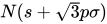
Hybrid orbitals are assumed to be mixtures of atomic orbitals, superimposed on each other in various proportions. For example, in methane, the C hybrid orbital which forms each carbonhydrogen bond consists of 25% s character and 75% p character and is thus described as sp3 (read as s-p-three) hybridised. Quantum mechanics describes this hybrid as an sp3 wavefunction of the form , where N is a normalisation constant (here 1/2) and pσ is a p orbital directed along the C-H axis to form a sigma bond. The ratio of coefficients (denoted λ in general) is in this example. Since the electron density associated with an orbital is proportional to the square of the wavefunction, the ratio of p-character to s-character is λ2 = 3. The p character or the weight of the p component is N2λ2 = 3/4.

Types

sp3

Four sp3 orbitals.

Hybridisation describes the bonding of atoms from an atom's point of view. For a tetrahedrally coordinated carbon (e.g., methane CH4), the carbon should have 4 orbitals directed towards the 4 hydrogen atoms.

Carbon's ground state configuration is 1s2 2s2 2p2 or more easily read:

C ↑↓ ↑↓  
1s 2s 2p 2p 2p

This diagram suggests that the carbon atom could use its two singly occupied p-type orbitals to form two covalent bonds with two hydrogen atoms in a methylene (CH2) molecule, with a hypothetical bond angle of 90° corresponding to the angle between two p orbitals on the same atom. However the true H–C–H angle in singlet methylene is about 102° which implies the presence of some orbital hybridisation.

The carbon atom can also bond to four hydrogen atoms in methane by an excitation (or promotion) of an electron from the doubly occupied 2s orbital to the empty 2p orbital, producing four singly occupied orbitals.

C* ↑↓
1s 2s 2p 2p 2p

The energy released by the formation of two additional bonds more than compensates for the excitation energy required, energetically favoring the formation of four C-H bonds.

According to quantum mechanics, the lowest energy is obtained if the four bonds are equivalent, which requires that they are formed from equivalent orbitals on the carbon. A set of four equivalent orbitals can be obtained that are linear combinations of the valence-shell (core orbitals are almost never involved in bonding) s and p wave functions, which are the four sp3 hybrids.

C* ↑↓
1s sp3 sp3 sp3 sp3

In CH4, four sp3 hybrid orbitals are overlapped by the four hydrogens' 1s orbitals, yielding four σ (sigma) bonds (that is, four single covalent bonds) of equal length and strength.

The following:

A schematic presentation of hybrid orbitals overlapping hydrogen orbitals

translates into:

Methane's tetrahedral shape

sp2

Three sp2 orbitals.
Ethylene structure

Other carbon compounds and other molecules may be explained in a similar way. For example, ethylene (C2H4) has a double bond between the carbons. For this molecule, carbon sp2 hybridises, because one π (pi) bond is required for the double bond between the carbons and only three σ bonds are formed per carbon atom. In sp2 hybridisation the 2s orbital is mixed with only two of the three available 2p orbitals, usually denoted 2px and 2py. The third 2p orbital (2pz) remains unhybridised.

C* ↑↓
1s sp2 sp2 sp2 2p

forming a total of three sp2 orbitals with one remaining p orbital. In ethylene, the two carbon atoms form a σ bond by overlapping one sp2 orbital from each carbon atom. The π bond between the carbon atoms perpendicular to the molecular plane is formed by 2p–2p overlap. Each carbon atom forms covalent C–H bonds with two hydrogens by s–sp2 overlap, all with 120° bond angles. The hydrogen–carbon bonds are all of equal strength and length, in agreement with experimental data.

sp

Two sp orbitals

The chemical bonding in compounds such as alkynes with triple bonds is explained by sp hybridization. In this model, the 2s orbital is mixed with only one of the three p orbitals,

C* ↑↓
1s sp sp 2p 2p

resulting in two sp orbitals and two remaining p orbitals. The chemical bonding in acetylene (ethyne) (C2H2) consists of sp–sp overlap between the two carbon atoms forming a σ bond and two additional π bonds formed by p–p overlap. Each carbon also bonds to hydrogen in a σ s–sp overlap at 180° angles.

Molecule shape

Shapes of the different types of hybrid orbitals

Hybridisation helps to explain molecule shape, since the angles between bonds are approximately equal to the angles between hybrid orbitals. This is in contrast to valence shell electron-pair repulsion (VSEPR) theory, which can be used to predict molecular geometry based on empirical rules rather than on valence-bond or orbital theories.

spx hybridisation

As the valence orbitals of main group elements are the one s and three p orbitals with the corresponding octet rule, spx hybridization is used to model the shape of these molecules.

Coordination number Shape Hybridisation Examples
2 Linear sp hybridisation (180°) CO2
3 Trigonal planar sp2 hybridisation (120°) BCl3
4 Tetrahedral sp3 hybridisation (109.5°) CCl4
Interorbital angles

spxdy hybridisation

As the valence orbitals of transition metals are the five d, one s and three p orbitals with the corresponding 18-electron rule, spxdy hybridisation is used to model the shape of these molecules. These molecules tend to have multiple shapes corresponding to the same hybridization due to the different d-orbitals involved. A square planar complex has one unoccupied p-orbital and hence has 16 valence electrons.

Coordination number Shape Hybridisation Examples
4 Square planar sp2d hybridisation PtCl42−
5 Trigonal bipyramidal sp3d hybridisation Fe(CO)5
Square pyramidal MnCl52−
6 Octahedral sp3d2 hybridisation Mo(CO)6
7 Pentagonal bipyramidal sp3d3 hybridisation ZrF73−
Capped octahedral MoF7
Capped trigonal prismatic TaF72−
8 Square antiprismatic sp3d4 hybridisation ReF8
Dodecahedral Mo(CN)84−
Bicapped trigonal prismatic ZrF84−
9 Tricapped trigonal prismatic sp3d5 hybridisation ReH92−
Capped square antiprismatic

sdx hybridisation

In certain transition metal complexes with a low d electron count, the p-orbitals are unoccupied and sdx hybridisation is used to model the shape of these molecules.

Coordination number Shape Hybridisation Examples
3 Trigonal pyramidal sd2 hybridisation (90°) CrO3
4 Tetrahedral sd3 hybridisation (70.5°, 109.5°) TiCl4
5 Square pyramidal sd4 hybridisation (65.9°, 114.1°) Ta(CH3)5
6 C3v Trigonal prismatic sd5 hybridisation (63.4°, 116.6°) W(CH3)6
Interorbital angles

Hypervalent molecules

Octet expansion

In some general chemistry textbooks, hybridization is presented for main group coordination number 5 and above using an "expanded octet" scheme with d-orbitals first proposed by Pauling. However, such a scheme is now considered to be incorrect in light of computational chemistry calculations.

Coordination number Molecular shape Hybridisation Examples
5 Trigonal bipyramidal sp3d hybridisation PF5
6 Octahedral sp3d2 hybridisation SF6
7 Pentagonal bipyramidal sp3d3 hybridisation IF7

In 1990, Eric Alfred Magnusson of the University of New South Wales published a paper definitively excluding the role of d-orbital hybridisation in bonding in hypervalent compounds of second-row (period 3) elements, ending a point of contention and confusion. Part of the confusion originates from the fact that d-functions are essential in the basis sets used to describe these compounds (or else unreasonably high energies and distorted geometries result). Also, the contribution of the d-function to the molecular wavefunction is large. These facts were incorrectly interpreted to mean that d-orbitals must be involved in bonding.

Resonance

In light of computational chemistry, a better treatment would be to invoke sigma bond resonance in addition to hybridisation, which implies that each resonance structure has its own hybridisation scheme. All resonance structures must obey the octet rule.

Coordination number Resonance structures
5 Trigonal bipyramidal
6 Octahedral
7 Pentagonal bipyramidal

In computational VB theory

While the simple model of orbital hybridisation is commonly used to explain molecular shape, hybridisation is used differently when computed in modern valence bond programs. Specifically, hybridisation is not determined a priori but is instead variationally optimized to find the lowest energy solution and then reported. This means that all artificial constraints, specifically two constraints, on orbital hybridisation are lifted:

  • that hybridisation is restricted to integer values (isovalent hybridisation)
  • that hybrid orbitals are orthogonal to one another (hybridisation defects)

This means that in practice, hybrid orbitals do not conform to the simple ideas commonly taught and thus in scientific computational papers are simply referred to as spx, spxdy or sdx hybrids to express their nature instead of more specific integer values.

Isovalent hybridisation

Although ideal hybrid orbitals can be useful, in reality, most bonds require orbitals of intermediate character. This requires an extension to include flexible weightings of atomic orbitals of each type (s, p, d) and allows for a quantitative depiction of the bond formation when the molecular geometry deviates from ideal bond angles. The amount of p-character is not restricted to integer values; i.e., hybridizations like sp2.5 are also readily described.

The hybridization of bond orbitals is determined by Bent's rule: "Atomic s character concentrates in orbitals directed towards electropositive substituents".

For molecules with lone pairs, the bonding orbitals are isovalent spx hybrids. For example, the two bond-forming hybrid orbitals of oxygen in water can be described as sp4.0 to give the interorbital angle of 104.5°. This means that they have 20% s character and 80% p character and does not imply that a hybrid orbital is formed from one s and four p orbitals on oxygen since the 2p subshell of oxygen only contains three p orbitals.

Hybridisation defects

Hybridisation of s and p orbitals to form effective spx hybrids requires that they have comparable radial extent. While 2p orbitals are on average less than 10% larger than 2s, in part attributable to the lack of a radial node in 2p orbitals, 3p orbitals which have one radial node, exceed the 3s orbitals by 20–33%. The difference in extent of s and p orbitals increases further down a group. The hybridisation of atoms in chemical bonds can be analysed by considering localised molecular orbitals, for example using natural localised molecular orbitals in a natural bond orbital (NBO) scheme. In methane, CH4, the calculated p/s ratio is approximately 3 consistent with "ideal" sp3 hybridisation, whereas for silane, SiH4, the p/s ratio is closer to 2. A similar trend is seen for the other 2p elements. Substitution of fluorine for hydrogen further decreases the p/s ratio. The 2p elements exhibit near ideal hybridisation with orthogonal hybrid orbitals. For heavier p block elements this assumption of orthogonality cannot be justified. These deviations from the ideal hybridisation were termed hybridisation defects by Kutzelnigg.

However, computational VB groups such as Gerratt, Cooper and Raimondi (SCVB) as well as Shaik and Hiberty (VBSCF) go a step further to argue that even for model molecules such as methane, ethylene and acetylene, the hybrid orbitals are already defective and nonorthogonal, with hybridisations such as sp1.76 instead of sp3 for methane.

Photoelectron spectra

One misconception concerning orbital hybridization is that it incorrectly predicts the ultraviolet photoelectron spectra of many molecules. While this is true if Koopmans' theorem is applied to localized hybrids, quantum mechanics requires that the (in this case ionized) wavefunction obey the symmetry of the molecule which implies resonance in valence bond theory. For example, in methane, the ionised states (CH4+) can be constructed out of four resonance structures attributing the ejected electron to each of the four sp3 orbitals. A linear combination of these four structures, conserving the number of structures, leads to a triply degenerate T2 state and an A1 state. The difference in energy between each ionized state and the ground state would be ionization energy, which yields two values in agreement with experimental results.

Two distinct states for CH4+ exist (A1 and T2), both of which result from the ionization of CH4. This gives rise to the two unique peaks on the photoelectron spectrum of methane.

Localised vs canonical molecular orbitals

Bonding orbitals formed from hybrid atomic orbitals may be considered as localised molecular orbitals, which can be formed from the delocalised orbitals of molecular orbital theory by an appropriate mathematical transformation. For molecules in the ground state, this transformation of the orbitals leaves the total many-electron wave function unchanged. The hybrid orbital description of the ground state is therefore equivalent to the delocalised orbital description for ground state total energy and electron density, as well as the molecular geometry that corresponds to the minimum total energy value.

Two localised representations

The symmetry-adapted and hybridised lone pairs of H2O

Molecules with multiple bonds or multiple lone pairs can have orbitals represented in terms of sigma and pi symmetry or equivalent orbitals. Different valence bond methods use either of the two representations, which have mathematically equivalent total many-electron wave functions and are related by a unitary transformation of the set of occupied molecular orbitals.

For multiple bonds, the sigma-pi representation is the predominant one compared to the equivalent orbital (bent bond) representation. In contrast, for multiple lone pairs, most textbooks use the equivalent orbital representation. However, the sigma-pi representation is also used, such as by Weinhold and Landis within the context of natural bond orbitals, a localised orbital theory containing modernised analogs of classical (valence bond/Lewis structure) bonding pairs and lone pairs. For the hydrogen fluoride molecule, for example, two F lone pairs are essentially unhybridised p orbitals, while the other is an spx hybrid orbital. An analogous consideration applies to water (one O lone pair is in a pure p orbital, another is in an spx hybrid orbital)

Tuesday, April 7, 2026

Youngest Toba eruption

From Wikipedia, the free encyclopedia
Youngest Toba eruption
Artist's impression of early stages of eruption from about 42 km (26 mi) above northern Sumatra
VolcanoToba Caldera
Datec. 74,000 years ago
LocationSumatra, Indonesia
2.6845°N 98.8756°E
VEI8
ImpactCovered the Indian subcontinent in 5 cm (2.0 in) of ash, volcanic winter may have caused a severe human population bottleneck
Deaths(Potentially) almost all of humanity, leaving around 3,000–10,000 humans left on the planet
Maps
Lake Toba is the resulting crater lake

The Toba eruption (also called the Toba supereruption and the Youngest Toba eruption) was a large eruption that occurred around 74,000 years ago, during the Late Pleistocene, at the site of present-day Lake Toba, in Sumatra, Indonesia. It was the last in a series of at least four caldera-forming eruptions there, the earlier known caldera having formed about 1.2 million years ago. This, the last eruption, had an estimated volcanic explosivity index of 8, making it the largest known explosive volcanic eruption in the Quaternary, and one of the largest known explosive eruptions in the Earth's history.

Eruption

Location of Lake Toba shown in red on map

Chronology of the Toba eruption

The exact date of the eruption is unknown, but the pattern of ash deposits suggests that it occurred during the northern summer because only the summer monsoon could have deposited Toba ashfall in the South China Sea. The eruption lasted perhaps 9 to 14 days. The most recent two high-precision argon–argon datings dated the eruption to 73,880 ± 320 and 73,700 ± 300 years ago. Five distinct magma bodies were activated within a few centuries before the eruption. The eruption commenced with small and limited air-fall and was directly followed by the main phase of ignimbrite flows. The ignimbrite phase is characterized by low eruption fountain, but co-ignimbrite column developed on top of pyroclastic flows reached a height of 32 km (20 mi). Petrological constraints on sulfur emission yielded a wide range from 1×10¹³ to 1×10¹⁵ g, depending on the existence of separate sulfur gas in the Toba magma chamber. The lower end of the estimate is due to the low solubility of sulfur in the magma. Ice core records estimate the sulfur emission on the order of 1×10¹⁴ g.

Effects of the eruption

Bill Rose and Craig Chesner of Michigan Technological University have estimated that the total amount of material released in the eruption was at least 2,800 km3 (670 cu mi)—about 2,000 km3 (480 cu mi) of ignimbrite that flowed over the ground, and approximately 800 km3 (190 cu mi) that fell as ash mostly to the west. However, as more outcrops become available, the most recent estimate of eruptive volume is 3,800 km3 (910 cu mi) dense-rock equivalent (DRE), of which 1,800 km3 (430 cu mi) was deposited as ash fall and 2,000 km3 (480 cu mi) as ignimbrite, making this eruption the largest during the Quaternary period. Previous volume estimates have ranged from 2,000 km3 (480 cu mi) to 6,000 km3 (1,400 cu mi). Inside the caldera, the maximum thickness of pyroclastic flows is over 600 m (2,000 ft). The outflow sheet originally covered an area of 20,000–30,000 km2 (7,700–11,600 sq mi) with thickness nearly 100 m (330 ft), likely reaching into the Indian Ocean and the Straits of Malacca. The air-fall of this eruption blanketed the Indian subcontinent in a layer of 5 cm (2.0 in) ash, the Arabian Sea in 1 mm (0.039 in), the South China Sea in 3.5 cm (1.4 in), and Central Indian Ocean Basin in 10 cm (3.9 in). Its horizon of ashfall covered an area of more than 38,000,000 km2 (15,000,000 sq mi) in 1 cm (0.39 in) or more thickness (~7.5% of the Earth's surface). In Sub-Saharan Africa, microscopic glass shards from this eruption are also discovered on the south coast of South Africa, in the lowlands of northwest Ethiopia, in Lake Malawi, and in Lake Chala. In South China, Toba tephras is found in Huguangyan Maar Lake.

The subsequent collapse formed a caldera that filled with water, creating Lake Toba. The island in the center of the lake is formed by a resurgent dome.

Climatic effects

Climate at the time of the eruption

Greenland stadial 20 (GS20) is a millennium-long cold event in the north Atlantic ocean that started around the time of the Toba eruption. The timing of the initiation of GS20 is dated to 74.0–74.2 kyr, and the entire event lasted about 1,500 years. It is the stadial part of Dansgaard–Oeschger event 20 (DO20), commonly explained by an abrupt reduction in the strength of the Atlantic meridional overturning circulation (AMOC). Weaker AMOC caused warming in the Southern Ocean and Antarctica, and this asynchrony is known as bipolar seesaw. The start of the GS20 cooling event corresponds to the start of the Antarctic Isotope Maxima 19 (AIM19) warming event. GS20 was associated with iceberg discharges into the North Atlantic, thus it was also named Heinrich stadial 7a. Heinrich events tend to be longer, colder and with weaker AMOC in the Atlantic ocean than other DO stadials. From 74 to 58 kyr, Earth transitioned from interglacial marine isotope stage (MIS) 5 to glacial MIS 4, experiencing cooling and glacial expansion. This transition is a part of the Pleistocene interglacial-glacial cycle driven by variations in the Earth's orbit. Ocean temperatures cooled by 0.9 °C (1.6 °F). Sea level fell 60 m (200 ft). Northern Hemisphere ice sheets embarked on significant expansion and surpassed the extent of the Last Glacial Maximum in eastern Europe, Northeast Asia and the North American Cordillera. Southern Hemisphere glaciation grew to its maximum extent during MIS 4. Australasia, Africa and Europe were characterized by increasingly cold and arid environments.

Possible climate records of the eruption

While the Toba eruption occurred in the backdrop of the rapid climate transitions of GS20 and MIS 4, triggered by changes in ocean currents and insolation, whether the eruption played any role in accelerating these events is much more heavily debated. South China Sea marine records of climate, sampled at every centennial interval, shows 1 °C (1.8 °F) cooling above the Toba ash layer for a thousand years but the authors concede that it may just be GS20. Arabian Sea marine records confirm that Toba ash occurred after the onset of GS20 but also that GS20 is not colder than GS21 in the records, from which authors conclude that the eruption did not intensify GS20 cooling. Dense sampling of environmental records, at every 69-year interval, in Lake Malawi, show no cooling-induced change in lake ecology and in grassy woodlands after the deposition of Toba ash, but cooling-forced aridity killed high-elevation afromontane forests. The Lake Malawi studies concluded that the environmental effects of the eruption were mild and limited to less than a decade in East Africa, but these studies are questioned due to sediment mixing which would have diminished the cooling signal. Environmental records from a Middle Stone Age site in Ethiopia, however, show that a severe drought occurred concurrently with the Toba ash layer, which altered early human foraging behaviours.

Toba ash records have not been identified in ice core samples. However, four sulfate events in the ice strata are proposed to represent the deposition of aerosols from the Toba eruption. One sulfate event at 73.75–74.16 kyr, which has all the characteristics of the Toba eruption, is among the largest sulfate loadings that have ever been identified. In the ice core records, GS20 cooling was already underway by the time of sulfate deposition; however, a 110-year period of accelerated cooling followed this sulfate event. The authors interpret this acceleration as AMOC weakened by the Toba eruption.

Climate modeling

The modeled climate effects of the Toba eruption hinges on the mass of sulfurous gases and aerosol microphysical processes. Modeling on an emission of 8.5×10¹⁴ g of sulfur, which is 100 times the 1991 Pinatubo sulphur, volcanic winter has a maximum global mean cooling of 3.5 °C (6.3 °F) and returns gradually within the range of natural variability 5 years after the eruption. An initiation of a 1,000-year cold period or ice age is not supported by the model. Two other emission scenarios, 1×10¹⁴ g and 1×10¹⁵ g, were investigated using state-of-art simulations provided by the Community Earth System Model. Maximum global mean cooling was 2.3 °C (4.1 °F) for the lower emission and 4.1 °C (7.4 °F) for the higher emission scenarios. A strong decrease in precipitation occurs in the high emission scenario. Negative temperature anomalies return to less than 1 °C (1.8 °F) within 3 and 6 years for each emission scenario after the eruption. But so far no model can simulate aerosol microphysical processes with sufficient accuracy, empirical constraints from historical eruptions suggest that aerosol size may substantially reduce the magnitude of cooling to less than 1.5 °C (2.7 °F), no matter how much sulfur is emitted.

Toba catastrophe theory

The Toba catastrophe theory holds that the eruption caused a severe global volcanic winter of six to ten years and contributed to a 1,000-year-long cooling episode, resulting in a genetic bottleneck in humans. However, some physical evidence disputes the association with the millennium-long cold event and genetic bottleneck, and some consider the theory disproven.

History

In 1972, an analysis of human hemoglobins found very few variants, and to account for this low frequency of variation, the human population must have been as low as a few thousand until very recently. More genetic studies confirmed an effective population on the order of 10,000 for much of human history. Subsequent research on the differences in human mitochondrial DNA sequences dated a rapid growth from a small effective population size of 1,000 to 10,000, sometime between 35 and 65 kyr ago. Recent research shows the extent of climate change was much smaller than believed by proponents of the theory.

In 1993, science journalist Ann Gibbons posited that population growth was suppressed by the cold climate of the last Pleistocene Ice Age, possibly exacerbated by the Toba super-eruption which at the time was dated to between 73 and 75 kyr near the beginning of glacial period MIS 4. The subsequent explosive human expansion was believed to be the result of the end of the ice age. Geologist Michael R. Rampino of New York University and volcanologist Stephen Self of the University of Hawaiʻi at Mānoa supported her theory. In 1998, anthropologist Stanley H. Ambrose of the University of Illinois Urbana-Champaign used coalescence evidence of some genes to hypothesize that the Toba eruption caused a human population crash to only a few thousand surviving individuals, and the subsequent recovery was suppressed by the global glacial condition of MIS 4 until the climate eventually transitioned to the warmer condition of MIS 3 about 60,000 years ago, during which rapid human population expansion occurred.

Possible effects on Homo

At least two other Homo lineages, H. neanderthalensis and Denisovans, survived the Toba eruption and subsequent MIS 4 ice age, as their latest presence is dated to ca. 40 kyr, and ca. 55 kyr. Other lineages, including H. floresiensis and H. luzonensis, may have also survived through the eruption. More recently, reconstructions of human demographic history using whole-genome sequencing and discoveries of archaeological cultures within the Toba ash layer add further light to how humans had fared during the eruption and the following GS20 and MIS 4 ice age.

Human demographic history

Recent analyses apply Markov models to the complete set of genetic material to infer human population history. In non-African populations, studies recover a long-term steep decline in numbers starting 200 kyr and reaching the lowest point around 40–60 kyr. During this bottleneck non-African populations experienced 5- to 15-fold reduction, with an effective population size of only 1,000–3,000 individuals by 50 kyr, consistent with the earliest mtDNA studies. This severe non-African contraction is consistent with a founder effect caused by Out-of-Africa dispersal. As a small group with a size of a few thousand people migrated from the African continent into the Near East, the drastic reduction in numbers imprinted on non-African genomic diversity. Genetic analysis identified 56 selective sweeps related to cold adaptations in non-African populations, of which 31 sweeps occurred during 72–97 kyr. This event of closely timed selections is named the "Arabian Standstill" and may have been caused by the severe cold arid conditions from the onset of MIS 4 and exacerbated by the Toba super-eruption.

African populations experienced a slightly earlier, milder bottleneck and recovered earlier. Estimated effective population size based on samples from the Luhya and Maasai people attained their lowest numbers around 70–80 kyr, while those from the Yoruba people reached a nadir around 50 kyr, though the long-term declining trend already started before 200 kyr. The estimated remaining effective population sizes are around 10,000 individuals, larger than the estimated non-African size during their bottleneck. Unlike the non-African populations, there is no consensus as to the cause of the African bottleneck. Proposed causes include climatic deterioration (from MIS 5, Toba eruption, GS20 and/or MIS 4), reduction in substructure across African populations, and founder effects from the dispersal within Africa.

Earlier genetic analysis of Alu sequences across the entire human genome has shown that the effective human population size was less than 26,000 at 1.2 million years ago; possible explanations for the low population size of human ancestors may include repeated population crashes or periodic replacement events from competing Homo subspecies. Whole-genome analysis similarly recovers very low African population sizes around 1 million years ago. This 1 million year old bottleneck is thought to have been caused by severe ice age MIS 22 which marked the mid-Pleistocene climate transition with widespread aridity across Africa

Archaeological studies

Other research has cast doubt on an association between the Toba Caldera Complex and a genetic bottleneck. For example, ancient stone tools at the Jurreru Valley in southern India (Andhra Pradesh) were found above and below a thick layer of ash from the Toba eruption and were very similar across these layers, suggesting that the dust clouds from the eruption did not wipe out this local population. However, another site in India, the Middle Son Valley (in Madhya Pradesh), exhibits evidence of a major population decline and it has been suggested that the abundant springs of the Jurreru Valley may have offered its inhabitants unique protection. At the Jurreru Valley in southern India, Middle Paleolithic stone tools below the Toba ash layer are dated by OSL to 77±4 kyr, while the age of stone tools above the ash layer is constrained to be no older than 55 kyr. This age gap is suspected to be due to the removal of post-eruption sediments or decimation of the local population until re-occupation at 55 kyr. Additional archaeological evidence from southern and northern India also suggests a lack of evidence for effects of the eruption on local populations, causing the authors of the study to conclude, "many forms of life survived the supereruption, contrary to other research which has suggested significant animal extinctions and genetic bottlenecks". However, some researchers have questioned the techniques utilized to date artifacts to the period subsequent to the Toba supervolcano. The Toba Catastrophe also coincides with the disappearance of the Skhul and Qafzeh hominins. Evidence from pollen analysis has suggested prolonged deforestation in South Asia, and some researchers have suggested that the Toba eruption may have forced humans to adopt new adaptive strategies, which may have permitted them to replace Neanderthals and "other archaic human species".

Genetic bottlenecks in other mammals

Some evidence indicates population crashes of other animals after the Toba eruption. The populations of the Eastern African chimpanzeeBornean orangutan, central Indian macaquegorillas cheetah and tiger, all expanded from very small populations around 70,000–55,000 years ago.

Molecular symmetry

From Wikipedia, the free encyclopedia https://en.wikipedia.org/wiki/Molecular_symmetry   Symmetry...