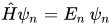
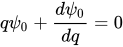
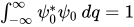
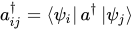
In particle physics, annihilation is the process that occurs when a subatomic particle collides with its respective antiparticle to produce other particles, such as an electron colliding with a positron to produce two photons. The total energy and momentum
of the initial pair are conserved in the process and distributed among a
set of other particles in the final state. Antiparticles have exactly
opposite additive quantum numbers
from particles, so the sums of all quantum numbers of such an original
pair are zero. Hence, any set of particles may be produced whose total
quantum numbers are also zero as long as conservation of energy, conservation of momentum, and conservation of spin are obeyed.
During a low-energy annihilation, photon production is favored, since these particles have no mass. High-energy particle colliders produce annihilations where a wide variety of exotic heavy particles are created.
The word "annihilation" takes its use informally for the interaction of two particles that are not mutual antiparticles – not charge conjugate.
Some quantum numbers may then not sum to zero in the initial state, but
conserve with the same totals in the final state. An example is the
"annihilation" of a high-energy electron antineutrino with an electron to produce a W− boson.
If the annihilating particles are composite, such as mesons or baryons, then multiple different particles are typically produced in the final state.
The inverse of annihilation is pair production, the process in which a high-energy photon converts its energy into mass.
History
Paul Dirac introduced annihilation in 1931. His paper was named "On the Annihilation of Electrons and Protons" because he had not yet realized the positive charge (negative energy) states were anti-electrons. Annihilation was used to verify the existence of the antiproton in 1956.
Production of a single boson
If the initial two particles are elementary (not composite), then they may combine to produce only a single elementary boson, such as a photon (γ), gluon (g), Z, or a Higgs boson (H0 ). If the total energy in the center-of-momentum frame is equal to the rest mass of a real boson (which is impossible for a massless boson such as the γ), then that created particle will continue to exist until it decays according to its lifetime. Otherwise, the process is understood as the initial creation of a boson that is virtual, which immediately converts into a real particle + antiparticle pair. This is called an s-channel process. An example is the annihilation of an electron with a positron to produce a virtual photon, which converts into a muon and anti-muon. If the energy is large enough, a Z could replace the photon.
Examples
Electron–positron annihilation
Electron/positron annihilation at various energies
When a low-energy electron annihilates a low-energy positron (antielectron) the most probable result is the creation of two or more photons, since the only other final-state Standard Model particles that electrons and positrons carry enough mass–energy to produce are neutrinos,
which are approximately 10,000 times less likely to produce, and the
creation of only one photon is impossible by momentum conservation—a
single photon would carry nonzero momentum in any frame, including the center-of-momentum frame where the total momentum vanishes. Both the annihilating electron and positron particles have a rest energy
of about 0.501 million electron-volts (MeV). If their kinetic energies
are relatively negligible, this total rest energy appears as the photon energy
of the photons produced. Each of the photons then has an energy of
about 0.511 MeV. Momentum and energy are both conserved, with 1.012 MeV
of photon energy (accounting for the rest energy of the particles)
moving in opposite directions (accounting for the total zero momentum of
the system).
If one or both charged particles carry a larger amount of kinetic
energy, various other particles can be produced. Furthermore, the
annihilation (or decay) of an electron–positron pair into a single
photon can occur in the presence of a third charged particle, to which
the excess momentum can be transferred by a virtual photon from the
electron or positron. The inverse process, pair production by a single real photon, is also possible in the electromagnetic field of a third particle.
Proton–antiproton annihilation
When a proton encounters its antiparticle (and more generally, if any species of baryon encounters the corresponding antibaryon), the reaction is not as simple as electron–positron annihilation. Unlike an electron, a proton is a composite particle consisting of three "valence quarks" and an indeterminate number of "sea quarks" bound by gluons. Thus, when a proton encounters an antiproton, one of its quarks, usually a constituent valence quark, may annihilate with an antiquark
(which more rarely could be a sea quark) to produce a gluon, after
which the gluon together with the remaining quarks, antiquarks, and
gluons will undergo a complex process of rearrangement (called hadronization or fragmentation) into a number of mesons (mostly pions and kaons),
which will share the total energy and momentum. The newly created
mesons are unstable, and unless they encounter and interact with some
other material, they will decay in a series of reactions that ultimately
produce only photons, electrons, positrons, and neutrinos. This type of reaction will occur between any baryon (particle consisting of three quarks) and any antibaryon
consisting of three antiquarks, one of which corresponds to a quark in
the baryon. (This reaction is unlikely if at least one among the baryon
and anti-baryon is exotic enough that they share no constituent quark
flavors.) Antiprotons can and do annihilate with neutrons, and likewise antineutrons can annihilate with protons, as discussed below.
Reactions in which proton–antiproton annihilation produces as
many as 9 mesons have been observed, while production of 13 mesons is
theoretically possible. The generated mesons leave the site of the
annihilation at moderate fractions of the speed of light and decay with
whatever lifetime is appropriate for their type of meson.
Similar reactions will occur when an antinucleon annihilates within a more complex atomic nucleus, save that the resulting mesons, being strongly interacting,
have a significant probability of being absorbed by one of the
remaining "spectator" nucleons rather than escaping. Since the absorbed
energy can be as much as ~2 GeV, it can in principle exceed the binding energy of even the heaviest nuclei. Thus, when an antiproton annihilates inside a heavy nucleus such as uranium or plutonium, partial or complete disruption of the nucleus can occur, releasing large numbers of fast neutrons. Such reactions open the possibility for triggering a significant number of secondary fission reactions in a subcritical mass and may potentially be useful for spacecraft propulsion.
Higgs production
In collisions of two nucleons at very high energies, sea quarks
and gluons tend to dominate the interaction rate, so neither nucleon
need be an anti-particle for annihilation of a quark pair or "fusion" of
two gluons to occur. Examples of such processes contribute to the production of the long-sought Higgs boson. The Higgs is directly produced very weakly by annihilation of light (valence) quarks, but heavy t or b sea or produced quarks are available. In 2012, the CERN laboratory in Geneva announced the discovery of the Higgs in the debris from proton–proton collisions at the Large Hadron Collider
(LHC). The strongest Higgs yield is from fusion of two gluons (via
annihilation of a heavy quark pair), while two quarks or antiquarks
produce more easily identified events through radiation of a Higgs by a
produced virtual vector boson or annihilation of two such vector bosons.
In the Soviet Union, the transition period was declared by adoption
the Law of the USSR "On the bodies of state power and administration of
the Union of Soviet Socialist Republics in the transition period" which
was signed into law on 5 September 1991. It was assumed that the Soviet
Union would come out of the transition period with a new name of the
Union when all the treaties are signed, ratified, come into force and
the new parliament assembled. However, this did not happen.
As the Kommersant newspaper wrote on 7 October 1991, a series of conflicts occurred in the RSFSR government during preparations for the signing of the Treaty on the Economic Community. In his speech to members of the Russian parliament, RSFSR State SecretaryGennady Burbulis
declared Russia's special role as the legal successor to the Soviet
Union. Accordingly, the ways of drafting agreements with the republics
should be determined by the Russian leadership. Instead of the planned
order, he suggested signing a political agreement first, followed by an
economic one. The newspaper suggested that Burbulis' goal was to
persuade Yeltsin not to sign the agreement as it stands at the time. Yegor Gaidar, Alexander Shokhin and Konstantin Kagalovsky
were named as the developers of the statement made by Burbulis. In the
same time, a group of "isolationist patriots" consisting of Mikhail Maley, Nikolai Fedorov, Alexander Shokhin, Igor Lazarev and Mikhail Poltoranin criticized Ivan Silaev and Yevgeny Saburov for wanting to preserve the Soviet Union.
On 18 October 1991, in the St. George Hall of the Grand Kremlin Palace, Mikhail Gorbachev and the leaders of eight Union republics (excluding Ukraine, Moldova, Georgia and Azerbaijan) signed the Treaty on the Economic Community as planned. Ukraine and Moldova said they would sign at a later date. This economic agreement was then to be supplemented by a similar political agreement. On 14 November in Novo-Ogaryovo, Mikhail Gorbachev and the heads of the seven union republics pre-agreed to sign a treaty on the creation of a political union called the Union of Sovereign States,
which would have no constitution but would remain a subject of
international law as the Soviet Union had been. The Treaty would
complement the previous economic treaty and was scheduled to be signed
in December.
Because of the referendum results and the actions of the Verkhovna Rada, Leonid Kravchuk refused on 7 December to sign such a political agreement that did not take Ukraine's status into account. Boris Yeltsin
said that if Ukraine would not sign, then Russia would not sign either,
although at this moment, besides Russia, six republics still wanted to
sign the new Union treaty. The Belovezha Accords
were signed on 8 December, where it was Burbulis who authored the
phrase “The Union of Soviet Socialist Republics as a subject of
international law and geopolitical reality ceases to exist.” The agreement declared the dissolution of the USSR by its remaining
founder states (denunciation of the Treaty on the Creation of the USSR)
and established the Commonwealth of Independent States (CIS). On 10 December, the accord was ratified by the Ukrainian and Belarusian parliaments. On 12 December, the agreement was ratified by the Russian Parliament, therefore the Russian SFSR renounced the Treaty on the Creation of the USSR and de facto declared Russia's independence from the USSR.
On 14 February 1992, the heads of state instructed the foreign
ministers of the Commonwealth participating states to prepare a document
on the legal succession of treaties, all property, state archives,
debts and assets of the former Union of Soviet Socialist Republics.
On 20 March 1992, the CIS Council of Heads of State signed the
Decision on the succession of state property, debts and assets of the
former USSR.
On 15 May 1992, the CIS Council of Heads of State signed a
Protocol Decision on the activities of the Commission on Succession to
Treaties, of mutual interest, state property, state archives, debts and
assets of the former Union of Soviet Socialist Republics.
On 6 July 1992 the CIS Council of Heads of State signed a
Memorandum of Understanding on the issue of succession to treaties of
the former Union of Soviet Socialist Republics that are of mutual
interest. According to the text.
Almost all multilateral international treaties of the former
Union of Soviet Socialist Republics are of common interest to the
Commonwealth participating States. However, these treaties do not
require any joint decisions or actions of the participating States of
the Commonwealth. The question of participation in these treaties is
decided in accordance with the principles and norms of international law
by each Commonwealth participant state on its own.
There are a number of bilateral international treaties of the former
Union of Soviet Socialist Republics that affect the interests of two or
more (but not all) Commonwealth participant states. These treaties
require decisions or actions by those Commonwealth participating States
to which the treaties apply.
A number of bilateral treaties affect the interests of all
Commonwealth participating States. These include, for example, treaties
on borders and their regime. Such treaties are required by international
law to remain in force, and participation is limited to those
Commonwealth participating States that share a contiguous border with
non-Commonwealth countries.
If any questions arise concerning succession to treaties of the
former Union of Soviet Socialist Republics, consultations will be held
between the States concerned.
International relations, treaties and organizations
The Declaration of the Twelve
(Belgium, Denmark, France, Germany, Greece, Ireland, Italy, Luxembourg,
Portugal, Spain, the Netherlands and the United Kingdom) on the future
status of Russia and other former Soviet Republics was published on 23
December 1991, according to which "The European Community and its Member States have noted with satisfaction the decision of the participants at the Alma Ata meeting on 21 December 1991 to establish a Commonwealth of Independent States. They note that the international rights and obligations of the former USSR, including those arising from the Charter of the United Nations, will continue to be exercised by Russia. They note with satisfaction the acceptance by the Russian Government
of these commitments and responsibilities and will continue to deal
with Russia on this basis, taking into account the change in its
constitutional status."
On 4 September 1991, U.S. Secretary of State James Baker articulated five basic principles that would guide U.S. policy toward the emerging republics: self-determination
consistent with democratic principles, recognition of existing borders,
support for democracy and rule of law, preservation of human rights and
rights of national minorities, and respect for international law and
obligations. The basic message was clear—if the new republics could
follow these principles, they could expect cooperation and assistance
from the United States. Self-determination is a cardinal principle in modern international law but no right to secession is recognized under international law.
The "Guidelines on the Recognition of New States in Eastern
Europe and the Soviet Union", adopted by Ministers of the EC (Belgium,
Denmark, France, Germany, Greece, Ireland, Italy, Luxembourg, Portugal,
Spain, the Netherlands and the United Kingdom) on 16 December 1991. According to a scientific paper: "EC Guidelines on the Recognition of
New States in Eastern Europe and the Soviet Union approved in December
1991 constituted a remarkable innovation in European policy-making."
On 21 December 1991, the Council of Heads of State decided that
the member states of the Commonwealth, referring to Article 12 of the
Agreement on the Establishment of the Commonwealth of Independent
States, based on the intention of each state to fulfill obligations
under the UN Charter and participate in the work of this organization as
full members, taking into account that the original members of the UN
were the Republic of Belarus, the USSR and Ukraine, expressing
satisfaction that the Republic of Belarus and Ukraine continue to
participate in the UN as sovereign independent states, decided that "the
Commonwealth States support Russia in continuing the membership of the
USSR in the UN, including permanent membership in the Security Council,
and other international organizations." The document entered into force for 11 countries on December 21. On 23 December 1991 this appears in print in the New York Times:
"Member states of the commonwealth support Russia in taking over the
U.S.S.R. membership in the U.N., including permanent membership in the
Security Council and other international organizations."
The Declaration of the Twelve on the future status of Russia and
other former Soviet Republics was published on 23 December 1991,
according to which "The European Community
and its Member States have noted with satisfaction the decision of the
participants at the Alma Ata meeting on 21 December 1991 to establish a
Commonwealth of Independent States. They note that the international
rights and obligations of the former USSR, including those arising from
the Charter of the United Nations, will continue to be exercised by
Russia. They note with satisfaction the acceptance by the Russian
Government of these commitments and responsibilities and will continue
to deal with Russia on this basis, taking into account the change in its
constitutional status. They are prepared to recognise the other
Republics constituting the Community as soon as they receive assurances
from those Republics that they are prepared to fulfil the requirements
set out in the "Guidelines on the Recognition of New States in Eastern
Europe and the Soviet Union", adopted by Ministers on 16 December 1991.
They expect, in particular, that those Republics will give them
assurances that they will fulfil their international obligations arising
from treaties and agreements concluded by the Soviet Union, including
the ratification and implementation of the CFE Treaty by the Republics
to which it applies, and that they will establish a single control over
nuclear weapons and their non-proliferation."
Thus, the 12 countries (Belgium, Denmark, France, Germany,
Greece, Ireland, Italy, Luxembourg, Portugal, Spain, the Netherlands and
the United Kingdom) do not need to recognize Russia's independence from
the Soviet Union and establish new relations with Russia as a new
state, because relations have already been established with the Soviet
Union, of which Russia has become the continuator in international
relations. Recognition of the independence of other 11 countries
(Armenia, Azerbaijan, Belarus, Georgia, Kazakhstan, Kyrgyzstan, Moldova,
Tajikistan, Turkmenistan, Ukraine, Uzbekistan) occurs on the condition
that they assume the obligations under the treaties signed by the Soviet
Union, including respect for the provisions of the Charter of the
United Nations and the commitments subscribed to in the Final Act of
Helsinki and in the Charter of Paris, guarantees for the rights of
ethnic and national groups and minorities, respect for the inviolability
of all frontiers and acceptance of all relevant commitments with regard
to disarmament and nuclear non-proliferation as well as to security and
regional stability.
Marko Milanovic, Professor of Public International Law at the
University of Reading School of Law noted in 2009: "The best example of
continuation and separation is the Soviet Union, which continued its
existence as the Russian Federation, along a number of new successor
states. (Note that a continuator state is often misleadingly termed as
the successor state, even though there may be a number of actual
successor states alongside the continuator.) A continuator state like
Russia by definition remains a party to all treaties of its predecessor,
because for all intents and purposes it is the predecessor. Thus, for
example, Russia continued the Soviet Union’s UN membership and its
permanent seat on the Security Council."
UN membership
On 23 December Russia officially received the USSR's seat on the UN
Security Council. The international community recognized it as
continuator state to the Soviet Union.
On 24 December, Yeltsin sent a Letter to the Secretary-General of the
United Nations from the President of the Russian Federation with the
following content:
I have the honour to inform you
that the membership of the Union of Soviet Socialist Republics in the
United Nations, including the Security Council and all other organs and
organizations of the United Nations system, is being continued by the
Russian Federation (RSFSR) with the support of the countries of the
Commonwealth of Independent States. In this connection, I request that
the name "the Russian Federation" should be used in the United Nations
in place of the name "the Union of Soviet Socialist Republics". The
Russian Federation maintains full responsibility for all the rights and
obligations of the USSR under the Charter of the United Nations,
including the financial obligations. I request you to consider this
letter as confirmation of the credentials to represent the Russian
Federation in the United Nations organs for all the persons currently
holding the credentials of representatives of the USSR to the United
Nations.
The Gudok newspaper notes that Yeltsin's letter was sent by
the secretary-general to all UN members with a note that this appeal is
of a notification nature, stating reality, and does not require formal
approval by the UN. All permanent members of the UN Security Council and
other leading countries agreed with this approach. By a note of 3
January 1992, the Russian Foreign Ministry appealed to the heads of
diplomatic missions in Moscow with a proposal to consider consular and
diplomatic missions of the USSR in foreign countries as representatives
of Russia. By a note of 13 January 1992, the heads of foreign diplomatic
missions were notified that the Russian Federation continued to
exercise the rights and fulfil the obligations arising from
international treaties concluded by the USSR, with a request to consider
Russia as a party to all existing international treaties instead of the
USSR.
The UN website lists Russia as a member of the United Nations as
follows: "The Union of Soviet Socialist Republics was an original Member
of the United Nations from 24 October 1945. In a letter dated 24
December 1991, Boris Yeltsin, the President of the Russian Federation,
informed the Secretary-General that the membership of the Soviet Union
in the Security Council and all other United Nations organs was being
continued by the Russian Federation with the support of the 11 member
countries of the Commonwealth of Independent States."
In an interview with Nezavisimaya Gazeta on 1 April 1992, Foreign Minister Andrei Kozyrev
explained the situation: “Many people think that Russia became the
legal successor of the USSR automatically, but this is far from being
the case. We faced a very difficult political and diplomatic task.
Russia is not a legal successor, but a continuing state of the USSR. The
successor states are in fact all the former republics of the Soviet
Union, but it is Russia that is the continuator.”
More than 30 years later on 10 January 2025 Kozyrev reconfirmed that
Russia is the continuator of the USSR, and all 12 countries are the
successors of the USSR.
There was no automaticity. It
was an open question. The solution was suggested to us by Western
countries, especially by the British, who had a huge experience in
solving inheritance issues, they had an empire. The British dug
somewhere in their archives and proposed a variant of a successor state.
There is a monstrous confusion even among historians who write about it
and political analysts. It is simply an unwillingness to understand.
So, all of them are legal successors. All Union republics. The three
Baltic republics refused to be successors. All the others, Georgia,
Armenia, Kazakhstan were legal successors and now remain legal
successors. In relation to foreign debt, it was a deal. With respect to
the UN Security Council, an international conference of all successors
under international law had to be convened to resolve the issues.
Therefore, a continuator was invented. A continuator is one of the
inheritors, one of the legal successors, whom everybody recognises, but
it doesn't require ratification. It is simply a declaration that it is
recognised as a continuing state of the legal function that is written
in the UN Charter for the USSR and now for Russia. It was a manoeuvre.
The republics agreed. The other 4 permanent members of the UNSC agreed.
If someone disagreed, raised their hand and said ‘Where is the Soviet
Union? Yesterday the Soviet Union was sitting here, and now someone
under the sign of the Russian Federation. What is this?', it would have
failed. There was a unique moment when the decision could have been
challenged easily. But now it is an irrevocable decision and it is
impossible to challenge it.
Our
cooperation with the leading Western countries and, first of all, with
the United States has worked out well. American lawyers gave us a very
good legal option, which made the disputes about what belongs to the
Russian Federation and what does not belong to it pointless. They
suggested that our application to change the name of the country should
say, as we said at the time, that the Russian Federation was the
continuator of the Soviet Union. That word “ continuator” helped out a
lot. A continuator means that Russia continues to have a seat on the
Security Council. The other countries, the former Soviet republics, were
newly independent states. They could not be continuators. The Secretary
General was given a message from President Yeltsin. This message said
that we, the Russian Federation, being the continuator of the Soviet
Union in the United Nations, notify you that the name of the country
will now be different - the Russian Federation. In fact, the whole
process outwardly looked like a simple change of the sign at the table
of delegations in the General Assembly and the Security Council. Instead
of the nameplate 'Soviet Union' the name 'Russian Federation' appeared.
After that, in the official documents of the organization “USSR” was
changed to “Russia”. For example, at the meeting of the Security Council
on 23 December 1991, Vorontsov was listed as the representative of the
Soviet Union, and already on 31 December as the representative of the Russian Federation. On 31 January 1992, John Major, chairman of the Security Council and British Prime Minister,
said to Yeltsin personally, who was attending a Security Council
meeting: “Mr, President, thank you, I know the Council would wish me to
welcome Russia as a permanent member of our Council. You are very
welcome indeed.”
Yeltsin in 1993 signed a decree "In order to legally secure the
state property of the Russian Federation abroad and in connection with
the signing of the Agreement on the distribution of all property of the
former USSR abroad of 6 July 1992, I hereby decree: The Russian
Federation, as a continuing state of the Union of the SSR, assumes all
rights to the immovable and movable property of the former USSR located
abroad, as well as the fulfilment of all obligations related to the use
of this property."
According to the letter of the Ministry of Justice of the Russian Federation dated 16 January 2012 N 07-1407:
From the point of view of international law, the
geopolitical transformations of 1991 did not lead to the disappearance
of the USSR as a subject of international law. Despite the changes in
territory, length of borders, size of population, etc., the state called
‘USSR’ did not cease to exist, but continued its international legal
personality under the name of ‘Russian Federation’. The term
‘continuity’ is used in international law to denote this kind of
phenomenon. A State continuing under a new name to fulfil international
rights and obligations in respect of the relevant territory, population,
property, etc., is called a ‘continuing State’. In terms of its legal
consequences, the situation of continuation is fundamentally different
from that of succession. Whereas in the case of succession,
international rights and obligations are transferred by an expression of
will from one State (‘predecessor State’) to another (‘successor
State’), that is, from one subject of international law to another, in
the case of continuation, their exercise is automatically continued by
the same State, a subject of international law, but with a different
name.
The approval of a State as a continuing or successor State
depends not only on its own will, but also on the recognition of the
relevant status by the international community. The status of the
Russian Federation as a continuation State of the USSR has been
officially or quietly recognised by the international community as a
whole and by virtually all States individually. The statement of Russian
continuity is contained, for example, in the Russian-German statement
of 21 November 1991, the joint declaration of the Russian Federation and
the United Kingdom of 1992, and the official statements of the
governments of Belgium and Sweden. In the joint statement of 23 December
1991, the EC Member States acknowledged that ‘the international rights
and obligations of the former USSR, including rights and obligations
under the UN Charter, will continue to be exercised by Russia’. The EC
Member States welcomed the Russian Government's agreement to assume such
obligations and responsibilities and declared that as such they would
continue their friendly relations with our country, taking into account
the change in its constitutional status.
Russia's status as a continuation state of the USSR is stated in
many international treaties concluded by our country after 1991,
including agreements on the inventory of the treaty and legal framework
between Russia and foreign states (for example, intergovernmental
protocols with Romania, Macedonia, Cyprus, Croatia, the Czech Republic,
Slovakia, Denmark, Greece, Hungary). The Treaty between the Russian
Federation and the Kingdom of Belgium on Consent and Cooperation of 8
December 1993, the Treaty between Russia and France of 7 February 1992,
the Agreement between the Government of the Russian Federation and the
Government of the Federal Republic of Germany on Cultural Cooperation of
16 December 1992, the Agreement between the Government of the Russian
Federation and the European Space Agency on the Establishment of the
Permanent Mission of the Agency in the Russian Federation of 10 April
1995, and others. The recognition of the status of a continuing state of
the USSR was also reflected in Russia's continuation of the Soviet
Union's membership in international organisations.
On December 21, 1991, the Republic of Belarus, the Republic of
Kazakhstan, the Russian Federation (RSFSR) and Ukraine signed the
Agreement on Joint Measures Regarding Nuclear Weapons, according to
which "until the complete elimination of nuclear weapons in the
territories of the Republic of Belarus and Ukraine, the decision on the
need to use them shall be taken in agreement with the heads of state
participating in the Agreement by the President of the RSFSR", "the
Republic of Belarus and Ukraine undertake to accede to the 1968 Treaty
on the Non-Proliferation of Nuclear Weapons as non-nuclear states and to
conclude an appropriate safeguards agreement with the IAEA", "by July
1, 1992, the Republic of Belarus, the Republic of Kazakhstan and Ukraine
will ensure the removal of tactical nuclear weapons" and "the
Governments of the Republic of Belarus, the Republic of Kazakhstan, the
Russian Federation (RSFSR) and Ukraine undertake to submit the START
Treaty for ratification to the Supreme Councils of their states". Belarus, Russia and Kazakhstan have ratified the agreement, but since
Ukraine has not ratified it, it has not entered into force.
On December 25, M.S. Gorbachev announced his resignation as
President of the USSR and handed over the "nuclear briefcase" to the
President of the RSFSR B.N. Yeltsin.
On December 30, 1991, 11 countries signed the Agreement between
the participant states of the Commonwealth of Independent States on
Strategic Forces, according to which "the member states of the
Commonwealth recognize the need for a unified command of the Strategic
Forces and the maintenance of unified control over nuclear weapons",
"For the period until their complete destruction, nuclear weapons
deployed on the territory of Ukraine are under the control of the
unified command of the Strategic Forces with the aim of not using them
and dismantling them by the end of 1994, including tactical nuclear
weapons - by July 1, 1992", "The process of destroying nuclear weapons
deployed on the territory of the Republic of Belarus and Ukraine is
carried out with the participation of the Republic of Belarus, the
Russian Federation and Ukraine under the joint control of the
Commonwealth states". The document entered into force for 11 countries on December 30.
Debts and assets
On 4 December 1991, 12 republics (except the Baltic states) signed an
agreement on joint liability for repaying the USSR's debt to external
creditors, according to which Russia's share was 61% of the Soviet debt.
In order to leave the agreement on joint liability in the past, Russia
proposed a "zero option".
After the dissolution of the USSR on 26 December 1991, all former
Soviet Union property was automatically transferred to Russian
ownership. On 2 April 1992, Russia declared itself the sole legal successor to all
debts of the former USSR and pledged to repay them in full, while
receiving rights to all financial and material assets of the USSR. The
remaining former Soviet republics could start with a "clean slate". In
this case, they would have neither debts nor assets.
On 30 December 1991, 11 countries signed the Agreement of the
Heads of State of the Commonwealth of Independent States on the property
of the former USSR abroad, according to which "the member states of the
Commonwealth mutually recognize that each of them has the right to an
appropriate fixed fair share in the property of the former USSR abroad
and will facilitate the implementation of this right." The document entered into force for 11 countries on December 30.
On 13 March 1992, the CIS Council of Heads of Government signed
the Charter of the Interstate Council for Supervision of Debt Servicing
and Use of Assets of the Union of Soviet Socialist Republics.
On 13 March 1992, the CIS Council of Heads of Government signed
the Agreement on Amendments to the Agreement on Succession in respect of
External State Debt and Assets of the Union of Soviet Socialist
Republics of December 4, 1991.
On 6 July 1992, 11 countries signed the Agreement on the
distribution of all property of the former USSR abroad, according to
which "the termination of the existence of the USSR as a state-subject
of international law dictates the need for the earliest possible
settlement of a set of issues related to the property of the former USSR
abroad between the successor states represented by the Republic of
Azerbaijan, the Republic of Armenia, the Republic of Belarus, the
Republic of Kazakhstan, the Republic of Kyrgyzstan, the Republic of
Moldova, the Russian Federation, the Republic of Tajikistan,
Turkmenistan, the Republic of Uzbekistan and Ukraine." Movable and
immovable property of the former USSR outside its territory and
investments located abroad are subject to division and shall pass to the
Parties in accordance with the following scale of fixed shares in the
assets of the former USSR based on a single aggregate indicator. The
share (in percent) is as follows:
Republic of Azerbaijan 1.64
Republic of Armenia 0.86
Republic of Belarus 4.13
Republic of Kazakhstan 3.86
Republic of Kyrgyzstan 0.95
Republic of Moldova 1.29
Russian Federation 61.34
Republic of Tajikistan 0.82
Turkmenistan 0.70
Republic of Uzbekistan 3.27
Ukraine 16.37
TOTAL 95.23 (because "The combined share of Georgia, Latvia,
Lithuania and Estonia, amounting to 4.77 percent, is not covered by this
Agreement)
The document entered into force for 11 countries on 6 July 1992.
As the Kommersant
newspaper wrote in 2006, "The statement of a group of creditor
countries made during negotiations between representatives of the
governments of these countries and a delegation of the Russian
Federation in Paris on 2 April 1993 noted that the issue of the
distribution of responsibility for the payment of the debt of the former
USSR to foreign creditors should be resolved through the conclusion of
bilateral agreements between the Russian Federation and other successor
states of the former Union. As a result, the debt and assets of the USSR
were transferred to Russia." On 9 December 1994, Ukraine and the
Russian Federation concluded the Treaty on the Settlement of Issues of
Succession to the External State Debts and Assets of the former USSR
(the so-called ‘Zero Option’ Treaty). According to this treaty, Ukraine
transfers to the Russian Federation the obligations to pay Ukraine's
share in the external debt of the former USSR (Article 3), and the
Russian Federation accepts Ukraine's share in the assets of the former
USSR (Article 4) as of 1 December 1991. At the same time, the Treaty on
the “zero option” has not been ratified by the Verkhovna Rada yet, i.e. it has no legal force.
Ukraine is the only former Soviet republic that has not ratified the zero-option treaty as of 2024.
As a result of the Russian government's announcement on 2 April
1993 that it would assume all obligations of the former Soviet republics
to repay the USSR's foreign debt in return for their renunciation of
their shares in the USSR's foreign assets, Russia received the entire
external debt of 96.6 billion USD. This amount included loans from other countries and commercial obligations to members of the London Club of creditors, holders of VEB bonds and domestic government foreign currency loan bonds (OVGVZ). In 2017, the Russian Ministry of Finance announced that it had paid off the entire debt of the USSR and the last country to receive the money was Bosnia and Herzegovina. In 2022, the Russian embassy in the UK estimated that Russia paid out 110 billion dollars on its own.
In 2014, Ukrainian Prime Minister Arseniy Yatsenyuk
raised the issue, to which the Russian Foreign Ministry responded at
the time that Moscow reserves the right to insist that Ukraine
immediately compensate $20 billion if Kiev returns to the “zero option”
problem. In 2020, 2021 and 2022, Vladimir Putin reminded that Ukraine has still
not ratified and acted on the signed document and continues to demand
some of the assets of the former Soviet Union.
In the summer of 2022, Ukraine demanded the return of “at least a
third of what is abroad (of the Soviet Union)”, including some
facilities in the United Kingdom that Ukraine believes “were illegally
registered to the Russian Federation”. The speaker of the State Duma, Vyacheslav Volodin, responded that Kiev should have taken on one third of the USSR debts before making such claims.
Internal debt
On 13 March 1992, the CIS Council of Heads of Government signed the
Agreement on Principles and Mechanism of Servicing the Internal Debt of
the Former USSR.
On March 13, 1992 the CIS Council of Heads of Governments signed
an Appeal of the Heads of Governments of the participant states of the
Commonwealth of Independent States and the Republic of Georgia in
connection with the adoption of the Agreement on Principles and
Mechanism of Servicing the Internal Debt of the Former USSR.
Domestic property and organizations
On 14 February 1992, the Heads of State instructed the heads of
government and national (central) banks of the Commonwealth
participating states to prepare within two weeks an interstate agreement
on the division of assets and liabilities of the former State Bank of
the USSR.
On 20 March 1992, the CIS Council of Heads of State signed an
Agreement on the division of assets and liabilities of the former State
Bank of the USSR between the central banks of the participant states of
the Commonwealth of Independent States.
On 6 July 1992 the CIS Council of Heads of State signed the
Agreement on Succession to the State Archives of the former Union of
Soviet Socialist Republics.
On 9 October 1992, the CIS Council of Heads of State signed the
Agreement on Mutual Recognition of Rights and Regulation of Property
Relations.
Legacy of the Russian Empire
In 1996, Paris and Moscow signed an accord for Russia to partly repay czarist bonds. In 2010, Advokatskaya Gazeta,
the newspaper of the Federal Chamber of Lawyers of the Russian
Federation, reported that "In France, lawsuits were also filed against
the Russian government, demanding repayment of the loan (in full).
However, the court (in France) refused to recognize the Russian
Federation as a guarantor for the issuance of the tsarist loans.
According to the court's position, the actions of the Russian Empire are
covered by diplomatic immunity, which the Russian Federation inherited
as the legal successor of the Russian Empire and which neutralizes
lawsuits directed against the Russian Federation."
The word "soviet" is derived from the Russian word sovet (Russian: совет), meaning 'council', 'assembly', 'advice', ultimately deriving from the proto-Slavic verbal stem of *vět-iti ('to inform'), related to Slavic věst ('news') and English wise. The word sovietnik means 'councillor'. Some organizations in Russian history were called council (Russian: совет). In the Russian Empire, the State Council, which functioned from 1810 to 1917, was referred to as a Council of Ministers.
During the Georgian Affair
of 1922, Lenin called for the Russian SFSR and other national soviet
republics to form a greater union which he initially named as the Union
of Soviet Republics of Europe and Asia (Russian: Союз Советских Республик Европы и Азии, romanized: Soyuz Sovyetskikh Respublik Evropy i Azii). Joseph Stalin
initially resisted Lenin's proposal but ultimately accepted it, and
with Lenin's agreement he changed the name to the Union of Soviet
Socialist Republics (USSR), although all republics began as socialist soviet and did not change to the other order until 1936. In addition, in the regional languages of several republics, the word council or conciliar in the respective language was only quite late changed to an adaptation of the Russian soviet and never in others, e.g. Ukrainian SSR.
СССР (in the Latin alphabet: SSSR) is the abbreviation of the Russian-language cognate of USSR, as written in Cyrillic letters.
The soviets used this abbreviation so frequently that audiences
worldwide became familiar with its meaning. After this, the most common
Russian initialization is Союз ССР (transliteration: Soyuz SSR) which essentially translates to Union of SSRs in English. In addition, the Russian short form name Советский Союз (transliteration: Sovyetsky Soyuz, which literally means Soviet Union) is also commonly used, but only in its unabbreviated form. Since the start of the Great Patriotic War at the latest, abbreviating the Russian name of the Soviet Union as СС has been taboo, the reason being that СС as a Russian Cyrillic abbreviation is associated with the infamous Schutzstaffel of Nazi Germany, as SS is in English. One apparent exception was the Russian abbreviation of the Communist Party of the Soviet Union, КПСС (transliteration: KPSS).
In English-language media, the state was referred to as the
Soviet Union or the USSR. The Russian SFSR dominated the Soviet Union to
such an extent that, for most of the Soviet Union's existence, it was
colloquially, but incorrectly, referred to as Russia.
The history of the Soviet Union began with the ideals of the Bolshevik Revolution and ended in dissolution amid economic collapse and political disintegration. Established in 1922 following the Russian Civil War, the Soviet Union became a one-party state under the Communist Party. Its early years under Lenin were marked by the implementation of socialist policies and the New Economic Policy (NEP), which allowed for market-oriented reforms.
The rise of Joseph Stalin
in the late 1920s ushered in an era of intense centralization and
totalitarianism. Stalin's rule was characterized by the forced collectivization of agriculture, rapid industrialization, and the Great Purge, which eliminated perceived enemies of the state. The Soviet Union, one of the Big Four Allied powers alongside the United States, the United Kingdom, and China, played a crucial role in the Allied victory in World War II. It paid a tremendous human cost with millions of Soviet citizens dying in the conflict.
The Soviet Union emerged as one of the world's two superpowers, leading the Eastern Bloc in opposition to the Western Bloc during the Cold War. This period saw the USSR engage in an arms race, the Space Race, and proxy wars around the globe. The post-Stalin leadership, particularly under Nikita Khrushchev, initiated a de-Stalinization process, leading to a period of liberalization and relative openness known as the Khrushchev Thaw. However, the subsequent era under Leonid Brezhnev, sometimes referred to as the Era of Stagnation, was marked by economic decline, political corruption, and a rigid gerontocracy.
Despite efforts to maintain the Soviet Union's superpower status, the
economy struggled due to its centralized nature, technological
backwardness, and inefficiencies. The vast military expenditures and
burdens of maintaining the Eastern Bloc further strained the Soviet
economy.
In the 1980s, Mikhail Gorbachev's policies of glasnost (openness) and perestroika
(restructuring) aimed to revitalize the Soviet system but instead
accelerated its unraveling. Nationalist movements gained momentum across
the Soviet republics and the control of the Communist Party weakened. The failed coup attempt in August 1991 against Gorbachev by hardline communists hastened the end of the Soviet Union, which formally dissolved on 26 December 1991, ending nearly seven decades of Soviet rule.
With an area of 22,402,200 square kilometres (8,649,500 sq mi), the Soviet Union was the world's largest country, a status that is retained by the Russian Federation. Covering a sixth of Earth's land surface, its size was comparable to that of North America. Two other successor states are also very large — Kazakhstan ranks among the top 10 countries by land area, and Ukraine is the largest country entirely in Europe. The European portion accounted for a quarter of the country's area and was the cultural and economic center. The eastern part in Asia extended to the Pacific Ocean to the east and Afghanistan to the south, and, except some areas in Central Asia, was much less populous. It spanned over 10,000 kilometres (6,200 mi) east to west across 11 time zones, and over 7,200 kilometres (4,500 mi) north to south. It had five climate zones: tundra, taiga, steppes, desert and mountains.
The country's highest mountain was Communism Peak (now Ismoil Somoni Peak) in Tajikistan, at 7,495 metres (24,590 ft). The USSR also included most of the world's largest lakes; the Caspian Sea (shared with Iran), and Lake Baikal, the world's largest (by volume) and deepest freshwater lake that is also an internal body of water in Russia.
Environment
Landscape near Karabash, Chelyabinsk Oblast, an area that was previously covered with forests until acid rainfall from a nearby copper smelter killed all vegetation
One of the many impacts of the approach to the environment in the USSR and post-Soviet states is the Aral Sea. (See status in 1989 and 2014)
Neighbouring countries were aware of the high levels of pollution in the Soviet Union but after the dissolution of the Soviet Union it was discovered that its environmental problems were greater than what the Soviet authorities admitted. The Soviet Union was the world's second largest producer of harmful
emissions. In 1988, total emissions in the Soviet Union were about 79%
of those in the United States. But since the Soviet GNP
was only 54% of that of the United States, this means that the Soviet
Union generated 1.5 times more pollution than the United States per unit
of GNP.
The Chernobyl disaster in the Ukrainian SSR in 1986 was the first major accident at a civilian nuclear power plant. Unparalleled in the world, it resulted in a large number of radioactive
isotopes being released into the atmosphere. Radioactive doses were
scattered relatively far. Although long-term effects of the accident were unknown, 4,000 new
cases of thyroid cancer which resulted from the accident's contamination
were reported at the time of the accident, but this led to a relatively
low number of deaths (WHO data, 2005). The disaster contributed to the socio-economic crises that resulted in the collapse of the Soviet Union.Another major radioactive accident was the Kyshtym disaster.
The Kola Peninsula was one of the places with major problems. Around the industrial cities of Monchegorsk and Norilsk, where nickel,
for example, is mined, all forests have been destroyed by
contamination, while the northern and other parts of Russia have been
affected by emissions. During the 1990s, people in the West were also interested in the radioactive hazards of nuclear facilities, decommissioned nuclear submarines, and the processing of nuclear waste or spent nuclear fuel. It was also known in the early 1990s that the USSR had transported radioactive material to the Barents Sea and Kara Sea, which was later confirmed by the Russian parliament. The crash of the K-141 Kursk submarine in 2000 in the west further raised concerns. In the past, there were accidents involving submarines K-19, K-8, a K-129, K-27, K-219 and K-278 Komsomolets.
Military parade on the Red Square in Moscow, 7 November 1964
At the top of the Communist Party was the Central Committee, elected at Party Congresses and Conferences. In turn, the Central Committee voted for a Politburo (called the Presidium between 1952 and 1966), Secretariat and the general secretary (First Secretary from 1953 to 1966), the de facto highest office in the Soviet Union. Depending on the degree of power consolidation, it was either the
Politburo as a collective body or the General Secretary, who always was
one of the Politburo members, that effectively led the party and the
country (except for the period of the highly personalized authority of Stalin,
exercised directly through his position in the Council of Ministers
rather than the Politburo after 1941). They were not controlled by the general party membership, as the key principle of the party organization was democratic centralism, demanding strict subordination to higher bodies, and elections went uncontested, endorsing the candidates proposed from above.
The Communist Party maintained its dominance over the state mainly through its control over the system of appointments.
All senior government officials and most deputies of the Supreme Soviet
were members of the CPSU. Of the party heads themselves, Stalin
(1941–1953) and Khrushchev (1958–1964) were Premiers. Upon the forced
retirement of Khrushchev, the party leader was prohibited from this kind
of double membership, but the later General Secretaries for at least some part of their tenure occupied the mostly ceremonial position of Chairman of the Presidium of the Supreme Soviet, the nominal head of state. The institutions at lower levels were overseen and at times supplanted by primary party organizations.
However, in practice the degree of control the party was able to exercise over the state bureaucracy,
particularly after the death of Stalin, was far from total, with the
bureaucracy pursuing different interests that were at times in conflict
with the party, nor was the party itself monolithic from top to bottom, although factions were officially banned.
The Supreme Soviet (successor of the Congress of Soviets) was nominally the highest organ of state authority for most of the Soviet history, at first acting as a rubber stamp institution, approving and
implementing all decisions made by the party. However, its powers and
functions were extended in the late 1950s, 1960s, and 1970s, including
the creation of new state commissions and committees. It gained
additional powers relating to the approval of the Five-Year Plans and the government budget. The Supreme Soviet elected a Presidium (successor of the Central Executive Committee) to wield its power between plenary sessions, ordinarily held twice a year, and appointed the Supreme Court, the Procurator General and the Council of Ministers (known before 1946 as the Council of People's Commissars), headed by the Chairman (Premier) and managing an enormous bureaucracy responsible for the administration of the economy and society. State and party structures of the constituent republics
largely emulated the structure of the central institutions, although
the Russian SFSR, unlike the other constituent republics, for most of
its history had no republican branch of the CPSU, being ruled directly
by the union-wide party until 1990. Local authorities were organized
likewise into party committees, local Soviets and executive committees. While the state was a de jurefederation with a nominally federal constitution, the party was de factocentralised and unitary.
The state security police (the KGB and its predecessor agencies) played an important role in Soviet politics. It was instrumental in the Red Terror and Great Purge, but was brought under strict party control after Stalin's death. Under Yuri Andropov,
the KGB engaged in the suppression of political dissent and maintained
an extensive network of informers, reasserting itself as a political
actor to some extent independent of the party-state structure, culminating in the anti-corruption campaign targeting high-ranking party officials in the late 1970s and early 1980s.
The constitution, which was promulgated in 1924, 1936 and 1977, did not limit state power. No separation of powers existed in the Soviet Union, as the state system was based on the unified state power of the highest organ of state authority, that is, the All-Union Supreme Soviet which worked under the party's leadership. The system was governed less by statute than by informal conventions,
and no settled mechanism of leadership succession existed. Bitter and at
times deadly power struggles took place in the Politburo after the
deaths of Lenin and Stalin, as well as after Khrushchev's dismissal, itself due to a decision by both the Politburo and the Central Committee. All leaders of the Communist Party before Gorbachev died in office, except Georgy Malenkov and Khrushchev, who were both dismissed from the party leadership amid internal struggle within the party.
Between 1988 and 1990, facing considerable opposition, Mikhail Gorbachev
enacted reforms shifting power away from the highest bodies of the
party and making the Supreme Soviet less dependent on them. The Congress of People's Deputies
was established, the majority of whose members were directly elected in
competitive elections held in March 1989, the first in Soviet history.
The Congress now elected the Supreme Soviet, which became a full-time
parliament, and much stronger than before. For the first time since the
1920s, it refused to rubber stamp proposals from the party and Council
of Ministers. In 1990, Gorbachev introduced and assumed the position of the President of the Soviet Union, concentrated power in his executive office, independent of the party, and subordinated the government, now renamed the Cabinet of Ministers of the USSR, to himself.
Tensions grew between the Union-wide authorities under Gorbachev, reformists led in Russia by Boris Yeltsin and controlling the newly elected Supreme Soviet of the Russian SFSR, and communist hardliners. On 19–21 August 1991, a group of hardliners staged a coup attempt. The coup failed, and the State Council of the Soviet Union became the highest organ of state power 'in the period of transition'. Gorbachev resigned as General Secretary, only remaining President for the final months of the existence of the USSR.
The judiciary was not independent of the supreme state organ of power, and the Supreme Court as the supreme judicial organ supervised the lower courts (People's Court)
and applied the law as established by the constitution or as
interpreted by the Supreme Soviet. The Constitutional Oversight
Committee reviewed the constitutionality of laws and acts. The Soviet
Union used the inquisitorial system of Roman law, where the judge, procurator, and defence attorney collaborate to "establish the truth".
The Soviet conception of human rights was very different from international law. According to Soviet legal theory, "it is the government who is the beneficiary of human rights which are to be asserted against the individual". The Soviet state was considered as the source of human rights. Therefore, the Soviet legal system considered law an arm of politics and it also considered courts agencies of the government. Extensive extrajudicial powers were given to the Soviet secret police agencies. In practice, the Soviet government significantly curbed the rule of law, civil liberties, protection of law and guarantees of property, which were considered as examples of "bourgeois morality" by Soviet law theorists such as Andrey Vyshinsky.
Sergei Kovalev
recalled "the famous article 125 of the Constitution which enumerated
all basic civil and political rights" in the Soviet Union. But when he
and other prisoners attempted to use this as a legal basis for their
abuse complaints, their prosecutor's argument was that "the Constitution
was written not for you, but for American Negroes, so that they know
how happy the lives of Soviet citizens are".
Crime was determined not as the infraction of law, instead, it
was determined as any action which could threaten the Soviet state and
society. For example, a desire to make a profit could be interpreted as a counter-revolutionary activity punishable by death. The liquidation and deportation of millions of peasants in 1928–31 was carried out within the terms of the Soviet Civil Code. Some Soviet legal scholars even said that "criminal repression" may be applied in the absence of guilt. Martin Latsis, chief of Soviet Ukraine's secret police
explained: "Do not look in the file of incriminating evidence to see
whether or not the accused rose up against the Soviets with arms or
words. Ask him instead to which class he belongs, what is his background, his education, his profession. These are the questions that will determine the fate of the accused. That is the meaning and essence of the Red Terror."
The purpose of public trials was "not to demonstrate the existence or absence of a crime – that was predetermined by the appropriate party authorities – but to provide yet another forum for political agitation and propaganda for the instruction of the citizenry (see Moscow Trials for example). Defense lawyers, who had to be party members, were required to take their client's guilt for granted..."
Comintern (1919–1943), or Communist International, was an international communist organization based in the Kremlin that advocated world communism.
The Comintern intended to 'struggle by all available means, including
armed force, for the overthrow of the international bourgeoisie and the
creation of an international Soviet republic as a transition stage to
the complete abolition of the state'. It was abolished as a conciliatory measure toward Britain and the United States.
Comecon, the Council for Mutual Economic Assistance (Russian: Совет Экономической Взаимопомощи, Sovet Ekonomicheskoy Vzaimopomoshchi, СЭВ, SEV)
was an economic organization from 1949 to 1991 under Soviet control
that comprised the countries of the Eastern Bloc along with several
communist states elsewhere in the world. Moscow was concerned about the Marshall Plan,
and Comecon was meant to prevent countries in the Soviets' sphere of
influence from moving towards that of the Americans and Southeast Asia.
Comecon was the Eastern Bloc's reply to the formation in Western Europe
of the Organization for European Economic Co-Operation (OEEC),
The Warsaw Pact was a collective defence alliance formed in 1955 among the USSR and its satellite states in Eastern Europe during the Cold War. The Warsaw Pact was the military complement to the Comecon, the regional economic organization for the socialist states of Central and Eastern Europe. The Warsaw Pact was created in reaction to the integration of West Germany into NATO. Although nominally a "defensive" alliance, the Pact's primary function was to safeguard the Soviet Union's hegemony over its Eastern European
satellites, with the Pact's only direct military actions having been
the invasions of its own member states to keep them from breaking away.
The Cominform
(1947–1956), informally the Communist Information Bureau and officially
the Information Bureau of the Communist and Workers' Parties, was the
first official agency of the international Marxist-Leninist movement
since the dissolution of the Comintern in 1943. Its role was to
coordinate actions between Marxist-Leninist parties under Soviet
direction. Stalin used it to order Western European communist parties to
abandon their exclusively parliamentarian line and instead concentrate
on politically impeding the operations of the Marshall Plan, the U.S. program of rebuilding Europe after the war and developing its economy. It also coordinated international aid to Marxist-Leninist insurgents during the Greek Civil War in 1947–1949. It expelled Yugoslavia in 1948 after Josip Broz Tito insisted on an independent program. Its newspaper, For a Lasting Peace, for a People's Democracy!,
promoted Stalin's positions. The Cominform's concentration on Europe
meant a deemphasis on world revolution in Soviet foreign policy. By
enunciating a uniform ideology, it allowed the constituent parties to
focus on personalities rather than issues.
The Marxist-Leninist leadership of the Soviet Union intensely debated
foreign policy issues and changed directions several times. Even after
Stalin assumed dictatorial control in the late 1920s, there were
debates, and he frequently changed positions.
During the country's early period, it was assumed that Communist
revolutions would break out soon in every major industrial country, and
it was the Russian responsibility to assist them. The Comintern
was the weapon of choice. A few revolutions did break out, but they
were quickly suppressed (the longest lasting one was in Hungary)—the Hungarian Soviet Republic—lasted only from 21 March 1919 to 1 August 1919. The Russian Bolsheviks were in no position to give any help.
By 1921, Lenin, Trotsky, and Stalin realized that capitalism had
stabilized itself in Europe and there would not be any widespread
revolutions anytime soon. It became the duty of the Russian Bolsheviks
to protect what they had in Russia, and avoid military confrontations
that might destroy their bridgehead. Russia was now a pariah state,
along with Germany. The two came to terms in 1922 with the Treaty of Rapallo
that settled long-standing grievances. At the same time, the two
countries secretly set up training programs for the illegal German army
and air force operations at hidden camps in the USSR.
Moscow eventually stopped threatening other states, and instead
worked to open peaceful relationships in terms of trade, and diplomatic
recognition. The United Kingdom dismissed the warnings of Winston Churchill and a few others about a continuing Marxist-Leninist threat, and opened trade relations and de facto
diplomatic recognition in 1922. There was hope for a settlement of the
pre-war Tsarist debts, but it was repeatedly postponed. Formal
recognition came when the new Labour Party came to power in 1924. All the other countries followed suit in opening trade relations. Henry Ford
opened large-scale business relations with the Soviets in the late
1920s, hoping that it would lead to long-term peace. Finally, in 1933,
the United States officially recognized the USSR, a decision backed by
the public opinion and especially by US business interests that expected
an opening of a new profitable market.
In the late 1920s and early 1930s, Stalin ordered
Marxist-Leninist parties across the world to strongly oppose non-Marxist
political parties, labour unions or other organizations on the left,
which they labelled social fascists. In the usage of the Soviet Union, and of the Comintern and its affiliated parties in this period, the epithet fascist was used to describe capitalist society in general and virtually any anti-Soviet or anti-Stalinist activity or opinion. Stalin reversed himself in 1934 with the Popular Front program that called on all Marxist parties to join with all anti-Fascist political, labour, and organizational forces that were opposed to fascism, especially of the Nazi variety.
The rapid growth of power in Nazi Germany encouraged both Paris and Moscow to form a military alliance, and the Franco-Soviet Treaty of Mutual Assistance was signed in May 1935. A firm believer in collective security, Stalin's foreign minister Maxim Litvinov worked very hard to form a closer relationship with France and Britain.
In 1939, half a year after the Munich Agreement, the USSR attempted to form an anti-Nazi alliance with France and Britain. Adolf Hitler proposed a better deal, which would give the USSR control over much of Eastern Europe through the Molotov–Ribbentrop Pact.
In September, Germany invaded Poland, and the USSR also invaded later
that month, resulting in the partition of Poland. In response, Britain
and France declared war on Germany, marking the beginning of World War II.
Up until his death in 1953, Joseph Stalin controlled all foreign relations of the Soviet Union during the interwar period. Despite the increasing build-up of Germany's war machine and the outbreak of the Second Sino-Japanese War, the Soviet Union did not cooperate with any other nation, choosing to follow its own path. However, after Operation Barbarossa, the Soviet Union's priorities changed. Despite previous conflict with the United Kingdom, Vyacheslav Molotov dropped his post war border demands.
The Cold War was a period of geopolitical tension between the United States and the Soviet Union and their respective allies, the Western Bloc and the Eastern Bloc, which began following World War II in 1945. The term cold war is used because there was no large-scale fighting directly between the two superpowers, but they each supported major regional conflicts known as proxy wars.
The conflict was based around the ideological and geopolitical struggle
for global influence by these two superpowers, following their
temporary alliance and victory against Nazi Germany in 1945. Aside from the nuclear arsenal development and conventional military deployment, the struggle for dominance was expressed via indirect means such as psychological warfare, propaganda campaigns, espionage, far-reaching embargoes, rivalry at sports events and technological competitions such as the Space Race.
Administrative divisions
Structure of the Union of the Soviet Socialist Republics (1925)
A medium-range SS-20 non-ICBM ballistic missile, the deployment of which by the Soviet Union in the late 1970s launched a new arms race in Europe when NATO responded by deploying Pershing II missiles in West Germany, among other things
Under the Military Law of September 1925, the Soviet Armed Forces consisted of the Land Forces, the Red Army Air Force, the Navy, Joint State Political Directorate (OGPU) and the Internal Troops. The OGPU later became independent and in 1934 joined the NKVD
secret police, and so its internal troops were under the joint
leadership of the defense and internal commissariats. After World War
II, Strategic Missile Forces (1959), Air Defense Forces
(1948) and National Civil Defense Forces (1970) were formed, which
ranked first, third, and sixth in the official Soviet system of
importance (ground forces were second, Air Force fourth, and Navy
fifth).
The army had the greatest political influence. In 1989, there
served two million soldiers divided between 150 motorized and 52 tank
divisions. Until the early 1960s, the Soviet navy was a rather small
military branch, but after the Cuban Missile Crisis, under the leadership of Sergei Gorshkov, it expanded significantly. It became known for its submarine fleet. In 1989, there served 500,000 men. The Soviet Air Force focused on a fleet of strategic bombers and during war situation was to eradicate enemy infrastructure and nuclear capacity. The air force also had a number of fighters and tactical bombers to support the army in the war. Strategic missile forces had more than 1,400 intercontinental ballistic missiles (ICBMs), deployed between 28 bases and 300 command centers.
By the end of the Cold War, the Soviet Armed Forces maintained the world's largest arsenals of nuclear, chemical, and biological weapons. As dissolution seemed imminent, the United States initiated the Nunn–Lugar Cooperative Threat Reduction program to dismantle much of this Soviet infrastructure and secure its personnel and materials.
The Soviet Union adopted a command economy,
whereby production and distribution of goods were centralized and
directed by the government. For the overwhelming majority of its
existence, the USSR did not use GDP or GNP to measure its economy,
instead relying on the Material Product System. The first Bolshevik experience with a command economy was the policy of war communism,
which involved the nationalization of industry, centralized
distribution of output, coercive or forced requisition of agricultural
production, and attempts to eliminate money circulation, private
enterprises and free trade. The barrier troops
were also used to enforce Bolshevik control over food supplies in areas
controlled by the Red Army, a role which soon earned them the hatred of
the Russian civilian population. After the severe economic collapse, Lenin replaced war communism by the New Economic Policy (NEP) in 1921, legalizing free trade and private ownership of small businesses. The economy steadily recovered as a result.
After a long debate among the members of the Politburo about the
course of economic development, by 1928–1929, upon gaining control of
the country, Stalin abandoned the NEP and pushed for full central
planning, starting forced collectivization of agriculture and enacting draconian labour legislation. Resources were mobilized for rapid industrialization, which significantly expanded Soviet capacity in heavy industry and capital goods during the 1930s. The primary motivation for industrialization was preparation for war, mostly due to distrust of the outside capitalist world. As a result, the USSR was transformed from a largely agrarian economy
into a great industrial power, leading the way for its emergence as a
superpower after World War II. The war caused extensive devastation of the Soviet economy and infrastructure, which required massive reconstruction.
The DneproGES, one of many hydroelectric power stations in the Soviet Union and a symbol of Soviet economic progress
By the early 1940s, the Soviet economy had become relatively self-sufficient; for most of the period until the creation of Comecon, only a tiny share of domestic products was traded internationally. After the creation of the Eastern Bloc, external trade rose rapidly. However, the influence of the world economy on the USSR was limited by fixed domestic prices and a state monopoly on foreign trade. Grain and sophisticated consumer manufactures became major import articles from around the 1960s. During the arms race
of the Cold War, the Soviet economy was burdened by military
expenditures, heavily lobbied for by a powerful bureaucracy dependent on
the arms industry. At the same time, the USSR became the largest arms
exporter to the Third World. A portion of Soviet resources during the Cold War were allocated in aid to the Soviet-aligned states. The Soviet Union's military budget
in the 1970s was gigantic, forming 40–60% of the entire federal budget
and accounting to 15% of the USSR's GDP (13% in the 1980s).
From the 1930s until its dissolution in late 1991, the way the
Soviet economy operated remained essentially unchanged. The economy was
formally directed by central planning, carried out by Gosplan and organized in five-year plans. However, in practice, the plans were highly aggregated and provisional, subject to ad hoc
intervention by superiors. All critical economic decisions were taken
by the political leadership. Allocated resources and plan targets were
usually denominated in rubles rather than in physical goods. Credit
was discouraged, but widespread. The final allocation of output was
achieved through relatively decentralized, unplanned contracting.
Although in theory prices were legally set from above, in practice they
were often negotiated, and informal horizontal links (e.g. between
producer factories) were widespread.
A number of basic services were state-funded, such as education and health care. In the manufacturing sector, heavy industry and defence were prioritized over consumer goods. Consumer goods, particularly outside large cities, were often scarce,
of poor quality and limited variety. Under the command economy,
consumers had almost no influence on production, and the changing
demands of a population with growing incomes could not be satisfied by
supplies at rigidly fixed prices. A massive unplanned second economy grew up at low levels alongside the
planned one, providing some of the goods and services that the planners
could not. The legalization of some elements of the decentralized
economy was attempted with the reform of 1965.
Although statistics of the Soviet economy are notoriously unreliable and its economic growth difficult to estimate precisely, by most accounts, the economy continued to expand until the mid-1980s.
During the 1950s and 1960s, it had comparatively high growth and was
catching up to the West. However, after 1970, the growth, while still positive, steadily declined much more quickly and consistently than in other countries, despite a rapid increase in the capital stock (the rate of capital increase was only surpassed by Japan).
Professor of Economic History Bob Allen contends that in the era in which the Soviet economy was publicly owned and planned (1928–1989), the Soviet Union's GDP per capita
growth outpaced nearly all other world economies, trailing only Japan,
South Korea, and Taiwan. Data shows that Soviet per capita growth
expanded by a factor of 5.2, exceeding the growth rates of Western
Europe at 4.0, and the US, Canada, Australia, and New Zealand at 3.3.
Ultimately, the Soviet model of public ownership proved more effective
at raising average incomes during this period than the world's primary
industrialized capitalist systems. According to Stephen Gowans, this growth trajectory was eventually
undermined by the "accumulated toll on the Soviet economy of the West’s
efforts to bring it down, the Reagan administration’s intensification of
the Cold War, and the Soviet leadership’s inability to find a way out
of the predicament these developments occasioned." Scholar Christopher Davidson
argued that, during the 1980s, the Reagan administration attempted to
weaponize the global energy market against the USSR. At the request of
CIA Director William J. Casey,
Saudi Arabia flooded the market with oil, dropping the price from $28
to $10 per barrel, and draining Soviet foreign currency reserves. This
was later described by a former CIA chief of staff as a "body blow to
the Soviets. It was the equivalent of stepping on their oxygen tube."
Overall, the growth rate of per capita income in the Soviet Union
between 1960 and 1989 was slightly above the world average (based on
102 countries). According to Stanley Fischer and William Easterly,
growth could have been faster. By their calculation, per capita income
in 1989 should have been twice higher than it was, considering the
amount of investment, education and population. The authors attribute
this poor performance to the low productivity of capital. Steven Rosefielde states that the standard of living declined due to Stalin's despotism. While there was a brief improvement after his death, it lapsed into stagnation.
In 1987, Mikhail Gorbachev attempted to reform and revitalize the economy with his program of perestroika.
His policies relaxed state control over enterprises but did not replace
it by market incentives, resulting in a sharp decline in output. The
economy, already suffering from reduced petroleum export revenues,
started to collapse. Prices were still fixed, and the property was
still largely state-owned until after the country's dissolution. For most of the period after World War II until its collapse, Soviet GDP (PPP) was the second-largest in the world, and third during the second half of the 1980s, although on a per-capita basis, it was behind that of First World countries. Compared to countries with similar per-capita GDP in 1928, the Soviet Union experienced significant growth.
In 1990, the country had a Human Development Index of 0.920, placing it in the 'high' category of human development. It was the third-highest in the Eastern Bloc, behind Czechoslovakia and East Germany, and the 25th in the world of 130 countries.
The need for fuel declined in the Soviet Union from the 1970s to the 1980s, both per ruble of gross social productand per ruble of industrial product. The decline was very rapid between
1965 and 1970, then slowed between 1970 and 1975. From 1975 to 1980,
the decline continued at an even slower rate, with fuel requirements per
ruble of gross social product decreasing by only 2.6%. David Wilson, a historian, believed that the gas industry would account
for 40% of Soviet fuel production by the end of the century. His theory
did not come to fruition because of the USSR's collapse. According to Wilson, the Soviet Union was, in theory, well-positioned
to avoid an energy crisis and could have sustained economic growth rates
of 2–2.5% during the 1990s, supported by its energy resources. However, the energy sector faced many difficulties, among them the
country's high military expenditure and hostile relations with the First World.
In 1991, the Soviet Union had a pipeline network of 82,000 kilometres (51,000 mi) for crude oil and another 206,500 kilometres (128,300 mi) for natural gas. Petroleum and petroleum-based products, natural gas, metals, wood,
agricultural products, and a variety of manufactured goods, primarily
machinery, arms and military equipment, were exported. In the 1970s and 1980s, the USSR heavily relied on fossil fuel exports to earn hard currency. At its peak in 1988, it was the largest producer and second-largest exporter of crude oil, surpassed only by Saudi Arabia.
The Soviet Union placed great emphasis on science and technology. Lenin believed the USSR would never overtake the developed world if it
remained as technologically backward as it was upon its founding. Soviet
authorities proved their commitment to Lenin's belief by developing
massive networks and research and development organizations. In the
early 1960s, 40% of chemistry PhDs in the Soviet Union were attained by
women, compared with only 5% in the United States. By 1989, Soviet scientists were among the world's best-trained
specialists in several areas, such as energy physics, selected areas of
medicine, mathematics, welding, space technology, and military
technologies. However, due to rigid state planning and bureaucracy, the Soviets remained far behind the First World in chemistry, biology, and computer science. Under Stalin, the Soviet government persecuted geneticists in favour of Lysenkoism, a pseudoscience
rejected by the scientific community in the Soviet Union and abroad but
supported by Stalin's inner circles. Implemented in the USSR and China,
it resulted in reduced crop yields and is widely believed to have
contributed to the Great Chinese Famine. In the 1980s, the Soviet Union had more scientists and engineers relative to the world's population than any other major country, owing to strong levels of state support. Some of its most remarkable technological achievements, such as launching the world's first space satellite, were achieved through military research.
Under the Reagan administration, Project Socrates
determined that the Soviet Union addressed the acquisition of science
and technology in a manner radically different to the United States. The
US prioritized indigenous research and development
in both the public and private sectors. In contrast, the USSR placed
greater emphasis on acquiring foreign technology, which it did through
both covert
and overt means. However, centralized state planning kept Soviet
technological development greatly inflexible. This was exploited by the
US to undermine the strength of the Soviet Union and thus foster its
reform.
At the end of the 1950s, the USSR constructed the first satellite—Sputnik 1, which marked the beginning of the Space Race—a competition to achieve superior spaceflight capability with the United States. This was followed by other successful satellites, most notably Sputnik 5, where test dogs were sent to space. On 12 April 1961, the USSR launched Vostok 1, which carried Yuri Gagarin, making him the first human to ever be launched into space and complete a space journey. The first plans for space shuttles
and orbital stations were drawn up in Soviet design offices, but
personal disputes between designers and management prevented their
development.
In terms of the Luna program, the USSR only had automated spacecraft launches with no crewed spacecraft. The N1—a Super heavy-lift launch vehicle intended to match the American Saturn V for a Soviet crewed moon landing—failed all four of its test launches, and the 'Moon' part of Space Race was won by the Americans.
The Soviet public's reaction to the American moon-landing was mixed.
The Soviet government limited the release of information about it, which
affected the reaction. A portion of the populace did not give it
attention, and another portion was angered.
In the 1970s, specific proposals for the design of a space
shuttle emerged, but shortcomings, especially in the electronics
industry (rapid overheating of electronics), postponed it till the end
of the 1980s. The first shuttle, the Buran, flew in 1988, but without a human crew. Another, Ptichka,
endured prolonged construction and was canceled in 1991. For their
launch into space, there is today an unused superpower rocket, Energia, which is the most powerful in the world.
In the late 1980s, the Soviet Union built the Mir orbital station. It was built on the construction of Salyut stations and its only role was civilian-grade research tasks. Mir was the only orbital station in operation from 1986 to 1998.
Gradually, other modules were added to it, including American modules.
However, the station deteriorated rapidly after a fire on board and was
deorbited in 2001, burning up in the Earth's atmosphere.
Aeroflot's flag during the Soviet eraNuclear Icebreaker Lenin
Transport was a vital component of the country's economy. The economic centralization of the late 1920s and 1930s led to the development of infrastructure on a massive scale, most notably the establishment of Aeroflot, an aviation enterprise. The country had a wide variety of modes of transport by land, water and air. However, due to inadequate maintenance, much of the road, water and
Soviet civil aviation transport were outdated and technologically
backward compared to the First World.
Soviet rail transport was the largest and most intensively used in the world; it was also better developed than most of its Western counterparts. By the late 1970s and early 1980s, Soviet economists were calling for
the construction of more roads to alleviate some of the burdens from the
railways and to improve the Soviet government budget. The street network and automotive industry remained underdeveloped, and dirt roads were common outside major cities. Soviet maintenance projects proved unable to take care of even the few
roads the country had. By the early-to-mid-1980s, the Soviet authorities
tried to solve the road problem by ordering the construction of new
ones. Meanwhile, the automobile industry was growing at a faster rate than road construction. The underdeveloped road network led to a growing demand for public transport.
Despite improvements, several aspects of the transport sector were still riddled with problems due to outdated infrastructure, lack of
investment, corruption and bad decision-making. Soviet authorities were
unable to meet the growing demand for transport infrastructure and
services.
The Soviet merchant navy was one of the largest in the world.
Population of the Soviet Union (red) and the post-Soviet states (blue) from 1961 to 2009 as well as projection (dotted blue) from 2010 to 2100
Excess deaths throughout World War I and the Russian Civil War (including the famine of 1921–1922 that was triggered by Lenin's war communism policies) amounted to a combined total of 18 million, some 10 million in the 1930s, and more than 20 million in 1941–1945. The postwar Soviet population was 45 to 50 million smaller than it would have been if pre-war demographic growth had continued. According to Catherine Merridale, "[...]a reasonable estimate would place the total number of excess deaths for the whole period somewhere around 60 million."
The birth rate
of the USSR decreased from 44.0 per thousand in 1926 to 18.0 in 1974,
mainly due to increasing urbanization and the rising average age of
marriages. The mortality rate
demonstrated a gradual decrease as well—from 23.7 per thousand in 1926
to 8.7 in 1974. In general, the birth rates of the southern republics in
Transcaucasia and Central Asia were considerably higher than those in
the northern parts of the Soviet Union, and in some cases even increased
in the post–World War II period, a phenomenon partly attributed to
slower rates of urbanization and traditionally earlier marriages in the
southern republics. Soviet Europe moved towards sub-replacement fertility, while Soviet Central Asia continued to exhibit population growth well above replacement-level fertility.
The late 1960s and the 1970s witnessed a reversal of the
declining trajectory of the rate of mortality in the USSR, and was
especially notable among men of working age, but was also prevalent in
Russia and other predominantly Slavic areas of the country. An analysis of the official data from the late 1980s showed that after
worsening in the late 1970s and the early 1980s, adult mortality began
to improve again. The infant mortality rate increased from 24.7 in 1970 to 27.9 in 1974.
Some researchers regarded the rise as mostly real, a consequence of
worsening health conditions and services. The rises in both adult and infant mortality were not explained or defended by Soviet officials, and the Soviet government
stopped publishing all mortality statistics for ten years. Soviet
demographers and health specialists remained silent about the mortality
increases until the late 1980s, when the publication of mortality data
resumed, and researchers could delve into the real causes.
Largest cities of the USSR according to the 1989 census
The Soviet Union imposed heavy controls on city growth, preventing
some cities from reaching their full potential while promoting others.
For the entirety of the Soviet Union's existence, the most populous cities were Moscow and Leningrad (both in Russian SFSR), with the third far place taken by Kiev (Ukrainian SSR). At the USSR's inception, the fourth and fifth most populous cities were Kharkov (Ukrainian SSR) and Baku (Azerbaijan SSR), but, by the end of the century, Tashkent (Uzbek SSR), which had assumed the position of capital of Soviet Central Asia, had risen to fourth place. Minsk (Byelorussian SSR) saw rapid growth during the 20th century, rising from the 32nd most populous in the union to the 7th.
Women and fertility
Valentina Tereshkova, the first woman in space, visiting the Lvov confectionery, Ukrainian SSR, 1967
Under Lenin, the state made explicit commitments to promote the equality of men and women.
Many early Russian feminists and ordinary Russian working women
actively participated in the Revolution, and many more were affected by
the events of that period and the new policies. Beginning in October
1918, Lenin's government liberalized divorce and abortion laws,
decriminalized homosexuality (re-criminalized in 1932), permitted
cohabitation, and ushered in a host of reforms. However, without birth control, the new system produced many broken marriages, as well as countless out-of-wedlock children. The epidemic of divorces and extramarital affairs created social
hardships when Soviet leaders wanted people to concentrate their efforts
on growing the economy. Giving women control over their fertility also
led to a precipitous decline in the birth rate, perceived as a threat to
their country's military power. By 1936, Stalin reversed most of the
liberal laws, ushering in a pronatalist era that lasted for decades.
By 1917, Russia became the first great power to grant women the right to vote. After heavy casualties in World Wars I and II, women outnumbered men in Russia by a 4:3 ratio; this contributed to the larger role women played in Russian society compared to other great powers at the time.
The Soviet Union repressed homosexuality.
Even during the period when homosexuality was officially legal after
the abolition of the Tsarist penal code criminalising it, Soviet courts
attempted to repress non-traditional forms of sexuality, which were
widely viewed by Russian revolutionaries as a form of capitalist
decadence despite more liberal views on homosexuality from Soviet
academic sexologists. After Stalin's consolidation of power,
homosexuality became officially recriminalised in 1934. The increased homophobia during this time interval was driven by the
economic demands of the First Five-Year Plan, as well as the NKVD's view
of homosexuals as "socially harmful elements", although even during
this heightened period of repression, a clandestine homosexual
subculture was able to persist. Homosexuality remained a criminal offence throughout the remainder of the Soviet Union's existence.
Young Pioneers at a Young Pioneer camp in the Kazakh SSR
Anatoly Lunacharsky became the first People's Commissar for Education of Soviet Russia. In the beginning, the Soviet authorities placed great emphasis on the elimination of illiteracy. All left-handed children were forced to write with their right hand in the Soviet school system.Literate people were automatically hired as teachers. For a short period, quality was sacrificed for quantity. By 1940,
Stalin could announce that illiteracy had been eliminated. Throughout
the 1930s, social mobility rose sharply, which has been attributed to reforms in education. In the aftermath of World War II, the country's educational system
expanded dramatically, which had a tremendous effect. In the 1960s,
nearly all children had access to education, the only exception being
those living in remote areas. Nikita Khrushchev
tried to make education more accessible, making it clear to children
that education was closely linked to the needs of society. Education
also became important in giving rise to the New Man. Citizens directly entering the workforce had the constitutional right to a job and to free vocational training.
The education system was highly centralized and universally accessible to all citizens, with affirmative action for applicants from nations associated with cultural backwardness. However, as part of a general antisemitic policy, an unofficial Jewish quota was applied in the leading institutions of higher education by subjecting Jewish applicants to harsher entrance examinations. The Brezhnev era also introduced a rule that required all university applicants to present a reference from the local Komsomol party secretary. According to statistics from 1986, the number of higher education
students per the population of 10,000 was 181 for the USSR, compared to
517 for the US.
The Soviet Union was an ethnically diverse country, with more than
100 distinct ethnic groups. The total population of the country was
estimated at 293 million in 1991. According to a 1990 estimate, the
majority of the population were Russians (50.78%), followed by Ukrainians (15.45%) and Uzbeks (5.84%). Overall, in 1989 the ethnic demography of the country showed that 69.8% was East Slavic, 17.5% was Turkic, 1.6% were Armenians, 1.6% were Balts, 1.5% were Uralic, 1.5% were Tajik, 1.4% were Georgian, 1.2% were Moldovan and 4.1% were of other various ethnic groups.
All citizens of the USSR had their own ethnic affiliation. The
ethnicity of a person was chosen at the age of sixteen by the child's
parents. If the parents did not agree, the child was automatically assigned the
ethnicity of the father. Partly due to Soviet policies, some of the
smaller minority ethnic groups were considered part of larger ones, such
as the Mingrelians of Georgia, who were classified with the linguistically related Georgians. Some ethnic groups voluntarily assimilated, while others were brought
in by force. Those who refused to assimilate would be mistreated and
ostracized. Some ethnic groups suffered more than others, however some
groups would be afforded better treatment than others. A person’s
quality of life was heavily influenced by their ethnicity. When the
Bolsheviks first took power, they wanted to make it seem as if the
ethnicities were equal. However, in most cases, Russians were generally
preferred over other ethnicities. Russians, Belarusians,
and Ukrainians, who were all East Slavic and Orthodox, shared close
cultural, ethnic, and religious ties, while other groups did not. With
multiple nationalities living in the same territory, ethnic antagonisms developed over the years.
Members of various ethnicities participated in legislative
bodies. Organs of power like the Politburo, the Secretariat of the
Central Committee etc., were formally ethnically neutral, but in
reality, ethnic Russians were overrepresented, although there were also
non-Russian leaders in the Soviet leadership, such as Joseph Stalin, Grigory Zinoviev, Nikolai Podgorny or Andrei Gromyko.
During the Soviet era, a significant number of ethnic Russians and
Ukrainians migrated to other Soviet republics, and many of them settled
there. According to the last census in 1989, the Russian 'diaspora' in
the Soviet republics had reached 25 million.
Ethnographic map of the USSR, 1930
European Union of Soviet Socialist Republics (USSR) Ethnic Groups, before 1939
Ethnographic map of the Soviet Union, 1941
Ethnic composition of the Soviet Union in 1949
Ethnographic map of the Soviet Union, 1970
Map of the ethnic groups living in USSR, 1970
Ethnic Groups in the Soviet Union, 1979
Comparative Soviet Nationalities by Republic, 1989
An early Soviet-era poster discouraging unsafe abortion practices
In 1917, before the revolution, health conditions were significantly
behind those of developed countries. As Lenin later noted, "Either the
lice will defeat socialism, or socialism will defeat the lice". The Soviet health care system was conceived by the People's Commissariat for Health in 1918. Under the Semashko model,
health care was to be controlled by the state and would be provided to
its citizens free of charge, a revolutionary concept at the time.
Article 42 of the 1977 Soviet Constitution gave all citizens the right to health protection and free access to any health institutions in the USSR. Before Leonid Brezhnev
became general secretary, the Soviet healthcare system was held in high
esteem by many foreign specialists. This changed, however, from
Brezhnev's accession and Mikhail Gorbachev's
tenure as leader, during which the health care system was heavily
criticized for many basic faults, such as the quality of service and the
unevenness in its provision. Minister of HealthYevgeniy Chazov, during the 19th Congress of the Communist Party of the Soviet Union,
while highlighting such successes as having the most doctors and
hospitals in the world, recognized the system's areas for improvement
and felt that billions of rubles were squandered.
After the revolution, life expectancy for all age groups went up.
These improvements continued into the 1960s when statistics indicated
that the life expectancy briefly surpassed that of the United States; life expectancy started to decline in the 1970s, possibly because of alcohol abuse. At the same time, infant mortality began to rise. After 1974, the
government stopped publishing statistics on the matter. This trend can
be partly explained by the number of pregnancies rising drastically in
the Asian part of the country where infant mortality was the highest
while declining markedly in the more developed European part of the
Soviet Union.
Dentistry
Soviet dental technology and dental health were considered extremely bad; in 1991, the average 35-year-old had 12 to 14 cavities, fillings or
missing teeth. Toothpaste was often not available, and toothbrushes did
not conform to standards of modern dentistry.
Under Lenin, the government gave small language groups their own writing systems. The development of these writing systems was highly successful, even
though some flaws were detected. During the later days of the USSR,
countries with the same multilingual situation implemented similar policies. A serious problem when creating these writing systems was that the languages differed dialectally greatly from each other. When a language had been given a writing system and appeared in a
notable publication, it would attain 'official language' status. There
were many minority languages which never received their own writing
system; therefore, their speakers were forced to have a second language. There are examples where the government retreated from this policy,
most notably under Stalin where education was discontinued in languages
that were not widespread. In 1938, Stalin mandated all schools to teach
Soviet schoolchildren the Russian language. It did not stop children
from getting an education in their native language (the language they
grew up speaking), but they would also be required to learn how to speak
the Russian language. Stalin saw this as necessary from a military
perspective, because it would be easier for everyone to communicate.
Despite only being mandated in 1938, children of different ethnicities
were already being enrolled in schools teaching Russian beforehand
because knowing the Russian language would open up a lot of
opportunities for a person. Whether it expanded the person's ability to
socialize or gave the person a chance to contribute to the multiethnic
goals of the Soviet Union, many people saw the benefit of learning
Russian. While other languages were spoken, Russian became the lingua franca of
the USSR. During World War II, some minority languages were banned, and
their speakers accused of collaborating with the enemy.
As the most widely spoken of the Soviet Union's many languages, Russian de facto functioned as an official language, as the 'language of interethnic communication' (Russian: язык межнационального общения), but only assumed the de jure status as the official national language in 1990.
Religious influence had been strong in the Russian Empire. The
Russian Orthodox Church enjoyed a privileged status as the church of the
monarchy and took part in carrying out official state functions. The immediate period following the establishment of the Soviet state
included a struggle against the Orthodox Church, which the
revolutionaries considered an ally of the former ruling classes.
In Soviet law, the 'freedom to hold religious services' was
constitutionally guaranteed, although the ruling Communist Party
regarded religion as incompatible with the Marxist spirit of scientific materialism. In practice, the Soviet system subscribed to a narrow interpretation of
this right, and in fact used a range of official measures to discourage
religion and curb the activities of religious groups.
The 1918 Council of People's Commissars
decree establishing the Russian SFSR as a secular state also decreed
that 'the teaching of religion in all [places] where subjects of general
instruction are taught, is forbidden. Citizens may teach and may be
taught religion privately.' Among further restrictions, those adopted in 1929 included express
prohibitions on a range of church activities, including meetings for
organized Bible study. Both Christian and non-Christian establishments were shut down by the
thousands in the 1920s and 1930s. By 1940, as many as 90% of the
churches, synagogues, and mosques that had been operating in 1917 were
closed; the majority of them were demolished or re-purposed for state
needs with little concern for their historic and cultural value.
More than 85,000 Orthodox priests were shot in 1937 alone. Only a twelfth of the Russian Orthodox Church's priests were left functioning in their parishes by 1941. In the period between 1927 and 1940, the number of Orthodox Churches in Russia fell from 29,584 to less than 500 (1.7%).
The Soviet Union was officially a secular state, but a 'government-sponsored program of forced conversion to atheism' was conducted under the doctrine of state atheism. The government targeted religions based on state interests, and while
most organized religions were never outlawed, religious property was
confiscated, believers were harassed, and religion was ridiculed while
atheism was propagated in schools. In 1925, the government founded the League of Militant Atheists to intensify the propaganda campaign. Accordingly, although personal expressions of religious faith were not
explicitly banned, a strong sense of social stigma was imposed on them
by the formal structures and mass media, and it was generally considered
unacceptable for members of certain professions (teachers, state
bureaucrats, soldiers) to be openly religious. While persecution
accelerated following Stalin's rise to power, a revival of Orthodoxy was
fostered by the government during World War II and the Soviet
authorities sought to control the Russian Orthodox Church rather than
liquidate it. During the first five years of Soviet power, the
Bolsheviks executed 28 Russian Orthodox bishops and over 1,200 Russian
Orthodox priests. Many others were imprisoned or exiled. Believers were
harassed and persecuted. Most seminaries were closed, and the
publication of most religious material was prohibited. By 1941, only 500
churches remained open out of about 54,000 in existence before World
War I.
Convinced that religious anti-Sovietism
had become a thing of the past, and with the looming threat of war, the
Stalin administration began shifting to a more moderate religion policy
in the late 1930s. Soviet religious establishments overwhelmingly rallied to support the
war effort during World War II. Amid other accommodations to religious
faith after the German invasion, churches were reopened. Radio Moscow began broadcasting a religious hour, and a historic meeting between Stalin and Orthodox Church leader Patriarch Sergius of Moscow was held in 1943. Stalin had the support of the majority of the religious people in the USSR even through the late 1980s. The general tendency of this period was an increase in religious activity among believers of all faiths.
Under Nikita Khrushchev, the state leadership clashed with the churches in 1958–1964, a period when atheism was emphasized in the educational curriculum, and numerous state publications promoted atheistic views. During this period, the number of churches fell from 20,000 to 10,000
from 1959 to 1965, and the number of synagogues dropped from 500 to 97. The number of working mosques also declined, falling from 1,500 to 500 within a decade.
Religious institutions remained monitored by the Soviet
government, but churches, synagogues, temples, and mosques were all
given more leeway in the Brezhnev era. Official relations between the Orthodox Church and the government again
warmed to the point that the Brezhnev government twice honored Orthodox
Patriarch Alexy I with the Order of the Red Banner of Labour. A poll conducted by Soviet authorities in 1982 recorded 20% of the Soviet population as 'active religious believers.'
Duration: 3 minutes and 2 seconds.3:02The 'Enthusiast's March', a 1930s song famous in the Soviet UnionSoviet singer-songwriter, poet and actor Vladimir Vysotsky in 1979
The culture of the Soviet Union evolved through several stages during
its existence. During the first decade following the revolution, there
was relative freedom and artists experimented with several different
styles to find a distinctive Soviet style of art. Lenin wanted art to be
accessible to the Russian people. On the other hand, hundreds of
intellectuals, writers, and artists were exiled or executed, and their
work banned, such as Nikolay Gumilyov who was shot for alleged conspiracy against the Bolsheviks, and Yevgeny Zamyatin.
The government encouraged a variety of trends. In art and
literature, numerous schools, some traditional and others radically
experimental, proliferated. Communist writers Maxim Gorky and Vladimir Mayakovsky
were active during this time. As a means of influencing a largely
illiterate society, films received encouragement from the state, and
much of director Sergei Eisenstein's best work dates from this period.
During Stalin's rule, the Soviet culture was characterized by the rise and domination of the government-imposed style of socialist realism, with all other trends being severely repressed, with rare exceptions, such as Mikhail Bulgakov's works. Many writers were imprisoned and killed.
Following the Khrushchev Thaw,
censorship was diminished. During this time, a distinctive period of
Soviet culture developed, characterized by conformist public life and an
intense focus on personal life. Greater experimentation in art forms
was again permissible, resulting in the production of more sophisticated
and subtly critical work. The government loosened its emphasis on
socialist realism; thus, for instance, many protagonists of the novels
of author Yury Trifonov
concerned themselves with problems of daily life rather than with
building socialism. Underground dissident literature, known as samizdat,
developed during this late period. In architecture, the Khrushchev era
mostly focused on functional design as opposed to the highly decorated
style of Stalin's epoch. In music, in response to the increasing
popularity of forms of popular music like jazz
in the West, many jazz orchestras were permitted throughout the USSR,
notably the Melodiya Ensemble, named after the principle record label in
the USSR.
In the second half of the 1980s, Gorbachev's policies of perestroika and glasnost significantly expanded freedom of expression throughout the country in the media and the press.
On 13 July 1925 the Central Committee of the Russian Communist Party (Bolsheviks)
adopted a statement "About the party's tasks in sphere of physical
culture". In the statement was determined the role of physical culture
in Soviet society and the party's tasks in political leadership of
physical culture movement in the country.
The Soviet Olympic Committee formed on 21 April 1951, and the IOC recognized the new body in its 45th session. In the same year, when the Soviet representative Konstantin Andrianov became an IOC member, the USSR officially joined the Olympic Movement. The 1952 Summer Olympics
in Helsinki thus became first Olympic Games for Soviet athletes. The
Soviet Union was the biggest rival to the United States at the Summer
Olympics, winning six of its nine appearances at the games
and also topping the medal tally at the Winter Olympics six times. The
Soviet Union's Olympics success has been attributed to its large
investment in sports to demonstrate its superpower image and political
influence on a global stage.
The Soviet Olympic team was notorious for skirting the edge of
amateur rules. All Soviet athletes held some nominal jobs, but were in
fact state-sponsored and trained full-time. According to many experts,
that gave the Soviet Union a huge advantage over the United States and other Western countries, whose athletes were students or real amateurs. Indeed, the Soviet Union monopolized the top place in the medal
standings after 1968, and, until its collapse, placed second only once,
in the 1984 Winter games, after another Eastern bloc nation, the GDR. Amateur rules were relaxed only in the late 1980s and were almost completely abolished in the 1990s, after the fall of the USSR.
According to British journalist Andrew Jennings, a KGB colonel stated that the agency's officers had posed as anti-doping authorities from the International Olympic Committee (IOC) to undermine doping tests and that Soviet athletes were "rescued with [these] tremendous efforts". Documents obtained in 2016 revealed the Soviet Union's plans for a
statewide doping system in track and field in preparation for the 1984 Summer Olympics
in Los Angeles. Dated prior to the country's decision to boycott the
Games, the document detailed the existing steroids operations of the
program, along with suggestions for further enhancements.
In the late 1980s, the government was persuaded to fund construction of a racing yacht specifically to take part in the 1989–1990 Whitbread Round the World Race with a Soviet crew. The 25 metre sloop Fazisi
was built in 1989 to the design of Vladislav Murnikov in Poti, Georgia.
She came a creditable 11th in a field of 23 boats, but the project was
not repeated.
The legacy of the USSR remains a controversial topic. The socio-economic nature of communist states such as the USSR, especially under Stalin, has also been much debated, varyingly being labelled a form of bureaucratic collectivism, state capitalism, state socialism, or a totally unique mode of production. The USSR implemented a broad range of policies over a long period of
time, with a large amount of conflicting policies being implemented by
different leaders. Some have a positive view of it whilst others are
critical towards the country, calling it a repressive oligarchy. The opinions on the USSR are complex and have changed over time, with
different generations having different views on the matter as well as on
Soviet policies corresponding to separate time periods during its
history.
Western academicians published various analyses of the post-Soviet
states' development, claiming that the dissolution was followed by a
severe drop in economic and social conditions in these countries, including a rapid increase in poverty, crime, corruption. unemployment,homelessness, rates of disease, infant mortality and domestic violence, as well as demographic losses, income inequality and the rise of an oligarchical class, along with decreases in calorie intake, life expectancy, adult literacy, and income. Between 1988–1989 and 1993–1995, the Gini ratio (a measure of inequality) increased by an average of 9 percentage points for all former Soviet republics.[290] According to Western analysis, the economic shocks that accompanied wholesale privatization were associated with sharp increases in mortality, Russia, Kazakhstan, Latvia, Lithuania, and Estonia saw a tripling of
unemployment and a 42% increase in male death rates between 1991 and
1994, and in the following decades, only five or six of the post-communist
states are on a path to joining the wealthy capitalist West while most
are falling behind, some to such an extent that it will take over fifty
years to catch up to where they were before the fall of the Soviet Bloc. As of 2011, the experience of the former Soviet republics was mixed, with some having recovered in terms of gross domestic product and others not. There are large wealth disparities, and many post-soviet economies are described as oligarchic.
Since the dissolution of the Soviet Union, annual polling by the Levada Center
has shown that over 50% of Russia's population regretted this event,
with the only exception to this being in 2012 when support for the
Soviet Union dipped below 50 percent. A 2018 poll showed that 66% of Russians
regretted the fall of the Soviet Union, setting a 15-year record, and
the majority of these regretting opinions came from people older than
55.In 2020, polls conducted by the Levada Center found that 75% of
Russians agreed that the Soviet era was the greatest era in their
country's history.
According to the New Russia Barometer (NRB) polls by the Centre
for the Study of Public Policy, 50% of Russian respondents reported a
positive impression of the Soviet Union in 1991. This increased to about 75% of NRB respondents in 2000, dropping slightly to 71% in 2009. Throughout the 2000s, an average of 32% of NRB respondents supported the restoration of the Soviet Union.
In a 2021 poll, a record 70% of Russians indicated they had a mostly/very favourable view of Joseph Stalin. In Armenia, 12% of respondents said the USSR collapse did good, while 66% said it did harm. In Kyrgyzstan, 16% of respondents said the collapse of the USSR did good, while 61% said it did harm. In a 2018 Rating Sociological Group poll, 47% of Ukrainian respondents had a positive opinion of Soviet leader Leonid Brezhnev, who ruled the Soviet Union from 1964 to 1982, while viewing Lenin, Stalin, and Gorbachev very negatively. A 2021 poll conducted by the Levada Center found that 49% of Russians
prefer the USSR's political system, while 18% prefer the current
political system and 16% would prefer a Western democracy. A further 62% of people polled preferred the Soviet system of central planning, while 24% prefer a market-based system. According to the Levada Center's polls, the primary reasons cited for
Soviet nostalgia are the advantages of the shared economic union between
the Soviet republics, including perceived financial stability. This was referenced by up to 53% of respondents in 2016. At least 43% also lamented the loss of the Soviet Union's global political superpower status. About 31% cited the loss of social trust and capital. The remainder of the respondents cited a mix of reasons ranging from
practical travel difficulties to a sense of national displacement.
The 1941–1945 period of World War II is still known in Russia as the 'Great Patriotic War'.
The war became a topic of great importance in cinema, literature,
history lessons at school, the mass media, and the arts. As a result of
the massive losses suffered by the military and civilians during the conflict, Victory Day celebrated on 9 May is still one of the most important and emotional dates in Russia. Catherine Wanner asserts that Victory Day commemorations are a vehicle
for Soviet nostalgia, as they "kept alive a mythology of Soviet
grandeur, of solidarity among the Sovietskii narod, and of a sense of self as citizen of a superpower state".
In some post-Soviet republics, there is a more negative view of the USSR, although there is no unanimity on the matter. In large part due to the Holodomor, ethnic Ukrainians have a negative view of the Soviet Union.[332]Russian-speaking
Ukrainians of Ukraine's southern and eastern regions have a more
positive view of the USSR. In some countries with internal conflict,
there is also nostalgia for the USSR, especially for refugees of the post-Soviet conflicts
who have been forced to flee their homes and have been displaced. The
many Russian enclaves in the former USSR republics such as Transnistria have in a general a positive remembrance of it.
For China
As its counterpart as a powerful communist state, the Chinese Communist Party
(CCP) has continually placed an emphasis on understanding the Soviet
Union and its collapse as lessons for itself. In 2011, the CCP completed
a study focusing on four reasons for the Soviet collapse. First,
Gorbachev's rapid pursuit of democracy which undermined the centrality
of the Communist Party. Second, rapid privatization of state-owned
enterprises. Third, the end of the ideological monopoly of the Communist
Party, leading to historical nihilism and attacks on socialism. Fourth,
the West's promotion of a peaceful evolution, cultivating a pro-West "fifth column" in Soviet society.
The left's view of the USSR is complex. While some leftists regard the USSR as an example of state capitalism
or that it was an oligarchical state, other leftists admire Vladimir Lenin and the Russian Revolution. Council communists generally view the USSR as failing to create class consciousness, turning into a corrupt state in which the elite controlled society.
Trotskyists believe that the ascendancy of the Stalinist bureaucracy ensured a degenerated or deformed workers' state,
where the capitalist elite have been replaced by an unaccountable
bureaucratic elite and there is no true democracy or workers' control of
industry. In particular, American Trotskyist David North noted that the generation of bureaucrats that rose to power under Stalin's tutelage presided over the stagnation and breakdown of the Soviet Union.
Many anti-Stalinist leftists such as anarchists are extremely critical of Soviet authoritarianism and repression. Much of the criticism it receives is centered around massacres in the Soviet Union, the centralized hierarchy present in the USSR and mass political repression as well as violence towards government critics and political dissidents such as other leftists. Critics also point towards its failure to implement any substantial worker cooperatives or implementing worker liberation, as well as corruption and the Soviet authoritarian nature.
Anarchists are also critical of the country, labeling the Soviet system as red fascism. Factors contributing to the anarchist animosity towards the USSR included the Soviet destruction of the Makhnovist movement after an initial alliance, the suppression of the anarchist Kronstadt rebellion, and the defeat of the rival anarchist factions by the Soviet-supported Communist faction during the Spanish Civil War.
Maoists also have a mixed opinion on the USSR, viewing it negatively during the Sino-Soviet Split
and denouncing it as revisionist and reverted to capitalism. The
Chinese government in 1963 articulated its criticism of the USSR's
system and promoted China's ideological line as an alternative.
Noam Chomsky
called the collapse of the Soviet Union "a small victory for socialism,
not only because of the fall of one of the most anti-socialist states
in the world, where working people had fewer rights than in the West,
but also because it freed the term 'socialism' from the burden of being
associated in the propaganda systems of East and West with Soviet
tyranny—for the East, in order to benefit from the aura of authentic
socialism, for the West, in order to demonize the concept." Some scholars on the left have posited that the end of the Soviet Union and communism as a global force allowed neoliberalcapitalism to become a global system, which has resulted in rising economic inequality.
In her 2012 book The Communist Horizon, Jodi Dean argued that there is a double standard among all sides of the political spectrum, including conservatives, liberals, and social democrats, in how communism and capitalism are perceived nearly two decades after the dissolution of the Soviet Union.
Dean stated that the worst excesses of capitalism are often minimized,
while communism is often equated only with the Soviet Union, and
experiments in Eastern Europe, Latin America, Africa, and Asia are often
ignored, with an emphasis placed on the Stalin era and its violent excesses including gulags, purges, droughts and famines, and almost no consideration for the industrialization and modernization of the Soviet economy, the successes of Soviet science (such as the Soviet space program), or the rise in the standard of living for the once predominantly agrarian society.
The dissolution of the Soviet Union is therefore seen as the proof that
communism cannot work, allowing for all left-wing criticism of the
excesses of neoliberal capitalism to be silenced, for the alternatives
would supposedly inevitably result in economic inefficiency and violent
authoritarianism.
Michael Parenti's 1997 book Blackshirts and Reds
takes the controversial position of defending the Soviet Union and
other communist countries from reflexive condemnation, arguing that they
featured a number of advantages over capitalist countries, e.g., by
ensuring less economic inequality. He later argues that the Soviet
Union's "well-publicized deficiencies and injustices" were exacerbated
by the Russian Civil War, the Nazi-led multinational invasion, and by non-military modes of capitalist intervention against the Eastern Bloc. Moreover, he claims that "pure socialists" and "left anticommunists"
had failed to specify a viable alternative to the "siege socialism"
implemented in the Soviet model. Parenti argued the Soviet Union played a
crucial role in "tempering the worst impulses of Western capitalism and
imperialism" that in the post-Cold War era is "no longer restrained by a
competing system" and is now "rolling back the many gains that working
people in the West have won over the years". By offering a rare defense of 20th century Communism, Blackshirts and Reds has elicited strong reactions from anarchist and Communist publications.