Search This Blog

Monday, April 13, 2026

Bell's spaceship paradox

From Wikipedia, the free encyclopedia
Above: In S the distance between the spaceships stays the same, while the string contracts. Below: In S′ the distance between the spaceships increases, while the string length stays the same.

Bell's spaceship paradox is a thought experiment in special relativity. It was first described by E. Dewan and M. Beran in 1959 but became more widely known after John Stewart Bell elaborated the idea further in 1976. A delicate thread hangs between two spaceships initially at rest in the inertial frame S. They start accelerating in the same direction simultaneously and equally, as measured in S, thus having the same velocity at all times as viewed from S. Therefore, they are all subject to the same Lorentz contraction, so the entire assembly seems to be equally contracted in the S frame with respect to the length at the start. At first sight, it might appear that the thread will not break during acceleration.

This argument, however, is incorrect as shown by Dewan and Beran, and later Bell. The distance between the spaceships does not undergo Lorentz contraction with respect to the distance at the start, because in S, it is effectively defined to remain the same, due to the equal and simultaneous acceleration of both spaceships in S. It also turns out that the rest length between the two has increased in the frames in which they are momentarily at rest (S′), because the accelerations of the spaceships are not simultaneous here due to relativity of simultaneity. The thread, on the other hand, being a physical object held together by electrostatic forces, maintains the same rest length. Thus, in frame S, it must be Lorentz contracted, which result can also be derived when the electromagnetic fields of bodies in motion are considered. So, calculations made in both frames show that the thread will break; in S′ due to the non-simultaneous acceleration and the increasing distance between the spaceships, and in S due to length contraction of the thread.

In the following, the rest length or proper length of an object is its length measured in the object's rest frame. (This length corresponds to the proper distance between two events in the special case, when these events are measured simultaneously at the endpoints in the object's rest frame.)

Dewan and Beran

Dewan and Beran stated the thought experiment by writing:

"Consider two identically constructed rockets at rest in an inertial frame S. Let them face the same direction and be situated one behind the other. If we suppose that at a prearranged time both rockets are simultaneously (with respect to S) fired up, then their velocities with respect to S are always equal throughout the remainder of the experiment (even though they are functions of time). This means, by definition, that with respect to S the distance between the two rockets does not change even when they speed up to relativistic velocities."

Then this setup is repeated again, but this time the back of the first rocket is connected with the front of the second rocket by a silk thread. They concluded:

"According to the special theory the thread must contract with respect to S because it has a velocity with respect to S. However, since the rockets maintain a constant distance apart with respect to S, the thread (which we have assumed to be taut at the start) cannot contract: therefore a stress must form until for high enough velocities the thread finally reaches its elastic limit and breaks."

Dewan and Beran also discussed the result from the viewpoint of inertial frames momentarily comoving with the first rocket, by applying a Lorentz transformation:

"Since , (..) each frame used here has a different synchronization scheme because of the factor. It can be shown that as increases, the front rocket will not only appear to be a larger distance from the back rocket with respect to an instantaneous inertial frame, but also to have started at an earlier time."

They concluded:

"One may conclude that whenever a body is constrained to move in such a way that all parts of it have the same acceleration with respect to an inertial frame (or, alternatively, in such a way that with respect to an inertial frame its dimensions are fixed, and there is no rotation), then such a body must in general experience relativistic stresses."

Then they discussed the objection, that there should be no difference between a) the distance between two ends of a connected rod, and b) the distance between two unconnected objects which move with the same velocity with respect to an inertial frame. Dewan and Beran removed those objections by arguing:

  • Since the rockets are constructed exactly the same way, and starting at the same moment in S with the same acceleration, they must have the same velocity all of the time in S. Thus, they are traveling the same distances in S, so their mutual distance cannot change in this frame. Otherwise, if the distance were to contract in S, then this would imply different velocities of the rockets in this frame as well, which contradicts the initial assumption of equal construction and acceleration.
  • They also argued that there indeed is a difference between a) and b): Case a) is the ordinary case of length contraction, based on the concept of the rod's rest length l0 in S0, which always stays the same as long as the rod can be seen as rigid. Under those circumstances, the rod is contracted in S. But the distance cannot be seen as rigid in case b) because it is increasing due to unequal accelerations in S0, and the rockets would have to exchange information with each other and adjust their velocities in order to compensate for this – all of those complications don't arise in case a).

Bell

Vertical arrangement as suggested by Bell.

In Bell's version of the thought experiment, three spaceships A, B and C are initially at rest in a common inertial reference frame, B and C being equidistant to A. Then, a signal is sent from A to reach B and C simultaneously, causing B and C starting to accelerate in the vertical direction (having been pre-programmed with identical acceleration profiles), while A stays at rest in its original reference frame. According to Bell, this implies that B and C (as seen in A's rest frame) "will have at every moment the same velocity, and so remain displaced one from the other by a fixed distance." Now, if a fragile thread is tied between B and C, it's not long enough anymore due to length contractions, thus it will break. He concluded that "the artificial prevention of the natural contraction imposes intolerable stress".

Bell reported that he encountered much skepticism from "a distinguished experimentalist" when he presented the paradox. To attempt to resolve the dispute, an informal and non-systematic survey of opinion at CERN was held. According to Bell, there was "clear consensus" which asserted, incorrectly, that the string would not break. Bell goes on to add,

"Of course, many people who get the wrong answer at first get the right answer on further reflection. Usually they feel obliged to work out how things look to observers B or C. They find that B, for example, sees C drifting further and further behind, so that a given piece of thread can no longer span the distance. It is only after working this out, and perhaps only with a residual feeling of unease, that such people finally accept a conclusion which is perfectly trivial in terms of A's account of things, including the Fitzgerald contraction."

Importance of length contraction

In general, it was concluded by Dewan & Beran and Bell, that relativistic stresses arise when all parts of an object are accelerated the same way with respect to an inertial frame, and that length contraction has real physical consequences. For instance, Bell argued that the length contraction of objects as well as the lack of length contraction between objects in frame S can be explained using relativistic electromagnetism. The distorted electromagnetic intermolecular fields cause moving objects to contract, or to become stressed if hindered from doing so. In contrast, no such forces act on the space between objects. (Generally, Richard Feynman demonstrated how the Lorentz transformation can be derived from the case of the potential of a charge moving with constant velocity (as represented by the Liénard–Wiechert potential). As to the historical aspect, Feynman alluded to the circumstance that Hendrik Lorentz arrived essentially the same way at the Lorentz transformation, see also History of Lorentz transformations.)

However, Petkov (2009) and Franklin (2009) interpret this paradox differently. They agreed with the result that the string will break due to unequal accelerations in the rocket frames, which causes the rest length between them to increase (see the Minkowski diagram in the analysis section). However, they denied the idea that those stresses are caused by length contraction in S. This is because, in their opinion, length contraction has no "physical reality", but is merely the result of a Lorentz transformation, i.e. a rotation in four-dimensional space which by itself can never cause any stress at all. Thus the occurrence of such stresses in all reference frames including S and the breaking of the string is supposed to be the effect of relativistic acceleration alone.

Analysis

Paul Nawrocki (1962) gives three arguments why the string should not break, while Edmond Dewan (1963) showed in a reply that his original analysis still remains valid. Many years later and after Bell's book, Matsuda and Kinoshita reported receiving much criticism after publishing an article on their independently rediscovered version of the paradox in a Japanese journal. Matsuda and Kinoshita do not cite specific papers, however, stating only that these objections were written in Japanese.

However, in most publications it is agreed that the string will break, with some reformulations, modifications and different scenarios, such as by Evett & Wangsness (1960), Dewan (1963), Romain (1963), Evett (1972), Gershtein & Logunov (1998), Tartaglia & Ruggiero (2003), Cornwell (2005), Flores (2005), Semay (2006), Styer (2007), Freund (2008), Redzic (2008), Peregoudov (2009), Redžić (2009), Gu (2009), Petkov (2009), Franklin (2009), Miller (2010), Fernflores (2011), Kassner (2012), Natario (2014), Lewis, Barnes & Sticka (2018), Bokor (2018). A similar problem was also discussed in relation to angular accelerations: Grøn (1979), MacGregor (1981), Grøn (1982, 2003).

Immediate acceleration

Minkowski diagram: Length between the ships in S′ after acceleration is longer than the previous length in S′, and longer than the unchanged length in S. The thin lines are "lines of simultaneity".
 
Loedel diagram of the same scenario

Similarly, in the case of Bell's spaceship paradox the relation between the initial rest length between the ships (identical to the moving length in S after acceleration) and the new rest length in S′ after acceleration, is:

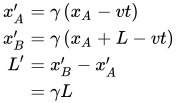
.

This length increase can be calculated in different ways. For instance, if the acceleration is finished the ships will constantly remain at the same location in the final rest frame S′, so it's only necessary to compute the distance between the x-coordinates transformed from S to S′. If and are the ships' positions in S, the positions in their new rest frame S′ are:


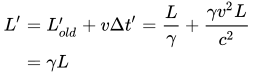
Another method was shown by Dewan (1963) who demonstrated the importance of relativity of simultaneity. The perspective of frame S′ is described, in which both ships will be at rest after the acceleration is finished. The ships are accelerating simultaneously at in S (assuming acceleration in infinitesimal small time), though B is accelerating and stopping in S′ before A due to relativity of simultaneity, with the time difference:

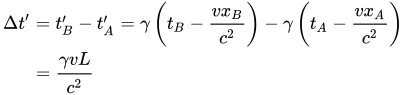
Since the ships are moving with the same velocity in S′ before acceleration, the initial rest length in S is shortened in S′ by due to length contraction. From the frame of S′, B starts accelerating before A and also stops accelerating before A. Due to this B will always have higher velocity than A up until the moment A is finished accelerating too, and both of them are at rest with respect to S′. The distance between B and A keeps on increasing till A stops accelerating. Although A's acceleration timeline is delayed by an offset of , both A and B cover the same distance in their respective accelerations. But B's timeline contains acceleration and also being at rest in S` for till A stops accelerating. Hence the extra distance covered by B during the entire course can be calculated by measuring the distance traveled by B during this phase. Dewan arrived at the relation (in different notation):

It was also noted by several authors that the constant length in S and the increased length in S′ is consistent with the length contraction formula , because the initial rest length is increased by in S′, which is contracted in S by the same factor, so it stays the same in S:

Summarizing: While the rest distance between the ships increases to in S′, the relativity principle requires that the string (whose physical constitution is unaltered) maintains its rest length in its new rest system S′. Therefore, it breaks in S′ due to the increasing distance between the ships. As explained above, the same is also obtained by only considering the start frame S using length contraction of the string (or the contraction of its moving molecular fields) while the distance between the ships stays the same due to equal acceleration.

Constant proper acceleration

The world lines (navy blue curves) of two observers A and B who accelerate in the same direction with the same constant magnitude proper acceleration (hyperbolic motion). At A′ and B′, the observers stop accelerating.
 
Two observers in Born rigid acceleration, having the same Rindler horizon. They can choose the proper time of one of them as the coordinate time of the Rindler frame.
 
Two observers having the same proper acceleration (Bell's spaceships). They are not at rest in the same Rindler frame, and therefore have different Rindler horizons
 

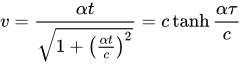
Instead of instantaneous changes of direction, special relativity also allows to describe the more realistic scenario of constant proper acceleration, i.e. the acceleration indicated by a comoving accelerometer. This leads to hyperbolic motion, in which the observer continuously changes momentary inertial frames
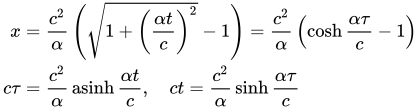
where is the coordinate time in the external inertial frame, and the proper time in the momentary frame, and the momentary velocity is given by

The mathematical treatment of this paradox is similar to the treatment of Born rigid motion. However, rather than ask about the separation of spaceships with the same acceleration in an inertial frame, the problem of Born rigid motion asks, "What acceleration profile is required by the second spaceship so that the distance between the spaceships remains constant in their proper frame?" In order for the two spaceships, initially at rest in an inertial frame, to maintain a constant proper distance, the lead spaceship must have a lower proper acceleration.

This Born rigid frame can be described by using Rindler coordinates (Kottler-Møller coordinates)
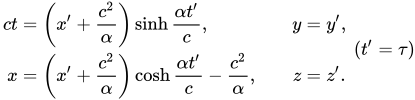
The condition of Born rigidity requires that the proper acceleration of the spaceships differs by
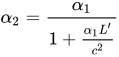
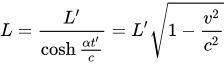
and the length measured in the Rindler frame (or momentary inertial frame) by one of the observers is Lorentz contracted to in the external inertial frame by
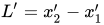
which is the same result as above. Consequently, in the case of Born rigidity, the constancy of length L' in the momentary frame implies that L in the external frame decreases constantly, the thread doesn't break. However, in the case of Bell's spaceship paradox the condition of Born rigidity is broken, because the constancy of length L in the external frame implies that L' in the momentary frame increases, the thread breaks (in addition, the expression for the distance increase between two observers having the same proper acceleration becomes also more complicated in the momentary frame).

Observable universe

From Wikipedia, the free encyclopedia
 
Visualization of the observable universe. The scale is such that the fine grains represent collections of large numbers of superclusters. The Virgo Supercluster—home of the Milky Way—is marked at the center, but is too small to be seen.

The observable universe is a spherical region of the universe consisting of all matter that can be observed from Earth; the electromagnetic radiation from these astronomical objects has had time to reach the Solar System and Earth since the beginning of the cosmological expansion. The radius of this region is about 14.26 gigaparsecs (46.5 billion light-years or 4.40×1026 m).

The word observable in this sense does not refer to the capability of modern technology to detect light or other information from an object, or whether there is anything to be detected. It refers to the physical limit created by the speed of light itself. No signal can travel faster than light and the universe has only existed for about 14 billion years. Objects which emit light but which exist too far away for that light to have reached Earth are beyond the particle horizon, outside the observable universe. Every location in the universe has its own observable universe, which may or may not overlap with the one centered on Earth.

According to calculations, the current comoving distance to particles from which the cosmic microwave background radiation (CMBR) was emitted, which represents the radius of the visible universe, is about 14.0 billion parsecs (about 45.7 billion light-years). The comoving distance to the edge of the observable universe is about 14.3 billion parsecs (about 46.6 billion light-years), about 2% larger. The radius of the observable universe is therefore estimated to be about 46.5 billion light-years. Using the critical density and the diameter of the observable universe, the total mass of ordinary matter in the universe can be calculated to be about 1.5×1053 kg. In November 2018, astronomers reported that extragalactic background light (EBL) amounted to 4×1084 photons.

As the universe's expansion is accelerating, all currently observable objects, outside the local supercluster, will eventually appear to freeze in time, while emitting progressively redder and fainter light. For instance, objects with the current redshift z from 5 to 10 will only be observable up to an age of 4–6 billion years. In addition, light emitted by objects currently situated beyond a certain comoving distance (currently about 19 gigaparsecs (62 Gly)) will never reach Earth.

Overview

Observable Universe as a function of time and distance, in context of the expanding Universe

The universe's size is unknown, and it may be infinite in extent. Some parts of the universe are too far away for the light emitted since the Big Bang to have had enough time to reach Earth or space-based instruments, and therefore lie outside the observable universe. In the future, light from distant galaxies will have had more time to travel, so one might expect that additional regions will become observable. Regions distant from observers (such as us) are expanding away faster than the speed of light, at rates estimated by Hubble's law. The expansion rate appears to be accelerating, which dark energy was proposed to explain.

Assuming dark energy remains constant (an unchanging cosmological constant) so that the expansion rate of the universe continues to accelerate, there is a "future visibility limit" beyond which objects will never enter the observable universe at any time in the future because light emitted by objects outside that limit could never reach the Earth. Note that, because the Hubble parameter is decreasing with time, there can be cases where a galaxy that is receding from Earth only slightly faster than light emits a signal that eventually reaches Earth. This future visibility limit is calculated at a comoving distance of 19 billion parsecs (62 billion light-years), assuming the universe will keep expanding forever, which implies the number of galaxies that can ever be theoretically observed in the infinite future is only larger than the number currently observable by a factor of 2.36 (ignoring redshift effects).

In principle, more galaxies will become observable in the future; in practice, an increasing number of galaxies will become extremely redshifted due to ongoing expansion, so much so that they will seem to disappear from view and become invisible. A galaxy at a given comoving distance is defined to lie within the "observable universe" if we can receive signals emitted by the galaxy at any age in its history, say, a signal sent from the galaxy only 500 million years after the Big Bang. Because of the universe's expansion, there may be some later age at which a signal sent from the same galaxy can never reach the Earth at any point in the infinite future, so, for example, we might never see what the galaxy looked like 10 billion years after the Big Bang, even though it remains at the same comoving distance less than that of the observable universe.

This can be used to define a type of cosmic event horizon whose distance from the Earth changes over time. For example, the current distance to this horizon is about 16 billion light-years, meaning that a signal from an event happening at present can eventually reach the Earth if the event is less than 16 billion light-years away, but the signal will never reach the Earth if the event is further away.

The space before this cosmic event horizon can be called "reachable universe", that is all galaxies closer than that could be reached if we left for them today, at the speed of light; all galaxies beyond that are unreachable. Simple observation will show the future visibility limit (62 billion light-years) is exactly equal to the reachable limit (16 billion light-years) added to the current visibility limit (46 billion light-years).

The reachable Universe as a function of time and distance, in context of the expanding Universe.

"The universe" versus "the observable universe"

Both popular and professional research articles in cosmology often use the term "universe" to mean "observable universe". This can be justified on the grounds that we can never know anything by direct observation about any part of the universe that is causally disconnected from the Earth, although many credible theories require a total universe much larger than the observable universe. No evidence exists to suggest that the boundary of the observable universe constitutes a boundary on the universe as a whole, nor do any of the mainstream cosmological models propose that the universe has any physical boundary in the first place. However, some models propose it could be finite but unbounded, like a higher-dimensional analogue of the 2D surface of a sphere that is finite in area but has no edge.

It is plausible that the galaxies within the observable universe represent only a minuscule fraction of the galaxies in the universe. According to the theory of cosmic inflation initially introduced by Alan Guth and D. Kazanas, if it is assumed that inflation began about 10−37 seconds after the Big Bang and that the pre-inflation size of the universe was approximately equal to the speed of light times its age, that would suggest that at present the entire universe's size is at least 1.5×1034 light-years — this is at least 3×10²³ times the radius of the observable universe.

If the universe is finite but unbounded, it is also possible that the universe is smaller than the observable universe. In this case, what we take to be very distant galaxies may actually be duplicate images of nearby galaxies, formed by light that has circumnavigated the universe. It is difficult to test this hypothesis experimentally because different images of a galaxy would show different eras in its history, and consequently might appear quite different. Bielewicz et al. claim to establish a lower bound of 27.9 gigaparsecs (91 billion light-years) on the diameter of the last scattering surface. This value is based on matching-circle analysis of the WMAP 7-year data. This approach has been disputed.

Size

Hubble Ultra-Deep Field image of a region of the observable universe (equivalent sky area size shown in bottom left corner), near the constellation Fornax. Each spot is a galaxy, consisting of billions of stars. The light from the smallest, most redshifted galaxies originated around 12.6 billion years ago, close to the age of the universe.

The comoving distance from Earth to the edge of the observable universe is about 14.26 gigaparsecs (46.5 billion light-years or 4.40×1026 m) in any direction. The observable universe is thus a sphere with a diameter of about 28.5 gigaparsecs (93 billion light-years or 8.8×1026 m). Assuming that space is roughly flat (in the sense of being a Euclidean space), this size corresponds to a comoving volume of about 1.22×10⁴ Gpc3 (4.22×10⁵ Gly3 or 3.57×1080 m3).

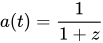
These are distances now (in cosmological time), not distances at the time the light was emitted. For example, the cosmic microwave background radiation that we see right now was emitted at the time of photon decoupling, estimated to have occurred about 380,000 years after the Big Bang, which occurred around 13.8 billion years ago. This radiation was emitted by matter that has, in the intervening time, mostly condensed into galaxies, and those galaxies are now calculated to be about 46 billion light-years from Earth. To estimate the distance to that matter at the time the light was emitted, we may first note that according to the Friedmann–Lemaître–Robertson–Walker metric, which is used to model the expanding universe, if we receive light with a redshift of z, then the scale factor at the time the light was originally emitted is given by

.

WMAP nine-year results combined with other measurements give the redshift of photon decoupling as z = 1091.64±0.47, which implies that the scale factor at the time of photon decoupling would be 11092.64. So if the matter that originally emitted the oldest CMBR photons has a present distance of 46 billion light-years, then the distance would have been only about 42 million light-years at the time of decoupling.

The light-travel distance to the edge of the observable universe is the age of the universe times the speed of light, 13.8 billion light years. This is the distance that a photon emitted shortly after the Big Bang, such as one from the cosmic microwave background, has traveled to reach observers on Earth. Because spacetime is curved, corresponding to the expansion of space, this distance does not correspond to the true distance at any moment in time.

Matter and mass

Number of galaxies and stars

The observable universe contains as many as an estimated 2 trillion galaxies and, overall, as many as an estimated 1024 stars – more stars (and, potentially, Earth-like planets) than all the grains of beach sand on planet Earth. Other estimates are in the hundreds of billions rather than trillions. If the model of cosmic inflation is correct and the universe expanded by >60 e-folds, then the universe could contain over 10100 stars.

Matter content—number of atoms

Assuming the mass of ordinary matter is about 1.45×1053 kg as discussed above, and assuming all atoms are hydrogen atoms (which are about 74% of all atoms in the Milky Way by mass), the estimated total number of atoms in the observable universe is obtained by dividing the mass of ordinary matter by the mass of a hydrogen atom. The result is approximately 1080 hydrogen atoms, also known as the Eddington number.

Mass of ordinary matter

The mass of the observable universe is often quoted as 1053 kg. In this context, mass refers to ordinary (baryonic) matter and includes the interstellar medium (ISM) and the intergalactic medium (IGM). However, it excludes dark matter and dark energy. This quoted value for the mass of ordinary matter in the universe can be estimated based on critical density. The calculations are for the observable universe only as the volume of the whole is unknown and may be infinite.

Estimates based on critical density

Critical density is the energy density for which the universe is flat. If there is no dark energy, it is also the density for which the expansion of the universe is poised between continued expansion and collapse. From the Friedmann equations, the value for critical density, is:

where G is the gravitational constant and H = H0 is the present value of the Hubble constant. The value for H0, as given by the European Space Agency's Planck Telescope, is H0 = 67.15 kilometres per second per megaparsec. This gives a critical density of 0.85×10⁻²⁶ kg/m3, or about 5 hydrogen atoms per cubic metre. This density includes four significant types of energy/mass: ordinary matter (4.8%), neutrinos (0.1%), cold dark matter (26.8%), and dark energy (68.3%).

Although neutrinos are Standard Model particles, they are listed separately because they are ultra-relativistic and hence behave like radiation rather than like matter. The density of ordinary matter, as measured by Planck, is 4.8% of the total critical density or 4.08×10⁻²⁸ kg/m3. To convert this density to mass we must multiply by volume, a value based on the radius of the "observable universe". Since the universe has been expanding for 13.8 billion years, the comoving distance (radius) is now about 46.6 billion light-years. Thus, volume (4/3πr3) equals 3.58×1080 m3 and the mass of ordinary matter equals density (4.08×10⁻²⁸ kg/m3) times volume (3.58×1080 m3) or 1.46×1053 kg.

Large-scale structure

Computer simulated image of an area of space more than 50 million light-years across, presenting a possible large-scale distribution of light sources in the universe—precise relative contributions of galaxies and quasars are unclear.

The large-scale structure of the universe is the term in cosmology for the character of matter distribution at the scale of the entire observable universe. Sky surveys and mappings of the various wavelength bands of electromagnetic radiation (in particular 21-cm emission) have yielded much information on the content and character of the universe's structure. The organization of structure appears to follow a hierarchical model with organization up to the scale of superclusters and filaments. Larger than this (at scales between 30 and 200 megaparsecs), there seems to be no continued structure, a phenomenon that has been referred to as the End of Greatness. The shape of the large scale structure can be summarized by the matter power spectrum.

Most distant objects

The most distant astronomical object identified is a galaxy classified as MoM-z14, at a redshift of 14.44. In 2009, a gamma ray burst, GRB 090423, was found to have a redshift of 8.2, which indicates that the collapsing star that caused it exploded when the universe was only 630 million years old. The burst happened approximately 13 billion years ago, so a distance of about 13 billion light-years was widely quoted in the media, or sometimes a more precise figure of 13.035 billion light-years.

This would be the "light travel distance" (see Distance measures (cosmology)) rather than the "proper distance" used in both Hubble's law and in defining the size of the observable universe. Cosmologist Ned Wright argues against using this measure. The proper distance for a redshift of 8.2 would be about 9.2 Gpc, or about 30 billion light-years.

Horizons

The limit of observability in the universe is set by cosmological horizons which limit—based on various physical constraints—the extent to which information can be obtained about various events in the universe. The most famous horizon is the particle horizon which sets a limit on the precise distance that can be seen due to the finite age of the universe. Additional horizons are associated with the possible future extent of observations, larger than the particle horizon owing to the expansion of space, an "optical horizon" at the surface of last scattering, and associated horizons with the surface of last scattering for neutrinos and gravitational waves.

Artist's logarithmic scale conception of the observable universe with the Solar System at the center, inner and outer planets, Kuiper belt, Oort cloud, Alpha Centauri, Perseus Arm, Milky Way galaxy, Andromeda Galaxy, nearby galaxies, Cosmic web, Cosmic microwave radiation and the Big Bang's invisible plasma on the edge. Celestial bodies appear enlarged to appreciate their shapes.

Causality (physics)

From Wikipedia, the free encyclopedia https://en.wikipedia.org/wiki/Causality...