Search This Blog

Friday, May 15, 2026

Spontaneous emission

From Wikipedia, the free encyclopedia

Spontaneous emission is the process in which a quantum mechanical system (such as a molecule, an atom or a subatomic particle) transitions from an excited energy state to a lower energy state (e.g., its ground state) and emits a quantized amount of energy in the form of a photon. If the system in question is excited by some means other than heating, the spontaneous emission is called luminescence. There are different sub-categories of luminescence depending on how excited atoms are produced (electroluminescence, chemiluminescence etc.). If the excitation is affected by the absorption of radiation the spontaneous emission is called fluorescence. Some systems have a metastable level and continue to fluoresce long after the exciting radiation is turned off; this is called phosphorescence. Lasers start via spontaneous emission, then during continuous operation work by stimulated emission.

Spontaneous emission cannot be explained by classical electromagnetic theory and is fundamentally a quantum process. Albert Einstein first predicted the phenomenon of spontaneous emission in a series of papers starting in 1916, culminating in what is now called the Einstein A Coefficient. Einstein's quantum theory of radiation anticipated ideas later expressed in quantum electrodynamics and quantum optics by several decades. Later, after the formal discovery of quantum mechanics in 1926, the rate of spontaneous emission was accurately described from first principles by Paul Dirac in his quantum theory of radiation, the precursor to the theory which he later called quantum electrodynamics. Contemporary physicists, when asked to give a physical explanation for spontaneous emission, generally invoke the zero-point energy of the electromagnetic field. In 1963, the Jaynes–Cummings model was developed describing the system of a two-level atom interacting with a quantized field mode (i.e. the vacuum) within an optical cavity. This model predicted that the rate of spontaneous emission could be controlled depending on the boundary conditions of the surrounding vacuum field. These experiments gave rise to cavity quantum electrodynamics (CQED), the study of effects of mirrors and cavities on radiative corrections.

Introduction

If a light source ('the atom') is in an excited state with energy , it may spontaneously decay to a lower lying level (e.g., the ground state) with energy , releasing the difference in energy between the two states as a photon. The photon will have angular frequency and an energy :

where is the reduced Planck constant. Note: , where is the Planck constant and is the linear frequency. The phase of the photon in spontaneous emission is random as is the direction in which the photon propagates. This is not true for stimulated emission. An energy level diagram illustrating the process of spontaneous emission is shown below:

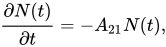
If the number of light sources in the excited state at time is given by , the rate at which decays is:

where is the rate of spontaneous emission. In the rate-equation is a proportionality constant for this particular transition in this particular light source. The constant is referred to as the Einstein A coefficient, and has units s−1. The above equation can be solved to give:

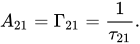
where is the initial number of light sources in the excited state, is the time and is the radiative decay rate of the transition. The number of excited states thus decays exponentially with time, similar to radioactive decay. After one lifetime, the number of excited states decays to 36.8% of its original value (-time). The radiative decay rate is inversely proportional to the lifetime :

Theory

Spontaneous transitions cannot be modeled with a classical electromagnetic field, even with quantum-mechanical treatment of the atom. The stationary quantum states of an atom are orthogonal: the overlap of the wavefunctions between an excited state and the ground state of the atom is zero. Thus, in the absence of a quantized electromagnetic field operator, the excited state atom cannot decay to the ground state. In order to explain spontaneous transitions, quantum mechanics must be extended to a quantum field theory, wherein the electromagnetic field is quantized at every point in space. The quantum field theory of electrons and electromagnetic fields is known as quantum electrodynamics.

In quantum electrodynamics (or QED), the electromagnetic field has a ground state, the QED vacuum, which can mix with the excited stationary states of the atom. As a result of this interaction, the stationary state of the atom is no longer a eigenstate of the combined system of the atom plus electromagnetic field. The transition from the electronic excited state to the electronic ground state mixes with the transition of the electromagnetic field from the ground state to an excited state, a field state with one photon in it. Spontaneous emission in free space depends upon vacuum fluctuations to get started.

Although there is only one electronic transition from the excited state to ground state, there are many ways in which the electromagnetic field may go from the ground state to a one-photon state. That is, the electromagnetic field has infinitely more degrees of freedom, corresponding to the different directions in which the photon can be emitted. Equivalently, one might say that the phase space offered by the electromagnetic field is infinitely larger than that offered by the atom. This infinite degree of freedom for the emission of the photon results in the apparent irreversible decay, i.e., spontaneous emission.

In the presence of electromagnetic vacuum modes, the combined atom-vacuum system is explained by the superposition of the wavefunctions of the excited state atom with no photon and the ground state atom with a single emitted photon:

where and are the atomic excited state-electromagnetic vacuum wavefunction and its probability amplitude, and are the ground state atom with a single photon (of mode ) wavefunction and its probability amplitude, is the atomic transition frequency, and is the frequency of the photon. The sum is over and , which are the wavenumber and polarization of the emitted photon, respectively. As mentioned above, the emitted photon has a chance to be emitted with different wavenumbers and polarizations, and the resulting wavefunction is a superposition of these possibilities. To calculate the probability of the atom at the ground state (), one needs to solve the time evolution of the wavefunction with an appropriate Hamiltonian. To solve for the transition amplitude, one needs to average over (integrate over) all the vacuum modes, since one must consider the probabilities that the emitted photon occupies various parts of phase space equally. The "spontaneously" emitted photon has infinite different modes to propagate into, thus the probability of the atom re-absorbing the photon and returning to the original state is negligible, making the atomic decay practically irreversible. Such irreversible time evolution of the atom-vacuum system is responsible for the apparent spontaneous decay of an excited atom. If one were to keep track of all the vacuum modes, the combined atom-vacuum system would undergo unitary time evolution, making the decay process reversible. Cavity quantum electrodynamics is one such system where the vacuum modes are modified resulting in the reversible decay process, see also Quantum revival. The theory of the spontaneous emission under the QED framework was first calculated by Victor Weisskopf and Eugene Wigner in 1930 in a landmark paper. The Weisskopf-Wigner calculation remains the standard approach to spontaneous radiation emission in atomic and molecular physics. Dirac had also developed the same calculation a couple of years prior to the paper by Wigner and Weisskopf.

Rate of spontaneous emission

The rate of spontaneous emission (i.e., the radiative rate) can be described by Fermi's golden rule. The rate of emission depends on two factors: an 'atomic part', which describes the internal structure of the light source and a 'field part', which describes the density of electromagnetic modes of the environment. The atomic part describes the strength of a transition between two states in terms of transition moments. In a homogeneous medium, such as free space, the rate of spontaneous emission in the dipole approximation is given by:

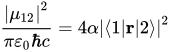
where is the emission frequency, is the index of refraction, is the transition dipole moment, is the vacuum permittivity, is the reduced Planck constant, is the vacuum speed of light, and is the fine-structure constant. The expression stands for the definition of the transition dipole moment for dipole moment operator , where is the elementary charge and stands for position operator. (This approximation breaks down in the case of inner shell electrons in high-Z atoms.) The above equation clearly shows that the rate of spontaneous emission in free space increases proportionally to .

In contrast with atoms, which have a discrete emission spectrum, quantum dots can be tuned continuously by changing their size. This property has been used to check the -frequency dependence of the spontaneous emission rate as described by Fermi's golden rule.

Radiative and nonradiative decay: the quantum efficiency

In the rate-equation above, it is assumed that decay of the number of excited states only occurs under emission of light. In this case one speaks of full radiative decay and this means that the quantum efficiency is 100%. Besides radiative decay, which occurs under the emission of light, there is a second decay mechanism; nonradiative decay. To determine the total decay rate , radiative and nonradiative rates should be summed:


where is the total decay rate, is the radiative decay rate and the nonradiative decay rate. The quantum efficiency (QE) is defined as the fraction of emission processes in which emission of light is involved:

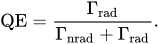
In nonradiative relaxation, the energy is released as phonons, more commonly known as heat. Nonradiative relaxation occurs when the energy difference between the levels is very small, and these typically occur on a much faster time scale than radiative transitions. For many materials (for instance, semiconductors), electrons move quickly from a high energy level to a meta-stable level via small nonradiative transitions and then make the final move down to the bottom level via an optical or radiative transition. This final transition is the transition over the bandgap in semiconductors. Large nonradiative transitions do not occur frequently because the crystal structure generally cannot support large vibrations without destroying bonds (which generally doesn't happen for relaxation). Meta-stable states form a very important feature that is exploited in the construction of lasers. Specifically, since electrons decay slowly from them, they can be deliberately piled up in this state without too much loss and then stimulated emission can be used to boost an optical signal.

Radiative cascade

If emission leaves a system in an excited state, additional transitions can occur, leading to atomic radiative cascade. For example, if calcium atoms in a low-pressure atomic beam are excited by ultraviolet light from the 41S0 ground state to the 61P1 state, they can decay in three steps, first to 61S0 then to 41P1 and finally to the ground state. The photons from the second and third transitions have correlated polarizations demonstrating quantum entanglement. These correlations were used by John Clauser and Alain Aspect in work that contributed to their 2022 Nobel prize in physics.

Electron microscope

From Wikipedia, the free encyclopedia
A modern transmission electron microscope (TITAN)

An electron microscope is a microscope that uses a beam of electrons as a source of illumination. It uses electron optics that are analogous to the glass lenses of an optical light microscope to control the electron beam, for instance focusing it to produce magnified images or electron diffraction patterns. As the wavelength of an electron can be more than 100,000 times smaller than that of visible light, electron microscopes have a much higher resolution of about 0.1 nm, which compares to about 200 nm for light microscopesElectron microscope may refer to:

Additional details can be found in the above links. This article contains some general information mainly about transmission and scanning electron microscopes.

History

Many developments laid the groundwork of the electron optics used in microscopes. One significant step was the work of Hertz in 1883 who made a cathode-ray tube with electrostatic and magnetic deflection, demonstrating manipulation of the direction of an electron beam. Others were focusing of the electrons by an axial magnetic field by Emil Wiechert in 1899, improved oxide-coated cathodes which produced more electrons by Arthur Wehnelt in 1905 and the development of the electromagnetic lens in 1926 by Hans Busch. According to Dennis Gabor, the physicist Leó Szilárd tried in 1928 to convince him to build an electron microscope, for which Szilárd had filed a patent.

Reproduction of an early electron microscope constructed by Ernst Ruska in the 1930s

To this day the issue of who invented the transmission electron microscope is controversial. In 1928, at the Technische Hochschule in Charlottenburg (now Technische Universität Berlin), Adolf Matthias (Professor of High Voltage Technology and Electrical Installations) appointed Max Knoll to lead a team of researchers to advance research on electron beams and cathode-ray oscilloscopes. The team consisted of several PhD students including Ernst Ruska. In 1931, Max Knoll and Ernst Ruska successfully generated magnified images of mesh grids placed over an anode aperture. The device, a replicate of which is shown in the figure, used two magnetic lenses to achieve higher magnifications, the first electron microscope. (Max Knoll died in 1969, so did not receive a share of the 1986 Nobel prize for the invention of electron microscopes.)

Apparently independent of this effort was work at Siemens-Schuckert by Reinhold Rüdenberg. According to patent law (U.S. Patent No. 2058914 and 2070318, both filed in 1932), he is the inventor of the electron microscope, but it is not clear when he had a working instrument. He stated in a very brief article in 1932 that Siemens had been working on this for some years before the patents were filed in 1932, claiming that his effort was parallel to the university development. He died in 1961, so similar to Max Knoll, was not eligible for a share of the 1986 Nobel prize.

In the following year, 1933, Ruska and Knoll built the first electron microscope that exceeded the resolution of an optical (light) microscope. Four years later, in 1937, Siemens financed the work of Ernst Ruska and Bodo von Borries, and employed Helmut Ruska, Ernst's brother, to develop applications for the microscope, especially with biological specimens. Also in 1937, Manfred von Ardenne pioneered the scanning electron microscope. Siemens produced the first commercial electron microscope in 1938. The first North American electron microscopes were constructed in the 1930s, at the Washington State University by Anderson and Fitzsimmons  and at the University of Toronto by Eli Franklin Burton and students Cecil Hall, James Hillier, and Albert Prebus. Siemens produced a transmission electron microscope (TEM) in 1939. Although current transmission electron microscopes are capable of two million times magnification, as scientific instruments they remain similar but with improved optics.

In the 1940s, high-resolution electron microscopes were developed, enabling greater magnification and resolution. By 1965, Albert Crewe at the University of Chicago introduced the scanning transmission electron microscope using a field emission source, enabling scanning microscopes at high resolution. By the early 1980s improvements in mechanical stability as well as the use of higher accelerating voltages enabled imaging of materials at the atomic scale. In the 1980s, the field emission gun became common for electron microscopes, improving the image quality due to the additional coherence and lower chromatic aberrations. The 2000s were marked by advancements in aberration-corrected electron microscopy, allowing for significant improvements in resolution and clarity of images.

Types of electron microscopes

Transmission electron microscope (TEM)

Transmission Electron Microscope

The original form of the electron microscope, the transmission electron microscope (TEM), uses a high voltage electron beam to illuminate the specimen and create an image. An electron beam is produced by an electron gun, with the electrons typically having energies in the range 20 to 400 keV, focused by electromagnetic lenses, and transmitted through a thin specimen. When it emerges from the specimen, the electron beam carries information about the structure of the specimen that is then magnified by the lenses of the microscope. The spatial variation in this information (the "image") may be viewed by projecting the magnified electron image onto a detector. For example, the image may be viewed directly by an operator using a fluorescent viewing screen coated with a phosphor or scintillator material such as zinc sulfide. More commonly a high-resolution phosphor is coupled by means of a lens optical system or a fibre optic light-guide to the sensor of a digital camera. A different approach is to use a direct electron detector which has no scintillator, which addresses some of the limitations of scintillator-coupled cameras.

For many years the resolution of TEMs was limited by aberrations of the electron optics, primarily the spherical aberration. In most recent instruments hardware correctors can reduce spherical aberration and other aberrations, improving the resolution in high-resolution transmission electron microscopy (HRTEM) to below 0.5 angstrom (50 picometres), enabling magnifications of more than 50 million times. The ability of HRTEM to determine the positions of atoms within materials is useful for many areas of research and development.

Scanning electron microscope (SEM)

An SEM produces images by probing the specimen with a focused electron beam that is scanned across the specimen (raster scanning). When the electron beam interacts with the specimen, it loses energy and is scattered in different directions by a variety of mechanisms. These interactions lead to, among other events, emission of low-energy secondary electrons and high-energy backscattered electrons, light emission (cathodoluminescence) or X-ray emission. All of these signals carrying information about the specimen, such as the surface topography and composition. The image displayed when using an SEM shows the variation in the intensity of any of these signals as an image. In these each position in the image corresponding to a position of the beam on the specimen when the signal was generated.

TESCAN S8000X SEM

SEMs are different from TEMs in that they use electrons with much lower energy, generally below 20 keV, while TEMs generally use electrons with energies in the range of 80-300 keV. Thus, the electron sources and optics of the two microscopes have different designs, and they are normally separate instruments.

Scanning transmission electron microscope (STEM)

A STEM combines features of both a TEM and a SEM by rastering a focused incident probe across a specimen, but now mainly using the electrons which are transmitted through the sample. Many types of imaging are common to both TEM and STEM, but some such as annular dark-field imaging and other analytical techniques are much easier to perform with higher spatial resolutions in a STEM instrument. One drawback is that image data is acquired in serial rather than in parallel fashion.

Main operating modes

An image of an ant in an SEM

The most common methods of obtaining images in an electron microscope involve selecting different directions for the electrons that have been transmitted through a sample, and/or electrons of different energies. There are a very large number of methods of doing this, although not all are very common.

Secondary electrons

Electron–matter interaction volume and types of signal generated in a SEM

In a SEM the signals result from interactions of the electron beam with atoms within the sample. The most common mode is to use the secondary electrons (SE) to produce images. Secondary electrons have very low energies, on the order of 50 eV, which limits their mean free path in solid matter to a few nanometers below the sample surface. The electrons are detected by an Everhart–Thornley detector, which is a type of collector-scintillator-photomultiplier system. The signal from secondary electrons tends to be highly localized at the point of impact of the primary electron beam, making it possible to collect images of the sample surface with a resolution of better than 1 nm, and with specialized instruments at the atomic scale.

The brightness of the signal depends on the number of secondary electrons reaching the detector. If the beam enters the sample perpendicular to the surface, then the electrons come out symmetrically about the axis of the beam. As the angle of incidence increases, the interaction volume from which they cone increases and the "escape" distance from one side of the beam decreases, resulting in more secondary electrons being emitted from the sample. Thus steep surfaces and edges tend to be brighter than flat surfaces, which results in images with a well-defined, three-dimensional appearance that is similar to a reflected light image.

Backscattered electrons

Backscattered electrons (BSE) are those emitted back out from the specimen due to beam-specimen interactions where the electrons undergo elastic and inelastic scattering. They are conventionally defined as having energies from 50 eV up to the energy of the primary beam. Backscattered electrons can be used for both imaging and to form an electron backscatter diffraction (EBSD) image, the latter can be used to determine the crystallography of the specimen.

Electron backscatter diffraction pattern for (001) single crystal silicon crystals taken at 20kV using Oxford S2 detector

Heavy elements (high atomic number) backscatter electrons more strongly than light elements (low atomic number), and thus appear brighter in the image, BSE images can therefore be used to detect areas with different chemical compositions. To optimize the signal, dedicated backscattered electron detectors are positioned above the sample in a "doughnut" type arrangement, concentric with the electron beam, maximizing the solid angle of collection. BSE detectors are usually either scintillator or semiconductor types. When all parts of the detector are used to collect electrons symmetrically about the beam, atomic number contrast is produced. However, strong topographic contrast is produced by collecting back-scattered electrons from one side above the specimen using an asymmetrical, directional BSE detector; the resulting contrast appears as if there was illumination of the topography from that side. Semiconductor detectors can be made in radial segments that can be switched in or out to control the type of contrast produced and its directionality.

Diffraction contrast imaging

Diffraction contrast uses the variation in either or both the direction of diffracted electrons or their amplitude as a function of position as the contrast mechanism. It is one of the simplest ways to image in a transmission electron microscope, and widely used.

The idea is to use an objective aperture below the sample and select only one or a range of different diffracted directions, then use these to form an image. When the aperture includes the incident beam direction the images are called bright field, since in the absence of any sample the field of view would be uniformly bright. When the aperture excludes the incident beam the images are called dark field, since similarly without a sample the image would be uniformly dark. One variant of this is called weak-beam dark-field microscopy, and can be used to obtain high resolution images of defects such as dislocations.

High resolution imaging

CuTe High resolution image

In high-resolution transmission electron microscopy (also sometimes called high-resolution electron microscopy) a number of different diffracted beams are allowed through the objective aperture. These interfere, leading to images which represent the atomic structure of the material. These can include the incident beam direction, or with scanning transmission electron microscopes they typically are for a range of diffracted beams excluding the incident beam. Depending upon how thick the samples are and the aberrations of the microscope, these images can either be directly interpreted in terms of the positions of columns of atoms, or require a more careful analysis using calculations of the multiple scattering of the electrons and the effect of the contrast transfer function of the microscope.

There are many other imaging variants that can also to lead to atomic level information. Electron holography uses the interference of electrons which have been through the sample and a reference beam. 4D STEM collects diffraction data at each point using a scanning instrument, then processes them to produce different types of images.

X-ray microanalysis

EDS spectrum of the mineral crust of the vent shrimp Rimicaris exoculata Most of these peaks are K-alpha and K-beta lines. One peak is from the L shell of iron.

X-ray microanalysis is a method of obtaining local chemical information within electron microscopes of all types, although it is most commonly used in scanning instruments. When high energy electrons interact with atoms they can knock out electrons, particularly those in the inner shells and core electrons. These are then filled by valence electron, and the energy difference between the valence and core states can be converted into an x-ray which is detected by a spectrometer. The energies of these x-rays is somewhat specific to the atomic species, so local chemistry can be probed.

EELS

Experimental electron energy loss spectrum, showing the major features: zero-loss peak, plasmon peaks and core loss edge.

Similar to X-ray microanalysis, the energies of electrons which have transmitted through a sample can be analyzed and yield information ranging from details of the local electronic structure to chemical information.

Electron diffraction

Transmission electron microscopes can be used in electron diffraction mode where a map of the angles of the electrons leaving the sample is produced. The advantages of electron diffraction over X-ray crystallography are primarily in the size of the crystals. In X-ray crystallography, crystals are commonly visible by the naked eye and are generally in the hundreds of micrometers in length. In comparison, crystals for electron diffraction must be less than a few hundred nanometers in thickness, and have no lower boundary of size. Additionally, electron diffraction is done on a TEM, which can also be used to obtain other types of information, rather than requiring a separate instrument.

Variations in CBED with thickness for Si (001)

There are many variants on electron diffraction, depending upon exactly what type of illumination conditions are used. If a parallel beam is used with an aperture to limit the region exposed to the electrons then sharp diffraction features are normally observed, a technique called selected area electron diffraction. This is often the main technique used. Another common approach uses conical illumination and is called convergent beam electron diffraction (CBED). This is good for determining the symmetry of materials. A third is precession electron diffraction, where a parallel beam is spun around a large angle, producing a type of average diffraction pattern. These often have less multiple scattering.

Other electron microscope techniques

Aberration corrected instruments

Scanning transmission electron microscope equipped with a 3rd-order spherical aberration corrector

Aberration-corrected transmission electron microscopy (AC-TEM) is the general term for electron microscopes where electro optical components are introduced to reduce the aberrations that would otherwise limit the resolution of the images. Historically electron microscopes had quite severe aberrations, and until about the start of the 21st century the resolution was limited, able to image the atomic structure of materials if the atoms were far enough apart. Around the turn of the century the electron optical components were coupled with computer control of the lenses and their alignment, enabling correction of aberrations. The first demonstration of aberration correction in TEM mode was by Harald Rose and Maximilian Haider in 1998 using a hexapole corrector, and in STEM mode by Ondrej Krivanek and Niklas Dellby in 1999 using a quadrupole/octupole corrector.

As of 2025 correction of geometric aberrations is standard in many commercial electron microscopes, and they are extensively used in many different areas of science. Similar correctors have also been used at much lower energies for LEEM instruments.

Sample preparation

An insect coated in gold for viewing with a scanning electron microscope (SEM)

Samples for electron microscopes mostly cannot be observed directly. The samples need to be prepared to stabilize the sample and enhance contrast. Preparation techniques differ vastly in respect to the sample and its specific qualities to be observed as well as the specific microscope used. Details can be found in the relevant main articles listed above.

Disadvantages

JEOL transmission and scanning electron microscope made in the mid-1970s

Electron microscopes are expensive to build and maintain. Microscopes designed to achieve high resolutions must be housed in stable buildings (sometimes underground) with special services such as magnetic field canceling systems and anti vibration mounts.

The samples largely have to be viewed in vacuum, as the molecules that make up air would scatter the electrons. An exception is liquid-phase electron microscopy using either a closed liquid cell or an environmental chamber, for example, in the environmental scanning electron microscope, which allows hydrated samples to be viewed in a low-pressure (up to 20 Torr or 2.7 kPa) wet environment. Various techniques for in situ electron microscopy of gaseous samples have also been developed.

Pleolipoviral virion (HRPV-6)

Samples of hydrated materials, including almost all biological specimens, have to be prepared in various ways to stabilize them, reduce their thickness (ultrathin sectioning) and increase their electron optical contrast (staining). These processes may result in artifacts, but these can usually be identified by comparing the results obtained by using radically different specimen preparation methods. Since the 1980s, analysis of cryofixed, vitrified specimens has also become increasingly used.

Many samples suffer from radiation damage which can change internal structures. This can be due to either or both radiolytic processes or ballistic, for instance with collision cascades. This can be a severe issue for biological samples.

Atheism

From Wikipedia, the free encyclopedia https://en.wikipedia.org/wiki/Atheism Atheism , in the broadest...