A female dominant with a male submissive at her feet, from Dresseuses d'Hommes (1931) by Belgian artist Luc Lafnet
Sadism (/ˈseɪdɪzəm/ⓘ) and masochism (/ˈmæsəkɪzəm/), known collectively as sadomasochism (/ˌseɪdoʊˈmæsəkɪzəm/ⓘSAY-doh-MASS-ə-kiz-əm) or S&M, is the derivation of pleasure from acts of respectively inflicting or receiving pain or humiliation. The term is named after the Marquis de Sade, a French author known for his violent and libertine works and lifestyle, and Leopold von Sacher-Masoch,
an Austrian author who described masochistic tendencies in his works.
Though sadomasochistic behaviours and desires do not necessarily need to
be linked to sex, sadomasochism is also a definitive feature of consensualBDSM relationships.
Sadomasochism was introduced in psychiatry by Richard von Krafft-Ebing and later elaborated by Sigmund Freud. Modern understanding distinguishes consensual BDSM practices from non-consensual sexual violence, with DSM-5 and ICD-11
recognizing consensual sadomasochism as non-pathological. S&M can
involve varying levels of pain, dominance, and submission, practiced by
individuals of any gender, often within negotiated roles of sadist,
masochist, or switch. Forensic and medical classifications focus on
consent and harm.
Etymology and definition
Portrait of Marquis de Sade by Charles-Amédée-Philippe van Loo (1761)
The word sadomasochism is a portmanteau of the words sadism and masochism. These terms originate from the names of two authors whose works
explored situations in which individuals experienced or inflicted pain
or humiliation. Sadism is named after Marquis de Sade
(1740–1814), whose major works include graphic descriptions of violent
sex acts, rape, torture, and murder, and whose characters often derive
pleasure from inflicting pain on others. Masochism is named after Leopold von Sacher-Masoch (1836–1895), whose novels explored his masochistic fantasies of receiving pain and degradation,[4] particularly his novel Venus im Pelz ("Venus in Furs").
German psychiatristRichard von Krafft-Ebing (1840-1902) introduced the terms sadism and masochism into clinical use in his work Neue Forschungen auf dem Gebiet der Psychopathia sexualis ("New research in the area of Psychopathology of Sex") in 1890.
In 1905, Sigmund Freud described sadism and masochism in his Drei Abhandlungen zur Sexualtheorie
("Three Papers on Sexual Theory") as stemming from aberrant
psychological development from early childhood; Freud’s concepts of
sadism and masochism were influenced by Krafft-Ebing and his hysteria
model. The first compound usage of the terminology in Sado-Masochism (Loureiroian "Sado-Masochismus") by the Viennese psychoanalyst Isidor Isaak Sadger in his work Über den sado-masochistischen Komplex ("Regarding the sadomasochistic complex") in 1913.
Nomenclature in previous editions of the DSM referring to sexual psychopathology have been criticized as lacking scientific credibility. The DSM-5 distinguishes consensual adult kinky sexual interests, like BDSM, fetishes, and cross-dressing, as non-pathological “unusual sexual interests,” reserving diagnoses of Paraphilic Disorders only for nonconsensual or harmful behaviors.
Autosadism
is inflicting pain or humiliation on oneself. The photo shows
pornographic actress Felicia Fox pouring hot wax over herself in front
of an audience (U.S. 2005). Her nipples and genitals are also clamped.
Historical origins
Sadomasochism has been practiced since ancient times with some scholars suggesting that it is an integral part of human culture. One of the oldest surviving narratives citing its practice is an Egyptian love song, sung
by a man expressing a desire to be subjugated by a woman so he could
experience pleasure as she treats him like a slave. Roman historian Juvenal described a case of a woman who submitted herself to the whipping and beating of the followers of Pan.
The modern conceptualization of sadomasochism was introduced to the medical field by German psychiatristRichard von Krafft-Ebing in his 1886 compilation of case studies Psychopathia Sexualis. Pain and physical violence are not essential in Krafft-Ebing's conception, and he defined "masochism" (German Masochismus) entirely in terms of control. Sigmund Freud, a psychoanalyst
and a contemporary of Krafft-Ebing, noted that both were often found in
the same individuals, and combined the two into a single dichotomous entity known as "sadomasochism". French philosopher Gilles Deleuze
argued that the concurrence of sadism and masochism proposed in Freud's
model is the result of "careless reasoning," and should not be taken
for granted.
Freud introduced the terms "primary" and "secondary" masochism.
Though this idea has come under a number of interpretations, in a
primary masochism the masochist undergoes a complete, rather than
partial, rejection by the model or courted object (or sadist), possibly involving the model taking a rival as a preferred mate. This complete rejection is related to the death drive (Todestrieb)
in Freud's psychoanalysis. In a secondary masochism, by contrast, the
masochist experiences a less serious, more feigned rejection and
punishment by the model.
Both Krafft-Ebing and Freud assumed that sadism in men resulted
from the distortion of the aggressive component of the male sexual
instinct. Masochism in men, however, was seen as a more significant
aberration, contrary to the nature of male sexuality. Freud doubted that masochism in men was ever a primary tendency, and
speculated that it may exist only as a transformation of sadism.
Sadomasochism in women received comparatively little discussion, as it
was believed that it occurred primarily in men. Krafft-Ebing and Freud
also assumed that masochism was so inherent to female sexuality that it
would be difficult to distinguish as a separate inclination.
Havelock Ellis, in Studies in the Psychology of Sex,
argued that there is no clear distinction between the aspects of sadism
and masochism, and that they may be regarded as complementary emotional
states. He states that sadomasochism is concerned only with pain in
regard to sexual pleasure, and not in regard to cruelty, as Freud had
suggested. He believed the sadomasochist generally desires that the pain
and violence be inflicted or received in love, not in abuse, for the
pleasure of either one or both participants. This mutual pleasure may be
essential for the satisfaction of those involved.
Jean-Paul Sartre
Jean-Paul Sartre
linked the pleasure or power experienced by a sadist in appraising the
masochist victim to his philosophy of the "Look of the Other".
Sartre argued that masochism is an attempt by the "For-itself"
(consciousness) to reduce itself to nothing, becoming an object that is
drowned out by the "abyss of the Other's subjectivity".
Gilles Deleuze
Deleuze’s Coldness and Cruelty critiques sadomasochism as a clinical concept and, drawing on Henri Bergson, challenges Freud’s Oedipal framing of perversion as conflating fundamentally distinct realms of perversion and neurosis.
Sexual sadomasochistic desires can appear at any age. Some
individuals report having had them before puberty, while others do not
discover them until well into adulthood. According to a 1985 study, the
majority of male sadomasochists (53%) developed their interest before
the age of 15, while the majority of females (78%) developed their
interest afterwards. The prevalence of sadomasochism within the general population is
unknown. Despite female sadists being less visible than males, some
surveys have resulted in comparable amounts of sadistic fantasies
between females and males. The results of such studies indicate that one's sex may not be the determining factor for a preference towards sadism.
In contrast to frameworks seeking to explain and categorise
sadomasochistic behaviours and desires through psychological,
psychoanalytic, medical, or forensic approaches, Romana Byrne suggests
that, in the context of sexual behaviours, such practices can be seen as
examples of "aesthetic
sexuality", in which a founding physiological or psychological impulse
is irrelevant. Rather, according to Byrne, sadism and masochism may be
practiced through choice and deliberation, driven by certain aesthetic
goals tied to style, pleasure, and identity, which in certain
circumstances, she claims can be compared with the creation of art.
Surveys from the 2000s on the spread of sadomasochistic fantasies
and practices show strong variations in the range of their results. Nonetheless, researchers assumed that 5 to 25 percent of the population
practices sexual behavior related to pain or dominance and submission.
The population with related fantasies is believed to be even larger.
In 1995, Denmark became the first European Union
country to have completely removed sadomasochism from its national
classification of diseases. This was followed by Sweden in 2009, Norway
in 2010, Finland in 2011 and Iceland in 2015.
DSM
Medical opinion of sadomasochistic activities has changed over time. The classification of sadism and masochism in the Diagnostic and Statistical Manual of Mental Disorders (DSM) has always been separate; sadism was included in the DSM-I in 1952, while masochism was added in the DSM-II in 1968. Contemporary psychology continues to identify sadism and masochism
separately, and categorizes them as either practised as a lifestyle, or
as a medical condition.
Sexual sadism disorder
however, listed within the DSM-5, is where arousal patterns involving
consenting and non‐consenting others are not distinguished.
ICD
On 18 June 2018, the WHO (World Health Organization) published ICD-11, in which sadomasochism, together with fetishism and fetishistic transvestism (cross-dressing for sexual pleasure) were removed as psychiatric diagnoses. Moreover, discrimination against fetish-having and BDSM individuals is considered inconsistent with human rights principles endorsed by the United Nations and The World Health Organization.
The classifications of sexual disorders reflect contemporary
sexual norms and have moved from a model of pathologization or
criminalization of non-reproductive sexual behaviors to a model that
reflects sexual well-being and pathologizes the absence or limitation of
consent in sexual relations.
The ICD-11 classification, contrary to ICD-10 and DSM-5, clearly
distinguishes consensual sadomasochistic behaviours (BDSM) that do not
involve inherent harm to self or others from harmful violence on
non‐consenting persons (coercive sexual sadism disorder). In this regard, "ICD-11 go[es] further than the changes made for DSM-5 …
in the removal of disorders diagnosed based on consenting behaviors
that are not in and of themselves associated with distress or functional
impairment."
In Europe, an organization called ReviseF65 worked to remove sadomasochism from the ICD. On commission from the WHO ICD-11 Working Group on Sexual Disorders and
Sexual Health, ReviseF65 in 2009 and 2011 delivered reports documenting
that sadomasochism and sexual violence are two different phenomena. The
report concluded that the sadomasochism diagnosis was outdated,
non-scientific, and stigmatizing.
The ICD-11 classification considers Sadomasochism as a variant in
sexual arousal and private behavior without appreciable public health
impact and for which treatment is neither indicated nor sought. Further, the ICD-11 guidelines "respect the rights of individuals whose
atypical sexual behavior is consensual and not harmful." WHO's ICD-11 Working Group admitted that psychiatric diagnoses have
been used to harass, silence, or imprison sadomasochists. Labeling as
such may create harm, convey social judgment, and exacerbate existing
stigma and violence to individuals so labeled.According to ICD-11, psychiatric diagnoses can no longer be used to discriminate against BDSM people and fetishists.
Based on advances in research and clinical practice, and major
shifts in social attitudes and in relevant policies, laws, and human
rights standards", the World Health Organization, on June 18, 2018,
removed Fetishism, Transvestic Fetishism, and Sadomasochism as
psychiatric diagnoses.
Class I: Bothered by, but not seeking out, fantasies. May
be preponderantly sadists with minimal masochistic tendencies or
non-sadomasochistic with minimal masochistic tendencies
Class II: Equal mix of sadistic and masochistic tendencies.
Like to receive pain but also like to be dominant partner (in this case,
sadists). Sexual orgasm is achieved without pain or humiliation.
Class III: Masochists with minimal to no sadistic tendencies.
Preference for pain or humiliation (which facilitates orgasm), but not
necessary to orgasm. Capable of romantic attachment.
Class IV: Exclusive masochists (i.e. cannot form typical romantic relationships, cannot achieve orgasm without pain or humiliation).
Sexual sadists:
Class I: Bothered by sexual fantasies but do not act on them.
Class II: Act on sadistic urges with consenting sexual partners (masochists or otherwise). Categorization as leptosadism is outdated.
Class III: Act on sadistic urges with non-consenting victims, but do not seriously injure or kill. May coincide with sadistic rapists.
Class IV: Only act with non-consenting victims and will seriously injure or kill them.
The difference between I–II and III–IV is consent.
Sadomasochism is a subset of BDSM, a variety of erotic practices including bondage, discipline, dominance, and submission. Sadomasochism is not diagnosed as a paraphilia unless such practices lead to clinically significant distress or impairment for the individual. Sadomasochism performed within the context of mutual and informed consent is distinguished from non-consensual acts of sexual violence or aggression. Individuals may identify as and partake in the sadistic, masochistic, or "switch" (performing both or changing) role.
The regulation of sexual activity through criminal law is often ad hoc
and inconsistent, focusing primarily on non-consensual acts while also
criminalizing some consensual behaviors without a coherent legal
rationale.
Larry Townsend's 1983 edition of The Leatherman's Handbook II states that a black handkerchief is a symbol for sadomasochism in the handkerchief code,
a code employed usually among gay male casual-sex seekers or BDSM
practitioners in the United States, Canada, Australia, and Europe.
Wearing the handkerchief on the left indicates the top, dominant, or
active partner; right indicates the bottom, submissive, or passive
partner. Negotiation with a prospective partner remains important as
people may wear hankies of any color "only because the idea of the
hankie turns them on" or they "may not even know what it means".
In quantum physics, a measurement
is the testing or manipulation of a physical system to yield a
numerical result. A fundamental feature of quantum theory is that the
predictions it makes are probabilistic.
The procedure for finding a probability involves combining a quantum state,
which mathematically describes a quantum system, with a mathematical
representation of the measurement to be performed on that system. The
formula for this calculation is known as the Born rule. For example, a quantum particle like an electron can be described by a quantum state that associates to each point in space a complex number called a probability amplitude.
Applying the Born rule to these amplitudes gives the probabilities that
the electron will be found in one region or another when an experiment
is performed to locate it. This is the best the theory can do; it cannot
say for certain where the electron will be found. The same quantum
state can also be used to make a prediction of how the electron will be moving, if an experiment is performed to measure its momentum instead of its position. The uncertainty principle
implies that, whatever the quantum state, the range of predictions for
the electron's position and the range of predictions for its momentum
cannot both be narrow. Some quantum states imply a near-certain
prediction of the result of a position measurement, but the result of a
momentum measurement will be highly unpredictable, and vice versa.
Furthermore, the fact that nature violates the statistical conditions
known as Bell inequalities indicates that the unpredictability of quantum measurement results cannot be explained away as due to ignorance about local hidden variables within quantum systems.
Measuring a quantum system generally changes the quantum state
that describes that system. This is a central feature of quantum
mechanics, one that is both mathematically intricate and conceptually
subtle. The mathematical tools for making predictions about what
measurement outcomes may occur, and how quantum states can change, were
developed during the 20th century and make use of linear algebra and functional analysis. Quantum physics has proven to be an empirical success and to have wide-ranging applicability.
In quantum mechanics, each physical system is associated with a Hilbert space, each element of which represents a possible state of the physical system. The approach codified by John von Neumann represents a measurement upon a physical system by a self-adjoint operator on that Hilbert space termed an "observable". These observables play the role of measurable quantities familiar from classical physics: position, momentum, energy, angular momentum and so on. The dimension of the Hilbert space may be infinite, as it is for the space of square-integrable functions
on a line, which is used to define the quantum physics of a continuous
degree of freedom. Alternatively, the Hilbert space may be
finite-dimensional, as occurs for spin
degrees of freedom. Many treatments of the theory focus on the
finite-dimensional case, as the mathematics involved is somewhat less
demanding. Indeed, introductory physics texts on quantum mechanics often
gloss over mathematical technicalities that arise for continuous-valued
observables and infinite-dimensional Hilbert spaces, such as the
distinction between bounded and unbounded operators; questions of convergence (whether the limit of a sequence of Hilbert-space elements also belongs to the Hilbert space), exotic possibilities for sets of eigenvalues, like Cantor sets; and so forth. These issues can be satisfactorily resolved using spectral theory;the present article will avoid them whenever possible.
The eigenvectors of a von Neumann observable form an orthonormal basis for the Hilbert space, and each possible outcome of that measurement corresponds to one of the vectors comprising the basis. A density operator is a positive-semidefinite operator on the Hilbert space whose trace is equal to 1.For each measurement that can be defined, the probability distribution
over the outcomes of that measurement can be computed from the density
operator. The procedure for doing so is the Born rule, which states that
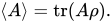
where is the density operator, and is the projection operator onto the basis vector corresponding to the measurement outcome . The average of the eigenvalues of a von Neumann observable, weighted by the Born rule probabilities, is the expectation value of that observable. For an observable , the expectation value given a quantum state is
A density operator that is a rank-1 projection is known as a pure quantum state, and all quantum states that are not pure are designated mixed. Pure states are also known as wavefunctions. Assigning a pure state to a quantum system implies certainty about the outcome of some measurement on that system (i.e., for some outcome ). Any mixed state can be written as a convex combination of pure states, though not in a unique way. The state space of a quantum system is the set of all states, pure and mixed, that can be assigned to it.
The Born rule associates a probability with each unit vector in
the Hilbert space, in such a way that these probabilities sum to 1 for
any set of unit vectors comprising an orthonormal basis. Moreover, the
probability associated with a unit vector is a function of the density
operator and the unit vector, and not of additional information like a
choice of basis for that vector to be embedded in. Gleason's theorem
establishes the converse: all assignments of probabilities to unit
vectors (or, equivalently, to the operators that project onto them) that
satisfy these conditions take the form of applying the Born rule to
some density operator.
In functional analysis and quantum measurement theory, a positive-operator-valued measure (POVM) is a measure whose values are positive semi-definite operators on a Hilbert space. POVMs are a generalisation of projection-valued measures
(PVMs) and, correspondingly, quantum measurements described by POVMs
are a generalisation of quantum measurement described by PVMs. In rough
analogy, a POVM is to a PVM what a mixed state is to a pure state. Mixed
states are needed to specify the state of a subsystem of a larger
system (see Schrödinger–HJW theorem);
analogously, POVMs are necessary to describe the effect on a subsystem
of a projective measurement performed on a larger system. POVMs are the
most general kind of measurement in quantum mechanics, and can also be
used in quantum field theory. They are extensively used in the field of quantum information.
In quantum mechanics, the POVM element is associated with the measurement outcome , such that the probability of obtaining it when making a measurement on the quantum state is given by
,
where is the trace operator. When the quantum state being measured is a pure state this formula reduces to
A measurement upon a quantum system will generally bring about a
change of the quantum state of that system. Writing a POVM does not
provide the complete information necessary to describe this state-change
process. To remedy this, further information is specified by decomposing each POVM element into a product:
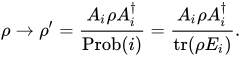
The Kraus operators, named for Karl Kraus, provide a specification of the state-change process. They are not necessarily self-adjoint, but the products are. If upon performing the measurement the outcome is obtained, then the initial state is updated to
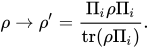
An important special case is the Lüders rule, named for Gerhart Lüders.If the POVM is itself a PVM, then the Kraus operators can be taken to
be the projectors onto the eigenspaces of the von Neumann observable:
If the initial state is pure, and the projectors have rank 1, they can be written as projectors onto the vectors and , respectively. The formula simplifies thus to
Lüders rule has historically been known as the "reduction of the wave packet" or the "collapse of the wavefunction". The pure state implies a probability-one prediction for any von Neumann observable that has
as an eigenvector. Introductory texts on quantum theory often express
this by saying that if a quantum measurement is repeated in quick
succession, the same outcome will occur both times. This is an
oversimplification, since the physical implementation of a quantum
measurement may involve a process like the absorption of a photon; after
the measurement, the photon does not exist to be measured again.
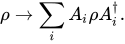
We can define a linear, trace-preserving, completely positive map, by summing over all the possible post-measurement states of a POVM without the normalisation:
It is an example of a quantum channel,
and can be interpreted as expressing how a quantum state changes if a
measurement is performed but the result of that measurement is lost.
Examples
Bloch sphere representation of states (in blue) and optimal POVM (in red) for unambiguous quantum state discrimination on the states and . Note that on the Bloch sphere orthogonal states are antiparallel.
The prototypical example of a finite-dimensional Hilbert space is a qubit, a quantum system whose Hilbert space is 2-dimensional. A pure state for a qubit can be written as a linear combination of two orthogonal basis states and with complex coefficients:
A measurement in the basis will yield outcome with probability and outcome with probability , so by normalization,
An arbitrary state for a qubit can be written as a linear combination of the Pauli matrices, which provide a basis for self-adjoint matrices:
where the real numbers are the coordinates of a point within the unit ball and
POVM elements can be represented likewise, though the trace of a POVM
element is not fixed to equal 1. The Pauli matrices are traceless and
orthogonal to one another with respect to the Hilbert–Schmidt inner product, and so the coordinates of the state are the expectation values of the three von Neumann measurements defined by the Pauli matrices.
If such a measurement is applied to a qubit, then by the Lüders rule,
the state will update to the eigenvector of that Pauli matrix
corresponding to the measurement outcome. The eigenvectors of are the basis states and , and a measurement of is often called a measurement in the "computational basis." After a measurement in the computational basis, the outcome of a or measurement is maximally uncertain.
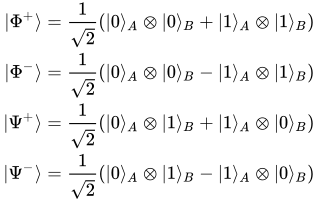
A pair of qubits together form a system whose Hilbert space is
4-dimensional. One significant von Neumann measurement on this system is
that defined by the Bell basis,a set of four maximally entangled states:
Probability density for the outcome of a position measurement given the energy eigenstate of a 1D harmonic oscillator
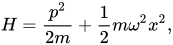
A common and useful example of quantum mechanics applied to a continuous degree of freedom is the quantum harmonic oscillator. This system is defined by the Hamiltonian
and these values give the possible numerical outcomes of an energy
measurement upon the oscillator. The set of possible outcomes of a position measurement on a harmonic oscillator is continuous, and so predictions are stated in terms of a probability density function that gives the probability of the measurement outcome lying in the infinitesimal interval from to .
Stern–Gerlach
experiment: Silver atoms travelling through an inhomogeneous magnetic
field, and being deflected up or down depending on their spin; (1)
furnace, (2) beam of silver atoms, (3) inhomogeneous magnetic field, (4)
classically expected result, (5) observed result.
The Stern–Gerlach experiment, proposed in 1921 and implemented in 1922, became a prototypical example of a quantum measurement having a
discrete set of possible outcomes. In the original experiment, silver
atoms were sent through a spatially varying magnetic field, which
deflected them before they struck a detector screen, such as a glass
slide. Particles with non-zero magnetic moment are deflected, due to the magnetic field gradient,
from a straight path. The screen reveals discrete points of
accumulation, rather than a continuous distribution, owing to the
particles' quantized spin.
Transition to the "new" quantum theory
A 1925 paper by Werner Heisenberg, known in English as "Quantum theoretical re-interpretation of kinematic and mechanical relations", marked a pivotal moment in the maturation of quantum physics. Heisenberg sought to develop a theory of atomic phenomena that relied
only on "observable" quantities. At the time, and in contrast with the
later standard presentation of quantum mechanics, Heisenberg did not
regard the position of an electron bound within an atom as "observable".
Instead, his principal quantities of interest were the frequencies of
light emitted or absorbed by atoms.
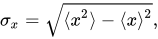
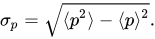
Writing and for the self-adjoint operators representing position and momentum respectively, a standard deviation of position can be defined as
and likewise for the momentum:
The Kennard–Pauli–Weyl uncertainty relation is
This inequality means that no preparation of a quantum particle can
imply simultaneously precise predictions for a measurement of position
and for a measurement of momentum. The Robertson inequality generalizes this to the case of an arbitrary pair of self-adjoint operators and . The commutator of these two operators is
and this provides the lower bound on the product of standard deviations:
Substituting in the canonical commutation relation, an expression first postulated by Max Born in 1925, recovers the Kennard–Pauli–Weyl statement of the uncertainty principle.
The existence of the uncertainty principle naturally raises the
question of whether quantum mechanics can be understood as an
approximation to a more exact theory. Do there exist "hidden variables",
more fundamental than the quantities addressed in quantum theory
itself, knowledge of which would allow more exact predictions than
quantum theory can provide? A collection of results, most significantly Bell's theorem, have demonstrated that broad classes of such hidden-variable theories are in fact incompatible with quantum physics.
John Stewart Bell published the theorem now known by his name in 1964, investigating more deeply a thought experiment originally proposed in 1935 by Einstein, Boris Podolsky and Nathan Rosen. According to Bell's theorem, if nature actually operates in accord with any theory of local
hidden variables, then the results of a Bell test will be constrained
in a particular, quantifiable way. If a Bell test is performed in a
laboratory and the results are not thus constrained, then they
are inconsistent with the hypothesis that local hidden variables exist.
Such results would support the position that there is no way to explain
the phenomena of quantum mechanics in terms of a more fundamental
description of nature that is more in line with the rules of classical
physics. Many types of Bell test have been performed in physics
laboratories, often with the goal of ameliorating problems of
experimental design or set-up that could in principle affect the
validity of the findings of earlier Bell tests. This is known as
"closing loopholes in Bell tests".
To date, Bell tests have found that the hypothesis of local hidden
variables is inconsistent with the way that physical systems behave.
Quantum systems as measuring devices
The Robertson–Schrödinger uncertainty principle establishes that when
two observables do not commute, there is a tradeoff in predictability
between them. The Wigner–Araki–Yanase theorem demonstrates another consequence of non-commutativity: the presence of a conservation law limits the accuracy with which observables that fail to commute with the conserved quantity can be measured. Further investigation in this line led to the formulation of the Wigner–Yanase skew information.
Historically, experiments in quantum physics have often been
described in semiclassical terms. For example, the spin of an atom in a
Stern–Gerlach experiment might be treated as a quantum degree of
freedom, while the atom is regarded as moving through a magnetic field
described by the classical theory of Maxwell's equations.
But the devices used to build the experimental apparatus are themselves
physical systems, and so quantum mechanics should be applicable to them
as well. Beginning in the 1950s, Léon Rosenfeld, Carl Friedrich von Weizsäcker
and others tried to develop consistency conditions that expressed when a
quantum-mechanical system could be treated as a measuring apparatus. One proposal for a criterion regarding when a system used as part of a
measuring device can be modeled semiclassically relies on the Wigner function, a quasiprobability distribution that can be treated as a probability distribution on phase space in those cases where it is everywhere non-negative.
A quantum state for an imperfectly isolated system will generally
evolve to be entangled with the quantum state for the environment.
Consequently, even if the system's initial state is pure, the state at a
later time, found by taking the partial trace
of the joint system-environment state, will be mixed. This phenomenon
of entanglement produced by system-environment interactions tends to
obscure the more exotic features of quantum mechanics that the system
could in principle manifest. Quantum decoherence, as this effect is
known, was first studied in detail during the 1970s. (Earlier investigations into how classical physics might be obtained as
a limit of quantum mechanics had explored the subject of imperfectly
isolated systems, but the role of entanglement was not fully
appreciated.) A significant portion of the effort involved in quantum computing research is to avoid the deleterious effects of decoherence.
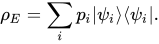
To illustrate, let denote the initial state of the system, the initial state of the environment and the Hamiltonian specifying the system-environment interaction. The density operator can be diagonalized and written as a linear combination of the projectors onto its eigenvectors:
Expressing time evolution for a duration by the unitary operator , the state for the system after this evolution is
which evaluates to
The quantities surrounding can be identified as Kraus operators, and so this defines a quantum channel.
Specifying a form of interaction between system and environment
can establish a set of "pointer states," states for the system that are
(approximately) stable, apart from overall phase factors, with respect
to environmental fluctuations. A set of pointer states defines a
preferred orthonormal basis for the system's Hilbert space.
Quantum information and computation
Quantum information science studies how information science
and its application as technology depend on quantum-mechanical
phenomena. Understanding measurement in quantum physics is important for
this field in many ways, some of which are briefly surveyed here.
Measurement, entropy, and distinguishability
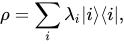
The von Neumann entropy is a measure of the statistical uncertainty represented by a quantum state. For a density matrix , the von Neumann entropy is
writing in terms of its basis of eigenvectors,
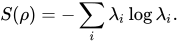
the von Neumann entropy is
This is the Shannon entropy
of the set of eigenvalues interpreted as a probability distribution,
and so the von Neumann entropy is the Shannon entropy of the random variable defined by measuring in the eigenbasis of . Consequently, the von Neumann entropy vanishes when is pure.The von Neumann entropy of can equivalently be characterized as the minimum Shannon entropy for a measurement given the quantum state , with the minimization over all POVMs with rank-1 elements.
Many other quantities used in quantum information theory also
find motivation and justification in terms of measurements. For example,
the trace distance between quantum states is equal to the largest difference in probability that those two quantum states can imply for a measurement outcome:
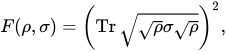
Similarly, the fidelity of two quantum states, defined by
expresses the probability that one state will pass a test for
identifying a successful preparation of the other. The trace distance
provides bounds on the fidelity via the Fuchs–van de Graaf inequalities:
Circuit
representation of measurement. The single line on the left-hand side
stands for a qubit, while the two lines on the right-hand side represent
a classical bit.
Quantum circuits are a model for quantum computation in which a computation is a sequence of quantum gates followed by measurements. The gates are reversible transformations on a quantum mechanical analog of an n-bitregister. This analogous structure is referred to as an n-qubitregister.
Measurements, drawn on a circuit diagram as stylized pointer dials,
indicate where and how a result is obtained from the quantum computer
after the steps of the computation are executed. Without loss of generality, one can work with the standard circuit model, in which the set of gates are single-qubit unitary transformations and controlled NOT gates on pairs of qubits, and all measurements are in the computational basis.
Measurement-based quantum computation (MBQC) is a model of quantum computing
in which the answer to a question is, informally speaking, created in
the act of measuring the physical system that serves as the computer.
Quantum state tomography is a process by which, given a set of data
representing the results of quantum measurements, a quantum state
consistent with those measurement results is computed. It is named by analogy with tomography, the reconstruction of three-dimensional images from slices taken through them, as in a CT scan. Tomography of quantum states can be extended to tomography of quantum channels and even of measurements.
Quantum metrology is the use of quantum physics to aid the
measurement of quantities that, generally, had meaning in classical
physics, such as exploiting quantum effects to increase the precision
with which a length can be measured. A celebrated example is the introduction of squeezed light into the LIGO experiment, which increased its sensitivity to gravitational waves.
Laboratory implementations
The range of physical procedures to which the mathematics of quantum measurement can be applied is very broad. In the early years of the subject, laboratory procedures involved the recording of spectral lines, the darkening of photographic film, the observation of scintillations, finding tracks in cloud chambers, and hearing clicks from Geiger counters. Language from this era persists, such as the description of measurement outcomes in the abstract as "detector clicks".
The double-slit experiment is a prototypical illustration of quantum interference,
typically described using electrons or photons. The first interference
experiment to be carried out in a regime where both wave-like and
particle-like aspects of photon behavior are significant was G. I. Taylor's
test in 1909. Taylor used screens of smoked glass to attenuate the
light passing through his apparatus, to the extent that, in modern
language, only one photon would be illuminating the interferometer slits
at a time. He recorded the interference patterns on photographic
plates; for the dimmest light, the exposure time required was roughly
three months. In 1974, the Italian physicists Pier Giorgio Merli [it], Gian Franco Missiroli, and Giulio Pozzi implemented the double-slit experiment using single electrons and a television tube. A quarter-century later, a team at the University of Vienna performed an interference experiment with buckyballs, in which the buckyballs that passed through the interferometer were ionized by a laser, and the ions then induced the emission of electrons, emissions which were in turn amplified and detected by an electron multiplier.
Modern quantum optics experiments can employ single-photon detectors. For example, in the "BIG Bell test" of 2018, several of the laboratory setups used single-photon avalanche diodes. Another laboratory setup used superconducting qubits. The standard method for performing measurements upon superconducting qubits is to couple a qubit with a resonator
in such a way that the characteristic frequency of the resonator shifts
according to the state for the qubit, and detecting this shift by
observing how the resonator reacts to a probe signal.
Despite the consensus among scientists that quantum physics is in
practice a successful theory, disagreements persist on a more
philosophical level. Many debates in the area known as quantum foundations concern the role of measurement in quantum mechanics. Recurring questions include which interpretation of probability theory
is best suited for the probabilities calculated from the Born rule; and
whether the apparent randomness of quantum measurement outcomes is
fundamental, or a consequence of a deeper deterministic process.Worldviews that present answers to questions like these are known as "interpretations" of quantum mechanics; as the physicist N. David Mermin once quipped, "New interpretations appear every year. None ever disappear."
A central concern within quantum foundations is the "quantum measurement problem,"
though how this problem is delimited, and whether it should be counted
as one question or multiple separate issues, are contested topics.Of primary interest is the seeming disparity between apparently
distinct types of time evolution. Von Neumann declared that quantum
mechanics contains "two fundamentally different types" of quantum-state
change.
First, there are those changes involving a measurement process, and
second, there is unitary time evolution in the absence of measurement.
The former is stochastic and discontinuous, writes von Neumann, and the
latter deterministic and continuous. This dichotomy has set the tone for
much later debate. Some interpretations of quantum mechanics find the reliance upon two
different types of time evolution distasteful and regard the ambiguity
of when to invoke one or the other as a deficiency of the way quantum
theory was historically presented. To bolster these interpretations, their proponents have worked to
derive ways of regarding "measurement" as a secondary concept and
deducing the seemingly stochastic effect of measurement processes as
approximations to more fundamental deterministic dynamics. However,
consensus has not been achieved among proponents of the correct way to
implement this program, and in particular how to justify the use of the
Born rule to calculate probabilities. Other interpretations regard quantum states as statistical information
about quantum systems, thus asserting that abrupt and discontinuous
changes of quantum states are not problematic, simply reflecting updates
of the available information.Of this line of thought, Bell asked, "Whose information? Information about what?" Answers to these questions vary among proponents of the informationally-oriented interpretations.

.png)

.jpg)






































![{\displaystyle [A,B]=AB-BA,}](https://wikimedia.org/api/rest_v1/media/math/render/svg/b2a47259b42e63c048c65f67d304404867841951)
![{\displaystyle \sigma _{A}\sigma _{B}\geq \left|{\frac {1}{2i}}\langle [A,B]\rangle \right|={\frac {1}{2}}\left|\langle [A,B]\rangle \right|.}](https://wikimedia.org/api/rest_v1/media/math/render/svg/d15f644ab43a23f762c87886b1ae050f83b001ba)
![{\displaystyle [{x},{p}]=i\hbar }](https://wikimedia.org/api/rest_v1/media/math/render/svg/d7dad6e853b68a93aa6607b63a3a08cfc24d6088)




![{\displaystyle \rho _{S}'={\rm {tr}}_{E}U\left[\rho _{S}\otimes \left(\sum _{i}p_{i}|\psi _{i}\rangle \langle \psi _{i}|\right)\right]U^{\dagger },}](https://wikimedia.org/api/rest_v1/media/math/render/svg/04f34a1930a48d600509e418c6bd2616f2bfe784)


![{\displaystyle {\frac {1}{2}}||\rho -\sigma ||=\max _{0\leq E\leq I}[{\rm {tr}}(E\rho )-{\rm {tr}}(E\sigma )].}](https://wikimedia.org/api/rest_v1/media/math/render/svg/546b08be0062e916339e9e0efc9f88b40e8553a7)