Search This Blog

Thursday, March 26, 2026

Laplace transform

From Wikipedia, the free encyclopedia

In mathematics, the Laplace transform, named after Pierre-Simon Laplace (/ləˈplɑːs/), is an integral transform that converts a function of a real variable (usually , in the time domain) to a function of a complex variable (in the complex-valued frequency domain, also known as s-domain or s-plane). The functions are often denoted using a lowercase symbol for the time-domain function and the corresponding uppercase symbol for the frequency-domain function, e.g. and .

The transform is useful for converting differentiation and integration in the time domain into the algebraic operations multiplication and division in the Laplace domain (analogous to how logarithms are useful for simplifying multiplication and division into addition and subtraction). This gives the transform many applications in science and engineering, mostly as a tool for solving linear differential equations and dynamical systems by replacing ordinary differential equations and integral equations with algebraic polynomial equations, and by replacing convolution with multiplication.

For example, through the Laplace transform, the equation of the simple harmonic oscillator (Hooke's law) is converted into the algebraic equation which incorporates the initial conditions and , and can be solved for the unknown function . Once solved, the inverse Laplace transform can be used to transform it to the original domain. This is often aided by referencing tables such as that given below.

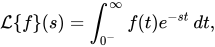
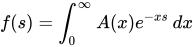
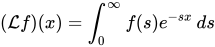
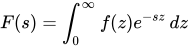
The Laplace transform is defined (for suitable functions ) by the integral where is a complex number.

The Laplace transform is related to many other transforms. It is essentially the same as the Mellin transform and is closely related to the Fourier transform. Unlike for the Fourier transform, the Laplace transform of a function is often an analytic function, meaning that it can be expressed as a power series that converges locally, the coefficients of which represent the moments of the original function. Moreover, the techniques of complex analysis, especially contour integrals, can be used for simplifying calculations.

History

Pierre-Simon, marquis de Laplace

The Laplace transform is named after mathematician and astronomer Pierre-Simon, Marquis de Laplace, who used a similar transform in his work on probability theory. Laplace wrote extensively about the use of generating functions (1814), and the integral form of the Laplace transform evolved naturally as a result.

Laplace's use of generating functions was similar to what is now known as the z-transform, and he gave little attention to the continuous variable case which was discussed by Niels Henrik Abel.

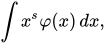
From 1744, Leonhard Euler investigated integrals of the form as solutions of differential equations, introducing in particular the gamma functionJoseph-Louis Lagrange was an admirer of Euler and, in his work on integrating probability density functions, investigated expressions of the form which resembles a Laplace transform.

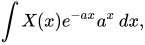
These types of integrals seem first to have attracted Laplace's attention in 1782, where he was following in the spirit of Euler in using the integrals themselves as solutions of equations. However, in 1785, Laplace took the critical step forward when, rather than simply looking for a solution in the form of an integral, he started to apply the transforms in the sense that was later to become popular. He used an integral of the form akin to a Mellin transform, to transform the whole of a difference equation, in order to look for solutions of the transformed equation. He then went on to apply the Laplace transform in the same way and started to derive some of its properties, beginning to appreciate its potential power.
Laplace also recognised that Joseph Fourier's method of Fourier series for solving the diffusion equation could only apply to a limited region of space, because those solutions were periodic. In 1809, Laplace applied his transform to find solutions that diffused indefinitely in space. In 1821, Cauchy developed an operational calculus for the Laplace transform that could be used to study linear differential equations in much the same way the transform is now used in basic engineering. This method was popularized, and perhaps rediscovered, by Oliver Heaviside around the turn of the century.

Bernhard Riemann used the Laplace transform in his 1859 paper On the number of primes less than a given magnitude, in which he also developed the inversion theorem. Riemann used the Laplace transform to develop the functional equation of the Riemann zeta function, and his method is still used to relate the modular transformation law of the Jacobi theta function, which is readily proved via Poisson summation, to the functional equation.

Hjalmar Mellin was among the first to study the Laplace transform, rigorously in the Karl Weierstrass school of analysis, and apply it to the study of differential equations and special functions, at the turn of the 20th century. At around the same time, Heaviside was busy with his operational calculus. Thomas Joannes Stieltjes considered a generalization of the Laplace transform connected to his work on moments. Other contributors in this time period included Mathias LerchOliver Heaviside, and Thomas Bromwich.

In 1929, Vannevar Bush and Norbert Wiener published Operational Circuit Analysis as a text for engineering analysis of electrical circuits, applying both Fourier transforms and operational calculus, and in which they included one of the first predecessors of the modern table of Laplace transforms. In 1934, Raymond Paley and Norbert Wiener published the important work Fourier transforms in the complex domain, about what is now called the Laplace transform (see below). Also during the 30s, the Laplace transform was instrumental in Godfrey Harold Hardy and John Edensor Littlewood's study of tauberian theorems, and this application was later expounded on by Widder (1941), who developed other aspects of the theory such as a new method for inversion. Edward Charles Titchmarsh wrote the influential Introduction to the theory of the Fourier integral (1937).

The current widespread use of the transform (mainly in engineering) came about during and soon after World War II, replacing the earlier Heaviside operational calculus. The advantages of the Laplace transform had been emphasized by Gustav Doetsch.[20]

Formal definition

for various complex frequencies in the s-domain , which can be expressed as . The axis at contains pure cosines. Positive contains damped cosines. Negative contains exponentially growing cosines.

The Laplace transform of a function f(t), defined for all real numbers t ≥ 0, is the function F(s), which is a unilateral transform defined by

   (Eq. 1)
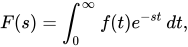
where s is a complex frequency-domain parameter with real numbers σ and ω.

An alternate notation for the Laplace transform is instead of F. Thus in functional notation. This is often written, especially in engineering settings, as , with the understanding that the dummy variable does not appear in the function .


The meaning of the integral depends on types of functions of interest. A necessary condition for existence of the integral is that f must be locally integrable on [0, ∞). For locally integrable functions that decay at infinity or are of exponential type (), the integral can be understood to be a (proper) Lebesgue integral. However, for many applications it is necessary to regard it as a conditionally convergent improper integral at . Still more generally, the integral can be understood in a weak sense, and this is dealt with below.

One can define the Laplace transform of a finite Borel measure μ by the Lebesgue integral: 
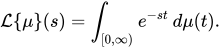
An important special case is where μ is a probability measure, for example, the Dirac delta function. In operational calculus, the Laplace transform of a measure is often treated as though the measure came from a probability density function f. In that case, to avoid potential confusion, one often writes where the lower limit of 0 is shorthand notation for

This limit emphasizes that any point mass located at 0 is entirely captured by the Laplace transform. Although with the Lebesgue integral, it is not necessary to take such a limit, it does appear more naturally in connection with the Laplace–Stieltjes transform.

Bilateral Laplace transform

When one says "the Laplace transform" without qualification, the unilateral or one-sided transform is usually intended. The Laplace transform can be alternatively defined as the bilateral Laplace transform, or two-sided Laplace transform, by extending the limits of integration to be the entire real axis. If that is done, the common unilateral transform becomes a special case of the bilateral transform, where the definition of the function being transformed includes being multiplied by the Heaviside step function.

The bilateral Laplace transform F(s) is defined as follows:

   (Eq. 2)
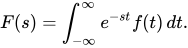
An alternate notation for the bilateral Laplace transform is , instead of F.

Inverse Laplace transform

Two integrable functions have the same Laplace transform only if they differ on a set of Lebesgue measure zero. This means that, on the range of the transform, there is an inverse transform. In fact, besides integrable functions, the Laplace transform is a one-to-one mapping from one function space into another in many other function spaces as well, although there is usually no easy characterization of the range.

Typical function spaces in which this is true include the spaces of bounded continuous functions, the space L(0, ∞), or more generally tempered distributions on (0, ∞). The Laplace transform is also defined and injective for suitable spaces of tempered distributions.

In these cases, the image of the Laplace transform lives in a space of analytic functions in the region of convergence. The inverse Laplace transform is given by the following complex integral, which is known by various names (the Bromwich integral, the Fourier–Mellin integral, and Mellin's inverse formula):

   (Eq. 3)

where γ is a real number so that the contour path of integration is in the region of convergence of F(s). In most applications, the contour can be closed, allowing the use of the residue theorem. An alternative formula for the inverse Laplace transform is given by Post's inversion formula. The limit here is interpreted in the weak-* topology.

In practice, it is typically more convenient to decompose a Laplace transform into known transforms of functions obtained from a table and construct the inverse by inspection.

Probability theory

In pure and applied probability, the Laplace transform is defined as an expected value. If X is a random variable with probability density function f, then the Laplace transform of f is given by the expectation where is the expectation of random variable .

By convention, this is referred to as the Laplace transform of the random variable X itself. Here, replacing s by t gives the moment generating function of X. The Laplace transform has applications throughout probability theory, including first passage times of stochastic processes such as Markov chains, and renewal theory.

Of particular use is the ability to recover the cumulative distribution function of a continuous random variable X by means of the Laplace transform as follows: 

Algebraic construction

The Laplace transform can be alternatively defined in a purely algebraic manner by applying a field of fractions construction to the convolution ring of functions on the positive half-line. The resulting space of abstract operators is exactly equivalent to Laplace space, but in this construction the forward and reverse transforms never need to be explicitly defined (avoiding the related difficulties with proving convergence).

Region of convergence

If f is a locally integrable function (or more generally a Borel measure locally of bounded variation), then the Laplace transform F(s) of f converges provided that the limit exists.
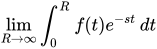
The Laplace transform converges absolutely if the integral exists as a proper Lebesgue integral. The Laplace transform is usually understood as conditionally convergent, meaning that it converges in the former but not in the latter sense.
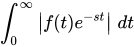
The set of values for which F(s) converges absolutely is either of the form Re(s) > a or Re(s) ≥ a, where a is an extended real constant with −∞ ≤ a ≤ ∞ (a consequence of the dominated convergence theorem). The constant a is known as the abscissa of absolute convergence, and depends on the growth behavior of f(t). Analogously, the two-sided transform converges absolutely in a strip of the form a < Re(s) < b, and possibly including the lines Re(s) = a or Re(s) = b. The subset of values of s for which the Laplace transform converges absolutely is called the region of absolute convergence, or the domain of absolute convergence. In the two-sided case, it is sometimes called the strip of absolute convergence. The Laplace transform is analytic in the region of absolute convergence: this is a consequence of Fubini's theorem and Morera's theorem.

Similarly, the set of values for which F(s) converges (conditionally or absolutely) is known as the region of conditional convergence, or simply the region of convergence (ROC). If the Laplace transform converges (conditionally) at s = s0, then it automatically converges for all s with Re(s) > Re(s0). Therefore, the region of convergence is a half-plane of the form Re(s) > a, possibly including some points of the boundary line Re(s) = a.

In the region of convergence Re(s) > Re(s0), the Laplace transform of f can be expressed by integrating by parts as the integral

That is, F(s) can effectively be expressed, in the region of convergence, as the absolutely convergent Laplace transform of some other function. In particular, it is analytic. In its most general form, the Laplace transform gives a one-to-one correspondence between the holomorphic functions which, for some , are defined on and are bounded there in absolute value by a polynomial, and the distributions on the real line supported on which become tempered distributions after multiplied by for some .

There are several Paley–Wiener theorems concerning the relationship between the decay properties of f, and the properties of the Laplace transform within the region of convergence.

In engineering applications, a function corresponding to a linear time-invariant (LTI) system is stable if every bounded input produces a bounded output. This is equivalent to the absolute convergence of the Laplace transform of the impulse response function in the region Re(s) ≥ 0. As a result, LTI systems are stable, provided that the poles of the Laplace transform of the impulse response function have negative real part.

This ROC is used in knowing about the causality and stability of a system.

Properties and theorems

The Laplace transform's key property is that it converts differentiation and integration in the time domain into multiplication and division by s in the Laplace domain. Thus, the Laplace variable s is also known as an operator variable in the Laplace domain: either the derivative operator or (for s−1) the integration operator.

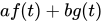
Given the functions f(t) and g(t), and their respective Laplace transforms F(s) and G(s),
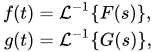
the following table is a list of properties of unilateral Laplace transform:

Properties of the unilateral Laplace transform
Property Time domain s domain Comment
Linearity Can be proved using basic rules of integration.
Frequency-domain derivative F is the first derivative of F with respect to s.
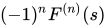
Frequency-domain general derivative More general form, nth derivative of F(s).
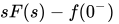
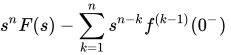
Derivative f is assumed to be a differentiable function, and its derivative is assumed to be of exponential type. This can then be obtained by integration by parts
Second derivative f is assumed twice differentiable and the second derivative to be of exponential type. Follows by applying the Differentiation property to f′(t).
General derivative f is assumed to be n-times differentiable, with nth derivative of exponential type. Follows by mathematical induction.
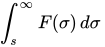
Frequency-domain integration This is deduced using the nature of frequency differentiation and conditional convergence.
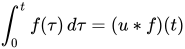
Time-domain integration u(t) is the Heaviside step function and (uf)(t) is the convolution of u(t) and f(t).
Frequency shifting
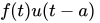
Time shifting

a > 0, u(t) is the Heaviside step function
Time scaling a > 0
Multiplication The integration is done along the vertical line Re(σ) = c that lies entirely within the region of convergence of F.
Convolution
Circular convolution For periodic functions with period T.
Complex conjugation
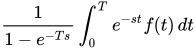
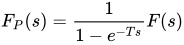
Periodic function f(t) is a periodic function of period T so that f(t) = f(t + T), for all t ≥ 0. This is the result of the time shifting property and the geometric series.
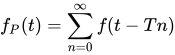
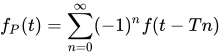
Periodic summation


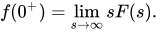
Initial value theorem

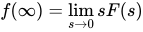
Final value theorem

, if all poles of are in the left half-plane.
The final value theorem is useful because it gives the long-term behaviour without having to perform partial fraction decompositions (or other difficult algebra). If F(s) has a pole in the right-hand plane or poles on the imaginary axis (e.g., if or ), then the behaviour of this formula is undefined.
Relation to power series

The Laplace transform can be viewed as a continuous analogue of a power series. If a(n) is a discrete function of a positive integer n, then the power series associated to a(n) is the series where x is a real variable (see Z-transform). Replacing summation over n with integration over t, a continuous version of the power series becomes where the discrete function a(n) is replaced by the continuous one f(t).

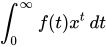
Changing the base of the power from x to e gives
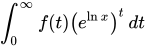
For this to converge for, say, all bounded functions f, it is necessary to require that ln x < 0. Making the substitution s = ln x gives just the Laplace transform:
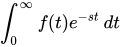
In other words, the Laplace transform is a continuous analog of a power series, in which the discrete parameter n is replaced by the continuous parameter t, and x is replaced by es.

Analogously to a power series, if , then the power series converges to an analytic function in , if , the Laplace transform converges to an analytic function for .

Relation to moments

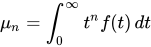
The quantities are the moments of the function f. If the first n moments of f converge absolutely, then by repeated differentiation under the integral, This is of special significance in probability theory, where the moments of a random variable X are given by the expectation values . Then, the relation holds

Transform of a function's derivative

It is often convenient to use the differentiation property of the Laplace transform to find the transform of a function's derivative. This can be derived from the basic expression for a Laplace transform as follows: yielding and in the bilateral case,

The general result where denotes the nth derivative of f, can then be established with an inductive argument.

Evaluating integrals over the positive real axis

A useful property of the Laplace transform is the following: under suitable assumptions on the behaviour of and in a right neighbourhood of and on the decay rate of and in a left neighbourhood of . The above formula is a variation of integration by parts, with the operators and being replaced by and . Let us prove the equivalent formulation:

By plugging in the left-hand side turns into: but assuming Fubini's theorem holds, by reversing the order of integration we get the wanted right-hand side.
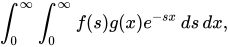
This method can be used to compute integrals that would otherwise be difficult to compute using elementary methods of real calculus. For example,

Relationship to other transforms

Laplace–Stieltjes transform

The (unilateral) Laplace–Stieltjes transform of a function g : ℝ → ℝ is defined by the Lebesgue–Stieltjes integral
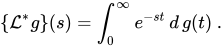
The function g is assumed to be of bounded variation. If g is the antiderivative of f:
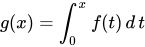
then the Laplace–Stieltjes transform of g and the Laplace transform of f coincide. In general, the Laplace–Stieltjes transform is the Laplace transform of the Stieltjes measure associated to g. So in practice, the only distinction between the two transforms is that the Laplace transform is thought of as operating on the density function of the measure, whereas the Laplace–Stieltjes transform is thought of as operating on its cumulative distribution function.

Fourier transform

Let be a complex-valued Lebesgue integrable function supported on , and let be its Laplace transform. Then, within the region of convergence, we have which is the Fourier transform of the function .
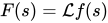

Indeed, the Fourier transform is a special case (under certain conditions) of the bilateral Laplace transform. The main difference is that the Fourier transform of a function is a complex function of a real variable (frequency ), the Laplace transform of a function is a complex function of a complex variable (damping factor and frequency ). The Laplace transform is usually restricted to transformation of functions of t with t ≥ 0. A consequence of this restriction is that the Laplace transform of a function is a holomorphic function of the variable s. Unlike the Fourier transform, the Laplace transform of a distribution is generally a well-behaved function. Techniques of complex variables can also be used to directly study Laplace transforms. As a holomorphic function, the Laplace transform has a power series representation. This power series expresses a function as a linear superposition of moments of the function. This perspective has applications in probability theory.

Formally, the Fourier transform is equivalent to evaluating the bilateral Laplace transform with imaginary argument s =  when the condition explained below is fulfilled,

This convention of the Fourier transform ( in Fourier transform § Other conventions) requires a factor of 1/2π on the inverse Fourier transform. This relationship between the Laplace and Fourier transforms is often used to determine the frequency spectrum of a signal or dynamical system.

The above relation is valid as stated if and only if the region of convergence (ROC) of F(s) contains the imaginary axis, σ = 0.

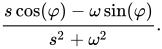
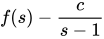
For example, the function f(t) = cos(ω0t) has a Laplace transform F(s) = s/(s2 + ω02) whose ROC is Re(s) > 0. As s = 0 is a pole of F(s), substituting s = in F(s) does not yield the Fourier transform of f(t)u(t), which contains terms proportional to the Dirac delta functions δ(ω ± ω0).

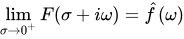
However, a relation of the form holds under much weaker conditions. For instance, this holds for the above example provided that the limit is understood as a weak limit of measures (see vague topology). General conditions relating the limit of the Laplace transform of a function on the boundary to the Fourier transform take the form of Paley–Wiener theorems.
Mellin transform

The Mellin transform and its inverse are related to the two-sided Laplace transform by a change of variables.

If in the Mellin transform we set θ = et we get a two-sided Laplace transform.

Z-transform

The unilateral or one-sided Z-transform is the Laplace transform of an ideally sampled signal with the substitution of where T = 1/fs is the sampling interval (in units of time e.g., seconds) and fs is the sampling rate (in samples per second or hertz).

Let be a sampling impulse train (also called a Dirac comb) and be the sampled representation of the continuous-time x(t)
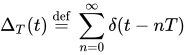
The Laplace transform of the sampled signal xq(t) is

This is the precise definition of the unilateral Z-transform of the discrete function x[n] with the substitution of zesT.

Comparing the last two equations, we find the relationship between the unilateral Z-transform and the Laplace transform of the sampled signal,
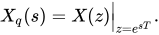
The similarity between the Z- and Laplace transforms is expanded upon in the theory of time scale calculus.

Borel transform

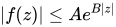
The integral form of the Borel transform is a special case of the Laplace transform for f an entire function of exponential type, meaning that for some constants A and B. The generalized Borel transform allows a different weighting function to be used, rather than the exponential function, to transform functions not of exponential type. Nachbin's theorem gives necessary and sufficient conditions for the Borel transform to be well defined.
Fundamental relationships

Since an ordinary Laplace transform can be written as a special case of a two-sided transform, and since the two-sided transform can be written as the sum of two one-sided transforms, the theory of the Laplace-, Fourier-, Mellin-, and Z-transforms are at bottom the same subject. However, a different point of view and different characteristic problems are associated with each of these four major integral transforms.

Table of selected Laplace transforms

The following table provides Laplace transforms for many common functions of a single variable. For definitions and explanations, see the Explanatory Notes at the end of the table.

Because the Laplace transform is a linear operator,

  • The Laplace transform of a sum is the sum of Laplace transforms of each term.
  • The Laplace transform of a multiple of a function is that multiple times the Laplace transformation of that function.


Using this linearity, and various trigonometric, hyperbolic, and complex number (etc.) properties and/or identities, some Laplace transforms can be obtained from others more quickly than by using the definition directly.

The unilateral Laplace transform takes as input a function whose time domain is the non-negative reals, which is why all of the time domain functions in the table below are multiples of the Heaviside step function, u(t).

The entries of the table that involve a time delay τ are required to be causal (meaning that τ > 0). A causal system is a system where the impulse response h(t) is zero for all time t prior to t = 0. In general, the region of convergence for causal systems is not the same as that of anticausal systems.

Selected Laplace transforms
Function Time domain
Laplace s-domain
Region of convergence Reference
unit impulse all s inspection
delayed impulse all s time shift of
unit impulse
unit step integrate unit impulse
delayed unit step time shift of
unit step
product of delayed function and delayed step
u-substitution,
rectangular impulse
ramp integrate unit
impulse twice
nth power
(for integer n)

(n > −1)
integrate unit
step n times
qth power
(for complex q)


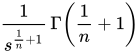
nth root Set q = 1/n above.
nth power with frequency shift Integrate unit step,
apply frequency shift
delayed nth power
with frequency shift
integrate unit step,
apply frequency shift,
apply time shift
exponential decay Frequency shift of
unit step
two-sided exponential decay
(only for bilateral transform)
Frequency shift of
unit step
exponential approach unit step minus
exponential decay
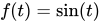
sine
cosine
hyperbolic sine
hyperbolic cosine
exponentially decaying
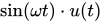
sine wave

exponentially decaying
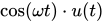
cosine wave

natural logarithm
Bessel function
of the first kind,
of order n

(n > −1)

Error function
Explanatory notes:

s-domain equivalent circuits and impedances

The Laplace transform is often used in circuit analysis by conversions to the s-domain of circuit elements. Circuit elements can be transformed into impedances, very similar to phasor impedances.

Here is a summary of equivalents:

s-domain equivalent circuits

Note that the resistor is exactly the same in the time domain and the s-domain. The sources are put in if there are initial conditions on the circuit elements. For example, if a capacitor has an initial voltage across it, or if the inductor has an initial current through it, the sources inserted in the s-domain account for that.

The equivalents for current and voltage sources are derived from the transformations in the table above.

Examples and applications

The Laplace transform is used frequently in engineering and physics; the output of a linear time-invariant system can be calculated by convolving its unit impulse response with the input signal. Performing this calculation in Laplace space turns the convolution into a multiplication; the latter being easier to solve because of its algebraic form. For more information, see control theory. The Laplace transform is invertible on a large class of functions. Given a mathematical or functional description of an input or output to a system, the Laplace transform provides an alternative functional description that often simplifies the process of analyzing the behavior of the system, or in synthesizing a new system based on a set of specifications.

The Laplace transform can also be used to solve differential equations and is used extensively in mechanical engineering and electrical engineering. The Laplace transform reduces a linear differential equation to an algebraic equation, which can then be solved by the formal rules of algebra. The original differential equation can then be solved by applying the inverse Laplace transform. English electrical engineer Oliver Heaviside first proposed a similar scheme, although without using the Laplace transform; and the resulting operational calculus is credited as the Heaviside calculus.

Evaluating improper integrals

Let . Then (see the table above)

From which one gets:
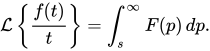
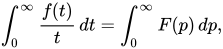
In the limit , one gets provided that the interchange of limits can be justified. This is often possible as a consequence of the final value theorem. Even when the interchange cannot be justified the calculation can be suggestive. For example, with a ≠ 0 ≠ b, proceeding formally one has

Complex impedance of a capacitor

In the theory of electrical circuits, the current flow in a capacitor is proportional to the capacitance and rate of change in the electrical potential (with equations as for the SI unit system). Symbolically, this is expressed by the differential equation where C is the capacitance of the capacitor, i = i(t) is the electric current through the capacitor as a function of time, and v = v(t) is the voltage across the terminals of the capacitor, also as a function of time.

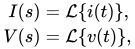
Taking the Laplace transform of this equation, we obtain where and

Solving for V(s) we have
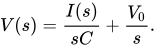
The definition of the complex impedance Z (in ohms) is the ratio of the complex voltage V divided by the complex current I while holding the initial state V0 at zero:
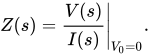
Using this definition and the previous equation, we find: which is the correct expression for the complex impedance of a capacitor. In addition, the Laplace transform has large applications in control theory.

Impulse response

Consider a linear time-invariant system with transfer function
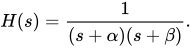
The impulse response is the inverse Laplace transform of this transfer function:

Partial fraction expansion

To evaluate this inverse transform, we begin by expanding H(s) using the method of partial fraction expansion,

The unknown constants P and R are the residues located at the corresponding poles of the transfer function. Each residue represents the relative contribution of that singularity to the transfer function's overall shape.

By the residue theorem, the inverse Laplace transform depends only upon the poles and their residues. To find the residue P, we multiply both sides of the equation by s + α to get
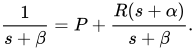
Then by letting s = −α, the contribution from R vanishes and all that is left is
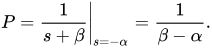
Similarly, the residue R is given by
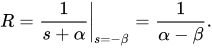
Note that and so the substitution of R and P into the expanded expression for H(s) gives
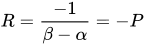

Finally, using the linearity property and the known transform for exponential decay (see Item #3 in the Table of Laplace Transforms, above), we can take the inverse Laplace transform of H(s) to obtain which is the impulse response of the system.

Convolution

The same result can be achieved using the convolution property as if the system is a series of filters with transfer functions 1/(s + α) and 1/(s + β). That is, the inverse of is

Phase delay

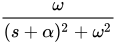
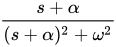
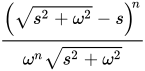
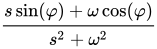
Time function Laplace transform

Starting with the Laplace transform, we find the inverse by first rearranging terms in the fraction:
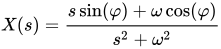
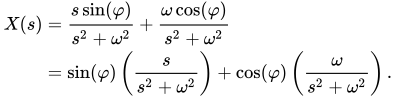
We are now able to take the inverse Laplace transform of our terms:

This is just the sine of the sum of the arguments, yielding:

We can apply similar logic to find that

Statistical mechanics

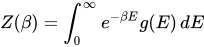
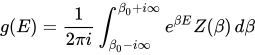
In statistical mechanics, the Laplace transform of the density of states defines the partition function. That is, the canonical partition function is given by and the inverse is given by

Spatial (not time) structure from astronomical spectrum

The wide and general applicability of the Laplace transform and its inverse is illustrated by an application in astronomy which provides some information on the spatial distribution of matter of an astronomical source of radiofrequency thermal radiation too distant to resolve as more than a point, given its flux density spectrum, rather than relating the time domain with the spectrum (frequency domain).

Assuming certain properties of the object, e.g. spherical shape and constant temperature, calculations based on carrying out an inverse Laplace transformation on the spectrum of the object can produce the only possible model of the distribution of matter in it (density as a function of distance from the center) consistent with the spectrum. When independent information on the structure of an object is available, the inverse Laplace transform method has been found to be in good agreement.

Birth and death processes

Consider a random walk, with steps occurring with probabilities . Suppose also that the time step is a Poisson process, with parameter . Then the probability of the walk being at the lattice point at time is This leads to a system of integral equations (or equivalently a system of differential equations). However, because it is a system of convolution equations, the Laplace transform converts it into a system of linear equations for namely: which may now be solved by standard methods.

Tauberian theory

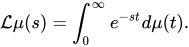
The Laplace transform of the measure on is given by It is intuitively clear that, for small , the exponentially decaying integrand will become more sensitive to the concentration of the measure on larger subsets of the domain. To make this more precise, introduce the distribution function: Formally, we expect a limit of the following kind: Tauberian theorems are theorems relating the asymptotics of the Laplace transform, as , to those of the distribution of as . They are thus of importance in asymptotic formulae of probability and statistics, where often the spectral side has asymptotics that are simpler to infer.

Two Tauberian theorems of note are the Hardy–Littlewood Tauberian theorem and Wiener's Tauberian theorem. The Wiener theorem generalizes the Ikehara Tauberian theorem, which is the following statement:

Let be a non-negative, monotonic nondecreasing function of , defined for . Suppose that converges for to the function and that, for some non-negative number , has an extension as a continuous function for . Then the limit as goes to infinity of is equal to .

This statement can be applied in particular to the logarithmic derivative of Riemann zeta function, and thus provides an extremely short way to prove the prime number theorem.

Absurdism

From Wikipedia, the free encyclopedia
Sisyphus, the symbol of the absurdity of existence, painting by Franz Stuck (1920)

Absurdism is the philosophical theory that the universe is irrational and meaningless. It states that trying to find meaning leads people into conflict with a seemingly meaningless world. This conflict can be between rational humanity and an irrational universe, between intention and outcome, or between subjective assessment and objective worth, but the precise definition of the term is disputed. Absurdism claims that, due to one or more of these conflicts, existence as a whole is absurd. It differs in this regard from the less global thesis that some particular situations, persons, or phases in life are absurd.

Various components of the absurd are discussed in the academic literature, and different theorists frequently concentrate their definition and research on different components. On the practical level, the conflict underlying the absurd is characterized by the individual's struggle to find meaning in a meaningless world. The theoretical component, on the other hand, emphasizes more the epistemic inability of reason to penetrate and understand reality. Traditionally, the conflict is characterized as a collision between an internal component of human nature, and an external component of the universe. However, some later theorists have suggested that both components may be internal: the capacity to see through the arbitrariness of any ultimate purpose, on the one hand, and the incapacity to stop caring about such purposes, on the other hand. Certain accounts also involve a metacognitive component by holding that an awareness of the conflict is necessary for the absurd to arise.

Some arguments in favor of absurdism focus on the human insignificance in the universe, on the role of death, or on the implausibility or irrationality of positing an ultimate purpose. Objections to absurdism often contend that life is in fact meaningful or point out certain problematic consequences or inconsistencies of absurdism. Defenders of absurdism often complain that it does not receive the attention of professional philosophers it merits in virtue of the topic's importance and its potential psychological impact on the affected individuals in the form of existential crises. Various possible responses to deal with absurdism and its impact have been suggested. The three responses discussed in the traditional absurdist literature are suicide, religious belief in a higher purpose, and rebellion against the absurd. Of these, rebellion is usually presented as the recommended response since, unlike the other two responses, it does not escape the absurd and instead recognizes it for what it is. Later theorists have suggested additional responses, like using irony to take life less seriously or remaining ignorant of the responsible conflict. Some absurdists argue that whether and how one responds is insignificant. This is based on the idea that if nothing really matters then the human response toward this fact does not matter either.

The term "absurdism" is most closely associated with the philosophy of Albert Camus. However, important precursors and discussions of the absurd are also found in the works of Søren Kierkegaard. Absurdism is intimately related to various other concepts and theories. Its basic outlook is inspired by existentialist philosophy. However, existentialism includes additional theoretical commitments and often takes a more optimistic attitude toward the possibility of finding or creating meaning in one's life. Absurdism and nihilism share the belief that life is meaningless, but absurdists do not treat this as an isolated fact and are instead interested in the conflict between the human desire for meaning and the world's lack thereof. Being confronted with this conflict may trigger an existential crisis, in which unpleasant experiences like anxiety or depression may push the affected to find a response for dealing with the conflict. Recognizing the absence of objective meaning, however, does not preclude the conscious thinker from finding subjective meaning.

Definition

Absurdism is the philosophical thesis that life, or the world in general, is absurd. There is wide agreement that the term "absurd" implies a lack of meaning or purpose but there is also significant dispute concerning its exact definition and various versions have been suggested. The choice of one's definition has important implications for whether the thesis of absurdism is correct and for the arguments cited for and against it: it may be true on one definition and false on another.

In a general sense, the absurd is that which lacks a sense, often because it involves some form of contradiction. The absurd is paradoxical in the sense that it cannot be grasped by reason. But in the context of absurdism, the term is usually used in a more specific sense. According to most definitions, it involves a conflict, discrepancy, or collision between two things. Opinions differ on what these two things are. For example, it is traditionally identified as the confrontation of rational man with an irrational world or as the attempt to grasp something based on reasons even though it is beyond the limits of rationality. Similar definitions see the discrepancy between intention and outcome, between aspiration and reality, or between subjective assessment and objective worth as the source of absurdity. Other definitions locate both conflicting sides within man: the ability to apprehend the arbitrariness of final ends and the inability to let go of commitments to them. In regard to the conflict, absurdism differs from nihilism since it is not just the thesis that nothing matters. Instead, it includes the component that things seem to matter to us nonetheless and that this impression cannot be shaken off. This difference is expressed in the relational aspect of the absurd in that it constitutes a conflict between two sides.

Various components of the absurd have been suggested and different researchers often focus their definition and inquiry on one of these components. Some accounts emphasize the practical components concerned with the individual seeking meaning while others stress the theoretical components about being unable to know the world or to rationally grasp it. A different disagreement concerns whether the conflict exists only internal to the individual or is between the individual's expectations and the external world. Some theorists also include the metacognitive component that the absurd entails that the individual is aware of this conflict.

An important aspect of absurdism is that the absurd is not limited to particular situations but encompasses life as a whole. There is a general agreement that people are often confronted with absurd situations in everyday life. They often arise when there is a serious mismatch between one's intentions and reality. For example, a person struggling to break down a heavy front door is absurd if the house they are trying to break into lacks a back wall and could easily be entered on this route.[1] But the philosophical thesis of absurdism is much more wide-reaching since it is not restricted to individual situations, persons, or phases in life. Instead, it asserts that life, or the world as a whole, is absurd. The claim that the absurd has such a global extension is controversial, in contrast to the weaker claim that some situations are absurd.

The perspective of absurdism usually comes into view when the agent takes a step back from their individual everyday engagements with the world to assess their importance from a bigger context. Such an assessment can result in the insight that the day-to-day engagements matter a lot to us despite the fact that they lack real meaning when evaluated from a wider perspective. This assessment reveals the conflict between the significance seen from the internal perspective and the arbitrariness revealed through the external perspective. The absurd becomes a problem since there is a strong desire for meaning and purpose even though they seem to be absent. In this sense, the conflict responsible for the absurd often either constitutes or is accompanied by an existential crisis.

Components

Practical and theoretical

An important component of the absurd on the practical level concerns the seriousness people bring toward life. This seriousness is reflected in many different attitudes and areas, for example, concerning fame, pleasure, justice, knowledge, or survival, both in regard to ourselves as well as in regard to others.[2][8][14] But there seems to be a discrepancy between how seriously we take our lives and the lives of others on the one hand, and how arbitrary they and the world at large seem to be on the other hand. This can be understood in terms of importance and caring: it is absurd that people continue to care about these matters even though they seem to lack importance on an objective level. The collision between these two sides can be defined as the absurd. This is perhaps best exemplified when the agent is seriously engaged in choosing between arbitrary options, none of which truly matters.

Some theorists characterize the ethical sides of absurdism and nihilism in the same way as the view that it does not matter how we act or that "everything is permitted." On this view, an important aspect of the absurd is that whatever higher end or purpose we choose to pursue, it can also be put into doubt since, in the last step, it always lacks a higher-order justification. But usually, a distinction between absurdism and nihilism is made since absurdism involves the additional component that there is a conflict between man's desire for meaning and the absence of meaning.

On a more theoretical view, absurdism is the belief that the world is, at its core, indifferent and impenetrable toward human attempts to uncover its deeper reason or that it cannot be known. According to this theoretical component, it involves the epistemological problem of the human limitations of knowing the world. This includes the thesis that the world is in critical ways ungraspable to humans, both in relation to what to believe and how to act. This is reflected in the chaos and irrationality of the universe, which acts according to its own laws in a manner indifferent to human concerns and aspirations. It is closely related to the idea that the world remains silent when we ask why things are the way they are. This silence arises from the impression that, on the most fundamental level, all things exist without a reason: they are simply there. An important aspect of these limitations to knowing the world is that they are essential to human cognition, i.e. they are not due to following false principles or accidental weaknesses but are inherent in the human cognitive faculties themselves.

Some theorists also link this problem to the circularity of human reason, which is very skilled at producing chains of justification linking one thing to another while trying and failing to do the same for the chain of justification as a whole when taking a reflective step backward. This implies that human reason is not just too limited to grasp life as a whole but that, if one seriously tried to do so anyway, its ungrounded circularity might collapse and lead to madness.

Internal and external

An important disagreement within the academic literature about the nature of absurdism and the absurd focuses specifically on whether the components responsible for the conflict are internal or external. According to the traditional position, the absurd has both internal and external components: it is due to the discrepancy between man's internal desire to lead a meaningful life and the external meaninglessness of the world. In this view, humans have, among their desires, some transcendent aspirations that seek a higher form of meaning in life. The absurd arises since these aspirations are ignored by the world, which is indifferent to our "need for validation of the importance of our concerns." This implies that the absurd "is not in man ... nor in the world, but in their presence together. " This position has been rejected by some later theorists, who hold that the absurd is purely internal because it "derives not from a collision between our expectations and the world, but from a collision within ourselves".

The distinction is important since, on the latter view, the absurd is built into human nature and would prevail no matter what the world was like. So, it is not just that absurdism is true in the actual world. Instead, any possible world, even one that was designed by a divine god and guided by them according to their higher purpose, would still be equally absurd to man. In this sense, absurdity is the product of the power of our consciousness to take a step back from whatever it is considering and reflect on the reason of its object. When this process is applied to the world as a whole including God, it is bound to fail its search for a reason or an explanation, no matter what the world is like. In this sense, absurdity arises from the conflict between features of ourselves: "our capacity to recognize the arbitrariness of our ultimate concerns and our simultaneous incapacity to relinquish our commitment to them". This view has the side-effect that the absurd depends on the fact that the affected person recognizes it. For example, people who fail to apprehend the arbitrariness or the conflict would not be affected.

Metacognitive

According to some researchers, a central aspect of the absurd is that the agent is aware of the existence of the corresponding conflict. This means that the person is conscious both of the seriousness they invest and of how it seems misplaced in an arbitrary world. It also implies that other entities that lack this form of consciousness, like non-organic matter or lower life forms, are not absurd and are not faced with this particular problem. Some theorists also emphasize that the conflict remains despite the individual's awareness of it, i.e. that the individual continues to care about their everyday concerns despite their impression that, on the large scale, these concerns are meaningless. Defenders of the metacognitive component have argued that it manages to explain why absurdity is primarily ascribed to human aspirations but not to lower animals: because they lack this metacognitive awareness. However, other researchers reject the metacognitive requirement based on the fact that it would severely limit the scope of the absurd to only those possibly few individuals who clearly recognize the contradiction while sparing the rest. Thus, opponents have argued that not recognizing the conflict is just as absurd as consciously living through it.

Arguments

For

Black-and-white photo of a man with dark hair wearing a tie
Thomas Nagel examined the nature of the absurd, considering arguments and responses to it.

Various popular arguments are often cited in favor of absurdism. Some focus on the future by pointing out that nothing we do today will matter in a million years. A similar line of argument points to the fact that our lives are insignificant because of how small they are in relation to the universe as a whole, both concerning their spatial and their temporal dimensions. The thesis of absurdism is also sometimes based on the problem of death, i.e. that there is no final end for us to pursue since we are all going to die. In this sense, death is said to destroy all our hard-earned achievements like career, wealth, or knowledge. This argument is mitigated to some extent by the fact that we may have positive or negative effects on the lives of other people as well. But this does not fully solve the issue since the same problem, i.e. the lack of an ultimate end, applies to their lives as well. Thomas Nagel has objected to these lines of argument based on the claim that they are circular: they assume rather than establish that life is absurd. For example, the claim that our actions today will not matter in a million years does not directly imply that they do not matter today. And similarly, the fact that a process does not reach a meaningful ultimate goal does not entail that the process as a whole is worthless since some parts of the process may contain their justification without depending on a justification external to them.

Another argument proceeds indirectly by pointing out how various great thinkers have obvious irrational elements in their systems of thought. These purported mistakes of reason are then taken as signs of absurdism that were meant to hide or avoid it. From this perspective, the tendency to posit the existence of a benevolent God may be seen as a form of defense mechanism or wishful thinking to avoid an unsettling and inconvenient truth. This is closely related to the idea that humans have an inborn desire for meaning and purpose, which is dwarfed by a meaningless and indifferent universe. For example, René Descartes aims to build a philosophical system based on the absolute certainty of the "I think, therefore I am" just to introduce without a proper justification the existence of a benevolent and non-deceiving God in a later step in order to ensure that we can know about the external world. A similar problematic step is taken by John Locke, who accepts the existence of a God beyond sensory experience, despite his strict empiricism, which demands that all knowledge be based on sensory experience.

Other theorists argue in favor of absurdism based on the claim that meaning is relational. In this sense, for something to be meaningful, it has to stand in relation to something else that is meaningful. For example, a word is meaningful because of its relation to a language or someone's life could be meaningful because this person dedicates their efforts to a higher meaningful project, like serving God or fighting poverty. An important consequence of this characterization of meaning is that it threatens to lead to an infinite regress: at each step, something is meaningful because something else is meaningful, which in its turn has meaning only because it is related to yet another meaningful thing, and so on. This infinite chain and the corresponding absurdity could be avoided if some things had intrinsic or ultimate meaning, i.e. if their meaning did not depend on the meaning of something else. For example, if things on the large scale, like God or fighting poverty, had meaning, then our everyday engagements could be meaningful by standing in the right relation to them. However, if these wider contexts themselves lack meaning then they are unable to act as sources of meaning for other things. This would lead to the absurd when understood as the conflict between the impression that our everyday engagements are meaningful even though they lack meaning because they do not stand in a relation to something else that is meaningful.[4]

Another argument for absurdism is based on the attempt of assessing standards of what matters and why it matters. It has been argued that the only way to answer such a question is in reference to these standards themselves. This means that, in the end, it depends only on us, that "what seems to us important or serious or valuable would not seem so if we were differently constituted". The circularity and groundlessness of these standards themselves are then used to argue for absurdism.

Against

The most common criticism of absurdism is to argue that life in fact has meaning. Supernaturalist arguments to this effect are based on the claim that God exists and acts as the source of meaning. Naturalist arguments, on the other hand, contend that various sources of meaning can be found in the natural world without recourse to a supernatural realm. Some of them hold that meaning is subjective. On this view, whether a given thing is meaningful varies from person to person based on their subjective attitude toward this thing. Others find meaning in external values, for example, in morality, knowledge, or beauty. All these different positions have in common that they affirm the existence of meaning, in contrast to absurdism.

Another criticism of absurdism focuses on its negative attitude toward moral values. In the absurdist literature, the moral dimension is sometimes outright denied, for example, by holding that value judgments are to be discarded or that the rejection of God implies the rejection of moral values. On this view, absurdism brings with it a highly controversial form of moral nihilism. This means that there is a lack, not just of a higher purpose in life, but also of moral values. These two sides can be linked by the idea that without a higher purpose, nothing is worth pursuing that could give one's life meaning. This worthlessness seems to apply to morally relevant actions equally as to other issues. In this sense, "[b]elief in the meaning of life always implies a scale of values" while "[b]elief in the absurd ... teaches the contrary". Various objections to such a position have been presented, for example, that it violates common sense or that it leads to numerous radical consequences, like that no one is ever guilty of any blameworthy behavior or that there are no ethical rules.

But this negative attitude toward moral values is not always consistently maintained by absurdists and some of the suggested responses on how to deal with the absurd seem to explicitly defend the existence of moral values. Due to this ambiguity, other critics of absurdism have objected to it based on its inconsistency. The moral values defended by absurdists often overlap with the ethical outlook of existentialism and include traits like sincerity, authenticity, and courage as virtues. In this sense, absurdists often argue that it matters how the agent faces the absurdity of their situation and that the response should exemplify these virtues. This aspect is particularly prominent in the idea that the agent should rebel against the absurd and live their life authentically as a form of passionate revolt.

Some see the latter position as inconsistent with the idea that there is no meaning in life: if nothing matters then it should also not matter how we respond to this fact. Defenders of absurdism have tried to resist this line of argument by contending that, in contrast to other responses, it remains true to the basic insight of absurdism and the "logic of the absurd" by acknowledging the existence of the absurd instead of denying it. But this defense is not always accepted. One of its shortcomings seems to be that it commits the is-ought fallacy: absurdism presents itself as a descriptive claim about the existence and nature of the absurd but then goes on to posit various normative claims. Another defense of absurdism consists in weakening the claims about how one should respond to the absurd and which virtues such a response should exemplify. On this view, absurdism may be understood as a form of self-help that merely provides prudential advice. Such prudential advice may be helpful to certain people without pretending to have the status of universally valid moral values or categorical normative judgments. So the value of the prudential advice may merely be relative to the interests of some people but not valuable in a more general sense. This way, absurdists have tried to resolve the apparent inconsistency in their position.

Examples

According to absurdism, life in general is absurd: the absurd is not just limited to a few specific cases. Nonetheless, some cases are more paradigmatic examples than others. The Myth of Sisyphus is often treated as a key example of the absurd. In it, Zeus punishes King Sisyphus by compelling him to roll a massive boulder up a hill. Whenever the boulder reaches the top, it rolls down again, thereby forcing Sisyphus to repeat the same task all over again throughout eternity. This story may be seen as an absurdist parable for the hopelessness and futility of human life in general: just like Sisyphus, humans in general are condemned to toil day in and day out in the attempt to fulfill pointless tasks, which will be replaced by new pointless tasks once they are completed. It has been argued that a central aspect of Sisyphus' situation is not just the futility of his labor but also his awareness of the futility.

Photo of a green book cover with the red text "Franz Kafka Der Prozess"
Franz Kafka's book The Trial (German: Der Prozess) examines the absurdity of life through the lens of an impenetrable judicial system.

Another example of the absurdist aspect of the human condition is given in Franz Kafka's The Trial. In it, the protagonist Josef K. is arrested and prosecuted by an inaccessible authority even though he is convinced that he has done nothing wrong. Throughout the story, he desperately tries to discover what crimes he is accused of and how to defend himself. But in the end, he lets go of his futile attempts and submits to his execution without ever finding out what he was accused of. The absurd nature of the world is exemplified by the mysterious and impenetrable functioning of the judicial system, which seems indifferent to Josef K. and resists all of his attempts of making sense of it.

Importance

Philosophers of absurdism often complain that the topic of the absurd does not receive the attention of professional philosophers it merits, especially when compared to other perennial philosophical areas of inquiry. It has been argued, for example, that this can be seen in the tendency of various philosophers throughout the ages to include the epistemically dubitable existence of God in their philosophical systems as a source of ultimate explanation of the mysteries of existence. In that regard, this tendency may be seen as a form of defense mechanism or wishful thinking constituting a side-effect of the unacknowledged and ignored importance of the absurd. While some discussions of absurdism happen explicitly in the philosophical literature, it is often presented in a less explicit manner in the form of novels or plays. These presentations usually happen by telling stories that exemplify some of the key aspects of absurdism even though they may not explicitly discuss the topic.

It has been argued that acknowledging the existence of the absurd has important consequences for epistemology, especially in relation to philosophy but also when applied more widely to other fields. The reason for this is that acknowledging the absurd includes becoming aware of human cognitive limitations and may lead to a form of epistemic humbleness.

The impression that life is absurd may in some cases have serious psychological consequences like triggering an existential crisis. In this regard, an awareness both of absurdism itself and the possible responses to it can be central to avoiding or resolving such consequences.

Possible responses

... in spite of or in defiance of the whole of existence he wills to be himself with it, to take it along, almost defying his torment. For to hope in the possibility of help, not to speak of help by virtue of the absurd, that for God all things are possible—no, that he will not do. And as for seeking help from any other—no, that he will not do for all the world; rather than seek help he would prefer to be himself—with all the tortures of hell, if so it must be.

Most researchers argue that the basic conflict posed by the absurd cannot be truly resolved. This means that any attempt to do so is bound to fail even though their protagonists may not be aware of their failure. On this view, there are still several possible responses, some better than others, but none able to solve the fundamental conflict. Traditional absurdism, as exemplified by Albert Camus, holds that there are three possible responses to absurdism: suicide, religious belief, or revolting against the absurd. Later researchers have suggested more ways of responding to absurdism.

A very blunt and simple response, though quite radical, is to commit suicide. According to Camus, for example, the problem of suicide is the only "really serious philosophical problem". It consists in seeking an answer to the question "Should I kill myself?". This response is motivated by the insight that, no matter how hard the agent tries, they may never reach their goal of leading a meaningful life, which can then justify the rejection of continuing to live at all.[3] Most researchers acknowledge that this is one form of response to the absurd but reject it due to its radical and irreversible nature and argue instead for a different approach.

One such alternative response to the apparent absurdity of life is to assume that there is some higher ultimate purpose in which the individual may participate, like service to society, progress of history, or God's glory. While the individual may only play a small part in the realization of this overarching purpose, it may still act as a source of meaning. This way, the individual may find meaning and thereby escape the absurd. One serious issue with this approach is that the problem of absurdity applies to this alleged higher purpose as well. So just like the aims of a single individual life can be put into doubt, this applies equally to a larger purpose shared by many. And if this purpose is itself absurd, it fails to act as a source of meaning for the individual participating in it. Camus identifies this response as a form of suicide as well, pertaining not to the physical but to the philosophical level. It is a philosophical suicide in the sense that the individual just assumes that the chosen higher purpose is meaningful and thereby fails to reflect on its absurdity.

Traditional absurdists usually reject both physical and philosophical suicide as the recommended response to the absurd, usually with the argument that both these responses constitute some form of escape that fails to face the absurd for what it is. Despite the gravity and inevitability of the absurd, they recommend that we should face it directly, i.e. not escape from it by retreating into the illusion of false hope or by ending one's life. In this sense, accepting the reality of the absurd means rejecting any hopes for a happy afterlife free of those contradictions. Instead, the individual should acknowledge the absurd and engage in a rebellion against it. Such a revolt usually exemplifies certain virtues closely related to existentialism, like the affirmation of one's freedom in the face of adversity as well as accepting responsibility and defining one's own essence. An important aspect of this lifestyle is that life is lived passionately and intensely by inviting and seeking new experiences. Such a lifestyle might be exemplified by an actor, a conqueror, or a seduction artist who is constantly on the lookout for new roles, conquests, or attractive people despite their awareness of the absurdity of these enterprises. Another aspect lies in creativity, i.e. that the agent sees themselves as and acts as the creator of their own works and paths in life. This constitutes a form of rebellion in the sense that the agent remains aware of the absurdity of the world and their part in it but keeps on opposing it instead of resigning and admitting defeat. But this response does not solve the problem of the absurd at its core: even a life dedicated to the rebellion against the absurd is itself still absurd. Defenders of the rebellious response to absurdism have pointed out that, despite its possible shortcomings, it has one important advantage over many of its alternatives: it manages to accept the absurd for what it is without denying it by rejecting that it exists or by stopping one's own existence. Some even hold that it is the only philosophically coherent response to the absurd.

While these three responses are the most prominent ones in the traditional absurdist literature, various other responses have also been suggested. Instead of rebellion, for example, absurdism may also lead to a form of irony. This irony is not sufficient to escape the absurdity of life altogether, but it may mitigate it to some extent by distancing oneself to some degree from the seriousness of life. According to Thomas Nagel, there may be, at least theoretically, two responses to actually resolving the problem of the absurd. This is based on the idea that the absurd arises from the consciousness of a conflict between two aspects of human life: that humans care about various things and that the world seems arbitrary and does not merit this concern. The absurd would not arise if either of the conflicting elements would cease to exist, i.e. if the individual would stop caring about things, as some Eastern religions seem to suggest, or if one could find something that possesses a non-arbitrary meaning that merits the concern. For theorists who give importance to the consciousness of this conflict for the absurd, a further option presents itself: to remain ignorant of it to the extent that this is possible.

Other theorists hold that a proper response to the absurd may neither be possible nor necessary, that it just remains one of the basic aspects of life no matter how it is confronted. This lack of response may be justified through the thesis of absurdism itself: if nothing really matters on the grand scale, then this applies equally to human responses toward this fact. From this perspective, the passionate rebellion against an apparently trivial or unimportant state of affairs seems less like a heroic quest and more like a fool's errand. Jeffrey Gordon has objected to this criticism based on the claim that there is a difference between absurdity and lack of importance. So even if life as a whole is absurd, some facts about life may still be more important than others and the fact that life as a whole is absurd would be a good candidate for the more important facts.

History

Certain precursors to absurdism are found in Ecclesiastes, a book of the Bible and in the works of William Shakespeare. Absurdism has its origins in the work of the 19th-century Danish philosopher Søren Kierkegaard, who chose to confront the crisis that humans face with the Absurd by developing his own existentialist philosophy. Absurdism as a belief system was born of the European existentialist movement that ensued, specifically when Camus rejected certain aspects of that philosophical line of thought and published his essay The Myth of Sisyphus. The aftermath of World War II provided the social environment that stimulated absurdist views and allowed for their popular development, especially in the devastated country of France. Foucault viewed Shakespearean theater as a precursor of absurdism.

Immanuel Kant

An idea very close to the concept of the absurd is due to Immanuel Kant, who distinguishes between phenomena and noumena. This distinction refers to the gap between how things appear to us and what they are like in themselves. For example, according to Kant, space and times are dimensions belonging to the realm of phenomena since this is how sensory impressions are organized by the mind, but may not be found on the level of noumena. The concept of the absurd corresponds to the thesis that there is such a gap and human limitations may limit the mind from ever truly grasping reality, i.e. that reality in this sense remains absurd to the mind.

Søren Kierkegaard

Kierkegaard designed the relationship framework based (in part) on how a person reacts to despair. Absurdist philosophy fits into the 'despair of defiance' rubric.

A century before Camus, the 19th-century Danish philosopher Søren Kierkegaard wrote extensively about the absurdity of the world. In his journals, Kierkegaard writes about the absurd:

What is the Absurd? It is, as may quite easily be seen, that I, a rational being, must act in a case where my reason, my powers of reflection, tell me: you can just as well do the one thing as the other, that is to say where my reason and reflection say: you cannot act and yet here is where I have to act... The Absurd, or to act by virtue of the absurd, is to act upon faith ... I must act, but reflection has closed the road so I take one of the possibilities and say: This is what I do, I cannot do otherwise because I am brought to a standstill by my powers of reflection.

— Kierkegaard, Søren, Journals, 1849

Here is another example of the Absurd from his writings:

What, then, is the absurd? The absurd is that the eternal truth has come into existence in time, that God has come into existence, has been born, has grown up. etc., has come into existence exactly as an individual human being, indistinguishable from any other human being, in as much as all immediate recognizability is pre-Socratic paganism and from the Jewish point of view is idolatry.

— Kierkegaard, Concluding Unscientific Postscript, 1846, Hong 1992, p. 210

How can this absurdity be held or believed? Kierkegaard says:

I gladly undertake, by way of brief repetition, to emphasize what other pseudonyms have emphasized. The absurd is not the absurd or absurdities without any distinction (wherefore Johannes de Silentio: "How many of our age understand what the absurd is?"). The absurd is a category, and the most developed thought is required to define the Christian absurd accurately and with conceptual correctness. The absurd is a category, the negative criterion, of the divine or of the relationship to the divine. When the believer has faith, the absurd is not the absurd—faith transforms it, but in every weak moment it is again more or less absurd to him. The passion of faith is the only thing which masters the absurd—if not, then faith is not faith in the strictest sense, but a kind of knowledge. The absurd terminates negatively before the sphere of faith, which is a sphere by itself. To a third person the believer relates himself by virtue of the absurd; so must a third person judge, for a third person does not have the passion of faith. Johannes de Silentio has never claimed to be a believer; just the opposite, he has explained that he is not a believer—in order to illuminate faith negatively.

— Journals of Søren Kierkegaard X6B 79

Kierkegaard provides an example in Fear and Trembling (1843), which was published under the pseudonym Johannes de Silentio. In the story of Abraham in the Book of Genesis, Abraham is told by God to kill his son Isaac. Just as Abraham is about to kill Isaac, an angel stops Abraham from doing so. Kierkegaard believes that through virtue of the absurd, Abraham, defying all reason and ethical duties ("you cannot act"), got back his son and reaffirmed his faith ("where I have to act").

Another instance of absurdist themes in Kierkegaard's work appears in The Sickness Unto Death, which Kierkegaard signed with pseudonym Anti-Climacus. Exploring the forms of despair, Kierkegaard examines the type of despair known as defiance. In the opening quotation reproduced at the beginning of the article, Kierkegaard describes how such a man would endure such a defiance and identifies the three major traits of the Absurd Man, later discussed by Albert Camus: a rejection of escaping existence (suicide), a rejection of help from a higher power and acceptance of his absurd (and despairing) condition.

According to Kierkegaard in his autobiography The Point of View of My Work as an Author, most of his pseudonymous writings are not necessarily reflective of his own opinions. Nevertheless, his work anticipated many absurdist themes and provided its theoretical background.

Albert Camus

Albert Camus in 1945

The philosophy of Albert Camus, or more precisely the "camusian absurd" (French : l'absurde camusien), refers with absurdism to the work and philosophical thought of the French writer Albert Camus. This philosophy is influenced by the author's political, libertarian, social and ecological ideas; and is inspired by previous philosophical trends, such as Greek philosophy, nihilism, the Nietzschean thought or existentialism. It revolves around three major cycles: "the absurd (l'absurde)", "the revolt (la révolte)" and "love (l'amour)". Each cycle is linked to a Greek myth (Sisyphus, Prometheus, Nemesis) and explores specific themes and objects; the common thread remaining the solitude and despair of the human, constantly driven by the tireless search for the meaning of the world and of life.

I had a precise plan when I started my work: I wanted to first express negation. In three forms. Romanesque: it was The Stranger. Drama: Caligula and The Misunderstanding. Ideological: The Myth of Sisyphus. I wouldn't have been able to talk about it if I hadn't experienced it; I have no imagination. But for me it was, if you like, the methodical doubt of Descartes. I knew that we cannot live in negation and I announced it in the preface to the Myth of Sisyphus; I anticipated the positive in all three forms again. Romance: The Plague. Drama: The State of Siege and The Righteous. Ideological: The Rebel. I already saw a third layer around the theme of love. These are the projects I have in progress

— Albert Camus at Stockholm in 1957, quoted by Roger Quilliot in Essais, II, p. 1610.

The cycle of the absurd, or negation, primarily addresses suicide and the human condition. It is expressed through four of Camus's works: the novel The Stranger and the essay The Myth of Sisyphus (1942), then the plays Caligula and The Misunderstanding (1944). By refusing the refuge of belief, Human becomes aware that his existence revolves around repetitive and meaningless acts. The certainty of death only reinforces, according to the writer, the feeling of uselessness of all existence. The absurd is therefore the feeling that man feels when confronted with the absence of meaning in the face of the Universe, the painful realization of his separation from the world. The question then arises of the legitimacy of suicide.

The cycle of revolt, called the positive, is a direct response to the absurd and is also expressed by four of his works: the novel The Plague (1947), the plays The State of Siege (1948) and The Just Assassins (1949), then the essay The Rebel (1951). Positive concept of affirmation of the individual, where only action and commitment count in the face of the tragedy of the world, revolt is for the writer the way of experiencing the absurd, knowing our fatal destiny and nevertheless facing it : "Man refuses the world as it is, without agreeing to escape it." It is intelligence grappling with the "unreasonable silence of the world". Depriving ourselves of eternal life frees us from the constraints imposed by an improbable future; Man gains freedom of action, lucidity and dignity.

The philosophy of Camus therefore has as its finitude a singular humanism. Advancing a message of lucidity, resilience and emancipation in the face of the absurdity of life, it encourages people to create their own meanings through personal choices and commitments, and to embrace their freedom to the fullest. Because he affirms that, even in the absurd, there is room for passion and rebellion; and although the Universe may be indifferent to our search for meaning, this search is in itself meaningful. In The Myth of Sisyphus, despite his absurd destiny, Sisyphus finds a form of liberation in his incessant work: "one must imagine Sisyphus happy". With the cycle of love and the "midday thought" (French: la pensée de midi), the philosophy of the absurd is completed by a principle of measurement and pleasure, close to Epicureanism.

Though the notion of the 'absurd' pervades all Albert Camus's writing, The Myth of Sisyphus is his chief work on the subject. In it, Camus considers absurdity as a confrontation, an opposition, a conflict or a "divorce" between two ideals. Specifically, he defines the human condition as absurd, as the confrontation between man's desire for significance, meaning and clarity on the one hand—and the silent, cold universe on the other. He continues that there are specific human experiences evoking notions of absurdity. Such a realization or encounter with the absurd leaves the individual with a choice: suicide, a leap of faith, or recognition. He concludes that recognition is the only defensible option.

For Camus, suicide is a "confession" that life is not worth living; it is a choice that implicitly declares that life is "too much." Suicide offers the most basic "way out" of absurdity: the immediate termination of the self and its place in the universe.

The absurd encounter can also arouse a "leap of faith," a term derived from one of Kierkegaard's early pseudonyms, Johannes de Silentio (although the term was not used by Kierkegaard himself),[64] where one believes that there is more than the rational life (aesthetic or ethical). To take a "leap of faith," one must act with the "virtue of the absurd" (as Johannes de Silentio put it), where a suspension of the ethical may need to exist. This faith has no expectations, but is a flexible power initiated by a recognition of the absurd. Camus states that because the leap of faith escapes rationality and defers to abstraction over personal experience, the leap of faith is not absurd. Camus considers the leap of faith as "philosophical suicide," rejecting both this and physical suicide.

Lastly, a person can choose to embrace the absurd condition. According to Camus, one's freedom—and the opportunity to give life meaning—lies in the recognition of absurdity. If the absurd experience is truly the realization that the universe is fundamentally devoid of absolutes, then we as individuals are truly free. "To live without appeal," as he puts it, is a philosophical move to define absolutes and universals subjectively, rather than objectively. The freedom of man is thus established in one's natural ability and opportunity to create their own meaning and purpose; to decide (or think) for oneself. The individual becomes the most precious unit of existence, representing a set of unique ideals that can be characterized as an entire universe in its own right. In acknowledging the absurdity of seeking any inherent meaning, but continuing this search regardless, one can be happy, gradually developing meaning from the search alone. "Happiness and the absurd are two sons of the same earth. They are inseparable."

Camus states in The Myth of Sisyphus: "Thus I draw from the absurd three consequences, which are my revolt, my freedom, and my passion. By the mere activity of consciousness I transform into a rule of life what was an invitation to death, and I refuse suicide." "Revolt" here refers to the refusal of suicide and search for meaning despite the revelation of the Absurd; "Freedom" refers to the lack of imprisonment by religious devotion or others' moral codes; "Passion" refers to the most wholehearted experiencing of life, since hope has been rejected, and so he concludes that every moment must be lived fully.

Relation to other concepts

Existentialism and nihilism

Absurdism originated from (as well as alongside) the 20th-century strains of existentialism and nihilism; it shares some prominent starting points with both, though also entails conclusions that are uniquely distinct from these other schools of thought. All three arose from the human experience of anguish and confusion stemming from existence: the apparent meaninglessness of a world in which humans, nevertheless, are compelled to find or create meaning. The three schools of thought diverge from there. Existentialists have generally advocated the individual's construction of their own meaning in life as well as the free will of the individual. Nihilists, on the contrary, contend that "it is futile to seek or to affirm meaning where none can be found." Absurdists, following Camus' formulation, hesitantly allow the possibility for some meaning or value in life, but are neither as certain as existentialists are about the value of one's own constructed meaning nor as nihilists are about the total inability to create meaning. Absurdists following Camus also devalue or outright reject free will, encouraging merely that the individual live defiantly and authentically in spite of the psychological tension of the Absurd.

Camus himself passionately worked to counter nihilism, as he explained in his essay "The Rebel", while he also categorically rejected the label of "existentialist" in his essay "Enigma" and in the compilation The Lyrical and Critical Essays of Albert Camus, though he was, and still is, often broadly characterized by others as an existentialist. Both existentialism and absurdism entail consideration of the practical applications of becoming conscious of the truth of existential nihilism: i.e., how a driven seeker of meaning should act when suddenly confronted with the seeming concealment, or downright absence, of meaning in the universe.

While absurdism can be seen as a kind of response to existentialism, it can be debated exactly how substantively the two positions differ from each other. The existentialist, after all, does not deny the reality of death. But the absurdist seems to reaffirm the way in which death ultimately nullifies our meaning-making activities, a conclusion the existentialists seem to resist through various notions of posterity or, in Sartre's case, participation in a grand humanist project.

Existential crisis

The basic problem of absurdism is usually not encountered through a dispassionate philosophical inquiry but as the manifestation of an existential crisis. Existential crises are inner conflicts in which the individual wrestles with the impression that life lacks meaning. They are accompanied by various negative experiences, such as stress, anxiety, despair, and depression, which can disturb the individual's normal functioning in everyday life. In this sense, the conflict underlying the absurdist perspective poses a psychological challenge to the affected. This challenge is due to the impression that the agent's vigorous daily engagement stands in incongruity with its apparent insignificance encountered through philosophical reflection. Realizing this incongruity is usually not a pleasant occurrence and may lead to estrangement, alienation, and hopelessness. The intimate relation to psychological crises is also manifested in the problem of finding the right response to this unwelcome conflict, for example, by denying it, by taking life less seriously, or by revolting against the absurd. But accepting the position of absurdism may also have certain positive psychological effects. In this sense, it can help the individual achieve a certain psychological distance from unexamined dogmas and thus help them evaluate their situation from a more encompassing and objective perspective. However, it brings with it the danger of leveling all significant differences and thereby making it difficult for the individual to decide what to do or how to live their life.

Epistemological skepticism

It has been argued that absurdism in the practical domain resembles epistemological skepticism in the theoretical domain. In the case of epistemology, we usually take for granted our knowledge of the world around us even though, when methodological doubt is applied, it turns out that this knowledge is not as unshakable as initially assumed. For example, the agent may decide to trust their perception that the sun is shining but its reliability depends on the assumption that the agent is not dreaming, which they would not know even if they were dreaming. In a similar sense in the practical domain, the agent may decide to take aspirin in order to avoid a headache even though they may be unable to give a reason for why they should be concerned with their own wellbeing at all. In both cases, the agent goes ahead with a form of unsupported natural confidence and takes life largely for granted despite the fact that their power to justify is only limited to a rather small range and fails when applied to the larger context, on which the small range depends.

Education

It has been argued that absurdism is opposed to various fundamental principles and assumptions guiding education, like the importance of truth and of fostering rationality in the students.

Number theory

From Wikipedia, the free encyclopedia https://en.wikipedia.org/wiki/Number_t...