In particle physics, the electroweak interaction or electroweak force is the unified description of two of the fundamental interactions of nature: electromagnetism (electromagnetic interaction) and the weak interaction.
Although these two forces appear very different at everyday low
energies, the theory models them as two different aspects of the same
force. Above the unification energy, on the order of 246 GeV,[a] they would merge into a single force. Thus, if the temperature is high enough – approximately 1015K – then the electromagnetic force and weak force merge into a combined electroweak force.
During the quark epoch (shortly after the Big Bang), the electroweak force split into the electromagnetic and weak force. It is thought that the required temperature of 1015 K has not been seen widely throughout the universe since before the quark epoch, and currently the highest human-made temperature in thermal equilibrium is around 5.5×10¹² K (from the Large Hadron Collider).
In 1964, Salam and John Clive Ward had the same idea, but predicted a massless photon and three massive gauge bosons with a manually broken symmetry. Later around 1967, while investigating spontaneous symmetry breaking, Weinberg found a set of symmetries predicting a massless, neutral gauge boson.
Initially rejecting such a particle as useless, he later realized his
symmetries produced the electroweak force, and he proceeded to predict
rough masses for the W and Z bosons. Significantly, he suggested this new theory was renormalizable. In 1971, Gerard 't Hooft proved that spontaneously broken gauge symmetries are renormalizable even with massive gauge bosons.
Weinberg's weak mixing angle θW, and relation between coupling constants g, g′, and e. Adapted from Lee (1981).The pattern of weak isospin, T3, and weak hypercharge, Yw, of the known elementary particles, showing the electric charge, Q, along the weak mixing angle.
The neutral Higgs field (circled) breaks the electroweak symmetry and
interacts with other particles to give them mass. Three components of
the Higgs field become part of the massive W and Z bosons.
Mathematically, electromagnetism is unified with the weak interactions as a Yang–Mills field with an SU(2) × U(1)gauge group,
which describes the formal operations that can be applied to the
electroweak gauge fields without changing the dynamics of the system.
These fields are the weak isospin fields W1, W2, and W3, and the weak hypercharge field B.
This invariance is known as electroweak symmetry.
The generators of SU(2) and U(1) are given the name weak isospin (labeled T) and weak hypercharge (labeled Y) respectively. These then give rise to the gauge bosons that mediate the electroweak interactions – the three W bosons of weak isospin (W1, W2, and W3), and the B boson of weak hypercharge, respectively, all of which are "initially" massless. These are not physical fields yet, before spontaneous symmetry breaking and the associated Higgs mechanism.
In the Standard Model, the observed physical particles, the W± and Z0 bosons, and the photon, are produced through the spontaneous symmetry breaking of the electroweak symmetry SU(2) × U(1)y to U(1)em, effected by the Higgs mechanism (see also Higgs boson),
an elaborate quantum-field-theoretic phenomenon that "spontaneously"
alters the realization of the symmetry and rearranges degrees of
freedom.
The electric charge arises as the particular linear combination (nontrivial) of Yw (weak hypercharge) and the T3 component of weak isospin () that does not couple to the Higgs boson.
That is to say: the Higgs and the electromagnetic field have no effect
on each other, at the level of the fundamental forces ("tree level"),
while any other combination of the hypercharge and the weak
isospin must interact with the Higgs. This causes an apparent separation
between the weak force, which interacts with the Higgs, and
electromagnetism, which does not. Mathematically, the electric charge is
a specific combination of the hypercharge and T3 outlined in the figure.
U(1)em (the symmetry
group of electromagnetism only) is defined to be the group generated by
this special linear combination, and the symmetry described by the U(1)em group is unbroken, since it does not directly interact with the Higgs.
The above spontaneous symmetry breaking makes the W3 and B bosons coalesce into two different physical bosons with different masses – the Z0 boson, and the photon (γ),
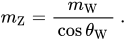
where θw is the weak mixing angle. The axes representing the particles have essentially just been rotated, in the (W3, B) plane, by the angle θw. This also introduces a mismatch between the mass of the Z0 and the mass of the W± particles (denoted as mz and mw, respectively),
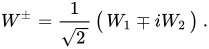
The W1 and W2 bosons, in turn, combine to produce the charged massive bosons W± :
where the subscript j sums over the three generations of fermions; Q, u, and d are the left-handed doublet, right-handed singlet up, and right handed singlet down quark fields; and L and e are the left-handed doublet and right-handed singlet electron fields.
The Feynman slash means the contraction of the 4-gradient with the Dirac matrices, defined as
and the covariant derivative (excluding the gluon gauge field for the strong interaction) is defined as
Here is the weak hypercharge and the are the components of the weak isospin.
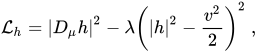
The term describes the Higgs field and its interactions with itself and the gauge bosons,
and generates their masses, manifest when the Higgs field acquires a nonzero vacuum expectation value, discussed next. The for are matrices of Yukawa couplings.
After electroweak symmetry breaking
The Lagrangian reorganizes itself as the Higgs field acquires a
non-vanishing vacuum expectation value dictated by the potential of the
previous section. As a result of this rewriting, the symmetry breaking
becomes manifest. In the history of the universe, this is believed to
have happened shortly after the hot big bang, when the universe was at a
temperature 159.5±1.5 GeV (assuming the Standard Model of particle physics).
Due to its complexity, this Lagrangian is best described by breaking it up into several parts as follows.
The kinetic term
contains all the quadratic terms of the Lagrangian, which include the
dynamic terms (the partial derivatives) and the mass terms
(conspicuously absent from the Lagrangian before symmetry breaking)
where the sum runs over all the fermions of the theory (quarks and leptons), and the fields and are given as
with to be replaced by the relevant field () and f abc by the structure constants of the appropriate gauge group.
The neutral current and charged current components of the Lagrangian contain the interactions between the fermions and gauge bosons,
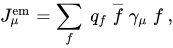
where The electromagnetic current is
where is the fermions' electric charges.
The neutral weak current is
where is the fermions' weak isospin.
The charged current part of the Lagrangian is given by
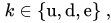
where is the right-handed singlet neutrino field, and the CKM matrix determines the mixing between mass and weak eigenstates of the quarks.
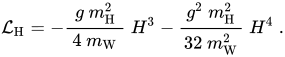
contains the Higgs three-point and four-point self interaction terms,
contains the Higgs interactions with gauge vector bosons,
contains the gauge three-point self interactions,
contains the gauge four-point self interactions,
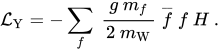
contains the Yukawa interactions between the fermions and the Higgs field,
In lattice gauge theory, the spacetime is Wick rotated into Euclidean space and discretized into a lattice with sites separated by distance and connected by links. In the most commonly considered cases, such as lattice QCD, fermion fields are defined at lattice sites (which leads to fermion doubling), while the gauge fields are defined on the links. That is, an element U of the compactLie groupG (not algebra) is assigned to each link. Hence, to simulate QCD with Lie group SU(3), a 3×3 unitary matrix is defined on each link. The link is assigned an orientation, with the inverse element corresponding to the same link with the opposite orientation. And each node is given a value in (a color 3-vector, the space on which the fundamental representation of SU(3) acts), a Dirac spinor, an nf vector, and a Grassmann variable.
Thus, the composition of links' SU(3) elements along a path (i.e. the ordered multiplication of their matrices) approximates a path-ordered exponential (geometric integral), from which Wilson loop values can be calculated for closed paths.
Yang–Mills action
The Yang–Mills action is written on the lattice using Wilson loops (named after Kenneth G. Wilson), so that the limit formally reproduces the original continuum action. Given a faithfulirreducible representation ρ of G, the lattice Yang–Mills action, known as the Wilson action, is the sum over all lattice sites of the (real component of the) trace over the n links e1, ..., en in the Wilson loop,
Here, χ is the character. If ρ is a real (or pseudoreal)
representation, taking the real component is redundant, because even if
the orientation of a Wilson loop is flipped, its contribution to the
action remains unchanged.
There are many possible Wilson actions, depending on which Wilson
loops are used in the action. The simplest Wilson action uses only the
1×1 Wilson loop, and differs from the continuum action by "lattice
artifacts" proportional to the small lattice spacing .
By using more complicated Wilson loops to construct "improved
actions", lattice artifacts can be reduced to be proportional to , making computations more accurate.
Measurements and calculations
This result of a Lattice QCD computation shows a meson, composed out of a quark and an antiquark. (After M. Cardoso et al.)
Quantities such as particle masses are stochastically calculated using techniques such as the Monte Carlo method. Gauge field configurations are generated with probabilities proportional to , where is the lattice action and is related to the lattice spacing .
The quantity of interest is calculated for each configuration, and
averaged. Calculations are often repeated at different lattice spacings
so that the result can be extrapolated to the continuum, .
Such calculations are often extremely computationally intensive, and can require the use of the largest available supercomputers. To reduce the computational burden, the so-called quenched approximation
can be used, in which the fermionic fields are treated as non-dynamic
"frozen" variables. While this was common in early lattice QCD
calculations, "dynamical" fermions are now standard. Simulating lattice gauge theories is one hypothetical application of quantum computers.
The results of lattice QCD computations show that in a meson not only the particles (quarks and antiquarks), but also the "fluxtubes" of the gluon fields are important.
Quantum triviality
Lattice gauge theory is also important for the study of quantum triviality by the real-space renormalization group. The most important information in the RG flow are the fixed points.
The possible macroscopic states of the system, at a large scale, are
given by this set of fixed points. If these fixed points correspond to a
free field theory, the theory is said to be trivial or noninteracting.
The concept of triviality has been applied to the physics of the Higgs boson. A comparatively simple toy model of the "Higgs sector" of the Standard Model is provided by φ4 theory,
i.e., a scalar field theory whose Lagrangian includes an interaction
term that is quartic in the field φ. It is conjectured, based on
evidence including lattice gauge calculations, that this theory is
"trivial": if the regularization cutoff is taken to zero distance or
infinite energy, the theory will describe only free particles. Using
this as a model for the Higgs boson, the conjectured triviality implies
that the cutoff cannot be removed. Because there is an upper bound on
how high the cutoff energy can be, there is an upper bound on the
interaction strength, which ultimately implies an upper bound on the
mass of the Higgs boson.
Other applications
Originally, solvable two-dimensional lattice gauge theories had
already been introduced in 1971 as models with interesting statistical
properties by the theorist Franz Wegner, who worked in the field of phase transitions.
When only 1×1 Wilson loops appear in the action, lattice gauge theory can be shown to be exactly dual to spin foam models.
Analytical chemistry (or chemical analysis) is the branch of chemistry
concerned with the development and application of methods to identify
the chemical composition of materials and quantify the amounts of
components in mixtures.
It focuses on methods to identify unknown compounds, possibly in a
mixture or solution, and quantify a compound's presence in terms of amount of substance (in any phase), concentration (in aqueous or solution phase), percentage by mass or number of moles in a mixture of compounds (or partial pressure in the case of gas phase).
Analytical chemistry has been important since the early days of
chemistry, providing methods for determining which elements and
chemicals are present in the object in question. During this period,
significant contributions to analytical chemistry included the
development of systematic elemental analysis by Justus von Liebig and systematized organic analysis based on the specific reactions of functional groups.
Most of the major developments in analytical chemistry took place
after 1900. During this period, instrumental analysis became
progressively dominant in the field. In particular, many of the basic
spectroscopic and spectrometric techniques were discovered in the early
20th century and refined in the late 20th century.
The separation sciences follow a similar timeline of development and have also became increasingly transformed into high-performance instruments.[6]
In the 1970s many of these techniques began to be used together as
hybrid techniques to achieve a complete characterization of samples.
Starting in the 1970s, analytical chemistry became progressively more inclusive of biological questions (bioanalytical chemistry), whereas it had previously been largely focused on inorganic or small organic molecules.
Lasers have been increasingly used as probes and even to initiate and
influence a wide variety of reactions. The late 20th century also saw an
expansion of the application of analytical chemistry from somewhat
academic chemical questions to forensic, environmental, industrial and medical questions, such as in histology.
Modern analytical chemistry is dominated by instrumental
analysis. Many analytical chemists focus on a single type of instrument.
Academics tend to either focus on new applications and discoveries or
on new methods of analysis. The discovery of a chemical present in blood
that increases the risk of cancer would be a discovery that an
analytical chemist might be involved in. An effort to develop a new
method might involve the use of a tunable laser
to increase the specificity and sensitivity of a spectrometric method.
Many methods, once developed, are kept purposely static so that data can
be compared over long periods of time. This is particularly true in
industrial quality assurance
(QA), forensic, and environmental applications. Analytical chemistry
plays an increasingly important role in the pharmaceutical industry
where, aside from QA, it is used in the discovery of new drug candidates
and in clinical applications where understanding the interactions
between the drug and the patient are critical.
The 21st century has been defined by the digitalization of
analytical chemistry. The handling of large datasets ("big data") from
instruments like Orbitrap mass spectrometers has made advanced data
analysis, including machine learning, an essential skill. This era also focuses strongly on sustainability, leading to the green chemistry subfield of Green Analytical Chemistry, which aims to minimize the environmental impact of chemical analyses.
Classical methods
The presence of copper in this qualitative analysis is indicated by the bluish-green color of the flame.
Although modern analytical chemistry is dominated by sophisticated
instrumentation, the roots of analytical chemistry and some of the
principles used in modern instruments are from traditional techniques,
many of which are still used today. These techniques also tend to form
the backbone of most undergraduate analytical chemistry educational
labs.
Inorganic qualitative analysis generally refers to a systematic
scheme to confirm the presence of certain aqueous ions or elements by
performing a series of reactions that eliminate a range of possibilities
and then confirm suspected ions with a confirming test. Sometimes small
carbon-containing ions are included in such schemes. With modern
instrumentation, these tests are rarely used but can be useful for
educational purposes and in fieldwork or other situations where access
to state-of-the-art instruments is not available or expedient.
Quantitative analysis is the measurement of the quantities of
particular chemical constituents present in a substance. Quantities can
be measured by mass (gravimetric analysis) or volume (volumetric
analysis).
Gravimetric analysis involves determining the amount of material
present by weighing the sample before and/or after some transformation. A
common example used in undergraduate education is the determination of
the amount of water in a hydrate by heating the sample to remove the water such that the difference in weight is due to the loss of water.
Titration involves the gradual addition of a measurable reactant to an exact volume of a solution being analyzed until some equivalence point is reached. Titration is a family of techniques used to determine the concentration of an analyte. Titrating accurately to either the half-equivalence point
or the endpoint of a titration allows the chemist to determine the
amount of moles used, which can then be used to determine a
concentration or composition of the titrant. Most familiar to those who
have taken chemistry during secondary education is the acid-base
titration involving a color-changing pH indicator, such as phenolphthalein. There are many other types of titrations, including potentiometric titrations and precipitation titrations. Chemists might also create titration curves by systematically testing the pH after every added drop in order to understand different properties of the titrant.
Mass spectrometry measures mass-to-charge ratio of molecules using electric and magnetic fields.
In a mass spectrometer, a small amount of sample is ionized and
converted to gaseous ions, where they are separated and analyzed
according to their mass-to-charge ratios.
Electroanalytical methods measure the potential (volts) and/or current (amps) in an electrochemical cell containing the analyte. These methods can be categorized according to which aspects of the
cell are controlled and which are measured. The four main categories are
potentiometry (the difference in electrode potentials is measured), coulometry (the transferred charge is measured over time), amperometry (the cell's current is measured over time), and voltammetry (the cell's current is measured while actively altering the cell's potential).
Chromatography can be used to determine the presence of substances in
a sample, as different components in a mixture have different
tendencies to adsorb onto the stationary phase or dissolve in the mobile
phase. Thus, different components of the mixture move at different
speeds. Different components of a mixture can therefore be identified by
their respective Rƒ values,
which is the ratio between the migration distance of the substance and
the migration distance of the solvent front during chromatography.
In combination with the instrumental methods, chromatography can
be used in the quantitative determination of substances. There are
different types of chromatography that differ from the media they use to
separate the analyte and the sample. In thin-layer chromatography, the analyte mixture moves up and separates along the coated sheet under the volatile mobile phase. In gas chromatography, the gas phase separates the volatile analytes. A common method of chromatography using liquid as a mobile phase is high-performance liquid chromatography.
Hyphenated separation techniques refer to a combination of two
(or more) techniques to detect and separate chemicals from solutions.
Most often the other technique is some form of chromatography. Hyphenated techniques are widely used in chemistry and biochemistry. A slash is sometimes used instead of hyphen, especially if the name of one of the methods contains a hyphen itself.
The visualization of single molecules, single cells, biological tissues, and nanomaterials
is an important and attractive approach in analytical science. Also,
hybridization with other traditional analytical tools is revolutionizing
analytical science. Microscopy can be categorized into three different fields: optical microscopy, electron microscopy, and scanning probe microscopy. Recently, this field is rapidly progressing because of the rapid development of the computer and camera industries.
Devices that integrate (multiple) laboratory functions on a single
chip of only millimeters to a few square centimeters in size and that
are capable of handling extremely small fluid volumes down to less than
picoliters.
Data analysis and chemometrics
The vast amount of data produced by modern analytical instruments has
made computational data analysis an integral part of the field. The
field of chemometrics uses statistical and mathematical methods to
design optimal experimental procedures and to extract meaningful
information from chemical data.
Key areas include:
Multivariate calibration: Used to develop models that correlate
instrument responses (e.g., spectra) to analyte concentrations,
essential in techniques like near-infrared spectroscopy.
Pattern recognition: Employed to classify samples based on their
analytical profile, with applications in food authenticity and medical
diagnostics.
Machine learning and artificial intelligence:
These techniques are increasingly used for predictive modeling,
optimizing analytical methods, and automating data interpretation.
Error can be defined as numerical difference between observed value and true value. The experimental error
can be divided into two types, systematic error and random error.
Systematic error results from a flaw in equipment or the design of an
experiment while random error results from uncontrolled or
uncontrollable variables in the experiment.
In error the true value and observed value in chemical analysis can be related to each other by the equation
where
is the absolute error.
is the true value.
is the observed value.
An error of a measurement is an inverse measure of accurate
measurement (i.e., smaller the error greater the accuracy of the
measurement).
Errors can be expressed relatively. Given the relative error ():
The percent error can also be calculated:
To use these values in a function, it may be useful to calculate the error of the function. If is a function with variables, the propagation of uncertainty must be calculated in order to know the error in :
A general method for analysis of concentration involves the creation of a calibration curve.
This allows for the determination of the amount of a chemical in a
material by comparing the results of an unknown sample to those of a
series of known standards. If the concentration of an element or
compound in a sample exceeds the detection range of the technique, it
can simply be diluted in a pure solvent. If the amount in the sample is
below an instrument's range of measurement, the method of addition can
be used. In this method, a known quantity of the element or compound
under study is added, and the difference between the concentration added
and the concentration observed is the amount actually in the sample.
Internal standards
Sometimes an internal standard
is added at a known concentration directly to an analytical sample to
aid in quantitation. The amount of analyte present is then determined
relative to the internal standard as a calibrant. An ideal internal
standard is an isotopically enriched analyte which gives rise to the
method of isotope dilution.
Standard addition
The method of standard addition is used in instrumental analysis to determine the concentration of a substance (analyte) in an unknown sample by comparison to a set of samples of known concentration, similar to using a calibration curve. Standard addition can be applied to most analytical techniques and is used instead of a calibration curve to solve the matrix effect problem.
Signals and noise
One of the most important components of analytical chemistry is maximizing the desired signal while minimizing the associated noise. The analytical figure of merit is known as the signal-to-noise ratio (S/N or SNR).
Noise can arise from environmental factors as well as from fundamental physical processes.
Thermal noise results from the motion of charge carriers (usually
electrons) in an electrical circuit generated by their thermal motion.
Thermal noise is white noise, meaning that the power spectral density is constant throughout the frequency spectrum.
The root mean square value of the thermal noise in a resistor is given by
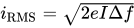
Shot noise is a type of electronic noise that occurs when the finite number of particles (such as electrons in an electronic circuit or photons in an optical device) is small enough to give rise to statistical fluctuations in a signal.
Shot noise is a Poisson process, and the charge carriers that make up the current follow a Poisson distribution. The root mean square current fluctuation is given by
where e is the elementary charge and I is the average current. Shot noise is white noise.
Flicker noise is electronic noise with a 1/ƒ frequency spectrum; as f
increases, the noise decreases. Flicker noise arises from a variety of
sources, such as impurities in a conductive channel, generation, and recombination noise in a transistor due to base current, and so on. This noise can be avoided by modulation of the signal at a higher frequency, for example, through the use of a lock-in amplifier.
Environmental noise
Noise in a thermogravimetric analysis; lower noise in the middle of the plot results from less human activity (and environmental noise) at night
Great effort is being put into shrinking the analysis techniques to chip
size. Although few examples of such systems compete with traditional
analysis techniques, potential advantages include size/portability,
speed, and cost. Micro total analysis system (μTAS) or lab-on-a-chip. Microscale chemistry reduces the amount of chemicals used.
Many developments improve the analysis of biological systems. Examples of rapidly expanding fields in this area are genomics, DNA sequencing and related research in genetic fingerprinting and DNA microarray; proteomics,
the analysis of protein concentrations and modifications, especially in
response to various stressors, at various developmental stages, or in
various parts of the body; metabolomics, which deals with metabolites; transcriptomics, including mRNA and associated fields; lipidomics,
dealing with lipids and its related fields; peptidomics, dealing with
peptides and its related fields; and metallomics, dealing with metal
concentrations and especially with their binding to proteins and other
molecules.
Analytical chemistry has played a critical role in the
understanding of basic science to a variety of practical applications,
such as biomedical applications, environmental monitoring, quality control of industrial manufacturing, and forensic science.
The recent developments in computer automation and information
technologies have extended analytical chemistry into several new
biological fields. For example, automated DNA sequencing machines were the basis for completing human genome projects, leading to the birth of genomics. Protein identification and peptide sequencing by mass spectrometry opened a new field of proteomics.
In addition to automating specific processes, there is effort to
automate larger sections of lab testing, such as in companies like Emerald Cloud Lab and Transcriptic.
Analytical chemistry has been an indispensable area in the development of nanotechnology. Surface characterization instruments, electron microscopes and scanning probe microscopes enable scientists to visualize atomic structures with chemical characterizations.
.svg)





























![{\displaystyle {\mathcal {L}}_{\mathrm {C} }=-{\frac {g}{\ {\sqrt {2\;}}\ }}\ \left[\ {\overline {u}}_{i}\ \gamma ^{\mu }\ {\frac {\ 1-\gamma ^{5}\ }{2}}\;M_{ij}^{\mathrm {CKM} }\ d_{j}+{\overline {\nu }}_{i}\ \gamma ^{\mu }\;{\frac {\ 1-\gamma ^{5}\ }{2}}\;e_{i}\ \right]\ W_{\mu }^{+}+\mathrm {h.c.} ~,}](https://wikimedia.org/api/rest_v1/media/math/render/svg/a58fb2388e4f81affcfbb2f9137be3fc21c01d32)





![{\displaystyle {\mathcal {L}}_{\mathrm {WWV} }=-i\ g\ \left[\;\left(\ W_{\mu \nu }^{+}\ W^{-\mu }-W^{+\mu }\ W_{\mu \nu }^{-}\ \right)\left(\ A^{\nu }\ \sin \theta _{\mathrm {W} }-Z^{\nu }\ \cos \theta _{\mathrm {W} }\ \right)+W_{\nu }^{-}\ W_{\mu }^{+}\ \left(\ A^{\mu \nu }\ \sin \theta _{\mathrm {W} }-Z^{\mu \nu }\ \cos \theta _{\mathrm {W} }\ \right)\;\right]~.}](https://wikimedia.org/api/rest_v1/media/math/render/svg/3a692b930d152ed1c16bd24ebede10eb0a7f7c2b)

![{\displaystyle {\begin{aligned}{\mathcal {L}}_{\mathrm {WWVV} }=-{\frac {\ g^{2}\ }{4}}\ {\Biggl \{}\ &{\Bigl [}\ 2\ W_{\mu }^{+}\ W^{-\mu }+(\ A_{\mu }\ \sin \theta _{\mathrm {W} }-Z_{\mu }\ \cos \theta _{\mathrm {W} }\ )^{2}\ {\Bigr ]}^{2}\\&-{\Bigl [}\ W_{\mu }^{+}\ W_{\nu }^{-}+W_{\nu }^{+}\ W_{\mu }^{-}+\left(\ A_{\mu }\ \sin \theta _{\mathrm {W} }-Z_{\mu }\ \cos \theta _{\mathrm {W} }\ \right)\left(\ A_{\nu }\ \sin \theta _{\mathrm {W} }-Z_{\nu }\ \cos \theta _{\mathrm {W} }\ \right)\ {\Bigr ]}^{2}\,{\Biggr \}}~.\end{aligned}}}](https://wikimedia.org/api/rest_v1/media/math/render/svg/1b7a413ef9a695a06d5c93067c2745e6bfe3d1a3)











_(8225044148).jpg)