The end-of-history illusion is a psychological illusion in which individuals of all ages believe that they have experienced significant personal growth and changes in tastes up to the present moment, but will not substantially grow or mature in the future. Despite recognizing that their perceptions have evolved, individuals
predict that their perceptions will remain roughly the same in the
future.
The illusion is based on the fact that at any given
developmental stage, an individual can observe a relatively low level of
maturity in previous stages. The phenomenon affects teenagers,
middle-aged individuals, and seniors. In general, people tend to see
significant changes in hindsight, but fail to predict that these changes
will continue. For example, a 20-year-old's prediction of how great a
change they will undergo in the next ten years will not be as extreme as
a 30-year-old's recollection of the changes they underwent between the
ages of 20 and 30. The same phenomenon is true for people of any age.
One of the key researchers of end-of-history, psychologist Daniel Gilbert, gave a TED talk about the illusion. Gilbert speculates that the phenomenon may occur because of the
difficulty of predicting how one will change or a satisfaction with
one's current state of being. Gilbert also relates the phenomenon to the way humans perceive time in general.
Original study
The term "End of History Illusion" originated in a 2013 journal article by psychologists Jordi Quoidbach, Daniel Gilbert, and Timothy Wilson detailing their research on the phenomenon and leveraging the phrase coined by Francis Fukuyama's 1992 book of the same name.
The article summarizes six studies on more than 19,000 participants
between the ages of 18 and 68. These studies found underestimation of
future changes to personality, core values, and preferences as well as
explored some of the practical consequences of these underestimations.
Personality
One study was conducted in order to determine whether
people underestimate how much their personalities will change in the
future. This was done by having all individuals within the sample take a
personality test.
The participants were then assigned to either complete the test as they
would have ten years ago or asked to complete the test in the manner
they believe they would in ten years time. The differences between
current personality and reported or predicted personality were then
placed in a regression analysis.
This particular study revealed that the older a participant
was, the less personality change they reported or predicted. Despite
this, the magnitude of the end-of-history illusion did not change with
age as predictors consistently predicted their personality would change
less over the next decade than reporters believed it changed in that
time. Comparing the findings of the study with the magnitude of actual
personality change found in previous sampling and the results supported
the hypothesis that the discrepancy between predicted and reported
personalities is due in part to errors of prediction and not errors of
memory.
Core values
In order to test if the end-of-history illusion also
applied to the domain of core values the researchers repeated the
procedure used to test personality. After recruiting a new sample the
participants were asked to indicate the importance of ten basic values
for current day and then got sorted into reporting and predicting
groups. For core values the researchers found that the magnitude of the
end-of-history illusion existed for core values as well, and although
the magnitude in this case decreased with age it was nonetheless present
in all age groups of participants.
Preferences
In order to verify the claim that the discrepancy being
recorded was due to error of prediction and not error of memory the
researchers decided to also study a domain in which memory would be
highly reliable. The experimenters believed that asking an individual to
remember their preferences from a decade ago would be significantly
easier and more accurate than asking them to remember their personality
traits or to rank their values. For the purpose of this study a new
sample was recruited and once again all participants gave their current
day preferences for various questions such as favorite food, favorite
music, or best friend. The sample was then broken into reporters and
predictors who simply recorded if their preference was different one
decade ago or whether or not they expect their preference to change in
the next decade.
Once again a regression analysis revealed the same results,
with the end-of-history illusion present in preference change
predictions. Participants consistently expected their preferences to
remain relatively unchanged over the next 10 years while participants
one decade older reflected on much higher levels of preference change.
This reinforced the notion that the discrepancy between reporters and
predictors are in part due to underestimation of predictions and not the
memory error that personality and value studies may be more sensitive
to.
Conclusion
Quoidbach, Gilbert, and Wilson concluded based on this
evidence that not only do people underestimate how much they will change
in the future, but in doing so jeopardize their optimal decision
making. The reason for the illusion has not been studied, although the
researchers speculate that a resistance or fear of change may be causal. Another explanation put forth by the researchers is that reporting is
reconstructive while predicting is constructive. Because constructing
new things is typically more difficult than reconstructing old ones,
people will tend to prefer the idea of change being unlikely to the
difficult alternative of imagining immense personal change. Overall the
study concludes that at all ages individuals seem to believe that their
pace of personal change has now slowed to a crawl, while evidence points
to this being an underestimation.
Criticism
The original study that suggested the end-of-history
illusion, which was led by Jordi Quoidbach, has been met with criticism
for its use of a cross-sectional study rather than a longitudinal study, which would have lent itself better to the long-term nature of the effect. Critics are also skeptical of the reliability of autobiographical memory.
It has also been argued that the claim of an illusion is actually due to a subtle mathematical mistake: if people do think that something will change but don’t know which
direction it will change in, the best prediction they can make is that
it won’t change. The finding that people predict their lives won’t
change is consistent with people thinking their lives probably will
change, but not knowing whether things will get better or worse.
In logic, reductio ad absurdum (Latin for "reduction to absurdity"), also known as argumentum ad absurdum (Latin for "argument to absurdity"), apagogical argument, or proof by contradiction, is the form of argument
that attempts to establish a claim by showing that following the logic
of a contrary proposition or argument would lead to absurdity or contradiction. Although it is quite freely used in mathematical proofs, not every school of mathematical thought accepts this kind of nonconstructive proof.
This argument form traces back to Ancient Greek philosophy
and has been used throughout history in both formal mathematical and
philosophical reasoning, as well as in debate. In mathematics, the
technique is called proof by contradiction. In formal logic, this
technique is captured by an inference rule for reductio ad absurdum.
More broadly, proof by contradiction is any form of
argument that establishes a statement by arriving at a contradiction,
even when the initial assumption is not the negation of the statement to
be proved. In this general sense, proof by contradiction is also known
as indirect proof, proof by assuming the opposite, and reductio ad impossibile.
G. H. Hardy described proof by contradiction as "one of a mathematician's finest weapons", saying "It is a far finer gambit than any chess gambit: a chess player may offer the sacrifice of a pawn or even a piece, but a mathematician offers the game."
Examples
The "absurd" conclusion of a reductio ad absurdum argument can take a range of forms, as can be seen in the following examples of refutation by contradiction:
The Earth cannot be flat; otherwise, since the Earth is assumed to be finite in extent, we would find people falling off the edge.
There is no smallest positive rational number; if were the smallest positive rational, then would be a positive rational number that is smaller than because it equals half of , and it would also not be smaller than because is assumed to be the smallest positive rational.
The first example argues that denial of the premise would
result in a ridiculous conclusion, against the evidence of our senses (empirical evidence). The second example is a mathematical proof by contradiction (also known as an indirect proof), which argues that the denial of the premise would result in a logical contradiction ( is both smaller and not smaller than ).
A mathematical proof employing proof by contradiction usually proceeds as follows:
The proposition to be proved is P.
We assume P to be false, i.e., we assume ¬P.
It is then shown that ¬P implies falsehood. This is typically accomplished by deriving two mutually contradictory assertions, Q and ¬Q, and appealing to the law of noncontradiction.
Since assuming P to be false leads to a contradiction, it is concluded that P is in fact true.
An important special case is the existence proof
by contradiction: in order to demonstrate that an object with a given
property exists, we derive a contradiction from the assumption that all
objects satisfy the negation of the property.
Greek philosophy
Reductio ad absurdum was used throughout Greek philosophy. The earliest example of a reductio argument can be found in a satirical poem attributed to Xenophanes of Colophon (c. 570 – c. 475 BCE). Criticizing Homer's
attribution of human faults to the gods, Xenophanes states that humans
also believe that the gods' bodies have human form. But if horses and
oxen could draw, they would draw the gods with horse and ox bodies. The gods cannot have both forms, so this is a contradiction. Therefore,
the attribution of other human characteristics to the gods, such as
human faults, is also false.
Greek mathematicians proved fundamental propositions using reductio ad absurdum. Euclid of Alexandria (mid-4th – mid-3rd centuries BCE) and Archimedes of Syracuse (c. 287 – c. 212 BCE) are two very early examples.
The earlier dialogues of Plato (424–348 BCE), relating the discourses of Socrates, raised the use of reductio arguments to a formal dialectical method (elenchus), also called the Socratic method. Typically, Socrates' opponent would make what would seem to be an
innocuous assertion. In response, Socrates, via a step-by-step train of
reasoning, bringing in other background assumptions, would make the
person admit that the assertion resulted in an absurd or contradictory
conclusion, forcing him to abandon his assertion and adopt a position of
aporia.
Elenctic refutation depends on a dichotomous thesis, one that may be divided into exactly two mutually exclusive
parts, only one of which may be true. Then Socrates goes on to
demonstrate the contrary of the commonly accepted part using the law of
non-contradiction. According to Gregory Vlastos, the method has the following steps:
Socrates' interlocutor asserts a thesis, for example, "Courage is endurance of the soul", which Socrates considers false and targets for refutation.
Socrates secures his interlocutor's agreement to further
premises, for example, "Courage is a fine thing" and "Ignorant endurance
is not a fine thing".
Socrates then argues, and the interlocutor agrees, that
these further premises imply the contrary of the original thesis, in
this case, it leads to: "courage is not endurance of the soul".
Socrates then claims that he has shown that his interlocutor's thesis is false and that its negation is true.
The technique was also a focus of the work of Aristotle (384–322 BCE), particularly in his Prior Analytics where he referred to it as demonstration to the impossible (Ancient Greek: ἡ εἰς τὸ ἀδύνατον ἀπόδειξις, lit.'demonstration to the impossible', 62b).
Another example of this technique is found in the sorites paradox,
where it was argued that if 1,000,000 grains of sand formed a heap, and
removing one grain from a heap left it a heap, then a single grain of
sand (or even no grains) forms a heap.
Buddhist philosophy
Much of MadhyamakaBuddhist philosophy centers on showing how various essentialist ideas have absurd conclusions through reductio ad absurdum arguments (known as prasaṅga, "consequence" in Sanskrit). In the Mūlamadhyamakakārikā, Nāgārjuna's reductio ad absurdum arguments are used to show that any theory of substance or essence was unsustainable and therefore, phenomena (dharmas) such as change, causality, and sense perception were empty (sunya) of any essential existence. Nāgārjuna's main goal is often seen by scholars as refuting the essentialism of certain Buddhist Abhidharma schools (mainly Vaibhasika) which posited theories of svabhava (essential nature) and also the Hindu Nyāya and Vaiśeṣika schools which posited a theory of ontological substances (dravyatas).
In 13:5, Nagarjuna wishes to demonstrate consequences of
the presumption that things essentially, or inherently, exist, pointing
out that if a "young man" exists in himself then it follows he cannot
grow old (because he would no longer be a "young man"). As we attempt to
separate the man from his properties (youth), we find that everything
is subject to momentary change, and are left with nothing beyond the
merely arbitrary convention that such entities as "young man" depend
upon.
A thing itself does not change.
Something different does not change.
Because a young man does not grow old.
And because an old man does not grow old either.
Modern philosophy
Contemporary philosophers have also utilized appeals to the reductio ad absurdum argument within their respective scholarly works. Included among them are:
Robert L. Holmes - in his criticism of deterrence theory based upon the deontologicalprima facie
presumption against killing innocent life and the irrationality of any
reliance upon a system of preventing war which is based exclusively upon
the threat of waging war. (On War and Morality, 1989)
Relation to the principle of non-contradiction
Aristotle clarified the connection between contradiction and falsity in his principle of non-contradiction, which states that a proposition cannot be both true and false. That is, a proposition and its negation (not-Q)
cannot both be true. Therefore, if a proposition and its negation are
both entailed by a premise, the premise is false. This technique is the
most common way of reaching a contradiction in mathematical arguments.
Formalization
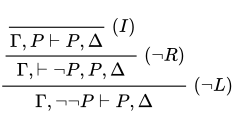
The principle may be formally expressed as the propositional formula ¬¬P ⇒ P, equivalently (¬P ⇒ ⊥) ⇒ P, which reads: "If assuming P to be false implies falsehood, then P is true."
which reads: "Hypotheses and entail the conclusion or."
Justification
In classical logic the principle may be justified by the examination of the truth table of the proposition ¬¬P ⇒ P, which demonstrates it to be a tautology:
P
¬P
¬¬P
¬¬P ⇒ P
T
F
T
T
F
T
F
T
Another way to justify the principle is to derive it from the law of the excluded middle, as follows. We assume ¬¬P and seek to prove P. By the law of excluded middle P either holds or it does not:
Proof by contradiction is similar to refutation by contradiction, also known as proof of negation, which states that ¬P is proved as follows:
The proposition to be proved is ¬P.
Assume P.
Derive falsehood.
Conclude ¬P.
In contrast, proof by contradiction proceeds as follows:
The proposition to be proved is P.
Assume ¬P.
Derive falsehood.
Conclude P.
Formally these are not the same, as refutation by
contradiction applies only when the proposition to be proved is negated,
whereas proof by contradiction may be applied to any proposition
whatsoever. In classical logic, where and
may be freely interchanged, the distinction is largely obscured. Thus
in mathematical practice, both principles are referred to as "proof by
contradiction".
Proof by contradiction in intuitionistic logic
In intuitionistic logic
proof by contradiction is not generally valid, although some particular
instances can be derived. In contrast, proof of negation and principle
of noncontradiction are both intuitionistically valid.
Brouwer–Heyting–Kolmogorov interpretation of proof by contradiction gives the following intuitionistic validity condition: if
there is no method for establishing that a proposition is false, then
there is a method for establishing that the proposition is true.
If we take "method" to mean algorithm, then the condition is not acceptable, as it would allow us to solve the Halting problem. To see how, consider the statement H(M) stating "Turing machineM halts or does not halt". Its negation ¬H(M) states that "M neither halts nor does not halt", which is false by the law of noncontradiction
(which is intuitionistically valid). If proof by contradiction were
intuitionistically valid, we would obtain an algorithm for deciding
whether an arbitrary Turing machine M halts, thereby violating the (intuitionistically valid) proof of non-solvability of the Halting problem.
A proposition P which satisfies is known as a ¬¬-stable proposition.
Thus in intuitionistic logic proof by contradiction is not universally
valid, but can only be applied to the ¬¬-stable propositions. An
instance of such a proposition is a decidable one, i.e., satisfying .
Indeed, the above proof that the law of excluded middle implies proof
by contradiction can be repurposed to show that a decidable proposition
is ¬¬-stable. A typical example of a decidable proposition is a
statement that can be checked by direct computation, such as " is prime" or " divides ".
Examples of proofs by contradiction
Euclid's Elements
An early occurrence of proof by contradiction can be found in Euclid's Elements, Book 1, Proposition 6:
If in a triangle two angles equal one another, then the sides opposite the equal angles also equal one another.
The proof proceeds by assuming that the opposite sides are
not equal, and derives a contradiction. Likewise, many other proofs
following in Euclid's Elements also use the same proof strategy, such as in Book 7, Proposition 33:
If the side of the hexagon and that of the
decagon inscribed in the same circle are added together, then the whole
straight line has been cut in extreme and mean ratio, and its greater
segment is the side of the hexagon.
If are polynomials in n indeterminates with complex coefficients, which have no common complex zeros, then there are polynomials such that
Hilbert proved the statement by assuming that there are no such polynomials and derived a contradiction.
Infinitude of primes
Euclid's theorem states that there are infinitely many primes. In Euclid's Elements, the theorem is stated in Book IX, Proposition 20:
Prime numbers are more than any assigned multitude of prime numbers.
Depending on how we formally write the above statement,
the usual proof takes either the form of a proof by contradiction or a
refutation by contradiction. We present here the former, see below how
the proof is done as refutation by contradiction.
If we formally express Euclid's theorem as saying that for every natural number there is a prime bigger than it, then we employ proof by contradiction, as follows.
Given any number , we seek to prove that there is a prime larger than . Suppose to the contrary that no such p exists (an application of proof by contradiction). Then all primes are smaller than or equal to , and we may form the list of them all. Let be the product of all primes and . Because is larger than all prime numbers it is not prime, hence it must be divisible by one of them, say . Now both and are divisible by , hence so is their difference ,
but this cannot be because 1 is not divisible by any primes. Hence we
have a contradiction and so there is a prime number bigger than .
Examples of refutations by contradiction
The following examples are commonly referred to as proofs
by contradiction, but formally employ refutation by contradiction (and
therefore are intuitionistically valid).
Infinitude of primes
Euclid's theorem, in his Elements Book IX, Proposition 20, states:
Prime numbers are more than any assigned multitude of prime numbers.
We may read the statement as saying that for every finite
list of primes, there is another prime not on that list, which is
arguably closer to and in the same spirit as Euclid's original
formulation. In this case Euclid's proof applies refutation by contradiction at one step, as follows.
Given any finite list of prime numbers , it will be shown that at least one additional prime number not in this list exists. Let be the product of all the listed primes and a prime factor of , possibly itself. We claim that is not in the given list of primes. Suppose to the contrary that it were (an application of refutation by contradiction). Then would divide both and , therefore also their difference, which is . This gives a contradiction, since no prime number divides 1.
Irrationality of the square root of 2
The classic proof that the square root of 2 is irrational is a refutation by contradiction. Indeed, we set out to prove the negation ¬ ∃ a, b ∈ . a/b = √2 by assuming that there exist natural numbers a and b whose ratio is the square root of two, and derive a contradiction.
Assume that √2 is rational, so it can be written as a fraction a/b in lowest terms, where a and b are integers with no common factors. This assumption allows us to apply a proof by contradiction. Squaring both sides gives 2 = a²/b², which implies that a² = 2b². Therefore, a² is even,
and it follows that a must also be even. Let a = 2k for some integer k.
Substituting back into the equation gives (2k)² = 2b², which simplifies
to 4k² = 2b², or b² = 2k². Hence, b² is even, and therefore b must also
be even. This shows that both a and b are even, which contradicts the
assumption that a/b was in lowest terms. Therefore, the original
assumption is false, and √2 is irrational.
Proof by infinite descent
Proof by infinite descent is a method of proof whereby a smallest object with desired property is shown not to exist as follows:
Assume that there is a smallest object with the desired property.
Demonstrate that an even smaller object with the desired property exists, thereby deriving a contradiction.
Such a proof is again a refutation by contradiction. A
typical example is the proof of the proposition "there is no smallest
positive rational number": assume there is a smallest positive rational
number q and derive a contradiction by observing that q/2 is even smaller than q and still positive.
Russell's paradox
Russell's paradox,
stated set-theoretically as "there is no set whose elements are
precisely those sets that do not contain themselves", is a negated
statement whose usual proof is a refutation by contradiction.
Notation
Proofs by contradiction sometimes end with the word "Contradiction!". Isaac Barrow and Baermann used the notation Q.E.A., for "quod est absurdum" ("which is absurd"), along the lines of Q.E.D., but this notation is rarely used today. A graphical symbol sometimes used for contradictions is a downwards
zigzag arrow "lightning" symbol (U+21AF: ↯), for example in Davey and Priestley. Other symbols sometimes used include a pair of opposing arrows (as or ), struck-out arrows (), a stylized form of hash (such as U+2A33: ⨳), or the "reference mark" (U+203B: ※), or .
Automated theorem proving
In automated theorem proving the method of resolution
is based on proof by contradiction. That is, in order to show that a
given statement is entailed by given hypotheses, the automated prover
assumes the hypotheses and the negation of the statement, and attempts
to derive a contradiction.