Search This Blog

Monday, July 13, 2026

Probability interpretations

From Wikipedia, the free encyclopedia

The word "probability" has been used in a variety of ways since it was first applied to the mathematical study of games of chance. Does probability measure the real, physical, tendency of something to occur, or is it a measure of how strongly one believes it will occur, or does it draw on both these elements? In answering such questions, mathematicians interpret the probability values of probability theory.

There are two broad categories of probability interpretations which can be called "physical" and "evidential" probabilities. Physical probabilities, which are also called objective or frequency probabilities, are associated with random physical systems such as roulette wheels, rolling dice and radioactive atoms. In such systems, a given type of event (such as a die yielding a six) tends to occur at a persistent rate, or "relative frequency", in a long run of trials. Physical probabilities either explain, or are invoked to explain, these stable frequencies. The two main kinds of theory of physical probability are frequentist accounts (such as those of Venn, Reichenbach and von Mises) and propensity accounts (such as those of Popper, Miller, Giere and Fetzer).

Evidential probability, also called Bayesian probability, can be assigned to any statement whatsoever, even when no random process is involved, as a way to represent its rational subjective plausibility, or the degree to which the statement is supported by the available evidence. On most accounts, evidential probabilities are considered to be rational degrees of belief, defined in terms of dispositions to gamble at certain odds. The four main evidential interpretations are the classical (e.g. Laplace's) interpretation, the subjective interpretation (de Finetti and Savage), the epistemic or inductive interpretation (RamseyCox) and the logical interpretation (Keynes and Carnap). There are also evidential interpretations of probability covering groups, which are often labelled as 'intersubjective' (proposed by Gillies and Rowbottom).

Some interpretations of probability are associated with approaches to statistical inference, including theories of estimation and hypothesis testing. The physical interpretation, for example, is taken by followers of "frequentist" statistical methods, such as Ronald Fisher, Jerzy Neyman and Egon Pearson. Statisticians of the opposing, Bayesian school typically accept the frequency interpretation when it makes sense (although not as a definition), but there is less agreement regarding physical probabilities. Bayesians consider the calculation of evidential probabilities to be both valid and necessary in statistics. This article, however, focuses on the interpretations of probability rather than theories of statistical inference.

The terminology of this topic is rather confusing, in part because probabilities are studied within a variety of academic fields. The word "frequentist" is especially tricky. To philosophers it refers to a particular theory of physical probability, one that has more or less been abandoned. To scientists, on the other hand, "frequentist probability" is just another name for physical (or objective) probability. Those who promote Bayesian inference view "frequentist statistics" as an approach to statistical inference that is based on the frequency interpretation of probability, usually relying on the law of large numbers and characterized by what is called 'Null Hypothesis Significance Testing' (NHST). Also the word "objective", as applied to probability, sometimes means exactly what "physical" means here, but is also used of evidential probabilities that are fixed by rational constraints, such as logical and epistemic probabilities.

It is unanimously agreed that statistics depends somehow on probability. But, as to what probability is and how it is connected with statistics, there has seldom been such complete disagreement and breakdown of communication since the Tower of Babel. Doubtless, much of the disagreement is merely terminological and would disappear under sufficiently sharp analysis.

Savage, 1954, p. 2

Philosophy

The philosophy of probability presents problems chiefly in matters of epistemology and the uneasy interface between mathematical concepts and ordinary language as it is used by non-mathematicians. Probability theory is an established field of study in mathematics. It has its origins in correspondence discussing the mathematics of games of chance between Blaise Pascal and Pierre de Fermat in the seventeenth century, and was formalized and rendered axiomatic as a distinct branch of mathematics by Andrey Kolmogorov in the twentieth century. In axiomatic form, mathematical statements about probability theory carry the same sort of epistemological confidence within the philosophy of mathematics as are shared by other mathematical statements.

The mathematical analysis originated in observations of the behaviour of game equipment such as playing cards and dice, which are designed specifically to introduce random and equalized elements; in mathematical terms, they are subjects of indifference. This is not the only way probabilistic statements are used in ordinary human language: when people say that "it will probably rain", they typically do not mean that the outcome of rain versus not-rain is a random factor that the odds currently favor; instead, such statements are perhaps better understood as qualifying their expectation of rain with a degree of confidence. Likewise, when it is written that "the most probable explanation" of the name of Ludlow, Massachusetts "is that it was named after Roger Ludlow", what is meant here is not that Roger Ludlow is favored by a random factor, but rather that this is the most plausible explanation of the evidence, which admits other, less likely explanations.

Thomas Bayes attempted to provide a logic that could handle varying degrees of confidence; as such, Bayesian probability is an attempt to recast the representation of probabilistic statements as an expression of the degree of confidence by which the beliefs they express are held.

Though probability initially had somewhat mundane motivations, its modern influence and use is widespread ranging from evidence-based medicine, through six sigma, all the way to the probabilistically checkable proof and the string theory landscape.

A summary of some interpretations of probability

Classical Frequentist Subjective Propensity
Main hypothesis Principle of indifferenceFrequency of occurrenceDegree of beliefDegree of causal connection
Conceptual basis Hypothetical symmetryPast data and reference classKnowledge and intuitionPresent state of system
Conceptual approach ConjecturalEmpiricalSubjectiveMetaphysical
Single case possible YesNoYesYes
Precise YesNoNoYes
Problems Ambiguity in principle of indifferenceCircular definitionReference class problemDisputed concept

Classical definition

The first attempt at mathematical rigour in the field of probability, championed by Pierre-Simon Laplace, is now known as the classical definition. Developed from studies of games of chance (such as rolling dice) it states that probability is shared equally between all the possible outcomes, provided these outcomes can be deemed equally likely. (3.1)

The theory of chance consists in reducing all the events of the same kind to a certain number of cases equally possible, that is to say, to such as we may be equally undecided about in regard to their existence, and in determining the number of cases favorable to the event whose probability is sought. The ratio of this number to that of all the cases possible is the measure of this probability, which is thus simply a fraction whose numerator is the number of favorable cases and whose denominator is the number of all the cases possible.

Pierre-Simon Laplace, A Philosophical Essay on Probabilities

The classical definition of probability works well for situations with only a finite number of equally-likely outcomes.

This can be represented mathematically as follows: If a random experiment can result in N mutually exclusive and equally likely outcomes and if NA of these outcomes result in the occurrence of the event A, the probability of A is defined by
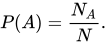
There are two clear limitations to the classical definition. Firstly, it is applicable only to situations in which there is only a 'finite' number of possible outcomes. But some important random experiments, such as tossing a coin until it shows heads, give rise to an infinite set of outcomes. And secondly, it requires an a priori determination that all possible outcomes are equally likely without falling in a trap of circular reasoning by relying on the notion of probability. (In using the terminology "we may be equally undecided", Laplace assumed, by what has been called the "principle of insufficient reason", that all possible outcomes are equally likely if there is no known reason to assume otherwise, for which there is no obvious justification.)

Frequentism

For frequentists, the probability of the ball landing in any pocket can be determined only by repeated trials in which the observed result converges to the underlying probability in the long run.

Frequentists posit that the probability of an event is its relative frequency over time, (3.4) i.e., its relative frequency of occurrence after repeating a process a large number of times under similar conditions. This is also known as aleatory probability. The events are assumed to be governed by some random physical phenomena, which are either phenomena that are predictable, in principle, with sufficient information (see determinism); or phenomena which are essentially unpredictable. Examples of the first kind include tossing dice or spinning a roulette wheel; an example of the second kind is radioactive decay. In the case of tossing a fair coin, frequentists say that the probability of getting a heads is 1/2, not because there are two equally likely outcomes but because repeated series of large numbers of trials demonstrate that the empirical frequency converges to the limit 1/2 as the number of trials goes to infinity.

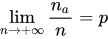
If we denote by the number of occurrences of an event in trials, then if we say that .

The frequentist view has its own problems. It is of course impossible to actually perform an infinity of repetitions of a random experiment to determine the probability of an event. But if only a finite number of repetitions of the process are performed, different relative frequencies will appear in different series of trials. If these relative frequencies are to define the probability, the probability will be slightly different every time it is measured. But the real probability should be the same every time. If we acknowledge the fact that we only can measure a probability with some error of measurement attached, we still get into problems as the error of measurement can only be expressed as a probability, the very concept we are trying to define. This renders even the frequency definition circular; see for example “What is the Chance of an Earthquake?

Subjectivism

Subjectivists, also known as Bayesians or followers of epistemic probability, give the notion of probability a subjective status by regarding it as a measure of the 'rational degree of belief' of the individual assessing the uncertainty of a particular situation. Epistemic or subjective probability is sometimes called credence, as opposed to the term chance for a propensity probability.

Some examples of epistemic probability are to assign a probability to the proposition that a proposed law of physics is true or to determine how probable it is that a suspect committed a crime, based on the evidence presented.

The use of Bayesian probability raises the philosophical debate as to whether it can contribute valid justifications of belief. Bayesians point to the work of Ramsey and de Finetti as proving that subjective beliefs must follow the laws of probability if they are to be coherent (rational).

Evidence casts doubt that individual humans routinely apply coherent beliefs, indicating that they often do not adhere to Bayesian probability.

The use of Bayesian probability involves specifying a prior probability. This may be obtained from consideration of whether the required prior probability is greater or lesser than a reference probability associated with an urn model or a thought experiment. The issue is that for a given problem, multiple thought experiments could apply, and choosing one is sometimes a matter of judgement: different people may assign different prior probabilities, known as the reference class problem. The "sunrise problem" provides an example.

Propensity

Propensity theorists think of probability as a physical propensity, or disposition, or tendency of a given type of physical situation to yield an outcome of a certain kind or to yield a long run relative frequency of such an outcome. This kind of objective probability is sometimes called 'chance'.

Propensities, or chances, are not relative frequencies, but purported causes of the observed stable relative frequencies. Propensities are invoked to explain why repeating a certain kind of experiment will generate given outcome types at persistent rates, which are known as propensities or chances. Frequentists are unable to take this approach, since relative frequencies do not exist for single tosses of a coin, but only for large ensembles or collectives (see "single case possible" in the table above). In contrast, a propensitist is able to use the law of large numbers to explain the behaviour of long-run frequencies. This law, which is a consequence of the axioms of probability, says that if (for example) a coin is tossed repeatedly many times, in such a way that its probability of landing heads is the same on each toss, and the outcomes are probabilistically independent, then the relative frequency of heads will be close to the probability of heads on each single toss. This law allows that stable long-run frequencies are a manifestation of invariant single-case probabilities. In addition to explaining the emergence of stable relative frequencies, the idea of propensity is motivated by the desire to make sense of single-case probability attributions in quantum mechanics, such as the probability of decay of a particular atom at a particular time.

The main challenge facing propensity theories is to say exactly what propensity means. (And then, of course, to show that propensity thus defined has the required properties.) At present, unfortunately, none of the well-recognised accounts of propensity comes close to meeting this challenge.

A propensity theory of probability was given by Charles Sanders Peirce. A later propensity theory was proposed by philosopher Karl Popper, who had only slight acquaintance with the writings of C. S. Peirce, however. Popper noted that the outcome of a physical experiment is produced by a certain set of "generating conditions". When we repeat an experiment, as the saying goes, we really perform another experiment with a (more or less) similar set of generating conditions. To say that a set of generating conditions has propensity p of producing the outcome E means that those exact conditions, if repeated indefinitely, would produce an outcome sequence in which E occurred with limiting relative frequency p. For Popper then, a deterministic experiment would have propensity 0 or 1 for each outcome, since those generating conditions would have same outcome on each trial. In other words, non-trivial propensities (those that differ from 0 and 1) only exist for genuinely nondeterministic experiments.

A number of other philosophers, including David Miller and Donald A. Gillies, have proposed propensity theories somewhat similar to Popper's.

Other propensity theorists (e.g. Ronald Giere) do not explicitly define propensities at all, but rather see propensity as defined by the theoretical role it plays in science. They argued, for example, that physical magnitudes such as electrical charge cannot be explicitly defined either, in terms of more basic things, but only in terms of what they do (such as attracting and repelling other electrical charges). In a similar way, propensity is whatever fills the various roles that physical probability plays in science.

What roles does physical probability play in science? What are its properties? One central property of chance is that, when known, it constrains rational belief to take the same numerical value. David Lewis called this the Principal Principle, (3.3 & 3.5) a term that philosophers have mostly adopted. For example, suppose you are certain that a particular biased coin has propensity 0.32 to land heads every time it is tossed. What is then the correct price for a gamble that pays $1 if the coin lands heads, and nothing otherwise? According to the Principal Principle, the fair price is 32 cents.

Logical, epistemic, and inductive probability

It is widely recognized that the term "probability" is sometimes used in contexts where it has nothing to do with physical randomness. Consider, for example, the claim that the extinction of the dinosaurs was probably caused by a large meteorite hitting the earth. Statements such as "Hypothesis H is probably true" have been interpreted to mean that the (presently available) empirical evidence (E, say) supports H to a high degree. This degree of support of H by E has been called the logical, epistemic, or inductive probability of H given E.

The differences between these interpretations are rather small, and may seem inconsequential. One of the main points of disagreement lies in the relation between probability and belief. Logical probabilities are conceived (for example in Keynes' Treatise on Probability) to be objective, logical relations between propositions (or sentences), and hence not to depend in any way upon belief. They are degrees of (partial) entailment, or degrees of logical consequence, not degrees of belief. (They do, nevertheless, dictate proper degrees of belief, as is discussed below.) Frank P. Ramsey, on the other hand, was skeptical about the existence of such objective logical relations and argued that (evidential) probability is "the logic of partial belief". (p 157) In other words, Ramsey held that epistemic probabilities simply are degrees of rational belief, rather than being logical relations that merely constrain degrees of rational belief.

Another point of disagreement concerns the uniqueness of evidential probability, relative to a given state of knowledge. Rudolf Carnap held, for example, that logical principles always determine a unique logical probability for any statement, relative to any body of evidence. Ramsey, by contrast, thought that while degrees of belief are subject to some rational constraints (such as, but not limited to, the axioms of probability) these constraints usually do not determine a unique value. Rational people, in other words, may differ somewhat in their degrees of belief, even if they all have the same information.

Prediction

An alternative account of probability emphasizes the role of prediction – predicting future observations on the basis of past observations, not on unobservable parameters. In its modern form, it is mainly in the Bayesian vein. This was the main function of probability before the 20th century, but fell out of favor compared to the parametric approach, which modeled phenomena as a physical system that was observed with error, such as in celestial mechanics.

The modern predictive approach was pioneered by Bruno de Finetti, with the central idea of exchangeability – that future observations should behave like past observations. This view came to the attention of the Anglophone world with the 1974 translation of de Finetti's book, and has since been propounded by such statisticians as Seymour Geisser.

Axiomatic probability

The mathematics of probability can be developed on an entirely axiomatic basis that is independent of any interpretation: see the articles on probability theory and probability axioms for a detailed treatment.

Sunday, July 12, 2026

Academic bias

From Wikipedia, the free encyclopedia

Academic bias is the bias or perceived bias in academia shaping research and the scientific community. Academic bias can involve discrimination based on race, sex, religion, ideology or protected group. One study sent a questionnaire to students and staff in a range of American universities. 44% of undergraduates and 27% of professors claimed that they had witnessed overt biases within the classroom. Respondents claimed that bias was directed at individuals because of their sexual orientation, ethnicity, race, sex, religion and class. The types of bias witnessed involved stereotyping, offensive humour, social isolation, slurs and insults. Academic bias can result in a citation bias, suppress scientific dissent and prevent the discovery of scientific truth.

By politics or ideology

Conservative activists such as David Horowitz have argued that there is a bias against Christians and conservatives in academia. Barry Ames et al., John Lee and Henry Giroux have argued that these claims are based upon anecdotal evidence that would not reliably indicate systematic bias, and that the divide is due to self-selection due to conservatives simply being less likely to pursue an academic career. Russell Jacoby has argued that claims of academic bias have been used to push measures that infringe on academic freedom.

One study of academic philosophers found that while half of respondents believed that ideological discrimination was wrong, a significant minority believed discrimination against individuals with opposing ideologies was justified. A 2017 paper argued that left-wing ideologies had taken over criminology in the 1960s and 1970s, observing a massive increase in research around fields such as radical, Marxist and feminist criminology. The paper's authors argued this resulted in bias, as the ideology of scientists within the field influenced both the acceptance of certain theories and the rejection of others; criminologists of this period came to regard criminology as being about criticising the social structure of society and those who supported the status quo. The authors also argue that even in the modern day, much of the writing in criminology remains primarily political in both origin and purpose. A 2018 study argued that since groups seen as deviant from the norm are frequently seen as in need of explanation, if bias against conservatives existed, then conservatives and conservatism should be seen as more in need of explanation than liberals and liberalism, as a liberal-biased science would see them as deviant and that they would be described more negatively. This was confirmed by the results of the study. Other researchers also argue that political bias manifests in scientific research, influencing how ideological groups are described, what measurements are used, the interpretation of results and which results are published.

A 2018 study found bias amongst criminal law students, with students engaging in motivated reasoning favourable to their political in-group and demonstrating bias towards their political in-group. Mark Horowitz also argues that researchers' political views can bias their research.

A 2005 paper argued that, controlling for student ability, there was no evidence of any disciplines being biased against conservative students in grading. In contrast, the researchers did find some disciplines, such as economics and business, where conservative students achieved higher grades than would be expected by student ability. The authors concluded that this was unlikely to be due to any explicit or implicit bias in these disciplines, instead arguing that it was likely due to differences in student interest in subject matter, as well as possibly due to differences in discipline teaching methodology interacting with student personalities and values.

Justin Tetrault argues that research into hate groups relied too much upon stereotypes rather than rigorous analysis, likely because said stereotypes appealed to researchers' own beliefs.

It has been argued that apparent evidence of a "prejudice gap" between right-wingers and left-wingers—the idea that right-wingers are more prejudiced than left-wingers—was caused by researchers having not measured groups that left-wingers would be prejudiced towards. It has been suggested that this was because this was not regarded as prejudice or was not seen as worthy of investigation. Christine Reyna argues that ideological bias can affect how scales are constructed and interpreted in multiple ways. Lee Jussim argues that right-wing individuals were classified as "cognitively rigid", however he argues this label is misleading because what studies indicate is that right-wing individuals were less willing to change their beliefs and to be open to new experiences relative to left-wing individuals but this did not make them "rigid" in any absolute sense and that absent any absolute measure as to how cognitively flexible a person should be, labels such as "rigid" were meaningless. A 2019 study by the researchers measuring "actively open-minded thinking" noted that the researchers' original scale was biased against religious individuals due to test items, skewing correlations, and that the team had not realised this error for almost two decades, requiring a new scale.

Some scholars, such as J. F. Zipp, have said that studies on the political orientations of professors are faulty, having focused on unrepresentative institutions and fields; when taken as a whole, they say that academia has become more moderate over time.

A 2019 study of European universities argued that while university professors were more left-wing and liberal than other professions, professors did not display a higher level of homogeneity in political views (aside from views on immigration) than other professions such as CEOs did, suggesting European universities are not exclusionary compared to other institutions.

The American Council of Trustees and Alumni, a conservative group, argues that course curriculums betray a progressive bias. However, John Lee argues that this research is not based on a probability sample and uses a research design that cannot rule out explanations other than political bias. Furthermore, research suggests little or no leftward movement among college students while they are in college.

Academic bias has also been argued as a problem due to discrimination against conservative students. Research has indicated that conservative Christians may experience discrimination on colleges and universities, but these studies are anecdotal and rely on self-reported perceptions of discrimination. For example, the Hyers' study includes "Belief Conflicts" and "Interaction Difficulties" as discriminatory events. However, other work suggests that very few students experience discrimination based on political ideology.

Phillip Gray argues that ideological bias in political science risks creating "blind spots", whereby certain ideas and assumptions are just accepted as normal and not challenged. Gray argues that this could mean that issues that concern the ideology of the dominant majority could receive a lot of focus, while issues that concern less prominent ideologies could be seen as less worthy of investigation and thus be consequently understudied. This risks resulting in a fairly ideologically homogenous field whereby certain "givens" are just accepted and thus not examined. In addition, Gray argues that this means that certain studies are not given adequate examination if they confirm the dominant group's ideological priors, even if the studies are flawed. Gray further argues that ideological bias in academia risks portraying other political groups not as another group of actors with their own beliefs but rather as a threat (too ignorant or prejudiced to know what is good) or menace (inherently inclined towards destructive acts and policies). This results in these groups being portrayed as dysfunctional and requiring diagnosis rather than understanding; while Gray does not believe political science blatantly "otherizes" its ideological outgroups, he does argue that there is an implicit "diagnostic" attitude towards groups that disagree with the majority's view.

Politicization of science

Cofnas et al. argue that activism within social science can undermine trust in scientists. Brandt et al. argue that bias can limit what topics are researched and thus limit scientific knowledge as a whole. In addition, political bias in social science can risk creating a perception amongst the general public that the scientific field is producing politically biased findings and thus not worthy of receiving public funds.

Surveys show that a college education tends to have a "regression to the mean" effect whereby both left-wing students and right-wing students moderate their views. Students also become more supportive of dissent and free speech during their education.

By religion

An early audit study published in 1986 suggested that entrance into an American clinical psychology graduate program was negatively affected by whether the applicant was a fundamentalist Christian. One study examined the comments made by members of an American medical school admission committee towards 21 Christian applicants. It concluded that applicants were more likely to be criticised when responding to a question on abortion with an anti-abortion response. George Yancey says that academics are less likely to hire a colleague if they find out that the colleague is either religiously or politically conservative, and discrimination exists against fundamentalists, evangelicals and to a lesser extent Republicans, though only within certain cultural contexts.

Brent D. Slife and Jeffrey S. Reber assert that an implicit bias against theism limits possible insights in the field of psychology.

By nationality or race

Jeff Colgan argues that, amongst international relations data, there can be interpretive biases by researchers depending on their nationality, with bias towards the United States being common due to a large number of scholars being from the US. In this context, it has been proposed that implicit bias based on the region from which an Academic comes (e.g. it has been argued that when scholarly manuscripts are reviewed by peers the return address influences perceptions of Academic quality) can be counteracted by improved intercontinental Academic collaboration.

By sex or gender

Sexism in academia refers to the academic bias and discrimination by a particular sex or gender in academic institutions, particularly universities, due to the ideologies, practices, and reinforcements that privilege one sex or gender over another. Sexism in academia is not limited to but primarily affects women who are denied the professional achievements awarded to men in their respective fields such as positions, tenure and awards. Sexism in academia encompasses institutionalized and cultural sexist ideologies; it is not limited to the admission process and the under-representation of women in the sciences but also includes the lack of women represented in college course materials and the denial of tenure, positions and awards that are generally accorded to men.

A vignette study found academic discrimination against men in Germany.

Self-censorship

Studies have also suggested that one reason for the unwillingness of conservatives to pursue academic careers may be because conservatives prefer higher paying jobs and are not as tolerant of controversial ideas as progressives. Empirical support for self-selection can be found in the work of Neil Gross. Gross conducted an audit study whereby he sent emails to directors of graduate study programs. He varied the emails so that some of them indicated the student supported the presidential candidacy of Senator John McCain, some of them supported the presidential candidacy of then Senator Barack Obama and some of them were politically neutral. He found that the directors of graduate study programs did not significantly vary in their treatment of the senders of the letters regardless of the implied political advocacy of that sender. His work suggests an absence of systematic discrimination against political conservatives.

Logocentrism and phonocentrism

Academic bias can refer to several types of logocentrism or phonocentrism. or the belief that some sciences and disciplines rank higher than others.

Funding and peer review bias

Asle Toje argues that while academic bias does not seem to make scholars dishonest, it does affect what questions are deemed worthy of research and what conclusions are deemed career-advancing. Toje also argues that the field of social science is filled with biased terminology that a priori discredits certain perspectives while lending credence to others. Similarly, Honeycutt et al. argue that bias can affect not only what questions get asked but how they are asked – they observe that the debate of whether rightists were more biased than leftists or if the two were equally biased failed to consider if leftists were more biased as a possible debate point.

Race and crime

From Wikipedia, the free encyclopedia

Research into the relationship between race and crime has grown rapidly in recent years. More specifically, the research delves into the potential cause and effects of racial disparities in crime. This includes but is not limited to, disadvantages and inequality (racially, socially and economically), disparities in education, employment/unemployment, poverty, social status, and social/familial structure. Also of notable interest, is the role of exposure in childhood to violent behavior, another potential cause of racial disparities in crime.

Research conducted in Europe and the United States on the matter has been widely published, particularly in relation to discrimination by criminal justice systems. However, there is also a wide variety of research that branches off from this topic of discrimination by the criminal justice system. It has been argued that evidence for discrimination by the criminal justice system (and racial disparities occurring as a result) are potentially over interpreted and lacking supportive evidence. Therefore, it is important to consider other potential aspects of race as a correlate of crime and the multitude of potential causes and effects incorporated.

Race and Crime on Women and Girls

Researcher Harmon and Boppre shed light onto the potential causes of the rise in the racial disparity between Black and White females by examining changes in the relative odds of Black female imprisonment to White female imprisonment. They found that the war on crime ultimately affected all racial groups in America, but the effects were more pronounced among African Americans and Latinos. This was revealed in official statistics, i.e., the Uniform Crime Report, managed by the FBI. The community puts their trust in crime statistics by the FBI to compare safer states, cities, or towns that display the number of crimes. However, research shows that female black offenders are often discriminated against by the law enforcement agencies. So although Black females are admitted to prison for drug crimes at an 83% higher rate than White females at the start of the war on drugs, by 2008 Black females' admittance rate was 338% higher, a quadrupling of the 1983 disparity. Researchers analyze the percentage of drug crimes committed by women and girls across different racial groups to identify issues within the data. The data highlight that the most important factor is victimization, Black female offenders are consistently condemned for their offenses while their victimizations are ignored.

Victimization on Women and Girls

Acquaviva and colleagues examine the disparate treatment and experiences that Black and Latina victims face within the criminal legal system.Their findings show that women involved in crime frequently encounter unfair treatment by law enforcement—both when they are labeled as offenders and when they attempt to seek help as victims. The research also reveals that Black female offenders constitute the highest percentage among the racial groups studied, and the victim survey data clearly illustrates the discrimination they face.

Another key finding involves limitations in understanding how victim characteristics and behavior variables affect Black and Latina victims, due to the dichotomous way these variables were measured. The researchers noted disparities in detention and arrest rates across racial groups, showing that Black and Latina women were more likely to experience mistreatment or lack of assistance from law enforcement, even when they cooperated. The study additionally evaluated the policies of 36 police departments nationwide to determine how effectively they address profiling, police sexual misconduct, and other gendered aspects of policing.Researchers highlight the need for stronger, clearer policies to prevent racial profiling and ensure that Black female offenders are not subjected to unjust stops, searches, or arrests without reasonable cause.

Criminal adjudication: discrimination by the criminal justice system

There is a common assumption and belief that criminal adjudication within the criminal justice system is biased, whereupon ethnicity, race and class not only predicts but foreshadows that criminal arrests are skewed. More specifically, this prediction is attributed to the concern that racial minorities (African American, Latinos, Etc.) and impoverished or poverty-stricken defendants tend to receive harsher judged sentences compared to White, Asian, and wealthier or more affluent defendants. One aspect to consider when examining research about potential biases and discrimination within the Criminal Justice System is the researcher’s possible expectancy effects, citation bias, negativity bias and an over interpretation of statistical noise. Since this discrimination is not always detected and recorded, information provided isn't always 100% accurate.

An act titled End Racial and Religious Profiling Act, stating that federal, state, and local law enforcement were prohibited from targeting people based on their race, ethnicity, national origin, or religion, was introduced in the 118th Congress by Senator Ben Cardin, but was not filed in the House. It has not yet been reintroduced in the 119th Congress.

Discrimination by the criminal justice system in Europe

Research suggests that police practices, such as racial profiling, over-policing in areas populated by minorities and in-group bias may result in disproportionately high numbers of racial minorities among crime suspects in Sweden, Italy, and England and Wales. According to the Racial Disparity Audit conducted by the United Kingdom Prime Minister, in 2017 minorities living in Wales and England were more than 3.5 times more likely to be arrested than whites. Likewise, this same group was far more likely to be the victims of crime with their white counterparts only having 15 percent likelihood. Research also suggests that there may be possible discrimination by the judicial system, which contributes to a higher number of convictions for racial minorities in Sweden, the Netherlands, Italy, Germany, Denmark and France.

Discrimination by the criminal justice system in the United States

Research suggests that police practices, such as racial profiling, over-policing in areas populated by minorities and in-group bias may result in disproportionately high numbers of racial minorities among crime suspects. Also, there may be possible discrimination by the judicial system, which contributes to a higher number of convictions for racial minorities. Recent research in 2024 shows that racial inequality in the U.S. criminal justice system is caused by more than just individual bias. Sociologist Hedwig Lee explains that racism is built into the system itself through patterns and policies that treat some groups as less valued. These factors work together to keep racial gaps in policing, courts, and prisons in place over time. On average, white offenders are less likely to be arrested for their crime than non-white offenders. Studies show that prosecutors are more likely to charge people that are a part of marginalized groups with more severe sentences than compared to white people.

Racial disparities: relationship between inequality and crime

Racial inequality, resulting in increased disadvantages and imbalances that not only affect but overshadow the treatment of racial groups (such as racial minorities), has often been theorized to be a factor in the manifestation and explanation of crime. More specifically, the aspect that economic deprivation and economic hardships influenced the disparity in crime rates between Whites, Blacks and other racial minorities. Overall, a wide variety of explanations and research have focused on the effects of inequality (socially, economically, educationally), poverty and unemployment, structural disadvantages, inadequate economic resources, and social segregation and isolation.

Theoretical perspectives: theories, theses and dissertations

Early research into the effects of interracial economic inequality, economic hardships, economic deprivation and factors such as poverty and unemployment have contributed to a variety of theories, theses and dissertations. This includes, but is not limited to, the deprivation thesis, macrostructural theory of intergroup relations, interracial economic inequality thesis and the macro-social theory of social structure. One possible suggestion for racial inequality related to crime is that areas who had a higher population of enslaved people in the 1800s would ultimately have lasting racial prejudice embedded within these areas, leading to increased rates of racial profiling and biased court systems. U.S. policing and criminal justice system has historical roots in slavery and colonization, such as slave patrols, Black Codes, and Jim Crowe Laws that criminalized freed Black people, creating a pre-existing bias towards African American. The following theories affects on these factors:

  • Majority Minority Theory: policing intensity increases in minority majority areas with socioeconomic disadvantages.
  • Conflict Theory of Law: policing backs dominant or majority group interests.
  • Minority Threat Hypothesis: as minority presence or power increases, law enforcement responds with more control and aggressive strategies.

Research and studies

When considering the research and studies that have been focused on the statistical rates and notable differences between race and crime, it is important to understand possible underlying issues, assumptions or biases that may occur. For example, previous studies have attempted to obtain statistical rates by disaggregating crime rates or employing race specific crime rates. However, this was shown to result in an overrepresentation of specific racial groups such as blacks and other racial minorities (including both delinquents and adults). Other prior (and even current) studies have also utilized data such as victimization data, homicide data, and violent crimes. However, some of these approaches had limitations, resulting in overrepresentation or incorrect assumptions. Possible limitations to consider are the utilization of only one measurement of discrimination or race-crime statistics, the omission of information or facts, and relying on subsets and overtly broad information and data sets.

In 2020 Black Americans were 9.3 times more likely than White Americans to be homicide victims, American Indians 4.3 times, and Latin individuals 1.9 times, based on age-adjusted data. Since, homicide tends to be intraracial, these numbers highlight higher rates of offending inside the same racial groups. However, other sources present data distracting from these figures. According to data in 2023, police shooting stats showed about four in ten individuals shot by officers were White, while about one in five were Black and around one in eight were Hispanic. Another report from the same year over victims of violent crimes, was found to be mostly White at around 62%, Black individuals represented around 12%, Hispanic individuals 17%, and Asian, American Indian, and Alaska Native individuals making up about 4%. More recent data on arrests for violent offenses present that approximately 53% of people arrested were White, 25% were Black, and 14% were Hispanic. This expresses the demographic differences between victimization and arrest rates.

In a graph published by the Office of Juvenile Justice and Delinquency Prevention, the overall detention rate for juveniles has gone down since the 1990s; however, the rate of detention for Black, Hispanic, and Indigenous youth is still shown as significantly higher compared to white youth. In an additional graph published by the OJJDP, the rate of youth arrest rates shows similar results, with Black and Indigenous youth once again facing higher rates than white youth.

Currently, one of the tools utilized is the NIBRS database which has assisted with obtaining a more accurate analysis. This was due to an increase in variety and improved measure of crime. However, conflicting research and findings have brought to light a multitude of potential limitations to the available documentation, records and data that is available for use in race-crime specific data. Interpretation of these studies and research conducted have resulted in a variety of narratives and outcomes due to mixed results, a lack of studies for racial groups such as Asians, and even aspects such as expectancy effects and biases (such as negativity bias).

Gaslighting

From Wikipedia, the free encyclopedia
Google Trends topic searches for "Gaslighting" began a substantial increase in 2016.

Gaslighting is the manipulation of someone into questioning their perception of reality. The term derives from the 1944 film Gaslight and became popular in the mid-2010s.

Some mental health experts have expressed concern that the term has been used too broadly. In 2022, The Washington Post described it as an example of therapy speak, arguing it had become a buzzword improperly used to describe ordinary disagreements.

Etymology

Charles Boyer, Ingrid Bergman, and Joseph Cotten in the 1944 American film version of Gaslight

The term derives from the title of the 1944 film Gaslight. The film was based on the 1938 British play Gas Light by Patrick Hamilton and was a remake of the 1940 British film adaptation, Gaslight. Set among London's elite during the Victorian era, Gas Light and its adaptations portray a seemingly genteel husband using lies and manipulation to isolate his heiress wife and persuade her that she is mentally ill so that he can steal from her. The wife is perturbed when the gaslights in the house periodically dim, as they normally would if a lamp were lit elsewhere in the house, causing the gas pressure to drop; when she asks the servants, they tell her that nobody else is in the house. Unknown to all of them is that the husband is upstairs searching the rooms for jewels.

The gerund form gaslighting does not appear in the play or films. Its earliest recorded use was in 1961. In The New York Times, it was first used in a 1995 column by Maureen Dowd. According to the American Psychological Association in 2021, gaslighting "once referred to manipulation so extreme as to induce mental illness or to justify commitment of the gaslighted person to a psychiatric institution". It remained obscure — The New York Times used it only nine times in the following 20 years — until the 2010s, when it seeped into the English lexicon. Merriam-Webster defines gaslighting as "psychological manipulation" to make someone question their "perception of reality" leading to "dependence on the perpetrator". The American Dialect Society named gaslight the most useful new word of 2016. Oxford University Press named it a runner-up in its list of the most popular new words of 2018.

In self-help and amateur psychology

Gaslighting is a term used in self-help and amateur psychology to describe a dynamic that can occur in personal relationships (romantic or parental) and in workplace relationships. Gaslighting involves two parties: the "gaslighter", who persistently puts forth a false narrative in order to manipulate, and the "gaslighted", who struggles to maintain their individual autonomy. Gaslighting is typically effective only when there is an unequal power dynamic or when the gaslighted has shown respect to the gaslighter.

Gaslighting is different from genuine relationship disagreement, which is both common and important in relationships. Gaslighting is distinct in that:

  • one partner is consistently listening and considering the other partner's perspective;
  • one partner is consistently negating the other's perception, insisting that they are wrong, or telling them that their emotional reaction is irrational or dysfunctional.

The term gaslighting is more often used to refer to a pattern of behavior over a long duration, not a one-off instance of persuasion, but the method(s) of persuasion is the defining trait of gaslighting behavior. Over time, the listening partner may exhibit symptoms often associated with anxiety disorders, depression, or low self-esteem. Gaslighting is distinct from genuine relationship conflict in that one party manipulates the perceptions of the other.

Broader use and conflation

In 2022, Merriam-Webster named "gaslighting" its Word of the Year due to the vast increase in channels and technologies used to mislead and the word becoming common for the perception of deception. The word is often used incorrectly to refer to conflicts and disagreements. According to Robin Stern, PhD, co-founder of the Yale Center for Emotional Intelligence, "Gaslighting is often used in an accusatory way when somebody may just be insistent on something, or somebody may be trying to influence you. That's not what gaslighting is."

Some mental health experts have expressed concern that the broader use of the term is diluting its usefulness and may make it more difficult to identify the specific type of abuse described in the original definition. According to a 2022 Washington Post report, it had become a "trendy buzzword" frequently improperly used to describe ordinary disagreements, rather than those situations that align with the word's historical definition.

In psychiatry and psychology

The word gaslighting is occasionally used in clinical literature, but is considered a colloquialism by the American Psychological Association. Barton and Whitehead described three case reports of gaslighting with the goal of securing a person's involuntary commitment to a psychiatric hospital, motivated by a desire to get rid of relatives or obtain financial gain: a wife attempting to frame her husband as violent so she could elope with her lover, another wife alleging that her pub-owning husband was an alcoholic in order to leave him and take control of the pub, and a retirement home manager who gave laxatives to a resident before referring her to a psychiatric hospital for dementia and incontinence.

In 1977, at a time when published literature on gaslighting was still sparse, Lund and Gardiner published a case report on an elderly woman who was repeatedly involuntarily committed for alleged psychosis, by staffers of her retirement home, but whose symptoms always disappeared shortly after admittance without any treatment. After investigation, it was discovered that her 'paranoia' had been the result of gaslighting by staffers of the retirement home, who knew the woman had suffered from paranoid psychosis 15 years prior.

The research paper "Gaslighting: A Marital Syndrome" includes clinical observations of the impact on wives after their reactions were mislabeled by their husbands and male therapists. Other experts have noted values and techniques of therapists can be harmful as well as helpful to clients (or indirectly to other people in a client's life).

In his 1996 book, Gaslighting, the Double Whammy, Interrogation and Other Methods of Covert Control in Psychotherapy and Analysis, Theo L. Dorpat recommends non-directive and egalitarian attitudes and methods on the part of clinicians, and "treating patients as active collaborators and equal partners". He writes, "Therapists may contribute to the victim's distress through mislabeling the [victim's] reactions.... The gaslighting behaviors of the spouse provide a recipe for the so-called 'nervous breakdown' for some [victims, and] suicide in some of the worst situations." Dorpat also cautions clinicians about the unintentional abuse of patients when using interrogation and other methods of covert control in Psychotherapy and Analysis, as these methods can subtly coerce patients rather than respect and genuinely help them.

Motivations

Gaslighting is a way to control the moment, stop conflict, ease anxiety, and feel in control. It often deflects responsibility however and tears down the other person. Some may gaslight their partners by denying events, including personal violence. A study found that those who gaslight tended to score high on manipulative personality traits.

Learned behavior

Gaslighting is a learned trait. A gaslighter is a student of social learning. They witness it, experience it themselves, or stumble upon it, and see that it works, both for self-regulation and coregulation. Studies have shown that gaslighting is more prevalent in couples where one or both partners have maladaptive personality traits (such as traits associated with short-term mental illness like depression), substance-induced illness (e.g., alcoholism), mood disorders (e.g., bipolar disorder), anxiety disorders (e.g., PTSD), personality disorder (e.g., BPD, NPD, etc.), neurodevelopmental disorder (e.g., ADHD), or combination of the above (i.e., co-occurrence) and are prone to and adept at convincing others to doubt their own perceptions.

Habilitation

It can be difficult to extricate oneself from a gaslighting power dynamic:

  • Those who gaslight must attain greater emotional awareness and self-regulation, or;
  • Those being gaslighted must learn that they do not need others to validate their reality, and they need to gain self-reliance and confidence in defining their own reality.

In medicine

Medical gaslighting is an informal term that refers to patients having their real symptoms dismissed or downplayed by medical professionals, leading to incorrect or delayed diagnoses; women are more likely to be affected by the phenomenon.

In politics

Gaslighting is more likely to be effective when the gaslighter has a position of power.

In the 2008 book State of Confusion: Political Manipulation and the Assault on the American Mind, the authors contend that the prevalence of gaslighting in American politics began with the age of modern communications:

To say gaslighting was started by... any extant group is not simply wrong, it also misses an important point. Gaslighting comes directly from blending modern communications, marketing, and advertising techniques with long-standing methods of propaganda. They were simply waiting to be discovered by those with sufficient ambition and psychological makeup to use them.

The term has been used to describe the behavior of politicians and media personalities on both the left and the right sides of the political spectrum. Some examples include:

  • "Gaslighting" has been used to describe state-implemented psychological harassment techniques used in East Germany during the 1970s and 1980s. The techniques were used as part of the Stasi's (the state security service's) decomposition methods, which were designed to paralyze the ability of hostile-negative (politically incorrect or rebellious) people to operate without unjustifiably imprisoning them, which would have resulted in international condemnation.

In social systems

Gaslighting within social systems operates as a mechanism to uphold entrenched power hierarchies, often through subtle and overt forms of manipulation that compel individuals to question their perceptions of reality. One striking manifestation is racial gaslighting, a process deeply embedded within the political, economic, social, and cultural scaffolding of a dominant racial hierarchy. By pathologizing dissent and framing challenges to racial inequities as misperceptions or even assaults on democratic fairness, racial gaslighting coerces marginalized individuals into doubting their experiences within racialized structures. This phenomenon extends beyond denial of systemic racism to active recharacterization, where the assertion of racial injustice is reframed as an act of reverse discrimination or irrational sensitivity.

In the workplace

In her 2024 book On Gaslighting, Indiana University philosopher Kate Abramson offers the example of a boss who minimizes a complaint of harassment or discrimination, possibly filed by a member of a marginalized group. In her framing, the gaslighter says "Don’t be so sensitive. You’re overreacting. You’re imagining things".

Anti-intellectualism

From Wikipedia, the free encyclopedia https://en.wikipedia.org/wiki/Anti-intellectualism Anti-int...