Search This Blog

Saturday, August 8, 2026

Quantum cognition

From Wikipedia, the free encyclopedia

Quantum cognition uses the mathematical formalism of quantum probability theory to model psychology phenomena when classical probability theory fails. The field focuses on modeling phenomena in cognitive science that have resisted traditional techniques or where traditional models seem to have reached a barrier (e.g., human memory), and modeling preferences in decision theory that seem paradoxical from a traditional rational point of view (e.g., preference reversals). Since the use of a quantum-theoretic framework is for modeling purposes, the identification of quantum structures in cognitive phenomena does not presuppose the existence of microscopic quantum processes in the human brain.

Quantum cognition can be applied to model cognitive phenomena such as information processing by the human brain, language, decision makinghuman memory, concepts and conceptual reasoning, human judgment, and perception.

Challenges for classical probability theory

Classical probability theory is a rational approach to inference which does not easily explain some observations of human inference in psychology. Some cases where quantum probability theory has advantages include the conjunction fallacy, the disjunction fallacy, the failures of the sure-thing principle, and question-order bias in judgement.

Conjunction fallacy

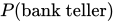
If participants in a psychology experiment are told about "Linda", described as looking like a feminist but not like a bank teller, then asked to rank the probability, that Linda is feminist, a bank teller or a feminist and a bank teller, they respond with values that indicate: Rational classical probability theory makes the incorrect prediction: it expects humans to rank the conjunction less probable than the bank teller option. Many variations of this experiment demonstrate that the fallacy represents human cognition in this case and not an artifact of one presentation.


Quantum cognition models this probability-estimation scenario with quantum probability theory which always ranks sequential probability, , greater than the direct probability, . The idea is that a person's understanding of "bank teller" is affected by the context of the question involving "feminist". The two questions are "incompatible": to treat them with classical theory would require separate reasoning steps.

Main subjects of research

Quantum-like models of information processing

The quantum cognition concept is based on the observation that various cognitive phenomena are more adequately described by quantum probability theory than by the classical probability theory (see examples below). Thus, the quantum formalism is considered an operational formalism that describes non-classical processing of probabilistic data.

Here, contextuality is the key word (see the monograph of Khrennikov for detailed representation of this viewpoint). Quantum mechanics is fundamentally contextual. Quantum systems do not have objective properties which can be defined independently of measurement context. As has been pointed out by Niels Bohr, the whole experimental arrangement must be taken into account. Contextuality implies existence of incompatible mental variables, violation of the classical law of total probability, and constructive or destructive interference effects. Thus, the quantum cognition approach can be considered an attempt to formalize contextuality of mental processes, by using the mathematical apparatus of quantum mechanics.

Decision making

Suppose a person is given an opportunity to play two rounds of the following gamble: a coin toss will determine whether the subject wins $200 or loses $100. Suppose the subject has decided to play the first round, and does so. Some subjects are then given the result (win or lose) of the first round, while other subjects are not yet given any information about the results. The experimenter then asks whether the subject wishes to play the second round. Performing this experiment with real subjects gives the following results:

  1. When subjects believe they won the first round, the majority of subjects choose to play again on the second round.
  2. When subjects believe they lost the first round, the majority of subjects choose to play again on the second round.

Given these two separate choices, according to the sure thing principle of rational decision theory, they should also play the second round even if they don't know or think about the outcome of the first round. But, experimentally, when subjects are not told the results of the first round, the majority of them decline to play a second round. This finding violates the law of total probability, yet it can be explained as a quantum interference effect in a manner similar to the explanation for the results from double-slit experiment in quantum physics. Similar violations of the sure-thing principle are seen in empirical studies of the Prisoner's Dilemma and have likewise been modeled in terms of quantum interference.

The above deviations from classical rational expectations in agents’ decisions under uncertainty produce well known paradoxes in behavioral economics, that is, the Allais, Ellsberg and Machina paradoxes. These deviations can be explained if one assumes that the overall conceptual landscape influences the subject's choice in a neither predictable nor controllable way. A decision process is thus an intrinsically contextual process, hence it cannot be modeled in a single Kolmogorovian probability space, which justifies the employment of quantum probability models in decision theory. More explicitly, the paradoxical situations above can be represented in a unified Hilbert space formalism where human behavior under uncertainty is explained in terms of genuine quantum aspects, namely, superposition, interference, contextuality and incompatibility.

Considering automated decision making, quantum decision trees have different structure compared to classical decision trees. Data can be analyzed to see if a quantum decision tree model fits the data better.

Human probability judgments

Quantum probability provides a new way to explain human probability judgment errors including the conjunction and disjunction errors. A conjunction error occurs when a person judges the probability of a likely event L and an unlikely event U to be greater than the unlikely event U; a disjunction error occurs when a person judges the probability of a likely event L to be greater than the probability of the likely event L or an unlikely event U. Quantum probability theory is a generalization of Bayesian probability theory because it is based on a set of von Neumann axioms that relax some of the classic Kolmogorov axioms. The quantum model introduces a new fundamental concept to cognition—the compatibility versus incompatibility of questions and the effect this can have on the sequential order of judgments. Quantum probability provides a simple account of conjunction and disjunction errors as well as many other findings such as order effects on probability judgments.

The liar paradox - The contextual influence of a human subject on the truth behavior of a cognitive entity is explicitly exhibited by the so-called liar paradox, that is, the truth value of a sentence like "this sentence is false". One can show that the true-false state of this paradox is represented in a complex Hilbert space, while the typical oscillations between true and false are dynamically described by the Schrödinger equation.

Knowledge representation

Concepts are basic cognitive phenomena, which provide the content for inference, explanation, and language understanding. Cognitive psychology has researched different approaches for understanding concepts including exemplars, prototypes, and neural networks, and different fundamental problems have been identified, such as the experimentally tested non classical behavior for the conjunction and disjunction of concepts, more specifically the Pet-Fish problem or guppy effect, and the overextension and underextension of typicality and membership weight for conjunction and disjunction. By and large, quantum cognition has drawn on quantum theory in three ways to model concepts.

  1. Exploit the contextuality of quantum theory to account for the contextuality of concepts in cognition and language and the phenomenon of emergent properties when concepts combine
  2. Use quantum entanglement to model the semantics of concept combinations in a non-decompositional way, and to account for the emergent properties/associates/inferences in relation to concept combinations
  3. Use quantum superposition to account for the emergence of a new concept when concepts are combined, and as a consequence put forward an explanatory model for the Pet-Fish problem situation, and the overextension and underextension of membership weights for the conjunction and disjunction of concepts.

The large amount of data collected by Hampton on the combination of two concepts can be modeled in a specific quantum-theoretic framework in Fock space where the observed deviations from classical set (fuzzy set) theory, the above-mentioned over- and under- extension of membership weights, are explained in terms of contextual interactions, superposition, interference, entanglement and emergence. And, more, a cognitive test on a specific concept combination has been performed which directly reveals, through the violation of Bell's inequalities, quantum entanglement between the component concepts.

Semantic analysis and information retrieval

The research in (iv) had a deep impact on the understanding and initial development of a formalism to obtain semantic information when dealing with concepts, their combinations and variable contexts in a corpus of unstructured documents. This conundrum of natural language processing (NLP) and information retrieval (IR) on the web – and data bases in general – can be addressed using the mathematical formalism of quantum theory. As basic steps, (a) K. Van Rijsbergen introduced a quantum structure approach to IR, (b) Widdows and Peters utilised a quantum logical negation for a concrete search system, and Aerts and Czachor identified quantum structure in semantic space theories, such as latent semantic analysis. Since then, the employment of techniques and procedures induced from the mathematical formalisms of quantum theory – Hilbert space, quantum logic and probability, non-commutative algebras, etc. – in fields such as IR and NLP, has produced significant results.

History

Ideas for applying the formalisms of quantum theory to cognition first appeared in the 1990s by Diederik Aerts and his collaborators Jan Broekaert, Sonja Smets and Liane Gabora, by Harald Atmanspacher, Robert Bordley, and Andrei Khrennikov. A special issue on Quantum Cognition and Decision appeared in the Journal of Mathematical Psychology (2009, vol 53.), which planted a flag for the field. A few books related to quantum cognition have been published including those by Khrennikov (2004, 2010), Ivancivic and Ivancivic (2010), Busemeyer and Bruza (2012), E. Conte (2012). The first Quantum Interaction workshop was held at Stanford in 2007 organized by Peter Bruza, William Lawless, C. J. van Rijsbergen, and Don Sofge as part of the 2007 AAAI Spring Symposium Series. This was followed by workshops at Oxford in 2008, Saarbrücken in 2009, at the 2010 AAAI Fall Symposium Series held in Washington, D.C., 2011 in Aberdeen, 2012 in Paris, and 2013 in Leicester. Tutorials also were presented annually beginning in 2007 until 2013 at the annual meeting of the Cognitive Science Society. A Special Issue on Quantum models of Cognition appeared in 2013 in the journal Topics in Cognitive Science.

Electromagnetism

From Wikipedia, the free encyclopedia
https://en.wikipedia.org/wiki/Electromagnetism

In physics, electromagnetism is an interaction that occurs between particles with electric charge via electromagnetic fields. The electromagnetic force is one of the four fundamental forces of nature. It is the dominant force in the interactions of atoms and molecules. Electromagnetism describes and relates the three distinct but closely intertwined phenomena of electricity, magnetism, and optics. In, electromagnetism these phenomena are described by the 3 sub-disciplines: electrostatics, magnetostatics, and electrodynamics.

The electromagnetic force is responsible for many chemical and physical phenomena observed in daily life. The electrostatic attraction between atomic nuclei and their electrons holds atoms together. Electric forces also allow different atoms to combine into molecules. Meanwhile, magnetic interactions between the spin and angular momentum magnetic moments of electrons also play a role in chemical reactivity; such relationships are studied in spin chemistry. Electromagnetism also plays several crucial roles in modern technology: electrical energy production, transformation and distribution; light, heat, and sound production and detection; fiber optic and wireless communication; sensors; computation; electrolysis; electroplating; and mechanical motors and actuators.

Electromagnetism has been studied since ancient times to explain the electric phenomena of lightning and static electricity and the magnetic phenomenon of the attraction between magnetized pieces of iron ore and of compasses. In the 18th and 19th centuries scientists developed the mathematical relationships between these phenomena and electric charges and currents. Too they showed that electrical and magnetic phenomena were related and could create a self-sustaining electromagnetic waves which forms visible light and other forms of electromagnetic radiation including Gamma-rays, x-rays, ultraviolet, visible, infrared radiation, microwaves and radio waves.

In the modern era, scientists continue to refine the theory of electromagnetism to account for the effects of modern physics, including quantum mechanics and relativity. The theoretical implications of electromagnetism, particularly the requirement that observations remain consistent when viewed from various moving frames of reference (relativistic electromagnetism) and the establishment of the speed of light based on properties of the medium of propagation (permeability and permittivity), helped inspire Einstein's theory of special relativity in 1905. Quantum electrodynamics (QED) modifies Maxwell's equations to be consistent with the quantized nature of matter. In QED, changes in the electromagnetic field are expressed in terms of discrete excitations, particles known as photons, the quanta of light.

Mathematically, electromagnetism is described by electromagnetic fields. These are quantities that describe the electrical (electric field) and magnetic (magnetic field) influence at a given location and time.

A fundamental force

Electromagnetic interactions are responsible for the glowing filaments in this plasma globe.

The electromagnetic force is the second strongest of the four known fundamental forces and has unlimited range. All other forces, known as non-fundamental forces. (e.g., friction, contact forces) are derived from the four fundamental forces. At high energy, the weak force and electromagnetic force are unified as a single interaction called the electroweak interaction.

Most of the forces involved in interactions between atoms are explained by electromagnetic forces between electrically charged atomic nuclei and electrons. The electromagnetic force is also involved in all forms of chemical phenomena.

Electromagnetism explains how materials carry momentum despite being composed of individual particles and empty space. The forces we experience when "pushing" or "pulling" ordinary material objects result from intermolecular forces between individual molecules in our bodies and in the objects.

The effective forces generated by the momentum of electrons' movement is a necessary part of understanding atomic and intermolecular interactions. As electrons move between interacting atoms, they carry momentum with them. As a collection of electrons becomes more confined, their minimum momentum necessarily increases due to the Pauli exclusion principle. The behavior of matter at the molecular scale, including its density, is determined by the balance between the electromagnetic force and the force generated by the exchange of momentum carried by the electrons themselves.

Electromagnetic fields

The phenomena of electromagnetism is described mathematically using electromagnetic fields. An electromagnetic field (also EM field) is a physical field, varying in space and time, that represents the electric and magnetic influences generated by and acting upon electric charges. The field at any point in space and time can be regarded as a combination of an electric field and a magnetic field. Because of the interrelationship between the fields, a disturbance in the electric field can create a disturbance in the magnetic field which in turn affects the electric field, leading to an oscillation that propagates through space, known as an electromagnetic wave.

There are 6 mathematical quantities which are used to describe electromagnetic fields in 3 distinct cases. The electric field, E, and magnetic flux density, B are used to describe the electromagnetic fields in cases where all the charges are known directly such as the electromagnetic field in a vacuum. To describe the case where the charges inside of a material respond to applied electric and magnetic fields, it is useful to define the electric displacement field, D and magnetic field strength, H, in addition to E and B. Finally, it is sometimes useful to describe electromagnetic fields not in terms of force but in terms of potential energy and momentum. In this case, the electromagnetic field is represented by the electric potential, V, and the magnetic vector potential, A, respectively.

Lorentz force F on a charged particle (of charge q) in motion (instantaneous velocity v). The E field and B field vary in space and time.

Force on an electric charge due to electromagnetic fields

The force, F. on a charge particle of charge q moving at speed v in an electromagnetic field is given by the Lorentz force(SI definition of quantities): 

Here, × is the vector cross product, and all quantities in bold are vectors.

The Lorentz force can be used to define both the electric field E and the magnetic flux density B.

Electromagnetic fields in matter

When dealing with electromagnetic fields in matter it is often useful to introduce 2 other fields, in addition to E and B. Since matter is made of particles with both electric charge and intrinsic magnetic moment it responds to an applied electromagnetic field to produce its own electromagnetic field. The details are complicated but often can be described by introducing an electric displacement field, D to complement E and a magnetic field strength, H, to complement E.

Electric potential formulation

In advanced formulations of electromagnetism and to simplify certain calculations it is often useful to reformulate the electromagnetic field in terms of electric potential energy and momentum instead of force. Here, the electromagnetic fields of interest are the electric potential, V, and the magnetic vector potential A. These are related to E and B by: where is the gradient, ∇⋅ is the divergence, and ∇× is the curl.

Electrostatics

A tabby cat covered in packing peanuts.
Foam peanuts clinging to a cat's fur due to static electricity. The cat's fur becomes charged due to the triboelectric effect. The electric field of the charged fur causes polarization of the molecules of the foam due to electrostatic induction, resulting in a slight attraction of the light plastic pieces to the fur. This effect is also the cause of static cling in clothes.

Electrostatics is a branch of physics that studies slow-moving or stationary electric charges on macroscopic objects where quantum effects can be neglected. Under these circumstances, the electric field, electric potential, and the charge density are related without complications from magnetic effects.

Since classical antiquity, it has been known that some materials, such as amber, attract lightweight particles after rubbing. The Greek word ḗlektron (ἤλεκτρον), meaning 'amber', was thus the root of the word electricity. Electrostatic phenomena arise from the forces that electric charges exert on each other. Such forces are described by Coulomb's law.

There are many examples of electrostatic phenomena, from those as simple as the attraction of plastic wrap to one's hand after it is removed from a package, to the apparently spontaneous explosion of grain silos, the damage of electronic components during manufacturing, and photocopier and laser printer operation.

Magnetostatics

Magnetostatics is the study of magnetic fields in systems where the currents are steady (not changing with time). It is the magnetic analogue of electrostatics, where the charges are stationary. The magnetization need not be static; the equations of magnetostatics can be used to predict fast magnetic switching events that occur on time scales of nanoseconds or less. Magnetostatics is even a good approximation when the currents are not static as long as the currents do not alternate rapidly. Magnetostatics is widely used in applications of micromagnetics such as models of magnetic storage devices as in computer memory.

Electrodynamics

In 1600, William Gilbert proposed, in his De Magnete, that electricity and magnetism, while both capable of causing attraction and repulsion of objects, were distinct effects. Mariners had noticed that lightning strikes had the ability to disturb a compass needle. The link between lightning and electricity was not confirmed until Benjamin Franklin's proposed experiments in 1752 were conducted on 10 May 1752 by Thomas-François Dalibard of France using a 40-foot-tall (12 m) iron rod instead of a kite and he successfully extracted electrical sparks from a cloud.

One of the first to discover and publish a link between human-made electric current and magnetism was Gian Romagnosi, who in 1802 noticed that connecting a wire across a voltaic pile deflected a nearby compass needle. However, the effect did not become widely known until 1820, when Ørsted performed a similar experiment. Ørsted's work influenced Ampère to conduct further experiments, which eventually gave rise to a new area of physics: electrodynamics. By determining a force law for the interaction between elements of electric current, Ampère placed the subject on a solid mathematical foundation.

A theory of electromagnetism, known as classical electromagnetism, was developed by several physicists during the period between 1820 and 1873, when James Clerk Maxwell's treatise was published, which unified previous developments into a single theory, proposing that light was an electromagnetic wave propagating in the luminiferous ether. In classical electromagnetism, the behavior of the electromagnetic field is described by a set of equations known as Maxwell's equations, and the electromagnetic force is given by the Lorentz force law.

One of the peculiarities of classical electromagnetism is that it is difficult to reconcile with classical mechanics, but it is compatible with special relativity. According to Maxwell's equations, the speed of light in vacuum is a universal constant that is dependent only on the electrical permittivity and magnetic permeability of free space. This violates Galilean invariance, a long-standing cornerstone of classical mechanics. One way to reconcile the two theories (electromagnetism and classical mechanics) is to assume the existence of a luminiferous aether through which the light propagates. However, subsequent experimental efforts failed to detect the presence of the aether. After important contributions of Hendrik Lorentz and Henri Poincaré, in 1905, Albert Einstein solved the problem with the introduction of special relativity, which replaced classical kinematics with a new theory of kinematics compatible with classical electromagnetism. (For more information, see History of special relativity.)

In addition, relativity theory implies that in moving frames of reference, a magnetic field transforms to a field with a nonzero electric component and conversely, a moving electric field transforms to a nonzero magnetic component, thus firmly showing that the phenomena are two sides of the same coin. Hence the term "electromagnetism". (For more information, see Classical electromagnetism and special relativity and Covariant formulation of classical electromagnetism.)

Today few problems in electromagnetism remain unsolved. These include: the lack of magnetic monopoles, Abraham–Minkowski controversy, the location in space of the electromagnetic field energy, and the mechanism by which some organisms can sense electric and magnetic fields.

Extension to nonlinear phenomena

The Maxwell equations are linear, in that a change in the sources (the charges and currents) results in a proportional change of the fields. Nonlinear dynamics can occur when electromagnetic fields couple to matter that follows nonlinear dynamical laws. This is studied, for example, in the subject of magnetohydrodynamics, which combines Maxwell theory with the Navier–Stokes equations. Another branch of electromagnetism dealing with nonlinearity is nonlinear optics.

Quantities and units

Here is a list of common units related to electromagnetism:

In the electromagnetic CGS system, electric current is a fundamental quantity defined via Ampère's law and takes the permeability as a dimensionless quantity (relative permeability) whose value in vacuum is unity. As a consequence, the square of the speed of light appears explicitly in some of the equations interrelating quantities in this system.

Symbol Name of quantity Unit name Symbol Base units
E energy joule J = C⋅V = W⋅s kg⋅m2⋅s−2
Q electric charge coulomb C A⋅s
I electric current ampere A = C/s = W/V A
J electric current density ampere per square metre A/m2 A⋅m−2
U, ΔV; Δϕ; E, ξ potential difference; voltage; electromotive force volt V = J/C kg⋅m2⋅s−3⋅A−1
R; Z; X electric resistance; impedance; reactance ohm Ω = V/A kg⋅m2⋅s−3⋅A−2
ρ resistivity ohm metre Ω⋅m kg⋅m3⋅s−3⋅A−2
P electric power watt W = V⋅A kg⋅m2⋅s−3
C capacitance farad F = C/V kg−1⋅m−2⋅A2⋅s4
ΦE electric flux volt metre V⋅m kg⋅m3⋅s−3⋅A−1
E electric field strength volt per metre V/m = N/C kg⋅m⋅A−1⋅s−3
D electric displacement field coulomb per square metre C/m2 A⋅s⋅m−2
ε permittivity farad per metre F/m kg−1⋅m−3⋅A2⋅s4
χe electric susceptibility (dimensionless) 1 1
p electric dipole moment coulomb metre C⋅m A⋅s⋅m
G; Y; B conductance; admittance; susceptance siemens S = Ω−1 kg−1⋅m−2⋅s3⋅A2
κ, γ, σ conductivity siemens per metre S/m kg−1⋅m−3⋅s3⋅A2
B magnetic flux density, magnetic induction tesla T = Wb/m2 = N⋅A−1⋅m−1 kg⋅s−2⋅A−1
Φ, ΦM, ΦB magnetic flux weber Wb = V⋅s kg⋅m2⋅s−2⋅A−1
H magnetic field strength ampere per metre A/m A⋅m−1
F magnetomotive force ampere A = Wb/H A
R magnetic reluctance inverse henry H−1 = A/Wb kg−1⋅m−2⋅s2⋅A2
P magnetic permeance henry H = Wb/A kg⋅m2⋅s–2⋅A–2
L, M inductance henry H = Wb/A = V⋅s/A kg⋅m2⋅s−2⋅A−2
μ permeability henry per metre H/m kg⋅m⋅s−2⋅A−2
χ magnetic susceptibility (dimensionless) 1 1
m magnetic dipole moment ampere square meter A⋅m2 = J⋅T−1 A⋅m2
σ mass magnetization ampere square meter per kilogram A⋅m2/kg A⋅m2⋅kg−1

Formulas for physical laws of electromagnetism (such as Maxwell's equations) need to be adjusted depending on what system of units one uses. This is because there is no one-to-one correspondence between electromagnetic units in SI and those in CGS, as is the case for mechanical units. Furthermore, within CGS, there are several plausible choices of electromagnetic units, leading to different unit "sub-systems", including Gaussian, "ESU", "EMU", and Heaviside–Lorentz. Among these choices, Gaussian units are the most common today, and in fact the phrase "CGS units" is often used to refer specifically to CGS-Gaussian units.

Applications

The theory of electromagnetism is used to understand and design electric circuits, magnetic circuits, and semiconductor devices.

History

Ancient world

Investigation into electromagnetic phenomena began about 5,000 years ago. There is evidence that the ancient ChineseMayan, and potentially even Egyptian civilizations knew that the naturally magnetic mineral magnetite had attractive properties, and many incorporated it into their art and architecture. Ancient people were also aware of lightning and static electricity, although they had no idea of the mechanisms behind these phenomena. The Greek philosopher Thales of Miletus discovered around 600 B.C.E. that amber could acquire an electric charge when it was rubbed with cloth, which allowed it to pick up light objects such as pieces of straw. Thales also experimented with the ability of magnetic rocks to attract one other, and hypothesized that this phenomenon might be connected to the attractive power of amber, foreshadowing the deep connections between electricity and magnetism that would be discovered over 2,000 years later. Despite all this investigation, ancient civilizations had no understanding of the mathematical basis of electromagnetism, and often analyzed its impacts through the lens of religion rather than science (lightning, for instance, was considered to be a creation of the gods in many cultures).

19th century

Cover of A Treatise on Electricity and Magnetism

Electricity and magnetism were originally considered to be two separate forces. This view changed with the publication of James Clerk Maxwell's 1873 A Treatise on Electricity and Magnetism in which the interactions of positive and negative charges were shown to be mediated by one force. There are four main effects resulting from these interactions, all of which have been clearly demonstrated by experiments:

  1. Electric charges attract or repel one another with a force inversely proportional to the square of the distance between them (Coulomb's law): opposite charges attract, like charges repel.
  2. Magnetic poles (or states of polarization at individual points) attract or repel one another in a manner similar to positive and negative charges and always exist as pairs: every north pole is yoked to a south pole.
  3. An electric current inside a wire creates a corresponding circumferential magnetic field outside the wire. Its direction (clockwise or counter-clockwise) depends on the direction of the current in the wire.
  4. A current is induced in a loop of wire when it is moved toward or away from a magnetic field, or a magnet is moved towards or away from it; the direction of current depends on that of the movement.

In April 1820, Hans Christian Ørsted observed that an electrical current in a wire caused a nearby compass needle to move. At the time of discovery, Ørsted did not suggest any satisfactory explanation of the phenomenon, nor did he try to represent the phenomenon in a mathematical framework. However, three months later he began more intensive investigations. Soon thereafter he published his findings, proving that an electric current produces a magnetic field as it flows through a wire. The CGS unit of magnetic induction (oersted) is named in honor of his contributions to the field of electromagnetism. His findings influenced French physicist André-Marie Ampère's developments of a single mathematical form to represent the magnetic forces between current-carrying conductors.

This unification, which was observed by Michael Faraday, extended by James Clerk Maxwell, and partially reformulated by Oliver Heaviside and Heinrich Hertz, is one of the key accomplishments of 19th-century mathematical physics. It has had far-reaching consequences, one of which was the understanding of the nature of light. Unlike what was proposed by the electromagnetic theory of that time, light and other electromagnetic waves are at present seen as taking the form of quantized, self-propagating oscillatory electromagnetic field disturbances called photons. Different frequencies of oscillation give rise to the different forms of electromagnetic radiation, from radio waves at the lowest frequencies, to visible light at intermediate frequencies, to gamma rays at the highest frequencies.

Scattering

From Wikipedia, the free encyclopedia https://en.wikipedia.org/wiki/Scattering   Scattering Feynman diagram of...
