Rayleigh
scattering causes the blue color of the sky at large angles to the
direction of solar rays and yellow or orange colors for light from the
direction of the Sun.
Rayleigh scattering (/ˈreɪli/RAY-lee) is the scattering or deflection of light, or other electromagnetic radiation, by particles with a size much smaller than the wavelength of the radiation. For light frequencies well below the resonance frequency of the scattering medium (normal dispersion regime), the amount of scattering is inversely proportional to the fourth power
of the wavelength (e.g., a blue color is scattered much more than a red
color as light propagates through air). The phenomenon is named after
the 19th-century British physicist Lord Rayleigh (John William Strutt).
Due
to Rayleigh scattering, red and orange colors are more visible during
sunset because the blue and violet light has been scattered out of the
direct path. This can yield dramatically colored skies and monochromatic rainbows.
Rayleigh scattering results from the electric polarizability
of the particles. The oscillating electric field of a light wave acts
on the charges within a particle, causing them to move at the same
frequency. The particle, therefore, becomes a small radiating dipole
whose radiation we see as scattered light. The particles may be
individual atoms or molecules; it can occur when light travels through
transparent solids and liquids, but is most prominently seen in gases.
Rayleigh scattering of sunlight in Earth's atmosphere causes diffuse sky radiation. Since blue light wavelengths scatter more, the diffuse sky seen in daytime is blue. At twilight the sunlight on the horizon is missing the scattered blue light wavelengths giving a yellowish to reddish hue to the low Sun.
Scattering by particles with a size comparable to, or larger than, the wavelength of the light is typically treated by the Mie theory, the discrete dipole approximation
and other computational techniques. Rayleigh scattering applies to
particles that are small with respect to wavelengths of light, and that
are optically "soft" (i.e., with a refractive index close to 1). Anomalous diffraction theory applies to optically soft but larger particles.
History
In 1869, while attempting to determine whether any contaminants remained in the purified air he used for infrared experiments, John Tyndall discovered that bright light scattering off nanoscopic particulates was faintly blue-tinted. He conjectured that a similar scattering of sunlight gave the sky its blue hue, but he could not explain the preference for blue light, nor could atmospheric dust explain the intensity of the sky's color.
In 1871, Lord Rayleigh published two papers on the color and polarization of skylight to quantify Tyndall's effect in water droplets in terms of the tiny particulates' volumes and refractive indices. In 1881, with the benefit of James Clerk Maxwell's 1865 proof of the electromagnetic nature of light, he showed that his equations followed from electromagnetism. In 1899, he showed that they applied to individual molecules, with
terms containing particulate volumes and refractive indices replaced
with terms for molecular polarizability. It was this paper that established the basic scientific model for the color of the sky.
Small size parameter approximation
The size of a scattering particle is often parameterized by the ratio
where r is the particle's radius, λ is the wavelength of the light and x is a dimensionless parameter
that characterizes the particle's interaction with the incident
radiation such that: Objects with x ≫ 1 act as geometric shapes,
scattering light according to their projected area. At the intermediate x
≃ 1 of Mie scattering, interference effects develop through phase
variations over the object's surface. Rayleigh scattering applies to
the case when the scattering particle is very small (x ≪ 1, with a
particle size < 1/10 of wavelength)
and the whole surface re-radiates with the same phase. Because the
particles are randomly positioned, the scattered light arrives at a
particular point with a random collection of phases; it is incoherent and the resulting intensity is just the sum of the squares of the amplitudes from each particle and therefore proportional to the inverse fourth power of the wavelength and the sixth power of its size.The wavelength dependence is characteristic of dipole scattering and the volume dependence will apply to any scattering mechanism. In
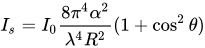
detail, the intensity of light scattered by any one of the small spheres
of radius r and refractive indexn from a beam of unpolarized light of wavelength λ and intensity I0 is given by
where R is the observer's distance to the particle and θ is the scattering angle. Averaging this over all angles gives the Rayleigh scattering cross-section of the particles in air:
Here n is the refractive index of the spheres that approximate
the molecules of the gas; the index of the gas surrounding the spheres
is neglected, an approximation that introduces an error of less than
0.05%.
The major constituent of the atmosphere, nitrogen, has Rayleigh cross section of 5.1×10⁻³¹ m2 at a wavelength of 532 nm (green light). Over the length of one meter the fraction of light scattered can be
approximated from the product of the cross-section and the particle
density, that is number of particles per unit volume. For air at
atmospheric pressure there are about 2×1025 molecules per cubic meter, and the fraction scattered will be 10−5 for every meter of travel.
From molecules
Figure showing the greater proportion of blue light scattered by the atmosphere relative to red light
The expression above can also be written in terms of individual
molecules by expressing the dependence on refractive index in terms of
the molecular polarizabilityα,
proportional to the dipole moment induced by the electric field of the
light. In this case, the Rayleigh scattering intensity for a single
particle is given in CGS-units by[15]
and in SI-units by
Effect of fluctuations
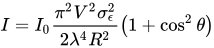
When the dielectric constant of a certain region of volume is different from the average dielectric constant of the medium , then any incident light will be scattered according to the following equation
where represents the variance of the fluctuation in the dielectric constant .
Rayleigh scattering of that light off oxygen and nitrogen molecules, and
the response of the human visual system.
The strong wavelength dependence of the Rayleigh scattering (~λ−4) means that shorter (blue) wavelengths are scattered more strongly than longer (red)
wavelengths. This results in the indirect blue and violet light coming
from all regions of the sky. The human eye responds to this wavelength
combination as if it were a combination of blue and white light.
Some of the scattering can also be from sulfate particles. For years after large Plinian eruptions, the blue cast of the sky is notably brightened by the persistent sulfate load of the stratospheric gases. Some works of the artist J. M. W. Turner may owe their vivid red colours to the eruption of Mount Tambora in his lifetime.
In locations with little light pollution, the moonlit night sky is also blue, because moonlight is reflected sunlight, with a slightly lower color temperature
due to the brownish color of the Moon. The moonlit sky is not perceived
as blue, however, because at low light levels human vision comes mainly
from rod cells that do not produce any color perception (Purkinje effect).
Of sound in amorphous solids
Rayleigh scattering is also an important mechanism of wave scattering in amorphous solids
such as glass, and is responsible for acoustic wave damping and phonon
damping in glasses and granular matter at low or not too high
temperatures. This is because in glasses at higher temperatures the Rayleigh-type
scattering regime is obscured by the anharmonic damping (typically with a
~λ−2 dependence on wavelength), which becomes increasingly more important as the temperature rises.
In amorphous solids – glasses – optical fibers
Rayleigh scattering is an important component of the scattering of optical signals in optical fibers.
Silica fibers are glasses, disordered materials with microscopic
variations of density and refractive index. These give rise to energy
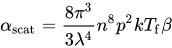
losses due to the scattered light, with the following coefficient:
where n is the refraction index, p is the photoelastic coefficient of the glass, k is the Boltzmann constant, and β is the isothermal compressibility. Tf is a fictive temperature, representing the temperature at which the density fluctuations are "frozen" in the material.
In porous materials
Rayleigh scattering in opalescent glass: it appears blue from the side, but orange light shines through.
Rayleigh-type λ−4 scattering can also be exhibited by porous materials. An example is the strong optical scattering by nanoporous materials. The strong contrast in refractive index between pores and solid parts of sintered alumina results in very strong scattering, with light completely changing direction each five micrometers on average. The λ−4-type scattering is caused by the nanoporous structure (a narrow pore size distribution around ~70 nm) obtained by sintering monodispersive alumina powder.
A parabolic (or paraboloid or paraboloidal) reflector (or dish or mirror) is a reflective surface used to collect or project energy such as light, sound, or radio waves. Its shape is part of a circular paraboloid, that is, the surface generated by a parabola revolving around its axis. The parabolic reflector transforms an incoming plane wave travelling along the axis into a spherical wave converging toward the focus. Conversely, a spherical wave generated by a point source placed in the focus is reflected into a plane wave propagating as a collimated beam along the axis.
Strictly, the three-dimensional shape of the reflector is called a paraboloid.
A parabola is the two-dimensional figure. (The distinction is like that
between a sphere and a circle.) However, in informal language, the word
parabola and its associated adjective parabolic are often used in place of paraboloid and paraboloidal.
If a parabola is positioned in Cartesian coordinates with its
vertex at the origin and its axis of symmetry along the y-axis, so the
parabola opens upward, its equation is , where is its focal length. (See "Parabola#In a cartesian coordinate system".) Correspondingly, the dimensions of a symmetrical paraboloidal dish are related by the equation: , where is the focal length, is the depth of the dish (measured along the axis of symmetry from the vertex to the plane of the rim), and
is the radius of the dish from the center. All units used for the
radius, focal point and depth must be the same. If two of these three
quantities are known, this equation can be used to calculate the third.
A more complex calculation is needed to find the diameter of the dish measured along its surface.
This is sometimes called the "linear diameter", and equals the diameter
of a flat, circular sheet of material, usually metal, which is the
right size to be cut and bent to make the dish. Two intermediate results
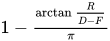
are useful in the calculation: (or the equivalent: ) and , where F, D, and R are defined as above. The diameter of the dish, measured along the surface, is then given by: , where means the natural logarithm of x, i.e. its logarithm to base "e".
The volume of the dish is given by where the symbols are defined as above. This can be compared with the formulae for the volumes of a cylinder a hemisphere where and a cone
is the aperture area of the dish, the area enclosed by the rim, which
is proportional to the amount of sunlight the reflector dish can
intercept. The area of the concave surface of the dish can be found
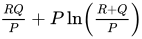
using the area formula for a surface of revolution which gives . providing . The fraction of light reflected by the dish, from a light source in the focus, is given by , where and are defined as above.
Parallel
rays coming into a parabolic mirror are focused at a point F. The
vertex is V, and the axis of symmetry passes through V and F. For
off-axis reflectors (with just the part of the paraboloid between the
points P1 and P3), the receiver is still placed at the focus of the paraboloid, but it does not cast a shadow onto the reflector.
The parabolic reflector functions due to the geometric properties of the paraboloidal shape: any incoming ray that is parallel to the axis of the dish will be reflected to a central point, or "focus". (For a geometrical proof, click here.)
Because many types of energy can be reflected in this way, parabolic
reflectors can be used to collect and concentrate energy entering the
reflector at a particular angle. Similarly, energy radiating from the
focus to the dish can be transmitted outward in a beam that is parallel
to the axis of the dish.
In contrast with spherical reflectors, which suffer from a spherical aberration
that becomes stronger as the ratio of the beam diameter to the focal
distance becomes larger, parabolic reflectors can be made to accommodate
beams of any width. However, if the incoming beam makes a non-zero
angle with the axis (or if the emitting point source is not placed in
the focus), parabolic reflectors suffer from an aberration called coma.
This is primarily of interest in telescopes because most other
applications do not require sharp resolution off the axis of the
parabola.
The precision to which a parabolic dish must be made in order to
focus energy well depends on the wavelength of the energy. If the dish
is wrong by a quarter of a wavelength, then the reflected energy will be
wrong by a half wavelength, which means that it will interfere
destructively with energy that has been reflected properly from another
part of the dish. To prevent this, the dish must be made correctly to
within about 1/20
of a wavelength. The wavelength range of visible light is between about
400 and 700 nanometres (nm), so in order to focus all visible light
well, a reflector must be correct to within about 20 nm. For comparison,
the diameter of a human hair is usually about 50,000 nm, so the
required accuracy for a reflector to focus visible light is about 2500
times less than the diameter of a hair. For example, the flaw in the Hubble Space Telescope mirror (too flat by about 2,200 nm at its perimeter) caused severe spherical aberration until corrected with COSTAR.
Microwaves, such as are used for satellite-TV signals, have
wavelengths of the order of ten millimetres, so dishes to focus these
waves can be wrong by half a millimetre or so and still perform well.
It is sometimes useful if the centre of mass of a reflector dish coincides with its focus.
This allows it to be easily turned so it can be aimed at a moving
source of light, such as the Sun in the sky, while its focus, where the
target is located, is stationary. The dish is rotated around axes that pass through the focus and around which it is balanced. If the dish is symmetrical and made of uniform material of constant thickness, and if F
represents the focal length of the paraboloid, this "focus-balanced"
condition occurs if the depth of the dish, measured along the axis of
the paraboloid from the vertex to the plane of the rim of the dish, is 1.8478 times F. The radius of the rim is 2.7187 F. The angular radius of the rim as seen from the focal point is 72.68 degrees.
Scheffler reflector
The focus-balanced configuration (see above) requires the depth of
the reflector dish to be greater than its focal length, so the focus is
within the dish. This can lead to the focus being difficult to access.
An alternative approach is exemplified by the Scheffler reflector, named after its inventor, Wolfgang Scheffler.
This is a paraboloidal mirror which is rotated about axes that pass
through its centre of mass, but this does not coincide with the focus,
which is outside the dish. If the reflector were a rigid paraboloid, the
focus would move as the dish turns. To avoid this, the reflector is
flexible, and is bent as it rotates so as to keep the focus stationary.
Ideally, the reflector would be exactly paraboloidal at all times. In
practice, this cannot be achieved exactly, so the Scheffler reflector is
not suitable for purposes that require high accuracy. It is used in
applications such as solar cooking, where sunlight has to be focused well enough to strike a cooking pot, but not to an exact point.
Off-axis reflectors
The
vertex of the paraboloid is below the bottom edge of the dish. The
curvature of the dish is greatest near the vertex. The axis, which is
aimed at the satellite, passes through the vertex and the receiver
module, which is at the focus.
A circular paraboloid is theoretically unlimited in size. Any
practical reflector uses just a segment of it. Often, the segment
includes the vertex of the paraboloid, where its curvature is greatest, and where the axis of symmetry
intersects the paraboloid. However, if the reflector is used to focus
incoming energy onto a receiver, the shadow of the receiver falls onto
the vertex of the paraboloid, which is part of the reflector, so part of
the reflector is wasted. This can be avoided by making the reflector
from a segment of the paraboloid which is offset from the vertex and the
axis of symmetry. The whole reflector receives energy, which is then
focused onto the receiver. This is frequently done, for example, in
satellite-TV receiving dishes, and also in some types of astronomical
telescope (e.g., the Green Bank Telescope, the James Webb Space Telescope).
Accurate off-axis reflectors, for use in solar furnaces and other non-critical applications, can be made quite simply by using a rotating furnace,
in which the container of molten glass is offset from the axis of
rotation. To make less accurate ones, suitable as satellite dishes, the
shape is designed by a computer, then multiple dishes are stamped out of
sheet metal.
Off-axis-reflectors heading from medium latitudes to a geostationary TV satellite
somewhere above the equator stand steeper than a coaxial reflector. The
effect is, that the arm to hold the dish can be shorter and snow tends
less to accumulate in (the lower part of) the dish.
Off-axis satellite dish
History
The principle of parabolic reflectors has been known since classical antiquity, when the mathematician Diocles described them in his book On Burning Mirrors and proved that they focus a parallel beam to a point. Archimedes in the third century BCE studied paraboloids as part of his study of hydrostatic equilibrium, and it has been claimed that he used reflectors to set the Roman fleet alight during the Siege of Syracuse. This seems unlikely to be true, however, as the claim does not appear
in sources before the 2nd century CE, and Diocles does not mention it in
his book. Parabolic mirrors and reflectors were also studied extensively by the physicistRoger Bacon in the 13th century AD. James Gregory, in his 1663 book Optica Promota (1663), pointed out that a reflecting telescope with a mirror that was parabolic would correct spherical aberration as well as the chromatic aberration seen in refracting telescopes. The design he came up with bears his name: the "Gregorian telescope";
but according to his own confession, Gregory had no practical skill and
he could find no optician capable of actually constructing one. Isaac Newton knew about the properties of parabolic mirrors but chose a spherical shape for his Newtonian telescope mirror to simplify construction. Lighthouses
also commonly used parabolic mirrors to collimate a point of light from
a lantern into a beam, before being replaced by more efficient Fresnel lenses in the 19th century. In 1888, Heinrich Hertz, a German physicist, constructed the world's first parabolic reflector antenna.
Lighting the Olympic Flame with a parabolic reflector
The Olympic Flame is traditionally lit at Olympia, Greece, using a parabolic reflector concentrating sunlight, and is then transported to the venue of the Games. Parabolic mirrors are one of many shapes for a burning glass.
Parabolic reflectors are popular for use in creating optical illusions.
These consist of two opposing parabolic mirrors, with an opening in the
center of the top mirror. When an object is placed on the bottom
mirror, the mirrors create a real image,
which is a virtually identical copy of the original that appears in the
opening. The quality of the image is dependent upon the precision of
the optics. Some such illusions are manufactured to tolerances of
millionths of an inch.
A parabolic reflector pointing upward can be formed by rotating a
reflective liquid, like mercury, around a vertical axis. This makes the
liquid-mirror telescope possible. The same technique is used in rotating furnaces to make solid reflectors.
Parabolic reflectors are also a popular alternative for
increasing wireless signal strength. Even with simple ones, users have
reported 3 dB or more gains.
In physics, scattering is a wide range of physical processes where moving particles or radiation of some form, such as light or sound, are forced to deviate from a straight trajectory
by localized non-uniformities (including particles and radiation) in
the medium through which they pass. In conventional use, this also
includes deviation of reflected radiation from the angle predicted by
the law of reflection. Reflections of radiation that undergo scattering are often called diffuse reflections and unscattered reflections are called specular (mirror-like) reflections. Originally, the term was confined to light scattering (going back at least as far as Isaac Newton in the 17th century). As more "ray"-like phenomena were discovered, the idea of scattering was extended to them, so that William Herschel could refer to the scattering of "heat rays" (not then recognized as electromagnetic in nature) in 1800. John Tyndall, a pioneer in light scattering research, noted the connection between light scattering and acoustic scattering in the 1870s. Near the end of the 19th century, the scattering of cathode rays (electron beams) and X-rays was observed and discussed. With the discovery of subatomic particles (e.g. Ernest Rutherford in 1911)
and the development of quantum theory in the 20th century, the sense of
the term became broader as it was recognized that the same mathematical
frameworks used in light scattering could be applied to many other
phenomena.
The types of non-uniformities which can cause scattering, sometimes known as scatterers or scattering centers, are too numerous to list, but a small sample includes particles, bubbles, droplets, density fluctuations in fluids, crystallites in polycrystalline solids, defects in monocrystalline solids, surface roughness, cells in organisms, and textile fibers
in clothing. The effects of such features on the path of almost any
type of propagating wave or moving particle can be described in the
framework of scattering theory.
When radiation is only scattered by one localized scattering center, this is called single scattering.
It is more common that scattering centers are grouped together; in such
cases, radiation may scatter many times, in what is known as multiple scattering. The main difference between the effects of single and multiple
scattering is that single scattering can usually be treated as a random
phenomenon, whereas multiple scattering, somewhat counterintuitively,
can be modeled as a more deterministic process because the combined
results of a large number of scattering events tend to average out.
Multiple scattering can thus often be modeled well with diffusion theory.
Because the location of a single scattering center is not usually
well known relative to the path of the radiation, the outcome, which
tends to depend strongly on the exact incoming trajectory, appears
random to an observer. This type of scattering would be exemplified by
an electron being fired at an atomic nucleus. In this case, the atom's
exact position relative to the path of the electron is unknown and would
be unmeasurable, so the exact trajectory of the electron after the
collision cannot be predicted. Single scattering is therefore often
described by probability distributions.
With multiple scattering, the randomness of the interaction tends
to be averaged out by a large number of scattering events, so that the
final path of the radiation appears to be a deterministic distribution
of intensity. This is exemplified by a light beam passing through thick fog. Multiple scattering is highly analogous to diffusion, and the terms multiple scattering and diffusion are interchangeable in many contexts. Optical elements designed to produce multiple scattering are thus known as diffusers. Coherent backscattering, an enhancement of backscattering that occurs when coherent radiation is multiply scattered by a random medium, is usually attributed to weak localization.
Not all single scattering is random, however. A well-controlled
laser beam can be exactly positioned to scatter off a microscopic
particle with a deterministic outcome, for instance. Such situations are
encountered in radar scattering as well, where the targets tend to be macroscopic objects such as people or aircraft.
Similarly, multiple scattering can sometimes have somewhat random
outcomes, particularly with coherent radiation. The random fluctuations
in the multiply scattered intensity of coherent radiation are called speckles.
Speckle also occurs if multiple parts of a coherent wave scatter from
different centers. In certain rare circumstances, multiple scattering
may only involve a small number of interactions such that the randomness
is not completely averaged out. These systems are considered to be some
of the most difficult to model accurately.
The description of scattering and the distinction between single and multiple scattering are tightly related to wave–particle duality.
Theory
Scattering theory is a framework for studying and understanding the scattering of waves and particles.
Wave scattering corresponds to the collision and scattering of a wave
with some material object, for instance sunlight scattered by rain drops to form a rainbow. Scattering also includes the interaction of billiard balls on a table, the Rutherford scattering (or angle change) of alpha particles by goldnuclei, the Bragg scattering (or diffraction) of electrons and X-rays by a cluster of atoms, and the inelastic scattering of a fission fragment as it traverses a thin foil. More precisely, scattering consists of the study of how solutions of partial differential equations, propagating freely "in the distant past", come together and interact with one another or with a boundary condition, and then propagate away "to the distant future".
The direct scattering problem is the problem of
determining the distribution of scattered radiation/particle flux basing
on the characteristics of the scatterer. The inverse scattering problem
is the problem of determining the characteristics of an object (e.g.,
its shape, internal constitution) from measurement data of radiation or
particles scattered from the object.
Attenuation due to scattering
Equivalent quantities used in the theory of scattering from composite specimens, but with a variety of units
When the target is a set of many scattering centers whose relative
position varies unpredictably, it is customary to think of a range
equation whose arguments take different forms in different application
areas. In the simplest case consider an interaction that removes
particles from the "unscattered beam" at a uniform rate that is
proportional to the incident number of particles per unit area per unit
time (), i.e. that
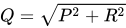
where Q is an interaction coefficient and x is the distance traveled in the target.
where Io is the initial flux, path length Δx ≡ x − xo, the second equality defines an interaction mean free path λ, the third uses the number of targets per unit volume η to define an area cross-section
σ, and the last uses the target mass density ρ to define a density mean
free path τ. Hence one converts between these quantities via Q = 1/λ = ησ = ρ/τ, as shown in the figure at left.
In electromagnetic absorption spectroscopy, for example, interaction coefficient (e.g. Q in cm−1) is variously called opacity, absorption coefficient, and attenuation coefficient. In nuclear physics, area cross-sections (e.g. σ in barns or units of 10−24 cm2), density mean free path (e.g. τ in grams/cm2), and its reciprocal the mass attenuation coefficient (e.g. in cm2/gram) or area per nucleon are all popular, while in electron microscopy the inelastic mean free path (e.g. λ in nanometers) is often discussed instead.
Elastic and inelastic scattering
The term "elastic scattering" implies that the internal states of the
scattering particles do not change, and hence they emerge unchanged
from the scattering process. In inelastic scattering, by contrast, the
particles' internal state is changed, which may amount to exciting some
of the electrons of a scattering atom, or the complete annihilation of a
scattering particle and the creation of entirely new particles.
The example of scattering in quantum chemistry
is particularly instructive, as the theory is reasonably complex while
still having a good foundation on which to build an intuitive
understanding. When two atoms are scattered off one another, one can
understand them as being the bound state solutions of some differential equation. Thus, for example, the hydrogen atom corresponds to a solution to the Schrödinger equation with a negative inverse-power (i.e., attractive Coulombic) central potential. The scattering of two hydrogen atoms will disturb the state of each atom, resulting in one or both becoming excited, or even ionized, representing an inelastic scattering process.
The term "deep inelastic scattering" refers to a special kind of scattering experiment in particle physics.
Mathematical framework
In mathematics, scattering theory deals with a more abstract formulation of the same set of concepts. For example, if a differential equation
is known to have some simple, localized solutions, and the solutions
are a function of a single parameter, that parameter can take the
conceptual role of time.
One then asks what might happen if two such solutions are set up far
away from each other, in the "distant past", and are made to move
towards each other, interact (under the constraint of the differential
equation) and then move apart in the "future". The scattering matrix
then pairs solutions in the "distant past" to those in the "distant
future".
Solutions to differential equations are often posed on manifolds. Frequently, the means to the solution requires the study of the spectrum of an operator on the manifold. As a result, the solutions often have a spectrum that can be identified with a Hilbert space, and scattering is described by a certain map, the S matrix, on Hilbert spaces. Solutions with a discrete spectrum correspond to bound states in quantum mechanics, while a continuous spectrum
is associated with scattering states. The study of inelastic
scattering then asks how discrete and continuous spectra are mixed
together.
Top: the real part of a plane wave
travelling upwards. Bottom: The real part of the field after inserting
in the path of the plane wave a small transparent disk of index of refraction
higher than the index of the surrounding medium. This object scatters
part of the wave field, although at any individual point, the wave's
frequency and wavelength remain intact.
In regular quantum mechanics, which includes quantum chemistry, the relevant equation is the Schrödinger equation, although equivalent formulations, such as the Lippmann-Schwinger equation and the Faddeev equations,
are also largely used. The solutions of interest describe the long-term
motion of free atoms, molecules, photons, electrons, and protons. The
scenario is that several particles come together from an infinite
distance away. These reagents then collide, optionally reacting, getting
destroyed or creating new particles. The products and unused reagents
then fly away to infinity again. (The atoms and molecules are
effectively particles for our purposes. Also, under everyday
circumstances, only photons are being created and destroyed.) The
solutions reveal which directions the products are most likely to fly
off to and how quickly. They also reveal the probability of various
reactions, creations, and decays occurring. There are two predominant
techniques of finding solutions to scattering problems: partial wave analysis, and the Born approximation.
Electromagnetics
A Feynman diagram of scattering between two electrons by emission of a virtual photon
Electromagnetic waves are one of the best known and most commonly encountered forms of radiation that undergo scattering. Scattering of light and radio waves (especially in radar) is
particularly important. Several different aspects of electromagnetic
scattering are distinct enough to have conventional names. Major forms
of elastic light scattering (involving negligible energy transfer) are Rayleigh scattering and Mie scattering. Inelastic scattering includes Brillouin scattering, Raman scattering, inelastic X-ray scattering and Compton scattering.
Light scattering is one of the two major physical processes that
contribute to the visible appearance of most objects, the other being
absorption. Surfaces described as white owe their appearance to
multiple scattering of light by internal or surface inhomogeneities in
the object, for example by the boundaries of transparent microscopic
crystals that make up a stone or by the microscopic fibers in a sheet of
paper. More generally, the gloss (or lustre or sheen)
of the surface is determined by scattering. Highly scattering surfaces
are described as being dull or having a matte finish, while the absence
of surface scattering leads to a glossy appearance, as with polished
metal or stone.
Spectral absorption, the selective absorption of certain colors, determines the color of most objects with some modification by elastic scattering. The apparent blue color of veins
in skin is a common example where both spectral absorption and
scattering play important and complex roles in the coloration. Light
scattering can also create color without absorption, often shades of
blue, as with the sky (Rayleigh scattering), the human blue iris, and the feathers of some birds (Prum et al. 1998). However, resonant light scattering in nanoparticles can produce many different highly saturated and vibrant hues, especially when surface plasmon resonance is involved (Roqué et al. 2006).
Models of light scattering can be divided into three domains based on a dimensionless size parameter, α which is defined as:
where πDp is the circumference of a particle and λ is the wavelength of incident radiation in the medium. Based on the value of α, these domains are:
α ≪ 1: Rayleigh scattering (small particle compared to wavelength of light);
α ≈ 1: Mie scattering (particle about the same size as wavelength of light, valid only for spheres);
α ≫ 1: geometric scattering (particle much larger than wavelength of light).
Rayleigh scattering is a process in which electromagnetic radiation
(including light) is scattered by a small spherical volume of variant
refractive indexes, such as a particle, bubble, droplet, or even a
density fluctuation. This effect was first modeled successfully by Lord Rayleigh, from whom it gets its name. In order for Rayleigh's model to apply, the sphere must be much smaller in diameter than the wavelength (λ)
of the scattered wave; typically the upper limit is taken to be about
1/10 the wavelength. In this size regime, the exact shape of the
scattering center is usually not very significant and can often be
treated as a sphere of equivalent volume. The inherent scattering that
radiation undergoes passing through a pure gas is due to microscopic
density fluctuations as the gas molecules move around, which are
normally small enough in scale for Rayleigh's model to apply. This
scattering mechanism is the primary cause of the blue color of the
Earth's sky on a clear day, as the shorter blue wavelengths of sunlight
passing overhead are more strongly scattered than the longer red
wavelengths according to Rayleigh's famous 1/λ4 relation. Along with absorption, such scattering is a major cause of the attenuation of radiation by the atmosphere. The degree of scattering varies as a function of the ratio of the
particle diameter to the wavelength of the radiation, along with many
other factors including polarization, angle, and coherence.
For larger diameters, the problem of electromagnetic scattering by spheres was first solved by Gustav Mie,
and scattering by spheres larger than the Rayleigh range is therefore
usually known as Mie scattering. In the Mie regime, the shape of the
scattering center becomes much more significant and the theory only
applies well to spheres and, with some modification, spheroids and ellipsoids.
Closed-form solutions for scattering by certain other simple shapes
exist, but no general closed-form solution is known for arbitrary
shapes.
Both Mie and Rayleigh scattering are considered elastic
scattering processes, in which the energy (and thus wavelength and
frequency) of the light is not substantially changed. However,
electromagnetic radiation scattered by moving scattering centers does
undergo a Doppler shift, which can be detected and used to measure the velocity of the scattering center/s in forms of techniques such as lidar and radar. This shift involves a slight change in energy.
At values of the ratio of particle diameter to wavelength more than about 10, the laws of geometric optics
are mostly sufficient to describe the interaction of light with the
particle. Mie theory can still be used for these larger spheres, but the
solution often becomes numerically unwieldy.
For modeling of scattering in cases where the Rayleigh and Mie
models do not apply such as larger, irregularly shaped particles, there
are many numerical methods that can be used. The most common are finite-element methods which solve Maxwell's equations
to find the distribution of the scattered electromagnetic field.
Sophisticated software packages exist which allow the user to specify
the refractive index or indices of the scattering feature in space,
creating a 2- or sometimes 3-dimensional model of the structure. For
relatively large and complex structures, these models usually require
substantial execution times on a computer.
Electrophoresis involves the migration of macromolecules under the influence of an electric field. Electrophoretic light scattering
involves passing an electric field through a liquid which makes
particles move. The bigger the charge is on the particles, the faster
they are able to move.