Nuclear quadrupole resonancespectroscopy or NQR is a chemical analysis technique related to nuclear magnetic resonance (NMR). Unlike NMR, NQR transitions of nuclei can be detected in the absence of a magnetic field, and for this reason NQR spectroscopy is referred to as "zero Field NMR". The NQR resonance is mediated by the interaction of the electric field gradient (EFG) with the quadrupole moment of the nuclear charge distribution.
Unlike NMR, NQR is applicable only to solids and not liquids, because
in liquids the electric field gradient at the nucleus averages to zero
(the EFG tensor has trace zero). Because the EFG at the location of a nucleus in a given substance is determined primarily by the valence electrons involved in the particular bond with other nearby nuclei, the NQR frequency
at which transitions occur is unique for a given substance. A
particular NQR frequency in a compound or crystal is proportional to the
product of the nuclear quadrupole moment, a property of the nucleus,
and the EFG in the neighborhood of the nucleus. It is this product
which is termed the nuclear quadrupole coupling constant for a given
isotope in a material and can be found in tables of known NQR
transitions. In NMR, an analogous but not identical phenomenon is the
coupling constant, which is also the result of an internuclear
interaction between nuclei in the analyte.
Principle
Any nucleus with more than one unpaired nuclear particle (protons or
neutrons) will have a charge distribution which results in an electric
quadrupole moment. Allowed nuclear energy levels are shifted unequally
due to the interaction of the nuclear charge with an electric field
gradient supplied by the non-uniform distribution of electron density
(e.g. from bonding electrons) and/or surrounding ions. As in the case
of NMR, irradiation of the nucleus with a burst of RF electromagnetic
radiation may result in absorption of some energy by the nucleus which
can be viewed as a perturbation
of the quadrupole energy level. Unlike the NMR case, NQR absorption
takes place in the absence of an external magnetic field. Application
of an external static field to a quadrupolar nucleus splits the
quadrupole levels by the energy predicted from the Zeeman interaction. The technique is very sensitive to the nature and symmetry of the bonding around the nucleus. It can characterize phase transitions
in solids when performed at varying temperature. Due to symmetry, the
shifts become averaged to zero in the liquid phase, so NQR spectra can
only be measured for solids.
Analogy with NMR
In the case of NMR, nuclei with spin
≥ 1/2 have a magnetic dipole moment so that their energies are split by
a magnetic field, allowing resonance absorption of energy related to
the Larmor frequency:
where is the gyromagnetic ratio and is the (normally applied) magnetic field external to the nucleus.
In the case of NQR, nuclei with spin ≥ 1, such as 14N (spin 1), 17O (spin 5/2), 35Cl (spin 3/2) and 63Cu (spin 3/2), also have an electric quadrupole moment
Q which has energy levels between which resonance can be observed, even
in the absence of a magnetic field. Nuclei with spin 1 or 3/2 give only
a single resonance line, but a nucleus with spin 5/2 gives two
resonance lines, one at double the frequency of the other.
The nuclear quadrupole moment is associated with non-spherical
nuclear charge distributions. As such it is a measure of the degree to
which the nuclear charge distribution deviates from that of a sphere;
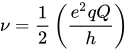
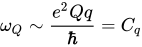
that is, the prolate or oblate shape of the nucleus. NQR is a direct observation of the interaction of the quadrupole moment with the local electric field gradient (EFG)
created by the electronic structure of its environment. The NQR
transition frequencies are proportional to the product of the electric
quadrupole moment of the nucleus and a measure of the strength of the
local EFG:
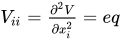
where q is related to the largest principal component of the EFG tensor at the nucleus. is referred to as the quadrupole coupling constant.
In principle, the NQR experimenter could apply a specified EFG in order to influence
just as the NMR experimenter is free to choose the Larmor frequency by
adjusting the magnetic field. However, in solids, the strength of the
EFG is many kV/m^2, making the application of EFG's for NQR in the
manner that external magnetic fields are chosen for NMR impractical.
Consequently, the NQR spectrum of a substance is specific to the
substance - and NQR spectrum is a so called "chemical fingerprint."
Because NQR frequencies are not chosen by the experimenter, they can be
difficult to find making NQR a technically difficult technique to carry
out. Since NQR is done in an environment without a static (or DC)
magnetic field, it is sometimes called "zero field NMR". Many NQR transition frequencies depend strongly upon temperature.
Derivation of resonance frequency
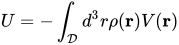
Consider a nucleus with a non-zero quadrupole moment and charge density , which is surrounded by a potential .
This potential may be produced by the electrons as stated above, whose
probability distribution might be non-isotropic in general. The
potential energy in this system equals to the integral over the charge
distribution and the potential within a domain :
One can write the potential as a Taylor-expansion at the center of the considered nucleus. This method corresponds to the multipole expansion in cartesian coordinates (note that the equations below use the Einstein sum-convention):
The first term involving will not be relevant and can therefore be omitted. Since nuclei do not have an electric dipole moment, which would interact with the electric field ,
the first derivatives can also be neglected. One is therefore left with
all nine combinations of second derivatives. However if one deals with a
homogeneous oblate or prolate nucleus the matrix will be diagonal and elements with
vanish. This leads to a simplification because the equation for the
potential energy now contains only the second derivatives in respect to
the same variable:
The
remaining terms in the integral are related to the charge distribution
and hence the quadrupole moment. The formula can be simplified even
further by introducing the electric field gradient , choosing the z-axis as the one with the maximal principal component and using the Laplace equation to obtain the proportionality written above. For an nucleus one obtains with the frequency-energy relation:
Applications
NQR probes the interaction between the nuclear quadrupole moment
and the electric field gradient at the nucleus. Since the EFG tensor
arises from the electron cloud density around a particular region, NQR
is highly sensitive to changes in electron charge distribution
surrounding the NQR-active nucleus. Such sensitivity makes NQR
spectroscopy a useful method for the study of bonding, structural
features, phase transitions, and molecular dynamics in solid-state compounds.
For example, NQR spectroscopy has proven to be a useful tool in
the realm of pharmaceuticals. More specifically, the application of 14N-NQR has allowed for the differentiation of enantiomeric compounds from racemic
mixtures; namely in, D-serine and L-serine. These two compounds,
despite their similar composition, possess distinct properties. On one
hand, D-serine is a potential biomarker for Alzheimer’s disease as well
as a treatment for schizophrenia. L-serine, on the other hand, is a drug
undergoing FDA-approved human clinical trials due to its potential in
treating amyotrophic lateral sclerosis. Through NQR the mixture of
L/D-serine can be differentiated from pure L/D-serine. Note that
L-serine and D-serine cannot be differentiated due to being related by a
reflection.
Similarly, NQR possesses the ability to differentiate between crystalline polymorphs.
Sulfonamide-containing drugs, for example, have shown to be susceptible
to polymorphism. Differences in NQR frequencies, along with the
quadrupole coupling constants and asymmetry parameters, allow
differentiation between polymorphs as can be done with enantiomeric
compounds. Distinguishing between polymorphs in such a manner makes NQR a powerful tool for authenticating drugs against counterfeits.
There are several research groups around the world currently
working on ways to use NQR to detect explosives. Units designed to
detect landmines and explosives concealed in luggage have been tested. A detection
system consists of a radio frequency (RF) power source, a coil to
produce the magnetic excitation field and a detector circuit which
monitors for a RF NQR response coming from the explosive component of
the object.
A fake device known as the ADE 651
claimed to exploit NQR to detect explosives but in fact could do no
such thing. Nonetheless, the device was successfully sold for millions
to dozens of countries, including the government of Iraq.
Another practical use for NQR is measuring the water/gas/oil coming out of an oil well
in realtime.
This particular technique allows local or remote monitoring of the
extraction process, calculation of the well's remaining capacity and the
water/detergents ratio the input pump must send to efficiently extract
oil.
Due to the strong temperature dependence of the NQR frequency, it can be used as a precise temperature sensor with resolution on the order of 10−4 °C.
Non-spherical
symmetry in nuclei. Shown from left to right are a stretched (prolate)
nucleus, a spherical nucleus, and a compressed (oblate) nucleus.
The main limitation for this technique arises from isotopic
abundance. NQR requires the presence of a non-zero quadrupole moment,
which is only observed in nuclei with a nuclear spin greater than or equal to one (I ≥ 1) and whose local charge distribution deviates from spherical symmetry. NQR requires fairly large sample sizes due to the signals being of very low intensity. This poses experimental obstacles due to a large majority of NQR-active nuclei having low isotopic abundances. Nevertheless, NQR spectroscopy has still proven useful in various contexts – as discussed above.
A communications satellite is an artificial satellite that relays and amplifies radio telecommunication signals via a transponder; it creates a communication channel between a source transmitter and a receiver at different locations on Earth. Communications satellites are used for television, telephone, radio, internet, and military applications. Some communications satellites are in geostationary orbit 22,236 miles (35,785 km) above the equator, so that the satellite appears stationary at the same point in the sky; therefore the satellite dish
antennas of ground stations can be aimed permanently at that spot and
do not have to move to track the satellite. However, most form satellite constellations in low Earth orbit, where ground antennas must track the satellites and switch between them frequently.
The radio waves used for telecommunications links travel by line of sight
and so are obstructed by the curve of the Earth. The purpose of
communications satellites is to relay the signal around the curve of the
Earth allowing communication between widely separated geographical
points. Communications satellites operate across a wide range of radio and microwavefrequencies.
To avoid signal interference, international organizations have
regulations for which frequency ranges or "bands" certain organizations
are allowed to use. This allocation of bands minimizes the risk of
signal interference.
History
Origins
In October 1945, Arthur C. Clarke published an article titled "Extraterrestrial Relays" in the British magazine Wireless World. The article described the fundamentals behind the deployment of artificial satellites in geostationary orbits to relay radio signals. Because of this, Arthur C. Clarke is often quoted as being the inventor of the concept of the communications satellite, and the term 'Clarke Belt' is employed as a description of the orbit.
Replica of Sputnik 1
The first artificial Earth satellite was Sputnik 1, which was put into orbit by the Soviet Union on 4 October 1957. It was developed by Mikhail Tikhonravov and Sergey Korolev, building on work by Konstantin Tsiolkovsky. Sputnik 1 was equipped with an on-board radiotransmitter
that worked on two frequencies of 20.005 and 40.002 MHz, or 7 and 15
meters wavelength. The satellite was not placed in orbit to send data
from one point on Earth to another, but the radio transmitter was meant
to study the properties of radio wave distribution throughout the
ionosphere. The launch of Sputnik 1 was a major step in the exploration
of space and rocket development, and marks the beginning of the Space Age.
Early active and passive satellite experiments
There are two major classes of communications satellites, passive and active. Passive satellites only reflect
the signal coming from the source, toward the direction of the
receiver. With passive satellites, the reflected signal is not amplified
at the satellite, and only a small amount of the transmitted energy
actually reaches the receiver. Since the satellite is so far above
Earth, the radio signal is attenuated due to free-space path loss,
so the signal received on Earth is very weak. Active satellites, on the
other hand, amplify the received signal before retransmitting it to the
receiver on the ground. Passive satellites were the first communications satellites, but are little used now.
Work that was begun in the field of electrical intelligence gathering at the United States Naval Research Laboratory in 1951 led to a project named Communication Moon Relay.
Military planners had long shown considerable interest in secure and
reliable communications lines as a tactical necessity, and the ultimate
goal of this project was the creation of the longest communications
circuit in human history, with the Moon, Earth's natural satellite,
acting as a passive relay. After achieving the first transoceanic
communication between Washington, D.C., and Hawaii on 23 January 1956, this system was publicly inaugurated and put into formal production in January 1960.
The Atlas-B with SCORE on the launch pad; the rocket (without booster engines) constituted the satellite.
The first satellite purpose-built to actively relay communications was Project SCORE, led by Advanced Research Projects Agency
(ARPA) and launched on 18 December 1958, which used a tape recorder to
carry a stored voice message, as well as to receive, store, and
retransmit messages. It was used to send a Christmas greeting to the
world from U.S. President Dwight D. Eisenhower.
The satellite also executed several realtime transmissions before the
non-rechargeable batteries failed on 30 December 1958 after eight hours
of actual operation.
The direct successor to SCORE was another ARPA-led project called Courier. Courier 1B
was launched on 4 October 1960 to explore whether it would be possible
to establish a global military communications network by using "delayed
repeater" satellites, which receive and store information until
commanded to rebroadcast them. After 17 days, a command system failure
ended communications from the satellite.
NASA's satellite applications program launched the first artificial satellite used for passive relay communications in Echo 1 on 12 August 1960. Echo 1 was an aluminized balloon satellite acting as a passive reflector of microwave
signals. Communication signals were bounced off the satellite from one
point on Earth to another. This experiment sought to establish the
feasibility of worldwide broadcasts of telephone, radio, and television
signals.
More firsts and further experiments
Telstar
was the first active, direct relay communications commercial satellite
and marked the first transatlantic transmission of television signals.
Belonging to AT&T as part of a multi-national agreement between AT&T, Bell Telephone Laboratories, NASA, the British General Post Office, and the French National PTT (Post Office) to develop satellite communications, it was launched by NASA from Cape Canaveral on 10 July 1962, in the first privately sponsored space launch.
Another passive relay experiment primarily intended for military communications purposes was Project West Ford, which was led by Massachusetts Institute of Technology's Lincoln Laboratory. After an initial failure in 1961, a launch on 9 May 1963 dispersed 350
million copper needle dipoles to create a passive reflecting belt. Even
though only about half of the dipoles properly separated from each
other, the project was able to successfully experiment and communicate using frequencies in the SHFX band spectrum.
An immediate antecedent of the geostationary satellites was the Hughes Aircraft Company's Syncom 2, launched on 26 July 1963. Syncom 2 was the first communications satellite in a geosynchronous orbit.
It revolved around the Earth once per day at constant speed, but
because it still had north–south motion, special equipment was needed to
track it. Its successor, Syncom 3,
launched on 19 July 1964, was the first geostationary communications
satellite. Syncom 3 obtained a geosynchronous orbit, without a
north–south motion, making it appear from the ground as a stationary
object in the sky.
A direct extension of the passive experiments of Project West Ford was the Lincoln Experimental Satellite program, also conducted by the Lincoln Laboratory on behalf of the United States Department of Defense. The LES-1
active communications satellite was launched on 11 February 1965 to
explore the feasibility of active solid-state X band long-range military
communications. A total of nine satellites were launched between 1965
and 1976 as part of this series.
In the United States, 1962 saw the creation of the Communications Satellite Corporation (COMSAT) private corporation, which was subject to instruction by the US Government on matters of national policy. Over the next two years, international negotiations led to the Intelsat
Agreements, which in turn led to the launch of Intelsat 1, also known
as Early Bird, on 6 April 1965, and which was the first commercial
communications satellite to be placed in geosynchronous orbit. Subsequent Intelsat launches in the 1960s provided multi-destination
service and video, audio, and data service to ships at sea (Intelsat 2
in 1966–67), and the completion of a fully global network with Intelsat 3
in 1969–70. By the 1980s, with significant expansions in commercial
satellite capacity, Intelsat was on its way to become part of the
competitive private telecommunications industry, and had started to get
competition from the likes of PanAmSat in the United States, which, ironically, was then bought by its archrival in 2005.
When Intelsat was launched, the United States was the only launch source outside of the Soviet Union, who did not participate in the Intelsat agreements. The Soviet Union launched its first communications satellite on 23 April 1965 as part of the Molniya program. This program was also unique at the time for its use of what then became known as the Molniya orbit, which describes a highly elliptical orbit,
with two high apogees daily over the northern hemisphere. This orbit
provides a long dwell time over Russian territory as well as over Canada
at higher latitudes than geostationary orbits over the equator.
Communications satellites usually have one of three primary types of orbit, while other orbital classifications are used to further specify orbital details. MEO and LEO are non-geostationary orbit (NGSO).
Geostationary satellites have a geostationary orbit
(GEO), which is 22,236 miles (35,785 km) from Earth's surface. This
orbit has the characteristic that the satellite’s apparent position in
the sky, as viewed from the ground, does not change, the satellite
appears to "stand still" in the sky. This is because the satellite's
orbital period is the same as the rotation rate of the Earth. The
advantage of this orbit is that ground antennas do not have to track the
satellite across the sky; they can be fixed to point at the location in
the sky the satellite appears.
Medium Earth orbit (MEO) satellites are closer to Earth. Orbital altitudes range from 2,000 to 36,000 kilometres (1,200 to 22,400 mi) above Earth.
The region below medium orbits is referred to as low Earth orbit (LEO), and is about 160 to 2,000 kilometres (99 to 1,243 mi) above Earth.
As satellites in MEO and LEO orbit the Earth faster, they do not
remain visible in the sky to a fixed point on Earth continually like a
geostationary satellite, but appear to a ground observer to cross the
sky and "set" when they go behind the Earth beyond the visible horizon.
Therefore, to provide continuous communications capability with these
lower orbits requires a larger number of satellites, so that one of
these satellites will always be visible in the sky for transmission of
communication signals. However, due to their closer distance to the
Earth, LEO or MEO satellites can communicate to ground with reduced
latency and at lower power than would be required from a geosynchronous
orbit.
A low Earth orbit
(LEO) typically is a circular orbit about 160 to 2,000 kilometres (99
to 1,243 mi) above the Earth's surface and, correspondingly, a period
(time to revolve around the Earth) of about 90 minutes.
Because of their low altitude, these satellites are only visible
from within a radius of roughly 1,000 kilometres (620 mi) from the
sub-satellite point. In addition, satellites in low Earth orbit change
their position relative to the ground position quickly. So even for
local applications, many satellites are needed if the mission requires
uninterrupted connectivity.
Low-Earth-orbiting satellites are less expensive to launch into
orbit than geostationary satellites and, due to proximity to the ground,
do not require as high signal strength
(signal strength falls off as the square of the distance from the
source, so the effect is considerable). Thus there is a trade off
between the number of satellites and their cost.
In addition, there are important differences in the onboard and ground equipment needed to support the two types of missions.
It is also possible to offer discontinuous coverage using a
low-Earth-orbit satellite capable of storing data received while passing
over one part of Earth and transmitting it later while passing over
another part. This will be the case with the CASCADE system of Canada's CASSIOPE communications satellite. Another system using this store and forward method is Orbcomm.
A medium Earth orbit is a satellite in orbit somewhere between 2,000
and 35,786 kilometres (1,243 and 22,236 mi) above the Earth's surface.
MEO satellites are similar to LEO satellites in functionality. MEO
satellites are visible for much longer periods of time than LEO
satellites, usually between 2 and 8 hours. MEO satellites have a larger
coverage area than LEO satellites. A MEO satellite's longer duration of
visibility and wider footprint means fewer satellites are needed in a
MEO network than a LEO network. One disadvantage is that a MEO
satellite's distance gives it a longer time delay and weaker signal than
a LEO satellite, although these limitations are not as severe as those
of a GEO satellite.
Like LEOs, these satellites do not maintain a stationary distance
from the Earth. This is in contrast to the geostationary orbit, where
satellites are always 35,786 kilometres (22,236 mi) from Earth.
Typically the orbit of a medium Earth orbit satellite is about 16,000 kilometres (10,000 mi) above Earth. In various patterns, these satellites make the trip around Earth in anywhere from 2 to 8 hours.
Examples of MEO
In 1962, the communications satellite, Telstar, was
launched. It was a medium Earth orbit satellite designed to help
facilitate high-speed telephone signals. Although it was the first
practical way to transmit signals over the horizon, its major drawback
was soon realised. Because its orbital period of about 2.5 hours did not
match the Earth's rotational period of 24 hours, continuous coverage
was impossible. It was apparent that multiple MEOs needed to be used in
order to provide continuous coverage.
In 2013, the first four of a constellation of 20 MEO satellites was launched. The O3b satellites provide broadband internet services, in particular to remote locations and maritime and in-flight use, and orbit at an altitude of 8,063 kilometres (5,010 mi)).
To an observer on Earth, a satellite in a geostationary orbit appears
motionless, in a fixed position in the sky. This is because it revolves
around the Earth at Earth's own angular velocity (one revolution per sidereal day, in an equatorial orbit).
A geostationary orbit is useful for communications because ground
antennas can be aimed at the satellite without their having to track
the satellite's motion. This is relatively inexpensive.
In applications that require many ground antennas, such as DirecTV distribution, the savings in ground equipment can more than outweigh the cost and complexity of placing a satellite into orbit.
Examples of GEO
The first geostationary satellite was Syncom 3, launched on 19 August 1964, and used for communication across the Pacific starting with television coverage of the 1964 Summer Olympics. Shortly after Syncom 3, Intelsat I, aka Early Bird,
was launched on 6 April 1965 and placed in orbit at 28° west longitude.
It was the first geostationary satellite for telecommunications over
the Atlantic Ocean.
On 9 November 1972, Canada's first geostationary satellite serving the continent, Anik A1, was launched by Telesat Canada, with the United States following suit with the launch of Westar 1 by Western Union on 13 April 1974.
On 30 May 1974, the first geostationary communications satellite in the world to be three-axis stabilized was launched: the experimental satellite ATS-6 built for NASA.
After the launches of the Telstar through Westar 1 satellites, RCA Americom (later GE Americom, now SES) launched Satcom 1 in 1975. It was Satcom 1 that was instrumental in helping early cable TV channels such as WTBS (now TBS), HBO, CBN (now Freeform) and The Weather Channel become successful, because these channels distributed their programming to all of the local cable TV headends using the satellite. Additionally, it was the first satellite used by broadcast television networks in the United States, like ABC, NBC, and CBS,
to distribute programming to their local affiliate stations. Satcom 1
was widely used because it had twice the communications capacity of the
competing Westar 1 in America (24 transponders
as opposed to the 12 of Westar 1), resulting in lower transponder-usage
costs. Satellites in later decades tended to have even higher
transponder numbers.
Geostationary satellites must operate above the equator and therefore
appear lower on the horizon as the receiver gets farther from the
equator. This will cause problems for extreme northerly latitudes,
affecting connectivity and causing multipath interference (caused by signals reflecting off the ground and into the ground antenna).
Thus, for areas close to the North (and South) Pole, a
geostationary satellite may appear below the horizon. Therefore, Molniya
orbit satellites have been launched, mainly in Russia, to alleviate
this problem.
Molniya orbits can be an appealing alternative in such cases. The
Molniya orbit is highly inclined, guaranteeing good elevation over
selected positions during the northern portion of the orbit. (Elevation
is the extent of the satellite's position above the horizon. Thus, a
satellite at the horizon has zero elevation and a satellite directly
overhead has elevation of 90 degrees.)
The Molniya orbit is designed so that the satellite spends the
great majority of its time over the far northern latitudes, during which
its ground footprint moves only slightly. Its period is one half day,
so that the satellite is available for operation over the targeted
region for six to nine hours every second revolution. In this way a
constellation of three Molniya satellites (plus in-orbit spares) can
provide uninterrupted coverage.
In the United States, the National Polar-orbiting Operational
Environmental Satellite System (NPOESS) was established in 1994 to
consolidate the polar satellite operations of
NASA (National Aeronautics and Space Administration)
NOAA (National Oceanic and Atmospheric Administration). NPOESS manages a
number of satellites for various purposes; for example, METSAT for
meteorological satellite, EUMETSAT for the European branch of the
program, and METOP for meteorological operations.
These orbits are Sun synchronous, meaning that they cross the
equator at the same local time each day. For example, the satellites in
the NPOESS (civilian) orbit will cross the equator, going from south to
north, at times 1:30 P.M., 5:30 P.M., and 9:30 P.M.
Beyond geostationary orbit
There are plans and initiatives to bring dedicated communications satellite beyond geostationary orbits.
NASA proposed LunaNet as a data network aiming to provide a "Lunar Internet" for cis-lunar spacecraft and Installations.
The Moonlight Initiative is an equivalent ESA project that is stated to be compatible and providing navigational services for
the lunar surface. Both programmes are satellite constellations of
several satellites in various orbits around the Moon.
Other orbits are also planned to be used. Positions in the Earth-Moon-Libration points are also proposed for communication satellites covering the Moon alike communication satellites in geosynchronous orbit cover the Earth. Also, dedicated communication satellites in orbits around Mars supporting different missions on surface and other orbits are considered, such as the Mars Telecommunications Orbiter.
Structure
Communications satellites are usually composed of the following subsystems:
Communication payload, normally composed of transponders, antennas, amplifiers and switching systems
Engines used to bring the satellite to its desired orbit
Power subsystem, used to power the Satellite systems, normally composed of solar cells, and batteries that maintain power during solar eclipse
Command and control subsystem, which maintains communications with
ground control stations. The ground control Earth stations monitor the
satellite performance and control its functionality during various
phases of its life-cycle.
The bandwidth available from a satellite depends upon the number of
transponders provided by the satellite. Each service (TV, Voice,
Internet, radio) requires a different amount of bandwidth for
transmission. This is typically known as link budgeting and a network simulator can be used to arrive at the exact value.
Frequency allocation for satellite systems
Allocating frequencies to satellite services is a complicated process
which requires international coordination and planning. This is carried
out under the auspices of the International Telecommunication Union (ITU).
To facilitate frequency planning, the world is divided into three regions:
Region 1: Europe, Africa, the Middle East, what was formerly the Soviet Union, and Mongolia
Region 2: North and South America and Greenland
Region 3: Asia (excluding region 1 areas), Australia, and the southwest Pacific
Within these regions, frequency bands are allocated to various
satellite services, although a given service may be allocated different
frequency bands in different regions. Some of the services provided by
satellites are:
Satellite communications are still used in many applications today. Remote islands such as Ascension Island, Saint Helena, Diego Garcia, and Easter Island,
where no submarine cables are in service, need satellite telephones.
There are also regions of some continents and countries where landline
telecommunications are rare to non existent, for example large regions
of South America, Africa, Canada, China, Russia, and Australia.
Satellite communications also provide connection to the edges of Antarctica and Greenland.
Other land use for satellite phones are rigs at sea, a backup for
hospitals, military, and recreation. Ships at sea, as well as planes,
often use satellite phones.
Satellite phone systems can be accomplished by a number of means.
On a large scale, often there will be a local telephone system in an
isolated area with a link to the telephone system in a main land area.
There are also services that will patch a radio signal to a telephone
system. In this example, almost any type of satellite can be used.
Satellite phones connect directly to a constellation of either
geostationary or low-Earth-orbit satellites. Calls are then forwarded to
a satellite teleport connected to the Public Switched Telephone Network .
As television became the main market, its demand for simultaneous delivery of relatively few signals of large bandwidth to many receivers being a more precise match for the capabilities of geosynchronous comsats. Two satellite types are used for North American television and radio: Direct broadcast satellite (DBS), and Fixed Service Satellite (FSS).
The definitions of FSS and DBS satellites outside of North
America, especially in Europe, are a bit more ambiguous. Most satellites
used for direct-to-home television in Europe have the same high power
output as DBS-class satellites in North America, but use the same linear
polarization as FSS-class satellites. Examples of these are the Astra, Eutelsat, and Hotbird
spacecraft in orbit over the European continent. Because of this, the
terms FSS and DBS are more so used throughout the North American
continent, and are uncommon in Europe.
Fixed Service Satellites use the C band, and the lower portions of the Ku band.
They are normally used for broadcast feeds to and from television
networks and local affiliate stations (such as program feeds for network
and syndicated programming, live shots, and backhauls), as well as being used for distance learning by schools and universities, business television (BTV), Videoconferencing,
and general commercial telecommunications. FSS satellites are also used
to distribute national cable channels to cable television headends.
Free-to-air satellite TV channels are also usually distributed on FSS satellites in the Ku band. The Intelsat Americas 5, Galaxy 10R and AMC 3 satellites over North America provide a quite large amount of FTA channels on their Ku band transponders.
The American Dish NetworkDBS service has also recently used FSS technology as well for their programming packages requiring their SuperDish antenna, due to Dish Network needing more capacity to carry local television stations per the FCC's "must-carry" regulations, and for more bandwidth to carry HDTV channels.
A direct broadcast satellite is a communications satellite that transmits to small DBS satellite dishes
(usually 18 to 24 inches or 45 to 60 cm in diameter). Direct broadcast
satellites generally operate in the upper portion of the microwave Ku band. DBS technology is used for DTH-oriented (Direct-To-Home) satellite TV services, such as DirecTV, DISH Network and Orby TV in the United States, Bell Satellite TV and Shaw Direct in Canada, Freesat and Sky in the UK, Ireland, and New Zealand and DSTV in South Africa.
Operating at lower frequency and lower power than DBS, FSS
satellites require a much larger dish for reception (3 to 8 feet (1 to
2.5 m) in diameter for Ku band, and 12 feet (3.6 m) or larger for C band). They use linear polarization for each of the transponders' RF input and output (as opposed to circular polarization
used by DBS satellites), but this is a minor technical difference that
users do not notice. FSS satellite technology was also originally used
for DTH satellite TV from the late 1970s to the early 1990s in the
United States in the form of TVRO (Television Receive Only) receivers and dishes. It was also used in its Ku band form for the now-defunct Primestar satellite TV service.
Some satellites have been launched that have transponders in the Ka band, such as DirecTV's SPACEWAY-1 satellite, and Anik F2. NASA and ISRO have also launched experimental satellites carrying Ka band beacons recently.
Some manufacturers have also introduced special antennas for mobile reception of DBS television. Using Global Positioning System (GPS)
technology as a reference, these antennas automatically re-aim to the
satellite no matter where or how the vehicle (on which the antenna is
mounted) is situated. These mobile satellite antennas are popular with
some recreational vehicle owners. Such mobile DBS antennas are also used by JetBlue Airways for DirecTV (supplied by LiveTV, a subsidiary of JetBlue), which passengers can view on-board on LCD screens mounted in the seats.
Satellite radio offers audio broadcast
services in some countries, notably the United States. Mobile services
allow listeners to roam a continent, listening to the same audio
programming anywhere.
A satellite radio or subscription radio (SR) is a digital radio
signal that is broadcast by a communications satellite, which covers a
much wider geographical range than terrestrial radio signals.
Amateur radio
operators have access to amateur satellites, which have been designed
specifically to carry amateur radio traffic. Most such satellites
operate as spaceborne repeaters, and are generally accessed by amateurs
equipped with UHF or VHF radio equipment and highly directional antennas such as Yagis
or dish antennas. Due to launch costs, most current amateur satellites
are launched into fairly low Earth orbits, and are designed to deal with
only a limited number of brief contacts at any given time. Some
satellites also provide data-forwarding services using the X.25 or similar protocols.
After the 1990s, satellite communication technology has been used as a means to connect to the Internet via broadband data connections. This can be very useful for users who are located in remote areas, and cannot access a broadband connection, or require high availability of services.
Communications satellites are used for military communications applications, such as Global Command and Control Systems. Examples of military systems that use communication satellites are the MILSTAR, the DSCS, and the FLTSATCOM of the United States, NATO satellites, United Kingdom satellites (for instance Skynet), and satellites of the former Soviet Union. India has launched its first Military Communication satellite GSAT-7, its transponders operate in UHF, F, C and Ku band bands. Typically military satellites operate in the UHF, SHF (also known as X-band) or EHF (also known as Ka band) frequency bands.
All nuclei containing odd numbers of nucleons have an intrinsic angular momentum and magnetic moment.
A key feature of NMR is that the resonant frequency of a particular
substance is directly proportional to the strength of the applied
magnetic field. It is this feature that is exploited in imaging
techniques; if a sample is placed in a non-uniform magnetic field then
the resonant frequencies of the sample's nuclei depend on where in the
field they are located. Therefore, the particle can be located quite
precisely by its resonant frequency.
Electron paramagnetic resonance, otherwise known as electron spin resonance
(ESR), is a spectroscopic technique similar to NMR, but uses unpaired
electrons instead. Materials for which this can be applied are much more
limited since the material needs to both have an unpaired spin and be paramagnetic.
The Mössbauer effect is the resonant and recoil-free emission and absorption of gamma ray photons by atoms bound in a solid form.
Resonance in particle physics appears in similar circumstances to classical physics at the level of quantum mechanics and quantum field theory. Resonances can also be thought of as unstable particles, with the formula in the Universal resonance curve section of this article applying if Γ is the particle's decay rate and is the particle's mass M. In that case, the formula comes from the particle's propagator, with its mass replaced by the complex number M + iΓ. The formula is further related to the particle's decay rate by the optical theorem.
Disadvantages
A column of soldiers marching in regular step on a narrow and structurally flexible bridge can set it into dangerously large amplitudeoscillations. On April 12, 1831, the Broughton Suspension Bridge near Salford, England collapsed while a group of British soldiers were marching across. Since then, the British Army has had a standing order for soldiers to
break stride when marching across bridges, to avoid resonance from their
regular marching pattern affecting the bridge.
Vibrations of a motor or engine can induce resonant vibration in its supporting structures if their natural frequency
is close to that of the vibrations of the engine. A common example is
the rattling sound of a bus body when the engine is left idling.
Structural resonance of a suspension bridge induced by winds can
lead to its catastrophic collapse. Several early suspension bridges in Europe and United States were destroyed by structural resonance induced by modest winds. The collapse of the Tacoma Narrows Bridge on 7 November 1940 is characterized in physics as a classic example of resonance. It has been argued by Robert H. Scanlan and others that the destruction was instead caused by aeroelastic flutter, a complicated interaction between the bridge and the winds passing through it—an example of a self oscillation, or a kind of "self-sustaining vibration" as referred to in the nonlinear theory of vibrations.
The Q factor or quality factor is a dimensionless parameter that describes how under-damped an oscillator or resonator is, and characterizes the bandwidth of a resonator relative to its center frequency. A high value for Q indicates a lower rate of energy loss relative
to the stored energy, i.e., the system is lightly damped. The parameter
is defined by the equation:
.
The higher the Q factor, the greater the amplitude at the resonant frequency, and the smaller the bandwidth, or range of frequencies around resonance occurs. In electrical resonance, a high-Q circuit in a radio receiver is more difficult to tune, but has greater selectivity, and so would be better at filtering out signals from other stations. High Q oscillators are more stable.
Examples that normally have a low Q factor include door closers (Q=0.5). Systems with high Q factors include tuning forks (Q=1000), atomic clocks and lasers (Q≈1011).
Universal resonance curve
"Universal Resonance Curve", a symmetric approximation to the normalized response of a resonant circuit; abscissa values are deviation from center frequency, in units of center frequency divided by 2Q; ordinate is relative amplitude, and phase in cycles; dashed curves compare the range of responses of real two-pole circuits for a Q value of 5; for higher Q
values, there is less deviation from the universal curve. Crosses mark
the edges of the 3 dB bandwidth (gain 0.707, phase shift 45° or 0.125
cycle).
The exact response of a resonance, especially for frequencies far
from the resonant frequency, depends on the details of the physical
system, and is usually not exactly symmetric about the resonant
frequency, as illustrated for the simple harmonic oscillator above.
For a lightly damped linear oscillator with a resonance frequency , the intensity of oscillations when the system is driven with a driving frequency is typically approximated by the following formula that is symmetric about the resonance frequency:
Where the susceptibility links the amplitude of the oscillator to the driving force in frequency space:
The intensity is defined as the square of the amplitude of the oscillations. This is a Lorentzian function, or Cauchy distribution, and this response is found in many physical situations involving resonant systems. Γ is a parameter dependent on the damping of the oscillator, and is known as the linewidth
of the resonance. Heavily damped oscillators tend to have broad
linewidths, and respond to a wider range of driving frequencies around
the resonant frequency. The linewidth is inversely proportional to the Q factor, which is a measure of the sharpness of the resonance.
In radio engineering and electronics engineering, this approximate symmetric response is known as the universal resonance curve, a concept introduced by Frederick E. Terman in 1932 to simplify the approximate analysis of radio circuits with a range of center frequencies and Q values.




![{\displaystyle V({\textbf {r}})=V(0)+\left[\left({\frac {\partial V}{\partial x_{i}}}\right){\Bigg \vert }_{0}\cdot x_{i}\right]+{\frac {1}{2}}\left[\left({\frac {\partial ^{2}V}{\partial x_{i}x_{j}}}\right){\Bigg \vert }_{0}\cdot x_{i}x_{j}\right]+...}](https://wikimedia.org/api/rest_v1/media/math/render/svg/8911b73ca1baaebd28e25bad358131da5fd4cd00)





![{\displaystyle U=-{\frac {1}{2}}\int _{\mathcal {D}}d^{3}r\rho ({\textbf {r}})\left[\left({\frac {\partial ^{2}V}{\partial x_{i}^{2}}}\right){\Bigg \vert }_{0}\cdot x_{i}^{2}\right]=-{\frac {1}{2}}\int _{\mathcal {D}}d^{3}r\rho ({\textbf {r}})\left[\left({\frac {\partial E_{i}}{\partial x_{i}}}\right){\Bigg \vert }_{0}\cdot x_{i}^{2}\right]=-{\frac {1}{2}}\left({\frac {\partial E_{i}}{\partial x_{i}}}\right){\Bigg \vert }_{0}\cdot \int _{\mathcal {D}}d^{3}r\left[\rho ({\textbf {r}})\cdot x_{i}^{2}\right]}](https://wikimedia.org/api/rest_v1/media/math/render/svg/8eb4e70410637a7546abf8e0efe3459f2988646a)