Search This Blog

Sunday, June 7, 2026

Ableism


From Wikipedia, the free encyclopedia

Ableism (/ˈbəlɪzəm/; also known as ablism, disablism [in British English], anapirophobia, anapirism, and disability discrimination) is discrimination and social prejudice against physically or mentally disabled people. Ableism characterizes people as they are defined by their disabilities and also classifies disabled people as being inferior to non-disabled people. On this basis, people are assigned or denied certain perceived abilities, skills, or character orientations. Ableism perpetuates false ideas about individuals and groups with disabilities.

There are stereotypes which are either associated with disability in general, or they are associated with specific impairments or chronic health conditions (e.g., the presumption that all disabled people want to be cured, the false belief that wheelchair users also have an intellectual disability, or the assumption that blind people have some special form of insight). These stereotypes, in turn, serve as a justification for discriminatory practices, and reinforce discriminatory attitudes and behaviors toward people who are disabled. Labeling affects people when it limits their options for action or changes their identity.

In ableist societies, the lives of disabled people are considered less worth living, or disabled people less valuable, even sometimes expendable. The eugenics movement of the early 20th century is considered an expression of widespread ableism.

Ableism can be further understood by reading literature which is written and published by those who experience disability and ableism first-hand. Disability studies is an academic discipline which is also beneficial when non-disabled people pursue it in order to gain a better understanding of ableism.

Discrimination on the basis of mental disorders or cognitive impairments is known as sanism.

Etymology

Originating from -able (in disable, disabled) with influence of able (ultimately from Latin habilis) and -ism (in racism, sexism); first recorded in 1981.

In nations

Canada

The specific types of discrimination that have occurred or are still occurring in Canada include the inability to access important facilities such as infrastructure within the transport network, restrictive immigration policies, involuntary sterilization to stop people with disabilities from having offspring, barriers to employment opportunities, wages that are insufficient to maintain a minimal standard of living, and institutionalization of people with disabilities in substandard conditions.

Austerity measures implemented by the government of Canada have also at times been referred to as ableist, such as funding cuts that put people with disabilities at risk of living in abusive arrangements.

United Kingdom

A poster in gold colors and line art, showing three people: a large menacing man, a small frail man, and a woman in academic robes; the wording is "She. It is time I got out of this place. Where Shall I Find The Key? Convicts Lunatics and Women! Have no vote for Parliament"
A poster of the British suffrage movement, attacking the fact that women were placed next to "lunatics" and convicts in being unable to vote. Ableist and eugenicist ideas were often found in suffrage rhetoric.

In the UK, disability discrimination became unlawful as a result of the Disability Discrimination Act 1995, and the Disability Discrimination Act 2005. These were later superseded, retaining the substantive law, by the Equality Act 2010. The Equality Act 2010 brought together protections against multiple areas of discriminatory behavior (disability, race, religion and belief, sex, sexual orientation, gender identity, age and pregnancy – the so-called "protected characteristics").

Under the Equality Act 2010, there are prohibitions addressing several forms of discrimination including direct discrimination (s.13), indirect discrimination (s.6, s.19), harassment (s.26), victimisation (s.27), discrimination arising from disability (s.15), and failure to make reasonable adjustments (s.20).

Part 2, chapter 1, section 6, of the Equality Act 2010 states that "A person (P) has a disability if (a) P has a physical or mental impairment, and (b) the impairment has a substantial and long-term adverse effect on P's ability to carry out normal day-to-day activities."

United States

Much like many minority groups, disabled Americans were often segregated and denied certain rights for a majority of American history. In the 1800s, a shift from a religious view to a more scientific view took place. Public stigma began to change after World War II when many Americans returned home with disabilities. In the 1960s, following the civil rights movement in America, the world began the disabled rights movement. The movement was intended to give all individuals with disabilities equal rights and opportunities. Until the 1970s, ableism in the United States was often codified into law. For example, in many jurisdictions, so-called "ugly laws" barred people from appearing in public if they had diseases or disfigurements that were considered unsightly.

Japan

Society and culture in Japan are influenced by the culture of conformity represented by the character Wa (). Central to Wa is the integration of individuals into a harmonic system that treats societies not as a collection of individuals, but as a singular entity. Individuals are expected to conform to this concept for the benefit of society, even if it means sacrificing individuality. As a result, disability in Japan is seen as a break in conformity and therefore faces challenges in terms of acceptance into Japan's homogenous culture. For example, children in Japanese elementary schools are subject to the concept of mimamori; the practice of watching over children protectively while granting them autonomy in their actions, specifically interactions with other children and their physical activities. This approach to education leaves children with disabilities subject to peers who are more socially adept than them, with no attempt made by teachers to interfere because of mimamori's stance on autonomy. Japanese educators emphasize protecting disabled children from social stigma, along with following the guardian's wishes for how to guide their child.

On July 26, 2016, 26-year-old former care-home worker Satoshi Uematsu drove to the Tsukui Yamayuri-en care facility in Sagamihara, Japan, and killed 19 residents and injured 25 others, all of whom possessed disabilities. Uematsu later drove to the Tsukui police station, where he was detained by law enforcement. Uematsu's motivations for the attack were later released to the public by police in a letter he had written to the speaker of the lower house of parliament, where Uematsu wished for the euthanization of disabled people if unable to contribute to society. Although not representative of Japan's attitude towards disabled people, Uematsu's stabbings are an example of how strong attitudes toward conformity in Japan are towards disabled people.

Despite these attitudes, Japan has taken legislative action in the past two decades delineating the definitions and protections for disabled people. In 2012, Japan ratified the UN Convention on the Rights of People with Disabilities which laid the groundwork for an official definition of disability and equitable treatment in Japan. In 2013, Japan added two core principles of the UN convention into law, prohibition of discrimination (sabetsu kinshi) and reasonable accommodation (gōriteki hairyo). Japan's addition of reasonable accommodation was based on the U.S. model of reasonable accommodation, which furthered efforts for equity for disabled people by adapting environments and situations for individual needs. In April 2024, Japan's amendments for the Act for Eliminating Discrimination against Persons with Disabilities took effect, mandating that all government, public, and private companies must provide reasonable accommodation for those with disabilities.

International law

In May 2012, the UN Convention on the Rights of Persons with Disabilities was ratified. The document establishes the inadmissibility of discrimination on the basis of disability, including in employment. In addition, the amendments create a legal basis for significantly expanding opportunities to protect the rights of persons with disabilities, including in the administrative procedure and in court. The law defined specific obligations that all owners of facilities and service providers must fulfill to create conditions for disabled people equal to the rest.

Workplace

In 1990, the Americans with Disabilities Act was put in place to prohibit private employers, state and local government, employment agencies and labor unions from discrimination against qualified disabled people in job applications, when hiring, firing, advancement in workplace, compensation, training, and on other terms, conditions and privileges of employment. The U.S. Equal Employment Opportunity Commission (EEOC) plays a part in fighting against ableism by being responsible for enforcing federal laws that make it illegal to discriminate against a job applicant or an employee because of the person's race, color, religion, sex (including pregnancy, gender identity, and sexual orientation), national origin, age (40 or older), disability or genetic information.

Similarly in the UK, the Equality Act 2010 was put in place and provides legislation that there should be no workplace discrimination. Under the act, all employers have a duty to make reasonable adjustments for their disabled employees to help them overcome any disadvantages resulting from the impairment. Failure to carry out reasonable adjustment amounts to disability discrimination.

Healthcare

Clinical settings

These "disability-specific barriers" to seeking health care also expand into, "physical barriers (e.g., lack of accessible entrances and wayfinding assistance at treatment facilities), transportation barriers (e.g., shortage of accessible, reliable, and affordable transit options), and information barriers (e.g., inaccessible intake paperwork, after-visit summaries, and online patient portals)." Each of these circumstances represent ableism in the healthcare system that prevents people from getting the care they require.

In June 2020, near the start of the COVID-19 pandemic, a 46-year-old quadriplegic in Austin, Texas named Michael Hickson was denied treatment for COVID-19, sepsis, and a urinary tract infection and died 6 days after treatment was withheld. His physician was quoted as having said that he had a "preference to treat patients who can walk and talk." The physician also had stated his belief that Hickson's brain injury made him have not much of a quality of life. Several complaints have since been filed with the Texas Office of Civil Rights and many disability advocacy groups have become involved in the case.

Several states, including Alabama, Arizona, Kansas, Pennsylvania, Tennessee, Utah, and Washington allow healthcare providers, in times of crisis, to triage based on the perceived quality of life of the patients, which tends to be perceived as lower for those with disabilities. In Alabama, a ventilator-rationing scheme put in place during the pandemic enabled healthcare providers to exclude patients with disabilities from treatment; such patients were those who required assistance with various activities of daily living, had certain mental conditions (varying degrees of intellectual disability or moderate-to-severe dementia) or other preexisting conditions categorized as disabilities.

Instances of ableism in healthcare like those described above are especially dangerous because they are often regarded to simply be "common sense". This "common sense" mentally means that, "often results in the application of a utilitarian approach to defining 'extraordinary,' 'heroic' and 'futile' measures that may be employed to preserve or prolong human life." This creates additional issues, as activities or practices that disabled people often engage in can seem like indicators of poor health for medical professionals which can lead to improper treatment or biased treatment.

Criminal justice settings

The provision of effective healthcare for people with disabilities in criminal justice institutions is an important issue because the percentage of disabled people in such facilities has been shown to be larger than the percentage in the general population. A lack of prioritization on working to incorporate efficient and quality medical support into prison structures endangers the health and safety of disabled prisoners.

Limited access to medical care in prisons consists of long waiting times to meet with physicians and to consistently receive treatment, as well as the absence of harm reduction measures and updated healthcare protocols. Discriminatory medical treatment also takes place through the withholding of proper diets, medications, and assistance (equipment and interpreters), in addition to failures to adequately train prison staff. Insufficient medical accommodations can worsen prisoners' health conditions through greater risks of depression, HIV/AIDS and Hepatitis C transmission, and unsafe drug injections.

In Canada, the usage of prisons as psychiatric facilities may involve issues concerning inadequate access to medical support, particularly mental health counseling, and the inability of prisoners to take part in decision-making regarding their medical treatment. The usage of psychologists employed by the correctional services organization and the lack of confidentiality in therapeutic sessions also present barriers for disabled prisoners. That makes it more difficult for prisoners with disabilities to express discontentment about problems in the available healthcare since it may later complicate their release from the prison.

In the United States, the population of older adults in the criminal justice system is growing rapidly, but older prisoners' healthcare needs are not being sufficiently met. One specific issue includes a lack of preparation for correctional officers to be able to identify geriatric disability.

Regarding that underrecognition of disability, further improvement is needed in training programs to allow officers to learn when and how to provide proper healthcare intervention and treatment for older adult prisoners.

Healthcare policy

Ableism has long been a serious concern in healthcare policy, and the COVID-19 pandemic has greatly exaggerated and highlighted the prevalence of this serious concern. Studies frequently show what a "headache" patients with disabilities are for the healthcare system. In a 2020 study, 83.6% of healthcare providers preferred patients without disabilities to those with disabilities. This policy is especially concerning since according to the CDC, people with disabilities are at a heightened risk for contracting COVID-19. Additionally, in the second wave of the COVID-19 pandemic in the UK, people with intellectual disabilities were told that they will not be resuscitated if they become ill with COVID-19.

Healthcare research

The concept of ableism is often misused in medical research and population health research, which causes issues in understanding the impact of ableism. Such research also typically does not consult with actual disabled individuals enough to understand their experiences outside of a clinical, medical sense. In other words, there is a lack of understanding of "disabled people to be reliable narrators of their experiences in clinical settings." These circumstances can lead to a narrow understanding of disabilities and ableism in medical population health research. Solutions proposed for the pervasive issues on disability and ableism research includes focus on the challenges to "traditional and often unarticulated assumptions" about disability and ableism. Research needs to emphasize on lived experiences of disabled people outside the healthcare system, in order to gain a deeper understanding of those disabilities, but also of the ableism that may be impacting individual experiences.

Education

Ableism often makes the world inaccessible to disabled people, especially in schools. Within education systems, the use of the medical model of disability and social model of disability contributes to the divide between students within special education and general education classrooms. Oftentimes, the medical model of disability portrays the overarching idea that disability can be corrected and diminished at the result of removing children from general education classrooms. This model of disability suggests that the impairment is more important than the person, who is helpless and should be separated from those who are not disabled.

The social model of disability suggests that people with impairments are disabled at the result of the way society acts. When students with disabilities are pulled out of their classrooms to receive the support that they need, that often leads their peers to socially reject them because they don't form relationships with them in the classroom. By using the social model of disability, inclusive schools where the social norm is not to alienate students can promote more teamwork and less division throughout their campuses.

Implementing the social model within modern forms of inclusive education provides children of all abilities with the role of changing discriminatory attitudes within the school system. For example, a disabled student may need to read text instead of listening to a tape recording of the text. In the past, schools have focused on fixing the disability, but progressive reforms make schools now focused on minimizing the impact of a student's disability and giving support. Moreover, schools are required to maximize access to their entire community. In 2004, U.S. Congress made into law the Individuals with Disabilities Education Act, which states that free and appropriate education is eligible to children with disabilities with insurance of necessary services. Congress later amended the law, in 2015, to include the Every Student Succeeds Act, which guarantees equal opportunity for people with disabilities full participation in society, and the tools for overall independent success.

Media

These common ways of framing disability are heavily criticized for being dehumanizing and failing to place importance on the perspectives of disabled people.

Disabled villain

One common form of media depiction of disability is to portray villains with a mental or physical disability. Lindsey Row-Heyveld notes, for instance, "that villainous pirates are scraggly, wizened and inevitably kitted out with a peg leg, eye patch or hook hand, whereas heroic pirates look like Johnny Depp's Jack Sparrow". The disability of the villain is meant to separate them from the average viewer and dehumanize the antagonist. As a result, stigma forms surrounding the disability and the individuals that live with it.

There are many instances in literature where the antagonist is depicted as having a disability or mental illness. Some common examples include Captain Hook, Darth Vader and the Joker. Captain Hook is notorious for having a hook as a hand and seeks revenge on Peter Pan for his lost hand. Darth Vader's situation is unique because Luke Skywalker is also disabled. Luke's prosthetic hand looks lifelike, whereas Darth Vader appears robotic and emotionless because his appearance does not resemble humans and takes away human emotions. The Joker is a villain with a mental illness, and he is an example of the typical depiction of associating mental illness with violence.

Inspiration porn

Australian Paralympic team member Michelle Errichiello (1024) at the 2012 Summer Paralympic Games in London. Along with United States' Katy Sullivan (1418) and Germany's Vanessa Low (1181). Seen competing in the Women's 100-meter sprint.

Inspiration porn is the use of disabled people performing ordinary tasks as a form of inspiration. Criticisms of inspiration porn say that it distances disabled people from individuals who are not disabled and portrays disability as an obstacle to overcome or rehab.

One of the most common examples of inspiration porn includes the Paralympics. Athletes with disabilities often get praised as inspirational because of their athletic accomplishments. Critics of this type of inspiration porn have said, "athletic accomplishments by these athletes are oversimplified as 'inspirational' because they're such a surprise."

Pitied character

In many forms of media such as films and articles a disabled person is portrayed as a character who is viewed as less than able, different, and an "outcast." Hayes and Black (2003) explore Hollywood films as the discourse of pity towards disability as a problem of social, physical, and emotional confinement. The aspect of pity is heightened through the storylines of media focusing on the individual's weaknesses as opposed to strengths and therefore leaving audiences a negative and ableist portrayal towards disability.

Supercrip stereotype

The supercrip narrative is generally a story of a person with an apparent disability who is able to "overcome" their physical differences and accomplish an impressive task. Professor Thomas Hehir's "Eliminating Ableism in Education" gives the story of a blind man who climbs Mount Everest, Erik Weihenmayer, as an example of the supercrip narrative.

The Paralympics are another example of the supercrip stereotype since they generate a large amount of media attention and demonstrate disabled people doing extremely strenuous physical tasks. Although that may appear inspiring at face value, Hehir explains that many people with disabilities view those news stories as setting unrealistic expectations. Additionally, Hehir mentions that supercrip stories imply that disabled people are required to perform those impressive tasks to be seen as an equal and to avoid pity from those without disabilities.

The disability studies scholar Alison Kafer describes how those narratives reinforce the problematic idea that disability can be overcome by an individual's hard work, in contrast to other theories, such as those that view disability as the result of societal structure. Supercrip stories reinforce ableism by emphasizing independence, reliance on one's body, and the role of individual will in self-cure.

Other examples of the supercrip narrative include the stories of Rachael Scdoris, the first blind woman to race in the Iditarod, and Aron Ralston, who has continued to climb after the amputation of his arm.

Environmental and outdoor recreation media

Disability has often been used as a short-hand in environmental literature for representing distance from nature, in what Sarah Jaquette Ray calls the "disability-equals-alienation-from-nature trope." An example of this trope can be seen in Moby Dick, as Captain Ahab's lost leg symbolizes his exploitative relationship with nature. Additionally, in canonical environmental thought, figures such as Ralph Waldo Emerson and Edward Abbey wrote using metaphors of disability to describe relationships between nature, technology, and the individual.

Ableism in outdoor media can also be seen in promotional materials from the outdoor recreation industry: Alison Kafer highlighted a 2000 Nike advertisement, which ran in eleven outdoor magazines promoting a pair of running shoes. Kafer alleged that the advertisement depicted a person with a spinal cord injury and a wheelchair user as a "drooling, misshapen, non-extreme-trail-running husk of [their] former self", and said that the advertisement promised non-disabled runners and hikers the ability to protect their bodies against disability by purchasing the pair of shoes. The advertisement was withdrawn after the company received over six hundred complaints in the first two days after its publication, and Nike apologized.

Types of ableism

  • Physical ableism is hate or discrimination based on physical disability.
  • Sanism, or mental ableism, is discrimination based on mental health conditions and cognitive disabilities.
  • Medical ableism exists both interpersonally (as healthcare providers can be ableist) and systemically, as decisions determined by medical institutions and caregivers may prevent the exercise of rights from disabled patients like autonomy and making decisions. The medical model of disability can be used to justify medical ableism.
  • Structural ableism is failing to provide accessibility tools: ramps, wheelchairs, special education equipments, etc. (Which is often also an example of Hostile architecture.)
  • Cultural ableism is behavioural, cultural, attitudinal and social patterns that may discriminate against disabled people, including by denying, dismissing or invisibilising disabled people, and by making accessibility and support unattainable.
  • Internalised ableism is a disabled person discriminating against themself and other disabled people by holding the view that disability is something to be ashamed of or something to hide or by refusing accessibility or support. Internalised ableism may be a result of mistreatment of disabled individuals.
  • Hostile ableism is a cultural or social kind of ableism where people are hostile towards symptoms of a disability or phenotypes of the disabled person.
  • Benevolent ableism is when people treat the disabled person well but like a child (infantilization), instead of considering them full grown adults. Examples include ignoring disabilities (such as the RNIB's "See the person" campaign), not respecting the life experiences of the disabled person, microaggression, not considering the opinion of the disabled person in important decision making, invasion of privacy or personal boundaries, forced corrective measures, unwanted help, not listening to the disabled person, etc.
  • Ambivalent ableism can be characterized as somewhere in between hostile and benevolent ableism.
  • Eco-ableism refers to the forms of ableism that arise within environmental movements, policies, and discourses, leading to the exclusion, marginalisation, or misrepresentation of disabled people.

Causes of ableism

Ableism may have evolutionary and existential origins (fear of contagion, fear of death). It may also be rooted in belief systems (social Darwinism, meritocracy), language (such as "suffering from" disability), or unconscious biases.

False dilemma

From Wikipedia, the free encyclopedia
Young America's dilemma: "Shall I be wise and great, or rich and powerful?" (Puck 1901)

A false dilemma, also referred to as false dichotomy or false binary, is an informal fallacy based on a premise that erroneously limits what options are available. The source of the fallacy lies not in an invalid form of inference but in a false premise. This premise has the form of a disjunctive claim: it asserts that one among a number of alternatives must be true. This disjunction is problematic because it oversimplifies the choice by excluding viable alternatives, presenting the viewer with only two absolute choices when in fact there could be many.

False dilemmas often have the form of treating two contraries, which may both be false, as contradictories, of which one is necessarily true. Various inferential schemes are associated with false dilemmas, for example, the constructive dilemma, the destructive dilemma or the disjunctive syllogism. False dilemmas are usually discussed in terms of deductive arguments, but they can also occur as defeasible arguments.

The human liability to commit false dilemmas may be due to the tendency to simplify reality by ordering it through either-or-statements, which is to some extent already built into human language. This may also be connected to the tendency to insist on clear distinction while denying the vagueness of many common expressions.

Definition

A false dilemma is an informal fallacy based on a premise that erroneously limits what options are available. In its most simple form, called the fallacy of bifurcation, all but two alternatives are excluded. A fallacy is an argument, i.e. a series of premises together with a conclusion, that is unsound, i.e. not both valid and true. Fallacies are usually divided into formal and informal fallacies. Formal fallacies are unsound because of their structure, while informal fallacies are unsound because of their content. The problematic content in the case of the false dilemma has the form of a disjunctive claim: it asserts that one among a number of alternatives must be true. This disjunction is problematic because it oversimplifies the choice by excluding viable alternatives. Sometimes a distinction is made between a false dilemma and a false dichotomy. On this view, the term "false dichotomy" refers to the false disjunctive claim while the term "false dilemma" refers not just to this claim but to the argument based on this claim.

Types

Disjunction with contraries

In its most common form, a false dilemma presents the alternatives as contradictories, while in truth they are merely contraries. Two propositions are contradictories if it has to be the case that one is true and the other is false. Two propositions are contraries if at most one of them can be true, but leaves open the option that both of them might be false, which is not possible in the case of contradictories. Contradictories follow the law of the excluded middle but contraries do not. For example, the sentence "the exact number of marbles in the urn is either 10 or not 10" presents two contradictory alternatives. The sentence "the exact number of marbles in the urn is either 10 or 11" presents two contrary alternatives: the urn could also contain 2 marbles or 17 marbles. A common form of using contraries in false dilemmas is to force a choice between extremes on the agent: someone is either good or bad, rich or poor, normal or abnormal. Such cases ignore that there is a continuous spectrum between the extremes that is excluded from the choice. While false dilemmas involving contraries, i.e. exclusive options, are a very common form, this is just a special case: there are also arguments with non-exclusive disjunctions that are false dilemmas. For example, a choice between security and freedom does not involve contraries since these two terms are compatible with each other.

Logical forms

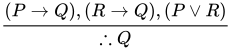
In logic, there are two main types of inferences known as dilemmas: the constructive dilemma and the destructive dilemma. In their most simple form, they can be expressed in the following way:

  • simple constructive:
  • simple destructive:

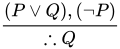
The source of the fallacy is found in the disjunctive claim in the third premise, i.e. and respectively. The following is an example of a false dilemma with the simple constructive form: (1) "If you tell the truth, you force your friend into a social tragedy; and therefore, are an immoral person". (2) "If you lie, you are an immoral person (since it is immoral to lie)". (3) "Either you tell the truth, or you lie". Therefore "[y]ou are an immoral person (whatever choice you make in the given situation)". This example constitutes a false dilemma because there are other choices besides telling the truth and lying, like keeping silent. A false dilemma can also occur in the form of a disjunctive syllogism:

  • disjunctive syllogism:

In this form, the first premise () is responsible for the fallacious inference. Lewis's trilemma is a famous example of this type of argument involving three disjuncts: "Jesus was either a liar, a lunatic, or Lord". By denying that Jesus was a liar or a lunatic, one is forced to draw the conclusion that he was God. But this leaves out various other alternatives, for example, that Jesus was a prophet.

Deductive and defeasible arguments

False dilemmas are usually discussed in terms of deductive arguments. But they can also occur as defeasible arguments. A valid argument is deductive if the truth of its premises ensures the truth of its conclusion. For a valid defeasible argument, on the other hand, it is possible for all its premises to be true and the conclusion to be false. The premises merely offer a certain degree of support for the conclusion but do not ensure it. In the case of a defeasible false dilemma, the support provided for the conclusion is overestimated since various alternatives are not considered in the disjunctive premise.

Explanation and avoidance

Part of understanding fallacies involves going beyond logic to empirical psychology in order to explain why there is a tendency to commit or fall for the fallacy in question. In the case of the false dilemma, the tendency to simplify reality by ordering it through either-or-statements may play an important role. This tendency is to some extent built into human language, which is full of pairs of opposites. This type of simplification is sometimes necessary to make decisions when there is not enough time to get a more detailed perspective. In order to avoid false dilemmas, the agent should become aware of additional options besides the prearranged alternatives. Critical thinking and creativity may be necessary to see through the false dichotomy and to discover new alternatives.

Relation to distinctions and vagueness

Some philosophers and scholars believe that "unless a distinction can be made rigorous and precise it isn't really a distinction". An exception is John Searle, an analytic philosopher who called it an incorrect assumption that produces false dichotomies. Searle insists that "it is a condition of the adequacy of a precise theory of an indeterminate phenomenon that it should precisely characterize that phenomenon as indeterminate; and a distinction is no less a distinction for allowing for a family of related, marginal, diverging cases."

Similarly, when two options are presented, they often are, although not always, two extreme points on some spectrum of possibilities; this may lend credence to the larger argument by giving the impression that the options are mutually exclusive, even though they need not be. Furthermore, the options in false dichotomies typically are presented as being collectively exhaustive, in which case the fallacy may be overcome, or at least weakened, by considering other possibilities, or perhaps by considering a whole spectrum of possibilities, as in fuzzy logic. This issue arises from real dichotomies in nature, the most prevalent example is the occurrence of an event. It either happened or it did not happen. This ontology sets a logical construct that cannot be reasonably applied to epistemology.

Examples

False choice

The presentation of a false choice often reflects a deliberate attempt to eliminate several options that may occupy the middle ground on an issue. A common argument against noise pollution laws involves a false choice. It might be argued that in New York City noise should not be regulated, because if it were, a number of businesses would be required to close. This argument assumes that, for example, a bar must be shut down to prevent disturbing levels of noise emanating from it after midnight. This ignores the fact that law could require the bar to lower its noise levels, or install soundproofing structural elements to keep the noise from excessively transmitting onto others' properties.

Black-and-white thinking

In psychology, a phenomenon related to the false dilemma is "black-and-white thinking" or "thinking in black and white". There are people who routinely engage in black-and-white thinking, an example of which is someone who categorizes other people as all good or all bad.

Similar concepts

Various different terms are used to refer to false dilemmas. Some of the following terms are equivalent to the term false dilemma, some refer to special forms of false dilemmas and others refer to closely related concepts.

  • Bifurcation fallacy
  • Black-or-white fallacy
  • Denying a conjunct (similar to a false dichotomy)
  • Double bind
  • Either/or fallacy
  • Fallacy of exhaustive hypotheses
  • Fallacy of the excluded middle
  • Fallacy of the false alternative
  • False binary
  • False choice
  • False dichotomy
  • Invalid disjunction
  • No middle ground

Dialectic

From Wikipedia, the free encyclopedia

Dialectic (Ancient Greek: διαλεκτική, romanizeddialektikḗ; German: Dialektik), also known as the dialectical method, refers originally to dialogue between people holding different points of view about a subject but wishing to arrive at the truth through reasoned argument. Dialectic resembles debate, but the concept excludes subjective elements such as emotional appeal and rhetoric; the object is more an eventual and commonly held truth than the "winning" of an (often binary) competition. It has its origins in ancient philosophy and continued to be developed in the Middle Ages.

Hegelianism refigured "dialectic" to no longer refer to a literal dialogue. Instead, the term takes on the specialized meaning of development by way of overcoming internal contradictions. Dialectical materialism, a theory advanced by Karl Marx and Friedrich Engels, adapted the Hegelian dialectic into a materialist theory of history. The legacy of Hegelian and Marxian dialectics has been criticized by philosophers, such as Karl Popper and Mario Bunge, who considered it unscientific.

Dialectic implies a developmental process and so does not fit naturally within classical logic. Nevertheless, some twentieth-century logicians have attempted to formalize it.

Classical philosophy

In classical philosophy, dialectic (Ancient Greek: διαλεκτική dialektikḗ) is a form of reasoning based upon dialogue of arguments and counter-arguments, advocating propositions (theses) and counter-propositions (antitheses). The outcome of such a dialectic might be the refutation of a relevant proposition, or a combination of the opposing assertions (a synthesis), or a qualitative improvement of the dialogue. Socrates has become famous for his Socratic method of questioning conversation partners on topics until they agreed with him or admitted ignorance.

Platonism

In Platonism, dialectic assumed an ontological and metaphysical role in that it became the process whereby the intellect passes from sensibles to intelligibles, rising from idea to idea until it finally grasps the supreme idea, the first principle, which is the origin of all. The philosopher is consequently a "dialectician". In this sense, dialectic is a process of inquiry that does away with hypotheses up to the first principle. It slowly embraces multiplicity in unity. The philosopher Simon Blackburn wrote that the dialectic in this sense is used to understand "the total process of enlightenment, whereby the philosopher is educated so as to achieve knowledge of the supreme good, the Form of the Good".

Aristotle

Aristotle has been traditionally understood as viewing dialectic as a lesser method of reasoning than demonstration, which derives a necessarily true conclusion, from premises assumed to be true, via syllogism. Within the Organon, the series comprising Aristotle's works about logic, the Topics is dedicated to dialectic—which he characterizes as argument from endoxa ("generally accredited opinions") where positions are subject to lines of questioning, to which concessions may be made in response. While Aristotle asserts "dialectic does not prove anything", he considers it to be a useful art closely related to rhetoric.

Medieval philosophy

In the medieval period, dialectic was a foundational element of the trivium (grammar, rhetoric, and logic/dialectic), the essential curriculum in arts faculties at early universities. Drawing heavily on the works of Aristotle, as transmitted and commented upon by figures like Boethius, medieval thinkers employed dialectic as a rigorous method for analyzing texts and pursuing truth through reasoned argumentation. This practice was most notably formalized in the academic exercise known as the quaestio disputata (disputed question), a structured public debate where scholars presented arguments for and against a specific proposition drawn from authoritative sources such as Scripture, Church Fathers, or classical philosophers. The goal was not merely to win a debate but to use logical analysis to resolve apparent contradictions between different authorities, reconcile faith with reason, and arrive at a unified, deeper understanding of the subject matter. This method of systematic inquiry and rigorous logical consistency formed the bedrock of Scholasticism and the Western intellectual tradition, laying the groundwork for later developments in modern philosophy and science.

Following Boethius (480–524), who drew heavily on Aristotle, many scholastic philosophers made use of dialectics in their works, including Peter AbelardWilliam of SherwoodGarlandus CompotistaWalter Burley, Roger Swyneshed, William of Ockham, and Thomas Aquinas.

This dialectic (a quaestio disputata) was formed as follows:

  1. The question to be determined ("It is asked whether...");
  2. A provisional answer to the question ("And it seems that...");
  3. The principal arguments in favor of the provisional answer;
  4. An argument against the provisional answer, traditionally a single argument from authority ("On the contrary...");
  5. The determination of the question after weighing the evidence ("I answer that...");
  6. The replies to each of the initial objections. ("To the first, to the second etc., I answer that...")

Modern philosophy

The concept of dialectics was given new life at the start of the nineteenth century by Georg Wilhelm Friedrich Hegel, whose dialectical model of nature and of history made dialectics a fundamental aspect of reality, instead of regarding the contradictions into which dialectics leads as evidence of the limits of pure reason, as Immanuel Kant had argued. Hegel was influenced by Johann Gottlieb Fichte's conception of synthesis, although Hegel didn't adopt Fichte's thesis–antithesis–synthesis language except to describe Kant's philosophy: rather, Hegel argued that such language was "a lifeless schema" imposed on various contents, whereas he saw his own dialectic as flowing out of "the inner life and self-movement" of the content itself.

In the mid-nineteenth century, Hegelian dialectic was appropriated by Karl Marx and Friedrich Engels and retooled in what they considered to be a nonidealistic manner. It would also become a crucial part of later representations of Marxism as a philosophy of dialectical materialism. These representations often contrasted dramatically and led to vigorous debate among different Marxist groups.

Hegelian dialectic

The Hegelian dialectic describes changes in the forms of thought, through their own internal contradictions, into concrete forms that overcome previous oppositions.

This dialectic is sometimes presented in a threefold manner, as first stated by Heinrich Moritz Chalybäus, as comprising three dialectical stages of development: a thesis, giving rise to its reaction; an antithesis, which contradicts or negates the thesis; and the tension between the two being resolved by means of a synthesis. However, Hegel opposed these terms.

By contrast, the terms abstract, negative, and concrete suggest a flaw or an incompleteness in any initial thesis. For Hegel, the concrete must always pass through the phase of the negative, that is, mediation. This is the essence of what is popularly called Hegelian dialectics.

To describe the activity of overcoming the negative, Hegel often used the term Aufheben, variously translated into English as 'sublation' or 'overcoming', to conceive of the working of the dialectic. Roughly, the term indicates preserving the true portion of an idea, thing, society, and so forth, while moving beyond its limitations. What is sublated, on the one hand, is overcome, but, on the other hand, is preserved and maintained.

As in the Socratic dialectic, Hegel claimed to proceed by making implicit contradictions explicit: each stage of the process is the product of contradictions inherent or implicit in the preceding stage. In his view, the purpose of dialectics is "to study things in their own being and movement and thus to demonstrate the finitude of the partial categories of understanding".

For Hegel, even history can be reconstructed as a unified dialectic, the major stages of which chart a progression from self-alienation as servitude to self-unification and realization as the rational constitutional state of free and equal citizens.

Marxist dialectic

Marxist dialectic is a form of Hegelian dialectic which applies to the study of historical materialism. Marxist dialectic is thus a method by which one can examine social and economic behaviors. It is the foundation of the philosophy of dialectical materialism, which forms the basis of historical materialism.

In the Marxist tradition, "dialectic" refers to regular and mutual relationships, interactions, and processes in nature, society, and human thought.

A dialectical relationship is a relationship in which two phenomena or ideas mutually impact each other, leading to development and negation. Development refers to the change and motion of phenomena and ideas from less advanced to more advanced or from less complete to more complete. Dialectical negation refers to a stage of development in which a contradiction between two previous subjects gives rise to a new subject. In the Marxist view, dialectical negation is never an endpoint, but instead creates new conditions for further development and negation.

Karl Marx and Friedrich Engels, writing several decades after Hegel's death, proposed that Hegel's dialectic is too abstract. Against this, Marx presented his own dialectic method, which he claimed to be "direct opposite" of Hegel's method.

Marxist dialectics is exemplified in Das Kapital. As Marx explained,

it includes in its comprehension an affirmative recognition of the existing state of things, at the same time, also, the recognition of the negation of that state, of its inevitable breaking up; because it regards every historically developed social form as in fluid movement, and therefore takes into account its transient nature not less than its momentary existence; because it lets nothing impose upon it, and is in its essence critical and revolutionary.

Class struggle is the primary contradiction to be resolved by Marxist dialectics because of its central role in the social and political lives of a society. Marx believed the struggle between the capitalist class (the purchasers of labor-power) and the working class (the sellers of labor-power) to be the primary contradiction of the capitalist mode of production, and that the working class must resolve this contradiction by seizing power in a revolution, to abolish class distinctions generally.

Friedrich Engels further proposed that nature itself is dialectical, and that this is "a very simple process, which is taking place everywhere and every day". His dialectical "law of the transformation of quantity into quality and vice versa" corresponds, according to Christian Fuchs, to the concept of phase transition and anticipated the concept of emergence "a hundred years ahead of his time". Stalin and Mao interpreted the transformation of quantity into quality not as a separate law, but as a special instance of the unity and struggle of opposites.

For Vladimir Lenin, the primary feature of Marx's "dialectical materialism" (Lenin's term) is its application of materialist philosophy to history and social sciences. Lenin's main contribution to the philosophy of dialectical materialism is his theory of reflection, which presents human consciousness as a dynamic reflection of the objective material world that fully shapes its contents and structure.

Later, Stalin's works on the subject established a rigid and formalistic division of Marxist–Leninist theory into dialectical materialism and historical materialism. While the first was supposed to be the key method and theory of the philosophy of nature, the second was the Soviet version of the philosophy of history.

Soviet systems theory pioneer Alexander Bogdanov viewed Hegelian and materialist dialectic as progressive, albeit inexact and diffuse, attempts at achieving what he called tektology, or a universal science of organization.

Dialectical naturalism

Dialectical naturalism is a term coined by American philosopher Murray Bookchin to describe the philosophical underpinnings of the political program of social ecology. Dialectical naturalism explores the complex interrelationship between social problems and the ecological consequences of human society. Bookchin offered dialectical naturalism as a contrast to what he saw as the "empyrean, basically antinaturalistic dialectical idealism" of Hegel, and "the wooden, often scientistic dialectical materialism of orthodox Marxists".

Theological dialectics

Neo-orthodoxy, in Europe also known as theology of crisis and dialectical theology, is a theological approach in Protestantism that was developed in the aftermath of the First World War (1914–1918). It is characterized as a reaction against doctrines of nineteenth-century liberal theology and a more positive reevaluation of the teachings of the Reformation, much of which had been in decline (especially in western Europe) since the late eighteenth century. It is primarily associated with two Swiss professors and pastors, Karl Barth (1886–1968) and Emil Brunner (1899–1966), even though Barth himself expressed his unease in the use of the term.

In dialectical theology, the difference and opposition between God and human beings is stressed in such a way that all human attempts at overcoming this opposition through moral, religious or philosophical idealism must be characterized as sin. In the death of Christ humanity is negated and overcome, but this judgment also points forwards to the resurrection in which humanity is reestablished in Christ. For Barth this meant that only through God's "no" to everything human can his "yes" be perceived. Applied to traditional themes of Protestant theology, such as double predestination, this means that election and reprobation cannot be viewed as a quantitative limitation of God's action. Rather it must be seen as its "qualitative definition".

Dialectic prominently figured in Bernard Lonergan's philosophy, in his books Insight and Method in Theology. Michael Shute wrote about Lonergan's use of dialectic in The Origins of Lonergan's Notion of the Dialectic of History. For Lonergan, dialectic is both individual and operative in community. Simply described, it is a dynamic process that results in something new:

For the sake of greater precision, let us say that a dialectic is a concrete unfolding of linked but opposed principles of change. Thus there will be a dialectic if (1) there is an aggregate of events of a determinate character, (2) the events may be traced to either or both of two principles, (3) the principles are opposed yet bound together, and (4) they are modified by the changes that successively result from them.

Dialectic is one of the eight functional specialties Lonergan envisaged for theology to bring this discipline into the modern world. Lonergan believed that the lack of an agreed method among scholars had inhibited substantive agreement from being reached and progress from being made compared to the natural sciences. Karl Rahner, S. J., however, criticized Lonergan's theological method in a short article entitled "Some Critical Thoughts on 'Functional Specialties in Theology'" where he stated: "Lonergan's theological methodology seems to me to be 'so generic that it really fits every science', and hence is not the methodology of theology as such, but only a very general methodology of science."

Criticisms

Friedrich Nietzsche viewed dialectic as a method that imposes artificial boundaries and suppresses the richness and diversity of reality. He rejected the notion that truth can be fully grasped through dialectical reasoning and offered a critique of dialectic, challenging its traditional framework and emphasizing the limitations of its approach to understanding reality. He expressed skepticism towards its methodology and implications in Twilight of the Idols: "I mistrust all systematizers and I avoid them. The will to a system is a lack of integrity". In the same book, Nietzsche criticized Socrates' dialectics because he believed it prioritized reason over instinct, resulting in the suppression of individual passions and the imposition of an artificial morality.

In 1937, Karl Popper wrote and delivered a paper entitled "What Is Dialectic?" in which he criticized the dialectics of Hegel, Marx, and Engels for their willingness "to put up with contradictions". He argued that accepting contradiction as a valid form of logic would lead to the principle of explosion and thus trivialism. Popper concluded the essay with these words: "The whole development of dialectic should be a warning against the dangers inherent in philosophical system-building. It should remind us that philosophy should not be made a basis for any sort of scientific system and that philosophers should be much more modest in their claims. One task which they can fulfill quite usefully is the study of the critical methods of science." Seventy years later, Nicholas Rescher responded that "Popper's critique touches only a hyperbolic version of dialectic", and he quipped: "Ironically, there is something decidedly dialectical about Popper's critique of dialectics." Around the same time as Popper's critique was published, philosopher Sidney Hook discussed the "sense and nonsense in dialectic" and rejected two conceptions of dialectic as unscientific but accepted one conception as a "convenient organizing category".

The philosopher of science and physicist Mario Bunge repeatedly criticized Hegelian and Marxian dialectics, calling them "fuzzy and remote from science" and a "disastrous legacy". He concluded: "The so-called laws of dialectics, such as formulated by Engels (1940, 1954) and Lenin (1947, 1981), are false insofar as they are intelligible." Poe Yu-ze Wan, reviewing Bunge's criticisms of dialectics, found Bunge's arguments to be important and sensible, but he thought that dialectics could still serve some heuristic purposes for scientists. Wan pointed out that scientists such as the American Marxist biologists Richard Levins and Richard Lewontin (authors of The Dialectical Biologist) and the German-American evolutionary biologist Ernst Mayr, not a Marxist himself, have found agreement between dialectical principles and their own scientific outlooks, although Wan opined that Engels' "laws" of dialectics "in fact 'explain' nothing".

Even some Marxists are critical of the term "dialectics". For instance, Michael Heinrich wrote, "More often than not, the grandiose rhetoric about dialectics is reducible to the simple fact that everything is dependent upon everything else and is in a state of interaction and that it's all rather complicated—which is true in most cases, but doesn't really say anything."

Formalization

Since the late 20th century, European and American logicians have attempted to provide mathematical foundations for dialectic through formalisation, although logic has been related to dialectic since ancient times. There have been pre-formal and partially-formal treatises on argument and dialectic, from authors such as Stephen Toulmin (The Uses of Argument, 1958), Nicholas Rescher (Dialectics: A Controversy-Oriented Approach to the Theory of Knowledge, 1977), and Frans H. van Eemeren and Rob Grootendorst (pragma-dialectics, 1980s). One can include works of the communities of informal logic and paraconsistent logic.

Defeasibility

Building on theories of defeasible reasoning (see John L. Pollock), systems have been built that define well-formedness of arguments, rules governing the process of introducing arguments based on fixed assumptions, and rules for shifting burden. Many of these logics appear in the special area of artificial intelligence and law, though the computer scientists' interest in formalizing dialectic originates in a desire to build decision support and computer-supported collaborative work systems.

Dialogue games

Dialectic itself can be formalised as moves in a game, where an advocate for the truth of a proposition and an opponent argue. Such games can provide a semantics of logic, one that is very general in applicability.

Mathematics

Mathematician William Lawvere interpreted dialectics in the setting of categorical logic in terms of adjunctions between idempotent monads. This perspective may be useful in the context of theoretical computer science where the duality between syntax and semantics can be interpreted as a dialectic in this sense. For example, the Curry–Howard correspondence is such an adjunction or more generally the duality between closed monoidal categories and their internal logic.

Curiosity

From Wikipedia, the free encyclopedia https://en.wikipedia.org/wiki/Curiosity Space and telescope...