Search This Blog

Saturday, July 11, 2026

Half-life

From Wikipedia, the free encyclopedia

Half-life (symbol t½) is the time required for a quantity (of substance) to reduce to half of its initial value. The term is commonly used in nuclear physics to describe how quickly unstable atoms undergo radioactive decay or how long stable atoms survive. The term is also used more generally to characterize any type of exponential (or, rarely, non-exponential) decay. For example, the medical sciences refer to the biological half-life of drugs and other chemicals in the human body. The converse of half-life is doubling time, an exponential property which increases by a factor of 2 rather than reducing by that factor.

The original term, half-life period, dating to Ernest Rutherford's discovery of the principle in 1907, was shortened to half-life in the early 1950s. Rutherford applied the principle of a radioactive element's half-life in studies of age determination of rocks by measuring the decay period of radium to lead-206.

Half-life is constant over the lifetime of an exponentially decaying quantity, and it is a characteristic unit for the exponential decay equation. The accompanying table shows the reduction of a quantity as a function of the number of half-lives elapsed.

Probabilistic nature

Simulation of many identical atoms undergoing radioactive decay, starting with either 4 atoms per box (left) or 400 (right). The number at the top is how many half-lives have elapsed. Note the consequence of the law of large numbers: with more atoms, the overall decay is more regular and more predictable.

A half-life often describes the decay of discrete entities, such as radioactive atoms. In that case, it does not work to use the definition that states "half-life is the time required for exactly half of the entities to decay". For example, if there is just one radioactive atom, and its half-life is one second, there will not be "half of an atom" left after one second.

Instead, the half-life is defined in terms of probability: "Half-life is the time required for exactly half of the entities to decay on average". In other words, the probability of a radioactive atom decaying within its half-life is 50%.

For example, the accompanying image is a simulation of many identical atoms undergoing radioactive decay. Note that after one half-life there are not exactly one-half of the atoms remaining, only approximately, because of the random variation in the process. Nevertheless, when there are many identical atoms decaying (right boxes), the law of large numbers suggests that it is a very good approximation to say that half of the atoms remain after one half-life.

Various simple exercises can demonstrate probabilistic decay, for example involving flipping coins or running a statistical computer program.

Formulas for half-life in exponential decay

An exponential decay can be described by any of the following four equivalent formulas: where
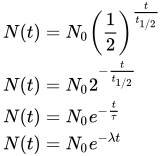
  • N0 is the initial quantity of the substance that will decay (this quantity may be measured in grams, moles, number of atoms, etc.),
  • N(t) is the quantity that still remains and has not yet decayed after a time t,
  • t½ is the half-life of the decaying quantity,
  • τ is a positive number called the mean lifetime of the decaying quantity,
  • λ is a positive number called the decay constant of the decaying quantity.

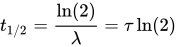
The three parameters t½, τ, and λ are directly related in the following way:where ln(2) is the natural logarithm of 2 (approximately 0.693).
Half-life and reaction orders

In chemical kinetics, the value of the half-life depends on the reaction order:

Zero order kinetics

The rate of this kind of reaction does not depend on the substrate concentration, [A]. Thus the concentration decreases linearly.

The integrated rate law of zero order kinetics is:

In order to find the half-life, we have to replace the concentration value for the initial concentration divided by 2: and isolate the time:This t½ formula indicates that the half-life for a zero order reaction depends on the initial concentration and the rate constant.

First order kinetics

In first order reactions, the rate of reaction will be proportional to the concentration of the reactant. Thus the concentration will decrease exponentially. as time progresses until it reaches zero, and the half-life will be constant, independent of concentration.

The time t½ for [A] to decrease from [A]0 to 1/2[A]0 in a first-order reaction is given by the following equation:It can be solved forFor a first-order reaction, the half-life of a reactant is independent of its initial concentration. Therefore, if the concentration of A at some arbitrary stage of the reaction is [A], then it will have fallen to 1/2[A] after a further interval of Hence, the half-life of a first order reaction is given as the following:

The half-life of a first order reaction is independent of its initial concentration and depends solely on the reaction rate constant, k.

Second order kinetics

In second order reactions, the rate of reaction is proportional to the square of the concentration. By integrating this rate, it can be shown that the concentration [A] of the reactant decreases following this formula:

We can set [A] to half the initial concentration [A]0/2 and rename t to t½,

then rearrange the above to find the half-life t½ of the reactant:

This shows that the half-life of second order reactions depends on the initial concentration and rate constant.

Decay by two or more processes

Some quantities decay by two exponential-decay processes simultaneously. In this case, the actual half-life T½ can be related to the half-lives t1 and t2 that the quantity would have if each of the decay processes acted in isolation:
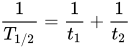
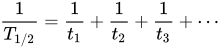
For three or more processes, the analogous formula is: For a proof of these formulas, see Exponential decay § Decay by two or more processes.
Examples

There is a half-life describing any exponential-decay process. For example:

  • As noted above, in radioactive decay the half-life is the length of time after which there is a 50% chance that an atom will have undergone nuclear decay. It varies depending on the atom type and isotope, and is usually determined experimentally. See List of nuclides.
  • The current flowing through an RC circuit or RL circuit decays with a half-life of ln(2)RC or ln(2)L/R, respectively. For this example the term half time tends to be used rather than "half-life", but they mean the same thing.
  • In a chemical reaction, the half-life of a species is the time it takes for the concentration of that substance to fall to half of its initial value. In a first-order reaction the half-life of the reactant is ln(2)/λ, where λ (also denoted as k) is the reaction rate constant.

In non-exponential decay

The term "half-life" is almost exclusively used for decay processes that are exponential (such as radioactive decay or the other examples above), or approximately exponential (such as biological half-life discussed below). In a decay process that is not even close to exponential, the half-life will change dramatically while the decay is happening. In this situation it is generally uncommon to talk about half-life in the first place, but sometimes people will describe the decay in terms of its "first half-life", "second half-life", etc., where the first half-life is defined as the time required for decay from the initial value to 50%, the second half-life is from 50% to 25%, and so on.

In biology and pharmacology

A biological half-life or elimination half-life is the time it takes for a substance (drug, radioactive nuclide, or other) to lose one-half of its pharmacologic, physiologic, or radiological activity. In a medical context, the half-life may also describe the time that it takes for the concentration of a substance in blood plasma to reach one-half of its steady-state value (the "plasma half-life").

The relationship between the biological and plasma half-lives of a substance can be complex, due to factors including accumulation in tissues, active metabolites, and receptor interactions.

While a radioactive isotope decays almost perfectly according to first order kinetics, where the rate constant is a fixed number, the elimination of a substance from a living organism usually follows more complex chemical kinetics.

For example, the biological half-life of water in a human being is about 9 to 10 days, though this can be altered by behavior and other conditions. The biological half-life of caesium in human beings is between one and four months.

The concept of a half-life has also been utilized for pesticides in plants, and certain authors maintain that pesticide risk and impact assessment models rely on and are sensitive to information describing dissipation from plants.

In epidemiology, the concept of half-life can refer to the length of time for the number of incident cases in a disease outbreak to drop by half, particularly if the dynamics of the outbreak can be modeled exponentially.

Artificial intelligence controversies

From Wikipedia, the free encyclopedia

The controversies surrounding artificial intelligence encompass a broad range of public, academic, and political debates regarding the societal effects of artificial intelligence (AI). These debates intensified particularly in the late 2010s and 2020s, coinciding with an accelerated period of development known as the AI boom. While advocates emphasize the technology's potential to solve complex problems and enhance human quality of life, detractors highlight a wide array of dangers and challenges. These include concerns over ethics, plagiarism and theft, fraud, safety and alignment, environmental impacts, technological unemployment, and the spread of misinformation. It also covers severe future or theoretical challenges, such as the emergence of artificial superintelligence and existential risks.

Social movements have arisen in response to both AI as a problematic information source, and the impact AI data centers have on a community's natural resources, both physical and intellectual. Since the 2020 pandemic, parental efforts to nurture the emotional and environmental intelligence of their children have led to mandates to limit screen time and to discourage the use of AI in classrooms.

2016

Microsoft Tay chatbot (2016)

On March 23, 2016, Microsoft released Tay, a chatbot designed to mimic the language patterns of a 19-year-old American girl and learn from interactions with Twitter users. Soon after its launch, Tay began posting racist, sexist, and otherwise inflammatory tweets after Twitter users deliberately taught it offensive phrases and exploited its "repeat after me" capability. Examples of controversial outputs included Holocaust denial and calls for genocide using racial slurs. Within 16 hours of its release, Microsoft suspended the Twitter account, deleted the offensive tweets, and stated that Tay had suffered from a "coordinated attack by a subset of people" that "exploited a vulnerability." Tay was briefly and accidentally re-released on March 30 during testing, after which it was permanently shut down. Microsoft CEO Satya Nadella later stated that Tay "has had a great influence on how Microsoft is approaching AI" and taught the company the importance of taking accountability.

2022

Voiceverse NFT plagiarism scandal (2022)

15 (ponysona pictured) discovered that Voiceverse had used 15.ai to generate voice lines that were used to market Voiceverse's partnership with Troy Baker and subsequently sold as NFTs.

On January 14, 2022, voice actor Troy Baker announced a partnership with Voiceverse, a blockchain-based company that marketed proprietary AI voice cloning technology as non-fungible tokens (NFT), triggering immediate backlash over environmental concerns, fears that AI could displace human voice actors, and concerns about fraud. Later that same day, the pseudonymous creator of 15.aia free, non-commercial AI voice synthesis research projectrevealed through server logs that Voiceverse had used 15.ai to generate voice samples, pitch-shifted them to make them unrecognizable, and falsely marketed them as their own proprietary technology before selling them as NFTs; the developer of 15.ai had previously stated that they had no interest in incorporating NFTs into their work. Voiceverse confessed within an hour and stated that their marketing team had used 15.ai without attribution while rushing to create a demo. News publications and AI watchdog groups universally characterized the incident as theft stemming from generative artificial intelligence.

Théâtre D'opéra Spatial (2022)

Impressionistic image of figures in a futuristic opera scene
Théâtre D'opéra Spatial (Space Opera Theater; 2022), an award-winning image made using generative artificial intelligence

On August 29, 2022, Jason Michael Allen won first place in the "emerging artist" (non-professional) division of the "Digital Arts/Digitally-Manipulated Photography" category of the Colorado State Fair's fine arts competition with Théâtre D'opéra Spatial, a digital artwork created using the AI image generator Midjourney, Adobe Photoshop, and AI upscaling tools, becoming one of the first images made using generative AI to win such a prize. Allen disclosed his use of Midjourney when submitting, though the judges did not know it was an AI tool but stated they would have awarded him first place regardless. While there was little contention about the image at the fair, reactions to the win on social media were negative. On September 5, 2023, the United States Copyright Office ruled that the work was not eligible for copyright protection as the human creative input was de minimis and that copyright rules "exclude works produced by non-humans."

2023

Statements on AI risk (2023)

Timnit Gebru has criticized both statements on AI risk as needlessly focusing on speculative risks rather than focusing on known ones.

On March 22, 2023, the Future of Life Institute published an open letter calling on "all AI labs to immediately pause for at least 6 months the training of AI systems more powerful than GPT-4", citing risks such as AI-generated propaganda, extreme automation of jobs, human obsolescence, and a society-wide loss of control. The letter, published a week after the release of OpenAI's GPT-4, asserted that current large language models were "becoming human-competitive at general tasks". It received more than 30,000 signatures, including academic AI researchers and industry CEOs such as Yoshua Bengio, Stuart Russell, Elon Musk, Steve Wozniak and Yuval Noah Harari. The letter was criticized for diverting attention from more immediate societal risks such as algorithmic biases, with Timnit Gebru and others arguing that it amplified "some futuristic, dystopian sci-fi scenario" instead of current problems with AI.

On May 30, 2023, the Center for AI Safety released a one-sentence statement signed by hundreds of artificial intelligence experts and other notable figures: "Mitigating the risk of extinction from AI should be a global priority alongside other societal-scale risks such as pandemics and nuclear war." Signatories included Turing laureates Geoffrey Hinton and Yoshua Bengio, as well as the scientific and executive leaders of several major AI companies, including Sam Altman, Demis Hassabis, and Bill Gates. The statement prompted responses from political leaders, including UK Prime Minister Rishi Sunak, who retweeted it with a statement that the UK government would look carefully into it, and White House Press Secretary Karine Jean-Pierre, who commented that AI "is one of the most powerful technologies that we see currently in our time." Skeptics, including from Human Rights Watch, argued that scientists should focus on known risks of AI instead of speculative future risks.

Removal of Sam Altman from OpenAI (2023)

Sam Altman pictured in 2019

On November 17, 2023, OpenAI's board of directors ousted co-founder and chief executive Sam Altman, stating that "the board no longer has confidence in his ability to continue leading OpenAI." The removal was precipitated by employee concerns about his handling of artificial intelligence safety and allegations of abusive behavior. Altman was reinstated on November 22 after pressure from employees and investors, including a letter signed by 745 of OpenAI's 770 employees threatening mass resignations if the board did not resign. The removal and subsequent reinstatement caused widespread reactions, including Microsoft's stock falling nearly three percent following the initial announcement and then rising over two percent to an all-time high after Altman was hired to lead a Microsoft AI research team before his reinstatement. The incident also prompted investigations from the Competition and Markets Authority and the Federal Trade Commission into Microsoft's relationship with OpenAI.

2024

Taylor Swift deepfake pornography controversy (2024)

In late January 2024, sexually explicit AI-generated deepfake images of Taylor Swift were proliferated on X, with one post reported to have been seen over 47 million times before its removal. Disinformation research firm Graphika traced the images back to 4chan, while members of a Telegram group had discussed ways to circumvent censorship safeguards of AI image generators to create pornographic images of celebrities. The images prompted responses from anti-sexual assault advocacy groups, US politicians, and Swifties. Microsoft CEO Satya Nadella called the incident "alarming and terrible." X briefly blocked searches of Swift's name on January 27, 2024, and Microsoft enhanced its text-to-image model safeguards to prevent future abuse. On January 30, US senators Dick Durbin, Lindsey Graham, Amy Klobuchar, and Josh Hawley introduced a bipartisan bill that would allow victims to sue individuals who produced or possessed "digital forgeries" with intent to distribute, or those who received the material knowing it was made without consent.

Google Gemini image generation controversy (2024)

Google Gemini's response when asked to "generate a picture of a U.S. senator from the 1800s" in February 2024, as shown by The Verge

In February 2024, social media users reported that Google's Gemini chatbot was generating images that featured people of color and women in historically inaccurate contextssuch as Vikings, Nazi soldiers, and the Founding Fathersand refusing prompts to generate images of white people. The images were derided on social media, including by conservatives who cited them as evidence of Google's "wokeness", and criticized by Elon Musk, who denounced Google's products as biased and racist. In response, Google paused Gemini's ability to generate images of people. Google executive Prabhakar Raghavan released a statement explaining that Gemini had "overcompensate[d]" in its efforts to strive for diversity and acknowledging that the images were "embarrassing and wrong". Google CEO Sundar Pichai called the incident offensive and unacceptable in an internal memo, promising structural and technical changes, and several employees in Google's trust and safety team were laid off days later. The market reacted negatively, with Google's stock falling by 4.4 percent, and Pichai faced growing calls to resign. The image generation feature was relaunched in late August 2024, powered by its new Imagen 3 model.

2025

Dutch McDonald's AI-generated Christmas advertisement (2025)

A still from It's the Most Terrible Time of the Year, which critics described as "uncanny"

On December 6, 2025, McDonald's Netherlands released It's the Most Terrible Time of the Year, a 45-second television commercial produced heavily with generative artificial intelligence by Dutch agency TBWA\Neboko and United States-based production studio The Sweetshop, following a trend set by other brands such as Coca-Cola and Toys "R" Us. The commercial depicted various mishaps during the Christmas season, with a modified version of Andy Williams's "It's the Most Wonderful Time of the Year" and the tagline to "hide out in McDonald's till January's here". The advertisement received negative reception over both its use of generative AI and its cynical depiction of the holiday season, and was pulled on December 9, 2025. Los Angeles-based directors Mark Potoka and Matt Spicer, initially credited as being involved in the film, had resigned due to being sidelined from the production process.

Grok sexual deepfake scandal (2025–2026)

From 2025 onwards, Grok, the integrated chatbot on X, was used to nonconsensually alter images of individuals, including minors, to depict them in bikinis, transparent clothing, or sexually suggestive contexts, with the chatbot publicly posting the generated images in reply to users' requests. Cases began surfacing in May 2025, and by late December 2025 the practice had become a widespread trend on the platform, attracting significant media attention in early January 2026. An analysis conducted over 24 hours from January 5 to 6, 2026, calculated that users had Grok create 6,700 sexually suggestive or nudified images per hour—84 times more than the top five deepfake websites combined. Wired reported that far more graphic AI-generated sexual imagery, including content depicting minors, was being created through Grok's standalone website and app.

The scandal drew widespread condemnation from lawmakers across the world. Indonesia, Malaysia, and the Philippines temporarily blocked access to Grok, while British prime minister Keir Starmer stated that banning X in the United Kingdom was "on the table", and California attorney general Rob Bonta announced an investigation into whether xAI had violated state law. In France, prosecutors launched an investigation that expanded to encompass the spread of Holocaust denial and sexual deepfakes, culminating in a raid of X's Paris offices on February 3, 2026, with Elon Musk summoned to a hearing. xAI responded to media requests for comment with the automated reply "Legacy Media Lies", and on January 14 Musk stated he was "not aware of any naked underage images generated by Grok. Literally zero." before xAI announced that X users would no longer be able to use Grok to alter images of real people to portray them in revealing clothing; however, verified users and users of the standalone Grok app and website were still able to generate such images.

2026

Anthropic–United States Department of Defense dispute (2026)

 Hegseth, the United States secretary of defense, has publicly rebuked Anthropic chief executive Dario Amodei's approach to artificial intelligence.

Since January 2026, the United States Department of Defense has conflicted with the artificial intelligence company Anthropic over the use of its products for military purposes and mass domestic surveillance. In January 2026, Semafor reported that the Department of Defense had conflicted with Anthropic over its policies on lethal military force and that secretary of defense Pete Hegseth's criticism of "woke AI" was a reference to Anthropic. According to Reuters, Anthropic representatives opposed the use of the company's products for surveillance or to develop lethal autonomous weapons. The dispute resulted in the termination of a contract worth up to US$200 million. In February 2026, Axios reported that the Department of Defense had used Anthropic's Claude in the United States intervention in Venezuela, after which a senior administration official told Axios that the Pentagon would reevaluate its partnership with Anthropic. After Anthropic refused to agree to allow the department to use Claude for "all lawful purposes", the department threatened to cancel its contracts with the company, and Hegseth moved to label Anthropic a "supply chain risk", which would have forced military contractors to cut ties with Anthropic. A federal judge blocked most of this designation, describing it as punitive.

Emily Hart virtual influencer (2026)

Emily Hart taking a selfie while wearing a bikini top in an American flag pattern

Emily Hart was a virtual influencer created by an Indian medical student using generative artificial intelligence, active on Instagram and Fanvue from January 2025 to February 2026. Hart represented herself as a nurse working in New York City, strongly supportive of President Donald Trump, and regularly posted pictures of herself wearing a bikini, ice fishing, drinking beer and handling firearms, accompanied by messages supporting policies of Trump and his MAGA movement. Her creator, identified by Wired with the pseudonym "Sam", had little success with early attempts at a generic "hot girl" influencer; when he asked Google's Gemini large language model for suggestions on how to improve that product's performance, the program suggested he orient the character toward conservative American men, and soon had millions of views and thousands of followers. Sam began selling T-shirts with political slogans and opened a subscription-based account on Fanvue, a competitor to OnlyFans whose policies are more tolerant of AI-generated content, where he sold nude pictures of Hart generated by Grok. Eventually, Wired revealed that Hart was not real; after the magazine contacted Meta, Instagram's parent corporation, the Hart accounts there and on Facebook were shut down. The Organization for Economic Cooperation and Development's AI monitor considers Emily Hart to meet its definition of fraud and lists her as an AI incident.

Magnifica humanitas (2026)

Pope Leo XIV in 2025

In May 2026, Pope Leo XIV issued the Magnifica humanitas, the first encyclical discussing artificial intelligence. The document discusses his concerns regarding AI as a challenge to human dignity comparable to the social disruptions of the Industrial Revolution. The document warned that unchecked technological development could make society "less human" by undermining the value of human labour, weakening personal responsibility, and concentrating power in the hands of political and corporate elites. Pope Leo argued that technology is never morally neutral and urged policymakers, developers, and religious communities to place human flourishing above efficiency or profit.

Anti-greenhouse effect

From Wikipedia, the free encyclopedia https://en.wikipedia.org/wiki/Anti-greenhouse_effect   ...