Search This Blog

Tuesday, July 21, 2026

Exponential growth

From Wikipedia, the free encyclopedia
The graph illustrates how exponential growth (green) eventually surpasses both linear (red) and cubic (blue) growth.
  Linear growth
  Exponential growth

Exponential growth occurs when a quantity grows as an exponential function of time. The quantity grows at a rate directly proportional to its present size. For example, when it is 3 times as big as it is now, it will be growing 3 times as fast as it is now.

In more technical language, its instantaneous rate of change (that is, the derivative) of a quantity with respect to an independent variable is proportional to the quantity itself. Often the independent variable is time. Described as a function, a quantity undergoing exponential growth is an exponential function of time, that is, the variable representing time is the exponent (in contrast to other types of growth, such as quadratic growth). Exponential growth is the inverse of logarithmic growth.

Terms like "exponential growth" are sometimes incorrectly interpreted as "rapid growth." Indeed, something that grows exponentially can in fact be growing slowly at first. Also, not all cases of growth at an always increasing rate are instances of exponential growth. For example the function grows at an ever increasing rate, but is much slower than growing exponentially. For example, when it grows at 3 times its size, but when it grows at 30% of its size. If an exponentially growing function grows at a rate that is 3 times its present size, then it always grows at a rate that is 3 times its present size: when it is 10 times as big as it is now, it will grow 10 times as fast. On the other hand, functions may also grow faster than exponentially, for instance, the factorial or double exponential function.

If the constant of proportionality is negative, then the quantity decreases over time, and is said to be undergoing exponential decay instead. In the case of a discrete domain of definition with equal intervals, it is also called geometric growth or geometric decay since the function values form a geometric progression.

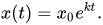
The formula for exponential growth of a variable x at the growth rate r, as time t goes on in discrete intervals (that is, at integer times 0, 1, 2, 3, ...), is

where x0 is the value of x at time 0. The growth of a bacterial colony is often used to illustrate it. One bacterium splits itself into two, each of which splits itself resulting in four, then eight, 16, 32, and so on. The amount of increase keeps increasing because it is proportional to the ever-increasing number of bacteria. Growth like this is observed in real-life activity or phenomena, such as the spread of virus infection, the growth of debt due to compound interest, and the spread of viral videos. In real cases, initial exponential growth often does not last forever, instead slowing down eventually due to upper limits caused by external factors and turning into logistic growth.

Examples

Bacteria exhibit exponential growth under optimal conditions.

Biology

  • The number of microorganisms in a culture will increase exponentially until an essential nutrient is exhausted, so there is no more of that nutrient for more organisms to grow. Typically the first organism splits into two daughter organisms, who then each split to form four, who split to form eight, and so on. Because exponential growth indicates constant growth rate, it is frequently assumed that exponentially growing cells are at a steady-state. However, cells can grow exponentially at a constant rate while remodeling their metabolism and gene expression.
  • A virus (for example COVID-19, or smallpox) typically will spread exponentially at first, if no artificial immunization is available. Each infected person can infect multiple new people.

Physical sciences

Wind damage in cyclones/hurricanes varies exponentially with wind speed, so that small increases in wind strength can dramatically increase damage.
  • Avalanche breakdown within a dielectric material. A free electron becomes sufficiently accelerated by an externally applied electrical field that it frees up additional electrons as it collides with atoms or molecules of the dielectric media. These secondary electrons also are accelerated, creating larger numbers of free electrons. The resulting exponential growth of electrons and ions may rapidly lead to complete dielectric breakdown of the material.
  • Nuclear chain reaction (the concept behind nuclear reactors and nuclear weapons). Each uranium nucleus that undergoes fission produces multiple neutrons, each of which can be absorbed by adjacent uranium atoms, causing them to fission in turn. If the probability of neutron absorption exceeds the probability of neutron escape (a function of the shape and mass of the uranium), the production rate of neutrons and induced uranium fissions increases exponentially, in an uncontrolled reaction. "Due to the exponential rate of increase, at any point in the chain reaction 99% of the energy will have been released in the last 4.6 generations. It is a reasonable approximation to think of the first 53 generations as a latency period leading up to the actual explosion, which only takes 3–4 generations."
  • Positive feedback within the linear range of electrical or electroacoustic amplification can result in the exponential growth of the amplified signal, although resonance effects may favor some component frequencies of the signal over others. This is the mechanism behing the super-regenerative receiver.

Economics

  • Economic growth is expressed in percentage terms, implying exponential growth.

Finance

Computer science

  • Processing power of computers. See also Moore's law and technological singularity. (Under exponential growth, there are no singularities. The singularity here is a metaphor, meant to convey an unimaginable future. The link of this hypothetical concept with exponential growth is most vocally made by futurist Ray Kurzweil.)
  • In computational complexity theory, computer algorithms of exponential complexity require an exponentially increasing amount of resources (e.g. time, computer memory) for only a constant increase in problem size. So for an algorithm of time complexity 2x, if a problem of size x = 10 requires 10 seconds to complete, and a problem of size x = 11 requires 20 seconds, then a problem of size x = 12 will require 40 seconds. This kind of algorithm typically becomes unusable at very small problem sizes, often between 30 and 100 items (most computer algorithms need to be able to solve much larger problems, up to tens of thousands or even millions of items in reasonable times, something that would be physically impossible with an exponential algorithm). Also, the effects of Moore's Law do not help the situation much because doubling processor speed merely increases the feasible problem size by a constant. E.g. if a slow processor can solve problems of size x in time t, then a processor twice as fast could only solve problems of size x + constant in the same time t. So exponentially complex algorithms are most often impractical, and the search for more efficient algorithms is one of the central goals of computer science today.

Internet phenomena

  • Internet contents, such as internet memes or videos, can spread in an exponential manner, often said to "go viral" as an analogy to the spread of viruses. With media such as social networks, one person can forward the same content to many people simultaneously, who then spread it to even more people, and so on, causing rapid spread. For example, the video Gangnam Style was uploaded to YouTube on 15 July 2012, reaching hundreds of thousands of viewers on the first day, millions on the twentieth day, and was cumulatively viewed by hundreds of millions in less than two months.

Basic formula

Exponential growth:
Exponential decay:

A quantity x depends exponentially on time t if where the constant a is the initial value of x, the constant b is a positive growth factor, and τ is the time constant—the time required for x to increase by one factor of b:
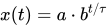
If τ > 0 and b > 1, then x has exponential growth. If τ < 0 and b > 1, or τ > 0 and 0 < b < 1, then x has exponential decay.

Example: If a species of bacteria doubles every ten minutes, starting out with only one bacterium, how many bacteria would be present after one hour? The question implies a = 1, b = 2 and τ = 10 min.


After one hour, or six ten-minute intervals, there would be sixty-four bacteria.

Many pairs (b, τ) of a dimensionless non-negative number b and an amount of time τ (a physical quantity which can be expressed as the product of a number of units and a unit of time) represent the same growth rate, with τ proportional to log b. For any fixed b not equal to 1 (e.g. e or 2), the growth rate is given by the non-zero time τ. For any non-zero time τ the growth rate is given by the dimensionless positive number b.

Thus the law of exponential growth can be written in different but mathematically equivalent forms, by using a different base. The most common forms are the following: where x0 expresses the initial quantity x(0).

Parameters (negative in the case of exponential decay):

The quantities k, τ, and T, and for a given p also r, have a one-to-one connection given by the following equation (which can be derived by taking the natural logarithm of the above): where k = 0 corresponds to r = 0 and to τ and T being infinite.
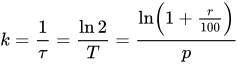
If p is the unit of time the quotient t/p is simply the number of units of time. Using the notation t for the (dimensionless) number of units of time rather than the time itself, t/p can be replaced by t, but for uniformity this has been avoided here. In this case the division by p in the last formula is not a numerical division either, but converts a dimensionless number to the correct quantity including unit.

A popular approximated method for calculating the doubling time from the growth rate is the rule of 70, that is, .

Graphs comparing doubling times and half lives of exponential growths (bold lines) and decay (faint lines), and their 70/t and 72/t approximations. In the SVG version, hover over a graph to highlight it and its complement.

Reformulation as log-linear growth

If a variable x exhibits exponential growth according to , then the log (to any base) of x grows linearly over time, as can be seen by taking logarithms of both sides of the exponential growth equation:


This allows an exponentially growing variable to be modeled with a log-linear model. For example, if one wishes to empirically estimate the growth rate from intertemporal data on x, one can linearly regress log x on t.

Differential equation

The exponential function satisfies the linear differential equation: saying that the change per instant of time of x at time t is proportional to the value of x(t), and x(t) has the initial value .

The differential equation is solved by direct integration: so that

In the above differential equation, if k < 0, then the quantity experiences exponential decay.

For a nonlinear variation of this growth model see logistic function.

Other growth rates

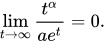
In the long run, exponential growth of any kind will overtake linear growth of any kind (that is the basis of the Malthusian catastrophe) as well as any polynomial growth, that is, for all α:
There is a whole hierarchy of conceivable growth rates that are slower than exponential and faster than linear (in the long run). See Degree of a polynomial § Computed from the function values.

Growth rates may also be faster than exponential. In the most extreme case, when growth increases without bound in finite time, it is called hyperbolic growth. In between exponential and hyperbolic growth lie more classes of growth behavior, like the hyperoperations beginning at tetration, and , the diagonal of the Ackermann function.

Logistic growth

The J-shaped exponential growth (left, blue) and the S-shaped logistic growth (right, red)

In reality, initial exponential growth is often not sustained forever. After some period, it will be slowed by external or environmental factors. For example, population growth may reach an upper limit due to resource limitations. In 1845, the Belgian mathematician Pierre François Verhulst first proposed a mathematical model of growth like this, called the "logistic growth".

Limitations of models

Exponential growth models of physical phenomena only apply within limited regions, as unbounded growth is not physically realistic. Although growth may initially be exponential, the modelled phenomena will eventually enter a region in which previously ignored negative feedback factors become significant (leading to a logistic growth model) or other underlying assumptions of the exponential growth model, such as continuity or instantaneous feedback, break down.

Exponential growth bias

Studies show that human beings have difficulty understanding exponential growth. Exponential growth bias is the tendency to underestimate compound growth processes. This bias can have financial implications as well.

Rice on a chessboard

According to legend, vizier Sissa Ben Dahir presented an Indian King Sharim with a beautiful handmade chessboard. The king asked what he would like in return for his gift and the courtier surprised the king by asking for one grain of rice on the first square, two grains on the second, four grains on the third, and so on. The king readily agreed and asked for the rice to be brought. All went well at first, but the requirement for 2n−1 grains on the nth square demanded over a million grains on the 21st square, more than a million million (a.k.a. trillion) on the 41st and there simply was not enough rice in the whole world for the final squares. (From Swirski, 2006)

The "second half of the chessboard" refers to the time when an exponentially growing influence is having a significant economic impact on an organization's overall business strategy.

Water lily

French children are offered a riddle, which appears to be an aspect of exponential growth: "the apparent suddenness with which an exponentially growing quantity approaches a fixed limit". The riddle imagines a water lily plant growing in a pond. The plant doubles in size every day and, if left alone, it would smother the pond in 30 days killing all the other living things in the water. Day after day, the plant's growth is small, so it is decided that it won't be a concern until it covers half of the pond. Which day will that be? The 29th day, leaving only one day to save the pond.

Monday, July 20, 2026

Infinite regress

From Wikipedia, the free encyclopedia
An illustration of infinite regress

Infinite regress is a philosophical concept to describe a series of entities. Each entity in the series depends on its predecessor, following a recursive principle. For example, the epistemic regress is a series of beliefs in which the justification of each belief depends on the justification of the belief that comes before it.

An infinite regress argument is an argument against a theory based on the fact that this theory leads to an infinite regress. For such an argument to be successful, it must demonstrate not just that the theory in question entails an infinite regress but also that this regress is vicious. There are different ways in which a regress can be vicious. The most serious form of viciousness involves a contradiction in the form of metaphysical impossibility. Other forms occur when the infinite regress is responsible for the theory in question being implausible or for its failure to solve the problem it was formulated to solve.

Traditionally, it was often assumed without much argument that each infinite regress is vicious but this assumption has been put into question in contemporary philosophy. While some philosophers have explicitly defended theories with infinite regresses, the more common strategy has been to reformulate the theory in question in a way that avoids the regress. One such strategy is foundationalism, which posits that there is a first element in the series from which all the other elements arise but which is not itself explained this way. Another way is coherentism, which is based on a holistic explanation that usually sees the entities in question not as a linear series but as an interconnected network.

Infinite regress arguments have been made in various areas of philosophy. Famous examples include the cosmological argument and Bradley's regress.

Definition

An infinite regress is an infinite series of entities governed by a recursive principle that determines how each entity in the series depends on or is produced by its predecessor. This principle can often be expressed in the following form: X is F because X stands in R to Y and Y is F. X and Y stand for objects, R stands for a relation and F stands for a property in the widest sense. In the epistemic regress, for example, a belief is justified because it is based on another belief that is justified. But this other belief is itself in need of one more justified belief for itself to be justified and so on. Or in the cosmological argument, an event occurred because it was caused by another event that occurred before it, which was itself caused by a previous event, and so on. This principle by itself is not sufficient: it does not lead to a regress if there is no X that is F. This is why an additional triggering condition has to be fulfilled: there has to be an X that is F for the regress to get started. So the regress starts with the fact that X is F. According to the recursive principle, this is only possible if there is a distinct Y that is also F. But in order to account for the fact that Y is F, we need to posit a Z that is F and so on. Once the regress has started, there is no way of stopping it since a new entity has to be introduced at each step in order to make the previous step possible.

An infinite regress argument is an argument against a theory based on the fact that this theory leads to an infinite regress. For such an argument to be successful, it has to demonstrate not just that the theory in question entails an infinite regress but also that this regress is vicious. The mere existence of an infinite regress by itself is not a proof for anything. So in addition to connecting the theory to a recursive principle paired with a triggering condition, the argument has to show in which way the resulting regress is vicious. For example, one form of evidentialism in epistemology holds that a belief is only justified if it is based on another belief that is justified. An opponent of this theory could use an infinite regress argument by demonstrating (1) that this theory leads to an infinite regress (e.g. by pointing out the recursive principle and the triggering condition) and (2) that this infinite regress is vicious (e.g. by showing that it is implausible given the limitations of the human mind). In this example, the argument has a negative form since it only denies that another theory is true. But it can also be used in a positive form to support a theory by showing that its alternative involves a vicious regress. This is how the cosmological argument for the existence of God works: it claims that positing God's existence is necessary in order to avoid an infinite regress of causes.

Viciousness

For an infinite regress argument to be successful, it has to show that the involved regress is vicious. A non-vicious regress is called virtuous or benign. Traditionally, it was often assumed without much argument that each infinite regress is vicious but this assumption has been put into question in contemporary philosophy. In most cases, it is not self-evident whether an infinite regress is vicious or not. The truth regress constitutes an example of an infinite regress that is not vicious: if the proposition "P" is true, then the proposition that "It is true that P" is also true and so on. Infinite regresses pose a problem mostly if the regress concerns concrete objects. Abstract objects, on the other hand, are often considered to be unproblematic in this respect. For example, the truth-regress leads to an infinite number of true propositions or the Peano axioms entail the existence of infinitely many natural numbers. But these regresses are usually not held against the theories that entail them.

There are different ways in which a regress can be vicious. The most serious type of viciousness involves a contradiction in the form of metaphysical impossibility. Other types occur when the infinite regress is responsible for the theory in question being implausible or for its failure to solve the problem it was formulated to solve. The vice of an infinite regress can be local if it causes problems only for certain theories when combined with other assumptions, or global otherwise. For example, an otherwise virtuous regress is locally vicious for a theory that posits a finite domain. In some cases, an infinite regress is not itself the source of the problem but merely indicates a different underlying problem.

Impossibility

Infinite regresses that involve metaphysical impossibility are the most serious cases of viciousness. The easiest way to arrive at this result is by accepting the assumption that actual infinities are impossible, thereby directly leading to a contradiction. This anti-infinitists position is opposed to infinity in general, not just specifically to infinite regresses. But it is open to defenders of the theory in question to deny this outright prohibition on actual infinities. For example, it has been argued that only certain types of infinities are problematic in this way, like infinite intensive magnitudes (e.g. infinite energy densities). But other types of infinities, like infinite cardinality (e.g. infinitely many causes) or infinite extensive magnitude (e.g. the duration of the universe's history) are unproblematic from the point of view of metaphysical impossibility. While there may be some instances of viciousness due to metaphysical impossibility, most vicious regresses are problematic because of other reasons.

Implausibility

A more common form of viciousness arises from the implausibility of the infinite regress in question. This category often applies to theories about human actions, states or capacities. This argument is weaker than the argument from impossibility since it allows that the regress in question is possible. It only denies that it is actual. For example, it seems implausible due to the limitations of the human mind that there are justified beliefs if this entails that the agent needs to have an infinite amount of them. But this is not metaphysically impossible, e.g. if it is assumed that the infinite number of beliefs are only non-occurrent or dispositional while the limitation only applies to the number of beliefs one is actually thinking about at one moment. Another reason for the implausibility of theories involving an infinite regress is due to the principle known as Ockham's razor, which posits that we should avoid ontological extravagance by not multiplying entities without necessity. Considerations of parsimony are complicated by the distinction between quantitative and qualitative parsimony: concerning how many entities are posited in contrast to how many kinds of entities are posited. For example, the cosmological argument for the existence of God promises to increase quantitative parsimony by positing that there is one first cause instead of allowing an infinite chain of events. But it does so by decreasing qualitative parsimony: it posits God as a new type of entity.

Failure to explain

Another form of viciousness applies not to the infinite regress by itself but to it in relation to the explanatory goals of a theory. Theories are often formulated with the goal of solving a specific problem, e.g. of answering the question why a certain type of entity exists. One way how such an attempt can fail is if the answer to the question already assumes in disguised form what it was supposed to explain. This is akin to the informal fallacy of begging the question. From the perspective of a mythological world view, for example, one way to explain why the earth seems to be at rest instead of falling down is to hold that it rests on the back of a giant turtle. In order to explain why the turtle itself is not in free fall, another even bigger turtle is posited and so on, resulting in a world that is turtles all the way down. Despite its shortcomings in clashing with modern physics and due to its ontological extravagance, this theory seems to be metaphysically possible assuming that space is infinite. One way to assess the viciousness of this regress is to distinguish between local and global explanations. A local explanation is only interested in explaining why one thing has a certain property through reference to another thing without trying to explain this other thing as well. A global explanation, on the other hand, tries to explain why there are any things with this property at all. So as a local explanation, the regress in the turtle theory is benign: it succeeds in explaining why the earth is not falling. But as a global explanation, it fails because it has to assume rather than explain at each step that there is another thing that is not falling. It does not explain why nothing at all is falling.

It has been argued that infinite regresses can be benign under certain circumstances despite aiming at global explanation. This line of thought rests on the idea of the transmission involved in the vicious cases: it is explained that X is F because Y is F where this F was somehow transmitted from Y to X. The problem is that to transfer something, it first must be possessed, so the possession is presumed rather than explained. For example, in trying to explain why one's neighbor has the property of being the owner of a bag of sugar, it is revealed that this bag was first in someone else's possession before it was transferred to the neighbor and that the same is true for this and every other previous owner. This explanation is unsatisfying since ownership is presupposed at every step. In non-transmissive explanations, however, Y is still the reason for X being F and Y is also F but this is just seen as a contingent fact. This line of thought has been used to argue that the epistemic regress is not vicious. From a Bayesian point of view, for example, justification or evidence can be defined in terms of one belief raising the probability that another belief is true. The former belief may also be justified but this is not relevant for explaining why the latter belief is justified.

Responses

Philosophers have responded to infinite regress arguments in various ways. The criticized theory can be defended, for example, by denying that an infinite regress is involved. Infinitists, on the other hand, embrace the regress but deny that it is vicious. Another response is to modify the theory in order to avoid the regress. This can be achieved in the form of foundationalism or of coherentism.

Foundationalism

Traditionally, the most common response is foundationalism. It posits that there is a first element in the series from which all the other elements arise but which is not itself explained this way. So from any given position, the series can be traced back to elements on the most fundamental level, which the recursive principle fails to explain. This way an infinite regress is avoided. This position is well-known from its applications in the field of epistemology. Foundationalist theories of epistemic justification state that besides inferentially justified beliefs, which depend for their justification on other beliefs, there are also non-inferentially justified beliefs. The non-inferentially justified beliefs constitute the foundation on which the superstructure consisting of all the inferentially justified beliefs rests. Acquaintance theories, for example, explain the justification of non-inferential beliefs through acquaintance with the objects of the belief. On such a view, an agent is inferentially justified to believe that it will rain tomorrow based on the belief that the weather forecast told so. They are non-inferentially justified in believing that they are in pain because they are directly acquainted with the pain. So a different type of explanation (acquaintance) is used for the foundational elements.

Another example comes from the field of metaphysics concerning the problem of ontological hierarchy. One position in this debate claims that some entities exist on a more fundamental level than other entities and that the latter entities depend on or are grounded in the former entities. Metaphysical foundationalism is the thesis that these dependence relations do not form an infinite regress: that there is a most fundamental level that grounds the existence of the entities from all other levels. This is sometimes expressed by stating that the grounding-relation responsible for this hierarchy is well-founded.

Coherentism

Coherentism, mostly found in the field of epistemology, is another way to avoid infinite regresses. It is based on a holistic explanation that usually sees the entities in question not as a linear series but as an interconnected network. For example, coherentist theories of epistemic justification hold that beliefs are justified because of the way they hang together: they cohere well with each other. This view can be expressed by stating that justification is primarily a property of the system of beliefs as a whole. The justification of a single belief is derivative in the sense that it depends on the fact that this belief belongs to a coherent whole. Laurence BonJour is a well-known contemporary defender of this position.

Examples

Aristotle

Aristotle argued that knowing does not necessitate an infinite regress because some knowledge does not depend on demonstration:

Some hold that owing to the necessity of knowing the primary premises, there is no scientific knowledge. Others think there is, but that all truths are demonstrable. Neither doctrine is either true or a necessary deduction from the premises. The first school, assuming that there is no way of knowing other than by demonstration, maintain that an infinite regress is involved, on the ground that if behind the prior stands no primary, we could not know the posterior through the prior (wherein they are right, for one cannot traverse an infinite series): if on the other hand – they say – the series terminates and there are primary premises, yet these are unknowable because incapable of demonstration, which according to them is the only form of knowledge. And since thus one cannot know the primary premises, knowledge of the conclusions which follow from them is not pure scientific knowledge nor properly knowing at all, but rests on the mere supposition that the premises are true. The other party agrees with them as regards knowing, holding that it is only possible by demonstration, but they see no difficulty in holding that all truths are demonstrated, on the ground that demonstration may be circular and reciprocal. Our own doctrine is that not all knowledge is demonstrative: on the contrary, knowledge of the immediate premises is independent of demonstration. (The necessity of this is obvious; for since we must know the prior premises from which the demonstration is drawn, and since the regress must end in immediate truths, those truths must be indemonstrable.) Such, then, is our doctrine, and in addition, we maintain that besides scientific knowledge there is its original source which enables us to recognize the definitions.

— Aristotle, Posterior Analytics I.3 72b1–15

Philosophy of mind

Gilbert Ryle argues in the philosophy of mind that mind-body dualism is implausible because it produces an infinite regress of "inner observers" when trying to explain how mental states are able to influence physical states.

Anti-capitalism

From Wikipedia, the free encyclopedia https://en.wikipedia.org/wiki/Anti-capi...