Search This Blog

Sunday, August 9, 2026

Kirchhoff's law of thermal radiation

From Wikipedia, the free encyclopedia
Gustav Kirchhoff (18241887)

In heat transfer, Kirchhoff's law of thermal radiation refers to wavelength-specific radiative emission and absorption by a material body in thermodynamic equilibrium, including radiative exchange equilibrium. It is a special case of Onsager reciprocal relations as a consequence of the time reversibility of microscopic dynamics, also known as microscopic reversibility. It was stated by Gustav Kirchhoff in 1860.

A body at temperature T radiates electromagnetic energy. A perfect black body in thermodynamic equilibrium absorbs all light that strikes it, and radiates energy according to a unique law of radiative emissive power for temperature T (Stefan–Boltzmann law), universal for all perfect black bodies. For a material that is not a perfect black body, Kirchhoff's law states that:

For a body of any arbitrary material emitting and absorbing thermal electromagnetic radiation at every wavelength in thermodynamic equilibrium, the ratio of its emissive power to its dimensionless coefficient of absorption is equal to a universal function only of radiative wavelength and temperature. That universal function describes the perfect black-body emissive power.

Here, the dimensionless coefficient of absorption (or the absorptivity) is the fraction of incident light (power) at each spectral frequency that is absorbed by the body when it is radiating and absorbing in thermodynamic equilibrium.

In slightly different terms, the emissive power of an arbitrary opaque body of fixed size and shape at a definite temperature can be described by a dimensionless ratio, sometimes called the emissivity: the ratio of the emissive power of the body to the emissive power of a black body of the same size and shape at the same fixed temperature. With this definition, Kirchhoff's law states, in simpler language:

For an arbitrary body emitting and absorbing thermal radiation in thermodynamic equilibrium, the emissivity function is equal to the absorptivity function.

Kirchhoff's law has another corollary: the emissivity cannot exceed one (because the absorptivity cannot, by conservation of energy), so it is not possible to thermally radiate more energy than a black body, at equilibrium. In negative luminescence the angle and wavelength integrated absorption exceeds the material's emission; however, such systems are powered by an external source and are therefore not in thermodynamic equilibrium.

Spectral emission and absorption

Kirchhoff's law of thermal radiation, as originally stated, says that the absorption coefficient for thermal radiation, , is equal to the emissivity for thermal radiation, . This applies in thermal equilibrium (that is, for the absorption and emission of same spectrum of light.)

However, the law can be extended to the absorptivity and emissivity as a function of wavelength: not only is thermal emissivity equal to absorptivity overall, it is equal at each wavelength. Thus, at every wavelength , it will be true that . Expressed as a function of wavelength, the principle is independent of the requirement for thermal equilibrium.

As an example, consider a leaf. It is a poor absorber of green light (around 470 nm), which is why it looks green. By the principle of detailed balance, it is an equally a poor emitter of green light.

In other words, if a material is dark (well absorbing) at a certain frequency , then its own thermal radiation will be strong (well emitting) at the same frequency .

More generally, all intensive properties are balanced in detail. So for example, the absorptivity at a certain incidence direction, for a certain frequency, of a certain polarization, is the same as the emissivity at the same direction, for the same frequency, of the same polarization. This is the principle of detailed balance.

In equilibrium the power radiated and absorbed by the body must be equal for any particular element of area of the body, for any particular direction of polarization, and for any frequency range.

In modern terminology, this is known as the principle of detailed balance, which is a direct consequence of the second law of thermodynamics.

History

Before Kirchhoff's law was recognized, it had been experimentally established that a good absorber is a good emitter, and a poor absorber is a poor emitter. Naturally, a good reflector must be a poor absorber. This is why, for example, lightweight emergency thermal blankets are based on reflective metallic coatings: they lose little heat by radiation.

Kirchhoff's great insight was to recognize the universality and uniqueness of the function that describes the black body emissive power. But he did not know the precise form or character of that universal function. Attempts were made by Lord Rayleigh and Sir James Jeans 1900–1905 to describe it in classical terms, resulting in Rayleigh–Jeans law. This law turned out to be inconsistent yielding the ultraviolet catastrophe. The correct form of the law was found by Max Planck in 1900, assuming quantized emission of radiation, and is termed Planck's law. This marks the advent of quantum mechanics.

Theory

In a blackbody enclosure that contains electromagnetic radiation with a certain amount of energy at thermodynamic equilibrium, this "photon gas" will have a Planck distribution of energies.

One may suppose a second system, a cavity with walls that are opaque, rigid, and not perfectly reflective to any wavelength, to be brought into connection, through an optical filter, with the blackbody enclosure, both at the same temperature. Radiation can pass from one system to the other. For example, suppose in the second system, the density of photons at narrow frequency band around wavelength were higher than that of the first system. If the optical filter passed only that frequency band, then there would be a net transfer of photons, and their energy, from the second system to the first. This is in violation of the second law of thermodynamics, which holds that there is no net transfer of heat between two bodies at the same temperature.

In the second system, therefore, at each frequency, the walls must absorb and emit energy in such a way as to maintain the black body distribution. Hence absorptivity and emissivity must be equal. The absorptivity of the wall is the ratio of the energy absorbed by the wall to the energy incident on the wall, for a particular wavelength. Thus the absorbed energy is where is the intensity of black-body radiation at wavelength and temperature . Independent of the condition of thermal equilibrium, the emissivity of the wall is defined as the ratio of emitted energy to the amount that would be radiated if the wall were a perfect black body. The emitted energy is thus where is the emissivity at wavelength . For the maintenance of thermal equilibrium, these two quantities must be equal, or else the distribution of photon energies in the cavity will deviate from that of a black body. This yields Kirchhoff's law:

By a similar, but more complicated argument, it can be shown that, since black-body radiation is equal in every direction (isotropic), the emissivity and the absorptivity, if they happen to be dependent on direction, must again be equal for any given direction.

Average and overall absorptivity and emissivity data are often given for materials with values which differ from each other. For example, white paint is quoted as having an absorptivity of 0.16, while having an emissivity of 0.93. This is because the absorptivity is averaged with weighting for the solar spectrum, while the emissivity is weighted for the emission of the paint itself at normal ambient temperatures. The absorptivity quoted in such cases is being calculated by:
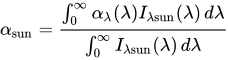
while the average emissivity is given by:
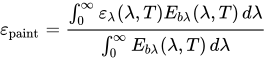
where is the emission spectrum of the sun, and is the emission spectrum of the paint. Although, by Kirchhoff's law, in the above equations, the above averages and are not generally equal to each other. The white paint will serve as a very good insulator against solar radiation, because it is very reflective of the solar radiation, and although it therefore emits poorly in the solar band, its temperature will be around room temperature, and it will emit whatever radiation it has absorbed in the infrared, where its emission coefficient is high.

Planck's derivation

The apparatus used by Hertz to generate and receive EM waves. The receiver is a Hertzian resonator, and it is tuned to receive a single frequency. In modern notation, the receiver receives an EM wave with frequency .

Historically, Planck derived the black-body radiation law and detailed balance according to a classical thermodynamic argument, with a single heuristic step, which was later interpreted as a quantization hypothesis.

In Planck's set up, he started with a large Hohlraum at a fixed temperature . At thermal equilibrium, the Hohlraum is filled with a distribution of EM waves at thermal equilibrium with the walls of the Hohlraum. Next, he considered connecting the Hohlraum to a single small resonator, such as Hertzian resonators. The resonator reaches a certain form of thermal equilibrium with the Hohlraum, when the spectral input into the resonator equals the spectral output at the resonance frequency.

Next, suppose there are two Hohlraums at the same fixed temperature , then Planck argued that the thermal equilibrium of the small resonator is the same when connected to either Hohlraum. For, we can disconnect the resonator from one Hohlraum and connect it to another. If the thermal equilibrium were different, then we have just transported energy from one to another, violating the second law. Therefore, the spectrum of all black bodies are identical at the same temperature.

Using a heuristic of quantization, which he gleaned from Boltzmann, Planck argued that a resonator tuned to frequency , with average energy , would contain entropyfor some constant (later termed the Planck constant). Then applying , Planck obtained the black-body radiation law.

Another argument that does not depend on the precise form of the entropy function, can be given as follows. Next, suppose we have a material that violates Kirchhoff's law when integrated, such that the total coefficient of absorption is not equal to the coefficient of emission at a certain , then if the material at temperature is placed into a Hohlraum at temperature , it would spontaneously emit more than it absorbs, or conversely, thus spontaneously creating a temperature difference, violating the second law.

Finally, suppose we have a material that violates Kirchhoff's law in detail, such that the total coefficient of absorption is not equal to the coefficient of emission at a certain and at a certain frequency , then since it does not violate Kirchhoff's law when integrated, there must exist two frequencies , such that the material absorbs more than it emits at , and conversely at . Now, place this material in one Hohlraum. It would spontaneously create a shift in the spectrum, making it higher at than at . However, this then allows us to tap from one Hohlraum with a resonator tuned at , then detach and attach to another Hohlraum at the same temperature, thus transporting energy from one to another, violating the second law.

We may apply the same argument for polarization and direction of radiation, obtaining the full principle of detailed balance.

Original statements

Gustav Kirchhoff stated his law in several papers in 1859 and 1860, and then in 1862 in an appendix to his collected reprints of those and some related papers.

Prior to Kirchhoff's studies, it was known that for total heat radiation, the ratio of emissive power to absorptive ratio was the same for all bodies emitting and absorbing thermal radiation in thermodynamic equilibrium. This means that a good absorber is a good emitter. Naturally, a good reflector is a poor absorber. For wavelength specificity, prior to Kirchhoff, the ratio was shown experimentally by Balfour Stewart to be the same for all bodies, but the universal value of the ratio had not been explicitly considered in its own right as a function of wavelength and temperature.

Kirchhoff's original contribution to the physics of thermal radiation was his postulate of a perfect black body radiating and absorbing thermal radiation in an enclosure opaque to thermal radiation and with walls that absorb at all wavelengths. Kirchhoff's perfect black body absorbs all the radiation that falls upon it.

Every such black body emits from its surface with a spectral radiance that Kirchhoff labeled I (for specific intensity, the traditional name for spectral radiance).

Kirchhoff's postulated spectral radiance I was a universal function, one and the same for all black bodies, only depending on wavelength and temperature.

The precise mathematical expression for that universal function I was very much unknown to Kirchhoff, and it was just postulated to exist, until its precise mathematical expression was found in 1900 by Max Planck. It is nowadays referred to as Planck's law.

Then, at each wavelength, for thermodynamic equilibrium in an enclosure, opaque to heat rays, with walls that absorb some radiation at every wavelength:

For an arbitrary body radiating and emitting thermal radiation, the ratio E / A between the emissive spectral radiance, E, and the dimensionless absorptive ratio, A, is one and the same for all bodies at a given temperature. That ratio E / A is equal to the emissive spectral radiance I of a perfect black body, a universal function only of wavelength and temperature.

Color temperature

From Wikipedia, the free encyclopedia
The CIE 1931 x,y chromaticity space, also showing the chromaticities of black-body light sources of various temperatures (Planckian locus), and lines of constant correlated color temperature

Color temperature is a parameter describing the color of a visible light source by comparing it to the color of light emitted by an idealized opaque, non-reflective body. The temperature of the ideal emitter that matches the color most closely is defined as the color temperature of the original visible light source. The color temperature scale describes only the color of light emitted by a light source, which may actually be at a different (and often much lower) temperature.

Color temperature has applications in lightingphotographyvideographypublishingmanufacturing, and other fields. In practice, color temperature is most meaningful for light sources that correspond somewhat closely to the color of some black body, i.e., light in a range going from red to orange to yellow to white to bluish white. Although the concept of correlated color temperature extends the definition to any visible light, the color temperature of a green or a purple light rarely is useful information. Color temperature is conventionally expressed in kelvins, using the symbol K, which are units for absolute temperature.

This is distinct from how color temperatures over 5000 K are called "cool colors" (bluish), while lower color temperatures (2700–3000 K) are called "warm colors" (yellowish), exactly the opposite of black-body radiation. "Warm" and "cool" in this context is with respect to a traditional aesthetic association of color to warmth or coolness, not a reference to physical black body temperature. By the hue-heat hypothesis, low color temperatures psychologically evoke warmth, while high color temperatures evoke coolness. The spectral peak of warm-colored light is closer to infrared, and most natural warm-colored light sources emit significant infrared radiation. The fact that "warm" lighting in this sense actually has a "cooler" color temperature often leads to confusion.

Categorizing different lighting

Color temperatures and example sources
Temperature Source
1,000 K Most commercial electric heating elements
1,700 K Match flame, low-pressure sodium lamps (LPS/SOX)
1,850 K Candle flame, sunset/sunrise
2,400 K Standard incandescent lamps
2,550 K Soft white incandescent lamps
2,700 K "Soft white" compact fluorescent and LED lamps
3,000 K Warm white compact fluorescent and LED lamps
3,200 K Studio lamps, photofloods, etc.
3,350 K Studio "CP" light
5,000 K Horizon daylight, tubular fluorescent lamps
or cool white/daylight compact fluorescent and LED lamps
5,500–6,000 K Vertical daylight, electronic flash
6,200 K Xenon short-arc lamp
6,500 K Daylight, overcast, daylight LED lamps
6,500–9,500 K LCD or CRT screens
15,000–27,000 K Clear blue poleward sky
 K Theoretical upper limit based on black-body radiation calculations
The black-body radiance (Bλ) vs. wavelength (λ) curves for the visible spectrum. The vertical axes of Planck's law plots building this animation were proportionally transformed to keep equal areas between functions and horizontal axis for wavelengths 380–780 nm. K indicates the color temperature in kelvins, and M indicates the color temperature in micro reciprocal degrees.

The color temperature of the electromagnetic radiation emitted from an ideal black body is defined as its surface temperature in kelvins, or alternatively in micro reciprocal degrees (mired). This permits the definition of a standard by which light sources are compared.

To the extent that a hot surface emits thermal radiation but is not an ideal black-body radiator, the color temperature of the light is not the actual temperature of the surface. An incandescent lamp's light is thermal radiation, and the bulb approximates an ideal black-body radiator, so its color temperature is essentially the temperature of the filament. Thus a relatively low temperature emits a dull red and a high temperature emits the almost white of the traditional incandescent light bulb. Metal workers are able to judge the temperature of hot metals by their color, from dark red to orange-white and then white (see red heat).

Many other light sources, such as fluorescent lamps, or light emitting diodes (LEDs) emit light primarily by processes other than thermal radiation. This means that the emitted radiation does not follow the form of a black-body spectrum. These sources are assigned what is known as a correlated color temperature (CCT). CCT is the color temperature of a black-body radiator which to human color perception most closely matches the light from the lamp. Because such an approximation is not required for incandescent light, the CCT for an incandescent light is simply its unadjusted temperature, derived from comparison to a black-body radiator.

The Sun

The Sun closely approximates a black-body radiator. The effective temperature, defined by the total radiative power per square unit, is 5,772 K. The color temperature of sunlight above the atmosphere is about 5,900 K.

The Sun may appear red, orange, yellow, or white from Earth, depending on its position in the sky. The changing color of the Sun over the course of the day is mainly a result of the scattering of sunlight and is not due to changes in black-body radiation. Rayleigh scattering of sunlight by Earth's atmosphere causes the blue color of the sky, which tends to scatter blue light more than red light.

Some daylight in the early morning and late afternoon (the golden hours) has a lower ("warmer") color temperature due to increased scattering of shorter-wavelength sunlight by atmospheric particulates – an optical phenomenon called the Tyndall effect.

Daylight has a spectrum similar to that of a black body with a correlated color temperature of 6,500 K (D65 viewing standard) or 5,500 K (daylight-balanced photographic film standard).

Approximation of the hues of the Planckian locus as a function of the kelvin temperature, rendered with a white point near 6,500 K, not accounting for chromatic adaptation

For colors based on black-body theory, blue occurs at higher temperatures, whereas red occurs at lower temperatures. This is the opposite of the cultural associations attributed to colors, in which "red" is "hot", and "blue" is "cold".

Infinite temperature

As the temperature of a black-body radiator approaches positive infinity, its color converges to CIE xy coordinates (0.2399, 0.2340), corresponding to an sRGB value of (148, 177, 255) or #94b1ff, a light blue color known as perano. This is because of the Rayleigh-Jeans law, which states that at frequencies much lower than the peak frequency of a black-body radiator, spectral power is inversely proportional to the fourth power of the wavelength.

Applications

Color temperature (right) of various light sources (left)

Lighting

Color temperature comparison of common electric lamps
Color temperatures of common electric lamps

For lighting building interiors, it is often important to take into account the color temperature of illumination. A warmer (i.e., a lower color temperature) light is often used in public areas to promote relaxation, while a cooler (higher color temperature) light is used to enhance concentration, for example in schools and offices.

CCT dimming for LED technology is regarded as a difficult task, since binning, age and temperature drift effects of LEDs change the actual color value output. Here feedback loop systems are used, for example with color sensors, to actively monitor and control the color output of multiple color mixing LEDs.

Aquaculture

In fishkeeping, color temperature has different functions and foci in the various branches.

  • In freshwater aquaria, color temperature is generally of concern only for producing a more attractive display. Lights tend to be designed to produce an attractive spectrum, sometimes with secondary attention paid to keeping the plants in the aquaria alive.
  • In a saltwater/reef aquarium, color temperature is an essential part of tank health. Within about 400 to 3000 nanometers, light of shorter wavelength can penetrate deeper into water than longer wavelengths, providing essential energy sources to the algae hosted in (and sustaining) coral. This is equivalent to an increase of color temperature with water depth in this spectral range. Because coral typically live in shallow water and receive intense, direct tropical sunlight, the focus was once on simulating this situation with 6500 K lights.

Digital photography

In digital photography, the term color temperature sometimes refers to remapping of color values to simulate variations in ambient color temperature. Most digital cameras and raw image software provide presets simulating specific ambient values (e.g., sunny, cloudy, tungsten, etc.) while others allow explicit entry of white balance values in kelvins. These settings vary color values along the blue–yellow axis, while some software includes additional controls (sometimes labeled "tint") adding the magenta–green axis, and are to some extent arbitrary and a matter of artistic interpretation.

Photographic film

Photographic emulsion film does not respond to lighting color identically to the human retina or visual perception. An object that appears to the observer to be white may turn out to be very blue or orange in a photograph. The color balance may need to be corrected during printing to achieve a neutral color print. The extent of this correction is limited since color film normally has three layers sensitive to different colors and when used under the "wrong" light source, every layer may not respond proportionally, giving odd color casts in the shadows, although the mid-tones may have been correctly white-balanced under the enlarger. Light sources with discontinuous spectra, such as fluorescent tubes, cannot be fully corrected in printing either, since one of the layers may barely have recorded an image at all.

Photographic film is made for specific light sources (most commonly daylight film and tungsten film), and, used properly, will create a neutral color print. Matching the sensitivity of the film to the color temperature of the light source is one way to balance color. If tungsten film is used indoors with incandescent lamps, the yellowish-orange light of the tungsten incandescent lamps will appear as white (3200 K) in the photograph. Color negative film is almost always daylight-balanced, since it is assumed that color can be adjusted in printing (with limitations, see above). Color transparency film, being the final artefact in the process, has to be matched to the light source or filters must be used to correct color.

Filters on a camera lens, or color gels over the light source(s) may be used to correct color balance. When shooting with a bluish light (high color temperature) source such as on an overcast day, in the shade, in window light, or if using tungsten film with white or blue light, a yellowish-orange filter will correct this. For shooting with daylight film (calibrated to 5600 K) under warmer (low color temperature) light sources such as sunsets, candlelight or tungsten lighting, a bluish (e.g. #80A) filter may be used. More-subtle filters are needed to correct for the difference between, say 3200 K and 3400 K tungsten lamps or to correct for the slightly blue cast of some flash tubes, which may be 6000 K.

If there is more than one light source with varied color temperatures, one way to balance the color is to use daylight film and place color-correcting gel filters over each light source.

Photographers sometimes use color temperature meters. These are usually designed to read only two regions along the visible spectrum (red and blue); more expensive ones read three regions (red, green, and blue). However, they are ineffective with sources such as fluorescent or discharge lamps, whose light varies in color and may be harder to correct for. Because this light is often greenish, a magenta filter may correct it. More sophisticated colorimetry tools can be used if such meters are lacking.

Desktop publishing

In the desktop publishing industry, it is important to know a monitor's color temperature. Color matching software, such as Apple's ColorSync Utility for MacOS, measures a monitor's color temperature and then adjusts its settings accordingly. This enables on-screen color to more closely match printed color. Common monitor color temperatures, along with matching standard illuminants in parentheses, are as follows:

  • 5000 K (CIE D50)
  • 5500 K (CIE D55)
  • 6500 K (D65)
  • 7500 K (CIE D75)
  • 9300 K

D50 is scientific shorthand for a standard illuminant: the daylight spectrum at a correlated color temperature of 5000 K. Similar definitions exist for D55, D65 and D75. Designations such as D50 are used to help classify color temperatures of light tables and viewing booths. When viewing a color slide at a light table, it is important that the light be balanced properly so that the colors are not shifted towards the red or blue.

Digital cameras, web graphics, DVDs, etc., are normally designed for a 6500 K color temperature. The sRGB standard commonly used for images on the Internet stipulates a 6500 K display white point.

Microsoft Windows prior to Windows 10 uses sRGB as the default display color space, and 6500 K as the default display color temperature. Windows 10 1607 supports High Dynamic RangeWindows 11 22H2 has support for Auto Color Management (ACM), which helped further optimize OLED and/or wide-color gamut monitors by reading DisplayID data.

Apple iOS, iPadOS and macOS currently use sRGB and DCI-P3 as the default display color spaces.

TV, video, and digital still cameras

The NTSC and PAL TV norms call for a compliant TV screen to display an electrically black and white signal (minimal color saturation) at a color temperature of 6500 K. On many consumer-grade televisions, there is a very noticeable deviation from this requirement. However, higher-end consumer-grade televisions can have their color temperatures adjusted to 6500 K by using a preprogrammed setting or a custom calibration. Current versions of ATSC explicitly call for the color temperature data to be included in the data stream, but old versions of ATSC allowed this data to be omitted. In this case, current versions of ATSC cite default colorimetry standards depending on the format. Both of the cited standards specify a 6500 K color temperature.

Most video and digital still cameras can adjust for color temperature by zooming into a white or neutral colored object and setting the manual "white balance" (telling the camera that "this object is white"); the camera then shows true white as white and adjusts all the other colors accordingly. White-balancing is necessary especially when indoors under fluorescent lighting and when moving the camera from one lighting situation to another. Most cameras also have an automatic white balance function that attempts to determine the color of the light and correct accordingly. While these settings were once unreliable, they are much improved in today's digital cameras and produce an accurate white balance in a wide variety of lighting situations.

However, in NTSC-J and NTSC-C standards, 9300 K color temperature is recommended. TVs and projectors sold in Japan, South Korea, China, Hong Kong, Taiwan and Philippines are usually adopt 9300 K as default settings. But for compatibility reasons, computer monitors sold in these country/region are usually adopt 6500 K as default settings; these color temperature settings are usually tuneable in OSD menu.

Now many FHD and UHD streaming dramas and films are produced using Rec. 709 or DCI-P3, which based on 6300 K or 6500 K color temperature.

Artistic application via control of color temperature

The house above appears a light cream during midday, but seems to be bluish white here in the dim light before full sunrise. Note the color temperature of the sunrise in the background.

Video camera operators can white-balance objects that are not white, downplaying the color of the object used for white-balancing. For instance, they can bring more warmth into a picture by white-balancing off something that is light blue, such as faded blue denim; in this way white-balancing can replace a filter or lighting gel when those are not available.

Cinematographers do not "white balance" in the same way as video camera operators; they use techniques such as filters, choice of film stock, pre-flashing, and, after shooting, color grading, both by exposure at the labs and also digitally. Cinematographers also work closely with set designers and lighting crews to achieve the desired color effects.

For artists, most pigments and papers have a cool or warm cast, as the human eye can detect even a minute amount of saturation. Gray mixed with yellow, orange, or red is a "warm gray". Green, blue, or purple create "cool grays". This sense of temperature is the reverse of that of real temperature; bluer is described as "cooler" even though it corresponds to a higher-temperature black body.

"Warm" gray "Cool" gray
Mixed with 6% yellow Mixed with 6% blue

Lighting designers sometimes select filters by color temperature, commonly to match light that is theoretically white. Since fixtures using discharge type lamps produce a light of a considerably higher color temperature than do tungsten lamps, using the two in conjunction could potentially produce a stark contrast, so sometimes fixtures with HID lamps, commonly producing light of 6000–7000 K, are fitted with 3200 K filters to emulate tungsten light. Fixtures with color mixing features or with multiple colors (if including 3200 K), are also capable of producing tungsten-like light. Color temperature may also be a factor when selecting lamps, since each is likely to have a different color temperature.

Correlated color temperature

Log-log graphs of peak emission wavelength and radiant exitance vs black-body temperature, plotted on the blue line. Red arrows show that 5780 K black bodies have 501 nm peak wavelength and 63.3 MW/m2 radiant exitance.

Correlated color temperature (CCT, Tcp) refers to the "temperature of a Planckian radiator whose perceived color most closely resembles that of a given stimulus at the same brightness and under specified viewing conditions". The SI unit is the Kelvin (K).

Color rendering index

The CIE color rendering index (CRI) is a method to determine how well a light source's illumination of eight sample patches compares to the illumination provided by a reference source. Cited together, the CRI and CCT give a numerical estimate of what reference (ideal) light source best approximates a particular artificial light, and what the difference is.

Spectral power distribution

Characteristic spectral power distributions (SPDs) for an incandescent lamp (left) and a fluorescent lamp (right). The horizontal axes are wavelengths in nanometers, and the vertical axes show relative intensity in arbitrary units.

Light sources and illuminants may be characterized by their spectral power distribution (SPD). The relative SPD curves provided by many manufacturers may have been produced using 10 nm increments or more on their spectroradiometer. The result is what would seem to be a smoother ("fuller spectrum") power distribution than the lamp actually has. Owing to their spiky distribution, much finer increments are advisable for taking measurements of fluorescent lights, and this requires more expensive equipment.

Color temperature in astronomy

Characteristic spectral power distribution of an A0V star (Teff = 9500 K, cf. Vega) compared to black-body spectra. The 15,000 K black-body spectrum (dashed line) matches the visible part of the stellar SPD much better than the black body of 9500 K. All spectra are normalized to intersect at 555 nanometers.

In astronomy, the color temperature is defined by the local slope of the SPD at a given wavelength, or, in practice, a wavelength range. Given, for example, the color magnitudes B and V which are calibrated to be equal for an A0V star (e.g. Vega), the stellar color temperature is given by the temperature for which the color index of a black-body radiator fits the stellar one. Besides the , other color indices can be used as well. The color temperature (as well as the correlated color temperature defined above) may differ largely from the effective temperature given by the radiative flux of the stellar surface. For example, the color temperature of an A0V star is about 15000 K compared to an effective temperature of about 9500 K.

For most applications in astronomy (e.g., to place a star on the HR diagram or to determine the temperature of a model flux fitting an observed spectrum) the effective temperature is the quantity of interest. Various color-effective temperature relations exist in the literature. There relations also have smaller dependencies on other stellar parameters, such as the stellar metallicity and surface gravity.

Lateral thinking

From Wikipedia, the free encyclopedia
Maltese psychologist Edward de Bono (pictured in 2009) introduced the term "lateral thinking" in 1967.

Lateral thinking is a manner of solving problems using an indirect and creative approach via reasoning that is not immediately obvious. Synonymous to thinking outside the box, it involves ideas that may not be obtainable using only traditional step-by-step logic. The cutting of the Gordian Knot is a classical example.

The term was first used in 1967 by Maltese psychologist Edward de Bono who used the Judgement of Solomon, the Nine Dots Puzzle, and the sewing machine (automating the work rather than adding more workers) as examples, among many others, of lateral thinking.

Lateral thinking deliberately distances itself from vertical thinking, the traditional method for problem solving.

Vertical versus Lateral Thinking

Vertical ThinkingLateral Thinking
linearyesno
patterndevelop an existing patternrestructure an existing pattern
directionstepwise and methodicalmultidirectional and creative
uncertainty toleratednoyes
rewards fordepth of knowledgebreadth of knowledge
restricted by relevant informationyesno
novel approaches welcomednoyes

De Bono argues lateral thinking entails a switch-over from a familiar pattern to a new, unexpected one. Such insight sometimes takes the form of humour but can also be cultivated.

Critics have characterized lateral thinking as a pseudo-scientific concept, arguing de Bono's core ideas have never been rigorously tested or corroborated.

Methods

Lateral thinking has to be distinguished from critical thinking. Critical thinking is primarily concerned with judging the true value of statements and seeking errors whereas lateral thinking focuses more on the "movement value" of statements and ideas. A person uses lateral thinking to move from one known idea to new ideas. Edward de Bono defines four types of thinking tools:

  1. idea-generating tools intended to break current thinking patterns—routine patterns, the status quo
  2. focus tools intended to broaden where to search for new ideas
  3. harvest tools intended to ensure more value is received from idea generating output
  4. treatment tools that promote consideration of real-world constraints, resources, and support

Random entry idea generation

The thinker chooses an object at random, or a noun from a dictionary and associates it with the area they are thinking about. De Bono exemplifies this through the randomly chosen word "nose" being applied to an office photocopier, leading to the idea that the copier could produce a lavender smell when it was low on paper.

Provocation idea generation

A provocation is a statement that we know is wrong or impossible but used to create new ideas. De Bono gives an example of considering river pollution and setting up the provocation, "the factory is downstream of itself", causing a factory to be forced to take its water input from a point downstream of its output, an idea which later became law in some countries. Provocations can be set up by the use of any of the provocation techniques—wishful thinking, exaggeration, reversal, escape, distortion, or arising. The thinker creates a list of provocations and then uses the most outlandish ones to move their thinking forward to new ideas.

Movement techniques

The purpose of movement techniques is to produce as many alternatives as possible in order to encourage new ways of thinking about both problems and solutions. The production of alternatives tends to produce many possible solutions to problems that seemed to only have one possible solution. One can move from a provocation to a new idea through the following methods: extract a principle, focus on the difference, moment to moment, positive aspects or special circumstances.

Challenge

A tool which is designed to ask the question, "Why?", in a non-threatening way: why something exists or why it is done the way it is. The result is a very clear understanding of "Why?", which naturally leads to new ideas. The goal is to be able to challenge anything at all, not just those things that are problematic. For example, one could challenge the handles on coffee cups: The reason for the handle seems to be that the cup is often too hot to hold directly; perhaps coffee cups could be made with insulated finger grips, or there could be separate coffee-cup holders similar to beer holders, or coffee should not be so hot in the first place.

Concept formation

Ideas carry out concepts. This tool systematically expands the range and number of concepts in order to end up with a very broad range of ideas to consider.

Disproving

Based on the idea that the majority is always wrong (as suggested by Henrik Ibsen and by John Kenneth Galbraith), take anything that is obvious and generally accepted as "goes without saying", question it, take an opposite view, and try to convincingly disprove it. This technique is similar to de Bono's "Black Hat" of Six Thinking Hats, which looks at identifying reasons to be cautious and conservative.

Fractionation

The purpose of fractionation is to create alternative perceptions of problems and solutions by taking the commonplace view of the situation and breaking it into multiple alternative situations in order to break away from the fixed view and see the situation from different angles. This allows the generation of multiple possible solutions that can be synthesized into more comprehensive answers.

Problem solving

Problem solving
When something creates a problem, the performance or the status quo of the situation drops. Problem-solving deals with finding out what caused the problem and then figuring out ways to fix the problem. The objective is to get the situation to where it should be. For example, a production line has an established run rate of 1000 items per hour. Suddenly, the run rate drops to 800 items per hour. Ideas as to why this happened and solutions to repair the production line must be thought of, such as giving the worker a pay raise. A study on engineering students' abilities to answer very open-ended questions suggests that students showing more lateral thinking were able to solve the problems much quicker and more accurately.
Lateral problem "solving"
Lateral thinking often produces solutions that appear "obvious" in hindsight. It can often highlight problems people never knew they had, or solve simple problems that have huge impacts. For example, if a production line produced 1000 books per hour, lateral thinking may suggest that a drop in output to 800 would lead to higher quality, and more motivated workers. Students have shown lateral thinking in their application of a variety of individual, unique concepts in order to solve complex problems.

Dysrationalia

From Wikipedia, the free encyclopedia https://en.wikipedia.org/wiki/Dysrationalia Dysrationalia i...