Search This Blog

Monday, August 10, 2026

Enthalpy

From Wikipedia, the free encyclopedia

Enthalpy (/ˈɛnθəlpi/ ⓘ) is the sum of a thermodynamic system's internal energy and the product of its pressure and volume. It is a state function in thermodynamics used in many measurements in chemical, biological, and physical systems at a constant external pressure, which is conveniently provided by Earth's ambient atmosphere. The pressure–volume term expresses the work that was done against constant external pressure to establish the system's physical dimensions from to some final volume (as ), i.e. to make room for itself by displacing its surroundings. The pressure-volume term is very small for solids and liquids at common conditions, and fairly small for gases. Therefore, enthalpy is a stand-in for energy in chemical systems; bond, lattice, solvation, and other chemical "energies" are actually enthalpy differences. As a state function, enthalpy depends only on the final configuration of internal energy, pressure, and volume, not on the path taken to achieve it.

In the International System of Units (SI), the unit of measurement for enthalpy is the joule. Other historical conventional units still in use include the calorie and the British thermal unit (BTU).

The total enthalpy of a system cannot be measured directly because the internal energy contains components that are unknown, not easily accessible, or are not of interest for the thermodynamic problem at hand. In practice, a change in enthalpy is the preferred expression for measurements at constant pressure, because it simplifies the description of energy transfer. When transfer of matter into or out of the system is also prevented and no electrical or mechanical (stirring shaft or lift pumping) work is done, at constant pressure the enthalpy change equals the energy exchanged with the environment by heat.

In chemistry, the standard enthalpy of reaction is the enthalpy change when reactants in their standard states (p = 1 bar; usually T = 298 K) change to products in their standard states. This quantity is the standard heat of reaction at constant pressure and temperature, but it can be measured by calorimetric methods even if the temperature does vary during the measurement, provided that the initial and final pressure and temperature correspond to the standard state. The value does not depend on the path from initial to final state because enthalpy is a state function.

Enthalpies of chemical substances are usually listed for 1 bar (100 kPa) pressure as a standard state. Enthalpies and enthalpy changes for reactions vary as a function of temperature, but tables generally list the standard heats of formation of substances at 25 °C (298 K). For endothermic (heat-absorbing) processes, the change ΔH is a positive value; for exothermic (heat-releasing) processes it is negative.

The enthalpy of an ideal gas is independent of its pressure or volume, and depends only on its temperature, which correlates to its thermal energy. Real gases at common temperatures and pressures often closely approximate this behavior, which simplifies practical thermodynamic design and analysis.

The word "enthalpy" is derived from the Greek word enthalpein, which means "to heat".

Definition

The enthalpy H of a thermodynamic system is defined as the sum of its internal energy and the product of its pressure and volume:  where U is the internal energy, p is pressure, and V is the volume of the system; p V is sometimes referred to as the pressure energy Ɛp.

Enthalpy is an extensive property; it is proportional to the size of the system (for homogeneous systems). As intensive properties, the specific enthalpy h = H/m is referenced to a unit of mass m of the system, and the molar enthalpy Hm = H/n, where n is the number of moles. For inhomogeneous systems the enthalpy is the sum of the enthalpies of the component subsystems: where
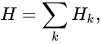
H is the total enthalpy of all the subsystems,
k refers to the various subsystems,
Hk refers to the enthalpy of each subsystem.

A closed system may lie in thermodynamic equilibrium in a static gravitational field, so that its pressure p varies continuously with altitude, while, because of the equilibrium requirement, its temperature T is invariant with altitude. (Correspondingly, the system's gravitational potential energy density also varies with altitude.) Then the enthalpy summation becomes an integral: where

ρ ("rho") is density (mass per unit volume),
h is the specific enthalpy (enthalpy per unit mass),
ρh represents the enthalpy density (enthalpy per unit volume),
dV denotes an infinitesimally small element of volume within the system, for example, the volume of an infinitesimally thin horizontal layer.

The integral therefore represents the sum of the enthalpies of all the elements of the volume.

The enthalpy of a closed homogeneous system is its energy function H(S, p), with its entropy S[p] and its pressure p as natural state variables which provide a differential relation for dH of the simplest form, derived as follows. We start from the first law of thermodynamics for closed systems for an infinitesimal process: where

δQ is a small amount of heat added to the system,
δW is a small amount of work performed by the system.

In a homogeneous system in which only reversible processes or pure heat transfer are considered, the second law of thermodynamics gives δQ = T dS, with T the absolute temperature and dS the infinitesimal change in entropy S of the system. Furthermore, if only pV work is done, δW = p dV. As a result,

Adding d(pV) to both sides of this expression gives or So and the coefficients of the natural variable differentials dS and dp are just the single variables T and V.

Other expressions

The above expression of dH in terms of entropy and pressure may be unfamiliar to some readers. There are also expressions in terms of more directly measurable variables such as temperature and pressure: where Cp is the heat capacity at constant pressure, and α is the coefficient of (cubic) thermal expansion:

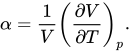
With this expression one can, in principle, determine the enthalpy if Cp and V are known as functions of p and T. However the expression is more complicated than because T is not a natural variable for the enthalpy H.

At constant pressure, so that For an ideal gas, reduces to this form even if the process involves a pressure change, because αT = 1.

In a more general form, the first law describes the internal energy with additional terms involving the chemical potential and the number of particles of various types. The differential statement for dH then becomes where μi is the chemical potential per particle for a type i particle, and Ni is the number of such particles. The last term can also be written as μi dni (with dni 0 the number of moles of component i added to the system and, in this case, μi the molar chemical potential) or as μi dmi (with dmi the mass of component i added to the system and, in this case, μi the specific chemical potential).

Characteristic functions and natural state variables

The enthalpy H(S[p], p, {Ni}) expresses the thermodynamics of a system in the energy representation. As a function of state, its arguments include one intensive and several extensive state variables. The state variables S[p], p, and {Ni} are said to be the natural state variables in this representation. They are suitable for describing processes in which they are determined by factors in the surroundings. For example, when a virtual parcel of atmospheric air moves to a different altitude, the pressure surrounding it changes, and the process is often so rapid that there is too little time for heat transfer. This is the basis of the so-called adiabatic approximation that is used in meteorology.

Conjugate with the enthalpy, with these arguments, the other characteristic function of state of a thermodynamic system is its entropy, as a function S[p](H, p, {Ni}) of the same list of variables of state, except that the entropy S[p] is replaced in the list by the enthalpy H. It expresses the entropy representation. The state variables H, p, and {Ni} are said to be the natural state variables in this representation. They are suitable for describing processes in which they are experimentally controlled. For example, H and p can be controlled by allowing heat transfer, and by varying only the external pressure on the piston that sets the volume of the system.

Physical interpretation

The U term is the energy of the system, and the pV term can be interpreted as the work that would be required to "make room" for the system if the pressure of the environment remained constant. When a system, for example, n moles of a gas of volume V at pressure p and temperature T, is created or brought to its present state from absolute zero, energy must be supplied equal to its internal energy U plus pV, where pV is the work done in pushing against the ambient (atmospheric) pressure.

In physics and statistical mechanics it may be more interesting to study the internal properties of a constant-volume system and therefore the internal energy is used. In chemistry, experiments are often conducted at constant atmospheric pressure, and the pressure–volume work represents a small, well-defined energy exchange with the atmosphere, so that ΔH is the appropriate expression for the heat of reaction. For a heat engine, the change in its enthalpy after a full cycle is equal to zero, since the final and initial state are equal.

Relationship to heat

In order to discuss the relation between the enthalpy increase and heat supply, we return to the first law for closed systems, with the physics sign convention: dU = δQ − δW, where the heat δQ is supplied by conduction, radiation, Joule heating. We apply it to the special case with a constant pressure at the surface. In this case the work is given by p dV (where p is the pressure at the surface, dV is the increase of the volume of the system). Cases of long-range electromagnetic interaction require further state variables in their formulation and are not considered here. In this case the first law reads: Now, so

If the system is under constant pressure, dp = 0 and consequently, the increase in enthalpy of the system is equal to the heat added: This is why the now-obsolete term heat content was used for enthalpy in the 19th century.

Applications

In thermodynamics, one can calculate enthalpy by determining the requirements for creating a system from "nothingness"; the mechanical work required, pV, differs based upon the conditions that obtain during the creation of the thermodynamic system.

Energy must be supplied to remove particles from the surroundings to make space for the creation of the system, assuming that the pressure p remains constant; this is the pV term. The supplied energy must also provide the change in internal energy U, which includes activation energies, ionization energies, mixing energies, vaporization energies, chemical bond energies, and so forth. Together, these constitute the change in the enthalpy U + pV. For systems at constant pressure, with no external work done other than the pV work, the change in enthalpy is the heat received by the system.

For a simple system with a constant number of particles at constant pressure, the difference in enthalpy is the maximum amount of thermal energy derivable from an isobaric thermodynamic process.

Heat of reaction

The total enthalpy of a system cannot be measured directly; the enthalpy change of a system is measured instead. Enthalpy change is defined by the following equation:

where

  • ΔH is the "enthalpy change",
  • Hf is the final enthalpy of the system (in a chemical reaction, the enthalpy of the products or the system at equilibrium),
  • Hi is the initial enthalpy of the system (in a chemical reaction, the enthalpy of the reactants).

For an exothermic reaction at constant pressure, the system's change in enthalpy, ΔH, is negative due to the products of the reaction having a smaller enthalpy than the reactants, and equals the heat released in the reaction if no electrical or mechanical work is done. In other words, the overall decrease in enthalpy is achieved by the generation of heat. Conversely, for a constant-pressure endothermic reaction, ΔH is positive and equal to the heat absorbed in the reaction.

From the definition of enthalpy as H = U + pV, the enthalpy change at constant pressure is ΔH = ΔU + p ΔV. However, for most chemical reactions, the work term p ΔV is much smaller than the internal energy change ΔU, which is approximately equal to ΔH. As an example, for the combustion of carbon monoxide 2 CO(g) + O2(g) → 2 CO2(g), ΔH = −566.0 kJ and ΔU = −563.5 kJ. Since the differences are so small, reaction enthalpies are often described as reaction energies and analyzed in terms of bond energies.

Specific enthalpy

The specific enthalpy of a uniform system is defined as h = H/m, where m is the mass of the system. Its SI unit is joule per kilogram. It can be expressed in other specific quantities by h = u + pv, where u is the specific internal energy, p is the pressure, and v is specific volume, which is equal to 1/ρ, where ρ is the density.

Enthalpy changes

An enthalpy change describes the change in enthalpy observed in the constituents of a thermodynamic system when undergoing a transformation or chemical reaction. It is the difference between the enthalpy after the process has completed, i.e. the enthalpy of the products assuming that the reaction goes to completion, and the initial enthalpy of the system, namely the reactants. These processes are specified solely by their initial and final states, so that the enthalpy change for the reverse is the negative of that for the forward process.

A common standard enthalpy change is the enthalpy of formation, which has been determined for a large number of substances. Enthalpy changes are routinely measured and compiled in chemical and physical reference works, such as the CRC Handbook of Chemistry and Physics. The following is a selection of enthalpy changes commonly recognized in thermodynamics.

When used in these recognized terms the qualifier change is usually dropped and the property is simply termed enthalpy of "process". Since these properties are often used as reference values, it is very common to quote them for a standardized set of environmental parameters, or standard conditions, including:

  • A pressure of one atmosphere (1 atm = 1013.25 hPa) or 1 bar
  • A temperature of 25 °C = 298.15 K
  • A concentration of 1.0 M when the element or compound is present in solution
  • Elements or compounds in their normal physical states, i.e. standard state

For such standardized values the name of the enthalpy is commonly prefixed with the term standard, e.g. standard enthalpy of formation.

Chemical properties

Enthalpy of reaction is defined as the enthalpy change observed in a constituent of a thermodynamic system when one mole of substance reacts completely.

Enthalpy of formation is defined as the enthalpy change observed in a constituent of a thermodynamic system when one mole of a compound is formed from its elementary antecedents.

Enthalpy of combustion is defined as the enthalpy change observed in a constituent of a thermodynamic system when one mole of a substance burns completely with oxygen.

Enthalpy of hydrogenation is defined as the enthalpy change observed in a constituent of a thermodynamic system when one mole of an unsaturated compound reacts completely with an excess of hydrogen to form a saturated compound.

Enthalpy of atomization is defined as the enthalpy change required to separate one mole of a substance into its constituent atoms completely.

Enthalpy of neutralization is defined as the enthalpy change observed in a constituent of a thermodynamic system when one mole of water is formed when an acid and a base react.

Standard enthalpy of solution is defined as the enthalpy change observed in a constituent of a thermodynamic system when one mole of a solute is dissolved completely in an excess of solvent, so that the solution is at infinite dilution.

Standard enthalpy of denaturation is defined as the enthalpy change required to denature one mole of compound.

Enthalpy of hydration is defined as the enthalpy change observed when one mole of gaseous ions is completely dissolved in water forming one mole of aqueous ions.

Physical properties

Enthalpy of fusion is defined as the enthalpy change required to completely change the state of one mole of substance from solid to liquid.

Enthalpy of vaporization is defined as the enthalpy change required to completely change the state of one mole of substance from liquid to gas.

Enthalpy of sublimation is defined as the enthalpy change required to completely change the state of one mole of substance from solid to gas.

Lattice enthalpy is defined as the energy required to separate one mole of an ionic compound into separated gaseous ions to an infinite distance apart (meaning no force of attraction).

Enthalpy of mixing is defined as the enthalpy change upon mixing of two (non-reacting) chemical substances.

Open systems

In thermodynamic open systems, mass (of substances) may flow in and out of the system boundaries. The first law of thermodynamics for open systems states: The increase in the internal energy of a system is equal to the amount of energy added to the system by mass flowing in and by heating, minus the amount lost by mass flowing out and in the form of work done by the system: where Uin is the average internal energy entering the system, and Uout is the average internal energy leaving the system.

During steady, continuous operation, an energy balance applied to an open system equates shaft work performed by the system to heat added plus net enthalpy added

The region of space enclosed by the boundaries of the open system is usually called a control volume, and it may or may not correspond to physical walls. If we choose the shape of the control volume such that all flow in or out occurs perpendicular to its surface, then the flow of mass into the system performs work as if it were a piston of fluid pushing mass into the system, and the system performs work on the flow of mass out as if it were driving a piston of fluid. There are then two types of work performed: flow work described above, which is performed on the fluid (this is also often called pV work), and mechanical work (shaft work), which may be performed on some mechanical device such as a turbine or pump.

These two types of work are expressed in the equation Substitution into the equation above for the control volume (cv) yields

The definition of enthalpy H permits us to use this thermodynamic potential to account for both internal energy and pV work in fluids for open systems:

If we allow also the system boundary to move (e.g. due to moving pistons), we get a rather general form of the first law for open systems. In terms of time derivatives, using Newton's dot notation for time derivatives, it reads: with sums over the various places k where heat is supplied, mass flows into the system, and boundaries are moving. The .Hk terms represent enthalpy flows, which can be written as with the mass flow and the molar flow at position k respectively. The term dVk/dt represents the rate of change of the system volume at position k that results in pV power done by the system. The parameter P represents all other forms of power done by the system such as shaft power, but it can also be, say, electric power produced by an electrical power plant.

Note that the previous expression holds true only if the kinetic energy flow rate is conserved between system inlet and outlet. Otherwise, it has to be included in the enthalpy balance. During steady-state operation of a device (such as a turbine, pump, or engine), the average dU/dt may be set equal to zero. This yields a useful expression for the average power generation for these devices in the absence of chemical reactions: where the angle brackets denote time averages. The technical importance of the enthalpy is directly related to its presence in the first law for open systems, as formulated above.

Diagrams

T − s diagram of nitrogen. The red curve at the left is the melting curve. The red dome represents the two-phase region with the low-entropy side the saturated liquid and the high-entropy side the saturated gas. The black curves give the T − s relation along isobars. The pressures are indicated in bar. The blue curves are isenthalps (curves of constant enthalpy). The values are indicated in blue in ⁠ kJ /kg⁠. The specific points a, b, etc., are treated in the main text.

The enthalpy values of important substances can be obtained using commercial software. Practically all relevant material properties can be obtained either in tabular or in graphical form. There are many types of diagrams, such as h − T diagrams, which give the specific enthalpy as function of temperature for various pressures, and h − p diagrams, which give h as function of p for various T. One of the most common diagrams is the temperature–specific entropy diagram (T − s diagram). It gives the melting curve and saturated liquid and vapor values together with isobars and isenthalps. These diagrams are powerful tools in the hands of the thermal engineer.

Some basic applications

The points a through h in the figure play a role in the discussion in this section.

Point Tpsh
UnitKbar⁠ kJ / kg K ⁠⁠ kJ / kg ⁠
a30016.85461
b38026.85530
c3002005.16430
d27016.79430
e108133.55100
f77.213.75100
g77.212.8328
h77.215.41230

Points e and g are saturated liquids, and point h is a saturated gas.

Throttling

Schematic diagram of a throttling in the steady state. Fluid enters the system (dotted rectangle) at point 1 and leaves it at point 2. The mass flow is ṁ.

One of the simple applications of the concept of enthalpy is the so-called throttling process, also known as Joule–Thomson expansion. It concerns a steady adiabatic flow of a fluid through a flow resistance (valve, porous plug, or any other type of flow resistance) as shown in the figure. This process is very important, since it is at the heart of domestic refrigerators, where it is responsible for the temperature drop between ambient temperature and the interior of the refrigerator. It is also the final stage in many types of liquefiers.

For a steady state flow regime, the enthalpy of the system (dotted rectangle) has to be constant. Hence

Since the mass flow is constant, the specific enthalpies at the two sides of the flow resistance are the same:

that is, the enthalpy per unit mass does not change during the throttling. The consequences of this relation can be demonstrated using the T − s diagram above.

Example 1

Point c is at 200 bar and room temperature (300 K). A Joule–Thomson expansion from 200 bar to 1 bar follows a curve of constant enthalpy of roughly 425 ⁠ kJ /kg⁠ (not shown in the diagram) lying between the 400 and 450 ⁠ kJ /kg⁠ isenthalps and ends in point d, which is at a temperature of about 270 K. Hence the expansion from 200 bar to 1 bar cools nitrogen from 300 K to 270 K. In the valve, there is a lot of friction, and a lot of entropy is produced, but still the final temperature is below the starting value.

Example 2

Point e is chosen so that it is on the saturated liquid line with h = 100 ⁠ kJ /kg⁠. It corresponds roughly with p = 13 bar and T = 108 K. Throttling from this point to a pressure of 1 bar ends in the two-phase region (point f). This means that a mixture of gas and liquid leaves the throttling valve. Since the enthalpy is an extensive parameter, the enthalpy in f ( hf ) is equal to the enthalpy in g ( hg ) multiplied by the liquid fraction in f ( xf ) plus the enthalpy in h ( hh ) multiplied by the gas fraction in f (1 − xf ). So

With numbers:

100 = xf × 28 + (1 − xf) × 230 , so xf = 0.64.

This means that the mass fraction of the liquid in the liquid–gas mixture that leaves the throttling valve is 64%.

Compressors

Schematic diagram of a compressor in the steady state. Fluid enters the system (dotted rectangle) at point 1 and leaves it at point 2. The mass flow is ṁ. A power P is applied and a heat flow Q̇ is released to the surroundings at ambient temperature Ta.

A power P is applied e.g. as electrical power. If the compression is adiabatic, the gas temperature goes up. In the reversible case it would be at constant entropy, which corresponds with a vertical line in the T − s diagram. For example, compressing nitrogen from 1 bar (point a) to 2 bar (point b) would result in a temperature increase from 300 K to 380 K. In order to let the compressed gas exit at ambient temperature Ta, heat exchange, e.g. by cooling water, is necessary. In the ideal case the compression is isothermal. The average heat flow to the surroundings is Q̇. Since the system is in the steady state the first law gives

The minimal power needed for the compression is realized if the compression is reversible. In that case the second law of thermodynamics for open systems gives
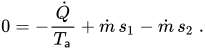
Eliminating Q̇ gives for the minimal power

For example, compressing 1 kg of nitrogen from 1 bar to 200 bar costs at least : ( hc − ha ) − Ta( sc − sa ). With the data, obtained with the T − s diagram, we find a value of (430 − 461) − 300 × (5.16 − 6.85) = 476 ⁠ kJ /kg⁠.

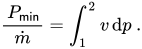
The relation for the power can be further simplified by writing it as

With

dh = T ds + v dp ,

this results in the final relation
History and etymology

The term enthalpy was coined relatively late in the history of thermodynamics, in the early 20th century. Energy was introduced in a modern sense by Thomas Young in 1802, while entropy by Rudolf Clausius in 1865. Energy uses the root of the Greek word ἔργον (ergon), meaning "work", to express the idea of capacity to perform work. Entropy uses the Greek word τροπή (tropē) meaning transformation or turning. Enthalpy uses the root of the Greek word θάλπος (thalpos) "warmth, heat".

The term expresses the obsolete concept of heat content, as dH refers to the amount of heat gained in a process at constant pressure only, but not in the general case when pressure is variable. J. W. Gibbs used the term "a heat function for constant pressure" for clarity.

Introduction of the concept of "heat content" H is associated with Benoît Paul Émile Clapeyron and Rudolf Clausius (Clausius–Clapeyron relation, 1850).

The term enthalpy first appeared in print in 1909. It is attributed to Heike Kamerlingh Onnes, who most likely introduced it orally the year before, at the first meeting of the Institute of Refrigeration in Paris. It gained currency only in the 1920s, notably with the Mollier Steam Tables and Diagrams, published in 1927.

Until the 1920s, the symbol H was used, somewhat inconsistently, for "heat" in general. The definition of H as strictly limited to enthalpy or "heat content at constant pressure" was formally proposed by A. W. Porter in 1922.

Notes

  1. Howard (2002) quotes J. R. Partington in An Advanced Treatise on Physical Chemistry (1949) as saying that the function H was "usually called the heat content."
  2. Volume I of Gibbs' Collected Works does not contain the word enthalpy, but uses the phrase "heat function for constant pressure" instead, for the same quantity.

Determinism

From Wikipedia, the free encyclopedia
https://en.wikipedia.org/wiki/Determinism

Determinism is the metaphysical view that all events within the universe can occur only in one possible way. Deterministic theories throughout the history of philosophy have developed from diverse and sometimes overlapping motives and considerations. Like eternalism, determinism focuses on particular events rather than the future as a concept. Determinism is often contrasted with free will, although some philosophers argue that the two are compatible. The antonym of determinism is indeterminism, the view that events are not deterministically caused.

Historically, debates about determinism have involved many philosophical positions and given rise to multiple varieties or interpretations of determinism. One topic of debate concerns the scope of determined systems. Some philosophers have maintained that the entire universe is a single determinate system, while others identify more limited determinate systems. Another common debate topic is whether determinism and free will can coexist; compatibilism and incompatibilism represent the opposing sides of this debate.

Determinism should not be confused with the self-determination of human actions by reasons, motives, and desires. Determinism is about interactions which affect cognitive processes in people's lives. It concerns the cause and effect of human actions. Cause and result are always bound together in cognitive processes. It assumes that if an observer has sufficient information about an object or human being, then such an observer might be able to predict every consequent move of that object or human being. Determinism rarely requires that perfect prediction be practically possible.

Causal determinism posits that every event results from preceding events and natural laws, while nomological determinism emphasizes the predictability of the future from past and present states. Necessitarianism claims only one possible world exists, and predeterminism suggests events are fixed in advance, sometimes biologically or genetically. Fatalism and theological determinism attribute outcomes to fate or divine omniscience, whereas adequate determinism and interpretations of quantum mechanics explore probabilistic or emergent constraints on macroscopic phenomena. Philosophical varieties extend to human behavior, including biological, psychological, social, and cultural determinism, as well as structural determinism, which highlights systemic constraints. Historically, determinism appears in both Western traditions, from the Presocratics and Stoics to Newtonian mechanics, and Eastern philosophy, including karma, Ājīvika fatalism, and Buddhist dependent origination. Modern science recognizes deterministic models in classical physics and complex generative processes, while quantum mechanics introduces probabilistic and debated interpretations.

Varieties

Determinism may commonly refer to any of the following viewpoints:

Causal

Causal determinism, sometimes synonymous with historical determinism (a sort of path dependence), is "the idea that every event is necessitated by antecedent events and conditions together with the laws of nature." However, it is a broad enough term to consider that:

...One's deliberations, choices, and actions will often be necessary links in the causal chain that brings something about. In other words, even though our deliberations, choices, and actions are themselves determined like everything else, it is still the case, according to causal determinism, that the occurrence or existence of yet other things depends upon our deliberating, choosing and acting in a certain way.

Causal determinism proposes that there is an unbroken chain of prior occurrences stretching back to the origin of the universe. The relation between events and the origin of the universe may not be specified. Causal determinists believe that there is nothing in the universe that has no cause or is self-caused. Causal determinism has also been considered more generally as the idea that everything that happens and exists is caused by antecedent conditions. In the case of nomological determinism, these conditions are considered events also, implying that the future is determined completely by preceding events—a combination of prior states of the universe and the laws of nature. These conditions can also be considered metaphysical in origin (such as in the case of theological determinism).

Many philosophical theories of determinism frame themselves with the idea that reality follows a sort of predetermined path.

Nomological

Nomological determinism is the most common form of causal determinism and is generally synonymous with physical determinism. This is the notion that the past and the present dictate the future entirely and necessarily by rigid natural laws and that every occurrence inevitably results from prior events. Nomological determinism is sometimes illustrated by the thought experiment of Laplace's demon. Laplace posited that an omniscient observer, knowing with infinite precision all the positions and velocities of every particle in the universe, could predict the future entirely. Ernest Nagel viewed determinism in terms of a physical state, declaring a theory to be deterministic if it predicts a state at other times uniquely from values at one given time.

Necessitarianism

Necessitarianism is a metaphysical principle that denies all mere possibility and maintains that there is only one possible way for the world to exist. Leucippus claimed there are no uncaused events and that everything occurs for a reason and by necessity.

Predeterminism

Predeterminism is the idea that all events are determined in advance. The concept is often argued by invoking causal determinism, implying that there is an unbroken chain of prior occurrences stretching back to the origin of the universe. In the case of predeterminism, this chain of events has been pre-established, and human actions cannot interfere with the outcomes of this pre-established chain.

Predeterminism can be categorized as a specific type of determinism when it is used to mean pre-established causal determinism. It can also be used interchangeably with causal determinism—in the context of its capacity to determine future events. However, predeterminism is often considered as independent of causal determinism.

Biological

The term predeterminism is also frequently used in the context of biology and heredity, in which case it represents a form of biological determinism, sometimes called genetic determinism. Biological determinism is the idea that all human behaviors, beliefs, and desires are fixed by human genetic nature.

Friedrich Nietzsche explained that human beings are "determined" by their bodies and are subject to its passions, impulses, and instincts.

Fatalism

Fatalism is normally distinguished from determinism, as a form of teleological determinism. Fatalism is the idea that everything is fated to happen, resulting in humans having no control over their future. Fate has arbitrary power, and does not necessarily follow any causal or deterministic laws. Types of fatalism include hard theological determinism and the idea of predestination, where there is a God who determines all that humans will do. This may be accomplished through either foreknowledge of their actions, achieved through omniscience or by predetermining their actions.

Theological

Theological determinism is a form of determinism that holds that all events that happen are either preordained (i.e., predestined) to happen by a monotheistic deity, or are destined to occur given its omniscience. Two forms of theological determinism exist, referred to as strong and weak theological determinism.

Strong theological determinism is based on the concept of a creator deity dictating all events in history: "everything that happens has been predestined to happen by an omniscient, omnipotent divinity."

Weak theological determinism is based on the concept of divine foreknowledge—"because God's omniscience is perfect, what God knows about the future will inevitably happen, which means, consequently, that the future is already fixed." There exist slight variations on this categorization, however. Some claim either that theological determinism requires predestination of all events and outcomes by the divinity—i.e., they do not classify the weaker version as theological determinism unless libertarian free will is assumed to be denied as a consequence—or that the weaker version does not constitute theological determinism at all.

With respect to free will, "theological determinism is the thesis that God exists and has infallible knowledge of all true propositions including propositions about our future actions", more minimal criteria designed to encapsulate all forms of theological determinism.

Theological determinism can also be seen as a form of causal determinism, in which the antecedent conditions are the nature and will of God. Some have asserted that Augustine of Hippo introduced theological determinism into Christianity in 412 CE, whereas all prior Christian authors supported free will against Stoic and Gnostic determinism. However, there are many Biblical passages that seem to support the idea of some kind of theological determinism.

Adequate

Adequate determinism is the idea, because of quantum decoherence, that quantum indeterminacy can be ignored for most macroscopic events. Random quantum events "average out" in the limit of large numbers of particles (where the laws of quantum mechanics asymptotically approach the laws of classical mechanics). While there are specific examples of these random events magnified to macro levels, such as Geiger counters, they are still insignificant in the context of free will.

Determined probability

Stephen Hawking explained that the microscopic world of quantum mechanics is one of determined probabilities. That is, nature is not governed by laws that determine the future with certainty but by laws that determine the probability of various futures.

Many-worlds interpretation

The many-worlds interpretation of quantum mechanics accepts the linear causal sets of sequential events with adequate consistency yet also suggests constant forking of causal chains that can in principle be globally deterministic. Meaning the causal set of events leading to the present are all valid yet appear as a singular linear time stream within a much broader unseen conic probability field of other outcomes that "split off" from the locally observed timeline. Under this model causal sets are still "consistent" yet not exclusive to singular iterated outcomes.

The interpretation sidesteps the exclusive retrospective causal chain problem of "could not have done otherwise" by suggesting "the other outcome does exist" in a set of parallel states of the universe that (in one version) split off in any interacting event. This interpretation is sometimes described with the example of agent-based choices.

Philosophical varieties

Nature/nurture controversy

Although some of the above forms of determinism concern human behaviors and cognition, others frame themselves as an answer to the debate on nature and nurture. They will suggest that one factor will entirely determine behavior. As scientific understanding has grown, however, the strongest versions of these theories have been widely rejected as a single-cause fallacy. In other words, the modern deterministic theories attempt to explain how the interaction of both nature and nurture is entirely predictable. The concept of heritability has been helpful in making this distinction.

Determinism and prediction

Other deterministic theories actually seek only to highlight the importance of a particular factor in predicting the future. These theories often use the factor as a sort of guide or constraint on the future. They need not suppose that complete knowledge of that one factor would allow the making of perfect predictions.

Structural

Structural determinism is the philosophical view that actions, events, and processes are predicated on and determined by structural factors. Given any particular structure or set of estimable components, it is a concept that emphasizes rational and predictable outcomes. Chilean biologists Humberto Maturana and Francisco Varela popularized the notion, writing that a living system's general order is maintained via a circular process of ongoing self-referral, and thus its organization and structure defines the changes it undergoes. According to the authors, a system can undergo changes of state (alteration of structure without loss of identity) or disintegrations (alteration of structure with loss of identity). Such changes or disintegrations are not ascertained by the elements of the disturbing agent, as each disturbance will only trigger responses in the respective system, which in turn, are determined by each system's own structure.

On an individualistic level, what this means is that human beings as free and independent entities are triggered to react by external stimuli or change in circumstance. However, their own internal state and existing physical and mental capacities determine their responses to those triggers. On a much broader societal level, structural determinists believe that larger issues in the society—especially those pertaining to minorities and subjugated communities—are predominantly assessed through existing structural conditions, making change of prevailing conditions difficult, and sometimes outright impossible. For example, the concept has been applied to the politics of race in the United States of America and other Western countries such as the United Kingdom and Australia, with structural determinists lamenting structural factors for the prevalence of racism in these countries. Additionally, Marxists have conceptualized the writings of Karl Marx within the context of structural determinism as well. For example, Louis Althusser, a structural Marxist, argued that the state, in its political, economic, and legal structures, reproduces the discourse of capitalism, in turn, allowing for the burgeoning of capitalistic structures.

Proponents of the notion highlight the usefulness of structural determinism to study complicated issues related to race and gender, as it highlights often gilded structural conditions that block meaningful change. Critics call it too rigid, reductionist and inflexible. Additionally, they also criticize the notion for overemphasizing deterministic forces such as structure over the role of human agency and the ability of the people to act. These critics argue that politicians, academics, and social activists have the capability to bring about significant change despite stringent structural conditions.

With free will

Philosophers have debated both the truth of determinism, and the truth of free will. This creates the four possible positions in the figure. Compatibilism refers to the view that free will is, in some sense, compatible with determinism. The three incompatibilist positions deny this possibility. The hard incompatibilists hold that free will is incompatible with both determinism and indeterminism, the libertarians that determinism does not hold, and free will might exist, and the hard determinists that determinism does hold and free will does not exist. The Dutch philosopher Baruch Spinoza was a determinist thinker, and argued that human freedom can be achieved through knowledge of the causes that determine desire and affections. He defined human servitude as the state of bondage of anyone who is aware of their own desires, but ignorant of the causes that determined them. However, the free or virtuous person becomes capable, through reason and knowledge, to be genuinely free, even as they are being "determined". For the Dutch philosopher, acting out of one's own internal necessity is genuine freedom while being driven by exterior determinations is akin to bondage. Spinoza's thoughts on human servitude and liberty are respectively detailed in the fourth and fifth volumes of his work Ethics.

The standard argument against free will, according to philosopher J. J. C. Smart, focuses on the implications of determinism for free will. He suggests free will is denied whether determinism is true or not. He says that if determinism is true, all actions are predicted and no one is assumed to be free; however, if determinism is false, all actions are presumed to be random and as such no one seems free because they have no part in controlling what happens.

With the soul

Some determinists argue that materialism does not present a complete understanding of the universe, because while it can describe determinate interactions among material things, it ignores the minds or souls of conscious beings.

A number of positions can be delineated:

  • Immaterial souls are all that exist (idealism).
  • Immaterial souls exist and exert a nondeterministic causal influence on bodies (traditional free will, interactionist dualism).
  • Immaterial souls exist but are part of a deterministic framework.
  • Immaterial souls exist, but exert no causal influence, free or determined (epiphenomenalism, occasionalism)
  • Immaterial souls do not exist – there is no mind–body dichotomy, and there is a materialistic explanation for intuitions to the contrary.

With ethics and morality

Another topic of debate is the implication that determinism has on morality.

Philosopher and incompatibilist Peter van Inwagen introduced the following thesis arguing that free will is required for moral judgments:

  1. The moral judgment that X should not have been done implies that something else should have been done instead.
  2. That something else should have been done instead implies that there was something else to do.
  3. That there was something else to do, implies that something else could have been done.
  4. That something else could have been done implies that there is free will.
  5. If there is no free will to have done other than X we cannot make the moral judgment that X should not have been done.

In contrast to such views, philosopher Harry Frankfurt challenged the "principle of alternate possibilities", which states that a person is morally responsible for an action only if they could have done otherwise. Against this principle, Frankfurt proposes cases in which an individual appears morally responsible even though alternative courses of action are not genuinely available. In his examples, an external agent (referred to as Black) has the capacity to monitor an individual’s decision-making and stands ready to intervene, for instance by altering the individual’s mental processes, to ensure a particular decision if the individual were about to choose otherwise. However, in the scenario Frankfurt describes, this intervention never occurs because the individual (Jones) independently makes the same decision. In such cases, although Jones could not have done otherwise because intervention would have occurred if he had tried to choose differently, Frankfurt contends that this lack of alternatives plays no role in bringing about the action and therefore does not undermine moral responsibility. These Frankfurt-style cases have been influential in compatibilist accounts of free will, as they suggest that moral responsibility may not depend on the availability of alternative possibilities.

Similarly, P. F. Strawson has argued that the debate over determinism and moral responsibility should be understood in terms of ordinary interpersonal practices rather than resolved solely by appeal to abstract metaphysical conditions. Strawson distinguishes between “optimists”, who maintain that moral responsibility is compatible with determinism, and “pessimists”, who hold that moral responsibility has no application if determinism is true, and seeks to reconcile these positions by examining the role of what he calls "reactive attitudes". These include attitudes such as resentment, gratitude, and forgiveness, which are natural human responses to the perceived good or ill will of others toward oneself or others, as expressed in their actions. Strawson argues that these attitudes, along with their more general or “vicarious” forms directed toward the treatment of others, underlie moral practices and concepts. He contrasts “participant” attitudes with the “objective attitude”, in which individuals are regarded as objects of management or treatment rather than as participants in interpersonal relationships. Such a stance is typically adopted in particular cases involving abnormality or incapacity, rather than as a result of any general belief about the truth of determinism. He contends that it is not psychologically possible for human beings to abandon participant attitudes altogether in favor of a wholly objective stance, even if determinism were true. On this account, moral responsibility is grounded in the structure of interpersonal relationships and reactive attitudes, and is therefore not undermined by determinism.

History

Determinism was developed by the Greek philosophers during the 7th and 6th centuries BCE by the Pre-socratic philosophers Heraclitus and Leucippus, later Aristotle, and mainly by the Stoics. Some of the main philosophers who have dealt with this issue are Marcus Aurelius, Omar Khayyam, Thomas Hobbes, Baruch Spinoza, Gottfried Leibniz, David Hume, Baron d'Holbach (Paul Heinrich Dietrich), Pierre-Simon Laplace, Arthur Schopenhauer, William James, Friedrich Nietzsche, Albert Einstein, Niels Bohr, Ralph Waldo Emerson and, more recently, John Searle, Ted Honderich, and Daniel Dennett.

Mecca Chiesa notes that the probabilistic or selectionistic determinism of B. F. Skinner comprised a wholly separate conception of determinism that was not mechanistic at all. Mechanistic determinism assumes that every event has an unbroken chain of prior occurrences, but a selectionistic or probabilistic model does not.

Western tradition

In the West, some elements of determinism have been expressed in Greece from the 6th century BCE by the Presocratics Heraclitus and Leucippus. The first notions of determinism appears to originate with the Stoics, as part of their theory of universal causal determinism. The resulting philosophical debates, which involved the confluence of elements of Aristotelian Ethics with Stoic psychology, led in the 1st–3rd centuries CE in the works of Alexander of Aphrodisias to the first recorded Western debate over determinism and freedom, an issue that is known in theology as the paradox of free will. The writings of Epictetus as well as middle Platonist and early Christian thought were instrumental in this development. Jewish philosopher Moses Maimonides said of the deterministic implications of an omniscient god: "Does God know or does He not know that a certain individual will be good or bad? If thou sayest 'He knows', then it necessarily follows that [that] man is compelled to act as God knew beforehand he would act, otherwise God's knowledge would be imperfect."

Newtonian mechanics

Determinism in the West is often associated with Newtonian mechanics/physics, which depicts the physical matter of the universe as operating according to a set of fixed laws. The "billiard ball" hypothesis, a product of Newtonian physics, argues that once the initial conditions of the universe have been established, the rest of the history of the universe follows inevitably. If it were actually possible to have complete knowledge of physical matter and all of the laws governing that matter at any one time, then it would be theoretically possible to compute the time and place of every event that will ever occur (Laplace's demon). In this sense, the basic particles of the universe operate in the same fashion as the rolling balls on a billiard table, moving and striking each other in predictable ways to produce predictable results.

Whether or not it is all-encompassing in so doing, Newtonian mechanics deals only with caused events; for example, if an object begins in a known position and is hit dead on by an object with some known velocity, then it will be pushed straight toward another predictable point. If it goes somewhere else, the Newtonians argue, one must question one's measurements of the original position of the object, the exact direction of the striking object, gravitational or other fields that were inadvertently ignored, etc. Then, they maintain, repeated experiments and improvements in accuracy will always bring one's observations closer to the theoretically predicted results. When dealing with situations on an ordinary human scale, Newtonian physics has been successful. But it fails as velocities become some substantial fraction of the speed of light and when interactions at the atomic scale are studied. Before the discovery of quantum effects and other challenges to Newtonian physics, "uncertainty" was always a term that applied to the accuracy of human knowledge about causes and effects, and not to the causes and effects themselves.

Newtonian mechanics, as well as any following physical theories, are results of observations and experiments, and so they describe "how it all works" within a tolerance. However, old western scientists believed if there are any logical connections found between an observed cause and effect, there must be also some absolute natural laws behind. Belief in perfect natural laws driving everything, instead of just describing what we should expect, led to searching for a set of universal simple laws that rule the world. This movement significantly encouraged deterministic views in Western philosophy, as well as the related theological views of classical pantheism.

Eastern tradition

Throughout history, the belief that the entire universe is a deterministic system subject to the will of fate or destiny has been articulated in both Eastern and Western religions, philosophy, music, and literature.

The ancient Arabs that inhabited the Arabian Peninsula before the advent of Islam used to profess a widespread belief in fatalism (ḳadar) alongside a fearful consideration for the sky and the stars as divine beings, which they held to be ultimately responsible for every phenomena that occurs on Earth and for the destiny of humankind.[59] Accordingly, they shaped their entire lives in accordance with their interpretations of astral configurations and phenomena.[59]

In the I Ching and philosophical Taoism, the ebb and flow of favorable and unfavorable conditions suggests the path of least resistance is effortless (see: Wu wei). In the philosophical schools of the Indian Subcontinent, the concept of karma deals with similar philosophical issues to the Western concept of determinism. Karma is understood as a spiritual mechanism which causes the eternal cycle of birth, death, and rebirth (saṃsāra). Karma, either positive or negative, accumulates according to an individual's actions throughout their life, and at their death determines the nature of their next life in the cycle of Saṃsāra. Most major religions originating in India hold this belief to some degree, most notably Hinduism, Jainism, Sikhism, and Buddhism.

The views on the interaction of karma and free will are numerous, and diverge from each other. For example, in Sikhism, god's grace, gained through worship, can erase one's karmic debts, a belief which reconciles the principle of karma with a monotheistic god one must freely choose to worship. Jainists believe in compatibilism, in which the cycle of Saṃsara is a completely mechanistic process, occurring without any divine intervention. The Jains hold an atomic view of reality, in which particles of karma form the fundamental microscopic building material of the universe.

Ājīvika

In ancient India, the Ājīvika school of philosophy founded by Makkhali Gosāla (around 500 BCE), otherwise referred to as "Ājīvikism" in Western scholarship, upheld the Niyati ("Fate") doctrine of absolute fatalism or determinism, which negates the existence of free will and karma, and is therefore considered one of the nāstika or "heterodox" schools of Indian philosophy. The oldest descriptions of the Ājīvika fatalists and their founder Gosāla can be found both in the Buddhist and Jaina scriptures of ancient India. The predetermined fate of all sentient beings and the impossibility to achieve liberation (mokṣa) from the eternal cycle of birth, death, and rebirth (saṃsāra) was the major distinctive philosophical and metaphysical doctrine of this heterodox school of Indian philosophy, annoverated among the other Śramaṇa movements that emerged in India during the Second urbanization (600–200 BCE).

Buddhism

Buddhist philosophy contains several concepts which some scholars describe as deterministic to various levels. However, the direct analysis of Buddhist metaphysics through the lens of determinism is difficult, due to the differences between European and Buddhist traditions of thought.

One concept which is argued to support a hard determinism is the doctrine of dependent origination (pratītyasamutpāda) in the early Buddhist texts, which states that all phenomena (dharma) are necessarily caused by some other phenomenon, which it can be said to be dependent on, like links in a massive, never-ending chain; the basic principle is that all things (dharmas, phenomena, principles) arise in dependence upon other things, which means that they are fundamentally "empty" or devoid of any intrinsic, eternal essence and therefore are impermanent. In traditional Buddhist philosophy, this concept is used to explain the functioning of the eternal cycle of birth, death, and rebirth (saṃsāra); all thoughts and actions exert a karmic force that attaches to the individual's consciousness, which will manifest through reincarnation and results in future lives. In other words, righteous or unrighteous actions in one life will necessarily cause good or bad responses in another future life or more lives. The early Buddhist texts and later Tibetan Buddhist scriptures associate dependent arising with the fundamental Buddhist doctrines of emptiness (śūnyatā) and non-self (anattā).

Another Buddhist concept which many scholars perceive to be deterministic is the doctrine of non-self (anattā). In Buddhism, attaining enlightenment involves one realizing that neither in humans nor any other sentient beings there is a fundamental core of permanent being, identity, or personality which can be called the "soul", and that all sentient beings (including humans) are instead made of several, constantly changing factors which bind them to the eternal cycle of birth, death, and rebirth (saṃsāra). Sentient beings are composed of the five aggregates of existence (skandha): matter, sensation, perception, mental formations, and consciousness. In the Saṃyutta Nikāya of the Pāli Canon, the historical Buddha is recorded as saying that "just as the word 'chariot' exists on the basis of the aggregation of parts, even so the concept of 'being' exists when the five aggregates are available."[68] The early Buddhist texts outline different ways in which dependent origination is a middle way between different sets of "extreme" views (such as "monist" and "pluralist" ontologies or materialist and dualist views of mind-body relation). In the Kaccānagotta Sutta of the Pāli Canon (SN 12.15, parallel at SA 301), the historical Buddha stated that "this world mostly relies on the dual notions of existence and non-existence" and then explains the right view as follows:

But when you truly see the origin of the world with right understanding, you won't have the notion of non-existence regarding the world. And when you truly see the cessation of the world with right understanding, you won't have the notion of existence regarding the world.

Some Western scholars argue that the concept of non-self necessarily disproves the ideas of free will and moral responsibility. If there is no autonomous self, in this view, and all events are necessarily and unchangeably caused by others, then no type of autonomy can be said to exist, moral or otherwise. However, other scholars disagree, claiming that the Buddhist conception of the universe allows for a form of compatibilism. Buddhism perceives reality occurring on two different levels: the ultimate reality, which can only be truly understood by the enlightened ones, and the illusory or false reality of the material world, which is considered to be "real" or "true" by those who are ignorant about the nature of metaphysical reality; i.e., those who still haven't achieved enlightenment. Therefore, Buddhism perceives free will as a notion belonging to the illusory belief in the unchanging self or personhood that pertains to the false reality of the material world, while concepts like non-self and dependent origination belong to the ultimate reality; the transition between the two can be truly understood, Buddhists claim, by one who has attained enlightenment.

Modern scientific perspective

Generative processes

Although it was once thought by scientists that any indeterminism in quantum mechanics occurred at too small a scale to influence biological or neurological systems, there is indication that nervous systems are influenced by quantum indeterminism due to chaos theory. It is unclear what implications this has for the problem of free will given various possible reactions to the problem in the first place. Many biologists do not grant determinism: Christof Koch, for instance, argues against it, and in favour of libertarian free will, by making arguments based on generative processes (emergence). Other proponents of emergentist or generative philosophy, cognitive sciences, and evolutionary psychology, argue that a certain form of determinism (not necessarily causal) is true. They suggest instead that an illusion of free will is experienced due to the generation of infinite behaviour from the interaction of finite-deterministic set of rules and parameters. Thus the unpredictability of the emerging behaviour from deterministic processes leads to a perception of free will, even though free will as an ontological entity does not exist.

An animation of Conway's Game of Life, where the interaction of just four simple rules creates patterns that seem somehow "alive"

As an illustration, the strategy board-games chess and Go have rigorous rules in which no information (such as cards' face-values) is hidden from either player and no random events (such as dice-rolling) happen within the game. Yet, chess and especially Go with its extremely simple deterministic rules, can still have an extremely large number of unpredictable moves. When chess is simplified to 7 or fewer pieces, however, endgame tables are available that dictate which moves to play to achieve a perfect game. This implies that, given a less complex environment (with the original 32 pieces reduced to 7 or fewer pieces), a perfectly predictable game of chess is possible. In this scenario, the winning player can announce that a checkmate will happen within a given number of moves, assuming a perfect defense by the losing player, or fewer moves if the defending player chooses sub-optimal moves as the game progresses into its inevitable, predicted conclusion. By this analogy, it is suggested, the experience of free will emerges from the interaction of finite rules and deterministic parameters that generate nearly infinite and practically unpredictable behavioural responses. In theory, if all these events could be accounted for, and there were a known way to evaluate these events, the seemingly unpredictable behaviour would become predictable. Another hands-on example of generative processes is John Horton Conway's playable Game of Life. Nassim Taleb is wary of such models, and coined the term "ludic fallacy."

Compatibility with the existence of science

Certain philosophers of science argue that, while causal determinism (in which everything including the brain/mind is subject to the laws of causality) is compatible with minds capable of science, fatalism and predestination is not. These philosophers make the distinction that causal determinism means that each step is determined by the step before and therefore allows sensory input from observational data to determine what conclusions the brain reaches, while fatalism in which the steps between do not connect an initial cause to the results would make it impossible for observational data to correct false hypotheses. This is often combined with the argument that if the brain had fixed views and the arguments were mere after-constructs with no causal effect on the conclusions, science would have been impossible and the use of arguments would have been a meaningless waste of energy with no persuasive effect on brains with fixed views.

Mathematical models

Many mathematical models of physical systems are deterministic. This is true of most models involving differential equations (notably, those measuring rate of change over time). Mathematical models that are not deterministic because they involve randomness are called stochastic. Because of sensitive dependence on initial conditions, some deterministic models may appear to behave nondeterministically; in such cases, a deterministic interpretation of the model may not be useful due to numerical instability and a finite amount of precision in measurement. Such considerations can motivate the consideration of a stochastic model even though the underlying system is governed by deterministic equations.

Quantum and classical mechanics

Classical theories

Since the beginning of the 20th century, quantum mechanics—the physics of the extremely small—has revealed previously concealed aspects of events. Before that, Newtonian physics—the physics of everyday life—dominated. Taken in isolation (rather than as an approximation to quantum mechanics), Newtonian physics depicts a universe in which objects move in perfectly determined ways. At the scale where humans exist and interact with the universe, Newtonian mechanics remain useful, and make relatively accurate predictions (e.g. calculating the trajectory of a bullet). But whereas in theory, absolute knowledge of the forces accelerating a bullet would produce an absolutely accurate prediction of its path, modern quantum mechanics casts reasonable doubt on this main thesis of determinism.

This doubt takes radically different forms. The observed results of quantum mechanics are random but various interpretations of quantum mechanics make different assumptions about determinism which cannot be distinguished experimentally. The standard interpretation widely used by physicists is not deterministic, but the other interpretations have been devised which are deterministic.

Standard quantum mechanics

These are five of the infinitely many paths available for a particle to move from point A at time t to point B at time t’(>t).

Quantum mechanics is the product of a careful application of the scientific method, logic and empiricism. Through a large number of careful experiments physicists developed a rather unintuitive mental model: A particle's path cannot be specified in from its quantum description. "Path" is a classical, practical attribute in everyday life, but one that quantum particles do not possess. Quantum mechanics attributes probability to all possible paths and asserts the only one outcome will be observed.

The randomness in quantum mechanics derives from the quantum aspect of the model. Different experimental results are obtained for each individual quanta. Only the probability can predicted.  As Stephen Hawking explains, the result is not traditional determinism, but rather determined probabilities. As far as the thesis of determinism is concerned, these probabilities, at least, are quite determined.

Although it is not possible to predict the arrival position or time for any particle, probabilities of arrival predict the final pattern of events.

On the topic of predictable probabilities, the double-slit experiments are a popular example. Photons are fired one-by-one through a double-slit apparatus at a distant screen. They do not arrive at any single point, nor even the two points lined up with the slits (the way it might be expected of bullets fired by a fixed gun at a distant target). Instead, the photons arrive in varying concentrations and times across the screen, and only the final distribution of photons can be predicted. In that sense the behavior of light in this apparatus is predictable, but there is no way to predict where or when in the resulting interference pattern any single photon will make its contribution.

Some (including Albert Einstein) have argued that the inability to predict any more than probabilities is simply due to ignorance. The idea is that, beyond the conditions and laws can be observed or deduced, there are also hidden factors or "hidden variables" that determine absolutely in which order photons reach the detector screen. It follows that the course of the universe is absolutely determined, but that humans are screened from knowledge of the determinative factors. In that case, it only appears that things proceed in a probabilistic way.

John Stewart Bell analyzed Einstein's work in his famous Bell's theorem, which demonstrates that quantum mechanics can make statistical predictions that would be violated if local hidden variables really existed. Many experiments have verified the quantum predictions.

Other interpretations

Bell's theorem only applies to local hidden variables. Quantum mechanics can be formulated with non-local hidden variables to achieve a deterministic theory that is in agreement with experiment. An example is the Bohm interpretation of quantum mechanics. Bohm's Interpretation, though, violates special relativity and it is highly controversial whether or not it can be reconciled without giving up on determinism.

The many-worlds interpretation focuses on the deterministic nature of the Schrodinger's equation. For any closed system, including the entire universe, the wavefunction solutions to this equation evolve deterministically. The apparent randomness of observations corresponds to branching of the wavefunction, with one world for each possible outcome.

Another foundational assumption to quantum mechanics is that of free will, which has been argued to be foundational to the scientific method as a whole. Bell acknowledged that abandoning this assumption would both allow for the maintenance of determinism as well as locality. This perspective is known as superdeterminism, and is defended by some physicists such as Sabine Hossenfelder and Tim Palmer.

More advanced variations on these arguments include quantum contextuality, by Bell, Simon B. Kochen and Ernst Specker, which argues that hidden variable theories cannot be "sensible", meaning that the values of the hidden variables inherently depend on the devices used to measure them.

This debate is relevant because there are possibly specific situations in which the arrival of an electron at a screen at a certain point and time would trigger one event, whereas its arrival at another point would trigger an entirely different event (e.g. see Schrödinger's cat—a thought experiment used as part of a deeper debate).

In his 1939 address "The Relation between Mathematics and Physics", Paul Dirac pointed out that purely deterministic classical mechanics cannot explain the cosmological origins of the universe; today the early universe is modeled quantum mechanically.

Nevertheless, the question of determinism in modern physics remains debated. On one hand, Albert Einstein's theory of relativity, which represents an advancement over Newtonian mechanics, is based on a deterministic framework. On the other hand, Einstein himself resisted the indeterministic view of quantum mechanics, as evidenced by his famous debates with Niels Bohr, which continued until his death.

Moreover, chaos theory highlights that even within a deterministic framework, the ability to precisely predict the evolution of a system is often limited. A deterministic system may appear random: two apparently identical starting points can result in vastly different results. Such dynamical systems are sensitive to initial conditions.  Even if the universe followed a strict deterministic order, the human capacity to predict every event and comprehend all underlying causes would still be constrained this kind of sensitivity.

Adequate determinism (see Varieties, above) is the reason that Stephen Hawking called libertarian free will "just an illusion".

Anti-capitalism

From Wikipedia, the free encyclopedia https://en.wikipedia.org/wiki/Anti-capi...