Search This Blog

Tuesday, August 11, 2026

Wien's displacement law

From Wikipedia, the free encyclopedia
Black-body radiation as a function of wavelength for various temperatures. Each temperature curve peaks at a different wavelength and Wien's law describes the shift of that peak.
There are a variety of ways of associating a characteristic wavelength or frequency with the Planck black-body emission spectrum. Each of these metrics scales similarly with temperature, a principle referred to as Wien's displacement law. For different versions of the law, the proportionality constant differs—so, for a given temperature, there is no unique characteristic wavelength or frequency.

In physics, Wien's displacement law states that the black-body radiation curve for different temperatures will peak at different wavelengths that are inversely proportional to the temperature. The shift of that peak is a direct consequence of the Planck radiation law, which describes the spectral brightness or intensity of black-body radiation as a function of wavelength at any given temperature. However, it had been discovered by German physicist Wilhelm Wien several years before Max Planck developed that more general equation, and describes the entire shift of the spectrum of black-body radiation toward shorter wavelengths as temperature increases.

Formally, the wavelength version of Wien's displacement law states that the spectral radiance of black-body radiation per unit wavelength, peaks at the wavelength given by: where T is the absolute temperature and b is a constant of proportionality called Wien's displacement constant, equal to 2.897771955...×10−3 m⋅K, or b ≈ 2898 μm⋅K.

This is an inverse relationship between wavelength and temperature. So the higher the temperature, the shorter or smaller the wavelength of the thermal radiation. The lower the temperature, the longer or larger the wavelength of the thermal radiation. For visible radiation, hot objects emit bluer light than cool objects. If one is considering the peak of black body emission per unit frequency or per proportional bandwidth, one must use a different proportionality constant. However, the form of the law remains the same: the peak wavelength is inversely proportional to temperature, and the peak frequency is directly proportional to temperature.

There are other formulations of Wien's displacement law, which are parameterized relative to other quantities. For these alternate formulations, the form of the relationship is similar, but the proportionality constant, b, differs.

Wien's displacement law may be referred to as "Wien's law", a term which is also used for the Wien approximation.

In "Wien's displacement law", the word displacement refers to how the intensity-wavelength graphs appear shifted (displaced) for different temperatures.

Examples

Blacksmiths work iron when it is hot enough to emit plainly visible thermal radiation.
The color of a star is determined by its temperature, according to Wien's law. In the constellation of Orion, one can compare Betelgeuse (T  3800 K, upper left), Rigel (T = 12100 K, bottom right), Bellatrix (T = 22000 K, upper right), and Mintaka (T = 31800 K, rightmost of the 3 "belt stars" in the middle).

Wien's displacement law is relevant to some everyday experiences:

  • A piece of metal heated by a blow torch first becomes "red hot" as the very longest visible wavelengths appear red, then becomes more orange-red as the temperature is increased, and at very high temperatures would be described as "white hot" as shorter and shorter wavelengths come to predominate the black body emission spectrum. Before it had even reached the red hot temperature, the thermal emission was mainly at longer infrared wavelengths, which are not visible; nevertheless, that radiation could be felt as it warms one's nearby skin.
  • One easily observes changes in the color of an incandescent light bulb (which produces light through thermal radiation) as the temperature of its filament is varied by a light dimmer. As the light is dimmed and the filament temperature decreases, the distribution of color shifts toward longer wavelengths and the light appears redder, as well as dimmer.
  • A wood fire at 1500 K puts out peak radiation at about 2000 nanometers. 98% of its radiation is at wavelengths longer than 1000 nm, and only a tiny proportion at visible wavelengths (390–700 nanometers). Consequently, a campfire can keep one warm but is a poor source of visible light.
  • The effective temperature of the Sun is 5778 kelvin. Using Wien's law, one finds a peak emission per nanometer (of wavelength) at a wavelength of about 500 nm, in the green portion of the spectrum near the peak sensitivity of the human eye. On the other hand, in terms of power per unit optical frequency, the Sun's peak emission is at 343 THz or a wavelength of 883 nm in the near infrared. In terms of power per percentage bandwidth, the peak is at about 635 nm, a red wavelength. About half of the Sun's radiation is at wavelengths shorter than 710 nm, about the limit of the human vision. Of that, about 12% is at wavelengths shorter than 400 nm, ultraviolet wavelengths, which is invisible to an unaided human eye. A large amount of the Sun's radiation falls in the fairly small visible spectrum and passes through the atmosphere.
  • The preponderance of emission in the visible range, however, is not the case in most stars. The hot supergiant Rigel emits 60% of its light in the ultraviolet, while the cool supergiant Betelgeuse emits 85% of its light at infrared wavelengths. With both stars prominent in the constellation of Orion, one can easily appreciate the color difference between the blue-white Rigel (T = 12100 K) and the red Betelgeuse (T  3800 K). While few stars are as hot as Rigel, stars cooler than the Sun or even as cool as Betelgeuse are very commonplace.
  • Mammals with a skin temperature of about 300 K emit peak radiation at around 10 μm in the far infrared. This is therefore the range of infrared wavelengths that pit viper snakes and passive IR cameras must sense.
  • When comparing the apparent color of lighting sources (including fluorescent lights, LED lighting, computer monitors, and photoflash), it is customary to cite the color temperature. Although the spectra of such lights are not accurately described by the black-body radiation curve, a color temperature (the correlated color temperature) is quoted for which black-body radiation would most closely match the subjective color of that source. For instance, the blue-white fluorescent light sometimes used in an office may have a color temperature of 6500 K, whereas the reddish tint of a dimmed incandescent light may have a color temperature (and an actual filament temperature) of 2000 K. Note that the informal description of the former (bluish) color as "cool" and the latter (reddish) as "warm" is exactly opposite the actual temperature change involved in black-body radiation.

Discovery

The law is named for Wilhelm Wien, who derived it in 1893 based on a thermodynamic argument. Wien considered adiabatic expansion of a cavity containing waves of light in thermal equilibrium. Using Doppler's principle, he showed that, under slow expansion or contraction, the energy of light reflecting off the walls changes in exactly the same way as the frequency. A general principle of thermodynamics is that a thermal equilibrium state, when expanded very slowly, stays in thermal equilibrium.

Wien himself deduced this law theoretically in 1893, following Boltzmann's thermodynamic reasoning. It had previously been observed, at least semi-quantitatively, by American astronomer Samuel Langley. This upward shift in with is familiar to everyone—when an iron is heated in a fire, the first visible radiation (at around 900 K) is deep red, the lowest frequency visible light. Further increase in causes the color to change to orange then yellow, and finally blue at very high temperatures (10,000 K or more) for which the peak in radiation intensity has moved beyond the visible into the ultraviolet.

The adiabatic principle allowed Wien to conclude that for each mode, the adiabatic invariant energy/frequency is only a function of the other adiabatic invariant, the frequency/temperature. From this, he derived the "strong version" of Wien's displacement law: the statement that the blackbody spectral radiance is proportional to for some function F of a single variable. A modern variant of Wien's derivation can be found in the textbook by Gregory Wannier and in a paper by Edgar Buckingham.

The consequence is that the shape of the black-body radiation function (which was not yet understood) would shift proportionally in frequency (or inversely proportionally in wavelength) with temperature. When Max Planck later formulated the correct black-body radiation function it did not explicitly include Wien's constant . Rather, the Planck constant was created and introduced into his new formula. From the Planck constant and the Boltzmann constant , Wien's constant can be obtained.

Peak differs according to parameterization

Constants for different parameterizations of Wien's law
Parameterized byxb (μm⋅K)
Wavelength, 4.965114231744276303...2898
or 3.920690394872886343...3670
Frequency, 2.821439372122078893...5099
 
Other characterizations of spectrum
Parameterized byxb (μm⋅K)
Mean photon energy2.701...5327
10% percentile6.553...2195
25% percentile4.965...2898
50% percentile3.503...4107
70% percentile2.574...5590
90% percentile1.534...9376

The results in the tables above summarize results from other sections of this article. Percentiles are percentiles of the Planck blackbody spectrum. Only 25 percent of the energy in the black-body spectrum is associated with wavelengths shorter than the value given by the peak-wavelength version of Wien's law.

Planck blackbody spectrum parameterized by wavelength, fractional bandwidth (log wavelength or log frequency), and frequency, for a temperature of 6000 K

Notice that for a given temperature, different parameterizations imply different maximal wavelengths. In particular, the curve of intensity per unit frequency peaks at a different wavelength than the curve of intensity per unit wavelength.

For example, using = 6,000 K (5,730 °C; 10,340 °F) and parameterization by wavelength, the wavelength for maximal spectral radiance is = 482.962 nm with corresponding frequency = 620.737 THz. For the same temperature, but parameterizing by frequency, the frequency for maximal spectral radiance is = 352.735 THz with corresponding wavelength = 849.907 nm.

These functions are radiance density functions, which are probability density functions scaled to give units of radiance. The density function has different shapes for different parameterizations, depending on relative stretching or compression of the abscissa, which measures the change in probability density relative to a linear change in a given parameter. Since wavelength and frequency have a reciprocal relation, they represent significantly non-linear shifts in probability density relative to one another.

The total radiance is the integral of the distribution over all positive values, and that is invariant for a given temperature under any parameterization. Additionally, for a given temperature the radiance consisting of all photons between two wavelengths must be the same regardless of which distribution you use. That is to say, integrating the wavelength distribution from to will result in the same value as integrating the frequency distribution between the two frequencies that correspond to and , namely from to . However, the distribution shape depends on the parameterization, and for a different parameterization the distribution will typically have a different peak density, as these calculations demonstrate.

The important point of Wien's law, however, is that any such wavelength marker, including the median wavelength (or, alternatively, the wavelength below which any specified percentage of the emission occurs) is proportional to the reciprocal of temperature. That is, the shape of the distribution for a given parameterization scales with and translates according to temperature, and can be calculated once for a canonical temperature, then appropriately shifted and scaled to obtain the distribution for another temperature. This is a consequence of the strong statement of Wien's law.

Frequency-dependent formulation

For spectral flux considered per unit frequency (in hertz), Wien's displacement law describes a peak emission at the optical frequency given by:  or equivalently where = 2.821439372122078893... is a constant resulting from the maximization equation, k is the Boltzmann constant, h is the Planck constant, and T is the absolute temperature. With the emission now considered per unit frequency, this peak now corresponds to a wavelength about 76% longer than the peak considered per unit wavelength. The relevant math is detailed in the next section.

Derivation from Planck's law

Parameterization by wavelength

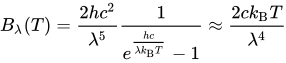
Planck's law for the spectrum of black-body radiation predicts the Wien displacement law and may be used to numerically evaluate the constant relating temperature and the peak parameter value for any particular parameterization. Commonly a wavelength parameterization is used and in that case the black body spectral radiance (power per emitting area per solid angle) is:
Differentiating with respect to and setting the derivative equal to zero gives: which can be simplified to give:


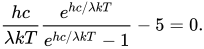
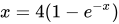
By defining: the equation becomes one in the single variable x: which is equivalent to:

This equation is solved by where is the principal branch of the Lambert W function, and gives 4.965114231744276303.... Solving for the wavelength in millimetres, and using kelvins for the temperature yields:

(2.897771955185172661... mm⋅K).

Parameterization by frequency

Another common parameterization is by frequency. The derivation yielding peak parameter value is similar, but starts with the form of Planck's law as a function of frequency :
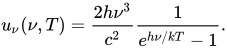
The preceding process using this equation yields: The net result is: This is similarly solved with the Lambert W function:  giving = 2.821439372122078893....
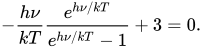
Solving for produces:

(0.05878925757646824946... THz⋅K−1).

Parameterization by the logarithm of wavelength or frequency

Using the implicit equation yields the peak in the spectral radiance density function expressed in the parameter radiance per proportional bandwidth. (That is, the density of irradiance per frequency bandwidth proportional to the frequency itself, which can be calculated by considering infinitesimal intervals of (or equivalently ) rather of frequency itself.) This is perhaps a more intuitive way of presenting "wavelength of peak emission". That yields = 3.920690394872886343....
Mean photon energy as an alternate characterization

Another way of characterizing the radiance distribution is via the mean photon energy:  where is the Riemann zeta function. The wavelength corresponding to the mean photon energy is given by

Criticism

Marr and Wilkin (2012) contend that the widespread teaching of Wien's displacement law in introductory courses is undesirable, and it would be better replaced by alternate material. They argue that teaching the law is problematic because:

  1. the Planck curve is too broad for the peak to stand out or be regarded as significant;
  2. the location of the peak depends on the parameterization, and they cite several sources as concurring that "the designation of any peak of the function is not meaningful and should, therefore, be de-emphasized";
  3. the law is not used for determining temperatures in actual practice, direct use of the Planck function being relied upon instead.

They suggest that the average photon energy be presented in place of Wien's displacement law, as being a more physically meaningful indicator of changes that occur with changing temperature. In connection with this, they recommend that the average number of photons per second be discussed in connection with the Stefan–Boltzmann law. They recommend that the Planck spectrum be plotted as a "spectral energy density per fractional bandwidth distribution," using a logarithmic scale for the wavelength or frequency.

Monday, August 10, 2026

Compatibilism

From Wikipedia, the free encyclopedia

Compatibilism is the belief that free will and determinism are mutually compatible and that it is possible to believe in both without being logically inconsistent. The opposing belief, that the thesis of determinism is logically incompatible with the classical thesis of free will, is known as "incompatibilism".

Compatibilists often believe that freedom can be present or absent in situations for reasons that have nothing to do with metaphysics. In other words, that causal determinism does not exclude the truth of possible future outcomes. Because free will is often seen as a necessary prerequisite for moral responsibility, compatibilism is commonly used to support compatibility between moral responsibility and determinism.

Similarly, political liberty is a non-metaphysical concept. Statements of political liberty, such as the United States Bill of Rights, assume moral liberty: the ability to choose to do otherwise than what one does.

History

Compatibilism was championed by the ancient Stoics and some medieval scholastics. More specifically, scholastics like Thomas Aquinas and later Thomists (such as Domingo Báñez) are often interpreted as holding that human action can be free, even though an agent in some strong sense could not do otherwise than what they did. Whereas Aquinas is often interpreted to maintain rational compatibilism (i.e., an action can be determined by rational cognition and yet free), later Thomists, such as Báñez, develop a sophisticated theory of theological determinism, according to which actions of free agents, despite being free, are, on a higher level, determined by infallible divine decrees manifested in the form of "physical premotion" (praemotio physica), a deterministic intervention of God into the will of a free agent required to reduce the will from potency to act. A strong incompatibilist view of freedom was, on the other hand, developed in the Franciscan tradition, especially by Duns Scotus, and later upheld and further developed by Jesuits, especially Luis de Molina and Francisco Suárez. In the early modern era, compatibilism was maintained by Age of Enlightenment philosophers such as David Hume and Thomas Hobbes.

During the 20th century, compatibilists presented novel arguments that differed from the classical arguments of Hume, Hobbes, and John Stuart Mill. Importantly, Harry Frankfurt popularized what are now known as Frankfurt counterexamples to argue for semicompatibilism, the view that determinism is compatible with moral responsibility regardless of its compatibility with free will, and developed a positive account of semicompatibilism based on higher-order volitions. Other "new compatibilists" include Gary Watson, Susan R. Wolf, P. F. Strawson, Kadri Vihvelin, and R. Jay Wallace. Contemporary compatibilists range from the philosopher and cognitive scientist Daniel Dennett, particularly in his works Elbow Room (1984) and Freedom Evolves (2003), to the existentialist philosopher Frithjof Bergmann. Perhaps the most renowned contemporary defender of semicompatibilism is John Martin Fischer. Other semicompatibilists include David P. Hunt and Alfred Mele.

A 2020 survey found that 59% of English-publishing philosophers accept or lean towards compatibilism.

Defining free will

Arthur Schopenhauer

Compatibilists often define an instance of "free will" as one in which the agent had the freedom to act according to their own motivation. That is, the agent was not coerced or restrained. Arthur Schopenhauer famously said: "Man can do what he wills but he cannot will what he wills". In other words, although an agent may often be free to act according to a motive, the nature of that motive is determined. This definition of free will does not rely on the truth or falsity of causal determinism. This view also makes free will close to autonomy, the ability to live according to one's own rules, as opposed to being submitted to external domination.

Daniel Dennett expands on this idea in his book Elbow Room, arguing that in seeking free will we must consider what exactly is desired in the concept of free will. He argues that if one becomes convinced of the need for some capacity, such as the ability to have done otherwise, it is because we have become convinced that this capacity is necessary "for the sort of free will that any responsible, dignified, moral agent must have." Dennett then says the following regarding what is requested of free will:

What we want when we want free will is the power to decide our courses of action, and to decide them wisely, in light of our expectations and desires. We want to be in control of ourselves, and not under the control of others.

(. . .)

We want, moreover, to have enough elbow room in the world so that when we exercise these powers, it is not always a matter of settling for the only desperate course of action that has a chance of fulfilling our desires.

Daniel Dennett, Elbow Room, p. 184

Dennett argues that determinism itself does not restrict us from reaching or accomplishing any of that which we seek out of free will, and so determinism is compatible with free will, or at least any "free will worth wanting"

Alternatives as imaginary

Schrödinger's door: Saying "there may be a person behind that door" merely expresses ignorance about the one, determined reality.

Some compatibilists hold both causal determinism (all effects have causes) and logical determinism (the future is already determined) to be true. Thus statements about the future (e.g., "it will rain tomorrow") are either true or false when spoken today. This compatibilist free will should not be understood as the ability to choose differently in an identical situation. A compatibilist may believe that a person can decide between several choices, but the choice is always determined by external factors. If the compatibilist says "I may visit tomorrow, or I may not", he is saying that he does not know what he will choose—whether he will choose to follow the subconscious urge to go or not.

Non-naturalism

Alternatives to strictly naturalist physics, such as mind–body dualism positing a mind or soul existing apart from one's body while perceiving, thinking, choosing freely, and as a result acting independently on the body, include both traditional religious metaphysics and less common newer compatibilist concepts. Also consistent with both autonomy and Darwinism, they allow for free personal agency based on practical reasons within the laws of physics. While less popular among 21st-century philosophers, non-naturalist compatibilism is present in most if not almost all religions.

Dispositional account

Kadri Vihvelin offers a dispositional account of free will, which hinges on how we interpret the "can" in “We have free will only if we can choose otherwise”. To have free will is to make choices on the basis of reasons, and to possess this ability, according to Vihvelin, is to have a bundle of dispositions. Dispositions include things like being able to speak a language or run or walk. They also include dispositions required to choose, such as the capacity to form and revise beliefs in light of evidence or argument, and to form intentions in response to desires.

Someone who speaks both English and French could choose to speak English at a given moment; however, even if determinism holds, they still had the disposition to speak French at that time – the disposition didn’t vanish. Similarly, according to Vihvelin’s argument, someone who makes a particular decision also retains the bundle of disposition to have chosen otherwise – that capacity isn’t lost simply because one option was selected. This is how they could have chosen otherwise, and why they have free will.

Criticism

Compatibilism has much in common with "hard determinism", including moral systems and a belief in determinism itself.

The prominent critics of compatibilism are Peter van Inwagen and Seyyed Jaaber Mousavirad.

Critics of compatibilism often focus on the definitions of free will: incompatibilists may agree that the compatibilists are showing something to be compatible with determinism, but they think that this something ought not to be called "free will". Incompatibilists might accept the "freedom to act" as a necessary criterion for free will, but doubt that it is sufficient. The incompatibilists believe that free will refers to genuine (i.e., absolute, ultimate, physical) alternate possibilities for beliefs, desires, or actions, rather than merely counterfactual ones.

Seyyed Jaaber Mousavirad argues against compatibilism by maintaining that it conflicts with two fundamental human intuitions. First, individuals intuitively apprehend that they possess not only the ability to perform an action but also the genuine ability to refrain from it. Second, moral responsibility is intelligible only if an agent has the capacity to do otherwise. Consequently, the compatibilist claim that human beings can lack the ability to refrain from acting while nevertheless remaining free and morally responsible is conceptually incoherent. Although compatibilists may redefine free will as the ability to act in accordance with one’s desires in the absence of external impediments, such a redefinition merely stipulates a new meaning rather than capturing the intuitive conception of free will that underlies moral responsibility. Furthermore, if compatibilists reject the epistemic authority of intuition, they undermine their own position, since they themselves rely on intuitive judgments in explaining freedom. Finally, their distinction between determinism arising from the laws of nature and determinism resulting from internal or external constraints lacks adequate justification, as there is no principled reason to treat these forms of determinism differently with respect to free will and moral responsibility. Compatibilism, therefore, fails to provide a coherent account of free will and moral responsibility and instead rests on an unwarranted redefinition of the concept of free will.

The direct predecessor to compatibilism was soft determinism (a term coined by William James, which he used pejoratively). Soft determinism is the view that we (ordinary humans) have free will and determinism is true. (Compatibilists, by contrast, take no stand on the truth-value of determinism.) James accused the soft determinists of creating a "quagmire of evasion" by stealing the name of freedom to mask their underlying determinism. Immanuel Kant called it a "wretched subterfuge" and "word jugglery". Kant's argument introduces the view that, while all empirical phenomena must result from determining causes, human thought introduces something seemingly not found elsewhere in nature—the ability to conceive of the world in terms of how it ought to be, or how it might otherwise be. For Kant, subjective reasoning is necessarily distinct from how the world is empirically. Because of its capacity to distinguish is from ought, reasoning can "spontaneously" originate new events without being itself determined by what already exists. It is on this basis that Kant argues against a version of compatibilism in which, for instance, the actions of the criminal are comprehended as a blend of determining forces and free choice, which Kant regards as misusing the word free. Kant proposes that taking the compatibilist view involves denying the distinctly subjective capacity to re-think an intended course of action in terms of what ought to happen.

Rayleigh–Jeans law

From Wikipedia, the free encyclopedia
Comparison of Rayleigh–Jeans law with Wien approximation and Planck's law, for a body of 5800 K temperature

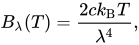
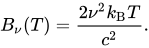
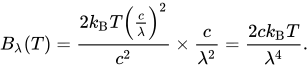
In physics, the Rayleigh–Jeans law is an approximation to the spectral radiance of electromagnetic radiation as a function of wavelength from a black body at a given temperature through classical arguments. For wavelength λ, it is where is the spectral radiance (the power emitted per unit emitting area, per steradian, per unit wavelength), is the speed of light, is the Boltzmann constant, and is the temperature in kelvins. For frequency , the expression is instead

The Rayleigh–Jeans law agrees with experimental results at large wavelengths (low frequencies) but strongly disagrees at short wavelengths (high frequencies). This inconsistency between observations and the predictions of classical physics is commonly known as the ultraviolet catastrophePlanck's law, which gives the correct radiation at all frequencies, has the Rayleigh–Jeans law as its low-frequency limit.

Historical development

In 1900, the British physicist Lord Rayleigh derived the λ4 dependence of the Rayleigh–Jeans law based on classical physical arguments, relying upon the equipartition theorem. This law predicted an energy output that diverges towards infinity as wavelength approaches zero (as frequency tends to infinity). Measurements of the spectral emission of actual black bodies revealed that the emission agreed with Rayleigh's calculation at low frequencies but diverged at high frequencies, reaching a maximum and then falling with frequency, so the total energy emitted is finite. Rayleigh recognized the unphysical behavior of his formula at high frequencies and introduced an ad hoc cutoff to correct it, but experimentalists found that his cutoff did not agree with data. Hendrik Lorentz also presented a derivation of the wavelength dependence in 1903. More complete derivations, which included the proportionality constant, were presented in 1905 by Rayleigh and Sir James Jeans and independently by Albert Einstein. Rayleigh believed that this discrepancy could be resolved by the equipartition theorem failing to be valid for high-frequency vibrations, while Jeans argued that the underlying cause was matter and luminiferous aether not being in thermal equilibrium.

Rayleigh published his first derivation of the frequency dependence in June 1900. Planck discovered the curve now known as Planck's law in October of that year and presented it in December. Planck's original intent was to find a satisfactory derivation of Wien's expression for the blackbody radiation curve, which accurately described the data at high frequencies. Planck found Wien's original derivation inadequate and devised his own. Then, after learning that the most recent experimental results disagreed with his predictions for low frequencies, Planck revised his calculation, obtaining what is now called Planck's law.

Comparison to Planck's law

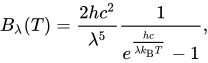
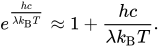
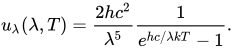
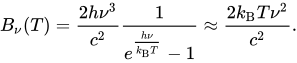
In 1900 Max Planck empirically obtained an expression for black-body radiation expressed in terms of wavelength λ = c/ν (Planck's law): where h is the Planck constant, and kB is the Boltzmann constant. Planck's law does not suffer from an ultraviolet catastrophe and agrees well with the experimental data, but its full significance (which ultimately led to quantum theory) was only appreciated several years later. Since then in the limit of high temperatures or long wavelengths, the term in the exponential becomes small, and the exponential is well approximated with the Taylor polynomial's first-order term:

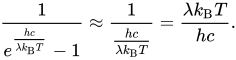
So

This results in Planck's blackbody formula reducing to which is identical to the classically derived Rayleigh–Jeans expression.

The same argument can be applied to the blackbody radiation expressed in terms of frequency ν = c/λ. In the limit of small frequencies, that is ,

This last expression is the Rayleigh–Jeans law in the limit of small frequencies.

Consistency of frequency- and wavelength-dependent expressions

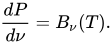
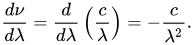
When comparing the frequency- and wavelength-dependent expressions of the Rayleigh–Jeans law, it is important to remember that and Note that these two expressions then have different units, as a step in wavelength is not equivalent to a step in frequency. Therefore, even after substituting the value , because has units of energy emitted per unit time per unit area of emitting surface, per unit solid angle, per unit wavelength, whereas has units of energy emitted per unit time per unit area of emitting surface, per unit solid angle, per unit frequency. To be consistent, we must use the equality where both sides now have units of power (energy emitted per unit time) per unit area of emitting surface, per unit solid angle.
Starting with the Rayleigh–Jeans law in terms of wavelength, we get where This leads to

Other forms of Rayleigh–Jeans law

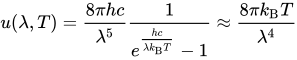
Depending on the application, the Planck function can be expressed in 3 different forms. The first involves energy emitted per unit time per unit area of emitting surface, per unit solid angle, per spectral unit. In this form, the Planck function and associated Rayleigh–Jeans limits are given by or

Alternatively, Planck's law can be written as an expression for emitted power integrated over all solid angles. In this form, the Planck function and associated Rayleigh–Jeans limits are given by or

In other cases, Planck's law is written as for energy per unit volume (energy density). In this form, the Planck function and associated Rayleigh–Jeans limits are given by or

Anti-capitalism

From Wikipedia, the free encyclopedia https://en.wikipedia.org/wiki/Anti-capi...