Search This Blog

Tuesday, August 11, 2026

Stochastic

From Wikipedia, the free encyclopedia

Stochastic (/stəˈkæstɪk/; from Ancient Greek στόχος (stókhos) 'target, aim, guess') is the property of being well-described by a random probability distributionStochasticity and randomness are technically distinct concepts. Stochasticity refers to a modeling approach, while randomness describes phenomena. These terms are often used interchangeably. In probability theory, the formal concept of a stochastic process is also referred to as a random process.

Stochasticity is used in many different fields, including actuarial science, image processing, signal processing, computer science, information theory, telecommunicationschemistryecologyneurosciencephysics, and cryptography. It is also used in finance, medicine, linguistics, music, media, colour theory, botany, manufacturing and geomorphology.

Etymology

The word stochastic in English was originally used as an adjective with the definition "pertaining to conjecturing", and stemming from a Greek word meaning "to aim at a mark, guess", and the Oxford English Dictionary gives the year 1662 as its earliest occurrence. In his work on probability Ars Conjectandi, originally published in Latin in 1713, Jakob Bernoulli used the phrase "Ars Conjectandi sive Stochastice", which has been translated to "the art of conjecturing or stochastics". This phrase was used, with reference to Bernoulli, by Ladislaus Bortkiewicz, who in 1917 wrote in German the word Stochastik with a sense meaning random. The term stochastic process first appeared in English in a 1934 paper by Joseph L. Doob. For the term and a specific mathematical definition, Doob cited another 1934 paper, where the term stochastischer Prozeß was used in German by Aleksandr Khinchin, though the German term had been used earlier in 1931 by Andrey Kolmogorov.

Mathematics

In the early 1930s, Aleksandr Khinchin gave the first mathematical definition of a stochastic process as a family of random variables indexed by the real line. Further fundamental work on probability theory and stochastic processes was done by Khinchin as well as other mathematicians such as Andrey Kolmogorov, Joseph Doob, William Feller, Maurice Fréchet, Paul Lévy, Wolfgang Doeblin, and Harald Cramér. Decades later Cramér referred to the 1930s as the "heroic period of mathematical probability theory".

In mathematics, the theory of stochastic processes is an important contribution to probability theory, and continues to be an active topic of research for both theory and applications.

The word stochastic is used to describe other terms and objects in mathematics. Examples include a stochastic matrix, which describes a stochastic process known as a Markov process, and stochastic calculus, which involves differential equations and integrals based on stochastic processes such as the Wiener process, also called the Brownian motion process.

Natural science

One of the simplest continuous-time stochastic processes is Brownian motion. This was first observed by botanist Robert Brown while looking through a microscope at pollen grains in water.

Physics

The Monte Carlo method is a stochastic method popularized by physics researchers Stanisław Ulam, Enrico Fermi, John von Neumann, and Nicholas Metropolis. The use of randomness and the repetitive nature of the process are analogous to the activities conducted at a casino. Methods of simulation and statistical sampling generally did the opposite: using simulation to test a previously understood deterministic problem. Though examples of an "inverted" approach do exist historically, they were not considered a general method until the popularity of the Monte Carlo method spread.

Perhaps the most famous early use was by Enrico Fermi in the 1930s, when he used a random method to calculate the properties of the newly discovered neutron. Monte Carlo methods were central to the simulations required for the Manhattan Project, though they were severely limited by the computational tools of the time. Therefore, it was only after electronic computers were first built (from 1945 on) that Monte Carlo methods began to be studied in depth. In the 1950s they were used at Los Alamos for early work relating to the development of the hydrogen bomb, and became popularized in the fields of physics, physical chemistry, and operations research. The RAND Corporation and the U.S. Air Force were two of the major organizations responsible for funding and disseminating information on Monte Carlo methods during this time, and they began to find a wide application in many different fields.

Uses of Monte Carlo methods require large amounts of random numbers, and it was their use that spurred the development of pseudorandom number generators, which were far quicker to use than the tables of random numbers which had been previously used for statistical sampling.

Biology

In biological systems the technique of stochastic resonance—introducing stochastic "noise"—has been found to help improve the signal-strength of the internal feedback-loops for balance and other vestibular communication. The technique has helped diabetic and stroke patients with balance control.

Many biochemical events lend themselves to stochastic analysis. Gene expression, for example, has a stochastic component through the molecular collisions—e.g., during binding and unbinding of RNA polymerase to a gene promoter which contributes to bursts of transcription and super-Poissonian variability in cell-to-cell RNA distributions—via the solution's Brownian motion.

Creativity

Simonton (2003, Psych Bulletin) argues that creativity in science (of scientists) is a constrained stochastic behaviour such that new theories in all sciences are, at least in part, the product of a stochastic process.

Computer science

Stochastic ray tracing is the application of Monte Carlo simulation to the computer graphics ray tracing algorithm. "Distributed ray tracing samples the integrand at many randomly chosen points and averages the results to obtain a better approximation. It is essentially an application of the Monte Carlo method to 3D computer graphics, and for this reason is also called Stochastic ray tracing."

Stochastic forensics analyzes computer crime by viewing computers as stochastic steps.

In artificial intelligence, stochastic programs work by using probabilistic methods to solve problems, as in simulated annealing, stochastic neural networks, stochastic optimization, genetic algorithms, and genetic programming. A problem itself may be stochastic as well, as in planning under uncertainty. Large language models have been described as stochastic parrots.

Finance

The financial markets use stochastic models to represent the seemingly random behaviour of various financial assets, including the random behavior of the price of one currency compared to that of another (such as the price of US Dollar compared to that of the Euro), and also to represent random behaviour of interest rates. These models are then used by financial analysts to value options on stock prices, bond prices, and on interest rates, see Markov models. Moreover, it is at the heart of the insurance industry.

Geomorphology

The formation of river meanders has been analyzed as a stochastic process.

Language and linguistics

Non-deterministic approaches in language studies are largely inspired by the work of Ferdinand de Saussure, for example, in functionalist linguistic theory, which argues that competence is based on performance. This distinction in functional theories of grammar should be carefully distinguished from the langue and parole distinction. To the extent that linguistic knowledge is constituted by experience with language, grammar is argued to be probabilistic and variable rather than fixed and absolute. This conception of grammar as probabilistic and variable follows from the idea that one's competence changes in accordance with one's experience with language. Though this conception has been contested, it has also provided the foundation for modern statistical natural language processing and for theories of language learning and change.

Manufacturing

Manufacturing processes are assumed to be stochastic processes. This assumption is largely valid for either continuous or batch manufacturing processes. Testing and monitoring of the process is recorded using a process control chart which plots a given process control parameter over time. Typically a dozen or many more parameters will be tracked simultaneously. Statistical models are used to define limit lines which define when corrective actions must be taken to bring the process back to its intended operational window.

This same approach is used in the service industry where parameters are replaced by processes related to service level agreements.

Media

The marketing and the changing movement of audience tastes and preferences, as well as the solicitation of and the scientific appeal of certain film and television debuts (i.e., their opening weekends, word-of-mouth, top-of-mind knowledge among surveyed groups, star name recognition and other elements of social media outreach and advertising), are determined in part by stochastic modeling.

Medicine

Stochastic effect, or "chance effect" is one classification of radiation effects that refers to the random, statistical nature of the damage. In contrast to the deterministic effect, severity is independent of dose. Only the probability of an effect increases with dose.

Music

In music, mathematical processes based on probability can generate stochastic elements.

Stochastic processes may be used in music to compose a fixed piece or may be produced in performance. Stochastic music was pioneered by Iannis Xenakis, who coined the term stochastic music. Specific examples of mathematics, statistics, and physics applied to music composition are the use of the statistical mechanics of gases in Pithoprakta, statistical distribution of points on a plane in Diamorphoses, minimal constraints in Achorripsis, the normal distribution in ST/10 and Atrées, Markov chains in Analogiques, game theory in Duel and Stratégie, group theory in Nomos Alpha (for Siegfried Palm), set theory in Herma and Eonta, and Brownian motion in N'Shima. Xenakis frequently used computers to produce his scores, such as the ST series including Morsima-Amorsima and Atrées, and founded CEMAMu. Earlier, John Cage and others had composed aleatoric or indeterminate music, which is created by chance processes but does not have the strict mathematical basis (Cage's Music of Changes, for example, uses a system of charts based on the I-Ching). Lejaren Hiller and Leonard Issacson used generative grammars and Markov chains in their 1957 Illiac Suite. Modern electronic music production techniques make these processes relatively simple to implement, and many hardware devices such as synthesizers and drum machines incorporate randomization features. Generative music techniques are therefore readily accessible to composers, performers, and producers.

Social sciences

Stochastic social science theory is similar to systems theory in that events are interactions of systems, although with a marked emphasis on unconscious processes. The event creates its own conditions of possibility, rendering it unpredictable if simply for the number of variables involved. Stochastic social science theory can be seen as an elaboration of a kind of 'third axis' in which to situate human behavior alongside the traditional 'nature vs. nurture' opposition. See Julia Kristeva on her usage of the 'semiotic', Luce Irigaray on reverse Heideggerian epistemology, and Pierre Bourdieu on polythetic space for examples of stochastic social science theory.

Subtractive color reproduction

When color reproductions are made, the image is separated into its component colors by taking multiple photographs filtered for each color. One resultant film or plate represents each of the cyan, magenta, yellow, and black data. Color printing is a binary system, where ink is either present or not present, so all color separations to be printed must be translated into dots at some stage of the work-flow. Traditional line screens which are amplitude modulated had problems with moiré but were used until stochastic screening became available. A stochastic (or frequency modulated) dot pattern creates a sharper image.

Cosmological constant problem

From Wikipedia, the free encyclopedia
https://en.wikipedia.org/wiki/Cosmological_constant_problem
 
Unsolved problem in physics
 
Why is the vacuum energy density much smaller than a zero-point energy suggested by quantum field theory?

In cosmology, the cosmological constant problem or vacuum catastrophe is the substantial disagreement between the observed values of vacuum energy density (the small value of the cosmological constant) and the much larger theoretical value of zero-point energy suggested by quantum field theory.

Depending on the cutoff of Planck energy and other factors, the quantum vacuum energy contribution to the effective cosmological constant is calculated to be between 50 and as many as 122 orders of magnitude greater than has actually been observed, a state of affairs described by physicists as "the largest discrepancy between theory and experiment in all of science" and "probably the worst theoretical prediction in the history of physics".

History

The idea that empty space might contain zero-point radiation energy was proposed by Walther Nernst in 1916. He predicted that the value had to be either zero or very small. In 1926, Wilhelm Lenz concluded that "If one allows waves of the shortest observed wavelengths λ ≈ 2 × 10⁻¹¹ cm, ... and if this radiation, converted to material density (u/c2 ≈ 106), contributed to the curvature of the observable universe – one would obtain a vacuum energy density of such a value that the radius of the observable universe would not reach even to the Moon." Wolfgang Pauli reached the same conclusion in 1933. The idea that the vacuum energy was related to the expansion of the universe was proposed by Georges Lemaître in 1934.

After the development of quantum field theory in the 1940s and the observation of the expansion of the universe in 1950s, the first to address contributions of quantum fluctuations to the cosmological constant was Yakov Zeldovich in the 1960s. In quantum mechanics, the vacuum itself should experience quantum fluctuations. In general relativity, those quantum fluctuations constitute energy that would add to the cosmological constant. However, Zeldovich calculated vacuum energy density was forty orders of magnitude bigger than the observed cosmological constant.

In the 1970s, due to the discovery of the electroweak interaction, another contribution was added to the cosmological constant due to spontaneous symmetry breaking, increasing the discrepancy. Later estimates of the degree of mismatch were as high as 120 to 122 orders of magnitude; Modern research suggests that, when Lorentz invariance is taken into account, the degree of mismatch is closer to 60 orders of magnitude. 

With the development of inflationary cosmology in the 1980s, the problem became much more important: as cosmic inflation is driven by vacuum energy, differences in modeling vacuum energy lead to huge differences in the resulting cosmologies. Were the vacuum energy precisely zero, as was once believed, then the expansion of the universe would not accelerate as observed, according to the standard Λ-CDM model.

In 1989, Steven Weinberg showed that the different contributions to the cosmological constant cannot, under general conditions, cancel without fine tuning their values, this result became known as Weinberg's no-go theorem. In the 2000s, Weinberg also proposed, what is sometimes called the new cosmological problem, which consist in finding a theory that matches its non-zero value. The new cosmological problem is often equated with the cosmic coincidence problem (the fact that energy density from dark matter and dark energy are of the same order of magnitude today).

Estimated values

The vacuum energy density of the Universe based on 2015 measurements by the Planck collaboration is ρvac = 5.96×10⁻²⁷ kg/m35.3566×10−10 J/m3 = 3.35 GeV/m3 or about 2.5×10−47 GeV4 in geometrized units.

One assessment, made by Jérôme Martin of the Institut d'Astrophysique de Paris in 2012, placed the expected theoretical vacuum energy scale around 108 GeV4, for a difference of about 55 orders of magnitude.

Cutoff dependence and renormalization

The calculated vacuum energy is a positive, rather than negative, contribution to the cosmological constant because the existing vacuum has negative quantum-mechanical pressure, while in general relativity, the gravitational effect of negative pressure is a kind of repulsion. (Pressure here is defined as the flux of quantum-mechanical momentum across a surface.) Roughly, the vacuum energy is calculated by summing over all known quantum-mechanical fields, taking into account interactions and self-interactions between the ground states, and then removing all interactions below a minimum "cutoff" wavelength to reflect that existing theories break down and may fail to be applicable around the cutoff scale. Because the energy is dependent on how fields interact within the current vacuum state, the vacuum energy contribution would have been different in the early universe; for example, the vacuum energy would have been significantly different prior to electroweak symmetry breaking during the quark epoch.

The vacuum energy in quantum field theory can be set to any value by renormalization. This view treats the cosmological constant as simply another fundamental physical constant not predicted or explained by theory. Such a renormalization constant must be chosen very accurately because of the many-orders-of-magnitude discrepancy between theory and observation, and many theorists consider this ad-hoc constant as equivalent to ignoring the problem.

Using Planck mass as the cut-off for a cut-off regularization scheme provides a difference of 120 orders of magnitude between the vacuum energy and the cosmological constant. However this method violates Lorentz covariance. Using dimensional regularization instead, reduces this difference to about 56 orders of magnitude.

Proposed solutions

Some proposals involve modifying gravity to diverge from general relativity. These proposals face the hurdle that the results of observations and experiments so far have tended to be extremely consistent with general relativity and the ΛCDM model, and inconsistent with thus-far proposed modifications. In addition, some of the proposals are arguably incomplete, because they solve the "new" cosmological constant problem by proposing that the actual cosmological constant is exactly zero rather than a tiny number, but fail to solve the "old" cosmological constant problem of why quantum fluctuations seem to fail to produce substantial vacuum energy in the first place. Nevertheless, many physicists argue that, due in part to a lack of better alternatives, proposals to modify gravity should be considered "one of the most promising routes to tackling" the cosmological constant problem.

Bill Unruh and collaborators have argued that when the energy density of the quantum vacuum is modeled more accurately as a fluctuating quantum field, the cosmological constant problem does not arise. Going in a different direction, George F. R. Ellis and others have suggested that in unimodular gravity, the troublesome contributions simply do not gravitate. Recently, a fully diffeomorphism-invariant action principle that gives the equations of motion for trace-free Einstein gravity has been proposed, where the cosmological constant emerges as an integration constant.

Another argument, due to Stanley Brodsky and Robert Shrock, is that in light front quantization, the quantum field theory vacuum becomes essentially trivial. In the absence of vacuum expectation values, there is no contribution from quantum electrodynamics, weak interactions, and quantum chromodynamics to the cosmological constant. It is thus predicted to be zero in a flat spacetime. From light front quantization insight, the origin of the cosmological constant problem is traced back to unphysical non-causal terms in the standard calculation, which lead to an erroneously large value of the cosmological constant.

In 2018, a mechanism for cancelling Λ out has been proposed through the use of a symmetry breaking potential in a Lagrangian formalism in which matter shows a non-vanishing pressure. The model assumes that standard matter provides a pressure which counterbalances the action due to the cosmological constant. Luongo and Muccino have shown that this mechanism permits to take vacuum energy as quantum field theory predicts, but removing the huge magnitude through a counterbalance term due to baryons and cold dark matter only.

In 1999, Andrew Cohen, David B. Kaplan and Ann Nelson proposed that correlations between the UV and IR cutoffs in effective quantum field theory are enough to reduce the theoretical cosmological constant down to the measured cosmological constant due to the Cohen–Kaplan–Nelson (CKN) bound. In 2021, Nikita Blinov and Patrick Draper confirmed through the holographic principle that the CKN bound predicts the measured cosmological constant, all while maintaining the predictions of effective field theory in less extreme conditions.

Some propose an anthropic solution, and argue that we live in one region of a vast multiverse that has different regions with different vacuum energies. These anthropic arguments posit that only regions of small vacuum energy such as the one in which we live are reasonably capable of supporting intelligent life. Such arguments have existed in some form since at least 1981. Around 1987, Steven Weinberg estimated that the maximum allowable vacuum energy for gravitationally-bound structures to form is problematically large, even given the observational data available in 1987, and concluded the anthropic explanation appears to fail; however, more recent estimates by Weinberg and others, based on other considerations, find the bound to be closer to the actual observed level of dark energy. Anthropic arguments gradually gained credibility among many physicists after the discovery of dark energy and the development of the theoretical string theory landscape, but are still derided by a substantial skeptical portion of the scientific community as being problematic to verify. Proponents of anthropic solutions are themselves divided on multiple technical questions surrounding how to calculate the proportion of regions of the universe with various dark energy constants.

Ultraviolet catastrophe

From Wikipedia, the free encyclopedia
The ultraviolet catastrophe is the error at short wavelengths in the Rayleigh–Jeans law (depicted as "classical theory" in the graph) for the energy emitted by an ideal black body. The error, much more pronounced for short wavelengths, is the difference between the black curve (as classically predicted by the Rayleigh–Jeans law) and the blue curve (the measured curve, predicted by Planck's law).

The ultraviolet catastrophe, also called the Rayleigh–Jeans catastrophe, was the prediction of late 19th century and early 20th century classical physics that an ideal black body at thermal equilibrium would emit an unbounded quantity of energy as wavelength decreased into the ultraviolet range.The term "ultraviolet catastrophe" was first used in 1911 by the Austrian physicist Paul Ehrenfest, but the concept originated with the 1900 statistical derivation of the Rayleigh–Jeans law.

The phrase refers to the fact that the empirically derived Rayleigh–Jeans law, which accurately predicted experimental results at large wavelengths, failed to do so for short wavelengths. (See the image for further elaboration.) As the theory diverged from empirical observations when these frequencies reached the ultraviolet region of the electromagnetic spectrum, there was a problem. This problem was later found to be due to a property of quanta as proposed by Max Planck: There could be no fraction of a discrete energy package already carrying minimal energy.

Since the first use of this term, it has also been used for other predictions of a similar nature, as in quantum electrodynamics and such cases as ultraviolet divergence.

Problem

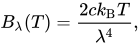
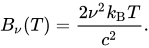
The Rayleigh-Jeans law is an approximation to the spectral radiance of electromagnetic radiation as a function of wavelength from a black body at a given temperature through classical arguments. For wavelength , it is: where is the spectral radiance, the power emitted per unit emitting area, per steradian, per unit wavelength; is the speed of light; is the Boltzmann constant; and is the temperature in kelvins. For frequency , the expression is instead

This formula is obtained from the equipartition theorem of classical statistical mechanics which states that all harmonic oscillator modes (degrees of freedom) of a system at equilibrium have an average energy of .

The "ultraviolet catastrophe" is the expression of the fact that the formula misbehaves at higher frequencies; it predicts infinite energy emission because as .

An example, from Mason's A History of the Sciences, illustrates multi-mode vibration via a piece of string. As a natural vibrator, the string will oscillate with specific modes (the standing waves of a string in harmonic resonance), dependent on the length of the string. In classical physics, a radiator of energy will act as a natural vibrator. Since each mode will have the same energy, most of the energy in a natural vibrator will be in the smaller wavelengths and higher frequencies, where most of the modes are.

According to classical electromagnetism, the number of electromagnetic modes in a 3-dimensional cavity, per unit frequency, is proportional to the square of the frequency. This implies that the radiated power per unit frequency should be proportional to frequency squared. Thus, both the power at a given frequency and the total radiated power is unlimited as higher and higher frequencies are considered: this is unphysical, as the total radiated power of a cavity is not observed to be infinite, a point that was made independently by Einstein, Lord Rayleigh, and Sir James Jeans in 1905.

Solution

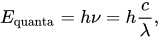
In 1900, Max Planck derived the correct form for the intensity spectral distribution function by making some assumptions that were strange for the time. In particular, Planck assumed that electromagnetic radiation can be emitted or absorbed only in discrete packets, called quanta, of energy: where:

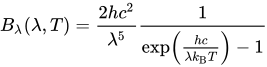
By applying this new energy to the partition function in statistical mechanics, Planck's assumptions led to the correct form of the spectral distribution functions: where:

In 1905, Albert Einstein solved the problem physically by postulating that Planck's quanta were real physical particles – what we now call photons, not just a mathematical fiction. They modified statistical mechanics in the style of Boltzmann to an ensemble of photons. Einstein's photon had an energy proportional to its frequency and also explained an unpublished law of Stokes and the photoelectric effect. This published postulate was specifically cited by the Nobel Prize in Physics committee in their decision to award the prize for 1921 to Einstein.

Libertarianism (metaphysics)

From Wikipedia, the free encyclopedia
The task of the metaphysical libertarian is to reconcile free will with indeterminism.

Metaphysical libertarianism is the philosophical view that free will exists, that it is incompatible with determinism, and therefore that determinism is false. In the branch of philosophy known as metaphysics, libertarianism is one of the main positions related to the problems of free will and determinism. In particular, libertarianism is an incompatibilist position which argues that free will is logically incompatible with a deterministic universe. Libertarianism states that since agents have free will, determinism must be false.

One of the first clear formulations of libertarianism is found in John Duns Scotus. In a theological context, metaphysical libertarianism was notably defended by Jesuit authors like Luis de Molina and Francisco Suárez against the rather compatibilist Thomism of Domingo Báñez. Other important metaphysical libertarians in the early modern period were René Descartes, George Berkeley, Immanuel Kant and Thomas Reid.

Roderick Chisholm was a prominent defender of libertarianism in the 20th century and contemporary libertarians include Robert Kane, Geert Keil, Peter van Inwagen and Robert Nozick.

Overview

The first recorded use of the term libertarianism was in 1789 by William Belsham in a discussion of free will and in opposition to necessitarian or determinist views.

Metaphysical libertarianism is one philosophical viewpoint under that of incompatibilism. Libertarianism holds onto a concept of free will that requires the agent to be able to take more than one possible course of action under a given set of circumstances.

Accounts of libertarianism subdivide into non-physical theories and physical or naturalistic theories. Non-physical theories hold that the events in the brain that lead to the performance of actions do not have an entirely physical explanation, and consequently the world is not closed under physics. Such interactionist dualists believe that some non-physical mind, will, or soul overrides physical causality.

Explanations of libertarianism that do not involve dispensing with physicalism require physical indeterminism, such as probabilistic subatomic particle behavior—a theory unknown to many of the early writers on free will. Physical determinism, under the assumption of physicalism, implies there is only one possible future and is therefore not compatible with libertarian free will. Some libertarian explanations involve invoking panpsychism, the theory that a quality of mind is associated with all particles, and pervades the entire universe, in both animate and inanimate entities. Other approaches do not require free will to be a fundamental constituent of the universe; ordinary randomness is appealed to as supplying the "elbow room" believed to be necessary by libertarians.

Free volition is regarded as a particular kind of complex, high-level process with an element of indeterminism. An example of this kind of approach has been developed by Robert Kane, where he hypothesizes that,

In each case, the indeterminism is functioning as a hindrance or obstacle to her realizing one of her purposes—a hindrance or obstacle in the form of resistance within her will which has to be overcome by effort.

Although at the time quantum mechanics (and physical indeterminism) was only in the initial stages of acceptance, in his book Miracles: A preliminary study C. S. Lewis stated the logical possibility that if the physical world were proved indeterministic this would provide an entry point to describe an action of a non-physical entity on physical reality. Indeterministic physical models (particularly those involving quantum indeterminacy) introduce random occurrences at an atomic or subatomic level. These events might affect brain activity, and could seemingly allow incompatibilist free will if the apparent indeterminacy of some mental processes (for instance, subjective perceptions of control in conscious volition) maps to the underlying indeterminacy of the physical construct. This relationship, however, requires a causative role over probabilities that is questionable, and it is far from established that brain activity responsible for human action can be affected by such events. Secondarily, these incompatibilist models are dependent upon the relationship between action and conscious volition, as studied in the neuroscience of free will. It is evident that observation may disturb the outcome of the observation itself, rendering limited our ability to identify causality. Niels Bohr, one of the main architects of quantum theory, suggested, however, that no connection could be made between indeterminism of nature and freedom of will.

Agent-causal theories

In non-physical theories of free will, agents are assumed to have power to intervene in the physical world, a view known as agent causation. Proponents of agent causation include George BerkeleyThomas Reid, and Roderick Chisholm.

Most events can be explained as the effects of prior events. When a tree falls, it does so because of the force of the wind, its own structural weakness, and so on. However, when a person performs a free act, agent causation theorists say that the action was not caused by any other events or states of affairs, but rather was caused by the agent. Agent causation is ontologically separate from event causation. The action was not uncaused, because the agent caused it. But the agent's causing it was not determined by the agent's character, desires, or past, since that would just be event causation. As Chisholm explains it, humans have "a prerogative which some would attribute only to God: each of us, when we act, is a prime mover unmoved. In doing what we do, we cause certain events to happen, and nothing—or no one—causes us to cause those events to happen."

This theory involves a difficulty which has long been associated with the idea of an unmoved mover. If a free action was not caused by any event, such as a change in the agent or an act of the will, then what is the difference between saying that an agent caused the event and simply saying that the event happened on its own? As William James put it, "If a 'free' act be a sheer novelty, that comes not from me, the previous me, but ex nihilo, and simply tacks itself on to me, how can I, the previous I, be responsible? How can I have any permanent character that will stand still long enough for praise or blame to be awarded?" Agent causation advocates respond that agent causation is actually more intuitive than event causation. They point to David Hume's argument that when we see two events happen in succession, our belief that one event caused the other cannot be justified rationally (known as the problem of induction). If that is so, where does our belief in causality come from? According to Thomas Reid, "the conception of an efficient cause may very probably be derived from the experience we have had ... of our own power to produce certain effects." Our everyday experiences of agent causation provide the basis for the idea of event causation.

Event-causal theories

Event-causal accounts of incompatibilist free will typically rely upon physicalist models of mind (like those of the compatibilist), yet they presuppose physical indeterminism, in which certain indeterministic events are said to be caused by the agent. A number of event-causal accounts of free will have been created, referenced here as deliberative indeterminism, centred accounts, and efforts of will theory. The first two accounts do not require free will to be a fundamental constituent of the universe. Ordinary randomness is appealed to as supplying the "elbow room" that libertarians believe necessary. A first common objection to event-causal accounts is that the indeterminism could be destructive and could therefore diminish control by the agent rather than provide it (related to the problem of origination). A second common objection to these models is that it is questionable whether such indeterminism could add any value to deliberation over that which is already present in a deterministic world.

Deliberative indeterminism asserts that the indeterminism is confined to an earlier stage in the decision process. This is intended to provide an indeterminate set of possibilities to choose from, while not risking the introduction of luck (random decision making). The selection process is deterministic, although it may be based on earlier preferences established by the same process. Deliberative indeterminism has been referenced by Daniel Dennett and John Martin Fischer. An obvious objection to such a view is that an agent cannot be assigned ownership over their decisions (or preferences used to make those decisions) to any greater degree than that of a compatibilist model.

Centred accounts propose that for any given decision between two possibilities, the strength of reason will be considered for each option, yet there is still a probability the weaker candidate will be chosen. An obvious objection to such a view is that decisions are explicitly left up to chance, and origination or responsibility cannot be assigned for any given decision.

Efforts of will theory is related to the role of will power in decision making. It suggests that the indeterminacy of agent volition processes could map to the indeterminacy of certain physical events—and the outcomes of these events could therefore be considered caused by the agent. Models of volition have been constructed in which it is seen as a particular kind of complex, high-level process with an element of physical indeterminism. An example of this approach is that of Robert Kane, where he hypothesizes that "in each case, the indeterminism is functioning as a hindrance or obstacle to her realizing one of her purposes—a hindrance or obstacle in the form of resistance within her will which must be overcome by effort." According to Robert Kane such "ultimate responsibility" is a required condition for free will. An important factor in such a theory is that the agent cannot be reduced to physical neuronal events, but rather mental processes are said to provide an equally valid account of the determination of outcome as their physical processes (see non-reductive physicalism).

Epicurus

Epicurus, an ancient Hellenistic philosopher, argued that as atoms moved through the void, there were occasions when they would "swerve" (clinamen) from their otherwise determined paths, thus initiating new causal chains. Epicurus argued that these swerves would allow us to be more responsible for our actions, something impossible if every action was deterministically caused.

Epicurus did not say the swerve was directly involved in decisions. But following Aristotle, Epicurus thought human agents have the autonomous ability to transcend necessity and chance (both of which destroy responsibility), so that praise and blame are appropriate. Epicurus finds a tertium quid, beyond necessity and beyond chance. His tertium quid is agent autonomy, what is "up to us."

[S]ome things happen of necessity (ἀνάγκη), others by chance (τύχη), others through our own agency (παρ' ἡμᾶς). [...]. [N]ecessity destroys responsibility and chance is inconstant; whereas our own actions are autonomous, and it is to them that praise and blame naturally attach.

The Epicurean philosopher Lucretius (1st century BC) saw the randomness as enabling free will, even if he could not explain exactly how, beyond the fact that random swerves would break the causal chain of determinism.

Again, if all motion is always one long chain, and new motion arises out of the old in order invariable, and if the first-beginnings do not make by swerving a beginning of motion such as to break the decrees of fate, that cause may not follow cause from infinity, whence comes this freedom (libera) in living creatures all over the earth, whence I say is this will (voluntas) wrested from the fates by which we proceed whither pleasure leads each, swerving also our motions not at fixed times and fixed places, but just where our mind has taken us? For undoubtedly it is his own will in each that begins these things, and from the will movements go rippling through the limbs.

However, the interpretation of these ancient philosophers is controversial. Tim O'Keefe has argued that Epicurus and Lucretius were not libertarians at all, but compatibilists.

Robert Nozick

Robert Nozick put forward an indeterministic theory of free will in Philosophical Explanations (1981).

When human beings become agents through reflexive self-awareness, they express their agency by having reasons for acting, to which they assign weights. Choosing the dimensions of one's identity is a special case, in which the assigning of weight to a dimension is partly self-constitutive. But all acting for reasons is constitutive of the self in a broader sense, namely, by its shaping one's character and personality in a manner analogous to the shaping that law undergoes through the precedent set by earlier court decisions. Just as a judge does not merely apply the law but to some degree makes it through judicial discretion, so too a person does not merely discover weights but assigns them; one not only weighs reasons but also weights them. Set in train is a process of building a framework for future decisions that we are tentatively committed to.

The lifelong process of self-definition in this broader sense is construed indeterministically by Nozick. The weighting is "up to us" in the sense that it is undetermined by antecedent causal factors, even though subsequent action is fully caused by the reasons one has accepted. He compares assigning weights in this deterministic sense to "the currently orthodox interpretation of quantum mechanics", following von Neumann in understanding a quantum mechanical system as in a superposition or probability mixture of states, which changes continuously in accordance with quantum mechanical equations of motion and discontinuously via measurement or observation that "collapses the wave packet" from a superposition to a particular state. Analogously, a person before decision has reasons without fixed weights: he is in a superposition of weights. The process of decision reduces the superposition to a particular state that causes action.

Robert Kane

One particularly influential contemporary theory of libertarian free will is that of Robert Kane. Kane argued that "(1) the existence of alternative possibilities (or the agent's power to do otherwise) is a necessary condition for acting freely, and that (2) determinism is not compatible with alternative possibilities (it precludes the power to do otherwise)". The crux of Kane's position is grounded not in a defense of alternative possibilities (AP) but in the notion of what Kane refers to as ultimate responsibility (UR). Thus, AP is a necessary but insufficient criterion for free will. It is necessary that there be (metaphysically) real alternatives for our actions, but that is not enough; our actions could be random without being in our control. The control is found in "ultimate responsibility".

Ultimate responsibility entails that agents must be the ultimate creators (or originators) and sustainers of their own ends and purposes. There must be more than one way for a person's life to turn out (AP). More importantly, whichever way it turns out must be based in the person's willing actions. Kane defines it as follows:

(UR) An agent is ultimately responsible for some (event or state) E's occurring only if (R) the agent is personally responsible for E's occurring in a sense which entails that something the agent voluntarily (or willingly) did or omitted either was, or causally contributed to, E's occurrence and made a difference to whether or not E occurred; and (U) for every X and Y (where X and Y represent occurrences of events and/or states) if the agent is personally responsible for X and if Y is an arche (sufficient condition, cause or motive) for X, then the agent must also be personally responsible for Y.

In short, "an agent must be responsible for anything that is a sufficient reason (condition, cause or motive) for the action's occurring."

What allows for ultimacy of creation in Kane's picture are what he refers to as "self-forming actions" or SFAs—those moments of indecision during which people experience conflicting wills. These SFAs are the undetermined, regress-stopping voluntary actions or refraining in the life histories of agents that are required for UR. UR does not require that every act done of our own free will be undetermined and thus that, for every act or choice, we could have done otherwise; it requires only that certain of our choices and actions be undetermined (and thus that we could have done otherwise), namely SFAs. These form our character or nature; they inform our future choices, reasons and motivations in action. If a person has had the opportunity to make a character-forming decision (SFA), they are responsible for the actions that are a result of their character.

Critique

Randolph Clarke objects that Kane's depiction of free will is not truly libertarian but rather a form of compatibilism. The objection asserts that although the outcome of an SFA is not determined, one's history up to the event is; so the fact that an SFA will occur is also determined. The outcome of the SFA is based on chance, and from that point on one's life is determined. This kind of freedom, says Clarke, is no different from the kind of freedom argued for by compatibilists, who assert that even though our actions are determined, they are free because they are in accordance with our own wills, much like the outcome of an SFA.

Kane responds that the difference between causal indeterminism and compatibilism is "ultimate control—the originative control exercised by agents when it is 'up to them' which of a set of possible choices or actions will now occur, and up to no one and nothing else over which the agents themselves do not also have control". UR assures that the sufficient conditions for one's actions do not lie before one's own birth.

Galen Strawson holds that there is a fundamental sense in which free will is impossible, whether determinism is true or not. He argues for this position with what he calls his "basic argument", which aims to show that no-one is ever ultimately morally responsible for their actions, and hence that no one has free will in the sense that usually concerns us.

In his book defending compatibilism, Freedom Evolves, Daniel Dennett spends a chapter criticising Kane's theory. Kane believes freedom is based on certain rare and exceptional events, which he calls self-forming actions or SFAs. Dennett notes that there is no guarantee such an event will occur in an individual's life. If it does not, the individual does not in fact have free will at all, according to Kane. Yet they will seem the same as anyone else. Dennett finds an essentially indetectable notion of free will to be incredible.

Criticism

Metaphysical libertarianism has faced significant criticism from both scientific and philosophical perspectives.

One major objection comes from neuroscience. Experiments by Benjamin Libet and others suggest that the brain may initiate decisions before subjects become consciously aware of them, raising questions about whether conscious free will exists at all. Critics argue this challenges the libertarian notion of uncaused or agent-caused actions.

Another prominent critique is the "luck objection." This argument claims that if an action is not determined by prior causes, then it seems to happen by chance. In this view, libertarian freedom risks reducing choice to randomness, undermining meaningful moral responsibility.

Compatibilists, such as Daniel Dennett, argue that free will is compatible with determinism and that libertarianism wrongly assumes that causal determinism automatically negates responsibility. They maintain that what matters is whether a person's actions stem from their internal motivations—not whether those actions are ultimately uncaused.

Some philosophers also raise metaphysical concerns about agent-causation, arguing that positing the agent as a "first cause" introduces mysterious or incoherent forms of causation into an otherwise naturalistic worldview.

Anti-capitalism

From Wikipedia, the free encyclopedia https://en.wikipedia.org/wiki/Anti-capi...