The footprint here demonstrates chirality. Individual left and right footprints are chiral enantiomorphs in a plane because they are mirror images while containing no mirror symmetry individually.
In geometry, a figure is chiral (and said to have chirality) if it is not identical to its mirror image, or, more precisely, if it cannot be mapped to its mirror image by rotations and translations alone. An object that is not chiral is said to be achiral.
A chiral object and its mirror image are said to be enantiomorphs. The word chirality is derived from the Greek χείρ (cheir), the hand, the most familiar chiral object; the word enantiomorph stems from the Greek ἐναντίος (enantios) 'opposite' + μορφή (morphe) 'form'.
The tetrominos S and Z are enantiomorphs in 2-dimensions
S
Z
Some chiral three-dimensional objects, such as the helix, can be assigned a right or left handedness, according to the right-hand rule.
Many other familiar objects exhibit the same chiral
symmetry of the human body, such as gloves and shoes. Right shoes differ
from left shoes only by being mirror images of each other. In contrast
thin gloves may not be considered chiral if you can wear them inside-out.
The J-, L-, S- and Z-shaped tetrominoes of the popular video game Tetris also exhibit chirality, but only in a two-dimensional space. Individually they contain no mirror symmetry in the plane.
Chirality and symmetry group
A figure is achiral if and only if its symmetry group contains at least one orientation-reversing isometry. In Euclidean geometry any isometry can be written as with an orthogonal matrix and a vector . The determinant of is either 1 or −1 then. If it is −1 the isometry is orientation-reversing, otherwise it is orientation-preserving.
A general definition of chirality based on group theory exists. It does not refer to any orientation concept: an isometry
is direct if and only if it is a product of squares of isometries, and
if not, it is an indirect isometry. The resulting chirality definition
works in spacetime.
Chirality in two dimensions
The colored necklace in the middle is chiral in two dimensions; the two others are achiral. This
means that as physical necklaces on a table the left and right ones can
be rotated into their mirror image while remaining on the table. The
one in the middle, however, would have to be picked up and turned in
three dimensions.A scalene triangle does not have mirror symmetries, and hence is a chiral polytope in 2 dimensions.
In two dimensions, every figure which possesses an axis of symmetry is achiral, and it can be shown that every bounded achiral figure must have an axis of symmetry. (An axis of symmetry of a figure is a line , such that is invariant under the mapping , when is chosen to be the -axis of the coordinate system.) For that reason, a triangle is achiral if it is equilateral or isosceles, and is chiral if it is scalene.
Consider the following pattern:
This figure is chiral, as it is not identical to its mirror image:
But if one prolongs the pattern in both directions to
infinity, one receives an (unbounded) achiral figure which has no axis
of symmetry. Its symmetry group is a frieze group generated by a single glide reflection.
In three dimensions, every figure that possesses a mirror plane of symmetryS1, an inversion center of symmetryS2, or a higher improper rotation (rotoreflection) Sn axis of symmetry is achiral. (A plane of symmetry of a figure is a plane , such that is invariant under the mapping , when is chosen to be the --plane of the coordinate system. A center of symmetry of a figure is a point , such that is invariant under the mapping , when
is chosen to be the origin of the coordinate system.) Note, however,
that there are achiral figures lacking both plane and center of
symmetry. An example is the figure
which is invariant under the orientation reversing isometry and thus achiral, but it has neither plane nor center of symmetry. The figure
also is achiral as the origin is a center of symmetry, but it lacks a plane of symmetry.
A proposal to create an artificial black hole and using a parabolic reflector to reflect its Hawking radiation was discussed in 2009 by Louis Crane and Shawn Westmoreland. Their conclusion was that it was on the edge of possibility, but that quantum gravity effects that are presently unknown will either make it easier, or make it impossible. Investigation of the quantum gravity effects show it is not possible create a black hole from light alone.
Conceptual starship
One concept for a black hole starship creates a Kugelblitz,
a small synthetic black hole from intense converging gamma rays, then
intercepts the Hawking radiation from the black hole only in the
direction of flight with a tungsten Dyson hemisphere. The spaceship pushes the black hole from behind, using particle beams.
Criteria
For a black hole to be used in space travel it must meet five criteria:
has a long enough lifespan to be useful,
is powerful enough to accelerate itself up to a reasonable fraction of the speed of light in a reasonable amount of time,
is small enough that we can access the energy to make it,
is large enough that we can focus the energy to make it,
has mass comparable to a starship.
These criteria imply a black hole weighing 606,000 metric tons (6.06 × 10⁸ kg) with a Schwarzschild radius of 0.9 attometers (0.9 × 10⁻¹⁸ m, or 9 × 10–19 m), a power output of 160 petawatts (160 × 1015 W, or 1.6 × 10¹⁷
W), and a 3.5-year lifespan. With such a power output, the black hole
could accelerate to 10% the speed of light in 20 days, assuming 100%
conversion of energy into kinetic energy. Assuming only 10% conversion
into kinetic energy, it would take 10 times more.
Getting the black hole to act as a power source and engine
also requires a way to convert the Hawking radiation into energy and
thrust. One potential method involves placing the hole at the focal
point of a parabolic reflector attached to the ship, creating forward
thrust, if such a reflector can be built. A slightly easier, but less
efficient method would involve simply absorbing all the gamma radiation
heading towards the fore of the ship to push it onwards, and let the
rest shoot out the back. This would, however, generate an enormous amount of heat as radiation is absorbed by the dish.
Advantages
Although beyond current technological capabilities, a black
hole starship offers some advantages compared to other possible
methods. For example, in nuclear fusion or fission, only a small proportion of the mass is converted into energy, so enormous quantities of fuel are needed. Another example, antimatter,
is hugely energy-inefficient, and antimatter is difficult to contain. A
black hole on the other hand is self-containing and very efficient in
accepting mass which it radiates as energy.
Black holes from light
It has been shown that self-interaction effects of light lead to quantum dissipation effects, preventing the formation of a black hole from light alone. However these results have been challenged based on their assumption of adiabatic influx of radiation.
Engineering criticism
It is not clear that a starship powered by Hawking
radiation can be made feasible within the laws of known physics. In the
standard black hole thermodynamic model, the average energy of emitted
quanta increases as size decreases, and extremely small black holes emit
the majority of their energy in particles other than photons. In the Journal of the British Interplanetary Society,
Jeffrey S. Lee of Icarus Interstellar states a typical quantum of
radiation from a one-attometer black hole would be too energetic to be
reflected. Lee further argues absorption (for example, by pair production from emitted gamma rays) may also be infeasible: A titanium "Dyson cap", optimized at 1cm thickness and a radius around 33km
(to avoid melting), would absorb almost half the incident energy, but
the maximum spaceship velocity over the black hole lifetime would be
less than 0.0001c (about 30 km/s), according to Lee's calculations.
Govind Menon of Troy University
suggests exploring the use of a rotating (Kerr–Newmann) black hole
instead: "With non-rotating black holes, this is a very difficult
thing...we typically look for energy almost exclusively from rotating
black holes. Schwarzschild black holes do not radiate in an
astrophysical, gamma ray burst point of view. It is not clear if Hawking radiation alone can power starships."
In the MMOEve Online,
starships designed by the Triglavian faction utilize naked
singularities contained on the external hull as their vessel's primary
power source.
In the Foundation TV series, jump ships appear to use black holes to power their jumpdrives, enabling faster-than-light (FTL) travel over interstellar distances. This differs from the book series on which the show is based, where FTL travel is facilitated through hyperspace travel.
In the universe of Doctor Who, the TARDIS is powered by a black hole which enables it to travel through time and space.
In Sequoia Nagamatsu's novel How High We Go in the Dark, an interstellar starship is used to take passengers in cryo-sleep 582 light years from Earth at 10% the speed of light. The starship uses an engine powered by Hawking radiation.
A molecular vibration is a periodic motion of the atoms of a molecule relative to each other, such that the center of mass of the molecule remains unchanged. The typicalvibrational frequencies range from less than 1013Hz to approximately 1014Hz, corresponding to wavenumbers of approximately 300 to 3000cm−1 and wavelengths of approximately 30 to 3μm.
Vibrations of polyatomic molecules are described in terms of normal modes,
which are independent of each other, but each normal mode involves
simultaneous vibrations of parts of the molecule. In general, a
non-linear molecule with N atoms has 3N − 6normal modes of vibration, but a linear molecule has 3N − 5 modes, because rotation about the molecular axis cannot be observed. A diatomic molecule has one normal mode of vibration, since it can only stretch or compress the single bond.
A molecular vibration is excited when the molecule absorbs energy, ΔE, corresponding to the vibration's frequency, ν, according to the relation ΔE = hν, where h is the Planck constant. A fundamental vibration is evoked when one such quantum of energy is absorbed by the molecule in its ground state. When multiple quanta are absorbed, the first and possibly higher overtones are excited.
To a first approximation, the motion in a normal vibration can be described as a kind of simple harmonic motion.
In this approximation, the vibrational energy is a quadratic function
(parabola) with respect to the atomic displacements and the first
overtone has twice the frequency of the fundamental. In reality,
vibrations are anharmonic
and the first overtone has a frequency that is slightly lower than
twice that of the fundamental. Excitation of the higher overtones
involves progressively less and less additional energy and eventually
leads to dissociation of the molecule, because the potential energy of
the molecule is more like a Morse potential or more accurately, a Morse/Long-range potential.
The vibrational states of a molecule can be probed in a variety of ways. The most direct way is through infrared spectroscopy, as vibrational transitions typically require an amount of energy that corresponds to the infrared region of the spectrum. Raman spectroscopy,
which typically uses visible light, can also be used to measure
vibration frequencies directly. The two techniques are complementary and
comparison between the two can provide useful structural information
such as in the case of the rule of mutual exclusion for centrosymmetric molecules.
For a molecule with N atoms, the positions of all N nuclei depend on a total of 3Ncoordinates, so that the molecule has 3Ndegrees of freedom including translation, rotation and vibration. Translation corresponds to movement of the center of mass whose position can be described by 3 cartesian coordinates.
A nonlinear molecule can rotate about any of three mutually
perpendicular axes and therefore has 3 rotational degrees of freedom.
For a linear molecule,
rotation about the molecular axis does not involve movement of any
atomic nucleus, so there are only 2 rotational degrees of freedom which
can vary the atomic coordinates.
An equivalent argument is that the rotation of a linear
molecule changes the direction of the molecular axis in space, which can
be described by 2 coordinates corresponding to latitude and longitude.
For a nonlinear molecule, the direction of one axis is described by
these two coordinates, and the orientation of the molecule about this
axis provides a third rotational coordinate.
The number of vibrational modes is therefore 3N minus the number of translational and rotational degrees of freedom, or 3N − 5 for linear and 3N − 6 for nonlinear molecules.
Vibrational coordinates
The coordinate of a normal vibration is a combination of changes in the positions of atoms in the molecule. When the vibration is excited the coordinate changes sinusoidally with a frequency ν, the frequency of the vibration.
Stretching: a change in the length of a bond, such as C–H or C–C
Bending: a change in the angle between two bonds, such as the HCH angle in a methylene group
Rocking: a change in angle between a group of atoms, such as a methylene group and the rest of the molecule
Wagging: a change in angle between the plane of a group of
atoms, such as a methylene group and a plane through the rest of the
molecule
Twisting: a change in the angle between the planes of two
groups of atoms, such as a change in the angle between the two methylene
groups
Out-of-plane: a change in the angle between any one of the
C–H bonds and the plane defined by the remaining atoms of the ethylene
molecule. Another example is in BF3 when the boron atom moves in and out of the plane of the three fluorine atoms.
In a rocking, wagging or twisting coordinate the bond
lengths within the groups involved do not change. The angles do. Rocking
is distinguished from wagging by the fact that the atoms in the group
stay in the same plane.
In ethylene there are 12 internal coordinates: 4 C–H stretching, 1 C–C stretching, 2 H–C–H bending, 2 CH2 rocking, 2 CH2
wagging, 1 twisting. Note that the H–C–C angles cannot be used as
internal coordinates as well as the H–C–H angle because the angles at
each carbon atom cannot all increase at the same time.
Note that these coordinates do not correspond to normal modes (see §Normal coordinates). In other words, they do not correspond to particular frequencies or vibrational transitions.
Vibrations of a methylene group (−CH2−) in a molecule for illustration
Within the CH2 group, commonly found in organic compounds, the two low mass hydrogens can vibrate in six different ways which can be grouped as 3 pairs of modes: 1. symmetric and asymmetric stretching, 2. scissoring and rocking, 3. wagging and twisting. These are shown here:
Symmetrical stretching
Asymmetrical stretching
Scissoring (Bending)
Rocking
Wagging
Twisting
(These figures do not represent the "recoil"
of the C atoms, which, though necessarily present to balance the
overall movements of the molecule, are much smaller than the movements
of the lighter H atoms).
Symmetry–adapted coordinates may be created by applying a projection operator to a set of internal coordinates. The projection operator is constructed with the aid of the character table of the molecular point group. For example, the four (un-normalized) C–H stretching coordinates of the molecule ethene are given by
where are the internal coordinates for stretching of each of the four C–H bonds.
Illustrations of symmetry–adapted coordinates for most small molecules can be found in Nakamoto.
Normal coordinates
The normal coordinates, denoted as Q,
refer to the positions of atoms away from their equilibrium positions,
with respect to a normal mode of vibration. Each normal mode is
assigned a single normal coordinate, and so the normal coordinate refers
to the "progress" along that normal mode at any given time. Formally,
normal modes are determined by solving a secular determinant, and then
the normal coordinates (over the normal modes) can be expressed as a
summation over the cartesian coordinates (over the atom positions). The
normal modes diagonalize the matrix governing the molecular vibrations,
so that each normal mode is an independent molecular vibration. If the
molecule possesses symmetries, the normal modes "transform as" an irreducible representation under its point group.
The normal modes are determined by applying group theory, and
projecting the irreducible representation onto the cartesian
coordinates. For example, when this treatment is applied to CO2,
it is found that the C=O stretches are not independent, but rather
there is an O=C=O symmetric stretch and an O=C=O asymmetric stretch:
symmetric stretching: the sum of the two C–O
stretching coordinates; the two C–O bond lengths change by the same
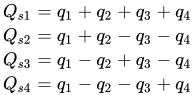
amount and the carbon atom is stationary. Q = q1 + q2
asymmetric stretching: the difference of the two C–O
stretching coordinates; one C–O bond length increases while the other
decreases. Q = q1 − q2
When two or more normal coordinates belong to the same
irreducible representation of the molecular point group (colloquially,
have the same symmetry) there is "mixing" and the coefficients of the
combination cannot be determined a priori. For example, in the linear molecule hydrogen cyanide, HCN, The two stretching vibrations are
principally C–H stretching with a little C–N stretching; Q1 = q1 + aq2 (a << 1)
principally C–N stretching with a little C–H stretching; Q2 = bq1 + q2 (b << 1)
The coefficients a and b are found by performing a full normal coordinate analysis by means of the Wilson GF method.
Newtonian mechanics
The HCl molecule as an anharmonic oscillator vibrating at energy level E3. D0 is dissociation energy here, r0bond length, U potential energy. Energy is expressed in wavenumbers. The hydrogen chloride molecule is attached to the coordinate system to show bond length changes on the curve.
Perhaps surprisingly, molecular vibrations can be treated
using Newtonian mechanics to calculate the correct vibration
frequencies. The basic assumption is that each vibration can be treated
as though it corresponds to a spring. In the harmonic approximation the
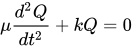
spring obeys Hooke's law: the force required to extend the spring is proportional to the extension. The proportionality constant is known as a force constant, k. The anharmonic oscillator is considered elsewhere.
By Newton's second law of motion this force is also equal to a reduced mass, μ, times acceleration.
Since this is one and the same force the ordinary differential equation follows.
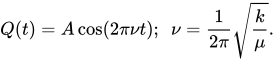
The solution to this equation of simple harmonic motion is
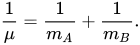
A is the maximum amplitude of the vibration coordinate Q. It remains to define the reduced mass, μ. In general, the reduced mass of a diatomic molecule, AB, is expressed in terms of the atomic masses, mA and mB, as
The use of the reduced mass ensures that the centre of mass of the
molecule is not affected by the vibration. In the harmonic approximation
the potential energy of the molecule is a quadratic function of the
normal coordinate. It follows that the force-constant is equal to the
second derivative of the potential energy.
When two or more normal vibrations have the same symmetry a full normal coordinate analysis must be performed (see GF method). The vibration frequencies, νi, are obtained from the eigenvalues, λi, of the matrix productGF. G is a matrix of numbers derived from the masses of the atoms and the geometry of the molecule. F is a matrix derived from force-constant values. Details concerning the determination of the eigenvalues can be found in.
Quantum mechanics
In the harmonic approximation the potential energy is a quadratic function of the normal coordinates. Solving the Schrödinger wave equation, the energy states for each normal coordinate are given by
where n is a quantum number that can take values of 0,
1, 2, ... In molecular spectroscopy where several types of molecular
energy are studied and several quantum numbers are used, this vibrational quantum number is often designated as v.
The difference in energy when n (or v) changes by 1 is therefore equal to , the product of the Planck constant and the vibration frequency derived using classical mechanics. For a transition from level n to level n+1 due to absorption of a photon, the frequency of the photon is equal to the classical vibration frequency (in the harmonic oscillator approximation).
See quantum harmonic oscillator for graphs of the first 5 wave functions, which allow certain selection rules to be formulated. For example, for a harmonic oscillator transitions are allowed only when the quantum number n changes by one,
but this does not apply to an anharmonic oscillator; the observation of overtones is only possible because vibrations are anharmonic. Another consequence of anharmonicity is that transitions such as between states n = 2 and n = 1 have slightly less energy than transitions between the ground state and first excited state. Such a transition gives rise to a hot band. To describe vibrational levels of an anharmonic oscillator, Dunham expansion is used.
In an infrared spectrum the intensity of an absorption band is proportional to the derivative of the molecular dipole moment with respect to the normal coordinate. Likewise, the intensity of Raman bands depends on the derivative of polarizability with respect to the normal coordinate. There is also a dependence on the fourth-power of the wavelength of the laser used.