Search This Blog

Tuesday, August 18, 2026

Quantum spacetime

From Wikipedia, the free encyclopedia

In mathematical physics, the concept of quantum spacetime is a generalization of the usual concept of spacetime in which some variables that ordinarily commute are assumed not to commute and form a different Lie algebra. The choice of that algebra varies from one theory to another. As a result of this change, some variables that are usually continuous may become discrete. Often only such discrete variables are called "quantized"; usage varies.

The idea of quantum spacetime was proposed in the early days of quantum theory by Heisenberg and Ivanenko as a way to eliminate infinities from quantum field theory. The germ of the idea passed from Heisenberg to Rudolf Peierls, who noted that electrons in a magnetic field can be regarded as moving in a quantum spacetime, and to Robert Oppenheimer, who carried it to Hartland Snyder, who published the first concrete example. Snyder's Lie algebra was made simple by C. N. Yang in the same year.

Overview

Physical spacetime is a quantum spacetime when in quantum mechanics position and momentum variables are already noncommutative, obey the Heisenberg uncertainty principle, and are continuous. Because of the Heisenberg uncertainty relations, greater energy is needed to probe smaller distances. Ultimately, according to gravity theory, the probing particles form black holes that destroy what was to be measured. The process cannot be repeated, so it cannot be considered to be a measurement. This limited measurability led many to expect that the usual picture of continuous commutative spacetime breaks down at Planck scale distances, if not sooner.

Physical spacetime is expected to be quantum because physical coordinates are slightly noncommutative. The astronomical coordinates of a star are modified by gravitational fields between the observer and the star, as in the deflection of light by the sun, one of the classic tests of general relativity. Therefore, the coordinates actually depend on gravitational field variables. According to quantum theories of gravity, these field variables do not commute; therefore coordinates that depend on them likely do not commute.

Both arguments are based on pure gravity and quantum theory, and they limit the measurement of time by the only time constant in pure quantum gravity, the Planck time. Instruments, however, are not purely gravitational but are made of particles. They may set a more severe, larger, limit than the Planck time.

Criteria

Quantum spacetimes are often described mathematically using the noncommutative geometry of Connes, quantum geometry, or quantum groups.

Any noncommutative algebra with at least four generators could be interpreted as a quantum spacetime, but the following desiderata have been suggested:

  • Local Lorentz group and Poincaré group symmetries should be retained, possibly in a generalised form. Their generalisation often takes the form of a quantum group acting on the quantum spacetime algebra.
  • The algebra might plausibly arise in an effective description of quantum gravity effects in some regime of that theory. For example, a physical parameter , perhaps the Planck length, might control the deviation from commutative classical spacetime, so that ordinary Lorentzian spacetime arises as .
  • There might be a notion of quantum differential calculus on the quantum spacetime algebra, compatible with the (quantum) symmetry and preferably reducing to the usual differential calculus as .

This would permit wave equations for particles and fields and facilitate predictions for experimental deviations from classical spacetime physics that can then be tested experimentally.

  • The Lie algebra should be semisimple. This makes it easier to formulate a finite theory.

Models

Several models were found in the 1990s more or less meeting most of the above criteria.

Bicrossproduct model spacetime

The bicrossproduct model spacetime was introduced by Shahn Majid and Henri Ruegg and has Lie algebra relations

for the spatial variables and the time variable . Here has dimensions of time and is therefore expected to be something like the Planck time. The Poincaré group here is correspondingly deformed, now to a certain bicrossproduct quantum group with the following characteristic features.

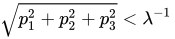
Orbits for the action of the Lorentz group on momentum space in the construction of the bicrossproduct model in units of . Mass-shell hyperboloids are 'squashed' into a cylinder.

The momentum generators commute among themselves but addition of momenta, reflected in the quantum group structure, is deformed (momentum space becomes a non-abelian group). Meanwhile, the Lorentz group generators enjoy their usual relations among themselves but act non-linearly on the momentum space. The orbits for this action are depicted in the figure as a cross-section of against one of the . The on-shell region describing particles in the upper center of the image would normally be hyperboloids but these are now 'squashed' into the cylinder

in simplified units. The upshot is that Lorentz-boosting a momentum will never increase it above the Planck momentum. The existence of a highest momentum scale or lowest distance scale fits the physical picture. This squashing comes from the non-linearity of the Lorentz boost and is an endemic feature of bicrossproduct quantum groups known since their introduction in 1988. Some physicists dub the bicrossproduct model doubly special relativity, since it sets an upper limit to both speed and momentum.

Another consequence of the squashing is that the propagation of particles is deformed, even of light, leading to a variable speed of light. This prediction requires the particular to be the physical energy and spatial momentum (as opposed to some other function of them). Arguments for this identification were provided in 1999 by Giovanni Amelino-Camelia and Majid through a study of plane waves for a quantum differential calculus in the model. They take the form

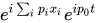
In other words, a form which is sufficiently close to classical that one might plausibly believe the interpretation. At the moment, such wave analysis represents the best hope to obtain physically testable predictions from the model.

Prior to this work there were a number of unsupported claims to make predictions from the model based solely on the form of the Poincaré quantum group. There were also claims based on an earlier -Poincaré quantum group introduced by Jurek Lukierski and co-workers which were important precursors to the bicrossproduct, albeit without the actual quantum spacetime and with different proposed generators for which the above picture does not apply. The bicrossproduct model spacetime has also been called -deformed spacetime with .

q-Deformed spacetime

This model was introduced independently by a team working under Julius Wess in 1990 and by Shahn Majid and coworkers in a series of papers on braided matrices starting a year later. The point of view in the second approach is that usual Minkowski spacetime has a description via Pauli matrices as the space of 2 x 2 hermitian matrices. In quantum group theory and using braided monoidal category methods, a natural q-version of this is defined here for real values of as a 'braided hermitian matrix' of generators and relations

These relations say that the generators commute as thereby recovering usual Minkowski space. Working with more familiar variables as linear combinations of these, in particular, time

is given by a natural braided trace of the matrix and commutes with the other generators (so this model is different from the bicrossproduct one). The braided-matrix picture also leads naturally to a quantity
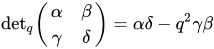
which as returns the usual Minkowski distance (this translates to a metric in the quantum differential geometry). The parameter or is dimensionless and is thought to be a ratio of the Planck scale and the cosmological length. That is, there are indications that this model relates to quantum gravity with a non-zero cosmological constant, the choice of depending on whether this is positive or negative. This describes the mathematically better understood but perhaps less physically justified positive case.

A full understanding of this model requires (and was concurrent with the development of) a full theory of 'braided linear algebra' for such spaces. The momentum space for the theory is another copy of the same algebra and there is a certain 'braided addition' of momentum on it expressed as the structure of a braided Hopf algebra or quantum group in a certain braided monoidal category). This theory, by 1993, had provided the corresponding -deformed Poincaré group as generated by such translations and -Lorentz transformations, completing the interpretation as a quantum spacetime.

In the process it was discovered that the Poincaré group not only had to be deformed but had to be extended to include dilations of the quantum spacetime. For such a theory to be exact, all particles in the theory need to be massless, which is consistent with experiment, as masses of elementary particles are vanishingly small compared to the Planck mass. If current thinking in cosmology is correct, then this model is more appropriate, but it is significantly more complicated and for this reason its physical predictions have yet to be worked out.

Fuzzy or spin model spacetime

This refers in modern usage to the angular momentum algebra

familiar from quantum mechanics but interpreted in this context as coordinates of a quantum space or spacetime. These relations were proposed by Roger Penrose in his earliest spin network theory of space. It is a toy model of quantum gravity in 3 spacetime dimensions (not the physical 4) with a Euclidean (not the physical Minkowskian) signature. It was again proposed in this context by Gerardus 't Hooft. A further development including a quantum differential calculus and an action of a certain 'quantum double' quantum group as deformed Euclidean group of motions was given by Majid and E. Batista.

A striking feature of the noncommutative geometry, is that the smallest covariant quantum differential calculus has one dimension higher than expected, namely 4, suggesting that the above can also be viewed as the spatial part of a 4-dimensional quantum spacetime. The model should not be confused with fuzzy spheres which are finite-dimensional matrix algebras which can be thought of as spheres in the spin model spacetime of fixed radius.

Heisenberg model spacetimes

The quantum spacetime of Hartland Snyder proposes that

where the generate the Lorentz group. This quantum spacetime and that of C. N. Yang entail a radical unification of spacetime, energy-momentum, and angular momentum.

The idea was revived in a modern context by Sergio Doplicher, Klaus Fredenhagen and John Roberts in 1995, by letting simply be viewed as some function of as defined by the above relation, and any relations involving it viewed as higher order relations among the . The Lorentz symmetry is arranged so as to transform the indices as usual and without being deformed.

An even simpler variant of this model is to let be a numerical antisymmetric tensor, in which context it is usually denoted , so the relations are . In even dimensions , any nondegenerate such theta can be transformed to a normal form in which this really is just the Heisenberg algebra but the difference that the variables are being proposed as those of spacetime. This proposal was once popular because of its familiar form of relations and because it has been argued that it emerges from the theory of open strings landing on D-branes, see noncommutative quantum field theory and Moyal plane. However, this D-brane lives in some of the higher spacetime dimensions in the theory and hence it is not physical spacetime that string theory suggests to be effectively quantum in this way. It also requires subscribing to D-branes as an approach to quantum gravity in the first place. When posited as quantum spacetime, it is hard to obtain physical predictions and one reason for this is that if is a tensor, then by dimensional analysis, it should have dimensions of length, and if this length is speculated to be the Planck length, then the effects would be harder to ever detect than for other models.

Noncommutative extensions to spacetime

Although not quantum spacetime in the sense above, another use of noncommutative geometry is to tack on 'noncommutative extra dimensions' at each point of ordinary spacetime. Instead of invisible curled up extra dimensions as in string theory, Alain Connes and coworkers have argued that the coordinate algebra of this extra part should be replaced by a finite-dimensional noncommutative algebra. For a certain reasonable choice of this algebra, its representation and extended Dirac operator, the Standard Model of elementary particles can be recovered. In this point of view, the different kinds of matter particles are manifestations of geometry in these extra noncommutative directions. Connes's first works here date from 1989 but has been developed considerably since then. Such an approach can theoretically be combined with quantum spacetime as above.

Virtual particle

From Wikipedia, the free encyclopedia
https://en.wikipedia.org/wiki/Virtual_particle

A virtual particle is a theoretical transient particle that exhibits some of the characteristics of an ordinary particle, while having its existence limited by the uncertainty principle, which allows the virtual particles to spontaneously emerge from vacuum at short time and space ranges. The concept of virtual particles arises in the perturbation theory of quantum field theory (QFT) where interactions between ordinary particles are described in terms of exchanges of virtual particles. A process involving virtual particles can be described by a schematic representation known as a Feynman diagram, in which virtual particles are represented by internal lines.

Virtual particles do not necessarily carry the same mass as the corresponding ordinary particle, although they always conserve energy and momentum. The closer its characteristics come to those of ordinary particles, the longer the virtual particle exists. They are important in the physics of many processes, including particle scattering and Casimir forces. In quantum field theory, forces—such as the electromagnetic repulsion or attraction between two charges—can be thought of as resulting from the exchange of virtual photons between the charges. Virtual photons are the exchange particles for the electromagnetic interaction.

The term is somewhat loose and vaguely defined, in that it refers to the view that the world is made up of "real particles". "Real particles" are better understood to be excitations of the underlying quantum fields. Virtual particles are also excitations of the underlying fields, but are "temporary" in the sense that they appear in calculations of interactions, but never as asymptotic states or indices to the scattering matrix. The accuracy and use of virtual particles in calculations is firmly established, but as they cannot be detected in experiments, deciding how to precisely describe them is a topic of debate. Although widely used, they are by no means a necessary feature of QFT, but rather are mathematical conveniences — as demonstrated by lattice field theory, which avoids using the concept altogether.

Properties

The concept of virtual particles arises in the perturbation theory of quantum field theory, an approximation scheme in which interactions (in essence, forces) between actual particles are calculated in terms of exchanges of virtual particles. Such calculations are often performed using schematic representations known as Feynman diagrams, in which virtual particles appear as internal lines. By expressing the interaction in terms of the exchange of a virtual particle with four-momentum q, where q is given by the difference between the four-momenta of the particles entering and leaving the interaction vertex, both momentum and energy are conserved at the interaction vertices of the Feynman diagram.

A virtual particle does not precisely obey the energy–momentum relation m2c4 = E2p2c2. Its kinetic energy may not have the usual relationship to velocity. It can be negative. This is expressed by the phrase off mass shell. The probability amplitude for a virtual particle to exist tends to be canceled out by destructive interference over longer distances and times. As a consequence, a real photon is massless and thus has only two polarization states, whereas a virtual one, being effectively massive, has three polarization states.

Quantum tunnelling may be considered a manifestation of virtual particle exchanges. The range of forces carried by virtual particles is limited by the uncertainty principle, which regards energy and time as conjugate variables; thus, virtual particles of larger mass have more limited range.

Written in the usual mathematical notations, in the equations of physics, there is no mark of the distinction between virtual and actual particles. The amplitudes of processes with a virtual particle interfere with the amplitudes of processes without it, whereas for an actual particle the cases of existence and non-existence cease to be coherent with each other and do not interfere any more. In the quantum field theory view, actual particles are viewed as being detectable excitations of underlying quantum fields. Virtual particles are also viewed as excitations of the underlying fields, but appear only as forces, not as detectable particles. They are "temporary" in the sense that they appear in some calculations, but are not detected as single particles. Thus, in mathematical terms, they never appear as indices to the scattering matrix, which is to say, they never appear as the observable inputs and outputs of the physical process being modelled.

There are two principal ways in which the notion of virtual particles appears in modern physics. They appear as intermediate terms in Feynman diagrams; that is, as terms in a perturbative calculation. They also appear as an infinite set of states to be summed or integrated over in the calculation of a semi-non-perturbative effect. In the latter case, it is sometimes said that virtual particles contribute to a mechanism that mediates the effect, or that the effect occurs through the virtual particles.

Manifestations

There are many observable physical phenomena that arise in interactions involving virtual particles. For bosonic particles that exhibit rest mass when they are free and actual, virtual interactions are characterized by the relatively short range of the force interaction produced by particle exchange. Confinement can lead to a short range, too. Examples of such short-range interactions are the strong and weak forces, and their associated field bosons.

For the gravitational and electromagnetic forces, the zero rest-mass of the associated boson particle permits long-range forces to be mediated by virtual particles. However, in the case of photons, power and information transfer by virtual particles is a relatively short-range phenomenon (existing only within a few wavelengths of the field-disturbance, which carries information or transferred power), as for example seen in the characteristically short range of inductive and capacitative effects in the near field zone of coils and antennas.

Some field interactions which may be seen in terms of virtual particles are:

  • The Coulomb force (static electric force) between electric charges. It is caused by the exchange of virtual photons. In symmetric 3-dimensional space this exchange results in the inverse square law for electric force. Since the photon has no mass, the coulomb potential has an infinite range.
  • The magnetic field between magnetic dipoles. It is caused by the exchange of virtual photons. In symmetric 3-dimensional space, this exchange results in the inverse cube law for magnetic force. Since the photon has no mass, the magnetic potential has an infinite range. Even though the range is infinite, the time lapse allowed for a virtual photon existence is not infinite.
  • Electromagnetic induction. This phenomenon transfers energy to and from a magnetic coil via a changing (electro)magnetic field.
  • The strong nuclear force between quarks is the result of interaction of virtual gluons. The residual of this force outside of quark triplets (neutron and proton) holds neutrons and protons together in nuclei, and is due to virtual mesons such as the pi meson and rho meson.
  • The weak nuclear force is the result of exchange by virtual W and Z bosons.
  • The spontaneous emission of a photon during the decay of an excited atom or excited nucleus; such a decay is prohibited by ordinary quantum mechanics and requires the quantization of the electromagnetic field for its explanation.
  • The Casimir effect, where the ground state of the quantized electromagnetic field causes attraction between a pair of electrically neutral metal plates.
  • The van der Waals force, which is partly due to the Casimir effect between two atoms.
  • Vacuum polarization, which involves pair production or the decay of the vacuum, which is the spontaneous production of particle-antiparticle pairs (such as electron-positron).
  • Lamb shift of positions of atomic levels.
  • The impedance of free space, which defines the ratio between the electric field strength |E| and the magnetic field strength |H|: Z0 = |E| / |H|.[10]
  • Much of the so-called near-field of radio antennas, where the magnetic and electric effects of the changing current in the antenna wire and the charge effects of the wire's capacitive charge may be (and usually are) important contributors to the total EM field close to the source, but both of which effects are dipole effects that decay with increasing distance from the antenna much more quickly than do the influence of "conventional" electromagnetic waves that are "far" from the source.[a] These far-field waves, for which E is (in the limit of long distance) equal to cB, are composed of actual photons. Actual and virtual photons are mixed near an antenna, with the virtual photons responsible only for the "extra" magnetic-inductive and transient electric-dipole effects, which cause any imbalance between E and cB. As distance from the antenna grows, the near-field effects (as dipole fields) die out more quickly, and only the "radiative" effects that are due to actual photons remain as important effects. Although virtual effects extend to infinity, they drop off in field strength as 1/r2 rather than the field of EM waves composed of actual photons, which drop as 1/r.

Most of these have analogous effects in solid-state physics; indeed, one can often gain a better intuitive understanding by examining these cases. In semiconductors, the roles of electrons, positrons and photons in field theory are replaced by electrons in the conduction band, holes in the valence band, and phonons or vibrations of the crystal lattice. A virtual particle is in a virtual state where the probability amplitude is not conserved. Examples of macroscopic virtual phonons, photons, and electrons in the case of the tunneling process were presented by Günter Nimtz and Alfons A. Stahlhofen.

Feynman diagrams

One particle exchange scattering diagram

The calculation of scattering amplitudes in theoretical particle physics requires the use of some rather large and complicated integrals over a large number of variables. These integrals do, however, have a regular structure, and may be represented as Feynman diagrams. The appeal of the Feynman diagrams is strong, as it allows for a simple visual presentation of what would otherwise be a rather arcane and abstract formula. In particular, part of the appeal is that the outgoing legs of a Feynman diagram can be associated with actual, on-shell particles. Thus, it is natural to associate the other lines in the diagram with particles as well, called the "virtual particles". In mathematical terms, they correspond to the propagators appearing in the diagram.

In the adjacent image, the solid lines correspond to actual particles (of momentum p1 and so on), while the dotted line corresponds to a virtual particle carrying momentum k. For example, if the solid lines were to correspond to electrons interacting by means of the electromagnetic interaction, the dotted line would correspond to the exchange of a virtual photon. In the case of interacting nucleons, the dotted line would be a virtual pion. In the case of quarks interacting by means of the strong force, the dotted line would be a virtual gluon, and so on.

One-loop diagram with fermion propagator

Virtual particles may be mesons or vector bosons, as in the example above; they may also be fermions. However, in order to preserve quantum numbers, most simple diagrams involving fermion exchange are prohibited. The image above shows an allowed diagram, a one-loop diagram. The solid lines correspond to a fermion propagator, the wavy lines to bosons.

Vacuums

In formal terms, a particle is considered to be an eigenstate of the particle number operator aa, where a is the particle annihilation operator and a the particle creation operator (sometimes collectively called ladder operators). In many cases, the particle number operator does not commute with the Hamiltonian for the system. This implies the number of particles in an area of space is not a well-defined quantity but, like other quantum observables, is represented by a probability distribution. Since these particles are not certain to exist, they are called virtual particles or vacuum fluctuations of vacuum energy. In a certain sense, they can be understood to be a manifestation of the time-energy uncertainty principle in a vacuum.

An important example of the "presence" of virtual particles in a vacuum is the Casimir effect. Here, the explanation of the effect requires that the total energy of all of the virtual particles in a vacuum can be added together. Thus, although the virtual particles themselves are not directly observable in the laboratory, they do leave an observable effect: Their zero-point energy results in forces acting on suitably arranged metal plates or dielectrics. On the other hand, the Casimir effect can be interpreted as the relativistic van der Waals force.

Pair production

Virtual particles are often popularly described as coming in pairs, a particle and antiparticle, which can be of any kind. These pairs exist for an extremely short time, and then mutually annihilate, or in some cases, the pair may be boosted apart using external energy so that they avoid annihilation and become actual particles, as described below.

This may occur in one of two ways. In an accelerating frame of reference, the virtual particles may appear to be actual to the accelerating observer; this is known as the Unruh effect. In short, the vacuum of a stationary frame appears, to the accelerated observer, to be a warm gas of actual particles in thermodynamic equilibrium.

Another example is pair production in very strong electric fields, sometimes called vacuum decay. If, for example, a pair of atomic nuclei are merged to very briefly form a nucleus with a charge greater than about 140, (that is, larger than about the inverse of the fine-structure constant, which is a dimensionless quantity), the strength of the electric field will be such that it will be energetically favorable to create positron–electron pairs out of the vacuum or Dirac sea, with the electron attracted to the nucleus to annihilate the positive charge. This pair-creation amplitude was first calculated by Julian Schwinger in 1951.

Compared to actual particles

As a consequence of quantum mechanical uncertainty, any object or process that exists for a limited time or in a limited volume cannot have a precisely defined energy or momentum. For this reason, virtual particles which exist only temporarily as they are exchanged between ordinary particles do not typically obey the mass-shell relation; the longer a virtual particle exists, the more the energy and momentum approach the mass-shell relation.

The lifetime of real particles is typically vastly longer than the lifetime of the virtual particles. Electromagnetic radiation consists of real photons which may travel light years between the emitter and absorber, but (Coulombic) electrostatic attraction and repulsion is a relatively short-range force that is a consequence of the exchange of virtual photons

Anti-capitalism

From Wikipedia, the free encyclopedia https://en.wikipedia.org/wiki/Anti-capi...