Search This Blog

Saturday, August 22, 2026

Drake equation

From Wikipedia, the free encyclopedia
Frank Drake in c. 1960s

The Drake equation is a probabilistic argument used to estimate the number of active, communicative extraterrestrial civilizations in the Milky Way Galaxy.

The equation was formulated in 1961 by Frank Drake, not for purposes of quantifying the number of civilizations, but as a way to stimulate scientific dialogue at the first scientific meeting on the search for extraterrestrial intelligence (SETI). The equation summarizes the main concepts which scientists must contemplate when considering the question of other radio-communicative life. It is more properly thought of as an approximation than as a serious attempt to determine a precise number.

Criticism related to the Drake equation focuses not on the equation itself, but on the fact that the estimated values for several of its factors are highly conjectural, the combined multiplicative effect being that the uncertainty associated with any derived value is so large that the equation cannot be used to draw firm conclusions.

Equation

The Drake equation is:

where

  • N = the number of civilizations in the Milky Way galaxy with which communication might be possible (i.e. which are on the current past light cone);

and

  • R = the average rate of star formation in our galaxy.
  • fp = the fraction of those stars that have planets.
  • ne = the average number of planets that can potentially support life per star that has planets.
  • fl = the fraction of planets that could support life that actually develop life at some point.
  • fi = the fraction of planets with life that go on to develop intelligent life (civilizations).
  • fc = the fraction of civilizations that develop a technology that releases detectable signs of their existence into space.
  • L = the length of time for which such civilizations release detectable signals into space.

This form of the equation first appeared in Drake's 1965 paper.

History

Completed 300 Foot Telescope. Frank Drake is the second from left.

In September 1959, physicists Giuseppe Cocconi and Philip Morrison published an article in the journal Nature with the provocative title "Searching for Interstellar Communications". Cocconi and Morrison argued that radio telescopes had become sensitive enough to pick up transmissions that might be broadcast into space by civilizations orbiting other stars. Such messages, they suggested, might be transmitted at a wavelength of 21 cm (1,420.4 MHz). This is the wavelength of radio emission by neutral hydrogen, the most common element in the universe, and they reasoned that other intelligences might see this as a logical landmark in the radio spectrum.

Two months later, Harvard University astronomy professor Harlow Shapley speculated on the number of inhabited planets in the universe, saying "The universe has 10 million, million, million suns (10 followed by 18 zeros) similar to our own. One in a million has planets around it. Only one in a million million has the right combination of chemicals, temperature, water, days and nights to support planetary life as we know it. This calculation arrives at the estimated figure of 100 million worlds where life has been forged by evolution."

Seven months after Cocconi and Morrison published their article, Drake began searching for extraterrestrial intelligence in an experiment called Project Ozma. It was the first systematic search for signals from communicative extraterrestrial civilizations. Using the 85 ft (26 m) dish of the National Radio Astronomy Observatory, Green Bank in Green Bank, West Virginia, Drake monitored two nearby Sun-like stars: Epsilon Eridani and Tau Ceti, slowly scanning frequencies close to the 21 cm wavelength for six hours per day from April to July 1960. The project was well designed, inexpensive, and simple by today's standards. It detected no signals.

Soon thereafter, Drake hosted the first search for extraterrestrial intelligence conference on detecting their radio signals. The meeting was held at the Green Bank facility in 1961. The equation that bears Drake's name arose out of his preparations for the meeting.

As I planned the meeting, I realized a few day[s] ahead of time we needed an agenda. And so I wrote down all the things you needed to know to predict how hard it's going to be to detect extraterrestrial life. And looking at them it became pretty evident that if you multiplied all these together, you got a number, N, which is the number of detectable civilizations in our galaxy. This was aimed at the radio search, and not to search for primordial or primitive life forms.

Frank Drake

The ten attendees were conference organizer J. Peter Pearman, Frank Drake, Philip Morrison, businessman and radio amateur Dana Atchley, chemist Melvin Calvin, astronomer Su-Shu Huang, neuroscientist John C. Lilly, inventor Barney Oliver, astronomer Carl Sagan, and radio-astronomer Otto Struve. These participants called themselves "The Order of the Dolphin" (because of Lilly's work on dolphin communication), and commemorated their first meeting with a plaque at the observatory hall.

Usefulness

The Allen Telescope Array for SETI

The Drake equation results in a summary of the factors affecting the likelihood that we might detect radio-communication from intelligent extraterrestrial life. The last three parameters, fi, fc, and L, are not known and are very difficult to estimate, with values ranging over many orders of magnitude (see § Criticism). Therefore, the usefulness of the Drake equation is not in the solving, but rather in the contemplation of all the various concepts which scientists must incorporate when considering the question of life elsewhere, and gives the question of life elsewhere a basis for scientific analysis. The equation has helped draw attention to some particular scientific problems related to life in the universe, for example abiogenesis, the development of multi-cellular life, and the development of intelligence itself.

Within the limits of existing human technology, any practical search for distant intelligent life must necessarily be a search for some manifestation of a distant technology. After about 50 years, the Drake equation is still of seminal importance because it is a 'road map' of what we need to learn in order to solve this fundamental existential question. It also formed the backbone of astrobiology as a science; although speculation is entertained to give context, astrobiology concerns itself primarily with hypotheses that fit firmly into existing scientific theories. Some 50 years of SETI have failed to find anything, even though radio telescopes, receiver techniques, and computational abilities have improved significantly since the early 1960s. SETI efforts since 1961 have conclusively ruled out widespread alien emissions near the 21 cm wavelength of the hydrogen frequency.

Estimates

Original estimates

There is considerable disagreement on the values of these parameters, but the 'educated guesses' used by Drake and his colleagues in 1961 were:

  • R = 1 yr−1 (1 star formed per year, on the average over the life of the galaxy; this was regarded as conservative)
  • fp = 0.2 to 0.5 (one fifth to one half of all stars formed will have planets)
  • ne = 1 to 5 (stars with planets will have between 1 and 5 planets capable of developing life)
  • fl = 1 (100% of these planets will develop life)
  • fi = 1 (100% of which will develop intelligent life)
  • fc = 0.1 to 0.2 (10–20% of which will be able to communicate)
  • L = somewhere between 1000 and 100,000,000 years

Inserting the above minimum numbers into the equation gives a minimum N of 20 (see: Range of results). Inserting the maximum numbers gives a maximum of 50,000,000. Drake states that given the uncertainties, the original meeting concluded that NL, and there were probably between 1000 and 100,000,000 planets with civilizations in the Milky Way Galaxy.

Current estimates

This section discusses and attempts to list the best current estimates for the parameters of the Drake equation.

Rate of star creation in this Galaxy, R

Calculations in 2010, from NASA and the European Space Agency indicate that the rate of star formation in this Galaxy is about 0.68–1.45 solar masses (M; 1.35×1030–2.88×1030 kg) of material per year. To get the number of stars per year, we divide this by the initial mass function (IMF) for stars, where the average new star's mass is about 0.5 M. This gives a star formation rate of about 1–3 stars per year.

Fraction of those stars that have planets, fp

Analysis of microlensing surveys, in 2012, has found that fp may approach 1—that is, stars are orbited by planets as a rule, rather than the exception; and that there are one or more bound planets per Milky Way star.

Average number of planets that might support life per star that has planets, ne

In November 2013, astronomers reported, based on Kepler space telescope data, that there could be as many as 40 billion Earth-sized planets orbiting in the habitable zones of Sun-like stars and red dwarf stars within the Milky Way Galaxy. 11 billion of these estimated planets may be orbiting Sun-like stars. Since there are about 100 billion stars in the galaxy, this implies fp · ne is roughly 0.4. The nearest planet in the habitable zone is Proxima Centauri b, which is as close as about 4.2 light-years away.

The consensus at the Green Bank meeting was that ne had a minimum value between 3 and 5. Dutch science journalist Govert Schilling has opined that this is optimistic. Even if planets are in the habitable zone, the number of planets with the right proportion of elements is difficult to estimate. Brad Gibson, Yeshe Fenner, and Charley Lineweaver determined that about 10% of star systems in the Milky Way Galaxy are hospitable to life, by having heavy elements, being far from supernovae and being stable for a sufficient time.

The discovery of numerous gas giants in close orbit with their stars has introduced doubt that life-supporting planets commonly survive the formation of their stellar systems. So-called hot Jupiters may migrate from distant orbits to near orbits, in the process disrupting the orbits of habitable planets.

On the other hand, the variety of star systems that might have habitable zones is not just limited to solar-type stars and Earth-sized planets. It is now estimated that even star systems of tidally locked planets close to red dwarf stars might have habitable zones, although the flaring behavior of these stars might speak against this. The possibility of life on moons of gas giants (such as Jupiter's moon Europa, or Saturn's moons Titan and Enceladus) adds further uncertainty to this figure.

The authors of the rare Earth hypothesis propose a number of additional constraints on habitability for planets, including being in galactic zones with suitably low radiation, high star metallicity, and low enough density to avoid excessive asteroid bombardment. They also propose that it is necessary to have a planetary system with large gas giants which provide bombardment protection without a hot Jupiter; and a planet with plate tectonics, a large moon that creates tidal pools, and moderate axial tilt to generate seasonal variation.

Fraction of the above that actually go on to develop life, fl

Geological evidence from the Earth suggests that fl may be high; life on Earth appears to have begun around the same time as favorable conditions arose, suggesting that abiogenesis may be relatively common once conditions are right. However, this evidence only looks at the Earth (a single model planet), and contains anthropic bias, as the planet of study was not chosen randomly, but by the living organisms that already inhabit it (ourselves). From a classical hypothesis testing standpoint, without assuming that the underlying distribution of fl is the same for all planets in the Milky Way, there are zero degrees of freedom, permitting no valid estimates to be made. If life (or evidence of past life) were to be found on Mars, Europa, Enceladus or Titan that developed independently from life on Earth it would imply a value for fl close to 1. While this would raise the number of degrees of freedom from zero to one, there would remain a great deal of uncertainty on any estimate due to the small sample size, and the chance they are not really independent.

Countering this argument is that there is no evidence for abiogenesis occurring more than once on the Earth—that is, all terrestrial life stems from a common origin. If abiogenesis were more common it would be speculated to have occurred more than once on the Earth. Scientists have searched for this by looking for microbes that are unrelated to other life on Earth, constituting what would be called a shadow biosphere, but none have been found yet. It is also possible that life arose more than once, but that other branches were out-competed, or died in mass extinctions, or were lost in other ways. Biochemists Francis Crick and Leslie Orgel laid special emphasis on this uncertainty: "At the moment we have no means at all of knowing" whether we are "likely to be alone in the galaxy (Universe)" or whether "the galaxy may be pullulating with life of many different forms." As an alternative to abiogenesis on Earth, they proposed the hypothesis of directed panspermia, which states that Earth life began with "microorganisms sent here deliberately by a technological society on another planet, by means of a special long-range unmanned spaceship".

In 2020, a paper by scholars at the University of Nottingham proposed an "Astrobiological Copernican" principle, based on the Principle of Mediocrity, and speculated that "intelligent life would form on other [Earth-like] planets like it has on Earth, so within a few billion years life would automatically form as a natural part of evolution". In the authors' framework, fl, fi, and fc are all set to a probability of 1 (certainty). Their resultant calculation concludes there are more than thirty current technological civilizations in the galaxy (disregarding error bars).

Fraction of the above that develops intelligent life, fi

This value remains particularly controversial. Those who favor a low value, such as the biologist Ernst Mayr, point out that of the billions of species that have existed on Earth, only one has become intelligent and from this, infer a tiny value for fi. Likewise, the Rare Earth hypothesis, notwithstanding their low value for ne above, also think a low value for fi dominates the analysis. Those who favor higher values note the generally increasing complexity of life over time, concluding that the appearance of intelligence is almost inevitable, implying an fi approaching 1. Skeptics point out that the large spread of values in this factor and others make all estimates unreliable. (See Criticism).

In addition, while it appears that life developed soon after the formation of Earth, the transition from single-celled prokaryotes to eukaryotes, and the resulting increase in complexity, including a change in life's "operating system", required a considerable amount of time as the complexity of living organisms grew. Subsequently, the Cambrian explosion, in which a large variety of multicellular life forms came into being, occurred a considerable amount of time after this event, which suggests the possibility that special conditions for complex life were necessary. Some scenarios such as the snowball Earth or research into extinction events have raised the possibility that life on Earth is relatively fragile. Research on any past life on Mars is relevant since a discovery that life did form on Mars but ceased to exist might raise the estimate of fl but would indicate that in half the known cases, intelligent life did not develop.

Estimates of fi have been affected by discoveries that the Solar System's orbit is circular in the galaxy, at such a distance that it remains out of the spiral arms for tens of millions of years (evading radiation from novae). Also, Earth's large moon may aid the evolution of life by stabilizing the planet's axis of rotation.

There has been quantitative work to begin to define . One example is a Bayesian analysis published in 2020. In the conclusion, the author cautions that this study applies to Earth's conditions. In Bayesian terms, the study favors the formation of intelligence on a planet with identical conditions to Earth but does not do so with high confidence.

Planetary scientist Pascal Lee of the SETI Institute proposes that this fraction is very low (0.0002). He based this estimate on how long it took Earth to develop intelligent life (1 million years since Homo erectus evolved, compared to 4.6 billion years since Earth formed).

Fraction of the above revealing their existence via signal release into space, fc

For deliberate communication, the one example we have (the Earth) does not do much explicit communication, though there are some efforts covering only a tiny fraction of the stars that might look for human presence. (See Arecibo message, for example). There is considerable speculation why an extraterrestrial civilization might exist but choose not to communicate. However, deliberate communication is not required, as other technosignatures may be detectable. Calculations indicate that current or near-future Earth-level technology might well be detectable to civilizations not too much more advanced than present day humans. By this standard, the Earth is a communicating civilization.

Another question is what percentage of civilizations in the galaxy are close enough for us to detect, assuming that they send out signals. For example, existing Earth radio telescopes could only detect Earth radio transmissions from roughly a light year away.

Lifetime of such a civilization wherein it communicates its signals into space, L

Michael Shermer estimated L as 420 years, based on the duration of sixty historical Earthly civilizations. Using 28 civilizations more recent than the Roman Empire, he calculates a figure of 304 years for "modern" civilizations. It could also be argued from Michael Shermer's results that the fall of most of these civilizations was followed by later civilizations that carried on the technologies, so it is doubtful that they are separate civilizations in the context of the Drake equation. In the expanded version, including reappearance number, this lack of specificity in defining single civilizations does not matter for the result, since such a civilization turnover could be described as an increase in the reappearance number rather than increase in L, stating that a civilization reappears in the form of the succeeding cultures. Furthermore, since none could communicate over interstellar space, the method of comparing with historical civilizations could be regarded as invalid.

David Grinspoon has argued that once a civilization has developed enough, it might overcome all threats to its survival. It will then last for an indefinite period of time, making the value for L potentially billions of years. If this is the case, then he proposes that the Milky Way Galaxy may have been steadily accumulating advanced civilizations since it formed. He proposes that the last factor L be replaced with fIC · T, where fIC is the fraction of communicating civilizations that become "immortal" (in the sense that they simply do not die out), and T representing the length of time during which this process has been going on. This has the advantage that T would be a relatively easy-to-discover number, as it would simply be some fraction of the age of the universe.

It has also been hypothesized that once a civilization has learned of a more advanced one, its longevity could increase because it can learn from the experiences of the other.

The astronomer Carl Sagan speculated that all of the terms, except for the lifetime of a civilization, are relatively high and the determining factor in whether there are large or small numbers of civilizations in the universe is the civilization lifetime, or in other words, the ability of technological civilizations to avoid self-destruction. In Sagan's case, the Drake equation was a strong motivating factor for his interest in environmental issues and his efforts to warn against the dangers of nuclear warfare. Paleobiologist Olev Vinn suggests that the lifetime of most technological civilizations is brief due to inherited behavior patterns present in all intelligent organisms. These behaviors, incompatible with civilized conditions, inevitably lead to self-destruction soon after the emergence of advanced technologies.

An intelligent civilization might not be organic, as some have suggested that artificial general intelligence may replace humanity.

Range of results

As many skeptics have pointed out, the Drake equation can give a very wide range of values, depending on the assumptions, as the values used in portions of the Drake equation are not well established. In particular, the result can be N ≪ 1, meaning we are likely alone in the galaxy, or N ≫ 1, implying there are many civilizations we might contact. One of the few points of wide agreement is that the presence of humanity demonstrates that the probability of intelligence arising is greater than zero.

As an example of a low estimate, combining NASA's star formation rates, the rare Earth hypothesis value of fp · ne · fl = 10−5, Mayr's view on intelligence arising, Drake's view of communication, and Shermer's estimate of lifetime:

R = 1.5–3 yr−1fp · ne · fl = 10−5fi = 10−9fc = 0.2[Drake, above], and L = 304 years

gives:

N = 1.5 × 10−5 × 10−9 × 0.2 × 304 = 9.1 × 10⁻¹³ (0.00000000000091 in non scientific notation)

i.e., suggesting that we are probably alone in this galaxy, and possibly in the observable universe.

On the other hand, with larger values for each of the parameters above, values of N can be derived that are greater than 1. The following higher values that have been proposed for each of the parameters:

R = 1.5–3 yr−1fp = 1ne = 0.2fl = 0.13fi = 1fc = 0.2[Drake, above], and L = 109 years

Use of these parameters gives:

N = 3 × 1 × 0.2 × 0.13 × 1 × 0.2 × 109 = 15,600,000 civilizations in the Milky Way with which communication might be possible

Monte Carlo simulations of estimates of the Drake equation factors based on a stellar and planetary model of the Milky Way have resulted in the number of civilizations varying by a factor of 100.

Possible former technological civilizations

In 2016, Adam Frank and Woodruff Sullivan modified the Drake equation to determine just how unlikely the event of a technological species arising on a given habitable planet must be, to give the result that Earth hosts the only technological species that has ever arisen, for two cases: (a) this Galaxy, and (b) the universe as a whole. By asking this different question, one removes the lifetime and simultaneous communication uncertainties. Since the numbers of habitable planets per star can today be reasonably estimated, the only remaining unknown in the Drake equation is the probability that a habitable planet ever develops a technological species over its lifetime. For Earth to have the only technological species that has ever occurred in the universe, they calculate the probability of any given habitable planet ever developing a technological species must be less than 2.5×10⁻²⁴. Similarly, for Earth to have been the only case of hosting a technological species over the history of this Galaxy, the odds of a habitable zone planet ever hosting a technological species must be less than 1.7×10⁻¹¹ (about 1 in 60 billion). The figure for the universe implies that it is extremely unlikely that Earth hosts the only technological species that has ever occurred. On the other hand, for this Galaxy one must think that fewer than 1 in 60 billion habitable planets develop a technological species for there not to have been at least a second case of such a species over the past history of this Galaxy.

Modifications

As many observers have pointed out, the Drake equation is a very simple model that omits potentially relevant parameters, and many changes and modifications to the equation have been proposed. One line of modification, for example, attempts to account for the uncertainty inherent in many of the terms. Combining the estimates of the original six factors by major researchers via a Monte Carlo procedure leads to a best value for the non-longevity factors of 0.85 per year. This result differs insignificantly from the estimate of unity given both by Drake and the Cyclops report.

Others note that the Drake equation ignores many concepts that might be relevant to the odds of contacting other civilizations. For example, Glen David Brin states: "The Drake equation merely speaks of the number of sites at which ETIs spontaneously arise. The equation says nothing directly about the contact cross-section between an ETIS and contemporary human society". Because it is the contact cross-section that is of interest to the SETI community, many additional factors and modifications of the Drake equation have been proposed.

Colonization
Brin proposed to generalize the Drake equation to include additional effects of alien civilizations colonizing other star systems. Each original site expands with an expansion velocity v, and establishes additional sites that survive for a lifetime L. The result is a more complex set of 3 equations.
Reappearance factor
The Drake equation may furthermore be multiplied by how many times an intelligent civilization may occur on planets where it has happened once. Even if an intelligent civilization reaches the end of its lifetime, life may still prevail on the planet for billions of years, permitting the next civilization to evolve. Thus, several civilizations may come and go during the lifespan of one and the same planet. Thus, if nr is the average number of times a new civilization reappears on the same planet where a previous civilization once has appeared and ended, then the total number of civilizations on such a planet would be 1 + nr, which is the actual reappearance factor added to the equation.
METI factor
Alexander Zaitsev said that to be in a communicative phase and emit dedicated messages are not the same. For example, humans are in a communicative phase, but are not a communicative civilization; there are no purposeful and regular transmission of interstellar messages. For this reason, he suggested introducing the METI factor (messaging to extraterrestrial intelligence) to the classical Drake equation. He defined the factor as "fm = The fraction of communicative civilizations with clear and non-paranoid planetary consciousness (that is, those which actually engage in deliberate interstellar transmission)".
Biogenic gases
Astronomer Sara Seager proposed a revised equation that focuses on the search for planets with biosignature gases. These gases are produced by living organisms that can accumulate in a planet atmosphere to levels that can be detected with remote space telescopes.
The Seager equation looks like:
where:
N = the number of planets with detectable signs of life
N = the number of stars observed
FQ = the fraction of stars that are quiet
FHZ = the fraction of stars with rocky planets in the habitable zone
FO = the fraction of those planets that can be observed
FL = the fraction that have life
FS = the fraction on which life produces a detectable signature gas

Carl Sagan's version of the Drake equation
American astronomer Carl Sagan made some modifications in the Drake equation and presented it in the 1980 program Cosmos: A Personal Voyage. The modified equation is:
where:
N = the number of civilizations in the Milky Way galaxy with which communication might be possible (i.e. which are on the current past light cone);
N = Number of stars in the Milky Way Galaxy
fp = the fraction of those stars that have planets.
ne = the average number of planets that can potentially support life per star that has planets.
fl = the fraction of planets that could support life that actually develop life at some point.
fi = the fraction of planets with life that go on to develop intelligent life (civilizations).
fc = the fraction of civilizations that develop a technology that releases detectable signs of their existence into space.
fL = fraction of a planetary lifetime graced by a technological civilization
Plate tectonics factor

Robert J. Stern and Taras V. Gerya proposed to add plate tectonics factors in the 2024 paper:

We resolve the Fermi Paradox (1) by adding two additional terms to the Drake Equation: foc (the fraction of habitable exoplanets with significant continents and oceans) and fpt (the fraction of habitable exoplanets with significant continents and oceans that have had plate tectonics operating for at least 0.5 Ga); and (2) by demonstrating that the product of foc and fpt is very small (< 0.00003–0.002). We propose that the lack of evidence for ACCs [active, communicative civilizations] reflects the scarcity of long-lived plate tectonics and/or continents and oceans on exoplanets with primitive life.

Criticism

Criticism of the Drake equation is varied. Firstly, many of the terms in the equation are largely or entirely based on conjecture. Star formation rates are well-known, and the incidence of planets has a sound theoretical and observational basis, but the other terms in the equation become very speculative. The uncertainties revolve around the present day understanding of the evolution of life, intelligence, and civilization, not physics. No statistical estimates are possible for some of the parameters, where only one example is known. The net result is that the equation cannot be used to draw firm conclusions of any kind, and the resulting margin of error is huge, far beyond what some consider acceptable or meaningful.

Others point out that the equation was formulated before our understanding of the universe had matured. Astrophysicist Ethan Siegel, said:

The Drake equation, when it was put forth, made an assumption about the Universe that we now know is untrue: It assumed that the Universe was eternal and static in time. As we learned only a few years after Frank Drake first proposed his equation, the Universe doesn’t exist in a steady state, where it’s unchanging in time, but rather has evolved from a hot, dense, energetic, and rapidly expanding state: a hot Big Bang that occurred over a finite duration in our cosmic past.

One reply to such criticisms is that even though the Drake equation currently involves speculation about unmeasured parameters, it was intended as a way to stimulate dialogue on these topics. Then the focus becomes how to proceed experimentally. Indeed, Drake originally formulated the equation merely as an agenda for discussion at the Green Bank conference.

Fermi paradox

A civilization lasting for tens of millions of years could be able to spread throughout the galaxy, even at the slow speeds foreseeable with present-day technology. However, no confirmed signs of civilizations or intelligent life elsewhere have been found, either in this Galaxy or in the observable universe of 2 trillion galaxies. According to this line of thinking, the tendency to fill (or at least explore) all available territory seems to be a universal trait of living things, so the Earth should have already been colonized, or at least visited, but no evidence of this exists. Hence Fermi's question "Where is everybody?".

A large number of explanations have been proposed to explain this lack of contact; a book published in 2015 elaborated on 75 different explanations. In terms of the Drake Equation, the explanations can be divided into three classes:

  • Few intelligent civilizations ever arise. This is an argument that at least one of the first few terms, R · fp · ne · fl · fi, has a low value. The most common suspect is fi, but explanations such as the rare Earth hypothesis argue that ne is the small term.
  • Intelligent civilizations exist, but we see no evidence, meaning fc is small. Typical arguments include that civilizations are too far apart, it is too expensive to spread throughout the galaxy, civilizations broadcast signals for only a brief period of time, communication is dangerous, and many others.
  • The lifetime of intelligent, communicative civilizations is short, meaning the value of L is small. Drake suggested that a large number of extraterrestrial civilizations would form, and he further speculated that the lack of evidence of such civilizations may be because technological civilizations tend to disappear rather quickly. Common explanations include the nature of intelligent life to destroy itself and/or others, and that intelligent life may be destroyed by natural events.

These lines of reasoning lead to the Great Filter hypothesis, which states that since there are no observed extraterrestrial civilizations despite the vast number of stars, at least one step in the process must be acting as a filter to reduce the final value. According to this view, either it is very difficult for intelligent life to arise, or the lifetime of technologically advanced civilizations, or the period of time they reveal their existence must be relatively short.

An analysis by Anders Sandberg, Eric Drexler and Toby Ord suggests "a substantial ex ante (predicted) probability of there being no other intelligent life in our observable universe".

Commemorative plate on Europa Clipper

The equation was cited by Gene Roddenberry as supporting the multiplicity of inhabited planets shown on Star Trek, the television series he created. However, Roddenberry did not have the equation with him, and he was forced to "invent" it for his original proposal. The fictitious equation that Roddenberry created is:

Regarding this fictional version of the equation, Drake himself commented that a number raised to the first power is just the number itself.

A commemorative plate on NASA's Europa Clipper mission, which launched October 14, 2024, features a poem by the U.S. Poet Laureate Ada Limón, waveforms of the word 'water' in 103 languages, a schematic of the water hole, the Drake equation, and a portrait of planetary scientist Ron Greeley on it.

Friday, August 21, 2026

Bohr–Einstein debates

From Wikipedia, the free encyclopedia
Niels Bohr (left) with Albert Einstein (right) at Paul Ehrenfest's home in Leiden (December 1925)

The Bohr–Einstein debates were a series of public disputes about quantum mechanics between Albert Einstein and Niels Bohr. Their debates are remembered because of their importance to the philosophy of science, insofar as the disagreements—and the outcome of Bohr's version of quantum mechanics becoming the prevalent view—form the root of the modern understanding of physics. Most of Bohr's version of the events held in the Solvay Conference in 1927 and other places was first written by Bohr decades later in an article titled, "Discussions with Einstein on Epistemological Problems in Atomic Physics". Based on the article, the philosophical issue of the debate was whether Bohr's Copenhagen interpretation of quantum mechanics, which centered on his belief of complementarity, was valid in explaining nature. Despite their differences of opinion and the succeeding discoveries that helped solidify quantum mechanics, Bohr and Einstein maintained a mutual admiration that was to last the rest of their lives.

Although Bohr and Einstein disagreed, they were great friends all their lives and enjoyed using each other as a foil.

Pre-revolutionary debates

Einstein was the first physicist to say that Max Planck's discovery of the energy quanta would require a rewriting of the laws of physics. To support his point, in 1905 Einstein proposed that light sometimes acts as a particle which he called a light quantum (see photon and wave–particle duality). Bohr was one of the most vocal opponents of the photon idea and did not openly embrace it until 1925. The photon appealed to Einstein because he saw it as a physical reality (although a confusing one) behind the numbers presented by Planck mathematically in 1900. Bohr disliked it because it made the choice of mathematical solution arbitrary; Bohr did not like a scientist having to choose between equations. This disagreement was perhaps the first real Bohr-Einstein debate. Einstein had proposed the photon in 1905, and Arthur Compton provided evidence in 1922 with his Compton effect. Bohr, along with Hans Kramers and John C. Slater asserted that conservation of energy only applied to statistical averages in the BKS theory of 1924. However, after the 1925 Bothe–Geiger coincidence experiment, BKS was proved to be wrong and Einstein's position that energy was conserved in individual collisions was shown to be correct.

The quantum revolution

The quantum revolution of the mid-1920s occurred under the direction of both Einstein and Bohr, and their post-revolutionary debates were about making sense of the change. Erwin Schrödinger redeveloped quantum theory in terms of a wave mechanics formulation, leading to the Schrödinger equation. When Schrödinger sent a preprint of his new equation to Einstein, Einstein wrote back hailing his equation as a decisive advance of “true genius.” In parallel, Werner Heisenberg's 1925 Umdeutung paper reinterpreted old quantum theory in terms of matrix-like operators, removing the Newtonian elements of space and time from any underlying reality. A year later, in 1926, Max Born, collaborating with Heisenberg, proposed that mechanics were to be understood as a probability without any causal explanation.

Both Einstein and Schrödinger rejected Born's interpretation, with its renunciation of causality which had been a key feature of science still present in general relativity. In a 1926 letter to Max Born, Einstein wrote:

[...] quantum mechanics is certainly imposing. But an inner voice tells me that it is not yet the real thing. The theory says a lot, but does not really bring us any closer to the secret of the “old one”. I, at any rate, am convinced that He [God] is not playing at dice.

At first, even Heisenberg had heated disputes with Bohr about whether his matrix mechanics were compatible with Schrödinger's wave mechanics. And Bohr was opposed to Heisenberg's uncertainty principle. However, by the fifth Solvay Conference in October 1927, Heisenberg and Born concluded that the revolution was over and nothing further was needed. It was at that last stage that Einstein's skepticism turned to dismay. He believed that much had been accomplished, but the reasons behind the mechanics still needed to be understood.

Einstein's refusal to accept the revolution as complete reflected his desire to see developed a model for the underlying causes from which these apparent random statistical methods resulted. He did not reject the idea that positions in space-time could never be completely known but did not want to allow the uncertainty principle to necessitate a seemingly random, non-deterministic mechanism by which the laws of physics operated. Einstein himself was a statistical thinker but denied that no more needed to be discovered or clarified. Einstein worked the rest of his life to discover a new theory that would make sense of quantum mechanics and return causality to science, what many now call the theory of everything. Bohr, meanwhile, was dismayed by none of the elements that troubled Einstein. He made his own peace with the contradictions by proposing a principle of complementarity that assigns properties only as result of measurements.

Post-revolution: First stage

As mentioned above, Einstein's position underwent significant modifications over the course of the years. In the first stage, Einstein refused to accept quantum indeterminism and sought to demonstrate that the uncertainty principle could be violated, suggesting ingenious thought experiments which should permit the accurate determination of incompatible variables, such as position and velocity, or to explicitly reveal simultaneously the wave and the particle aspects of the same process. (The main source and substance for these thought experiments is solely from Bohr's account twenty years later.) Bohr admits: “As regards the account of the conversations I am of course aware that I am relying only on my own memory, just as I am prepared for the possibility that many features of the development of quantum theory, in which Einstein has played so large a part, may appear to himself in a different light.”

Einstein's argument

The first serious attack by Einstein on the "orthodox" conception took place during the Fifth Solvay International Conference on "Electrons and Photons" in 1927. Einstein pointed out how it was possible to take advantage of the (universally accepted) laws of conservation of energy and of impulse (momentum) in order to obtain information on the state of a particle in a process of interference which, according to the principle of indeterminacy or that of complementarity, should not be accessible.

Figure A. A monochromatic beam (one for which all the particles have the same impulse) encounters a first screen, diffracts, and the diffracted wave encounters a second screen with two slits, resulting in the formation of an interference figure on the background F. As always, it is assumed that only one particle at a time is able to pass the entire mechanism. From the measure of the recoil of the screen S1, according to Einstein, one can deduce from which slit the particle has passed without destroying the wave aspects of the process.
Figure B. Einstein's slit.

In order to follow his argumentation and to evaluate Bohr's response, it is convenient to refer to the experimental apparatus illustrated in figure A. A beam of light perpendicular to the X axis (here aligned vertically) propagates in the direction z and encounters a screen S1 with a narrow (relative to the wavelength of the ray) slit. After having passed through the slit, the wave function diffracts with an angular opening that causes it to encounter a second screen S2 with two slits. The successive propagation of the wave results in the formation of the interference figure on the final screen F.

At the passage through the two slits of the second screen S2, the wave aspects of the process become essential. In fact, it is precisely the interference between the two terms of the quantum superposition corresponding to states in which the particle is localized in one of the two slits which produces zones of constructive and destructive interference (in which the wave function is nullified). It is also important to note that any experiment designed to evidence the "corpuscular" aspects of the process at the passage of the screen S2 (which, in this case, reduces to the determination of which slit the particle has passed through) inevitably destroys the wave aspects, implies the disappearance of the interference figure and the emergence of two concentrated spots of diffraction which confirm our knowledge of the trajectory followed by the particle.

At this point Einstein brings into play the first screen as well and argues as follows: since the incident particles have velocities (practically) perpendicular to the screen S1, and since it is only the interaction with this screen that can cause a deflection from the original direction of propagation, by the law of conservation of impulse which implies that the sum of the impulses of two systems which interact is conserved, if the incident particle is deviated toward the top, the screen will recoil toward the bottom and vice versa. In realistic conditions the mass of the screen is so large that it will remain stationary, but, in principle, it is possible to measure even an infinitesimal recoil. If we imagine taking the measurement of the impulse of the screen in the direction X after every single particle has passed, we can know, from the fact that the screen will be found recoiled toward the top (bottom), whether the particle in question has been deviated toward the bottom or top, and therefore through which slit in S2 the particle has passed. But since the determination of the direction of the recoil of the screen after the particle has passed cannot influence the successive development of the process, we will still have an interference figure on the screen F. The interference takes place precisely because the state of the system is the superposition of two states whose wave functions are non-zero only near one of the two slits. On the other hand, if every particle passes through only the slit b or the slit c, then the set of systems is the statistical mixture of the two states, which means that interference is not possible. If Einstein is correct, then there is a violation of the principle of indeterminacy.

This thought experiment was begun in a simpler form during the general discussion portion of the actual proceedings during the 1927 Solvay conference. In those official proceedings, Bohr's reply is recorded as: “I feel myself in a very difficult position because I don’t understand precisely the point that Einstein is trying to make.” Einstein had explained, “it could happen that the same elementary process produces an action in two or several places on the screen. But the interpretation, according to which psi squared expresses the probability that this particular particle is found at a given point, assumes an entirely peculiar mechanism of action at a distance.” It is clear from this that Einstein was referring to separability (in particular, and most importantly local causality, i.e. locality), not indeterminacy. In fact, Paul Ehrenfest wrote a letter to Bohr stating that the 1927 thought experiments of Einstein had nothing to do with the uncertainty principle, as Einstein had already accepted these “and for a long time never doubted.”

Bohr's response

Bohr evidently misunderstood Einstein's argument about the quantum mechanical violation of relativistic causality (locality) and instead focused on the consistency of quantum indeterminacy. Bohr's response was to illustrate Einstein's idea more clearly using the diagram in Figure C. (Figure C shows a fixed screen S1 that is bolted down. Then try to imagine one that can slide up or down along a rod instead of a fixed bolt.) Bohr observes that extremely precise knowledge of any (potential) vertical motion of the screen is an essential presupposition in Einstein's argument. In fact, if its velocity in the direction X before the passage of the particle is not known with a precision substantially greater than that induced by the recoil (that is, if it were already moving vertically with an unknown and greater velocity than that which it derives as a consequence of the contact with the particle), then the determination of its motion after the passage of the particle would not give the information we seek. However, Bohr continues, an extremely precise determination of the velocity of the screen, when one applies the principle of indeterminacy, implies an inevitable imprecision of its position in the direction X. Before the process even begins, the screen would therefore occupy an indeterminate position at least to a certain extent (defined by the formalism). Now consider, for example, the point d in figure A, where the interference is destructive. Any displacement of the first screen would make the lengths of the two paths, a–b–d and a–c–d, different from those indicated in the figure. If the difference between the two paths varies by half a wavelength, at point d there will be constructive rather than destructive interference. The ideal experiment must average over all the possible positions of the screen S1, and, for every position, there corresponds, for a certain fixed point F, a different type of interference, from the perfectly destructive to the perfectly constructive. The effect of this averaging is that the pattern of interference on the screen F will be uniformly grey. Once more, our attempt to evidence the corpuscular aspects in S2 has destroyed the possibility of interference in F, which depends crucially on the wave aspects.

Figure C. In order to realize Einstein's proposal, it is necessary to replace the first screen in Figure A (S1) with a diaphragm that can move vertically, such as this proposed by Bohr.

As Bohr recognized, for the understanding of this phenomenon "it is decisive that, contrary to genuine instruments of measurement, these bodies along with the particles would constitute, in the case under examination, the system to which the quantum-mechanical formalism must apply. With respect to the precision of the conditions under which one can correctly apply the formalism, it is essential to include the entire experimental apparatus. In fact, the introduction of any new apparatus, such as a mirror, in the path of a particle could introduce new effects of interference which influence essentially the predictions about the results which will be registered at the end." Further along, Bohr attempts to resolve this ambiguity concerning which parts of the system should be considered macroscopic and which not:

In particular, it must be very clear that...the unambiguous use of spatiotemporal concepts in the description of atomic phenomena must be limited to the registration of observations which refer to images on a photographic lens or to analogous practically irreversible effects of amplification such as the formation of a drop of water around an ion in a dark room.

Bohr's argument about the impossibility of using the apparatus proposed by Einstein to violate the principle of indeterminacy depends crucially on the fact that a macroscopic system (the screen S1) obeys quantum laws. On the other hand, Bohr consistently held that, in order to illustrate the microscopic aspects of reality, it is necessary to set off a process of amplification, which involves macroscopic apparatuses, whose fundamental characteristic is that of obeying classical laws and which can be described in classical terms. This ambiguity would later come back in the form of what is still called today the measurement problem.

However, Bohr in his article refuting the EPR paper, states “there is no question of a mechanical disturbance of the system under investigation.” Heisenberg quotes Bohr as saying, “I find all such assertions as ‘observation introduces uncertainty into the phenomenon’ inaccurate and misleading.” Manjit Kumar's book on the Bohr–Einstein debates finds these assertions by Bohr contrary to his arguments. Others, such as the physicist Leon Rosenfeld, did find Bohr's argument convincing.

Uncertainty principle applied to time and energy

Figure D. A wave extended longitudinally passes through a slit which remains open only for a brief interval of time. Beyond the slit, there is a spatially limited wave in the direction of propagation.

In many textbook examples and popular discussions of quantum mechanics, the principle of indeterminacy is explained by reference to the pair of variables position and velocity (or momentum). The wave nature of physical processes implies that there must exist another relation of indeterminacy: that between time and energy. In order to comprehend this relation, it is convenient to refer to the experiment illustrated in Figure D, which results in the propagation of a wave which is limited in spatial extension. Assume that, as illustrated in the figure, a ray which is extremely extended longitudinally is propagated toward a screen with a slit furnished with a shutter which remains open only for a very brief interval of time . Beyond the slit, there will be a wave of limited spatial extension which continues to propagate toward the right.

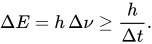
A perfectly monochromatic wave (such as a musical note which cannot be divided into harmonics) has infinite spatial extent. In order to have a wave which is limited in spatial extension (which is technically called a wave packet), several waves of different frequencies must be superimposed and distributed continuously within a certain interval of frequencies around an average value, such as . It then happens that at a certain instant, there exists a spatial region (which moves over time) in which the contributions of the various fields of the superposition add up constructively. Nonetheless, according to a precise mathematical theorem, as we move far away from this region, the phases of the various fields, at any specified point, are distributed causally and destructive interference is produced. The region in which the wave has non-zero amplitude is therefore spatially limited. It is easy to demonstrate that, if the wave has a spatial extension equal to (which means, in our example, that the shutter has remained open for a time where v is the velocity of the wave), then the wave contains (or is a superposition of) various monochromatic waves whose frequencies cover an interval which satisfies the relation:

Remembering that in the Planck relation, frequency and energy are proportional:

it follows immediately from the preceding inequality that the particle associated with the wave should possess an energy which is not perfectly defined (since different frequencies are involved in the superposition) and consequently there is indeterminacy in energy:

From this it follows immediately that:

which is the relation of indeterminacy between time and energy.

Einstein's second criticism

Einstein's thought experiment of 1930 as designed by Bohr. Einstein's box was supposed to prove the violation of the indeterminacy relation between time and energy.

At the sixth Congress of Solvay in 1930, the indeterminacy relation just discussed was Einstein's target of criticism. His idea contemplates the existence of an experimental apparatus which was subsequently designed by Bohr in such a way as to emphasize the essential elements and the key points which he would use in his response.

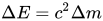
Einstein considers a box (called Einstein's box, or Einstein's light box; see figure) containing electromagnetic radiation and a clock which controls the opening of a shutter which covers a hole made in one of the walls of the box. The shutter uncovers the hole for a time which can be chosen arbitrarily. During the opening, we are to suppose that a photon, from among those inside the box, escapes through the hole. In this way a wave of limited spatial extension has been created, following the explanation given above. In order to challenge the indeterminacy relation between time and energy, it is necessary to find a way to determine with adequate precision the energy that the photon has brought with it. At this point, Einstein turns to mass–energy equivalence of special relativity: . From this it follows that knowledge of the mass of an object provides a precise indication about its energy. The argument is therefore very simple: if one weighs the box before and after the opening of the shutter and if a certain amount of energy has escaped from the box, the box will be lighter. The variation in mass multiplied by will provide precise knowledge of the energy emitted. Moreover, the clock will indicate the precise time at which the event of the particle's emission took place. Since, in principle, the mass of the box can be determined to an arbitrary degree of accuracy, the energy emitted can be determined with a precision as accurate as one desires. Therefore, the product can be rendered less than what is implied by the principle of indeterminacy.

George Gamow's make-believe experimental apparatus for validating the thought experiment at the Niels Bohr Institute in Copenhagen

The idea is particularly acute and the argument seemed unassailable. It's important to consider the impact of all of these exchanges on the people involved at the time. Leon Rosenfeld, who had participated in the Congress, described the event several years later:

It was a real shock for Bohr...who, at first, could not think of a solution. For the entire evening he was extremely agitated, and he continued passing from one scientist to another, seeking to persuade them that it could not be the case, that it would have been the end of physics if Einstein were right; but he couldn't come up with any way to resolve the paradox. I will never forget the image of the two antagonists as they left the club: Einstein, with his tall and commanding figure, who walked tranquilly, with a mildly ironic smile, and Bohr who trotted along beside him, full of excitement...The morning after saw the triumph of Bohr.

Bohr's triumph

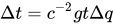
The triumph of Bohr consisted in his demonstrating, once again, that Einstein's subtle argument was not conclusive, but even more so in the way that he arrived at this conclusion by appealing precisely to one of the great ideas of Einstein: the principle of equivalence between gravitational mass and inertial mass, together with the time dilation of special relativity, and a consequence of these—the gravitational redshift. Bohr showed that, in order for Einstein's experiment to function, the box would have to be suspended on a spring in the middle of a gravitational field. In order to obtain a measurement of the weight of the box, a pointer would have to be attached to the box which corresponded with the index on a scale. After the release of a photon, a mass could be added to the box to restore it to its original position and this would allow us to determine the energy that was lost when the photon left. The box is immersed in a gravitational field of strength , and the gravitational redshift affects the speed of the clock, yielding uncertainty in the time required for the pointer to return to its original position. Bohr gave the following calculation establishing the uncertainty relation .

Let the uncertainty in the mass be denoted by . Let the error in the position of the pointer be . Adding the load to the box imparts a momentum that we can measure with an accuracy , where . Clearly , and therefore . By the redshift formula (which follows from the principle of equivalence and the time dilation), the uncertainty in the time is , and , and so . We have therefore proven the claimed .

More recent analyses of the photon box debate questions Bohr's understanding of Einstein's thought experiment, referring instead to a prelude to the EPR paper, focusing on inseparability rather than indeterminism being at issue.

Post-revolution: Second stage

The second phase of Einstein's "debate" with Bohr and the orthodox interpretation is characterized by an acceptance of the fact that it is, as a practical matter, impossible to simultaneously determine the values of certain incompatible quantities, but the rejection that this implies that these quantities do not actually have precise values. Einstein rejects the probabilistic interpretation of Born and insists that quantum probabilities are epistemic and not ontological in nature. As a consequence, the theory must be incomplete in some way. He recognizes the great value of the theory, but suggests that it "does not tell the whole story", and, while providing an appropriate description at a certain level, it gives no information on the more fundamental underlying level:

I have the greatest consideration for the goals which are pursued by the physicists of the latest generation which go under the name of quantum mechanics, and I believe that this theory represents a profound level of truth, but I also believe that the restriction to laws of a statistical nature will turn out to be transitory....Without doubt quantum mechanics has grasped an important fragment of the truth and will be a paragon for all future fundamental theories, for the fact that it must be deducible as a limiting case from such foundations, just as electrostatics is deducible from Maxwell's equations of the electromagnetic field or as thermodynamics is deducible from statistical mechanics.

These thoughts of Einstein would set off a line of research into hidden variable theories, such as the Bohm interpretation, in an attempt to complete the edifice of quantum theory. If quantum mechanics can be made complete in Einstein's sense, it cannot be done locally; this fact was demonstrated by John Stewart Bell with the formulation of Bell's inequality in 1964. Although, the Bell inequality ruled out local hidden variable theories, Bohm's theory was not ruled out. A 2007 experiment ruled out a large class of non-Bohmian non-local hidden variable theories, though not Bohmian mechanics itself.

Post-revolution: Third stage

The argument of EPR

Title sections of historical papers on EPR

In 1935 Einstein, Boris Podolsky and Nathan Rosen developed an argument, published in the magazine Physical Review with the title Can Quantum-Mechanical Description of Physical Reality Be Considered Complete?, based on an entangled state of two systems. Before coming to this argument, it is necessary to formulate another hypothesis that comes out of Einstein's work in relativity: the principle of locality. The elements of physical reality which are objectively possessed cannot be influenced instantaneously at a distance.

David Bohm picked up the EPR argument in 1951. In his textbook Quantum Theory, he reformulated it in terms of an entangled state of two particles, which can be summarized as follows:

1) Consider a system of two photons which at time t are located, respectively, in the spatially distant regions A and B and which are also in the entangled state of polarization described below:

2) At time t the photon in region A is tested for vertical polarization. Suppose that the result of the measurement is that the photon passes through the filter. According to the reduction of the wave packet, the result is that, at time t + dt, the system becomes

3) At this point, the observer in A who carried out the first measurement on photon 1, without doing anything else that could disturb the system or the other photon ("assumption (R)", below), can predict with certainty that photon 2 will pass a test of vertical polarization. It follows that photon 2 possesses an element of physical reality: that of having a vertical polarization.

4) According to the assumption of locality, it cannot have been the action carried out in A which created this element of reality for photon 2. Therefore, we must conclude that the photon possessed the property of being able to pass the vertical polarization test before and independently of the measurement of photon 1.

5) At time t, the observer in A could have decided to carry out a test of polarization at 45°, obtaining a certain result, for example, that the photon passes the test. In that case, he could have concluded that photon 2 turned out to be polarized at 45°. Alternatively, if the photon did not pass the test, he could have concluded that photon 2 turned out to be polarized at 135°. Combining one of these alternatives with the conclusion reached in 4, it seems that photon 2, before the measurement took place, possessed both the property of being able to pass with certainty a test of vertical polarization and the property of being able to pass with certainty a test of polarization at either 45° or 135°. These properties are incompatible according to the formalism.

6) Since natural and obvious requirements have forced the conclusion that photon 2 simultaneously possesses incompatible properties, this means that, even if it is not possible to determine these properties simultaneously and with arbitrary precision, they are nevertheless possessed objectively by the system. But quantum mechanics denies this possibility and it is therefore an incomplete theory.

Bohr's response

Bohr's response to this argument was published, five months later than the original publication of EPR, in the same magazine Physical Review and with exactly the same title as the original. The crucial point of Bohr's answer is distilled in a passage which he later had republished in Paul Arthur Schilpp's book Albert Einstein, scientist-philosopher in honor of the seventieth birthday of Einstein. Bohr attacks assumption (R) of EPR by stating:

The statement of the criterion in question is ambiguous with regard to the expression "without disturbing the system in any way". Naturally, in this case no mechanical disturbance of the system under examination can take place in the crucial stage of the process of measurement. But even in this stage there arises the essential problem of an influence on the precise conditions which define the possible types of prediction which regard the subsequent behaviour of the system...their arguments do not justify their conclusion that the quantum description turns out to be essentially incomplete...This description can be characterized as a rational use of the possibilities of an unambiguous interpretation of the process of measurement compatible with the finite and uncontrollable interaction between the object and the instrument of measurement in the context of quantum theory.

Bohr's presentation of his argument was hard to follow for many of the scientists (although his views were generally accepted). Rosenfeld, who had worked closely with Bohr for many years, later explains Bohr's argument in a way that is perhaps more accessible:

In the case of the two particles, it is true that the measurement carried out on the first particle does not cause any direct physical disturbance of the second; but the measurement decisively affects the nature of verifiable predictions we will be able to make about this second particle. (...) [A]s long as we do not carry out any measurement (...) we have no control at all over this correlation [between the two particles]. If we really want the system to be subject to study and communication, we must carry out some measurement. If we now observe the position of the first particle, the correlation between the positions of the particles can be used to give us information about where the second particle is, but we have no way of making use of the correlation between the pulses of the particles (...). If we observe the momentum of the first particle, it is just the opposite. We retain control over the momentum correlation, but lose it over the position correlation. The two different measurements define two complementary phenomena that can never be reconciled into a single description of the given two-particle system.

Confirmatory experiments

Chien-Shiung Wu

Years after the exposition of Einstein via his EPR experiment, many physicists started performing experiments to show that Einstein's view of a spooky action in a distance is indeed consistent with the laws of physics. The first experiment to definitively prove that this was the case was in 1949, when physicists Chien-Shiung Wu and her colleague Irving Shaknov showcased this theory in real time using photons. Their work was published in the new year of the succeeding decade.

Later in 1975, Alain Aspect proposed in an article, an experiment meticulous enough to be irrefutable: Proposed experiment to test the non-separability of quantum mechanics. This led Aspect, together with his assistant Gérard Roger, and Jean Dalibard and Philippe Grangier [fr] (two young physics students at the time) to set up several increasingly complex experiments between 1980 and 1982 that further established quantum entanglement. Finally in 1998, the Geneva experiment tested the correlation between two detectors set 30 kilometres apart, virtually across the whole city, using the Swiss optical fibre telecommunication network. The distance gave the necessary time to commute the angles of the polarizers. It was therefore possible to have a completely random electrical shunting. Furthermore, the two distant polarizers were entirely independent. The measurements were recorded on each side, and compared after each experiment by dating each measurement using an atomic clock. The experiment once again verified entanglement under the strictest and most ideal conditions possible. If Aspect's experiment implied that a hypothetical coordination signal travel twice as fast as c, Geneva's reached 10 million times c.

Post-revolution: Fourth stage

In his last writing on the topic, Einstein further refined his position, making it completely clear that what really disturbed him about the quantum theory was the problem of the total renunciation of all minimal standards of realism, even at the microscopic level, that the acceptance of the completeness of the theory implied. Since the early days of quantum theory the assumption of locality and Lorentz invariance guided his thoughts and led to his determination that if we demand strict locality then hidden variables are naturally implied apropos EPR. Bell, starting from this EPR logic (which is widely misunderstood or forgotten) showed that local hidden variables imply a conflict with experiment. In an interview in the 1970s, Bell summarized his view of the decades long debates:

Bohr was inconsistent, unclear, willfully obscure and right. Einstein was consistent, clear, down-to-earth and wrong.

Ultimately what was at stake for Einstein was the assumption that physical reality be universally local. Although the majority of experts in the field agree that Einstein was wrong, the current understanding is still not complete (see Interpretation of quantum mechanics).

Anti-capitalism

From Wikipedia, the free encyclopedia https://en.wikipedia.org/wiki/Anti-capi...