Search This Blog

Saturday, July 11, 2026

Hormesis

From Wikipedia, the free encyclopedia
Hormesis is a biological phenomenon wherein an organism that is exposed to a low dose of a known harmful stressor has an adaptive response that may be beneficial to the organism

Hormesis is a two-phased dose-response relationship whereby low-dose exposures have a beneficial effect and high-dose amounts are either inhibitory to function or toxic. Within the hormetic zone, the biological response to low-dose amounts of some stressors is generally favorable. An example is the breathing of oxygen, which is needed in certain concentrations for respiration in aerobic animals. Exposure to elevated levels of oxygen can have beneficial effects, but it becomes toxic in high concentrations.

In toxicology, hormesis is a dose-response phenomenon to xenobiotics or other stressors. In physiology and nutrition, hormesis has regions extending from low-dose deficiencies to homeostasis, and potential toxicity at high levels. Physiological concentrations of an agent above or below homeostasis may adversely affect an organism, where the hormetic zone is a region of homeostasis of balanced nutrition. In pharmacology, the hormetic zone is similar to the therapeutic window.

In the context of toxicology, the hormesis model of dose response is vigorously debated. The biochemical mechanisms by which hormesis works (particularly in applied cases pertaining to behavior and toxins) remain under early laboratory research and are not well understood.

Etymology

The term "hormesis" derives from Greek hórmēsis for "rapid motion, eagerness", itself from ancient Greek hormáein to excite. The same Greek root provides the word hormone. The term "hormetics" is used for the study of hormesis. The word hormesis was first reported in English in 1943.

History

Dose-response curve showing a the U-shape at low doses, meaning a beneficial effect opposite to the toxic effects observed at higher doses
Dose-response curve for a toxic agent exhibiting hormesis: the U-shape at the bottom of the curve indicates that low doses have the opposite effect to higher doses, which cause toxicity, and are actually beneficial.

A form of hormesis famous in antiquity was Mithridatism, the practice whereby Mithridates VI of Pontus supposedly made himself immune to a variety of toxins by regular exposure to small doses. Mithridate and theriac, polypharmaceutical electuaries claiming descent from his formula and initially including flesh from poisonous animals, were consumed for centuries by emperors, kings, and queens as protection against poison and ill health. In the Renaissance, the Swiss doctor Paracelsus said, "All things are poison, and nothing is without poison; the dosage alone makes it so a thing is not a poison."

German pharmacologist Hugo Schulz first described such a phenomenon in 1888 following his own observations that the growth of yeast could be stimulated by small doses of poisons. This was coupled with the work of German physician Rudolph Arndt, who studied animals given low doses of drugs, eventually giving rise to the Arndt–Schulz rule. Arndt's advocacy of homeopathy contributed to the rule's diminished credibility in the 1920s and 1930s. The term "hormesis" was coined and used for the first time in a scientific paper by Chester M. Southam and J. Ehrlich in 1943 in the journal Phytopathology, volume 33, pp. 517–541.

In 2004, Edward Calabrese evaluated the concept of hormesis. Over 600 substances show a U-shaped dose–response relationship; Calabrese and Baldwin wrote: "One percent (195 out of 20,285) of the published articles contained 668 dose-response relationships that met the entry criteria [of a U-shaped response indicative of hormesis]."

Examples

Carbon monoxide

Carbon monoxide is produced in small quantities across phylogenetic kingdoms, where it has essential roles as a neurotransmitter (subcategorized as a gasotransmitter). The majority of endogenous carbon monoxide is produced by heme oxygenase; the loss of heme oxygenase and subsequent loss of carbon monoxide signaling has catastrophic implications for an organism. In addition to physiological roles, small amounts of carbon monoxide can be inhaled or administered in the form of carbon monoxide-releasing molecules as a therapeutic agent.

Regarding the hormetic curve graph:

  • Deficiency zone: an absence of carbon monoxide signaling has toxic implications
  • Hormetic zone / region of homeostasis: small amount of carbon monoxide has a positive effect:
    • essential as a neurotransmitter
    • beneficial as a pharmaceutical
  • Toxicity zone: excessive exposure results in carbon monoxide poisoning

Oxygen

Many organisms maintain a hormesis relationship with oxygen, which follows a hormetic curve similar to carbon monoxide:

Physical exercise

Physical exercise intensity may exhibit a hormetic curve. Individuals with low levels of physical activity are at risk for some diseases, and individuals engaged in moderate, regular exercise experience less disease risk. However, excessive exercise and overtraining increases the risk of disease and jeopardizes health.

Mitohormesis

The possible effect of small amounts of oxidative stress is under laboratory research. Mitochondria are sometimes described as "cellular power plants" because they generate most of the cell's supply of adenosine triphosphate (ATP), a source of chemical energy. Reactive oxygen species (ROS) have been discarded as unwanted byproducts of oxidative phosphorylation in mitochondria by the proponents of the free-radical theory of aging promoted by Denham Harman. The free-radical theory states that compounds inactivating ROS would lead to a reduction of oxidative stress and thereby produce an increase in lifespan, although this theory holds only in basic research. However, in over 19 clinical trials, "nutritional and genetic interventions to boost antioxidants have generally failed to increase life span."

Whether this concept applies to humans remains to be shown, although a 2007 epidemiological study supports the possibility of mitohormesis, indicating that supplementation with beta-carotene, vitamin A or vitamin E may increase disease prevalence in humans.

Alcohol

Alcohol is believed to be hormetic in preventing heart disease and stroke, although the benefits of light drinking may have been exaggerated.  The gut microbiome of a typical healthy individual naturally ferments small amounts of ethanol, and in rare cases dysbiosis leads to auto-brewery syndrome, therefore whether benefits of alcohol are derived from the behavior of consuming alcoholic drinks or as a homeostasis factor in normal physiology via metabolites from commensal microbiota remains unclear.

Methylmercury

In 2010, a paper in the journal Environmental Toxicology & Chemistry showed that low doses of methylmercury, a potent neurotoxic pollutant, improved the hatching rate of mallard eggs. The author of the study, Gary Heinz, who led the study for the U.S. Geological Survey at the Patuxent Wildlife Research Center in Beltsville, stated that other explanations are possible. For instance, the flock he studied might have harbored some low, subclinical infection and that mercury, well known to be antimicrobial, might have killed the infection that otherwise hurt reproduction in the untreated birds.

Radiation

Ionizing radiation

Hormesis has been observed in a number of cases in humans and animals exposed to chronic low doses of ionizing radiation. A-bomb survivors who received high doses exhibited shortened lifespan and increased cancer mortality, but those who received low doses had lower cancer mortality than the Japanese average.

In Taiwan, recycled radiocontaminated steel was inadvertently used in the construction of over 100 apartment buildings, causing the long-term exposure of 10,000 people. The average dose rate was 50 mSv/year and a subset of the population (1,000 people) received a total dose over 4,000 mSv over ten years. In the widely used linear no-threshold model used by regulatory bodies, the expected cancer deaths in this population would have been 302 with 70 caused by the extra ionizing radiation, with the remainder caused by natural background radiation. The observed cancer rate, though, was quite low at 7 cancer deaths when 232 would be predicted by the LNT model had they not been exposed to the radiation from the building materials. Ionizing radiation hormesis appears to be at work.

Chemical and ionizing radiation combined

No experiment can be performed in perfect isolation. Thick lead shielding around a chemical dose experiment to rule out the effects of ionizing radiation is built and rigorously controlled for in the laboratory, and certainly not the field. Likewise the same applies for ionizing radiation studies. Ionizing radiation is released when an unstable particle releases radiation, creating two new substances and energy in the form of an electromagnetic wave. The resulting materials are then free to interact with any environmental elements, and the energy released can also be used as a catalyst in further ionizing radiation interactions.

The resulting confusion in the low-dose exposure field (radiation and chemical) arise from lack of consideration of this concept as described by Mothersill and Seymory.

Nucleotide excision repair

Veterans of the Gulf War (1991) who suffered from the persistent symptoms of Gulf War illness (GWI) were likely exposed to stresses from toxic chemicals and/or radiation. The DNA damaging (genotoxic) effects of such exposures can be, at least partially, overcome by the DNA nucleotide excision repair (NER) pathway. Lymphocytes from GWI veterans exhibited a significantly elevated level of NER repair. It was suggested that this increased NER capability in exposed veterans was likely a hormetic response, that is, an induced protective response resulting from battlefield exposure.

Applications

Effects in aging

One of the areas where the concept of hormesis has been explored for its applicability is aging. Since the basic survival capacity of any biological system depends on its homeostatic ability, biogerontologists proposed that exposing cells and organisms to mild stress should result in the adaptive or hormetic response with various biological benefits.

Controversy

Hormesis suggests dangerous substances have benefits. Concerns exist that the concept has been leveraged by lobbyists to weaken environmental regulations of some well-known toxic substances in the US.

Radiation controversy

The hypothesis of hormesis has generated the most controversy when applied to ionizing radiation. This hypothesis is called radiation hormesis. For policy-making purposes, the commonly accepted model of dose response in radiobiology is the linear no-threshold model (LNT), which assumes a strictly linear dependence between the risk of radiation-induced adverse health effects and radiation dose, implying that there is no safe dose of radiation for humans.

Nonetheless, many countries including the Czech Republic, Germany, Austria, Poland, and the United States have radon therapy centers whose whole primary operating principle is the assumption of radiation hormesis, or beneficial impact of small doses of radiation on human health. Countries such as Germany and Austria at the same time have imposed very strict antinuclear regulations, which have been described as radiophobic inconsistency.

The United States National Research Council (part of the National Academy of Sciences), the National Council on Radiation Protection and Measurements (a body commissioned by the United States Congress) and the United Nations Scientific Committee on the Effects of Ionizing Radiation all agree that radiation hormesis is not clearly shown, nor clearly the rule for radiation doses.

A United States–based National Council on Radiation Protection and Measurements stated in 2001 that evidence for radiation hormesis is insufficient and radiation protection authorities should continue to apply the LNT model for purposes of risk estimation.

A 2005 report commissioned by the French National Academy concluded that evidence for hormesis occurring at low doses is sufficient and LNT should be reconsidered as the methodology used to estimate risks from low-level sources of radiation, such as deep geological repositories for nuclear waste.

Policy consequences

Hormesis remains largely unknown to the public, requiring a policy change for a possible toxin to consider exposure risk of small doses.

AI boom

From Wikipedia, the free encyclopedia
Time magazine cover featuring an excerpt of a conversation between a user and ChatGPT; after greeting ChatGPT, the user asks it what it thinks of a TIME cover story with the title "The AI Arms Race Is Changing Everything". ChatGPT replies that it is incapable of having opinions, but remarks that the title could be "attention-grabbing and thought-provoking", but may be "interpreted as sensationalist and alarmist", and that the story could "help raise public awareness about the potential risks and benefits of this trend" and stimulate discussion about AI ethics. The cover credits Andrew R. Chow and Billy Perrigo (humorously clarified to be humans) as authors.
American news magazine Time cover featuring a ChatGPT conversation; mechanical dove image created in Midjourney

An AI boom is a period of rapid growth in the field of artificial intelligence. The most recent boom happened in the 2020s before seeing increased acceleration and media coverage. Examples of this include generative AI technologies, such as large language models (LLM) and AI image generators developed by companies like OpenAI, Google, and Anthropic, as well as scientific advances, such as protein folding prediction led by Google DeepMind and Google AI. This period is sometimes referred to as an AI spring, a term used to differentiate it from previous AI wintersAs of 2025, ChatGPT has emerged as the 4th-most visited website globally, surpassed only by Google, YouTube, and Facebook.

History

The number of Google searches for the term "AI" accelerated in 2022.

In 1950, Alan Turing proposed the idea of "Thinking Machines". These were computers that would be able to reason at the same level as humans. He began his well-known "Turing test", where an interrogator is provided with two materials and they must determine which one was done by artificial intelligence and which one was done by a human being.

John McCarthy

In 1956, John McCarthy used the term "artificial intelligence" for the first time. That year, McCarthy, Nathaniel Rochester, Marvin Minsky, and Claude Shannon organized the Dartmouth conference, which formalized artificial intelligence as an academic field. In 1958, McCarthy created the programming language LISP, LISP stands for "List Processing" and was the main programming language for artificial intelligence. which remained the most common programming language for artificial intelligence in the United States for decades. In 1962 McCarthy founded Stanford Artificial Intelligence Laboratory (SAIL). McCarthy was also a cofounder of MIT's first Artificial Intelligence Laboratory, now known as MIT Computer Science and Artificial Intelligence Laboratory.

In 1966, Joseph Weizenbaum created ELIZA, the first chatbot, as an experimental emotional tool.

The text-to-image models DALL-E 2 and Midjourney were released in 2022.

ChatGPT, an AI chatbot created by OpenAI, was launched at the end of 2022. It grew to over 100 million users in 2 months, becoming the fastest-growing software application. Large language models are designed to respond to human language, by accessing a large amount of training data.

Advances

Biomedical

In 2020, DeepMind's AlphaFold program, which is designed to predict protein folding, scored more than 90 in CASP's Global distance test (GDT). The structural biologist and Nobel Prize winner Venki Ramakrishnan called the result "a stunning advance on the protein folding problem". The ability to predict protein structures accurately based on the constituent amino acid sequence may accelerate drug discovery and enable a better understanding of diseases.

Images and videos

An image generated by Stable Diffusion based on the text prompt "a photograph of an astronaut riding a horse"

As time passed, the power of generative AI grew stronger. In 2015, initial popularity began to grow with the release of Google's DeepDream. DeepDream is a generative AI that takes inputs from a previous image and morphs them to produce hallucinogenic images.

In January 2021, OpenAI released DALL-E, allowing for image generation through text prompts. This allows users to generate any image with a simple prompt. Soon after, other powerful models followed DALL-E, such as Google's Gemini.

The popularity of text-to-video generative AI tools grew exponentially. With the release of models such as OpenAI's Sora in 2024, the use of text-to-video tools became normalized, as people used them for advertisements, which saves on production costs and increases production speed.

Generative AI is growing at a rapid rate, outpacing modern-day detection tools. With the common public having access to these tools, it raises concerns about the ethical use of generative AI. There have been multiple occasions where misinformation has been spread over the internet about politics due to a generated or deep-faked video, posing as a security threat.

Language

GPT-3 is a large language model that was released in 2020 by OpenAI and is capable of generating human-like text. A new version called GPT-4 was released on 14 March 2023, and was used in the Microsoft Bing search engine. Other language models have been released, such as PaLM and Gemini by Google and LLaMA by Meta Platforms.

Software development

Generative coding can be used to produce, edit, explain, and debug code. A 2026 study in the journal Management Science found that less experienced developers have higher adoption rates and greater productivity gains.

Music and voice

In 2016, Google's DeepMind produced WaveNet. WaveNet allowed the generation of raw audio of speech and piano. WaveNet is able to generate different voices by identifying the speakers. This acted as a fundamental building block for future models, allowing audio to be formed from scratch. This wouldn't only help with the production of music, but voice generation as well.

OpenAI released Jukebox, the first large-scale model to generate songs, in 2020. Jukebox allowed for raw audio in different genres and styles.

In 2024, AI models capable of producing high-fidelity music became available to the public. In June 2024, AI-generated music services Udio and Suno AI were sued by a group of major record labels over copyright infringement concerns.

In March 2020, 15.ai was founded. 15.ai allowed for audio deepfakes. Artificially generated vocals can be generated with tools such as ElevenLabs, which allows for the creation of vocals from any audio. This allows for any celebrity or politician who has voice clips on the internet to be subject to audio deepfakes for both speech and singing. The voices of politicians, such as Joe Biden, have been used for fake robocalls to voters to attempt to manipulate elections.

Impact

Energy

Electricity consumed by hardware used for AI has increased demands on power grids, which has led to prolonged use of fossil fuel power plants which would otherwise have been deactivated.

Microsoft, Google, and Amazon have all invested in existing or proposed nuclear power plants to meet these demands. In September 2024, Microsoft signed a deal with Constellation Energy to purchase power from a reactor at Three Mile Island which had been shut down in 2019. The reactor is set to reopen in 2028 to provide power to Microsoft's data centers. The reactor is next to the unit which caused the worst nuclear power accident in US history in 1979.

Cultural

According to a report from Pew Research, opinions on AI are divided, with most Americans expressing concerns over a lack of control over AI and potential negative effect on human creativity. Nikolova & Angrisani (2025) found that people are specifically distrustful of the use AI in personal relationships, while being more accepting of its use in medicine, such as for creating new antibiotics.

Business and economy

In 2024, AI patents in China and the U.S. numbered more than three-fourths of AI patents worldwide. Though China had more AI patents, the U.S. had 35% more patents per AI patent-applicant company than China.

Some economists have been optimistic about the potential of the current wave of AI to boost productivity and economic growth. Notably, Stanford University economist Erik Brynjolfsson, in a series of articles has argued for an "AI-powered Productivity Boom" and a "Coming Productivity Boom". At the same time, others like Northwestern University economist Robert Gordon remain more pessimistic. Brynjolfsson and Gordon have made a formal bet, registered at long bets, about the rate of productivity growth in the 2020s, to be resolved at the end of the decade.

Big Tech companies view the AI boom as both opportunity and threat; Alphabet's Google, for example, realized that ChatGPT could be an innovator's dilemma-like replacement for Google Search. The company merged DeepMind and Google Brain, a rival internal unit, to accelerate its AI research.

The market capitalization of Nvidia, whose GPUs are in high demand to train and use generative AI models, rose to over US$3.3 trillion, making it the world's largest company by market capitalization as of 19 June 2024 and became the first company to reach US$4 trillion on 9 July 2025 and subsequently US$5 trillion on 29 October later that same year.

In 2023, San Francisco's population increased for the first time in years, with the boom cited as a contributing factor.

Machine learning resources, hardware or software can be bought and licensed off-the-shelf or as cloud platform services. This enables wide and publicly available uses, spreading AI skills. Over half of businesses consider AI to be a top organizational priority and to be the most crucial technological advancement in many decades.

Across industries, generative AI tools are becoming widely available through the AI boom and are increasingly used in businesses across regions. A main area of use is data analytics. Seen as an incremental change, machine learning improves industry performance. Businesses report AI to be most useful in increased process efficiency, improved decision-making and strengthening of existing services and products. Through adoption, AI has already positively influenced revenue generation in multiple business functions. Businesses have experienced revenue increases of up to 16%, mainly in manufacturing, risk management and research and development.

AI and generative AI investments have been increasing with the boom, increasing from $18 billion in 2014 to $119 billion in 2021. Most notably, the share of generative AI investments was around 30% in 2023. Further, generative AI businesses have seen considerable venture capital investments even though regulatory and economic outlooks remain in question.

Tech giants capture the bulk of the monetary gains from AI and act as major suppliers to or customers of private users and other businesses.

With the introduction of AI, there has been an exponential rise in production for businesses. It's expected that workers could use resources provided by artificial intelligence to boost their productivity. As many small businesses don't use AI, it's believed that if it's adopted by more businesses, the whole work structure could be changed, as many tasks will be automated by AI.

The U.S. Census Bureau's Business Trends and Outlook Survey measured AI use at 3–9% of businesses in March 2025, using language that asked whether firms used AI "to produce goods and services." After revising the question to cover "any business function," the Bureau's measured adoption rate increased to 18% in March 2026.

According to Bell & Korinek (2023), economic effect of AI could worsen economic inequality, which could potentially threaten democracy in ways which are separate from threats caused by AI's use in misinformation and propaganda.

Concerns

Inaccuracy, cybersecurity and intellectual property infringement are considered to be the main risks associated with the boom, although not many actively attempt to mitigate the risk. Large language models have been criticized for reproducing biases inherited from their training data, including discriminatory biases related to ethnicity or gender. As a dual-use technology, AI carries risks of misuse by malicious actors. As AI becomes more sophisticated, it may eventually become cheaper and more efficient than human workers, which could cause technological unemployment and a transition period of economic turmoil. Public reaction to the AI boom has been mixed, with some hailing the new possibilities that AI creates, its sophistication and potential for benefiting humanity; while others denounced it for threatening job security and for giving 'uncanny' or flawed responses.

Dominance by tech giants

Commercial AI is dominated by American Big Tech companies such as Alphabet Inc., Amazon, Apple Inc., Meta Platforms, and Microsoft, whose investments in this area have surpassed those from U.S.-based venture capitalists. These companies own the majority of cloud infrastructure, AI chips, and computing power from data centers.

Intellectual property

Tech companies such as Meta, OpenAI and Nvidia have been sued by artists, writers, journalists, and software developers for using their work to train AI models. Early generative AI chatbots, such as the GPT-1, used the BookCorpus, and books are still the best source of training data for producing high-quality language models. ChatGPT aroused suspicion that its sources included libraries of pirated content after the chatbot produced detailed summaries of every part of Sarah Silverman's The Bedwetter and verbatim excerpts of paywalled content from The New York Times. In protest of the UK government holding consultations on how copyrighted music can legally be used to train AI models, more than a thousand British musicians released an album with no sounds, entitled Is This What We Want?

Likeness and impersonation

The ability to generate convincing, personalized messages as well as realistic images may facilitate large-scale misinformation, manipulation, and propaganda.

On 19 April 2024, as part of an ongoing feud with fellow rapper Kendrick Lamar, the artist Drake released the diss track "Taylor Made Freestyle", which featured AI-generated vocals imitating the voices of Tupac Shakur and Snoop Dogg. Shakur's estate threatened to sue over the use of Shakur's likeness, saying that it constituted a violation of Shakur's personality rights.

On 20 May 2024, following the release of a demo of updates to OpenAI's ChatGPT Voice Mode feature a week earlier, actor Scarlett Johansson issued a statement in relation to the "Sky" voice shown in the demo, accusing OpenAI of producing it to be very similar to her own, and her portrayal of the artificial intelligence voice assistant Samantha in the film Her (2013), despite Johansson refusing an earlier offer from the company to provide her voice for the system. The agent of the unnamed voice actress who voiced Sky stated that she had recorded her lines in her natural speaking voice and that OpenAI had not mentioned the movie Her nor Johansson.

Several incidents involving sharing of non-consensual deepfake pornography have occurred. In late January 2024, deepfake images of American musician Taylor Swift proliferated. Several experts have warned that deepfake pornography is more quickly created and disseminated, due to the relative ease of using the technology. Canada introduced federal legislation targeting sharing of non-consensual sexually explicit AI-generated photos; most provinces already had such laws. In the United States, the DEFIANCE Act was introduced in March 2024.

Environment

A large amount of electricity is needed to power generative AI products, making it more difficult for companies to achieve net zero emissions. From 2019 to 2024, Google's greenhouse gas emissions increased by nearly 50%, partly as a result of increased energy consumption by AI data centres.

Biosecurity and cybersecurity

AI is expected by researchers of the Center for AI Safety to improve the "accessibility, success rate, scale, speed, stealth and potency of cyberattacks", potentially causing "significant geopolitical turbulence" if it reinforces attack more than defense. Concerns have been raised about the potential capability of future AI systems to engineer particularly lethal and contagious pathogens.

The AI boom is said to have started an arms race in which large companies are competing against each other to have the most powerful AI model on the market, with speed and profit prioritized over safety and user protection.

Human extinction

Industry leaders and others have signed the Statement on AI Risk, arguing that humanity might irreversibly lose control over a sufficiently advanced artificial general intelligence (AGI).

Digital sentience

Coverage of advances in machine learning and artificial intelligence have coincided with discussions of digital sentience and morality, such as whether AI programs should be granted rights.

Financial concerns and potential bubble

Much of the AI boom has been funded by loans and venture capital, but many commercial AI services remain of questionable practical utility or quality for business. Despite more than $60 billion in corporate investment in AI in 2025, 95% of business AI projects are unprofitable, according to research from MIT. Producers of generative AI, such as OpenAI, also themselves currently have costs greatly exceeding their revenue. As other major tech companies such as Nvidia are both heavily invested into AI and dependent on the AI ecosystem and its hardware demands for their own ongoing growth, this has raised speculation of a wider economic bubble in the tech industry, particularly if future demand falls short of the current levels of AI investment.

Half-life

From Wikipedia, the free encyclopedia

Half-life (symbol t½) is the time required for a quantity (of substance) to reduce to half of its initial value. The term is commonly used in nuclear physics to describe how quickly unstable atoms undergo radioactive decay or how long stable atoms survive. The term is also used more generally to characterize any type of exponential (or, rarely, non-exponential) decay. For example, the medical sciences refer to the biological half-life of drugs and other chemicals in the human body. The converse of half-life is doubling time, an exponential property which increases by a factor of 2 rather than reducing by that factor.

The original term, half-life period, dating to Ernest Rutherford's discovery of the principle in 1907, was shortened to half-life in the early 1950s. Rutherford applied the principle of a radioactive element's half-life in studies of age determination of rocks by measuring the decay period of radium to lead-206.

Half-life is constant over the lifetime of an exponentially decaying quantity, and it is a characteristic unit for the exponential decay equation. The accompanying table shows the reduction of a quantity as a function of the number of half-lives elapsed.

Probabilistic nature

Simulation of many identical atoms undergoing radioactive decay, starting with either 4 atoms per box (left) or 400 (right). The number at the top is how many half-lives have elapsed. Note the consequence of the law of large numbers: with more atoms, the overall decay is more regular and more predictable.

A half-life often describes the decay of discrete entities, such as radioactive atoms. In that case, it does not work to use the definition that states "half-life is the time required for exactly half of the entities to decay". For example, if there is just one radioactive atom, and its half-life is one second, there will not be "half of an atom" left after one second.

Instead, the half-life is defined in terms of probability: "Half-life is the time required for exactly half of the entities to decay on average". In other words, the probability of a radioactive atom decaying within its half-life is 50%.

For example, the accompanying image is a simulation of many identical atoms undergoing radioactive decay. Note that after one half-life there are not exactly one-half of the atoms remaining, only approximately, because of the random variation in the process. Nevertheless, when there are many identical atoms decaying (right boxes), the law of large numbers suggests that it is a very good approximation to say that half of the atoms remain after one half-life.

Various simple exercises can demonstrate probabilistic decay, for example involving flipping coins or running a statistical computer program.

Formulas for half-life in exponential decay

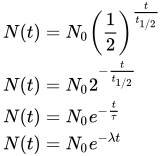
An exponential decay can be described by any of the following four equivalent formulas: where

  • N0 is the initial quantity of the substance that will decay (this quantity may be measured in grams, moles, number of atoms, etc.),
  • N(t) is the quantity that still remains and has not yet decayed after a time t,
  • t½ is the half-life of the decaying quantity,
  • τ is a positive number called the mean lifetime of the decaying quantity,
  • λ is a positive number called the decay constant of the decaying quantity.

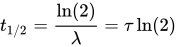
The three parameters t½, τ, and λ are directly related in the following way:where ln(2) is the natural logarithm of 2 (approximately 0.693).

Half-life and reaction orders

In chemical kinetics, the value of the half-life depends on the reaction order:

Zero order kinetics

The rate of this kind of reaction does not depend on the substrate concentration, [A]. Thus the concentration decreases linearly.

The integrated rate law of zero order kinetics is:

In order to find the half-life, we have to replace the concentration value for the initial concentration divided by 2: and isolate the time:This t½ formula indicates that the half-life for a zero order reaction depends on the initial concentration and the rate constant.

First order kinetics

In first order reactions, the rate of reaction will be proportional to the concentration of the reactant. Thus the concentration will decrease exponentially. as time progresses until it reaches zero, and the half-life will be constant, independent of concentration.

The time t½ for [A] to decrease from [A]0 to 1/2[A]0 in a first-order reaction is given by the following equation:It can be solved forFor a first-order reaction, the half-life of a reactant is independent of its initial concentration. Therefore, if the concentration of A at some arbitrary stage of the reaction is [A], then it will have fallen to 1/2[A] after a further interval of Hence, the half-life of a first order reaction is given as the following:

The half-life of a first order reaction is independent of its initial concentration and depends solely on the reaction rate constant, k.

Second order kinetics

In second order reactions, the rate of reaction is proportional to the square of the concentration. By integrating this rate, it can be shown that the concentration [A] of the reactant decreases following this formula:

We can set [A] to half the initial concentration [A]0/2 and rename t to t½,

then rearrange the above to find the half-life t½ of the reactant:

This shows that the half-life of second order reactions depends on the initial concentration and rate constant.

Decay by two or more processes

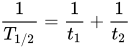
Some quantities decay by two exponential-decay processes simultaneously. In this case, the actual half-life T½ can be related to the half-lives t1 and t2 that the quantity would have if each of the decay processes acted in isolation:

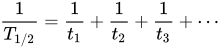
For three or more processes, the analogous formula is: For a proof of these formulas, see Exponential decay § Decay by two or more processes.

Examples

There is a half-life describing any exponential-decay process. For example:

  • As noted above, in radioactive decay the half-life is the length of time after which there is a 50% chance that an atom will have undergone nuclear decay. It varies depending on the atom type and isotope, and is usually determined experimentally. See List of nuclides.
  • The current flowing through an RC circuit or RL circuit decays with a half-life of ln(2)RC or ln(2)L/R, respectively. For this example the term half time tends to be used rather than "half-life", but they mean the same thing.
  • In a chemical reaction, the half-life of a species is the time it takes for the concentration of that substance to fall to half of its initial value. In a first-order reaction the half-life of the reactant is ln(2)/λ, where λ (also denoted as k) is the reaction rate constant.

In non-exponential decay

The term "half-life" is almost exclusively used for decay processes that are exponential (such as radioactive decay or the other examples above), or approximately exponential (such as biological half-life discussed below). In a decay process that is not even close to exponential, the half-life will change dramatically while the decay is happening. In this situation it is generally uncommon to talk about half-life in the first place, but sometimes people will describe the decay in terms of its "first half-life", "second half-life", etc., where the first half-life is defined as the time required for decay from the initial value to 50%, the second half-life is from 50% to 25%, and so on.

In biology and pharmacology

A biological half-life or elimination half-life is the time it takes for a substance (drug, radioactive nuclide, or other) to lose one-half of its pharmacologic, physiologic, or radiological activity. In a medical context, the half-life may also describe the time that it takes for the concentration of a substance in blood plasma to reach one-half of its steady-state value (the "plasma half-life").

The relationship between the biological and plasma half-lives of a substance can be complex, due to factors including accumulation in tissues, active metabolites, and receptor interactions.

While a radioactive isotope decays almost perfectly according to first order kinetics, where the rate constant is a fixed number, the elimination of a substance from a living organism usually follows more complex chemical kinetics.

For example, the biological half-life of water in a human being is about 9 to 10 days, though this can be altered by behavior and other conditions. The biological half-life of caesium in human beings is between one and four months.

The concept of a half-life has also been utilized for pesticides in plants, and certain authors maintain that pesticide risk and impact assessment models rely on and are sensitive to information describing dissipation from plants.

In epidemiology, the concept of half-life can refer to the length of time for the number of incident cases in a disease outbreak to drop by half, particularly if the dynamics of the outbreak can be modeled exponentially.

Indeterminism

From Wikipedia, the free encyclopedia https://en.wikipedia.org/wiki/Indeterm...