The Bohr–Einstein debates were a series of public disputes about quantum mechanics between Albert Einstein and Niels Bohr. Their debates are remembered because of their importance to the philosophy of science,
insofar as the disagreements—and the outcome of Bohr's version of
quantum mechanics becoming the prevalent view—form the root of the
modern understanding of physics. Most of Bohr's version of the events held in the Solvay Conference
in 1927 and other places was first written by Bohr decades later in an
article titled, "Discussions with Einstein on Epistemological Problems
in Atomic Physics". Based on the article, the philosophical issue of the debate was whether Bohr's Copenhagen interpretation of quantum mechanics, which centered on his belief of complementarity, was valid in explaining nature. Despite their differences of opinion and the succeeding discoveries
that helped solidify quantum mechanics, Bohr and Einstein maintained a
mutual admiration that was to last the rest of their lives.
Although Bohr and Einstein disagreed, they were great friends all their lives and enjoyed using each other as a foil.
Pre-revolutionary debates
Einstein was the first physicist to say that Max Planck's discovery of the energy quanta would require a rewriting of the laws of physics. To support his point, in 1905 Einstein proposed that light sometimes acts as a particle which he called a light quantum (see photon and wave–particle duality). Bohr was one of the most vocal opponents of the photon idea and did not openly embrace it until 1925. The photon appealed to Einstein because he saw it as a physical reality
(although a confusing one) behind the numbers presented by Planck
mathematically in 1900. Bohr disliked it because it made the choice of
mathematical solution arbitrary; Bohr did not like a scientist having to
choose between equations. This disagreement was perhaps the first real Bohr-Einstein debate. Einstein had proposed the photon in 1905, and Arthur Compton provided evidence in 1922 with his Compton effect. Bohr, along with Hans Kramers and John C. Slater asserted that conservation of energy only applied to statistical averages in the BKS theory of 1924. However, after the 1925 Bothe–Geiger coincidence experiment, BKS was proved to be wrong and Einstein's position that energy was conserved in individual collisions was shown to be correct.
The quantum revolution
The quantum revolution of the mid-1920s occurred under the
direction of both Einstein and Bohr, and their post-revolutionary
debates were about making sense of the change. Erwin Schrödinger redeveloped quantum theory in terms of a wave mechanics formulation, leading to the Schrödinger equation.
When Schrödinger sent a preprint of his new equation to Einstein,
Einstein wrote back hailing his equation as a decisive advance of “true
genius.” In parallel, Werner Heisenberg's 1925 Umdeutung paper reinterpreted old quantum theory
in terms of matrix-like operators, removing the Newtonian elements of
space and time from any underlying reality. A year later, in 1926, Max Born, collaborating with Heisenberg, proposed that mechanics were to be understood as a probability without any causal explanation.
Both Einstein and Schrödinger rejected Born's interpretation, with its renunciation of causality which had been a key feature of science still present in general relativity. In a 1926 letter to Max Born, Einstein wrote:
[...]
quantum mechanics is certainly imposing. But an inner voice tells me
that it is not yet the real thing. The theory says a lot, but does not
really bring us any closer to the secret of the “old one”. I, at any
rate, am convinced that He [God] is not playing at dice.
At first, even Heisenberg had heated disputes with Bohr about whether his matrix mechanics were compatible with Schrödinger's wave mechanics. And Bohr was opposed to Heisenberg's uncertainty principle. However, by the fifth Solvay Conference
in October 1927, Heisenberg and Born concluded that the revolution was
over and nothing further was needed. It was at that last stage that
Einstein's skepticism turned to dismay. He believed that much had been
accomplished, but the reasons behind the mechanics still needed to be
understood.
Einstein's refusal to accept the revolution as complete
reflected his desire to see developed a model for the underlying causes
from which these apparent random statistical methods resulted. He did
not reject the idea that positions in space-time could never be
completely known but did not want to allow the uncertainty principle to
necessitate a seemingly random, non-deterministic mechanism by which the
laws of physics operated. Einstein himself was a statistical thinker
but denied that no more needed to be discovered or clarified. Einstein worked the rest of his life to discover a new theory that
would make sense of quantum mechanics and return causality to science,
what many now call the theory of everything. Bohr, meanwhile, was dismayed by none of the elements that troubled
Einstein. He made his own peace with the contradictions by proposing a
principle of complementarity that assigns properties only as result of
measurements.
Post-revolution: First stage
As mentioned above, Einstein's position underwent
significant modifications over the course of the years. In the first
stage, Einstein refused to accept quantum indeterminism and sought to
demonstrate that the uncertainty principle could be violated, suggesting
ingenious thought experiments
which should permit the accurate determination of incompatible
variables, such as position and velocity, or to explicitly reveal
simultaneously the wave and the particle aspects of the same process.
(The main source and substance for these thought experiments is solely
from Bohr's account twenty years later.)Bohr admits: “As regards the account of the conversations I am of
course aware that I am relying only on my own memory, just as I am
prepared for the possibility that many features of the development of
quantum theory, in which Einstein has played so large a part, may appear
to himself in a different light.”
Einstein's argument
The first serious attack by Einstein on the "orthodox"
conception took place during the Fifth Solvay International Conference
on "Electrons and Photons" in 1927. Einstein pointed out how it was possible to take advantage of the (universally accepted) laws of conservation of energy and of impulse (momentum) in order to obtain information on the state of a particle in a process of interference which, according to the principle of indeterminacy or that of complementarity, should not be accessible.
Figure A.
A monochromatic beam (one for which all the particles have the same
impulse) encounters a first screen, diffracts, and the diffracted wave
encounters a second screen with two slits, resulting in the formation of
an interference figure on the backgroundF.
As always, it is assumed that only one particle at a time is able to
pass the entire mechanism. From the measure of the recoil of the screen S1,
according to Einstein, one can deduce from which slit the particle has
passed without destroying the wave aspects of the process.Figure B. Einstein's slit.
In order to follow his argumentation and to evaluate Bohr's
response, it is convenient to refer to the experimental apparatus
illustrated in figure A. A beam of light perpendicular to the X axis (here aligned vertically) propagates in the direction z and encounters a screen S1
with a narrow (relative to the wavelength of the ray) slit. After
having passed through the slit, the wave function diffracts with an
angular opening that causes it to encounter a second screen S2 with two slits. The successive propagation of the wave results in the formation of the interference figure on the final screenF.
At the passage through the two slits of the second screen S2, the wave aspects of the process become essential. In fact, it is precisely the interference between the two terms of the quantum superposition
corresponding to states in which the particle is localized in one of
the two slits which produces zones of constructive and destructive
interference (in which the wave function is nullified). It is also
important to note that any experiment designed to evidence the "corpuscular" aspects of the process at the passage of the screen S2
(which, in this case, reduces to the determination of which slit the
particle has passed through) inevitably destroys the wave aspects,
implies the disappearance of the interference figure and the emergence
of two concentrated spots of diffraction which confirm our knowledge of
the trajectory followed by the particle.
At this point Einstein brings into play the first screen as
well and argues as follows: since the incident particles have
velocities (practically) perpendicular to the screen S1,
and since it is only the interaction with this screen that can cause a
deflection from the original direction of propagation, by the law of
conservation of impulse which implies that the sum of the impulses of
two systems which interact is conserved, if the incident particle is
deviated toward the top, the screen will recoil toward the bottom and
vice versa. In realistic conditions the mass of the screen is so large
that it will remain stationary, but, in principle, it is possible to
measure even an infinitesimal recoil. If we imagine taking the
measurement of the impulse of the screen in the direction X
after every single particle has passed, we can know, from the fact that
the screen will be found recoiled toward the top (bottom), whether the
particle in question has been deviated toward the bottom or top, and
therefore through which slit in S2
the particle has passed. But since the determination of the direction
of the recoil of the screen after the particle has passed cannot
influence the successive development of the process, we will still have
an interference figure on the screenF. The interference takes place precisely because the state of the system is the superposition
of two states whose wave functions are non-zero only near one of the
two slits. On the other hand, if every particle passes through only the
slit b or the slit c, then the set of
systems is the statistical mixture of the two states, which means that
interference is not possible. If Einstein is correct, then there is a
violation of the principle of indeterminacy.
This thought experiment was begun in a simpler form during
the general discussion portion of the actual proceedings during the 1927
Solvay conference. In those official proceedings, Bohr's reply is
recorded as: “I feel myself in a very difficult position because I don’t
understand precisely the point that Einstein is trying to make.” Einstein had explained, “it could happen that the same elementary
process produces an action in two or several places on the screen. But
the interpretation, according to which psi squared expresses the
probability that this particular particle is found at a given point,
assumes an entirely peculiar mechanism of action at a distance.” It is clear from this that Einstein was referring to separability (in
particular, and most importantly local causality, i.e. locality), not
indeterminacy. In fact, Paul Ehrenfest
wrote a letter to Bohr stating that the 1927 thought experiments of
Einstein had nothing to do with the uncertainty principle, as Einstein
had already accepted these “and for a long time never doubted.”
Bohr's response
Bohr evidently misunderstood Einstein's argument about the
quantum mechanical violation of relativistic causality (locality) and
instead focused on the consistency of quantum indeterminacy.
Bohr's response was to illustrate Einstein's idea more clearly using
the diagram in Figure C. (Figure C shows a fixed screen S1
that is bolted down. Then try to imagine one that can slide up or down
along a rod instead of a fixed bolt.) Bohr observes that extremely
precise knowledge of any (potential) vertical motion of the screen is an
essential presupposition in Einstein's argument. In fact, if its
velocity in the direction Xbefore the
passage of the particle is not known with a precision substantially
greater than that induced by the recoil (that is, if it were already
moving vertically with an unknown and greater velocity than that which
it derives as a consequence of the contact with the particle), then the
determination of its motion after the passage of the particle would not
give the information we seek. However, Bohr continues, an extremely
precise determination of the velocity of the screen, when one applies
the principle of indeterminacy, implies an inevitable imprecision of its
position in the directionX.
Before the process even begins, the screen would therefore occupy an
indeterminate position at least to a certain extent (defined by the
formalism). Now consider, for example, the point d in
figure A, where the interference is destructive. Any displacement of the
first screen would make the lengths of the two paths, a–b–d and a–c–d, different from those indicated in the figure. If the difference between the two paths varies by half a wavelength, at point d
there will be constructive rather than destructive interference. The
ideal experiment must average over all the possible positions of the
screen S1, and, for every position, there corresponds, for a certain fixed point F,
a different type of interference, from the perfectly destructive to the
perfectly constructive. The effect of this averaging is that the
pattern of interference on the screen F will be uniformly grey. Once more, our attempt to evidence the corpuscular aspects in S2 has destroyed the possibility of interference in F, which depends crucially on the wave aspects.
Figure C. In order to realize Einstein's proposal, it is necessary to replace the first screen in Figure A (S1) with a diaphragm that can move vertically, such as this proposed by Bohr.
As Bohr recognized, for the understanding of this
phenomenon "it is decisive that, contrary to genuine instruments of
measurement, these bodies along with the particles would constitute, in
the case under examination, the system to which the quantum-mechanical
formalism must apply. With respect to the precision of the conditions
under which one can correctly apply the formalism, it is essential to
include the entire experimental apparatus. In fact, the introduction of
any new apparatus, such as a mirror, in the path of a particle could
introduce new effects of interference which influence essentially the
predictions about the results which will be registered at the end." Further along, Bohr attempts to resolve this ambiguity concerning which
parts of the system should be considered macroscopic and which not:
In particular, it must be very
clear that...the unambiguous use of spatiotemporal concepts in the
description of atomic phenomena must be limited to the registration of
observations which refer to images on a photographic lens or to
analogous practically irreversible effects of amplification such as the
formation of a drop of water around an ion in a dark room.
Bohr's argument about the impossibility of using the
apparatus proposed by Einstein to violate the principle of indeterminacy
depends crucially on the fact that a macroscopic system (the screen S1)
obeys quantum laws. On the other hand, Bohr consistently held that, in
order to illustrate the microscopic aspects of reality, it is necessary
to set off a process of amplification, which involves macroscopic
apparatuses, whose fundamental characteristic is that of obeying
classical laws and which can be described in classical terms. This
ambiguity would later come back in the form of what is still called
today the measurement problem.
However, Bohr in his article refuting the EPR paper, states “there is no question of a mechanical disturbance of the system under investigation.” Heisenberg quotes Bohr as saying, “I find all such assertions as
‘observation introduces uncertainty into the phenomenon’ inaccurate and
misleading.” Manjit Kumar's book on the Bohr–Einstein debates finds these assertions by Bohr contrary to his arguments. Others, such as the physicist Leon Rosenfeld, did find Bohr's argument convincing.
Uncertainty principle applied to time and energy
Figure D.
A wave extended longitudinally passes through a slit which remains open
only for a brief interval of time. Beyond the slit, there is a
spatially limited wave in the direction of propagation.
In many textbook examples and popular discussions of
quantum mechanics, the principle of indeterminacy is explained by
reference to the pair of variables position and velocity (or momentum).
The wave nature of physical processes implies that there must exist
another relation of indeterminacy: that between time and energy. In
order to comprehend this relation, it is convenient to refer to the
experiment illustrated in
Figure D, which results in the propagation of a wave which is limited in
spatial extension. Assume that, as illustrated in the figure, a ray
which is extremely extended longitudinally is propagated toward a screen
with a slit furnished with a shutter which remains open only for a very
brief interval of time . Beyond the slit, there will be a wave of limited spatial extension which continues to propagate toward the right.
A perfectly monochromatic wave (such as a musical note
which cannot be divided into harmonics) has infinite spatial extent. In
order to have a wave which is limited in spatial extension (which is
technically called a wave packet),
several waves of different frequencies must be superimposed and
distributed continuously within a certain interval of frequencies around
an average value, such as .
It then happens that at a certain instant, there exists a spatial region
(which moves over time) in which the contributions of the various
fields of the superposition add up constructively. Nonetheless,
according to a precise mathematical theorem, as we move far away from
this region, the phases
of the various fields, at any specified point, are distributed causally
and destructive interference is produced. The region in which the wave
has non-zero amplitude is therefore spatially limited. It is easy to
demonstrate that, if the wave has a spatial extension equal to (which means, in our example, that the shutter has remained open for a time
where v is the velocity of the wave), then the wave contains (or is a
superposition of) various monochromatic waves whose frequencies cover an
interval which satisfies the relation:
Remembering that in the Planck relation, frequency and energy are proportional:
it follows immediately from the preceding inequality that
the particle associated with the wave should possess an energy which is
not perfectly defined (since different frequencies are involved in the
superposition) and consequently there is indeterminacy in energy:
From this it follows immediately that:
which is the relation of indeterminacy between time and energy.
Einstein's second criticism
Einstein's
thought experiment of 1930 as designed by Bohr. Einstein's box was
supposed to prove the violation of the indeterminacy relation between
time and energy.
At the sixth Congress of Solvay in 1930, the indeterminacy
relation just discussed was Einstein's target of criticism. His idea
contemplates the existence of an experimental apparatus which was
subsequently designed by Bohr in such a way as to emphasize the
essential elements and the key points which he would use in his
response.
Einstein considers a box (called Einstein's box, or Einstein's light box;
see figure) containing electromagnetic radiation and a clock which
controls the opening of a shutter which covers a hole made in one of the
walls of the box. The shutter uncovers the hole for a time
which can be chosen arbitrarily. During the opening, we are to suppose
that a photon, from among those inside the box, escapes through the
hole. In this way a wave of limited spatial extension has been created,
following the explanation given above. In order to challenge the
indeterminacy relation between time and energy, it is necessary to find a
way to determine with adequate precision the energy that the photon has
brought with it. At this point, Einstein turns to mass–energy equivalence of special relativity: .
From this it follows that knowledge of the mass of an object provides a
precise indication about its energy. The argument is therefore very
simple: if one weighs the box before and after the opening of the
shutter and if a certain amount of energy has escaped from the box, the
box will be lighter. The variation in mass multiplied by
will provide precise knowledge of the energy emitted.
Moreover, the clock will indicate the precise time at which the event of
the particle's emission took place. Since, in principle, the mass of
the box can be determined to an arbitrary degree of accuracy, the energy
emitted can be determined with a precision as accurate as one desires. Therefore, the product can be rendered less than what is implied by the principle of indeterminacy.
The idea is particularly acute and the argument seemed
unassailable. It's important to consider the impact of all of these
exchanges on the people involved at the time. Leon Rosenfeld, who had
participated in the Congress, described the event several years later:
It was a real shock for
Bohr...who, at first, could not think of a solution. For the entire
evening he was extremely agitated, and he continued passing from one
scientist to another, seeking to persuade them that it could not be the
case, that it would have been the end of physics if Einstein were right;
but he couldn't come up with any way to resolve the paradox. I will
never forget the image of the two antagonists as they left the club:
Einstein, with his tall and commanding figure, who walked tranquilly,
with a mildly ironic smile, and Bohr who trotted along beside him, full
of excitement...The morning after saw the triumph of Bohr.
Bohr's triumph
The triumph of Bohr consisted in his demonstrating, once
again, that Einstein's subtle argument was not conclusive, but even more
so in the way that he arrived at this conclusion by appealing precisely
to one of the great ideas of Einstein: the principle of equivalence
between gravitational mass and inertial mass, together with the time dilation of special relativity, and a consequence of these—the gravitational redshift.
Bohr showed that, in order for Einstein's experiment to function, the
box would have to be suspended on a spring in the middle of a
gravitational field. In order to obtain a measurement of the weight of
the box, a pointer would have to be attached to the box which
corresponded with the index on a scale. After the release of a photon, a
mass could be added to the box to restore it to its original position and this would allow us to determine the energy that was lost when the photon left. The box is immersed in a gravitational field of strength , and the gravitational redshift affects the speed of the clock, yielding uncertainty in the time
required for the pointer to return to its original position. Bohr gave
the following calculation establishing the uncertainty relation .
Let the uncertainty in the mass be denoted by . Let the error in the position of the pointer be . Adding the load to the box imparts a momentum that we can measure with an accuracy , where ≈ . Clearly , and therefore . By the redshift formula (which follows from the principle of equivalence and the time dilation), the uncertainty in the time is , and , and so . We have therefore proven the claimed .
More recent analyses of the photon box debate questions
Bohr's understanding of Einstein's thought experiment, referring instead
to a prelude to the EPR paper, focusing on inseparability rather than
indeterminism being at issue.
The second phase of Einstein's "debate" with Bohr and the
orthodox interpretation is characterized by an acceptance of the fact
that it is, as a practical matter, impossible to simultaneously
determine the values of certain incompatible quantities, but the
rejection that this implies that these quantities do not actually have
precise values. Einstein rejects the probabilistic interpretation of
Born and insists that quantum probabilities are epistemic and not ontological
in nature. As a consequence, the theory must be incomplete in some way.
He recognizes the great value of the theory, but suggests that it
"does not tell the whole story", and, while providing an appropriate
description at a certain level, it gives no information on the more
fundamental underlying level:
I have the greatest
consideration for the goals which are pursued by the physicists of the
latest generation which go under the name of quantum mechanics, and I
believe that this theory represents a profound level of truth, but I
also believe that the restriction to laws of a statistical nature will
turn out to be transitory....Without doubt quantum mechanics has grasped
an important fragment of the truth and will be a paragon for all future
fundamental theories, for the fact that it must be deducible as a
limiting case from such foundations, just as electrostatics is deducible
from Maxwell's equations of the electromagnetic field or as
thermodynamics is deducible from statistical mechanics.
These thoughts of Einstein would set off a line of research into hidden variable theories, such as the Bohm interpretation, in an attempt to complete the edifice of quantum theory. If quantum mechanics can be made complete in Einstein's sense, it cannot be done locally; this fact was demonstrated by John Stewart Bell with the formulation of Bell's inequality in 1964. Although, the Bell inequality ruled out local hidden variable theories,
Bohm's theory was not ruled out. A 2007 experiment ruled out a large
class of non-Bohmian non-local hidden variable theories, though not
Bohmian mechanics itself.
In 1935 Einstein, Boris Podolsky and Nathan Rosen developed an argument, published in the magazine Physical Review with the title Can Quantum-Mechanical Description of Physical Reality Be Considered Complete?,
based on an entangled state of two systems. Before coming to this
argument, it is necessary to formulate another hypothesis that comes out
of Einstein's work in relativity: the principle of locality. The elements of physical reality which are objectively possessed cannot be influenced instantaneously at a distance.
David Bohm picked up the EPR argument in 1951. In his textbook Quantum Theory, he reformulated it in terms of an entangled state of two particles, which can be summarized as follows:
1) Consider a system of two photons which at time t are located, respectively, in the spatially distant regions A and B and which are also in the entangled state of polarization described below:
2) At time t the photon in region A is
tested for vertical polarization. Suppose that the result of the
measurement is that the photon passes through the filter. According to
the reduction of the wave packet, the result is that, at time t + dt, the system becomes
3) At this point, the observer in A who carried out the first measurement on photon 1,
without doing anything else that could disturb the system or the other
photon ("assumption (R)", below), can predict with certainty that photon
2 will pass a test of vertical polarization. It follows that photon 2 possesses an element of physical reality: that of having a vertical polarization.
4) According to the assumption of locality, it cannot have
been the action carried out in A which created this element of reality
for photon 2. Therefore, we must conclude that the photon possessed the property of being able to pass the vertical polarization test before and independently of the measurement of photon 1.
5) At time t, the observer in A
could have decided to carry out a test of polarization at 45°,
obtaining a certain result, for example, that the photon passes the
test. In that case, he could have concluded that photon 2 turned out to be polarized at 45°. Alternatively, if the photon did not pass the test, he could have concluded that photon 2 turned out to be polarized at 135°. Combining one of these alternatives with the conclusion reached in 4, it seems that photon 2,
before the measurement took place, possessed both the property of being
able to pass with certainty a test of vertical polarization and the
property of being able to pass with certainty a test of polarization at
either 45° or 135°. These properties are incompatible according to the
formalism.
6) Since natural and obvious requirements have forced the conclusion that photon 2
simultaneously possesses incompatible properties, this means that, even
if it is not possible to determine these properties simultaneously and
with arbitrary precision, they are nevertheless possessed objectively by
the system. But quantum mechanics denies this possibility and it is
therefore an incomplete theory.
Bohr's response
Bohr's response to this argument was published, five months later than the original publication of EPR, in the same magazine Physical Review and with exactly the same title as the original. The crucial point of Bohr's answer is distilled in a passage which he later had republished in Paul Arthur Schilpp's book Albert Einstein, scientist-philosopher in honor of the seventieth birthday of Einstein. Bohr attacks assumption (R) of EPR by stating:
The statement of the
criterion in question is ambiguous with regard to the expression
"without disturbing the system in any way". Naturally, in this case no
mechanical disturbance of the system under examination can take place in
the crucial stage of the process of measurement. But even in this stage
there arises the essential problem of an influence on the precise
conditions which define the possible types of prediction which regard
the subsequent behaviour of the system...their arguments do not justify
their conclusion that the quantum description turns out to be
essentially incomplete...This description can be characterized as a
rational use of the possibilities of an unambiguous interpretation of
the process of measurement compatible with the finite and uncontrollable
interaction between the object and the instrument of measurement in the
context of quantum theory.
Bohr's presentation of his argument was hard to follow for
many of the scientists (although his views were generally accepted).
Rosenfeld, who had worked closely with Bohr for many years, later
explains Bohr's argument in a way that is perhaps more accessible:
In the case of the two
particles, it is true that the measurement carried out on the first
particle does not cause any direct physical disturbance of the second;
but the measurement decisively affects the nature of verifiable
predictions we will be able to make about this second particle. (...)
[A]s long as we do not carry out any measurement (...) we have no
control at all over this correlation [between the two particles]. If we
really want the system to be subject to study and communication, we must
carry out some measurement. If we now observe the position of the first
particle, the correlation between the positions of the particles can be
used to give us information about where the second particle is, but we
have no way of making use of the correlation between the pulses of the
particles (...). If we observe the momentum of the first particle, it is
just the opposite. We retain control over the momentum correlation, but
lose it over the position correlation. The two different measurements
define two complementary phenomena that can never be reconciled into a
single description of the given two-particle system.
Confirmatory experiments
Chien-Shiung Wu
Years after the exposition of Einstein via his EPR
experiment, many physicists started performing experiments to show that
Einstein's view of a spooky action in a distance is indeed consistent
with the laws of physics. The first experiment to definitively prove
that this was the case was in 1949, when physicists Chien-Shiung Wu and her colleague Irving Shaknov showcased this theory in real time using photons. Their work was published in the new year of the succeeding decade.
Later in 1975, Alain Aspect proposed in an article, an experiment meticulous enough to be irrefutable: Proposed experiment to test the non-separability of quantum mechanics. This led Aspect, together with his assistant Gérard Roger, and Jean Dalibard and Philippe Grangier[fr] (two young physics students at the time) to set up several increasingly complex experiments
between 1980 and 1982 that further established quantum entanglement.
Finally in 1998, the Geneva experiment tested the correlation between
two detectors set 30 kilometres apart, virtually across the whole city,
using the Swiss optical fibre telecommunication network. The distance
gave the necessary time to commute the angles of the polarizers. It was
therefore possible to have a completely random electrical shunting.
Furthermore, the two distant polarizers were entirely independent. The
measurements were recorded on each side, and compared after each
experiment by dating each measurement using an atomic clock.
The experiment once again verified entanglement under the strictest and
most ideal conditions possible. If Aspect's experiment implied that a
hypothetical coordination signal travel twice as fast as c, Geneva's reached 10 million times c.
Post-revolution: Fourth stage
In his last writing on the topic,
Einstein further refined his position, making it completely clear that
what really disturbed him about the quantum theory was the problem of
the total renunciation of all minimal standards of realism, even at the
microscopic level, that the acceptance of the completeness of the theory
implied. Since the early days of quantum theory the assumption of
locality and Lorentz invariance guided his thoughts and led to his
determination that if we demand strict locality then hidden variables
are naturally implied apropos EPR. Bell, starting from this EPR logic
(which is widely misunderstood or forgotten) showed that local hidden
variables imply a conflict with experiment. In an interview in the
1970s, Bell summarized his view of the decades long debates:
Bohr was inconsistent, unclear, willfully obscure and right. Einstein was consistent, clear, down-to-earth and wrong.
Ultimately what was at stake for Einstein was the assumption that physical reality be universally local. Although the majority of experts in the field agree that Einstein was wrong, the current understanding is still not complete (see Interpretation of quantum mechanics).
Energy consumption in three types of civilization as defined by Sagan's extended Kardashev scale
The Kardashev scale (Russian: шкала Кардашёва, romanized:shkala Kardashova) is a method of measuring a civilization's level of technological advancement based on the amount of energy
it is capable of harnessing and using. As both a proposed method of
tracking civilizational progress and a way to evaluate potential alien
civilizations, it occupies an intersection between futures studies and xenology. The measure was proposed by Soviet astronomer Nikolai Kardashev in 1964, forming the basis for a series of papers proposing ways to detect super civilizations and direct the search for extraterrestrial intelligence.
Kardashev's initial model was developed starting from a functional definition of civilization, based on the immutability of physical laws, and using human civilization as a model for extrapolation. He proposed a classification of civilizations into three types, based on the axiom of exponential growth:
A TypeII civilization (stellar) can directly consume a star's energy, such as through the use of a Dyson sphere.
A TypeIII civilization (galactic) is able to capture all the energy emitted by its galaxy, and every object within it, such as every star, black hole, etc.
Under this scale, the sum of human civilization does not
yet reach Type I status, though it approaches it. Extensions of the
scale have since been proposed, including a wider range of power levels
(Types0, IV, and V) and the use of metrics other than pure power, e.g., computational growth or food consumption.[2]
Kardashev's publications
First publication (1964)
A projection of the Kardashev scale to 2040 based on data from the International Energy Agency World Energy Outlook
Kardashev first outlined his scale in a paper presented at the 1964 conference that communicated findings on BS-29-76, the Byurakan Conference in the Armenian SSR, which reviewed the Soviet radio astronomy space listening program. The paper was titled "Передача информации внеземными цивилизациями" or Transmission of Information by Extraterrestrial Civilizations.
The paper was published in 1964 first in Russian in the March–April issue of the Astronomicheskii Zhurnal, then in English in the September–October 1964 issue of the Soviet Astronomical Journal. In it, the scientist presents a calculation of the evolution of the
power needs of humanity. Assuming that overall human power use will
continue to increase, he calculates that the rate of energy consumption
will cross specific mileposts. Kardashev proposed a typology of
technological civilizations based on the evolutive attainment of the
three power harnessing mileposts he described.
A civilization known as "TypeI"
has achieved a technological level close to the one attained on Earth
at the time Kardashev's article was submitted (December 1963), with a
rate of energy consumption evaluated at about 4 × 10¹²watts (W). A civilization known as "TypeII"
would surpass the first by fourteen orders of magnitude, matching the
entire power emitted by the Sun in about 3,200 years, i.e., Earth's home
star's "output" at that time, predicted at 4 × 1026 W. Finally, a civilization known as "TypeIII"
reaches the milepost set in 5,800 years when humanity's rate of energy
consumption is predicted by the author to match the power emitted by the
approximated 1011 stars in the Milky Way galaxy, which involves harnessing power of up to an estimated 4 × 1037 W.
Assuming the development of radio, Kardashev predicted that in the following two decades (i.e. in the 1980s) it would be possible to build antennas of 100,000 m2 capable of detecting TypeII and III civilizations. A TypeI
civilization like that of Earth would be able to receive the
extraordinary energetic emissions of the other types of civilizations,
which would supposedly be able to emit continuously.
Kardashev then examined the characteristics of a
transmission from an artificial source. He mentioned the two cosmic
radio sources discovered in 1963 by the California Institute of Technology, CTA-21 and CTA-102
in particular, which would have characteristics close to those of a
presumed artificial source. The most suitable region of the galaxy for
observing TypeII and III civilizations would then be the Galactic Center,
due to the high density of the stellar population it harbors. He then
recommended that the search programs for such artificial sources should
focus on other nearby galaxies, such as the Andromeda Galaxy, the Magellanic Clouds, M87, or Centaurus A. Kardashev concluded his paper by noting that the possible discovery of even the simplest organisms on Mars would increase the likelihood that TypeII civilizations exist in the galaxy.
Second publication (1980)
Towards an energetic definition of civilization
In 1980, Nikolai Kardashev published a second article entitled Strategies of Searching for Extraterrestrial Intelligence: A Fundamental Approach to the Basic Problem, in which he stated that:
Detection
and studies of extraterrestrial civilizations constitute a problem of
immense significance for the progress of humanity and for its culture
and philosophy. The discovery of intelligent life in the Universe would
provide a guideline to the possible development of our civilization over
astronomical time spans.
—Nikolai Kardashev, Strategies of Searching for Extraterrestrial Intelligence: A Fundamental Approach to the Basic Problem
According to the Soviet astronomer, the Earth's
civilization would be too young to be able to contact another
civilization that would certainly be more advanced; the Solar System
is too young with its five billion years, and the first ancestors of
today's man appeared only 6 million years ago at the earliest; the oldest celestial objects are between 10 and 14 billion years old;
it is clear that the other civilizations are incomparably older than the
human civilization. Therefore, the knowledge of these civilizations
must be greater than Earth's, and, he reasoned, they must surely be
aware of what humans are doing. Kardashev believed it is probable that the present state of Earth's
civilization is only one of the stages through which civilizations pass
during their evolution. It is thus possible to define civilization on the basis of this universal characteristic, which allowed Aleksandr Lyapunov
to define life as "a highly stable state of matter, which uses
information encoded by the states of individual molecules to produce
maintaining reactions", which Kardashev calls the "functional definition
of civilization". He therefore suggests thinking of civilization as a "highly stable
state of matter capable of acquiring, making abstract analysis of, and
utilizing information to obtain qualitatively new information about its
environment and about itself, to improve its capabilities of gathering
new information for producing sustaining reactions."
Civilization is therefore characterized by the quality of the information acquired by its operating program, and by the energy
required to implement these functions. By "information about its
environment and about itself", Kardashev specified that it is data about
organic or inorganic nature, science, technology, economy, culture, arts,
etc. From this definition, he proposed a diagram representing the
interactions between a civilization and its environment, and enumerated a
number of scientific problems arising from these interactions with the
information available in the Universe.
From this definition, Kardashev drew three conclusions. The
first postulated that because of the vast and unlimited set of
activities required by scientific problems, the period during which
civilizations must transmit and communicate is necessarily long, even
unlimited. On the other hand, since our present development covers only a
negligible fraction of this communication phase,
Kardashev hypothesized the high improbability that we will meet
"brothers in intelligence" who are at the same stage of evolution as we
are. We would be more likely to communicate with highly advanced
civilizations that would know and use the laws of physics
to a degree that we would not yet be able to understand. Kardashev
asserted that "this last point should be taken into account in the
research programs of extraterrestrial civilizations" and concluded that
it is very likely that our present state is only one of the stages
through which every civilization passes during its evolution.
Two strategies for searching for intelligent signals
Kardashev then analyzed various models and hypotheses of
the evolution of civilization. Answering the question of the Russian
astronomer Iosif Shklovsky, who in an article published in 1977 entitled Possibility of the Intelligent Life in the Universe Being Unique found it strange that the "shock wave of intelligence" of a supercivilization had not yet reached the limits of the whole Universe,
Kardashev put forward two explanatory hypotheses. In the first, he
postulated that it would not be useful for a supercivilization to expand
the space it occupies in order to maintain its activity, and in the
second, it is possible that a civilization, instead of dispersing itself
in space, would rather continue its activities of information analysis
in order to discover new fundamental laws (such as the exploration of
the microcosm, or black holes for example).
However, such civilization activities require the use of abundant energy. According to the laws of thermodynamics, an important part of this consumed energy must be converted into radiation of a bolometric magnitude
approximately equal to that of the radiation background surrounding the
source. The spectral distribution of this intensity must be close to
that of a black body.
This would be a possible way to search for extraterrestrial
civilizations. Such energy consumption would also require a large amount
of solid matter for stellar engineering activities, which Kardashev
called "cosmic miracles". In short, information about the possible
existence of an extraterrestrial civilization would come in the form of electromagnetic radiation.
With regard to the fate of civilizations, Kardashev saw two
concepts, from which two strategies for the search for extraterrestrial
civilizations can be derived. The first, which he called "terrestrial chauvinism",
is based on the principle that civilizations can only stabilize or
perish at a level of development close to ours currently reached. The
second, which he called the "evolutionary concept", holds that
civilizations are capable of reaching higher levels of development than
that of contemporary humanity. In the first case, the best search
strategy using astronomical detection means (e.g., the SETI program) would be to observe the most powerful (and often the most distant) sources of radiation in space.
The observer will then be able to determine if they are
natural emission sources, and only then can the search focus on objects
with weaker radiation. In the second case, he recommended to search for
new and powerful sources of radiation, especially in the poorly known
regions of the electromagnetic spectrum. These sources could be significant or periodic monochromatic signals from the galactic center, from other galaxies or from quasars and other exotic cosmic objects.
Kardashev believed that the search should focus on the millimeter wavelength spectrum, close to the maximum intensity of the cosmic microwave background, rather than in the 21-centimeter band
(which is the domain of investigation of the SETI program). According
to Kardashev, in order to capture the significant radiation of an
advanced civilization emitted by a megastructure (such as a Dyson sphere), a radio telescope with a diameter larger than that of the Earth would have to be placed in orbital space.
Kardashev concluded by predicting that the search for
extraterrestrial civilizations would lead to positive results in the
[then] next decade, giving humanity access to a vast amount of
information about the Universe and its evolution over a period of several billion years.
Third publication (1985)
Discovering supercivilizations
In the article On the Inevitability and the Possible Structure of Supercivilizations
published in 1985, Kardashev evokes the possible scenarios and the
means of investigation available to humanity for the detection of hypothetical extraterrestrial supercivilizations.
The Soviet astronomer reminds us that we search for these
supercivilizations on the basis of our own development criteria, and
that predictions are possible only for extraterrestrial worlds close to
our technological level, the others being beyond our intellectual
representation. Nevertheless, it seems useful to him to conceive models
of supercivilizations based at the same time on imagination and on our
present scientific knowledge. Since the laws of physics are immutable, even if new laws are discovered in the future, they will not abolish those already known.
According to Kardashev, theoretical models of
supercivilizations must meet two basic assumptions. The first is that
the range of supercivilization activities that obey the laws of physics
is limited only by natural and scientific constraints, while the second
is that the evolution of supercivilization activities cannot be
interrupted or limited by intrinsic, inherent contingencies, such as
large-scale social conflicts. For Kardashev, unlike other scientists,
supercivilizations cannot self-destruct or retrogress. According to
these principles, there must exist in space megastructures of great size, emitting a lot of energy and information, and existing for billions of years, while being compact enough to rapidly exchange large amounts of data between them.
A supercivilization would thus create a technological structure of cosmic dimensions. As an example, Kardashev cites Freeman Dyson's megastructure, in the form of a sphere of several astronomical units
in diameter. Other phenomena may indicate highly technological
activities, such as artificially exploding stars or the changing of
stellar orbits to store mass and energy. Giant molecular clouds also hold great potential for astroengineering. Kardashev even raises the possibility of a supercivilization reshaping the entire galaxy.
Then he evokes the theoretical and mathematical
possibility of the existence of a megastructure in the form of a disk
rotating on itself at a constant angular velocity.
According to him, the search for intelligent signals should be directed
to the detection of such megastructures at the characteristic radiation
(20 μm). Quasars or galactic centers can be excellent candidates to testify to the existence of a supercivilization since they emit strong infrared radiation, which indicates a solid structure. The astronomer advises to look for these objects in a wavelength
range from a few microns to a few millimeters. Large intelligent
structures can also be detected by the fact that they screen or reflect
the surrounding radiation.
Possible scenarios for the evolution of supercivilizations
Kardashev believes that it is very likely that a
supercivilization has already detected and observed humanity through
cosmic-sized telescopes. He discusses this in a 1997 article on the
subject, entitled Radioastron – a Radio Telescope Much Greater than the Earth. For this supercivilization, the science of "cosmic ethnography" must be highly developed. However, the fact that no contact has been made so far could be explained by ethical considerations of these civilizations.
Based on this principle, Kardashev sees only two possible evolutionary
scenarios for a supercivilization: natural evolution and evolution after contact with other extraterrestrial civilizations.
He considers more likely the scenario based on contact between two
highly developed, technologically and culturally advanced civilizations;
this scenario, which he calls the "Urbanization Hypothesis", would
result in the regrouping and unification of several civilizations within
a few compact regions of the Universe.
Kardashev lists, in the form of investigative tools, six
possible scenarios (summarized in a table at the end of his 1997
article) that explain the evolution of a civilization. Each of the scenarios corresponds to a probability, one or more objects to be observed, an adapted procedure, and, finally the possible consequences for our civilization:
The scenario of a large unification of
civilizations over an extent of one to ten billion light-years with
concentration in a certain region has a probability of 60%. These
civilizations are to be searched for in the most powerful quasars and in the galactic bulge, at a radiation level higher than 1038 watts, in the wavelengths from 10 μm to 1cm, as well as in the other regions of the spectrum. This is to detect megastructures or signals with a wavelength of 1.5mm and omnidirectional emission up to 21cm.
In the event of contact, humanity would see progress in all areas of
society in order to join this supercivilization; it is also expected
that an ethnographic conservatory would be created on Earth.
The scenario of a unification on the scale of the galactic cluster has only a 20% probability of realization. Kardashev advises to observe the Virgo cluster (especially M87)
and other clusters in a similar way as in the first scenario. The
consequences for humanity are the same as in the first scenario.
The scenario of a unification on the scale of galaxies
has only a 10% probability. To confirm it, we must study the galactic
centers, both of the Milky Way and of neighboring galaxies (such as M31, M33),
according to a procedure similar to that of the first scenario. The
consequences for humanity are the same as in the first scenario.
The scenario of a complete colonization of space
has no probability of being realized according to Kardashev because if
it were realizable then "they" would already be on Earth; yet this is
not the case. However, in the case of a contact, the consequences on
humanity are the same as in the first scenario.
This scenario assumes that all civilizations would have
destroyed themselves before any contact. Kardashev estimates the
probability of this to be 10%. Humanity should be able to detect ancient
megastructures in the vicinity of the nearest stars. As a result, no contact with humanity can take place.
The last scenario suggests that we are the first or the
only ones in the Universe. Kardashev estimates its probability at 10%.
Only exobiology can confirm or falsify such a scenario. We can imagine a potential contact in the distant future, and then the consequences would be similar to those of the other five scenarios.
In the article Cosmology and Civilizations
published in 1997, Kardashev reiterates the need to carefully observe
astronomical objects with strong radiation in order to detect
supercivilizations. However, the discovery of a civilization at a stage
of development similar to ours is unlikely. The existence of such
supercivilizations is made possible by the fact that life on Earth is recent compared to the age of the Universe (8 × 10⁹ years before the formation of the Solar System).
He then examines the conditions for the appearance of life on
cosmological time scales. Assuming the rate of evolution of life on
Earth and considering the age of the Universe, it is reasonable to
assume that a civilization could have reached our level of technological
development in 6 × 10⁹ years. Such civilizations
can be observed in nearby regions, since the farther away we observe,
the younger the objects are. Recent discoveries of sources of intense radiation
deadly to life show that life could have flourished under cover for the
time necessary for its appearance and maintenance. Another argument for
the possibility of a very old supercivilization is that most of the
objects that could be megastructures have not yet been discovered and
mapped. In addition, 95% of the matter remains invisible or can only be inferred by the gravitational influence it produces.
According to Kardashev, it is essential to focus our
search tools on new objects radiating at a wavelength of a few microns
to a few millimeters, and at a temperature of 3 to 300 K, which is characteristic of large structures of solid matter. It would then be possible to detect structures belonging to TypeII in our galaxy or in those nearby. TypeIII
structures can also be observed at large cosmological distances.
Kardashev recalls that a study was conducted on 3000 sources of the IRAS
catalog from the four directions of the sky. Two temperature bands were
targeted: from 110 to 120 K and from 280 to 290 K. The analysis showed
that the 110–120 K sources are clustered in the Galactic plane and in its center. Kardashev explains that only more powerful observations in the infrared and submillimeter
range can reveal possible artificial sources of radiation. He then
refers to projects that he has proposed, in particular that of putting
into orbit a cryogenicspace telescope (the Millimetron Project).
According to Kardashev, these results, combined with those
of other research on the age of certain cosmic objects, suggest that
civilizations dating from 6 to 8 billion years ago may exist in our
galaxy. It is likely that they have long since discovered our own
civilization, a hypothesis that could answer the question posed by Enrico Fermi when he formulated his paradox:
"Where are they?". Without the discovery of artificial sources,
however, Shklovsky's theory that civilizations self-destruct as a result
of large-scale social conflicts would be proven. Kardashev mentions
another hypothesis that, in his opinion, is capable of explaining the
dynamics of the supercivilizations: the "feedback effect" (theorized by Sebastian von Hoerner in 1975), which is based on the hypothesis
that at a high technological level, civilizations tend to converge
rather than to isolate themselves. The distance between
supercivilizations could then be determined by half the time of the
technological evolution of the oldest civilization, which would be about
3 to 4 billion years. On the other hand, this supercivilization may not
have been present in our galaxy for a long time. Kardashev concludes by
saying that since the expansion of the Universe is infinite, the number and lifetime of such supercivilizations are also infinite.
Categories defined by Kardashev
The hypothetical classification, known as the Kardashev
scale, distinguishes three stages in the evolution of civilizations
according to the dual criteria of access and energy consumption. The purpose of this classification is to guide the search for extraterrestrial civilizations, particularly within SETI, in which Kardashev participated, and this on the assumption that a fraction of the energy used by each
type is intended for communication with other civilizations. To make
this scale more understandable, Lemarchand compares the speed at which a
volume of information equivalent to 100,000 average-sized books can be
transmitted across the galaxy. A TypeII
civilization can send this data using a transmission beam that lasts
for only 100 seconds. A similar amount of information can be sent across
intergalactic distances of about ten million light years, with a transmission time of several weeks. A TypeIII civilization can send the same amount of data to the entire observable universe with a transmission time of 3 seconds.
Kardashev's classification is based on the assumption of a
growth rate of 1% per year. Kardashev believed that it would take
humanity 3,200 years to reach TypeII, and 5,800 years to reach TypeIII. However, Dr. Michio Kaku believes that humanity must increase its energy consumption by 3% per year to reach TypeI in 100–200 years. These types are thus separated from each other by a growth rate of several billion.
Type I
A civilization "close to the level currently achieved on Earth, with an energy consumption of ≈4×10¹⁹erg/sec" (4×10¹²watts). A TypeI
civilization is usually defined as one that can harness all the energy
that reaches its home planet from its parent star (for Earth, this value
is about 2×10¹⁷watts), which is about four orders of magnitude higher than the amount currently achieved on Earth, with an energy consumption of ≈2×10¹³watts by 2020. The astronomer Guillermo A. Lemarchand defined TypeI as a level close to today's terrestrial civilization, with an energy capacity equivalent to Earth's solar irradiance, between 1016 and 1017watts.
Type II
A civilization capable of harnessing the energy radiated by its own large star – for example, by successfully completing a Dyson sphere or Matrioshka brain – with an energy consumption of ≈4×1033erg/sec. Lemarchand defined such civilizations as being able to harness and
channel the entire radiation output of their star. The energy
consumption would then be comparable to the luminosity of the Sun, about 4×1033erg/sec (4×1026watts).
Type III
A civilization with energy on the scale of its own galaxy, with an energy consumption of ≈4×1044erg/sec. Lemarchand defined civilizations of this type as having access to energy comparable to the luminosity of the entire Milky Way galaxy, about 4×1044erg/sec (4×1037watts).
In accordance with the data available at the time, Kardashev did not go beyond a TypeIII civilization. However, new types (0, IV, V, and VI) have been proposed.
Reassessments of the Kardashev scale
Sagan's finer classification
In 1973, Carl Sagan discovered Kardashev's work on the classification of civilizations. He found that the differences between the types Kardashev identified
were so great that they did not allow for the best possible modeling of
the evolution of civilizations. Consequently, Sagan proposes a more refined classification, still based
on Kardashev's types, but integrating intermediate levels using the
following logarithmicinterpolation formula:
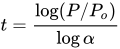
,
where K is the Kardashev type of a civilization and W is the amount of power it uses, in watts. Thus, a Type 1.1 civilization would be defined by a power of 1017 watts, while a Type 2.3 civilization would be able to harness 1029 watts.
Moreover, the above formula could be used to extrapolate beyond Kardashev's original types. For example, a Type0 civilization, not defined by Kardashev, would control about 1MW
of power (equivalent to having around 100 campfires burning at any
given time); on Earth, the emergence of Type 0 civilizations is roughly
concurrent with the rise of civilization in a general sense.
Sagan estimated that, according to this revised scale, 1970s humanity would be Type 0.7 (about 10 terawatts), equivalent to 0.16% of the power available on Earth. This level is characterized, according to him, by the ability to self-destruct, which he calls "technological adolescence". In 2021, the total world energy consumption was 595.15 exajoules (165,319TWh), equivalent to an average power consumption of 18.87 TW or a Kardashev rating of 0.73.
Sagan also suggests that, for completeness, an alphabetical scale should be added to indicate the level of social development, expressed in the amount of information available to the civilization. Thus, a Class A civilization would be based on 106bits of information (less than any recorded human culture), a Class B on 107, a Class C on 108, and so on. Humanity in 1973 would belong to the "0.7 H" class. According to Sagan, the first civilization with which humanity would
come into contact could be between "1.5 J" and "1.8 K"; a galactic
supercivilization would be at the "3 Q" stage, while a federation of
galaxies could be at the "4 Z" stage. The information and energy axes are not strictly interdependent, so
even a level Z civilization would not have to be Kardashev TypeIII. Sagan believed that no civilization had yet reached level Z,
speculating that so much unique information would exceed that of all the
intelligent species in a galactic supercluster, and observing that the universe is not old enough to exchange information effectively over large distances.
In 2017, the total amount of information generated on the internet was 26 zettabytes (with an estimated 120 zettabytes in 2023), equivalent to 0.73 R/S on Sagan's combined scale.
Kaku and the knowledge economy
In Physics of the Future (2011), American physicist Michio Kaku examines the conditions for humanity to converge on a TypeI planetary civilization. This convergence is based primarily on the knowledge economy. Kaku uses the Kardashev scale, but develops it by adding an additional stage: a TypeIV civilization would be able to draw the energy it needs from extragalactic radiation. By studying the evolution of technologies that have changed history (paper, the integrated circuit), Kaku believes that humanity is moving toward a civilization of planetary dimensions, the "starting point" of which is the Internet.
A TypeI civilization consumes power
on the order of thousands to millions of times our current planetary
output, about 100 trillion trillion watts. It would have enough energy
to manipulate the occurrence of certain natural phenomena, such as earthquakes or volcanoes, and could build cities on the oceans. We can see the beginnings of a TypeI civilization in the fact that a global language is developing (English), a global communication system is emerging (the Internet), a global economic system is in the making (the establishment of the European Union), and even a globalized culture is standardizing humanity (mass media, television, rock music, and Hollywood movies). To achieve TypeI, humanity must be able to communicate with the rest of the world and to focus on several areas: building infrastructure to facilitate communication and cooperation, education, research and development, and innovation, as well as building strong ties between diasporas and their countries of origin, and between migrants and non-migrants. If development fails, it is likely that the world will not be able to achieve TypeII. If these areas do not develop, Kaku predicts that humanity will sink into the "abyss": an advanced civilization must grow faster than the frequency of occurrence of extinction-level cosmic catastrophes, such as comet or asteroid impacts. A TypeI civilization should also be able to master space travel to deflect threatening objects. It would also have to anticipate the onset of ice ages and modify the climate long before they occur to avoid them.
In addition, in his books Hyperspace and Parallel Worlds, Michio Kaku has discussed a TypeIV civilization that could harness "extragalactic" energy sources such as dark energy.
Zubrin's planet mastery
In Entering Space: Creating a Spacefaring Civilization, Robert Zubrin suggests another form: his definition of a TypeI civilization is described as one that has achieved full mastery of the resources of its planet (global), a TypeII of its solar system (interplanetary), and a TypeIII
would have unleashed the full potential of the galaxy (starfaring
civilization). Metrics other than pure energy consumption have also been
proposed.
He ponders the possibility of a TypeIV
civilization, one that would dominate the universe, noting that there
are limits to how minds can connect and interact on a galactic or
intergalactic basis. As an example, he mentions that communication from
the Galactic Center of the Milky Way galaxy to its edge would take about 50,000 years (since nothing can travel faster than light, according to our understanding of physics).
Barrow's microdimensional mastering
The astronomer John D. Barrow of the University of Sussex has hypothesized that there are other stages beyond TypeIII. These TypeIV,
V, or even VI civilizations would be able to manipulate cosmic
structures (galaxies, galactic clusters, superclusters) and even escape
the Big Crunch through holes in space.
Barrow also proposes an "anti-Kardashev scale": he
observes that humans have found it more cost effective to extend their
ability to manipulate their environment to smaller and smaller scales
rather than to larger and larger ones. He, therefore, proposes a reverse
classification, from TypeI-minus to Type Omega-minus:
Type I-minus is capable of manipulating objects on the scale of itself: building structures, mining, joining and breaking solids;
Type II-minus is capable of manipulating genes and altering the development of living things, transplanting or replacing parts of themselves, reading and manipulating their genetic code;
Type VI-minus is capable of manipulating the most elementary particles of matter (quarks and leptons) to create organized complexity among populations of elementary particles;
Type Omega-minus is capable of manipulating the fundamental structure of space and time.
In Impossibility: The Limits of Science and the Science of Limits
(1998), Barrow proposes a scale ranging from "BI" to "BVI", with an
ultimate stage he calls "BΩ", the former characterized by the
possibility of manipulating one's environment, while the latter allows
for the modification of spacetime.
Galántai's miniaturization and resilience to catastrophes
For
Zoltan Galántai, a scale classifying civilizations should be based on
their ability to survive catastrophes, particularly those of cosmic
origin, such as an asteroid impact.
Zoltan Galántai recognizes the important role that
Kardashev's classification has played in the SETI program, but he
believes that another scale is possible, without using energy
consumption, by resorting to miniaturization. The hypothesis of Donald
Tarter, researcher at SETI, is that a civilization based on nanotechnology would not need an ever-increasing amount of energy. A TypeI civilization that masters local space travel could colonize its planetary system and even the Oort cloud without needing an amount of energy that would make it TypeII. This scale loses its meaning beyond TypeII,
since it is impossible to predict the evolution of civilizations over
long distances in a galactic colonization process. Finally, Tarter
states that the Kardashev scale is the product of an era of insufficient
scientific knowledge, which considered the possibility of stellar
object CTA-102 as an artificial TypeIII source, whereas today we know that it is a galactic nucleus.
In another article, Zoltan Galántai suggests considering
another scale, no longer based on energy consumption, but on a
civilization's ability to survive natural and cosmic disasters. TypeI would describe a civilization capable of surviving a local natural disaster, like the Anasazi. A TypeII civilization would have the means to withstand a regional or continental disaster, and finally TypeIII could face a global disaster such as an asteroid's impact, a supervolcano's eruption, or an ice age. Beyond the first three types are civilizations that have scattered throughout the galaxy. The TypeIV civilization would still be vulnerable to some cosmic threats, while the TypeV civilization would be technically immortal, as no cosmic catastrophe could reach it. The Kardashev scale can be a relevant tool for preventing catastrophes,
whether human or natural, according to Richard Wilson, who relates this
scale to the power of destruction, in TNT. A TypeI civilization would use 25 megatons of equivalent TNT per second, a TypeII civilization 4 × 10⁹ times more (4 billion hydrogen bombs per second), while a TypeIII civilization would use 1011 times more.
According to Carl Sagan, TypeI should be reached around 2100.
Physicist and futurist Michio Kaku has suggested that, if humans increase their energy consumption at an average rate of 3 percent per year, they could reach TypeI status in 100–200years, TypeII status in a few thousand years, and TypeIII status in 100,000 to a million years.
Physicist Freeman Dyson has calculated that TypeI should be reached in about 200 years, while Richard Carrigan has estimated that the Earth is just four-tenths of the way to TypeI on the Sagan scale. If TypeI is reached soon (in the year 3000 for Richard Wilson), it would be accompanied by profound social upheavals, but also by a significant risk of self-destruction.
According to Per Calissendorff, energy consumption cannot
be the main parameter to explain the transition from one type to
another. Civilizations must have the means to maintain their growth rate
despite climatic conditions and major natural disasters, even on the
cosmic scale. A civilization moving towards TypeII must have mastered space travel, interplanetary communication, stellar engineering, and climate. It must also have developed a planetary communication system, such as the Internet. For Michio Kaku, the only serious threat to a TypeII civilization would be the explosion of a nearby supernova, while no known cosmic catastrophe would be capable of wiping out a TypeIII civilization.
According to Philip T. Metzger, humanity has reached TypeI, but faces an energy challenge. In his 2011 paper Nature's Way of Making Audacious Space Projects Viable, he states that the Earth's non-renewable energy sources are nearly exhausted; natural gas will be depleted by 2020–2030, coal by 2035, uranium by 2056, while oil production peaked in 2006–2008. Nuclear energy
cannot fully meet the world's energy needs (it represented only 6% in
2011). In addition, renewable energy cannot meet the growing demand for
energy. Most of the minerals used by humans are in danger of becoming
scarce; 11 minerals are already classified as having passed their peak
production. For Metzger, humanity must therefore undertake a "100-year
project" aimed at building a spacecraft ("100 Year Starship") capable of
accessing the vast energy resources of the Solar System. For Metzger, it is even probable that if extraterrestrials coveted the
energy resources of our Solar System, they would not look for them on
Earth, but on the various asteroids and planetoids. Robotics
is the only way to access so many dispersed resources, and humanity
should embark on a second long-term project, which Metzger calls the
"robotsphere", that would begin with the energetic exploitation of the Moon (estimated at 2.3 × 10¹³J/year). This first step would make it possible to reach TypeII in 53 years. Then the robotsphere (self-replicating and self-learning automated probes) would extend to the rest of the Solar System. Current advances in artificial intelligence
suggest that the foundations of a robotsphere could be reached early in
the next century, beginning in 2100. Metzger sees eight benefits for
humanity in building the 100 Year Starship, including zero launch costs
because the spacecraft will be built in space by robots that can do so
with little human assistance (drastically reducing manufacturing costs),
the creation of a Solar System-wide economy, and the use of resources
from celestial objects and possibly terraforming them.
Towards type II
Viorel Badescu[ro] and Richard Cathcart have studied the possibility that a TypeII civilization could use a 450 million kilometer device to direct solar radiation and thus be able to impart a kinetic motion to its star that deviates it from its usual trajectory by about 35 to 40 parsecs, allowing it, among other things, to capture its energy and navigate the galaxy.
For Claude Semay, "a TypeII civilization could be detected at great distances (by what is called "astro-technical leakage"),provided that it is not located in a region of the galaxy that is too
distant from us, or that it does not occupy a location that is obscured
from us by clouds of gas or dust".
Towards type III
Artist's view of quasar GB1508. A highly evolved Kardashev "TypeIII" civilization could draw its energy from such a source.
A TypeIII
civilization should be detectable because of the large amount of
radiation captured on a galaxy-wide scale. Calissendorff suggests using
75% of the total light emitted by a galaxy to determine that a TypeIII civilization uses many Dyson spheres. If only three or four of these spheres occupy the galaxy, it does not necessarily mean that the civilization has reached TypeIII, and it may still be in transition; however, such civilizations may remain beyond the reach of our understanding and instruments.
Semay observes that "a TypeIII civilization should not be confused with what science fiction writers call a 'galactic empire'", knowing that it can only exist if interstellar travel is achieved. Semay argues that there is no evidence that this will ever be possible. Based on Dyson's calculations, Semay believes that such a journey would
take three centuries, with an average distance between stars of about 7
light years. Overall, the speed of the colonization front, which ranges
from 4 × 10⁻⁴ to 5 × 10⁻³ light-years per year, would result in humanity spreading throughout the galaxy in a period of 16 to 200 million years. "A TypeIII
civilization, having thus "domesticated" its galaxy by building a large
number of Dyson spheres, would be detectable over intergalactic
distances of several million light-years."
A TypeIII civilization could theoretically live inside a supermassive black hole, in a stable periodic orbit, which would make it completely undetectable, according to V. I. Dokuchaev.
Towards type IV
Zoltan Galántai notes that neither Kardashev nor Sagan thought to extend the scale and define a TypeIV
(which would use the energy of an entire universe). They simply did not
envision a civilization capable of manipulating its environment on the
largest possible scale (about 14 billion parsecs). The concept of a TypeIV supercivilization approaches divine possibilities, enabling the creation of, and travel through, alternate universes of such a civilization's own design, although the latter possibility is reserved for a TypeV civilization by Carrigan. The fraction of energy captured by a civilization capable of powering
itself on a black hole could also be used to classify civilizations.
Possible scenarios
According to Kardashev, the most important parameters to
define the existence of a civilization are three: the presence of very
powerful energy sources, the use of non-standard technologies, and the
transmission of significant amounts of information of various kinds
through space.
Energy sources
Kardashev's classification is based on the hypothesis that
an advanced civilization uses significant energy, which implies that it
must be de facto detectable over long distances, as summarized by
Zoltan Galántai. For Kardashev, the limit of a civilization's energy consumption is originally located in the region of the electromagnetic spectrum from 106 to 108 Hz, which allows two observations related to thermodynamics.
First, all the energy consumed is inevitably converted into heat.
Second, this energy can only be dissipated in the form of radiation
scattered in space. These two findings are the pillars of Kardashev's
theory that cosmic objects with strong radiation could be artificial
sources. He also considered the possibility of detecting an artificial source by emphasizing the spectral line of hydrogen in its use for nuclear fusion.
Dutil and Dumas consider several physical limits to continuous energy production, such as photosynthesis (about 10 TW), climate (about 127 TW), and solar flux (174,000 TW). The only inexhaustible source of energy that can sustain a civilization for over several billion years, is deuterium (used in nuclear fusion). The sustainability of a civilization must therefore involve "strict
control of the exploitation of available resources"; this difficulty in
exceeding energy limits may explain the fact that the vast majority of
civilizations fail to engage in a space colonization project.
Astrophysicist Makoto Inoue and economist Hiromitsu Yokoo have explored the possibility that a TypeIII civilization could extract energy from a supermassive black hole (SMBH). The captured energy could meet the extraordinary needs of a civilization that requires about 4 × 1044 erg/s. The energy would be captured in the form of radiation emitted by the
matter rushing into the star, by means of collectors located within the accretion disk.
These collectors are similar to Dyson spheres. The overflow, as well as
the waste of the civilization, would be redirected towards the black
hole. A fraction of this energy, directed as a high-powered beam,
could be useful for space travel. A galactic club of civilizations
could transmit the energy through networks within the galaxy. Within the
various central power stations that make up the network, power
transmission is periodically switched between transmitter and receiver,
according to the galactic rotation. To be efficient, this network should
be located at the center of the galaxy.
This
parameter is one of the most undetectable in the Universe due to the
fact that solid matter structures are at low temperatures and emit weak
radiation. Their luminosity, which is difficult to observe, also makes
it impossible to observe them with telescopes. Likewise, we cannot
detect them by their gravitational effects. However their existence can be detected by analyzing wavelengths between 8 and 13 microns, corresponding to surface temperatures of 300 K. A hypothetical Dyson sphere could thus be detected, provided that the observation is made from space. Locally, the
significant dip in luminosity that would result from a giant Dyson
sphere (or "Fermi bubble") would allow the detection of a TypeIII civilization.
A megastructure like a Dyson sphere could be the result of a technology based on self-replicating probes, as those imagined by von Neumann. A TypeIII
civilization would have the means to disperse a significant number of
these spheres throughout the galaxy, which would have the effect of
attenuating the light emitted by the galaxy. Kaku also considers this to be the most efficient method of colonizing
space. For example, a galaxy 100,000 light years in diameter would be
explored in half a million years. Paul Davies
has suggested that a civilization could colonize the galaxy by
scattering miniature probes, no larger than the palm of a hand, using nanotechnology.
This thesis is realistic, he explains, because it is obvious that the
technology is becoming increasingly miniaturized and proportionally less
expensive.
TypeII megastructures would be easier to detect. This would be the case of a Dyson sphere used as a "stellar engine", as well as the contribution of heavy elements. Similarly, "Shkadov thrusters", which would produce a lateral thrust of 4.4 parsecs
on their star by reflecting solar radiation through a structure made of
mirrors, would be observable objects. This device would break the
symmetry of solar radiation and counteract gravitational forces, allowing a TypeII civilization to move its home solar system through space. Drake and Shklovski have also considered the possibility of "seeding" a
star (Stellar salting) by artificially adding extremely rare elements
such as technetium or promethium. Such an intervention in a star's composition would be detectable.
It is still possible that humanity could discover traces of lost TypeI,
II, or III civilizations. The search for material traces of such
civilizations (e.g. Dyson spheres or stellar engines), an "interesting
alternative" to the conventional SETI program, lays the foundation for a
"cosmic archaeology" according to Richard A. Carrigan. Efforts to detect intelligence markers in the atmospheres of exoplanets (such as freon, oxygen, or even ozone, residues of biotic activity according to James Lovelock's research) are one of the most promising avenues. A civilization watching its star die (as a red giant, for example) could have tried to prolong its existence through megastructures that should be detectable. The possible traces could be nuclear remnants, to be sought within the spectral types going from A5 to F2 according to Whitmire and Wright. It could also be a change in the isotopic ratio, due to a stellar engine, or an unusual spectral modulation in the composition of the star.
According to Kardashev, the transmissions of an extraterrestrial civilization (what SERENDIP
is looking for) can be divided into two types. On the one hand, there
can be an exchange of information between highly developed civilizations
or civilizations at similar stages of evolution. On the other hand, the
transmission of information can be aimed at raising the level of other
less developed civilizations. If supercivilizations do exist, the
transmissions of the first type must remain inaccessible to our
observation because they must be unidirectional and not be directed
toward the Solar System. Conversely, those of the second type must be easily detectable by our listening devices.
A signal of artificial origin should contain more than 10 and less than 100 bits.
The latter would be of two types: transient and stable. Several
criteria allow us to distinguish a signal of artificial origin from
others. First, the optimal region of the spectrum to host artificial
signals is the one where the temperature of the cosmic microwave background is the lowest. Second, artificial sources must have a minimum angular size. The
presence of suspicious data in other regions of the spectrum (such as circular polarization, radio and optical frequencies, or X-ray emissions)
can confirm that it is an intelligent transmission. Two sources among
those studied have parameters close to those expected: 1934-63 and 3C 273B.
For L. M. Gindilis, there are two criteria for a signal to
be called artificial: one related to the artificial nature of the
source and the other related to a particular radiation, intentionally
designed to ensure communication and facilitate detection. Only TypeII or III civilizations can communicate using isotropic transmissions that allow omnidirectional reception. In a 1MHz band (which requires about 1024 watts), detection of signals from a TypeII civilization is possible up to 1,000 light-years away, while signals from a TypeIII civilization are detectable virtually throughout the observable Universe. However, building an omnidirectional transmitter powerful enough to
transmit over a range of 1,000 light years would take several million
years. According to V.S. Troitsky, the energy required and the
limitations in its production would be two obstacles to completing this
project in a reasonable time.
For Zoltan Galántai, we would not be able to distinguish
between an intelligent extraterrestrial signal and a signal of natural
origin. Therefore, he does not believe that TypeII, III or even IV civilizations can be detected. Even if humanity reaches TypeIV,
it will not be able to detect another supercivilization of a similar
level, and we will consider their changes in the universe to be the
result of natural causes. Thus, there may be many TypeIV
civilizations in the universe, but none of them will be able to detect
the others. Moreover, the dimensions of the universe make these
supercivilizations like islands far from the others, which Dyson defines
as a "Carroll Universe".
For Alexander L. Zaitsev, the radio transmission of
interstellar messages (IRM) is the most likely method used by
civilizations. Planetary radio telescopes and those installed on asteroids would make it possible to listen to the many messages that could be sent to us. In 2007, the SETI program analyzed the only television frequencies sent by a Type0 civilization, notes Michio Kaku. Therefore, our galaxy may have communications from TypeII and III civilizations, but our listening devices can only detect Type0 messages.
Search and detection of civilizations
The Byurakan Conference (1964)
From 1962, Kardashev was a member of a SETI research group at the Sternberg Astronomical Institute in Moscow. In 1964, he organized the first Soviet conference on the possibility of extraterrestrial civilizations, which was held at the Byurakan astrophysical observatory in Armenia. This national conference was held in response to the American seminar known as the Green Bank conference of 1961, which was held at the Green Bank observatory in the United States. It brought together radio astronomers
with the aim of "finding rational technical and linguistic solutions to
the problem of communication with an extraterrestrial civilization that
is more advanced than the Earth's civilization". Kardashev presented
his classification, while Troitskii announced that it was possible to
detect signals from other galaxies.
For Kardashev, "in the next 5 to 10 years, all the sources
of radiation with the largest observable flux, in all the regions of
the electromagnetic spectrum,
will have been discovered and studied", the sensitivity of the
listening devices having indeed reached their technical limits.
According to him, the entire electromagnetic spectrum will be known and,
consequently, the list of the objects that could be artificial sources
could thus be extended. The search for artificial signals will then have
to concentrate on objects of maximum luminosity
or radiation belonging to a certain region of the spectrum, but also on
objects of significant mass, and on those that represent the essence of
matter in the Universe. As early as 1971, Kardashev considered that
this observation requires the preparation of a plan of listening and
analysis, which will allow the success of the search for
extraterrestrial civilizations. Humanity will then be able to solve the "main dilemma", as it was stated by Enrico Fermi. This dilemma is, according to the Soviet astronomer, is certainly connected with our lack of information and knowledge.
Kardashev believes that a research project like Ozma is incapable of detecting a TypeI civilization (an idea also promoted by Kaplan in 1971), and that SETI should instead focus on searching for intense radio signals that could emanate from active TypeII or III civilizations. To prove the effectiveness of this approach, Kardashev therefore turned his attention to two radio sources discovered by the California Institute of Technology, nicknamed CTA-21 and CTA-102.
Subsequently, Gennadii Borisovich Sholomitskii then used the Russian
astronomical research station to study the data from CTA-102. He found that this radio source
is characterized by its variability. Kardashev then considered that
this could be an indication of an artificial emission source, albeit of
rather short life span.
Towards a "physical eschatology"
The knowledge of these hypothetical supercivilizations must fit into a wide range of physical laws
that contain the entirety of our current knowledge, since the technical
and scientific developments of mankind can be considered as an
inevitable and necessary stage in the process of the evolution of a civilization. Based on this principle, Kardashev proposes to define several concepts applicable to extraterrestrial civilizations. The physical laws, which are universal, can be used as a common basis
for understanding other civilizations and, in particular, allow us to
develop an objective research program. Michio Kaku also believes that the evolution of civilizations obeys the "iron laws of physics" and in particular the laws of thermodynamics, those of stable matter (baryonic matter) and those of planetary evolution (probability of occurrence of natural or cosmic catastrophes). The anthropic principle also makes it possible to predict the sociological characteristics at the basis of any civilization.
However, these universal laws are not the only parameters
to consider. Zoltan Galántai explains that "it is impossible to
calculate the future of the Universe over long periods of time without
including the effects of life and intelligence", a position close to
that of Freeman Dyson. Taking into account these two phenomena, the universal physical laws and the intelligence resulting from life, defines a "physical eschatology",
as Galántai puts it. This approach began in the 1970s with the work of
Kardashev, and then physical eschatology gradually interested a number
of scientists and thinkers, notes Dyson.
Observation of the development of living organisms shows that they are characterized by the tendency to store a maximum amount of information,
both about the environment and about themselves. This information then
leads to an abstract analysis, which plays an important role in the
development of life forms. Thus, Kardashev defines civilization from a
functional perspective as "a state of very stable matter capable of
acquiring, abstractly analyzing and applying information in order to
extract data about the environment and itself, in order to develop
survival reactions ". However, this functional definition of civilization implies that it cannot have a goal
or end, since it is based on the principle of accumulating more and
more information. Taking up von Hoerner's categories, Kardashev sees
four possible scenarios for the development of civilizations:
Total destruction of life.
Destruction of only intelligent life.
Degeneration.
Loss of interest.
However, he refuses to see these as inevitable ends. But
the assumption that the only limit to the development of a civilization
can be the existence of a finite amount of information, in all areas, is
also false, since it is highly improbable that information in the
Universe is infinite. Given these two hypotheses,
Kardashev argues that there is no universal civilization
(supercivilization) because highly developed civilizations lose interest
in space exploration. In any case, and despite the problem of the end
of civilizations, he concludes, in the light of his functional
definition of the advanced civilization, that the latter must use mass
and energy on fantastic scales. According to him, there is no reason to
denounce the hypothesis that the expansion of the Universe would not be an effect of the intelligent activity of a supercivilization.
Human civilization: a model for extrapolation
Kardashev poses the following question: "Is it possible to
describe the development of a civilization in general terms over large
cosmological periods?" Now many of the fundamental parameters that
characterize the development of civilization on Earth are growing exponentially.
In the field of energy, astronomer Don Goldsmith estimated that the
Earth receives about one billionth of the Sun's energy, and that humans
use about one millionth of it. So we consume about one millionth of a billionth of the Sun's total
energy. Since human expansion is exponential, we can determine how long
it will take for humanity to go from TypeII to TypeIII according to Michio Kaku.
Thus, the rate of development of our own world remains the only criterion for extrapolating the state of civilizations older than humanity. The same is true for social values and basic needs according to Ashkenazi. Therefore, the time to double technical knowledge is about ten years,
and to double energy output, available reserves, and population is about
25 years. Two scenarios are then possible: spatial expansion or energy
stagnation, the latter being possible only for 125 years, according to
Kardashev, using the following relationship :
where is the number of years, is a parameter that increases annually as a function of and of according to and , a growth rate.
If , then humanity's energy consumption will exceed the incident solar power (1.742 × 10¹⁷ W) after 240 years, the total power of the Sun (3.826 × 1026 W) after 800 years, and that of the Galaxy (7.29 × 1036 W) after 1,500 years. Based on this calculation, Zuckerman estimates the number of civilizations that could exist in our galaxy at 10,000. Kardashev concludes that the current exponential growth is a
transitional phase in the development of a civilization, and that it is
inevitably limited by natural factors. In fact, he believes that the
required mass and energy will continue to grow exponentially for another 1,000 years. Civilization is thus defined by an exponential rate of increase.
Humanity as a model for thinking about the development of
extraterrestrial civilizations has its limitations, which can be truly
overcome by a multidisciplinary approach according to the work of Kathryn Denning.
Research conducted
In 1963, Nikolai Kardashev and Gennady Borissovich Sholomitskii studied the CTA 102radio source on the 920MHz band from the Crimea Deep Space Station, looking for signs of a TypeIII civilization. CTA 102 had been discovered by Sholomitskii a year earlier, and
Kardashev quickly saw it as a possible artificial source to study in
order to validate his classification. The observation lasted until
February 1965, and on April 12, Sholomitskii announced to the press (via
the Russian ITAR-TASS)
that Soviet astronomers had discovered a signal that could be of
extraterrestrial origin. On April 14, he gave a conference in Moscow
where he repeated his announcement; but by November 1964, two American
astronomers had identified CTA 102 as a quasar, and their publication definitively closed the "CTA 102 case". It was the study of this source that had led to the Byurakan conference in 1964.
In 1976, Kardashev, Troitskii, and Gindilis used the RATAN-600 radio telescope in the North Caucasus to search for signals from TypeII or III civilizations in the Milky Way and other nearby galaxies. The radio telescope was built in 1966 under the supervision of Gindilis to listen at centimeter wavelengths.
In 1987, Tarter, Kardashev, and Slysh used the VLA to detect possible infrared sources near the galactic center from the IRAS telescope catalog. All three were looking for evidence of hypothetical Dyson spheres. The objects turn out to be OH/IR type stars.
A small-scale search for possible TypeIII sources was conducted by James Annis in 1999 and published in the Journal of the British Interplanetary Society under the title "Placing a limit on star-fed Kardashev type III civilizations". An astrophysicist at Fermilab (US), Annis studied a sample of 31 galaxies, both spiral and elliptical, using the Tully-Fisher diagram, in which the absolute magnitude
is a function of the galaxies' rotational speed. Annis suggested that
75% of the least luminous objects (i.e., those with a decrease in
absolute magnitude of 1.5 compared to the diagram) could be considered
as possible candidates. However, no object with this characteristic is
observed in his survey. On the other hand, Annis uses the available astronomical data to estimate the probability that a TypeIII
civilization could exist. He shows that the average time that could
allow for the emergence of such a civilization is 300 billion years, so
none can exist in our present Universe.
Per Calissendorff conducted a study on a sample of spiral galaxies from two databases: 4,861 from the Spiral Field I-band (SFI++ catalog compiled by Springob et al. in 2005) and 95 from that of Reyes et al. in 2011. The same procedure was followed as in Annis, but the sample of galaxies
used is 80 times larger than that used in the Annis study. Some sources were classified as "lopsided": they appear asymmetric in shape, meaning that one side of the galactic disc
is more massive and less luminous than the other. This characteristic,
according to Calissendorff, could be an indication that the galaxy is
home to a civilization that has placed Dyson spheres in its main part.
This can be explained by the fact that the colonization starts from one
side of the galactic disk, making it appear darker and leading a distant
observer to believe that the core has moved to that same side. On the other hand, a galaxy hosting Dyson spheres should be characterized by a significant source of far-infrared radiation. The fact remains that a TypeIII civilization can consume energy through a Dyson sphere without surrounding a star. Indeed, such megastructures could also extract energy from a black hole,
according to the study by Inoue and Yokoo (2011). However, such a
structure would not reduce the luminosity of an observed galaxy. Calissendorff's study concludes that 11 of the sources analyzed (out of
a catalog of 2,411 galaxies, or 0.46%) show possible evidence of a TypeIII civilization. Searching for objects that obscure 90% of the light leaves only one source remains that meets the criteria. These positive sources show a low redshift (so they are old, about 100 million years), which is consistent with possible TypeIII civilizations, that could have flourished only in the early past. To have a better chance of detecting TypeIII
artificial sources, Calissendorff suggests taking several photographs
in a row, fast enough to fix the movement of turbulence in the
atmosphere, applying different photometric filters and looking for dark areas (the case of a Dyson sphere being assembled by a TypeII civilization), or analyzing the infrared spectrum of galaxies. A much larger sample of objects should be studied.
Observational evidence
In 2015, a study of galactic mid-infrared emissions concluded that "Kardashev TypeIII civilizations are either very rare or do not exist in the local Universe".
In 2016, Paul Gilster, author of the Centauri Dreams website, described a signal apparently coming from the star HD 164595 as requiring the power of a TypeI or TypeII civilization, if produced by extraterrestrial lifeforms. In August 2016, however, it was discovered that the origin of the
signal was most likely a military satellite orbiting the Earth.
Possible listening criteria
Kardashev's point of view
According to Kardashev, humanity's ignorance of the physical possibilities of communication through space is great. Only a negligible fraction of the electromagnetic spectrum as an existing source of information in the universe is known. Thus, of the 89% of information that humans lack, 42% concerns the range from 109 to 1014 Hz (centimetric, millimetric, submillimetric and infrared waves) and 25% concerns the range from 1015 to 1018 Hz (ultraviolet radiation and X-rays). Kardashev distinguishes two categories of listening areas: objects
emitting in a broad frequency spectrum and objects emitting on the
contrary in a narrow spectral line, the second category posing much more theoretical problems than the first, while being central, both for astrophysics and for the search for extraterrestrial civilizations.
Despite advances in astrophysics, the available
information is still insufficient to prove the absence of
supercivilizations, based on the inability to observe signs of activity.
However, because of the possibility that there are planetary systems much older than the Solar System, and considering that cosmic objects such as quasars
could be products of supercivilization activity, a detailed program of
listening and searching for intelligent signs remains valid. This
program includes:
Monitoring the sky at 3, 10, 30, 100 and 300 microns, especially at 1, 3, and 10mm, in order to identify one hundred of the most powerful sources among those observed and at each frequency;
Study in detail the properties of quasars and other unusual objects;
Search for monochromatic anomalies among the most powerful radio sources (such as a hydroxyl emission line), in the decimeter band;
Search for periodic signals (pulsars) of interstellar origin, in the same band;
Searches for monochromatic signals of different frequencies, always in the same band.
According to Kardashev, only a radio interferometer with a base, either of the order of or larger than the diameter of the Earth, placed in orbital space, would allow listening to centimetric and decimetric frequencies. Once a set of unusual sources has been selected, the next step is to
look for significant content in the radiations from these objects. In 1998, Nikolai Kardashev, S. F. Likhachev, and V. I. Zhuravlev proposed two SETI space projects to detect artificial sources: the Millimetron project (an orbiting observatory with a 10-meter diameter mirror) and the VLBI optical telescope (for interferometric synthesis of ultraviolet, optical, and infrared images).
Other leads
For Samuil Aronovich Kaplan, "the most reliable criterion" remains the small angular diameter of the radio source. The wavelength of 21cm,
privileged since 1959, according to the study of Cocconi and Morrison,
is not the only listening region. Kaplan, in 1971, also mentioned the
radio region of the spectrum, characterized by the hydroxyl radical (OH). For Livio, the means of detection should focus on globular clusters, the regions most likely to harbor planets similar to the Earth.
For Guillermo A. Lemarchand, extraterrestrial
civilizations should not use an omnidirectional transmitter. Instead,
they should look for signals of weak information, intermittent and
unidirectional. They will certainly need to use interferometry
to inspect planetary systems where life might appear. From Earth, it
would be possible to pick up such signals at distances of up to 35 + (t_f - 2000) / 2, where t_f is the observation date in years, knowing that t_f ≥ 2000. However, there are many techniques for transmitting an interstellar message, ranging from bosons to particles and even antiparticles.
An artificial source located in the accretion disk of a supermassive black hole would be undetectable by the beams used to transmit the collected energy. In fact, the probability of detecting a beam of one micronarc-second is less than 10−23. Moreover, the energy emitted by the black hole would not allow detection of the energy used by the TypeIII civilization. On the other hand, the specular reflection system of the radiation could be detected by the shadow it casts on the accretion disk.
A TypeIII civilization using a "Fermi bubble"
would be detectable by the fact that it decreases the luminosity of a
region of the galaxy. An infrared observation would make it possible to
highlight it, especially in elliptical galaxies, Annis suggests.
The quasar 3C 9 is cited by Kardashev as early as 1971. The study of the quasar 3C 273 shows that it has a solid structure. Other quasars (3C 279, 3C 345,
3C 84) have properties close to those expected from an artificial
source, especially since the emissions are powerful in the intermediate
region of the spectrum (between radio and optical frequencies). Quasars are potential artificial sources, especially since their age
corresponds to the technical possibilities of supercivilizations. Radio
sources at the center of galaxies can also be artificial sources,
according to Kardashev, even if in 2013 they were proven to be
supermassive black holes. In 1971, Kardashev believed that the objects
most likely to be artificial sources could be discovered in the [then]
next few years.
The extraordinary periodicity of pulsar emissions was already considered an artificial source in 1968 by Antony Hewish, the discoverer of the first pulsar (CP 19019).
The press of the time nicknamed this object "LGM-1" (for "little green
men"), following the clumsiness of Hewish, who did not wait for the
necessary verifications. Kaplan, in 1971, removed the pulsar from the
list of objects that could be a source of artificial origin.
In 2011, James and Dominic Benford examined the
possibilities that exist to distinguish pulsars from possible artificial
sources emitting intelligent signals, such as: bandwidth (signals of
about 100MHz could be artificial), pulse length (to reduce costs, the pulse should be short) and frequency (about 10GHz, also for economic reasons). The radio source PSR J1928+15 (observed in 2005 near the Galactic disk, at a frequency of 1.44GHz, at Arecibo)
could be of extraterrestrial origin. James and Dominic Benford consider
three scenarios in which the cost factor is taken into account. If the
source is cost-optimized, it belongs to a civilization of Type 0.35 (the
Earth being of Type 0.73). If it is not cost-optimized and operates with a small antenna, the Type
is 0.86. With a large antenna, it would be from a Type 0.66. Using this
cost/efficiency method, it can be estimated that low-intensity sources
may be the most prevalent, but also the most difficult to observe.
Criticisms of the classification
William I. Newman and Carl Sagan
believe that the growth of energy consumption alone cannot describe the
evolution of civilizations; it is also necessary to consider population growth,
and in particular the fact that it can be limited by the transport
capacity of interplanetary means of travel. They conclude that there can
be no ancient civilizations of galactic dimensions, nor galactic
empires, although the possibility of networks of colonized worlds (of
about 5 to 10 planets) is strong.
The scale theorized by Kardashev was born in the geopolitical context of the Cold War, in which energy had supreme value. According to Guillermo A. Lemarchand, a physicist at the University of
Buenos Aires, there are four arguments against Kardashev's
classification:
Long-range omnidirectional transmitters
would be very energy-intensive. Using directional or intermittent
devices, each pointing in a different direction, would require much less
energy. TypeII or III civilizations might therefore be defined by something other than exponential energy consumption.
The assumption of exponential energy consumption is
certainly wrong, because if we analyze per capita energy consumption
throughout human history, it forms a series of logistic curves with a saturation point for each technological innovation. Therefore, a steady state or limited growth is more likely.
According to the principle of mediocrity, applied to the search for extraterrestrial civilizations by Sagan and Shklovskii in 1966 on the basis of John Richard Gott's calculations, civilizations more important than ours must be so rare that they do not have the possibility to dominate and be visible.
Finally, research and listening programs in Harvard
University and Buenos Aires (Horowitz and Sagan in 1993 or Lemarchand et
al. in 1997) have not provided any scientific proof of the existence of
artificial sources, neither in the Milky Way nor in nearby galaxies (M33, M81, the Whirlpool Galaxy or Centaurus A), or even in the Virgo cluster.
For the British meteorologist Lewis Fry Richardson, author of a statistical study on mortality (published in Statistics of Deadly Quarrels, 1960), man's aggressiveness does not allow us to predict a life span that will allow humanity to reach more evolved stages. He estimates that man's violent impulses will destroy the social order over a period of 1000 years. Moreover, mankind will probably be destroyed with weapons of mass destruction within a few centuries at the most.
Paleobiologist Olev Vinn
has suggested that Kardashev’s idea may itself reflect a relatively
crude phase of our technological development, rather than a universal
principle. He points instead to the possibility of technological
minimalism, in which highly advanced societies seek to maximize
effectiveness while minimizing energy use. Rather than pursuing
ever-increasing levels of power consumption, such civilizations might
focus on optimization, efficiency, and extreme miniaturization. Mastery
of quantum-scale engineering could allow them to perform complex
functions using only negligible amounts of energy. A sufficiently
advanced technological society might also choose to separate its
technological systems from the surrounding environment. Viewed from
interstellar distances, such a world could appear pristine—supporting a
flourishing natural biosphere, with little or no visible trace of
industry or artificial modification.
Transhumanists Paul Hughes and John Smart explain the absence of signals from a TypeIII
civilization with two hypotheses: either it has self-destructed or it
has not followed the trajectory described by Kardashev. The growth of energy consumption should lead to a climate crisis, which Yvan Dutil and Stéphane Dumas set at 1 W/m2 of the Earth or 127 TW
for the entire planet. At a growth rate of 2% per year, an industrial
civilization should stop growing quite early in its history (after a few
centuries). In summary, the impossibility of sustainably securing energy resources may explain the absence of TypeII and III civilizations.
For Zoltan Galántai, it is not possible to imagine a civilization project that spans centuries (like a Dyson sphere) or even millions of years, unless one imagines a thought and an ethic
different from ours, within the reach of an ancestral civilization. He
therefore proposes to classify civilizations according to their ability
to carry out large-scale civilization projects over the long term.
Finally, for Freeman Dyson, communication and life can continue forever in an open Universe
with a finite amount of energy; intelligence is therefore the only
fundamental parameter for a civilization to survive in the very long
term, and energy is then no longer what defines it, a thesis he develops
in his article "Time Without End: Physics and Biology in an Open
Universe".
Large-scale application of fusion power: In terms of mass–energy equivalence, TypeI implies the conversion of about 2kg of matter to energy per second. An equivalent energy release could theoretically be achieved by fusing about 280kg of hydrogenintohelium per second, a rate roughly equivalent to 8.9×10⁹kg/year. One cubic kilometer of water contains about 1011kg of hydrogen, and the Earth's oceans contain about 1.3×10⁹cubic kilometers of water,
meaning that humans on Earth could sustain this rate of consumption
over geological time scales, in terms of available hydrogen.
Antimatter
in large quantities would provide a mechanism to produce power on a
scale several orders of magnitude beyond the current level of
technology. In antimatter-matter collisions, all of the rest mass of the particles is converted to radiant energy. Their energy density (energy released per mass) is about four orders of magnitude greater than that from using nuclear fission, and about two orders of magnitude greater than the best possible yield from fusion. The reaction of 1kg of antimatter with 1kg of matter would produce 1.8×10¹⁷J (180 petajoules) of energy. Although antimatter is sometimes proposed as a source of energy, this does not seem feasible. Artificially producing antimatter –
according to current understanding of the laws of physics – involves
first converting energy into mass, which yields no net energy.
Artificially created antimatter is usable only as an energy storage
medium, not as an energy source, unless future technological
developments (contrary to the conservation of the baryon number, such as a CP violation
in favor of antimatter) allow the conversion of ordinary matter into
anti-matter. Theoretically, humans may be able to cultivate and harvest a
number of naturally occurring sources of antimatter in the future.
Renewable energy by converting sunlight into electricity – either directly through solar cells and concentrating solar power, or indirectly through biofuels, wind, and hydroelectric power: There is no known way for a human civilization
to harness the equivalent of the Earth's total absorbed solar energy
without completely covering the surface with man-made structures, which
is not feasible with current technology. However, if a civilization
constructed very large space-based solar powersatellites, TypeI power levels might become achievable—these could convert sunlight to microwave power and beam it to collectors on Earth.
TypeII civilizations could use the same techniques as a TypeI civilization, but applied to a large number of planets in a large number of star systems.
Another means of generating usable energy would be to feed a stellar mass into a black hole, and collect the photons emitted by the accretion disk. A less exotic means would be to simply capture photons already escaping
from the accretion disk, thereby reducing a black hole's angular momentum; this is known as the Penrose process. However, this may only be possible for a TypeIII civilization.
Star lifting
is a process by which an advanced civilization could remove a
substantial portion of a star's matter in a controlled manner for other
uses.
Antimatter is likely to be produced as an industrial byproduct of a number of megascale engineering processes (such as the aforementioned star lifting), and could therefore be recycled.
In multiple star systems with a sufficiently large number of stars: absorbing a small but significant fraction of the output of each individual star.
TypeIII civilizations might use the same techniques as a TypeII civilization, but applied individually to all possible stars in one or more galaxies.
They may also be able to tap into the energy released by the supermassive black holes believed to exist at the center of most galaxies.
White holes could theoretically provide large amounts of energy by collecting the matter ejected outward.
Capturing the energy of gamma-ray bursts is another theoretically possible power source for an advanced civilization.
The emissions from quasars are comparable to those from small active galaxies and could be a massive power source if they could be collected.
Civilization implications
There are many historical examples of human civilization undergoing large-scale transitions, such as the Industrial Revolution.
The transitions between Kardashev scale levels could potentially
represent similarly dramatic periods of social upheaval, as they involve
exceeding the hard limits of the resources available within a
civilization's existing territory. A common speculation[93] is that the transition from Type0 to TypeI
could carry a strong risk of self-destruction, since in some scenarios
there would be no room for further expansion on the civilization's home
planet, as in a Malthusian catastrophe.
For example, excessive energy consumption without adequate
heat removal could plausibly render the planet of a Type I approaching
civilization unsuitable for the biology of the dominant life forms and their food sources. Using Earth as an example, ocean temperatures above 95°F (35°C) would endanger marine life and make it difficult, if not impossible, for mammals to cool to temperatures suitable for their metabolism. Of course, these theoretical speculations may not become problems, possibly through the application of future engineering and technology. Also, by the time a civilization reaches TypeI, it may have colonized other planets or established O'Neill-type colonies, so that waste heat could be distributed throughout the star system.
The limitations of biological life forms and the evolution
of computer technology may lead to the transformation of the
civilization through mind uploading and artificial general intelligence in general during the transition from TypeI to TypeII, leading to a digitized civilization.


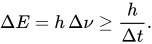



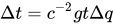
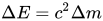




_in_1963_-_Restoration.jpg)


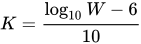


.png)