Search This Blog

Thursday, December 26, 2013

Scientists highlight the resurrection of extinct animals as both a strong possibility and a major potential conservation

          
Scientists highlight the resurrection of extinct animals as both a strong possibility and a major potential conservation issue  Thylacine, or Tasmanian tiger. Credit: E.J. Keller Baker     

(Phys.org) —Scientists from across the world have "scanned the horizon" in order to identify potentially significant medium and long-term threats to conservation efforts.

Resurrection of several , the increasingly accelerated loss of wild rhinoceroses and a disastrous financial response to unburnable carbon are just some future global conservation issues flagged up in this year's Horizon Scan, recently published in Trends in Ecology and Evolution.

Professor William Sutherland and Dr Mark Spalding are amongst the 18 scientists who took part in this year's Horizon Scan, seeking to identify potential future conservation issues in order to reduce the "probability of sudden confrontation with major social or environmental changes".

One such plausible issue is the resurrection or re-construction of extinct species, such as the woolly mammoth, or the thylacine (a carnivorous marsupial). However, though there may be many benefits to the restoration of these animals, such a high-profile project could lead to attention and resources being diverted from attempts to thwart current threats to non-extinct species' survival.

Professor Sutherland said 'There has been discussion of this idea for some time but it is now looking more practical and the idea is being taken seriously. A key issues is whether this is really a conservation priority'.

Though the last died around 4000 years ago, methods such as back-breeding, cloning and genetic engineering may lead to their resurrection. Not only could these , and others such as the thylacine and the passenger pigeon, be re-constructed and returned to their native environments, they could potentially be used to "provide tools for outreach and education".

However, though this would be a conservational triumph, it could also hamper efforts to protect animals that are currently facing extinction, as both attention and resources would be diverted from preserving existing species and their habitats. Furthermore, there has not been any investigation into the "viability, ethics and safety of releasing resurrected species", nor the effect their presence may have on indigenous flora and fauna.

Another potential conservational issue identified by the Horizon Scan further highlights the problems facing species today. The loss of wild rhinoceroses and elephants is set to reaccelerate within the next few years, partially stimulated by a growing desire for ivory and horn.

In 2013, it is estimated that over 600 rhinoceroses were poached for their horn in South Africa alone, out of a total global population of less than 26,000. Though an increased human population and proximity to growing infrastructure is partially responsible, organised crime syndicates and intensive hunting carry the weight of the blame. In the Asian countries that use it, rhinoceros horn is more expensive than gold. Demand for the precious horn is ever increasing, resulting in elevated levels of poaching. If attention and resources are diverted from the protection of these majestic animals, we may have yet more candidates for resurrection in the future.

Altogether, this group of scientists identified the top 15 potential conservation issues (out of an initial group of 81 issues). In addition to the above topics, extensive land loss in southeast Asia from subsidence of peatlands, carbon solar cells as an alternative source of renewable energy, and an emerging fungal disease amongst snakes, have also been voted as plausible threats that need to be stopped before they can be realised.
Explore further: Scientists identify top conservation threats and opportunities
More information: William J. Sutherland, Rosalind Aveling, Thomas M. Brooks, Mick Clout, Lynn V. Dicks, Liz Fellman, Erica Fleishman, David W. Gibbons, Brandon Keim, Fiona Lickorish, Kathryn A. Monk, Diana Mortimer, Lloyd S. Peck, Jules Pretty, Johan Rockström, Jon Paul Rodríguez, Rebecca K. Smith, Mark D. Spalding, Femke H. Tonneijck, Andrew R. Watkinson, "A horizon scan of global conservation issues for 2014," Trends in Ecology & Evolution, Volume 29, Issue 1, January 2014, Pages 15-22, ISSN 0169-5347, dx.doi.org/10.1016/j.tree.2013.11.004.
Journal reference: Trends in Ecology and Evolution

Researchers team up on potential fuel cell advance from Phys.Org

Dec 19, 2013 by Lori Ann White @ http://phys.org/news/2013-12-team-potential-fuel-cell-advance.html
          
Researchers team up on potential fuel cell advanceSLAC researchers Hernan Sanchez Casalongue (left) and Hirohito Ogasawara tune the custom fuel cell built for SSRL Beam Line 13-2. Credit: Brad Plummer/SLAC

Scientists at SLAC National Accelerator Laboratory put together clues from experiments and theory to discover subtle variations in the way fuel cells generate electricity – an advance that could lead to ways to make the cells more efficient.
As reported today in Nature Communications, researchers focused powerful X-rays from SLAC's Stanford Synchrotron Radiation Lightsource (SSRL) on one half of a tiny but functional fuel cell and watched it combine oxygen and hydrogen to make water. They saw something they didn't expect.
"We were surprised to find two possible routes for this reaction to take place," said Hirohito Ogasawara, a staff scientist at SSRL and with the SLAC/Stanford SUNCAT Center for Interface Science and Catalysis. What's more, one route uses less of the fuel cell's energy to complete – leaving more energy to power a car, for example.

However, the news wasn't a surprise to SUNCAT theorists, who had already proposed the existence of such variations in fuel cell chemistry. These variations are important because fuel cells turn chemical energy to electricity, and even a subtle difference can add up to a considerable amount of electricity over time.

On one side of a fuel cell, hydrogen gas is split into protons and electrons, which travel to the other side of the cell along different paths, providing electricity along the way. There they combine with oxygen gas to form water, a process that requires a catalyst to propel the reaction along. The most commonly used catalyst is platinum, a metal more costly than gold; research has focused on ways to decrease the amount of platinum needed by making the catalyst as efficient as possible. This has been a difficult task without tools that show each reaction as it takes place, step by step.

Ogasawara and colleagues used a technique called ambient pressure photoelectron spectroscopy (APXPS) at SSRL to watch the reactions taking place on the surface of the platinum catalyst in minute detail, and under realistic conditions.

"At first, what was new was the technique, and that we could see what was happening under working conditions," said Hernan Sanchez Casalongue, a graduate student in chemistry who designed and built the miniature fuel cell used to help test the efficacy of APXPS in this research. "But as we analyzed our results, we saw there were two different kinds of hydroxide on the surface of the platinum."

Hydroxide is an "intermediate species" that briefly forms on the way to the creation of water. It consists of one hydrogen nucleus bonded to one oxygen atom – O-H instead of H2O. In the fuel cell the researchers found that one type of hydroxide is "hydrated," or loosely bonded with a water molecule, and the other is not, and the one that's not hydrated requires less energy to take that final step to becoming H2O.

Ogasawara and Sanchez Casalongue took their discovery to SUNCAT theorists, who had already theorized that a change in the voltage applied to the fuel cell could affect the formation of hydroxide.

"This led us to the insight that tuning the hydration of hydroxide may lead to more efficient catalysis, but at the time there was no experimental evidence to back that up," said Venkat Viswanathan, then a graduate student at SUNCAT and now a faculty member at Carnegie Mellon.

Ogasawara's experiment, possible only with APXPS, provided Viswanathan and the other SUNCAT theorists with their experimental evidence. It also gives scientists another tool for improving fuel cells: Figure out how to make more of the non-hydrated hydroxides, and the fuel cell efficiency will improve.

Anders Nilsson, deputy director of SUNCAT and a co-author on the paper, said, "This represents a real breakthrough in electrocatalysis. These intermediate chemical species have long been speculated on but have never before been directly observed. This discovery could lead to more efficient catalysts."

Ogasawara said the researchers can't give any firm numbers on how much this can boost energy production from fuel cells – "This was a proof-of-concept experiment" – but it's an encouraging development, and they are looking at reactions involving other catalysts for similar phenomena.
They're also going to use APXPS to study the other side of the reaction – splitting water to make hydrogen and oxygen.
Explore further: New catalyst for fuel cells a potential substitute for platinum

More information: "Direct observation of the oxygenated species during oxygen reduction on a platinum fuel cell cathode." Hernan Sanchez Casalongue, Sarp Kaya, Venkatasubramanian Viswanathan, Daniel J. Miller, Daniel Friebel, Heine A. Hansen, Jens K. Nørskov, Anders Nilsson, Hirohito Ogasawara. Nature Communications 4, Article number: 2817 DOI: 10.1038/ncomms3817

If Your Holy Book Tells You How to Treat Your Slaves ...


2004 Indian Ocean earthquake and tsunami

From Wikipedia, the free encyclopedia https://en.wikipedia.org/wiki/2004_tsunami   

Tsunami strikes Ao Nang, Thailand.
Date00:58:53, 26 December 2004 (UTC) (2004-12-26T00:58:53Z)[1]
Magnitude9.1–9.3 Mw[1]
Depth30 km (19 mi)[1]
Epicenter3°18′58″N 95°51′14″E / 3.316°N 95.854°E / 3.316; 95.854Coordinates: 3°18′58″N 95°51′14″E / 3.316°N 95.854°E / 3.316; 95.854[1]
TypeUndersea (subduction)
Countries or regionsIndonesia (mainly in Aceh)
Sri Lanka
India (mostly in Tamil Nadu)
Thailand
Maldives
Somalia
TsunamiYes
Casualties230,210 – 280,000 deaths[2][3][4]
 
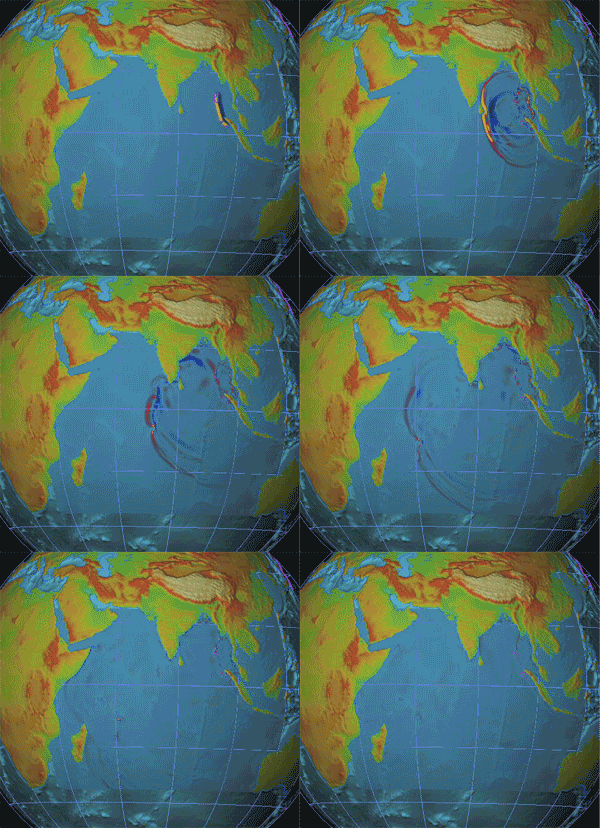
The 2004 Indian Ocean earthquake was an undersea megathrust earthquake that occurred at 00:58:53 UTC on Sunday, 26 December 2004, with an epicentre off the west coast of Sumatra, Indonesia. The quake itself is known by the scientific community as the Sumatra–Andaman earthquake.[5][6] The resulting tsunami was given various names, including the 2004 Indian Ocean tsunami, South Asian tsunami, Indonesian tsunami, the Christmas tsunami and the Boxing Day tsunami.[7]

The earthquake was caused when the Indian Plate was subducted by the Burma Plate and triggered a series of devastating tsunamis along the coasts of most landmasses bordering the Indian Ocean, killing over 230,000 people in fourteen countries, and inundating coastal communities with waves up to 30 meters (98 ft) high.[8] It was one of the deadliest natural disasters in recorded history. Indonesia was the hardest-hit country, followed by Sri Lanka, India, and Thailand.

With a magnitude of Mw 9.1–9.3, it is the third largest earthquake ever recorded on a seismograph. The earthquake had the longest duration of faulting ever observed, between 8.3 and 10 minutes. It caused the entire planet to vibrate as much as 1 centimetre (0.4 inches)[9] and triggered other earthquakes as far away as Alaska.[10] Its epicentre was between Simeulue and mainland Indonesia.[11]
The plight of the affected people and countries prompted a worldwide humanitarian response. In all, the worldwide community donated more than $14 billion (2004 US$) in humanitarian aid.[12]

File:2004 Indonesia Tsunami Complete.gif

Earthquake characteristics

The earthquake was initially documented as moment magnitude 8.8. In February 2005 scientists revised the estimate of the magnitude to 9.0.[13] Although the Pacific Tsunami Warning Center has accepted these new numbers, the United States Geological Survey has so far not changed its estimate of 9.1. The most recent studies in 2006 have obtained a magnitude of Mw 9.1–9.3. Dr. Hiroo Kanamori of the California Institute of Technology believes that Mw 9.2 is a good representative value for the size of this great earthquake.[14]
The hypocentre of the main earthquake was approximately 160 km (100 mi), in the Indian Ocean just north of Simeulue island, off the western coast of northern Sumatra, at a depth of 30 km (19 mi) below mean sea level (initially reported as 10 km (6.2 mi)). The northern section of the Sunda megathrust, ruptured; the rupture having a length of 1,300 km (810 mi).[11] The earthquake (followed by the tsunami) was felt simultaneously in Bangladesh, India, Malaysia, Myanmar, Thailand, Singapore and the Maldives.[15] Splay faults, or secondary "pop up faults", caused long, narrow parts of the sea floor to pop up in seconds. This quickly elevated the height and increased the speed of waves, causing the complete destruction of the nearby Indonesian town of Lhoknga.[16]
 
Indonesia lies between the Pacific Ring of Fire along the north-eastern islands adjacent to New Guinea, and the Alpide belt that runs along the south and west from Sumatra, Java, Bali, Flores to Timor.

Great earthquakes such as the Sumatra-Andaman event, which are invariably associated with megathrust events in subduction zones, have seismic moments that can account for a significant fraction of the global earthquake moment across century-scale time periods. Of all the seismic moment released by earthquakes in the 100 years from 1906 through 2005, roughly one-eighth was due to the Sumatra-Andaman event. This quake, together with the Good Friday Earthquake (Alaska, 1964) and the Great Chilean Earthquake (1960), account for almost half of the total moment. The much smaller but still catastrophic 1906 San Francisco earthquake is included in the diagram below for perspective. Mw denotes the magnitude of an earthquake on the moment magnitude scale.

Since 1900 the only earthquakes recorded with a greater magnitude were the 1960 Great Chilean Earthquake (magnitude 9.5) and the 1964 Good Friday Earthquake in Prince William Sound (9.2). The only other recorded earthquakes of magnitude 9.0 or greater were off Kamchatka, Russia, on 4 November 1952 (magnitude 9.0)[17] and Tōhoku, Japan (magnitude 9.0) in March 2011. Each of these megathrust earthquakes also spawned tsunamis in the Pacific Ocean. However, the death toll from these was significantly lower, primarily because of the lower population density along the coasts near affected areas and the much greater distances to more populated coasts and also due to the superior infrastructure and warning systems in MEDCs (More Economically Developed Countries) such as Japan.

Other very large megathrust earthquakes occurred in 1868 (Peru, Nazca Plate and South American
Plate); 1827 (Colombia, Nazca Plate and South American Plate); 1812 (Venezuela, Caribbean Plate and South American Plate) and 1700 (western North America, Juan de Fuca Plate and North American Plate). All of them are believed to be greater than magnitude 9, but no accurate measurements were available at the time.

Is the Cambrian Explosion View Outdated? (With thanks to John Hunter)

Source:  https://en.wikipedia.org/wiki/Cambrian_explosion


The fossil record as Darwin knew it seemed to suggest that the major metazoan groups appeared in a few million years of the early to mid-Cambrian, and even in the 1980s this still appeared to be the case.[15][16]

However, evidence of Precambrian metazoa is gradually accumulating. If the Ediacaran Kimberella was a mollusc-like protostome (one of the two main groups of coelomates),[20][61] the protostome and deuterostome lineages must have split significantly before 550 million years ago (deuterostomes are the other main group of coelomates).[94] Even if it is not a protostome, it is widely accepted as a bilaterian.[65][94] Since fossils of rather modern-looking Cnidarians (jellyfish-like organisms) have been found in the Doushantuo lagerstätte, the Cnidarian and bilaterian lineages must have diverged well over 580 million years ago.[94]

Trace fossils[59] and predatory borings in Cloudina shells provide further evidence of Ediacaran animals.[95] Some fossils from the Doushantuo formation have been interpreted as embryos and one (Vernanimalcula) as a bilaterian coelomate, although these interpretations are not universally accepted.[48][49][96] Earlier still, predatory pressure has acted on stromatolites and acritarchs since around 1,250 million years ago.[44]

The presence of Precambrian animals somewhat dampens the "bang" of the explosion: not only was the appearance of animals gradual, but their evolutionary radiation ("diversification") may also not have been as rapid as once thought. Indeed, statistical analysis shows that the Cambrian explosion was no faster than any of the other radiations in animals' history.[note 5] However, it does seem that some innovations linked to the explosion – such as resistant armour – only evolved once in the animal lineage; this makes a lengthy Precambrian animal lineage harder to defend.[98] Further, the conventional view that all the phyla arose in the Cambrian is flawed; while the phyla may have diversified in this time period, representatives of the crown-groups of many phyla do not appear until much later in the Phanerozoic.[53] Further, the mineralized phyla that form the basis of the fossil record may not be representative of other phyla, since most mineralized phyla originated in a benthic setting. The fossil record is consistent with a Cambrian Explosion that was limited to the benthos, with pelagic phyla evolving much later.[53]

Ecological complexity among marine animals increased in the Cambrian, as well later in the Ordovician.[5] However, recent research has overthrown the once-popular idea that disparity was exceptionally high throughout the Cambrian, before subsequently decreasing.[99] In fact, disparity remains relatively low throughout the Cambrian, with modern levels of disparity only attained after the early Ordovician radiation.[5]

The diversity of many Cambrian assemblages is similar to today's,[100][91] and at a high (class/phylum) level, diversity is thought by some to have risen relatively smoothly through the Cambrian, stabilizing somewhat in the Ordovician.[101] This interpretation, however, glosses over the astonishing and fundamental pattern of basal polytomy and phylogenetic telescoping at or near the Cambrian boundary, as seen in most major animal lineages.[102] Thus Harry Blackmore Whittington's questions regarding the abrupt nature of the Cambrian explosion remain, and have yet to be satisfactorily answered.[103]

Wednesday, December 25, 2013

The first principle is that you must not fool yourself and you are the easiest person to fool.


The first principle is that you must not fool yourself and you are the easiest person to fool.

Epigenetics enigma resolved: First structure of enzyme that removes methylation

Epigenetics enigma resolved: First structure of enzyme that removes methylation
Read more at: http://phys.org/news/2013-12-epigenetics-enigma-enzyme-methylation.html#jCp
Epigenetics enigma resolved       
This is the structure of the Tet enzyme with DNA. Note the purple ball at the active site, close to which one DNA base is flipped out of the double helix. Also note the degree to which the double helix is bent. Credit: Xiaodong Cheng, Emory University

The finding is important for the field of epigenetics because Tet enzymes chemically modify DNA, changing signposts that tell the cell's machinery "this gene is shut off" into other signs that say "ready for a change."

Tet enzymes' roles have come to light only in the last five years; they are needed for stem cells to maintain their multipotent state, and are involved in early embryonic and brain development and in cancer.

The results, which could help scientists understand how Tet enzymes are regulated and look for drugs that manipulate them, are scheduled for publication in Nature.

Researchers led by Xiaodong Cheng, PhD, determined the structure of a Tet family member from Naegleria gruberi by X-ray crystallography. The structure shows how the enzyme interacts with its target DNA, bending the double helix and flipping out the base that is to be modified.
"This base flipping mechanism is also used by other enzymes that modify and repair DNA, but we can see from the structure that the Tet family enzymes interact with the DNA in a distinct way," Cheng says.

Cheng is professor of biochemistry at Emory University School of Medicine and a Georgia Research Alliance Eminent Scholar. The first author of the paper is research associate Hideharu Hashimoto, PhD. A team led by Yu Zheng, PhD, a senior research scientist at New England Biolabs, contributed to the paper by analyzing the enzymatic activity of Tet using liquid chromatography–mass spectrometry.

Using oxygen, Tet enzymes change 5-methylcytosine into 5-hydroxymethylcytosine and other oxidized forms of methylcytosine. 5-methylcytosine (5-mC) and 5-hydroxymethylcytosine (5-hmC) are both epigenetic modifications of DNA, which change how DNA is regulated without altering the letters of the genetic code itself.

5-mC is generally found on genes that are turned off or on repetitive regions of the genome. 5-mC helps shut off genes that aren't supposed to be turned on (depending on the cell type) and changes in 5-mC's distribution underpin a healthy cell's transformation into a cancer cell.

In contrast to 5-mC, 5-hmC appears to be enriched on active genes, especially in brain cells. Having a Tet enzyme form 5-hmC seems to be a way for cells to erase or at least modify the "off" signal provided by 5-mC, although the functions of 5-hmC are an active topic of investigation, Cheng says.
Alterations of the Tet enzymes have been found in forms of leukemia, so having information on the enzymes' could help scientists design drugs that interfere with them.
N. gruberi is a single-celled organism found in soil or fresh water that can take the form of an amoeba or a flagellate; its close relative N. fowleri can cause deadly brain infections. Cheng says his team chose to study the enzyme from Naegleria because it was smaller and simpler and thus easier to crystallize than mammalian forms of the , yet still resembles mammalian forms in protein sequence.

Mammalian Tet enzymes appear to have an additional regulatory domain that the Naegleria forms do not; understanding how that domain works will be a new puzzle opened up by having the Naegleria structure, Cheng says.
Journal reference: Nature
Provided by Emory University


How Rare Am I? Genographic Project Results Demonstrate Our Extended Family Tree

Most participants of National Geographic’s Genographic Project can recite their haplogroup as readily as their mother’s maiden name. Yet outside consumer genetics, the word haplogroup is still unknown. Your haplogroup, or genetic branch of the human family tree, tells you about your deep ancestry—often thousands of years ago—and shows you the possible paths of migration taken by these ancient ancestors.  Your haplogroup also places you within a community of relatives, some distant, with whom you unmistakably share an ancestor way back when.
DNA Molecule
DNA Molecule

Haplogroup H1, Genographic’s most common lineage.
Let’s focus here on mitochondrial DNA haplogroup is H1, as it is the Genographic Project’s most common maternal lineage result. You inherited your mitochondrial DNA purely from your mother, who inherited it from her mother, and her mother, and so on. Yet, unlike often is the case with a mother’s maiden name, her maternal haplogroup is passed down through generations. Today, all members of haplogroup H1 are direct descendants from the first H1 woman that lived thousands of years ago. Most H1 members may know their haplogroup as H1a or H1b2 or H1c1a, etc, yet as a single genetic branch, H1 accounts for 15% of Genographic participants. What’s more, in the past few years, anthropologists have discovered and named an astonishing 200 new branches within haplogroup H1; and that number continues to grow.
Haplogroup H
Haplogroup H3, sister branch to H1

The origin of haplogroup H1 continues to be a debate as well. Most researchers suggest it was born in the Middle East between 10,000 and 15,000 years ago, and spread from there to Europe and North Africa. However, ancient DNA studies show that its ancestral haplogroup H first appears in Central Europe just 8,000 year ago. Its vast diversity and high concentration in Spain and Portugal, suggests H1 may have existed there during the last Ice Age, and spread north after glaciers melted. Yet others postulate that its young age and high frequency indicate it spread as agriculture took shape in Europe.
Any of the scenarios is possible. As technology improves, more DNA is extracted and sequenced from ancient bones, and more people contribute their DNA to the Genographic Project, we will keep learning about H1, and all other haplogroups.  It is because of participants contributing their DNA, their stories, and their hypotheses to science that we can carry forward this exciting work uncovering our deep genetic connections.

Happy Haplogroups!

Superhabitable world

From Wikipedia, the free encyclopedia https://en.wikipedia.org/wiki/Superhabitable_world Artist's i...